1 Chronicles 5:17

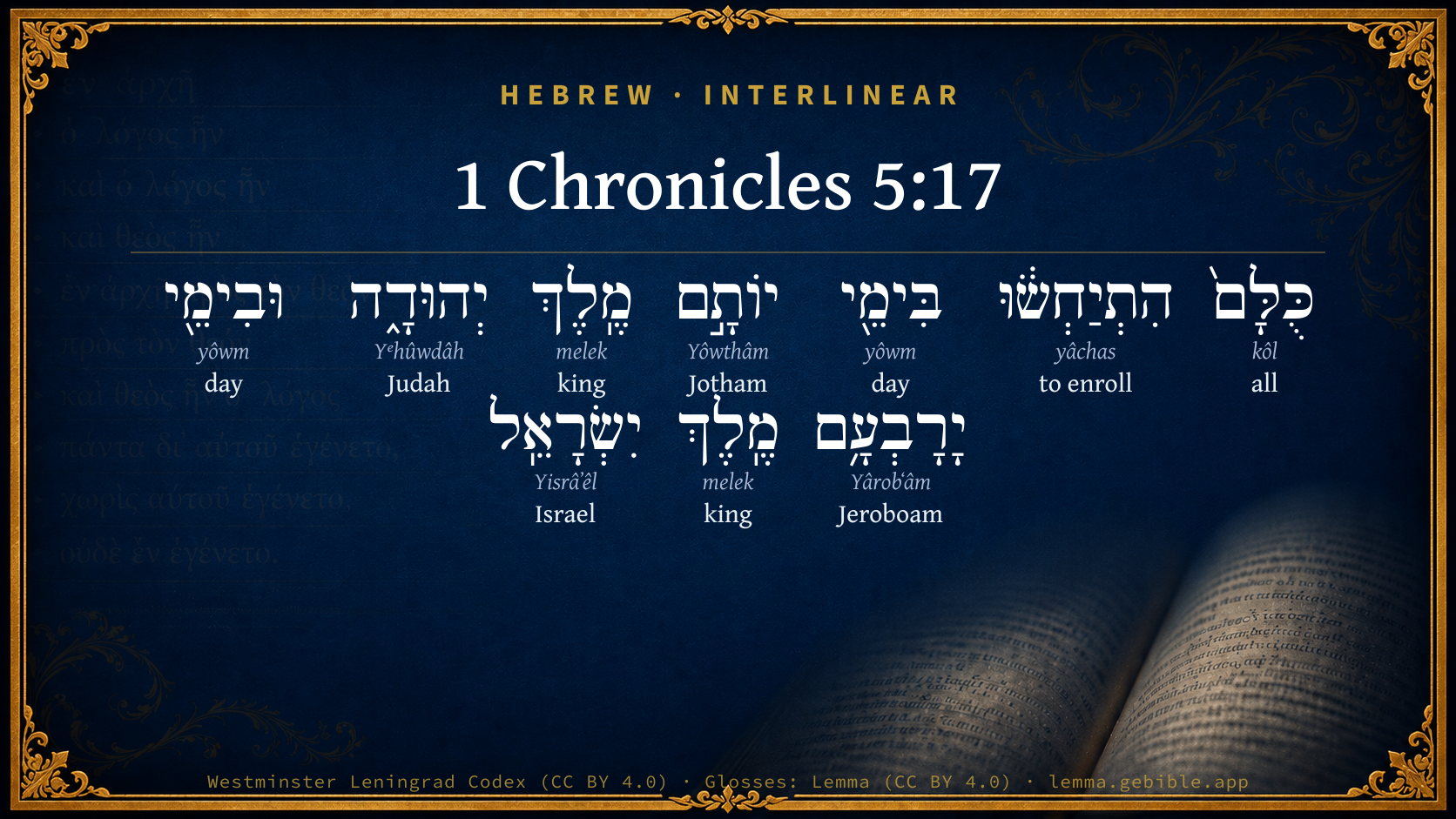
Hebrew (Westminster Leningrad Codex) 1 Chronicles 5:17 appears in the Hebrew Old Testament. The text above is from the Westminster Leningrad Codex. Each word links to its Strong’s number, a concise gloss, and parsing drawn from the Open Scriptures Hebrew Bible morphology. Click any word for its full Brown-Driver-Briggs (BDB) entry.
Download image
Cite this verse

1 Chronicles 5:17 (World English Bible). Public Domain. Lemma interlinear Bible study tool, https://lemma.gebible.app/v/1-chronicles/5/17.

Show BibTeX & RIS
BibTeX
RIS
English Translation
All these were reckoned by genealogies in the days of Jotham king of Judah, and in the days of Jeroboam king of Israel.
World English Bible · Public Domain
Download a study sheet

One document with this verse’s original text, its word-by-word gloss line, the meaning frame, cross-references with their text, attributed commentary, and full source and license credits — printable, and it pastes into notes with its structure intact.

This verse Autodidact and up

Study sheet (.html) Plain text (.txt)

A passage Seminary Student

Up to 50 verses in one chapter. A passage sheet keeps up to 6 commentary sources and 12 cross-references per verse, in the order this page ranks them, and says so on the sheet whenever that leaves anything out. Ask for a single verse and you get the Autodidact verse sheet above.

Everything on this page stays free to read, with no account — the sheet is a download of what is already on screen, not access to it.

Want to remove ads? Support Godless Engineer
Compare translations 3

The same verse in 3 English versions, stacked beneath the original-language interlinear above. Click any original word for its lexicon entry.

Each is an independent rendering of the whole verse — the interlinear is not word-aligned to these translations.

Highlighted words mark where these versions differ — a whole-verse word diff, not a word-by-word alignment.

  • World English Bible Public Domain
    All these were reckoned by genealogies in the days of Jotham king of Judah, and in the days of Jeroboam king of Israel.
  • King James Version Public Domain
    All these were reckoned by genealogies in the days of Jotham king of Judah, and in the days of Jeroboam king of Israel.
  • unfoldingWord Literal Text CC BY-SA 4.0
    All of them were enrolled in the days of Jotham, the king of Judah, and in the days of Jeroboam, the king of Israel.

unfoldingWord Literal Text — © unfoldingWord, licensed CC BY-SA 4.0. Word-aligned USFM3 via Door43 (git.door43.org/unfoldingWord/en_ult).

Versions to compare (up to 4)

3 of 4 selected

Show all 18 translations

Every available English version of this verse, each an independent rendering of the whole verse.

  • World English Bible Public Domain
    All these were reckoned by genealogies in the days of Jotham king of Judah, and in the days of Jeroboam king of Israel.
  • Berean Standard Bible Public Domain
    All of them were reckoned in the genealogies during the reigns of Jotham king of Judah and Jeroboam king of Israel.
  • Majority Standard Bible Public Domain
    All of them were recorded in the genealogies during the reigns of Jotham king of Judah and Jeroboam king of Israel.
  • King James Version Public Domain
    All these were reckoned by genealogies in the days of Jotham king of Judah, and in the days of Jeroboam king of Israel.
  • American Standard Version (1901) Public Domain
    All these were reckoned by genealogies in the days of Jotham king of Judah, and in the days of Jeroboam king of Israel.
  • Revised Version (1885) Public Domain
    All these were reckoned by genealogies in the days of Jotham king of Judah, and in the days of Jeroboam king of Israel.
  • Geneva Bible (1599) Public Domain
    All these were rekoned by genealogies in the dayes of Iotham King of Iudah, and in the dayes of Ieroboam King of Israel.
  • Douay-Rheims (1899) Public Domain
    All these were numbered in the days of Joathan king of Juda, and in the days of Jeroboam king of Israel.
  • Young's Literal Translation Public Domain
    all of them reckoned themselves by genealogy in the days of Jotham king of Judah, and in the days of Jeroboam king of Israel.
  • Literal Standard Version CC BY-SA 4.0
    all of them reckoned themselves by genealogy in the days of Jotham king of Judah, and in the days of Jeroboam king of Israel.
  • Unlocked Literal Bible CC BY-SA 4.0
    All these were listed by genealogical records in the days of Jotham king of Judah and of Jeroboam king of Israel.
  • unfoldingWord Literal Text CC BY-SA 4.0
    All of them were enrolled in the days of Jotham, the king of Judah, and in the days of Jeroboam, the king of Israel.
  • Darby Bible Public Domain
    All these were registered by genealogy in the days of Jotham king of Judah, and in the days of Jeroboam king of Israel.
  • World Messianic Bible Public Domain
    All these were listed by genealogies in the days of Jotham king of Judah, and in the days of Jeroboam king of Israel.
  • Webster's Bible Public Domain
    All these were reckoned by genealogies in the days of Jotham king of Judah, and in the days of Jeroboam king of Israel.
  • Free Bible Version CC BY-SA 4.0
    They were all recorded in the genealogy during the time of Jotham, king of Judah, and Jeroboam, king of Israel.
  • Bible in Basic English Public Domain
    All these were listed under the names of their families, in the time of Jotham, king of Judah, and in the time of Jeroboam, king of Israel.
  • JPS Tanakh (1917) Public Domain
    All these were reckoned by genealogies in the days of Jotham king of Judah and in the days of Jeroboam king of Israel.

Literal Standard Version (2020), Covenant Press — licensed CC BY-SA 4.0. Text via the HelloAO Bible API (eBible.org). Unlocked Literal Bible (unfoldingWord) — licensed CC BY-SA 4.0. Text via the HelloAO Bible API (eBible.org). unfoldingWord Literal Text — © unfoldingWord, licensed CC BY-SA 4.0. Word-aligned USFM3 via Door43 (git.door43.org/unfoldingWord/en_ult). Free Bible Version, Dr. Jonathan Gallagher — licensed CC BY-SA 4.0. Text via the HelloAO Bible API (eBible.org).

Word by word

More ways to search: Search by grammar → Find every occurrence → Compare this word →

Practice this passage: Drill this verse → Learn its vocabulary →

About this verse

These counts appear in no published source. They are computed here, from the morphology-tagged text and Lemma’s own curated glosses. What Lemma adds →

10
words
8
distinct lemmas
Historical
section

Notable vocabulary

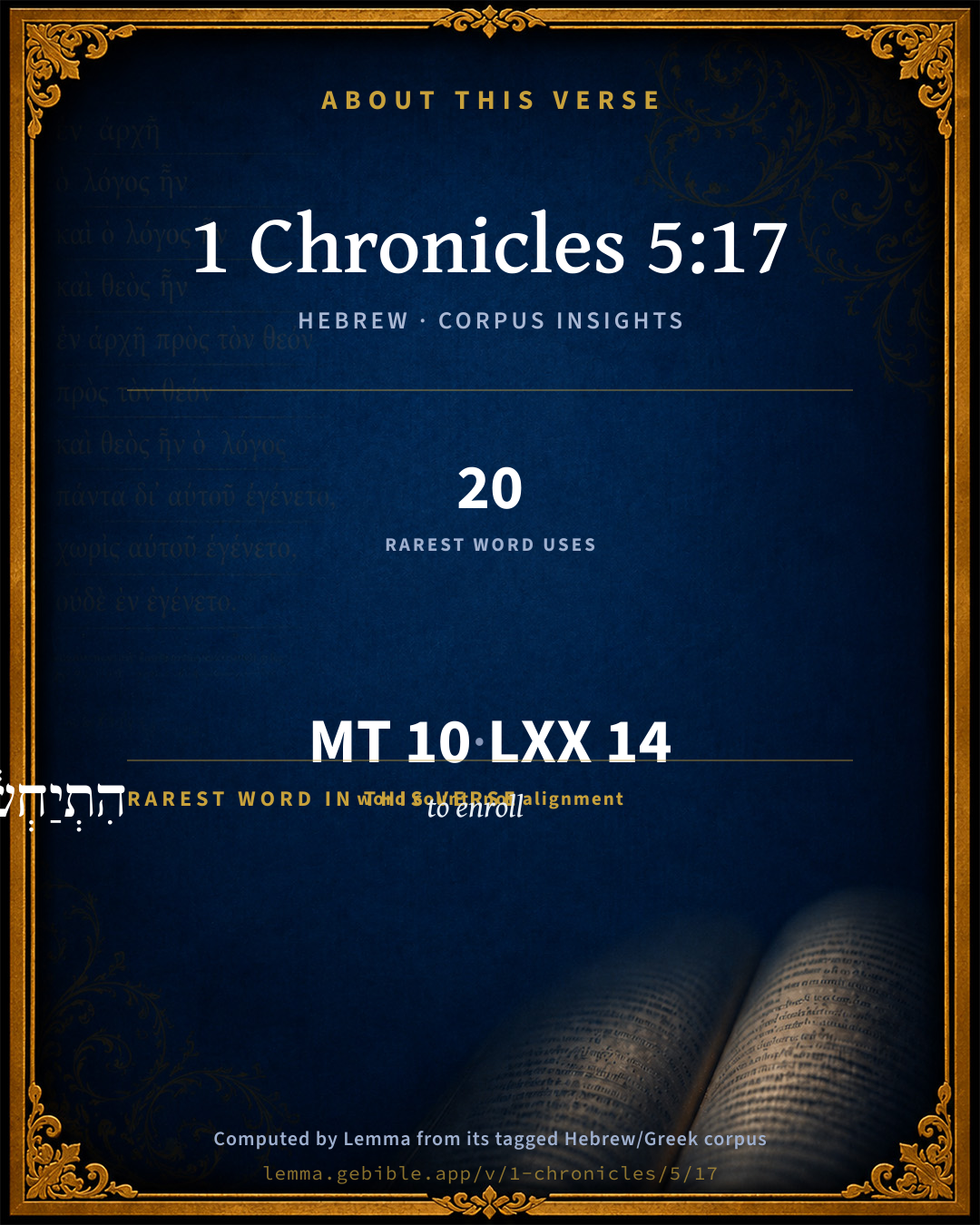
The rarest word here is הִתְיַחְשׂ֔וּ to enroll H3187 — appearing just 20 times in the whole Hebrew Bible.

Shared distinctive vocabulary

הִתְיַחְשׂ֔וּ to enroll H3187 occurs in 20 verses of the Hebrew Bible. Also found in:

Grammatical profile

  • 1 verb
  • 9 nouns

Verb forms

  • הִתְיַחְשׂ֔וּ Hithpael · Perfect

Repetition

Words recur within this verse — often emphatic in Hebrew:

  • בִּימֵ֖י day H3117 ×2
  • מֶֽלֶךְ king H4428 ×2

Hebrew & Septuagint length

In English translation the verse runs 23 words from the Hebrew and 24 from the Septuagint (LXX English) — closely comparable.

A rough comparison of the two English renderings, which tokenize alike — not a word-level alignment.

Word counts can differ between the Hebrew and the Greek without any difference in meaning — e.g. the Hebrew direct-object marker אֵת has no separate Greek word, and Greek often adds the article ὁ.

In the original languages it is 10 Hebrew tokens and 14 Greek tokens — but the two are counted differently (Hebrew bundles its prefixes and suffixes into one token; the Greek is in lemma form), so that isn’t a like-for-like length.

Cross-references

6

Topical passages linked to 1 Chronicles 5:17 in the Treasury of Scripture Knowledge — connected by theme and wording, ordered by reader-vote popularity; previews shown in the World English Bible.

  • 2 Kings 14:16 Jehoash slept with his fathers, and was buried in Samaria with the kings of Israel; and Jeroboam his son reigned in his place.
  • 2 Kings 14:28 Now the rest of the acts of Jeroboam, and all that he did, and his might, how he warred, and how he recovered Damascus, and Hamath, [which had belonged] to Judah, for Israel, aren't they written in the book of the chronicles of the kings of Israel?
  • 2 Kings 15:32 In the second year of Pekah the son of Remaliah king of Israel began Jotham the son of Uzziah king of Judah to reign.
  • 2 Kings 15:5 Yahweh struck the king, so that he was a leper to the day of his death, and lived in a separate house. Jotham the king's son was over the household, judging the people of the land.
  • 2 Kings 14:23 In the fifteenth year of Amaziah the son of Joash king of Judah Jeroboam the son of Joash king of Israel began to reign in Samaria, [and reigned] forty-one years.
  • 2 Chronicles 27:1 Jotham was twenty-five years old when he began to reign; and he reigned sixteen years in Jerusalem: and his mother's name was Jerushah the daughter of Zadok.

Cross-references courtesy of OpenBible.info (CC BY 4.0).

Hebrew and Greek witnesses Masoretic Hebrew ↔ Greek Septuagint

The same verse in the two great witnesses to the Old Testament, shown verse-for-verse.

These are two independent witnesses, not word-aligned to each other, and the Septuagint is shown in lemma (dictionary) form.

Hebrew 1 Chronicles 5:17 Masoretic · Westminster Leningrad Codex

כֻּלָּם֙ הִתְיַחְשׂ֔וּ בִּימֵ֖י יוֹתָ֣ם מֶֽלֶךְ יְהוּדָ֑ה וּבִימֵ֖י יָרָבְעָ֥ם מֶֽלֶךְ יִשְׂרָאֵֽל

All these were reckoned by genealogies in the days of Jotham king of Judah, and in the days of Jeroboam king of Israel.

World English Bible · Public Domain

Greek LXX 1 Chronicles 5:17 Septuagint · lemma form

πᾶς ὁ καταλοχισμός ἐν ἡμέρα ιωαθαμ βασιλεύς ἰουδά καί ἐν ἡμέρα ιεροβοαμ βασιλεύς ἰσραήλ

The enumeration of them all took place in the days of Joatham king of Juda, and in the days of Jeroboam king of Israel.

LXX2012 (modern English Septuagint) · Public Domain

Hebrew: Westminster Leningrad Codex (CC BY 4.0). Greek: Septuagint (public domain); English from LXX2012 (modern English Septuagint) (Public Domain). How the Septuagint differs from the Hebrew →

Commentary

Notes on 1 Chronicles 5:17 from classic Christian and Jewish commentators (each source and its license shown beneath its notes). The classic Christian expositions comment on the surrounding passage and are grouped to its opening verse, so a note may address several verses; the Jewish commentaries on the Tanakh (Rashi and others) are per-verse, so they appear only where the commentator wrote on this verse.

Lemma curates 59 commentaries, every one of them public domain or Creative Commons licensed, each selected and text-cleaned for this edition rather than reprinted as found. About our sources →

Trapp's Complete Commentary

John Trapp

1Ch 5:17 All these were reckoned by genealogies in the days of Jotham king of Judah, and in the days of Jeroboam king of Israel.

Ver. 17. In the days of Jeroboam,] i.e., Jeroboam the second, who ruled over them.

John Trapp, A Commentary or Exposition upon All the Books of the Old and New Testament (1647–1656) — public domain. Text from a community e-Sword module.

Joseph Benson's Commentary

1Ch 5:17. In the days of Jotham king of Judah — Who, reigning long, partly in his father’s days, and partly by himself, and being at leisure from wars and troubles, thought this a fit season to examine the state of his people. And in the days of Jeroboam — Probably Jeroboam the second, of whom see 2Ki 13:13-14. This does not imply that Jotham and Jeroboam reigned at the same time; but only that in their several reigns this account was taken.

Joseph Benson's Commentary on the Old and New Testaments (1811–1818) — public domain. Text from a community e-Sword module.

Jamieson, Fausset & Brown

Robert Jamieson, A. R. Fausset & David Brown

All these were reckoned . . . in the days of Jotham--His long reign and freedom from foreign wars as well as intestine troubles were favorable for taking a census of the people.

and in the days of Jeroboam--the second of that name.

Jamieson, Fausset & Brown — Commentary Critical and Explanatory on the Whole Bible (1871) — public domain (CC PDM 1.0). Text via the HelloAO Bible API.

The Cambridge Bible for Schools and Colleges

gen. ed. J. J. S. Perowne

17. reckoned by genealogy] A specimen of this kind of reckoning is given in Neh_7:5-65.

in the days of Jotham … and in the days of Jeroboam] “Reckoning by genealogy” is a phrase used only in the writings of the Chronicler (Chron., Ezra, Neh.), but the practice probably resembled what is called in other books “numbering the people.” The object however was different and corresponded with the circumstances of the returned exiles, who found themselves in the midst of a Gentile population in Judaea. The people were “reckoned by genealogy” not so much to take a census of them, as to inquire into the purity of their Israelite descent. The ancient term “numbering” would probably be a more suitable description of a transaction belonging to the days of Jotham. For Jotham see 2 Chronicles 27 and for Jeroboam 2Ki_14:23-29. The last years of the reign of Jeroboam II. synchronized with part at least of the reign of Jotham.

The Cambridge Bible for Schools and Colleges (gen. ed. J. J. S. Perowne; Cambridge University Press, 1878–1918) — public domain. Text from a community e-Sword module.

John Gill's Exposition

And they made war with the Hagarites,.... Before mentioned, Ch1 5:19.

with Jetur, and Nephish: with the posterity of these men, who were sons of Ishmael, Gen 25:15 and so was Nodab; perhaps the same with Kedemah, mentioned along with the other two there; so Hillerus (z) thinks.

(z) Onomastic. Sacr. p. 554.

John Gill's Exposition of the Whole Bible (1746–1763) — public domain (CC PDM 1.0). Text via the HelloAO Bible API.

Albert Barnes' Notes on the Bible

The writer refers here to two registrations, one made under the authority of Jeroboam II when he was king and Israel flourishing, the other made under the authority of Jotham, king of Judah, during the troublous time which followed on the great invasion of Tiglath-pileser. There is nothing surprising in a king of Judah having exercised a species of lordship over the trans-Jordanic territory at this period.

Albert Barnes' Notes on the Bible (1834–1885) — public domain. Text from a community e-Sword/MySword module.

Haydock's Catholic Bible Commentary

Israel. Jeroboam II had been dead two years before Joathan was born: unless some of the numbers be incorrect; which seem very probable, 4 Kings xv. 5. Yet these registers might be made at different times, and one, perhaps, under Jeroboam I, as when any war seemed to threaten, the number of soldiers was to be known. (Calmet) --- It does not appear why the king of Juda is mentioned, as the people were not under his dominion, unless (Haydock) he was contemporary with Jeroboam II, as some assert. (Menochius) --- Yet the following expedition seems to have taken place while Israel was still faithful to God. (Haydock) By faith they overcame kingdoms, Hebrews xi. (Worthington)

George Leo Haydock (1774–1849), Haydock's Catholic Family Bible and Commentary, 1859 edition — public domain. Excludes Psalms (Douay-Rheims chapter numbering differs from Protestant) and Deuterocanonical books (Catholic canon only).

Matthew Poole's English Annotations

In the days of Jotham king of Judah; who reigning long, partly in his father’s days, and partly by himself, 2Ki 15, and being at leisure as to wars or troubles, thought this a fit season to examine the state of his people.

In the days of Jeroboam; either the second of that name, of whom see 2Ki 13:13. Or rather the first Jeroboam; partly because he is called simply Jeroboam, without any addition; which shows that he speaks of the most famous of the two; and partly because this work of taking an account of the people doth far better agree to the times of Jeroboam the First, when the kingdom of Israel was first erected and established, and broken off from that of Judah, when it was necessary for Jeroboam to know his own strength, and the numbers of his people, than to the times of Jeroboam the Second, when the kingdom of Israel was broken, and near to its ruin.

Matthew Poole's English Annotations on the Holy Bible (1683–1685) — public domain. Text from a community e-Sword/MySword module.

The Pulpit Commentary

The very form of the language of this verse would indicate that two genealogies are intended. This quite tallies with the fact that there were two chronicles, one for each division of the nation, i.e. "the chronicles of the kings of Judah" (2Ki_15:6) and "the chronicles of the kings of Israel", (2Ki_15:11) in which same chapter both Jeroboam (II) of Israel and Jotham of Judah are spoken of, the latter beginning to reign in Judah some twenty years (the exact chronology is very confused here) after the death of the former. Although presumably it would be an object of closer interest with Israel than with Judah to effect the registration of the Gadite genealogy, yet it was most just that Judah should do so as well. This would both vindicate Judah"s own right place and be a happy omen of the continued predominance of her position compared with that of Israel. Independently of the question of effecting the actual registration, however, it is quite possible that, so long as history ran by the side of history. Israel would gather and keep all it could of Judah, and Judah all it could of Israel.

The Pulpit Commentary (1880–1919), ed. H.D.M. Spence-Jones & Joseph S. Exell — public domain. Text from a community e-Sword module.

Keil & Delitzsch

C. F. Keil & F. Delitzsch

And they made war with the Hagarites,.... Before mentioned, Ch1 5:19.

with Jetur, and Nephish: with the posterity of these men, who were sons of Ishmael, Gen 25:15 and so was Nodab; perhaps the same with Kedemah, mentioned along with the other two there; so Hillerus (z) thinks.

(z) Onomastic. Sacr. p. 554.

Keil & Delitzsch — Biblical Commentary on the Old Testament (1861–1891) — public domain (CC PDM 1.0). Text via the HelloAO Bible API. (Old Testament only.)

Lesson kit

Teaching starters — assembled from the data on this page, not authored interpretation. Every prompt links to the verse data it draws on. Edit before teaching.

1 Chronicles, in the Historical, opens this verse with 10 words (8 distinct Hebrew lemmas). Its most distinctive word is yâchas (“to enroll”). A historical commentator’s framing appears above. Read the whole chapter for the surrounding context.

Discussion questions

  1. The word yâchas carries the sense “to enroll.” How does it shape the verse?
  2. 1 Chronicles 4:33 shares the word «to enroll» with this verse. How do the two illuminate each other?
  3. “day” occurs 2× in this one verse. What is the effect of the repetition?
  4. These translations render this verse differently; the difference is in the English rendering, not the original. What questions does that raise?
  5. The verb «הִתְיַחְשׂ֔וּ» is Hithpael Perfect. How does its form color the action?
  6. Reading how Trapp's Complete Commentary and Joseph Benson's Commentary read this verse, where do the two commentators agree and where do they part?

Things to notice

Reading settings

Reading text

Shown beneath each verse's original-language words.

Old Testament
Old Testament edition

Read the OT as the Masoretic Hebrew (MT) or the Greek Septuagint (LXX).

English shown for the Greek Septuagint (in the Hebrew ↔ Greek comparison).

Comparing translations? Open the Compare panel on any verse page to stack up to four side by side.