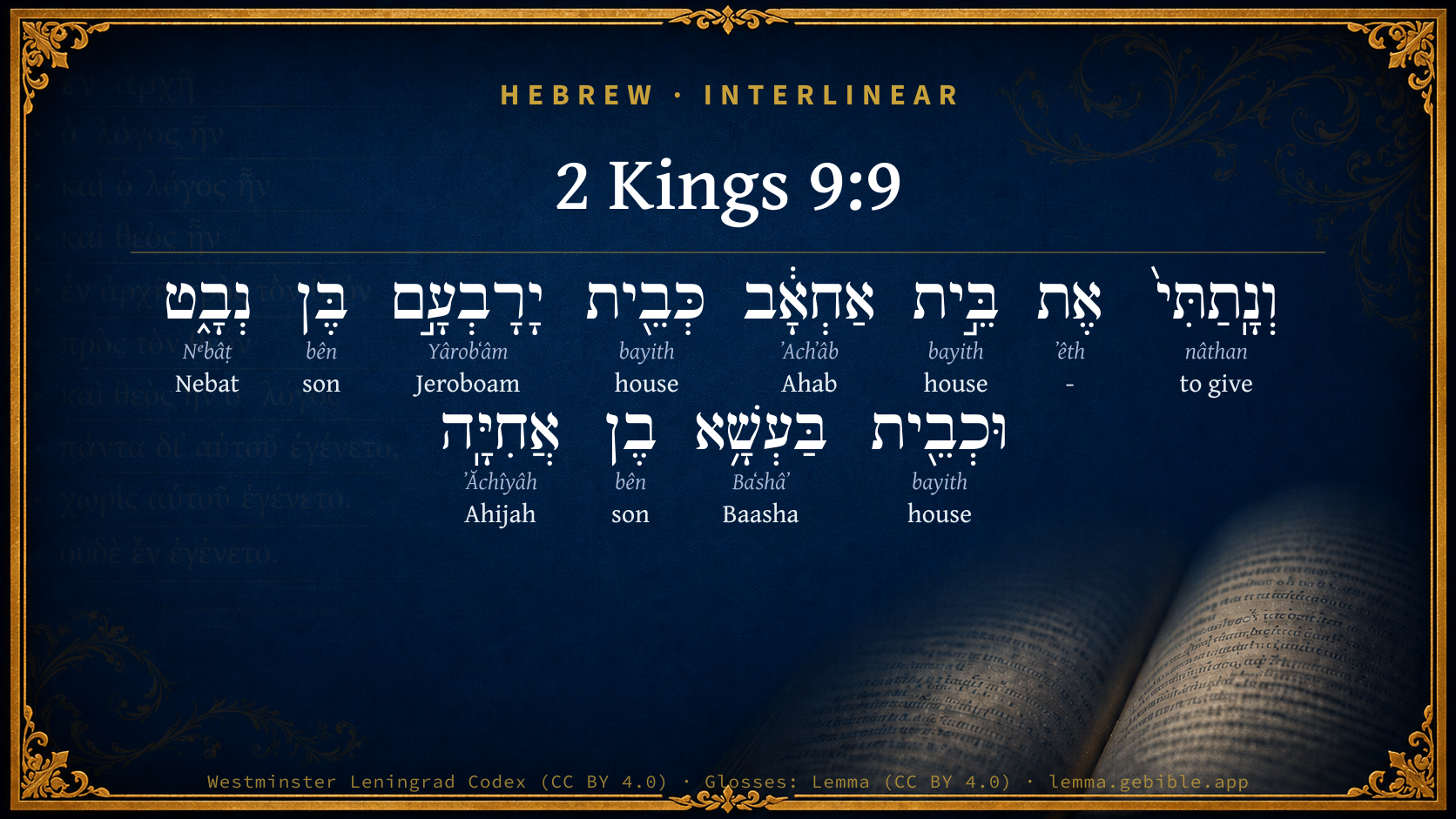
2 Kings 9:9

Hebrew (Westminster Leningrad Codex) 2 Kings 9:9 appears in the Hebrew Old Testament. The text above is from the Westminster Leningrad Codex. Each word links to its Strong’s number, a concise gloss, and parsing drawn from the Open Scriptures Hebrew Bible morphology. Click any word for its full Brown-Driver-Briggs (BDB) entry.
Download image
Cite this verse

2 Kings 9:9 (World English Bible). Public Domain. Lemma interlinear Bible study tool, https://lemma.gebible.app/v/2-kings/9/9.

Show BibTeX & RIS
BibTeX
RIS
English Translation
I will make the house of Ahab like the house of Jeroboam the son of Nebat, and like the house of Baasha the son of Ahijah.
World English Bible · Public Domain
Download a study sheet

One document with this verse’s original text, its word-by-word gloss line, the meaning frame, cross-references with their text, attributed commentary, and full source and license credits — printable, and it pastes into notes with its structure intact.

This verse Autodidact and up

Study sheet (.html) Plain text (.txt)

A passage Seminary Student

Up to 50 verses in one chapter. A passage sheet keeps up to 6 commentary sources and 12 cross-references per verse, in the order this page ranks them, and says so on the sheet whenever that leaves anything out. Ask for a single verse and you get the Autodidact verse sheet above.

Everything on this page stays free to read, with no account — the sheet is a download of what is already on screen, not access to it.

Want to remove ads? Support Godless Engineer
Compare translations 3

The same verse in 3 English versions, stacked beneath the original-language interlinear above. Click any original word for its lexicon entry.

Each is an independent rendering of the whole verse — the interlinear is not word-aligned to these translations.

Highlighted words mark where these versions differ — a whole-verse word diff, not a word-by-word alignment.

  • World English Bible Public Domain
    I will make the house of Ahab like the house of Jeroboam the son of Nebat, and like the house of Baasha the son of Ahijah.
  • King James Version Public Domain
    And I will make the house of Ahab like the house of Jeroboam the son of Nebat, and like the house of Baasha the son of Ahijah:
  • unfoldingWord Literal Text CC BY-SA 4.0
    And I will make the house of Ahab like the house of Jeroboam, the son of Nebat, and like the house of Baasha, the son of Ahijah.

unfoldingWord Literal Text — © unfoldingWord, licensed CC BY-SA 4.0. Word-aligned USFM3 via Door43 (git.door43.org/unfoldingWord/en_ult).

Versions to compare (up to 4)

3 of 4 selected

Show all 18 translations

Every available English version of this verse, each an independent rendering of the whole verse.

  • World English Bible Public Domain
    I will make the house of Ahab like the house of Jeroboam the son of Nebat, and like the house of Baasha the son of Ahijah.
  • Berean Standard Bible Public Domain
    I will make the house of Ahab like the houses of Jeroboam son of Nebat and Baasha son of Ahijah.
  • Majority Standard Bible Public Domain
    I will make the house of Ahab like the houses of Jeroboam son of Nebat and Baasha son of Ahijah.
  • King James Version Public Domain
    And I will make the house of Ahab like the house of Jeroboam the son of Nebat, and like the house of Baasha the son of Ahijah:
  • American Standard Version (1901) Public Domain
    And I will make the house of Ahab like the house of Jeroboam the son of Nebat, and like the house of Baasha the son of Ahijah.
  • Revised Version (1885) Public Domain
    And I will make the house of Ahab like the house of Jeroboam the son of Nebat, and like the house of Baasha the son of Ahijah.
  • Geneva Bible (1599) Public Domain
    And I will make the house of Ahab like the house of Ieroboam the sonne of Nebat, and like the house of Baasha the sonne of Ahiiah.
  • Douay-Rheims (1899) Public Domain
    And I will make the house of Achab like the house of Jeroboam the son of Nabat, and like the house of Baasa the son of Ahias.
  • Young's Literal Translation Public Domain
    and I have given up the house of Ahab like the house of Jeroboam son of Nebat, and as the house of Baasha son of Ahijah,
  • Literal Standard Version CC BY-SA 4.0
    and I have given up the house of Ahab like the house of Jeroboam son of Nebat, and as the house of Baasha son of Ahijah,
  • Unlocked Literal Bible CC BY-SA 4.0
    I will make the house of Ahab like the house of Jeroboam son of Nebat and like the house of Baasha son of Ahijah.
  • unfoldingWord Literal Text CC BY-SA 4.0
    And I will make the house of Ahab like the house of Jeroboam, the son of Nebat, and like the house of Baasha, the son of Ahijah.
  • Darby Bible Public Domain
    And I will make the house of Ahab as the house of Jeroboam the son of Nebat, and as the house of Baasha the son of Ahijah.
  • World Messianic Bible Public Domain
    I will make Ahab’s house like the house of Jeroboam the son of Nebat, and like the house of Baasha the son of Ahijah.
  • Webster's Bible Public Domain
    And I will make the house of Ahab like the house of Jeroboam the son of Nebat, and like the house of Baasha the son of Ahijah:
  • Free Bible Version CC BY-SA 4.0
    I will make the house of Ahab like the house of Jeroboam, son of Nebat, and like the house of Baasha, son of Ahijah.
  • Bible in Basic English Public Domain
    I will make the family of Ahab like that of Jeroboam, the son of Nebat, and Baasha, the son of Ahijah.
  • JPS Tanakh (1917) Public Domain
    And I will make the house of Ahab like the house of Jeroboam the son of Nebat, and like the house of Baasa the son of Ahijah.

Literal Standard Version (2020), Covenant Press — licensed CC BY-SA 4.0. Text via the HelloAO Bible API (eBible.org). Unlocked Literal Bible (unfoldingWord) — licensed CC BY-SA 4.0. Text via the HelloAO Bible API (eBible.org). unfoldingWord Literal Text — © unfoldingWord, licensed CC BY-SA 4.0. Word-aligned USFM3 via Door43 (git.door43.org/unfoldingWord/en_ult). Free Bible Version, Dr. Jonathan Gallagher — licensed CC BY-SA 4.0. Text via the HelloAO Bible API (eBible.org).

Word by word

More ways to search: Search by grammar → Find every occurrence → Compare this word →

Practice this passage: Drill this verse → Learn its vocabulary →

אֲחִיָּֽה
ʼĂchîyâh
H281
“Ahijah”
Noun, Proper
Part of Speech
Noun
Type
Proper
Full BDB Definition

Origin: from H251 and H3050

TWOT: None

Ahiah or Ahijah = "brother of Jehovah (Yahu)" - grandson of Phinehas - scribe of Solomon - a prophet who predicted the revolt of the Northern tribes - father of Baasha, who usurped the Northern throne - grandson of Hezron (or mother of 1-4 above) - a Benjamite, son of Ehud - one of David's heroes - a Levite during David's time - a chief man under Nehemiah
  1. וְנָֽתַתִּי֙ nâthan H5414 “and · to give” Conjunction + Verb, Qal, Sequential Perfect, 1st Person, Common, Singular
  2. אֶת ʼêth H853 “-” Particle, Direct Object
  3. בֵּ֣ית bayith H1004 “house of” Noun, Common, Masculine, Singular, Construct
  4. אַחְאָ֔ב ʼAchʼâb H256 “Ahab” Noun, Proper
  5. כְּבֵ֖ית bayith H1004 “like/as · house of” Preposition + Noun, Common, Masculine, Singular, Construct
  6. יָרָבְעָ֣ם Yârobʻâm H3379 “Jeroboam” Noun, Proper
  7. בֶּן bên H1121 “son of” Noun, Common, Masculine, Singular, Construct
  8. נְבָ֑ט Nᵉbâṭ H5028 “Nebat” Noun, Proper
  9. וּכְבֵ֖ית bayith H1004 “and · like/as · house of” Conjunction + Preposition + Noun, Common, Masculine, Singular, Construct
  10. בַּעְשָׁ֥א Baʻshâʼ H1201 “Baasha” Noun, Proper
  11. בֶן bên H1121 “son of” Noun, Common, Masculine, Singular, Construct

About this verse

These counts appear in no published source. They are computed here, from the morphology-tagged text and Lemma’s own curated glosses. What Lemma adds →

12
words
9
distinct lemmas
Historical
section

Notable vocabulary

The rarest word here is אֲחִיָּֽה Ahijah H281 — appearing just 24 times in the whole Hebrew Bible.

Shared distinctive vocabulary

אֲחִיָּֽה Ahijah H281 occurs in 23 verses of the Hebrew Bible. Also found in:

Grammatical profile

  • 1 verb
  • 10 nouns
  • 1 particle

Verb forms

  • וְנָֽתַתִּי֙ Qal · Sequential Perfect

Repetition

Words recur within this verse — often emphatic in Hebrew:

  • בֵּ֣ית house H1004 ×3
  • בֶּן son H1121 ×2

Hebrew & Septuagint length

In English translation the verse runs 26 words from the Hebrew and 27 from the Septuagint (LXX English) — closely comparable.

A rough comparison of the two English renderings, which tokenize alike — not a word-level alignment.

Word counts can differ between the Hebrew and the Greek without any difference in meaning — e.g. the Hebrew direct-object marker אֵת has no separate Greek word, and Greek often adds the article ὁ.

In the original languages it is 12 Hebrew tokens and 18 Greek tokens — but the two are counted differently (Hebrew bundles its prefixes and suffixes into one token; the Greek is in lemma form), so that isn’t a like-for-like length.

Cross-references

5

Topical passages linked to 2 Kings 9:9 in the Treasury of Scripture Knowledge — connected by theme and wording, ordered by reader-vote popularity; previews shown in the World English Bible.

  • 1 Kings 15:29 It happened that, as soon as he was king, he struck all the house of Jeroboam: he didn't leave to Jeroboam any who breathed, until he had destroyed him; according to the saying of Yahweh, which he spoke by his servant Ahijah the Shilonite;
  • 1 Kings 21:22 and I will make your house like the house of Jeroboam the son of Nebat, and like the house of Baasha the son of Ahijah for the provocation with which you have provoked me to anger, and have made Israel to sin.
  • 1 Kings 14:10–11 therefore, behold, I will bring evil on the house of Jeroboam, and will cut off from Jeroboam every man-child, him who is shut up and him who is left at large in Israel, and will utterly sweep away the house of Jeroboam, as a man sweeps away dung, until it be all gone.
  • 1 Kings 16:3–5 behold, I will utterly sweep away Baasha and his house; and I will make your house like the house of Jeroboam the son of Nebat.
  • 1 Kings 16:11–12 It happened, when he began to reign, as soon as he sat on his throne, that he struck all the house of Baasha: he didn't leave him a single man-child, neither of his relatives, nor of his friends.

Cross-references courtesy of OpenBible.info (CC BY 4.0).

Hebrew and Greek witnesses Masoretic Hebrew ↔ Greek Septuagint

The same verse in the two great witnesses to the Old Testament, shown verse-for-verse.

These are two independent witnesses, not word-aligned to each other, and the Septuagint is shown in lemma (dictionary) form.

Hebrew 2 Kings 9:9 Masoretic · Westminster Leningrad Codex

וְנָֽתַתִּי֙ אֶת בֵּ֣ית אַחְאָ֔ב כְּבֵ֖ית יָרָבְעָ֣ם בֶּן נְבָ֑ט וּכְבֵ֖ית בַּעְשָׁ֥א בֶן אֲחִיָּֽה

I will make the house of Ahab like the house of Jeroboam the son of Nebat, and like the house of Baasha the son of Ahijah.

World English Bible · Public Domain

Greek LXX 2 Kings 9:9 Septuagint · lemma form

καί δίδωμι ὁ οἶκος αχααβ ὡς ὁ οἶκος ιεροβοαμ υἱός ναβατ καί ὡς ὁ οἶκος βαασα υἱός αχια

And I will make the house of Achaab like the house of Jeroboam the son of Nabat, and as the house of Baasa the son of Achia.

LXX2012 (modern English Septuagint) · Public Domain

Hebrew: Westminster Leningrad Codex (CC BY 4.0). Greek: Septuagint (public domain); English from LXX2012 (modern English Septuagint) (Public Domain). How the Septuagint differs from the Hebrew →

Targum (Aramaic paraphrase)

1

The Targum is the ancient Jewish Aramaic paraphrase of the Hebrew Scriptures — an interpretive translation, not the Hebrew text itself. Onkelos (literal) and Pseudo-Jonathan (expansive) render the Torah, and Jonathan the Prophets. Coverage is partial: where no permissively-licensed English translation exists for a verse, only the Aramaic is shown. This is verse-level text, not a word-by-word alignment to the Hebrew.

  1. Targum Jonathan Prophets (Joshua–Malachi)
    וְאֶתֵּן יַת בֵּית אַחְאָב כְּבֵית יָרָבְעָם בַּר נְבָט וּכְבֵית בַּעְשָׁא בַּר אֲחִיָה:

    (no public-domain English translation for this verse)

    Targum Jonathan — Aramaic: “Mikraot Gedolot” (public domain). English: “Sefaria Community Translation” (CC0 1.0 (public-domain dedication)); “London "Chaldee Paraphrase," 1871” (public domain). Text via Sefaria.

Commentary

Notes on 2 Kings 9:9 from classic Christian and Jewish commentators (each source and its license shown beneath its notes). The classic Christian expositions comment on the surrounding passage and are grouped to its opening verse, so a note may address several verses; the Jewish commentaries on the Tanakh (Rashi and others) are per-verse, so they appear only where the commentator wrote on this verse.

Lemma curates 59 commentaries, every one of them public domain or Creative Commons licensed, each selected and text-cleaned for this edition rather than reprinted as found. About our sources →

Trapp's Complete Commentary

John Trapp

2Ki 9:9 And I will make the house of Ahab like the house of Jeroboam the son of Nebat, and like the house of Baasha the son of Ahijah:

Ver. 9. Like the house of Jeroboam.] Hereby was hinted to Jehu what himself was to expect if found faulty.

John Trapp, A Commentary or Exposition upon All the Books of the Old and New Testament (1647–1656) — public domain. Text from a community e-Sword module.

Ellicott's Commentary for English Readers

(9) Baasha.—See 1Ki_14:10; 1Ki_16:3-4. Shalmaneser II. mentions a king of Ammon named Ba’sa.

A Bible Commentary for English Readers, edited by Charles John Ellicott (1878–1897) — public domain. Text from a community e-Sword module.

The Cambridge Bible for Schools and Colleges

gen. ed. J. J. S. Perowne

9. like the house of Jeroboam] Against whom the like prophecy is spoken in 1Ki_14:10, and against Baasha in 1Ki_16:3-4.

The Cambridge Bible for Schools and Colleges (gen. ed. J. J. S. Perowne; Cambridge University Press, 1878–1918) — public domain. Text from a community e-Sword module.

John Gill's Exposition

Then Jehu came forth to the servants of his lord,.... The rest of the captains of the army, who served under Joram as he did:

and one said unto him, is all well? one of the captains, the greatest of them, as Kimchi; he inquired whether he brought any ill news, since he came and went in such haste:

wherefore came this mad fellow to thee? so profane men, especially the worshippers of Baal, as those captains might be, were wont to call the prophets of the Lord, because of their habit, their manner of living, and the gestures they sometimes used in prophesying, and especially because of the things they prophesied of; and even prophets were sometimes called so, because, in the time of their prophesying, they appeared as madmen (m), and in a frenzy:

and he said unto them, ye know the man, and his communication; you saw by his habit of what profession he is, and you may easily guess what he talked of, as such men usually do, about religion, and one whimsical thing or another, reproving men for their sins, and telling them what they ought to do; and such like things you may well imagine he has been talking of to me; you rightly call him a mad fellow, and you may well suppose his discourse was agreeably to his character, and not worth relating and hearing; this he said, to put them off inquiring any further.

(m) David de Pomis, Lexic. p. 204. 3.

John Gill's Exposition of the Whole Bible (1746–1763) — public domain (CC PDM 1.0). Text via the HelloAO Bible API.

The Pulpit Commentary

And I will make the house of Ahab like the house of Jeroboam the son of Nebat. Jeroboam"s house had been "cut off," smitten, destroyed, till not one of his posterity was left, about seventy years previously, (1Ki_15:29) by Baasha, "because of his sins which he sinned, and which he made Israel sin, by his provocation wherewith he provoked the Lord God of Israel to anger". (1Ki_15:30) The far greater sin of Ahab could not be visited with less severity. And like the house of Baasha the Son of Ahijah. As the whole house of Jeroboam had been cut off for its idolatries, so the house of Baasha, which succeeded to the throne, was removed even more speedily, Baasha himself and all his posterity being swept from the earth by. Zimri, who "smote him and killed him," and succeeded him. (1Ki_16:11) The house of Ahab had had a double warning of the fate in reserve for those who deserted the religion of Jehovah, but had disregarded both warnings alike, and had provoked God yet more than their predecessors, by introducing a novel and degraded form of idolatrous worship.

The Pulpit Commentary (1880–1919), ed. H.D.M. Spence-Jones & Joseph S. Exell — public domain. Text from a community e-Sword module.

unfoldingWord translationNotes

Door43 World Missions Community

General Information:

The young prophet continues to speak the words of Yahweh to Jehu, whom he had just anointed as king over Israel.

I will make the house of Ahab like

This means that God will destroy Ahab and his family just as he destroyed Jeroboam and Baasha and their families. AT: "I will get rid of the house of Ahab like I got rid of" (See: Assumed Knowledge and Implicit Information)

the house of

This phrase is used in this verse three times. Each time, the word "house" refers to the "family" of the man specified. AT: "the family of" (See: Metonymy)

Nebat ... Ahijah

These are the names of men. Translate the name "Nebat" the same as you did in 2 Kings 3:3. (See: Copy or Borrow Words)

The dogs will eat Jezebel

This means that the dogs will eat her dead body. AT: "Dogs will eat the dead body of Jezebel" (See: Assumed Knowledge and Implicit Information)

translationWords

house

Jeroboam

Baasha

Jezebel

Jezreel

bury

unfoldingWord translationNotes — © Distant Shores Media and the Door43 World Missions Community, licensed CC BY-SA 4.0. Source: git.door43.org/Door43/en_tn.

Lesson kit

Teaching starters — assembled from the data on this page, not authored interpretation. Every prompt links to the verse data it draws on. Edit before teaching.

2 Kings, in the Historical, opens this verse with 12 words (9 distinct Hebrew lemmas). Its most distinctive word is ʼĂchîyâh (“Ahijah”). A historical commentator’s framing appears above. Read the whole chapter for the surrounding context.

Discussion questions

  1. The word ʼĂchîyâh carries the sense “Ahijah.” How does it shape the verse?
  2. 1 Samuel 14:3 shares the word «Ahijah» with this verse. How do the two illuminate each other?
  3. “house” occurs 3× in this one verse. What is the effect of the repetition?
  4. The verb «וְנָֽתַתִּי֙» is Qal Sequential Perfect. How does its form color the action?
  5. Reading how Trapp's Complete Commentary and Ellicott's Commentary for English Readers read this verse, where do the two commentators agree and where do they part?

Things to notice

Reading settings

Reading text

Shown beneath each verse's original-language words.

Old Testament
Old Testament edition

Read the OT as the Masoretic Hebrew (MT) or the Greek Septuagint (LXX).

English shown for the Greek Septuagint (in the Hebrew ↔ Greek comparison).

Comparing translations? Open the Compare panel on any verse page to stack up to four side by side.