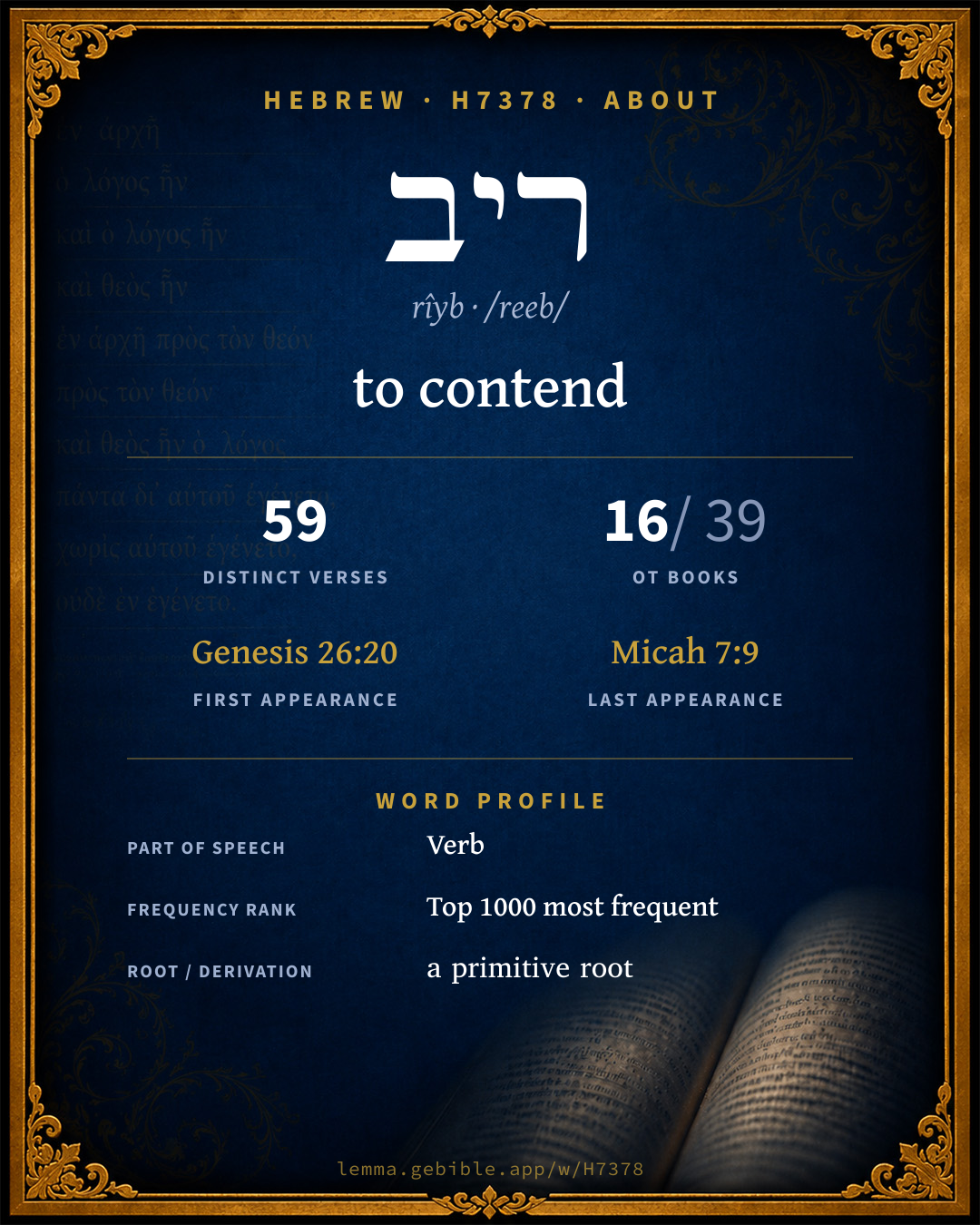
רִיב
to contend
‘to contend’ is one of 2 main senses fuller range ↓
Full lexicon entry — Brown-Driver-Briggs (BDB)
From Brown-Driver-Briggs (BDB)
Where this word appears
See every Qal verb in the Hebrew Bible →
Grammar key — what these labels mean
Part of speech
- Verb
- An action or state-of-being word.
Stem
- Qal
- The basic, simple active stem — the plain form of the verb (“he wrote”).
- Hiphil
- The causative active stem (“he caused / brought about”).
- Niphal
- Usually the simple passive or reflexive of the Qal (“he was written”).
Form
- Imperfect
- An incomplete, ongoing, or future action (“he will / would write”).
- Infinitive Construct
- A bound verbal noun, frequently with prepositions (“to write / in writing”).
- Sequential Imperfect
- An imperfect with prefixed waw — the standard past-narrative form (waw-consecutive imperfect).
- Jussive
- A third- or second-person volitional form expressing wish or command (“let him write”).
- Imperative
- A direct command (“write!”).
- Infinitive Absolute
- An unbound verbal noun, often intensifying or standing in for a finite verb.
- Perfect
- A completed action or state — Hebrew marks aspect (completeness) more than strict tense (“he wrote”).
- Participle Active
- A verbal adjective expressing ongoing or characteristic action (“writing / one who writes”).
State
- Absolute
- The independent form of a noun, not bound to a following word.
- Construct
- A noun bound to a following noun in a possessive / “of” relationship (the construct chain).
Person
- 3rd Person
- The one spoken about (“he / she / it / they”).
- 1st Person
- The speaker (“I / we”).
- 2nd Person
- The one addressed (“you”).
Gender
- Masculine
- Grammatically masculine.
- Common
- Either gender — not distinguished for this form.
Number
- Singular
- One.
- Plural
- More than one (in Hebrew, generally three or more).
Grammatical forms 22 distinct
- Verb, Qal, Imperfect, 3rd Person, Masculine, Singular 10 times (14%)
- Verb, Qal, Infinitive Construct 6 times (9%)
- Verb, Qal, Imperative, 2nd Person, Masculine, Singular 6 times (9%)
- Verb, Qal, Imperfect, 1st Person, Common, Singular 5 times (7%)
- Verb, Qal, Sequential Imperfect, 1st Person, Common, Singular 4 times (6%)
- Verb, Qal, Imperfect, 2nd Person, Masculine, Plural 4 times (6%)
- Verb, Qal, Jussive, 3rd Person, Masculine, Singular 4 times (6%)
- Verb, Qal, Sequential Imperfect, 3rd Person, Masculine, Singular 3 times (4%)
+14 more forms (28 occurrences)
Parsed forms decoded from the imported morphology (morphhb / Westminster Leningrad Codex — WLC text public domain, morphhb tagging CC BY 4.0), counted across 70 parsed occurrences — not distinct verses.
Every verse where H7378 appears — 59 distinct verses across 16 books. Click any verse to open its interlinear word-by-word view. Verse text shown in the World English Bible for context — . Each verse’s Hebrew form is shown with its reference; the English is not keyword-highlighted, since the data carries no word-level English alignment. Use “Compare translations” on any verse to read it across multiple English versions. This concordance covers the Hebrew Bible; Septuagint (Greek Old Testament) occurrences are not indexed here.
Genesis 4 verses
- Genesis 26:20 וַ/יָּרִ֜יבוּ conj + Qal wimpf 3mp The herdsmen of Gerar argued with Isaac's herdsmen, saying, "The water is ours." He called the name of the well Esek, because they contended with him.
- Genesis 26:21 וַ/יָּרִ֖יבוּ conj + Qal wimpf 3mp They dug another well, and they argued over that, also. He called the name of it Sitnah.
- Genesis 26:22 רָב֖וּ Qal pf 3cp He left that place, and dug another well. They didn't argue over that one. He called it Rehoboth. He said, "For now Yahweh has made room for us, and we will be fruitful in the land."
- Genesis 31:36 וַ/יָּ֣רֶב conj + Qal wimpf 3ms Jacob was angry, and argued with Laban. Jacob answered Laban, "What is my trespass? What is my sin, that you have hotly pursued after me?
Exodus 2 verses
- Exodus 17:2 וַ/יָּ֤רֶב תְּרִיבוּ/ן֙ conj + Qal wimpf 3ms Qal impf 2mp + sfx n Therefore the people quarreled with Moses, and said, "Give us water to drink." Moses said to them, "Why do you quarrel with me? Why do you test Yahweh?"
- Exodus 21:18 יְרִיבֻ֣/ן Qal impf 3mp + sfx n "If men quarrel and one strikes the other with a stone, or with his fist, and he doesn't die, but is confined to bed;
Numbers 2 verses
- Numbers 20:3 וַ/יָּ֥רֶב conj + Qal wimpf 3ms The people strove with Moses, and spoke, saying, Would that we had died when our brothers died before Yahweh!
- Numbers 20:13 רָב֥וּ Qal pf 3cp These are the waters of Meribah; because the children of Israel strove with Yahweh, and he was sanctified in them.
Deuteronomy 1 verse
Judges 5 verses
- Judges 6:31 תְּרִיב֣וּ/ן יָרִ֥יב יָ֣רֶב Qal impf 2mp + sfx n Qal impf 3ms Qal juss 3ms Joash said to all who stood against him, Will you contend for Baal? Or will you save him? he who will contend for him, let him be put to death while [it is yet] morning: if he be a god, let him contend for himself, because one has broken down his altar.
- Judges 6:32 יָ֤רֶב Qal juss 3ms Therefore on that day he named him Jerubbaal, saying, Let Baal contend against him, because he has broken down his altar.
- Judges 8:1 וַ/יְרִיב֥וּ/ן conj + Qal wimpf 3mp + sfx n The men of Ephraim said to him, Why have you served us thus, that you didn't call us, when you went to fight with Midian? They did chide with him sharply.
- Judges 11:25 הֲ/ר֥וֹב רָב֙ ptcl inter + Qal inf.abs Qal pf 3ms Now are you anything better than Balak the son of Zippor, king of Moab? did he ever strive against Israel, or did he ever fight against them?
- Judges 21:22 ל/רוב לָ/רִ֣יב prep + Qal inf.cs prep + Qal inf.cs It shall be, when their fathers or their brothers come to complain to us, that we will say to them, Grant them graciously to us, because we didn't take for each man his wife in battle, neither did you give them to them, else would you now be guilty.
1 Samuel 4 verses
- 1 Samuel 2:10 מריב/ו מְרִיבָ֗י/ו Hiphil ptcp.act ms cs + sfx pers 3ms Hiphil ptcp.act mp cs + sfx pers 3ms Those who strive with Yahweh shall be broken to pieces; Against them will he thunder in the sky: Yahweh will judge the ends of the earth; He will give strength to his king, Exalt the horn of his anointed.
- 1 Samuel 15:5 וַ/יָּ֖רֶב conj + Hiphil wimpf 3ms Saul came to the city of Amalek, and laid wait in the valley.
- 1 Samuel 24:15 וְ/יָרֵ֣ב conj + Qal juss 3ms Yahweh therefore be judge, and give sentence between me and you, and see, and plead my cause, and deliver me out of your hand.
- 1 Samuel 25:39 רָב֩ Qal pf 3ms When David heard that Nabal was dead, he said, Blessed be Yahweh, who has pleaded the cause of my reproach from the hand of Nabal, and has kept back his servant from evil: and the evil-doing of Nabal has Yahweh returned on his own head. David sent and spoke concerning Abigail, to take her to him as wife.
Nehemiah 4 verses
- Nehemiah 5:7 וָ/אָרִ֨יבָ/ה֙ conj + Qal wimpf 1cs + sfx h Then I consulted with myself, and contended with the nobles and the rulers, and said to them, You exact usury, everyone of his brother. I held a great assembly against them.
- Nehemiah 13:11 וָ/אָרִ֨יבָ/ה֙ conj + Qal wimpf 1cs + sfx h Then contended I with the rulers, and said, Why is the house of God forsaken? I gathered them together, and set them in their place.
- Nehemiah 13:17 וָ/אָרִ֕יבָ/ה conj + Qal wimpf 1cs + sfx h Then I contended with the nobles of Judah, and said to them, What evil thing is this that you do, and profane the Sabbath day?
- Nehemiah 13:25 וָ/אָרִ֤יב conj + Qal wimpf 1cs I contended with them, and cursed them, and struck certain of them, and plucked off their hair, and made them swear by God, [saying], You shall not give your daughters to their sons, nor take their daughters for your sons, or for yourselves.
Job 8 verses
- Job 9:3 לָ/רִ֣יב prep + Qal inf.cs If he is pleased to contend with him, He can't answer him one time in a thousand.
- Job 10:2 תְּרִיבֵֽ/נִי Qal impf 2ms + sfx pers 1cs I will tell God, 'Do not condemn me, Show me why you contend with me.
- Job 13:8 תְּרִיבֽוּ/ן Qal impf 2mp + sfx n Will you show partiality to him? Will you contend for God?
- Job 13:19 יָרִ֣יב Qal impf 3ms Who is he who will contend with me? For then would I hold my peace and give up the spirit.
- Job 23:6 יָרִ֣יב Qal impf 3ms Would he contend with me in the greatness of his power? No, but he would listen to me.
- Job 31:13 בְּ֝/רִבָ֗/ם prep + Niphal inf.cs + sfx pers 3mp "If I have despised the cause of my man-servant Or of my maid-servant, When they contended with me;
- Job 33:13 רִיב֑וֹתָ Qal pf 2ms Why do you strive against him, Because he doesn't give account of any of his matters?
- Job 40:2 הֲ֭/רֹב ptcl inter + Qal inf.abs "Shall he who argues contend with the Almighty? He who argues with God, let him answer it."
Psalms 5 verses
- Psalms 35:1 רִיבָ֣/ה Qal impv 2ms + sfx h Contend, Yahweh, with those who contend with me. Fight against those who fight against me.
- Psalms 43:1 וְ/רִ֘יבָ֤/ה conj + Qal impv 2ms + sfx h Vindicate me, God, and plead my cause against an ungodly nation. Oh, deliver me from deceitful and wicked men.
- Psalms 74:22 רִיבָ֣/ה Qal impv 2ms + sfx h Arise, God! Plead your own cause. Remember how the foolish man mocks you all day.
- Psalms 103:9 יָרִ֑יב Qal impf 3ms He will not always accuse; Neither will he stay angry forever.
- Psalms 119:154 רִיבָ֣/ה Qal impv 2ms + sfx h Plead my cause, and redeem me! Revive me according to your promise.
Proverbs 5 verses
- Proverbs 3:30 תרוב תָּרִ֣יב Qal juss 2ms Qal juss 2ms Don't strive with a man without cause, If he has done you no harm.
- Proverbs 22:23 יָרִ֣יב Qal impf 3ms For Yahweh will plead their case, And plunder the life of those who plunder them.
- Proverbs 23:11 יָרִ֖יב Qal impf 3ms For their Defender is strong. He will plead their case against you.
- Proverbs 25:8 לָ/רִ֗ב prep + Qal inf.cs Don't be hasty in bringing charges to court. What will you do in the end when your neighbor shames you?
- Proverbs 25:9 רִ֣יב Qal impv 2ms Debate your case with your neighbor, And don't betray the confidence of another;
Isaiah 8 verses
- Isaiah 1:17 רִ֖יבוּ Qal impv 2mp Learn to do well. Seek justice, Relieve the oppressed, Judge the fatherless, Plead for the widow."
- Isaiah 3:13 לָ/רִ֖יב prep + Qal inf.cs Yahweh stands up to contend, And stands to judge the peoples.
- Isaiah 27:8 תְּרִיבֶ֑/נָּה Qal impf 2ms + sfx pers 3fs In measure, when you send them away, you do contend with them; he has removed [them] with his rough blast in the day of the east wind.
- Isaiah 45:9 רָ֚ב Qal ptcp.act ms Woe to him who strives with his Maker--a potsherd among the potsherds of the earth! Shall the clay ask him who fashions it, "What are you making?" or your work, "He has no hands?"
- Isaiah 49:25 אָרִ֔יב Qal impf 1cs But thus says Yahweh, Even the captives of the mighty shall be taken away, and the prey of the terrible shall be delivered; for I will contend with him who contends with you, and I will save your children.
- Isaiah 50:8 יָרִ֥יב Qal impf 3ms He is near who justifies me; who will bring charges against me? Let us stand up together: who is my adversary? Let him come near to me.
- Isaiah 51:22 יָרִ֣יב Qal impf 3ms Thus says your Lord Yahweh, and your God who pleads the cause of his people, Behold, I have taken out of your hand the cup of staggering, even the bowl of the cup of my wrath; you shall no more drink it again:
- Isaiah 57:16 אָרִ֔יב Qal impf 1cs For I will not contend forever, neither will I be always angry; for the spirit would faint before me, and the souls who I have made.
Jeremiah 5 verses
- Jeremiah 2:9 אָרִ֥יב אָרִֽיב Qal impf 1cs Qal impf 1cs Therefore I will yet contend with you, says Yahweh, and with your children's children will I contend.
- Jeremiah 2:29 תָרִ֖יבוּ Qal impf 2mp Why will you contend with me? you all have transgressed against me, says Yahweh.
- Jeremiah 12:1 אָרִ֖יב Qal impf 1cs Righteous are you, Yahweh, when I contend with you; yet would I reason the cause with you: why does the way of the wicked prosper? why are all they at ease who deal very treacherously?
- Jeremiah 50:34 רִ֥יב יָרִ֖יב Qal inf.abs Qal impf 3ms Their Redeemer is strong; Yahweh of Hosts is his name: he will thoroughly plead their cause, that he may give rest to the earth, and disquiet the inhabitants of Babylon.
- Jeremiah 51:36 רָב֙ Qal ptcp.act ms Therefore thus says Yahweh: Behold, I will plead your cause, and take vengeance for you; and I will dry up her sea, and make her fountain dry.
Lamentations 1 verse
Hosea 2 verses
- Hosea 2:2 רִ֤יבוּ רִ֔יבוּ Qal impv 2mp Qal impv 2mp Contend with your mother! Contend, for she is not my wife, Neither am I her husband; And let her put away her prostitution from her face, And her adulteries from between her breasts;
- Hosea 4:4 יָרֵ֖ב כִּ/מְרִיבֵ֥י Qal juss 3ms prep + Hiphil ptcp.act mp cs "Yet let no man bring a charge, neither let any man accuse; For your people are like those who bring charges against a priest.
Amos 1 verse
Micah 2 verses
- Micah 6:1 רִ֣יב Qal impv 2ms Listen now to what Yahweh says: "Arise, plead your case before the mountains, And let the hills hear what you have to say.
- Micah 7:9 יָרִ֤יב Qal impf 3ms I will bear the indignation of Yahweh, Because I have sinned against him, Until he pleads my case, and executes judgment for me. He will bring me forth to the light. I will see his righteousness.
About this entry
At a glance — auto-summarized from this page’s data, not written by a person. Every figure links to its source below. This summary describes the numbers; it doesn’t interpret them.
“to contend” is the headline sense of the Hebrew verb ריב (rîyb). Translators differ — “plead” in the King James Version, then “contend” (Berean Standard Bible), as the renderings breakdown shows. It turns up in 59 verses across 16 books, a moderately common footprint. First canonically at Genesis 26:20, it enters the text early. Carrying more than one sense, it rewards its full sense range. See the sense tree, 59-verse concordance, and the renderings breakdown below.
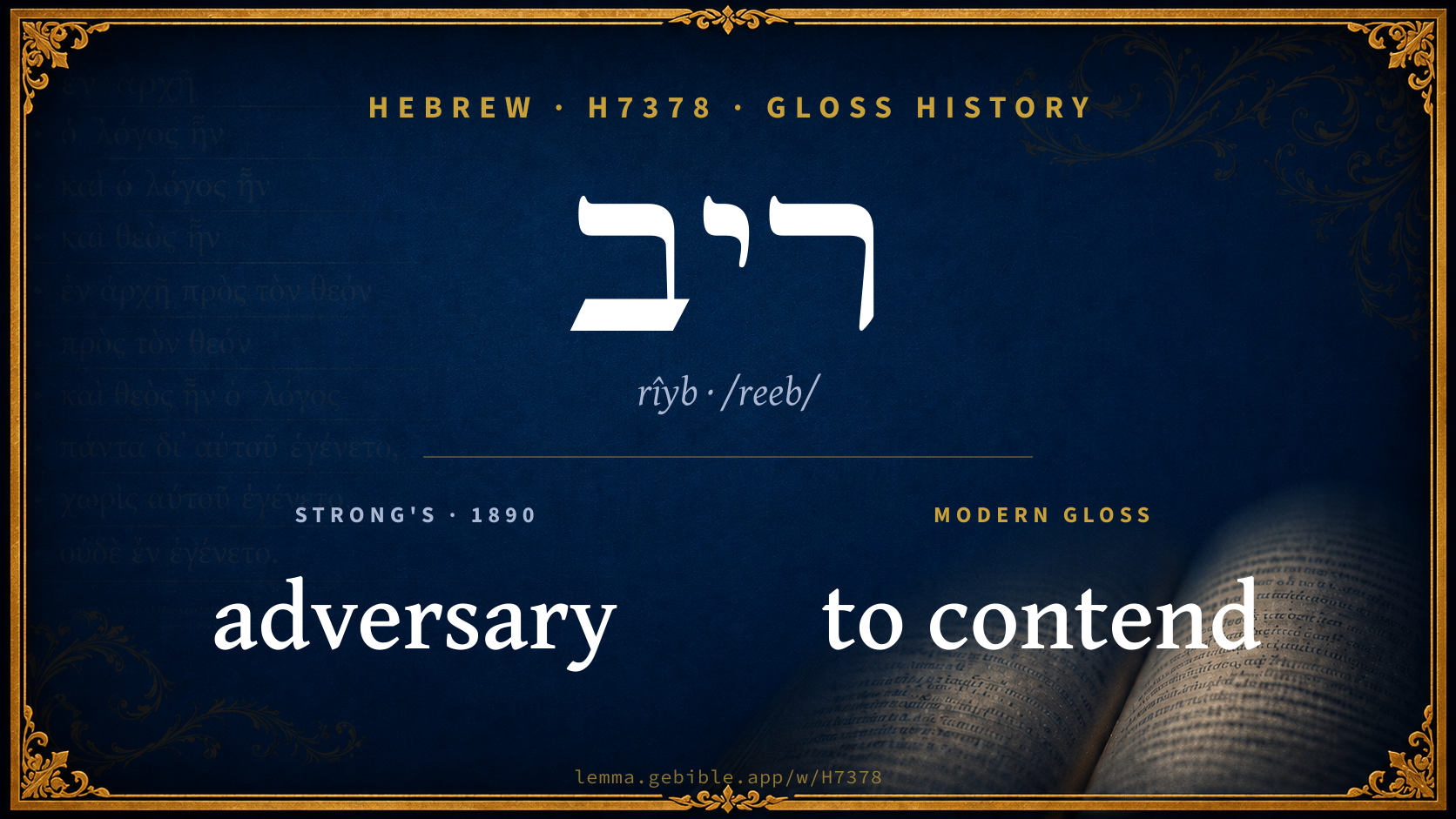
Gloss history
Strong's 1890 vs modern scholarship
About this word
Strong's H7378 catalogs a Hebrew word from the Hebrew Old Testament.
These counts are not copied from any lexicon or concordance. They are computed here, from the morphology-tagged Hebrew Old Testament. What Lemma adds →
- 59
- distinct verses
- The word appears in 59 distinct verses.
- 16 / 39
- OT books
- The word appears in 16 of 39 Old Testament books.
- #569
- by frequency
- Top 1000 most frequent Hebrew words (rank 569 of 8,640 Hebrew words by occurrence).
View all 59 occurrences in the concordance →
By section of the Old Testament
By traditional corpus
Conventional, traditional groupings — biblical authorship is debated, so this is a traditional corpus grouping, not an authorship claim. Each share is this word’s portion of its verses in that division of the Hebrew canon. Each figure is a share of the word’s 59 distinct verses.
- Prophets (Nevi'im) 27 verses · 46%
- Writings (Ketuvim) 23 verses · 39%
- Torah (Pentateuch) 9 verses · 15%
How translations render this word
Counts come from each version’s own published word-to-Strong’s tagging or interlinear alignment — an approximate guide to how each version renders this word, not a word-level alignment the data otherwise carries. Because each total is that version’s own tagged count, the per-version totals vary from one another and need not match the appearance or distinct-verse counts above. These counts may also differ from a printed concordance because Lemma counts each distinctly tagged rendering and does not collapse phrase taggings into a single head-word total. This is a fixed set of word-tagged versions (KJV, ASV, BSB, ULT) and does not change with the reading translation you choose elsewhere. Each version’s license is shown beside its name below (and on Sources).
BDB lists this Strong’s number as 2 distinct words (homographs). Each count above pools all of them and is not split by sense — see the Senses section below. A low-frequency rendering may belong to a different one of those words, not the primary meaning.
- King James Version†: Plead 11×, Strive 5×, Contend 3×
- American Standard Version†: Contend 7×, Plead 4×, Strive 4×
- Berean Standard Bible†: Contend 6×, Quarreled 4×, I rebuked 3×
- unfoldingWord Literal Text†: Contend 11×, I contended 4×, Plead 4×
King James Version Public Domain
Renders H7378 across 66† tagged occurrences — most commonly:
Plus 41 renderings that appear only once — usually multi-word phrases or single function words the recovered tagging swept in, not distinct renderings. Not rendered by a distinct English word in 1 further occurrence.
American Standard Version Public Domain
Renders H7378 across 65† tagged occurrences — most commonly:
Plus 36 renderings that appear only once — usually multi-word phrases or single function words the recovered tagging swept in, not distinct renderings.
Berean Standard Bible Public Domain
Renders H7378 across 64† tagged occurrences — most commonly:
Plus 45 renderings that appear only once — usually multi-word phrases or single function words the recovered tagging swept in, not distinct renderings. Not rendered by a distinct English word in 2 further occurrences.
unfoldingWord Literal Text CC BY-SA 4.0
Renders H7378 across 78† tagged occurrences — most commonly:
Plus 45 renderings that appear only once — usually multi-word phrases or single function words the recovered tagging swept in, not distinct renderings.
8 senses and sub-senses in the full BDB
What do BDB’s symbols mean?
BDB uses these scholarly abbreviations:
| Symbol | Meaning |
|---|---|
| 𝔊 | the Septuagint (the ancient Greek translation, LXX) |
| 𝔙 | the Vulgate (the Latin translation) |
| 𝔖 | the Syriac version (the Peshitta) |
| 𝔗 | the Targum (the Aramaic translation) |
| ψ | the Psalms |
| √ | root (the underlying root or stem) |
| ‖ | parallel passage (a synonymous or contrasted parallel) |
| † | the dagger: every passage where the word occurs is cited |
The 8 senses and sub-senses the full Brown-Driver-Briggs lexicon distinguishes for this word, in lexicon order (not ranked by frequency), with BDB’s own verbatim wording and sub-sense lettering. Shown in Hebrew script with BDB’s own scholarly abbreviations. The condensed entry is in the Lexicon Entry tab. See also the Forms in the corpus table below.
ריב I [NöZMG xxxvii (1883), 530, 534 Ges§ 73b] vb. strive, contend (cf. Arabic رَابَ (ى) agitate (the mind), رَيْبٌ disquiet
- 1. involving bodily struggle Ex 21:18 (sc. one with another; E); public hostilities, יָדָיו רָב לוֹ Dt 33:7 (with) his hands he strove for it, c. עִם of Israel, הֲרוֹב רָב Ju 11:25 (‖ נִלְחַם). e.g. Exodus 21:18
- 2. with words, c. ב pers., Gn 31:36 (E), Ex 17:2a (J) Ju 6:32, so (in fig.) Ho 2:4 cf. v 4; often = quarrel, c. עִם pers. Gn 26:20; Ex 17:2b; Nu 20:3 (all J), Ne 13:25; subj. God Jb 9:3; 13:19; 23:6; also 40:2 (עִם of God; on inf. abs. v. Ges§ 114ee), in gen. Pr 3:30; c. אֵת pers. Ju 8:1; Ne 5:7; 13:11, 17, subj. י׳ Is 49:25 (cf. i. יָרִיב infr.), ψ 35:1 (‖ לָחַם); אֵת of י׳ Is 45:9 (pt. one striving), Nu 20:13 (P); c. עַל rei Gn 26:21, 22; abs. = find fault Ho 4:4 (‖ הוֹכִיחַ). Especially e.g. Genesis 31:36
- 3. conduct a (legal) case, suit, usually fig., י׳ sub.; Is 3:13 (‖ דִּין), 57:16 (‖ קָצַף), ψ 103:9 (נָטַר [אַף]), cf. קֹרֵא לָרִב בָּאֵשׁ Am 7:4; c. acc. pers. with whom (unfriendly sense), Jb 10:2; Is 27:8; c. acc. cogn. רִיב in good sense, = take one’s part, 1 S 24:15 (Gi; v 16 van d. H. Baer; ‖ שָׁפַט), Mi 7:9; Je 50:34 (רִיב יָרִיב אֶת־רִיבָם, inf. cstr. = inf. abs., v. supr.), 51:36 (‖ נקם), La 3:58; Pr 22:23 ψ 43:1 (+ מִגּוֹי; ‖ שָׁפַט), 119:154 (+ גָּאַל), also 74:22 (God, his own cause); + מִיַד pers. against whom 1 S 25:39 (of vengeance); + אֵת pers. against whom Pr 23:11, so (without acc. cogn.) Is 50:8 Je 2:9(×2); cf. אֶת־ הֶהָרִים Mi 6:1 (II. אֵת 1 c; 𝔊 πρός, whence We Now אֶל־ in the presence of, but on רִיב אֶל v. 4); ר׳ = plead, c. ל pers. for whom Ju 6:31(×3) Jb 13:8, c. acc. pers. for whom Is 1:17, of God 51:22, cf. Dt 33:8 (obscure, v. Dr); of human disputes Pr 25:8, רִיבְךָ ר׳ אֶת־רֵעֶ֑ךָ v 9. e.g. Isaiah 3:13
- 4. = make complaint, c. אֶל pers. unto and against whom Ju 21:22; Je 2:29; 12:1; Jb 33:13. Hiph. Pt. sf. מריבו 1 S 2:10 Kt (Qr מְּרִיבָיו), i.e. (those) displaying contention against him (י׳), cf. pl. cstr. וְעַמְּךָ כִמְרִיבֵי כֹהֵן Ho 4:4, obscure; RSProph. 406 מָרוּ בִי thy people have rebelled against me, O priest! Beck Wü We GASm וְעַמִּי כִּכְמָרָיו הַכֹּהֵן (הַכּ׳ as voc., and [by some] joined to v 5); HermannSK, 1879, 516 וְעִמְּךָ עמרִיבִי הַכּ׳, cf. Oort (רִיבִי); Ruben Crit. Rem. ad loc. וְעַמִּי כָמוֹךָ הַכּ׳, so Now.—וַיָּרֶב 1 S 15:5 v. ארב Hiph. e.g. Judges 21:22
ריב II
- 1. in words, Ex 17:7 (J), Dt 1:12, about pasturage Gn 13:7 (J; = מְרִיבָה v 8), in gen. Pr 15:18; 17:14; 20:3; 26:17, 21; 30:33, + מָדוֹן Hb 1:3, so זִבְהֵי־ר׳ Pr 17:1; fig. ר׳ עֲצָמָיו Jb 33:19 Kt (Qr רוב, i.e. רֹב q.v.); ר׳ לְשֹׁנוֹת ψ 31:21, cf. Is 58:4; Pr 18:6; אִישׁ ר׳ Je 15:10 (+ א׳ מָדוֹן). e.g. Exodus 17:7
- 2. of public hostilities 2 S 22:44 = ψ 18:44, cf. אִישׁ רִיב Ju 12:2, אַנְשֵׁי רִיבֶ֑ךָ Is 41:11; ‖ חָמָם ψ 55:10. e.g. 2 Samuel 22:44
- 3. 39 especially dispute, controversy, case at law: Ex 23:2, 3, 6 (E), Dt 21:5 (+ נֶגַע), 25:1 2 S 15:2, 4 (‖ מִשְׁפָּט), + 10 times, + (of י׳) Ho 4:1; 12:3 Mi 6:2(×2) Je 25:31; Ez 44:24; La 3:36; as acc. cogn., case, cause Mi 7:9 Je 50:34 + 8 times (v. √ 3), + רִיב חֶרְפָּתִי 1 S 25:39, רִיבֵי נַפְשִׁי La 3:58; דִּבְרֵי רִיבֹת Dt 17:8 matters of controversy; ר׳ 19:17 dispute as to guilt; אִישׁ רִיבִי Jb 31:35 = accuser. e.g. Exodus 23:2
- 4. plea: Pr 18:17, רִבוֹת שְׂפָתַי Jb 13:6 pleadings of my lips. e.g. Proverbs 18:17
Senses from the full Brown-Driver-Briggs lexicon (Brown, Driver, Briggs; Oxford 1906 — public domain), digitized via Sefaria, supplemented by the OpenScriptures HebrewLexicon (CC BY 4.0). Full attribution on Sources.
Word origin
I. [NöZMG xxxvii (1883), 530, 534 Ges§ 73b] vb. strive, contend (cf. Arabic رَابَ (ى) agitate (the mind), رَيْبٌ disquiet; cf. also Syriac ܪܳܒ cry, shout, Aph. also quarrel noisily, ܪܰܘܒܳܐ shouting, clamour (v. Nöl.c.); on Sab. n.pr. ריב = Arabic رياب v. DHMib. 14);—Qal Pf. 3 ms. רָב Ju 11:25 1 S 25:39; 2 ms. רַבְתָּ La 3:58, רִיבוֹתָ Jb 33:13, etc.; Impf. 3 ms. יָרִיב Ju 6:31 +, juss. יָרֵב Ho 4:4; 1 S 24:16, יָרֶ֫ב לוֹ(בּוֹ) Ju 6:31, 32; וַיָּ֫רֶב Gn 31:36 +; 2 ms. תרוב Pr 3:30 Kt, תָּרִיב Qr; 3 mpl. יְרִיבֻן Ex 21:18, etc.; Imv. ms. רִיב Mi 6:1; Pr 25:9, רִיבָה ψ 35:1 +, mpl. רִיבוּ Is 1:17; Ho 2:4; Inf. abs. רוֹב Ju 11:25, רֹב Jb 40:2; רִיב Je 50:34 (Ges§ 73d Köi. 509 BaNB 80); cstr. רִיב Is 3:13; Jb 9:3 + Ju 21:22 Qr (Kt רוב), רִב Am 7:4; Pr 25:8; Pt. רָב Is 19:20 +;—strive:
II. n.m. Is 1:23 strife, dispute;—abs. ר׳ Gn 13:7 +, רִב Ex 23:2 +; cstr. רִיב 17:7 +; sf. רִיבִי 1 S 24:16 +, בְּרִבָם Jb 31:13 (or inf.?), etc.; pl. רִיבֹת Dt 17:8; cstr. רִיבֵי 2 S 22:44 + 2 times, רִבוֹת Jb 13:6;—strife, quarrel:
— Brown-Driver-Briggs (Oxford 1906, public domain), digitized via Sefaria, supplemented by the OpenScriptures HebrewLexicon (CC BY 4.0). See Sources.
Origin: a primitive root
Jastrow Dictionary
A second Hebrew/Aramaic lexicon for comparison, covering Aramaic and post-biblical (Talmudic, Targumic, Midrashic) usage that the biblical-Hebrew BDB does not. Matched by lemma rather than by Strong’s number, so a lemma may carry more than one Jastrow headword (shown separately below), and the entries cover usage well beyond the Bible.
רִיב I
- (b. h.) to contend, strive; to plead. Meg. 21ᵇ הרָב את ריבנו who pleaded our cause.
- same. Tanḥ. Naso 12 כל זמן … אינה מְרִיבָה as long as she was engaged in it, she did not quarrel, v. רָנַן. Y. Taan. IV, 68ᵈ, v. מְסַרְבַּיי. Mekh. B’shall., Vayassʿa, s. 6 כל … מְרִיבִין וכ׳ whenever you strive with me, you tempt God. Tanḥ. Mick. 10 עד … מֵרִיב עמו while he was yet in his mother’s womb, Esau was contending with him. Num. R. s. 5 שלא יָרִיבוּ זה עם זה that they might not quarrel with one another; היה זה מריב וכ׳ this one contended and said, I want to load here &c.; a. fr.
רִיב II
- preced.) strife, contest, cause. Meg. 21ᵇ רִיבֵנוּ, v. preced.; a. e.—Pl. רִיבוֹת, רִיבִים. Lev. R. s. 9 מַצּוּת ור׳ ed. Wil. (oth. ed. only מצות) strife and lawsuits. Snh. 34ᵇ; Nidd. 50ᵃ; Sifré Deut. 208 (ref. to Deut. XXI, 5) מקיש ר׳ לנגעים וכ׳ the text puts lawsuits on a level with plagues, as the former must be transacted in day-time &c.; Yeb. 104ᵃ e.g. Deuteronomy 21:5
A Dictionary of the Targumim, the Talmud Babli and Yerushalmi, and the Midrashic Literature (Marcus Jastrow; London, Luzac, 1903) — Public Domain. Digitized via Sefaria. Digitized via Sefaria. Full attribution on Sources.
Forms in the corpus
The 58 distinct written forms H7378 takes in the Hebrew Bible, most frequent first — each parse links to that stem’s occurrences in the concordance. Hebrew forms include their vowel points and cantillation, so a single lemma takes many written forms.
Same root — word family
Other BDB entries built from the same root as H7378, grouped by Strong’s listed origin. These share a root / origin per the lexicon — not necessarily a shared meaning. Each links to that word’s own entry.
Derived from this word
Proper names from this root
People and places named from this root — a name, not an additional meaning of the word.
- ירב Yârêb H3377 Jareb
- ירבעל Yᵉrubbaʻal H3378 Jerubbaal
- ירבעם Yârobʻâm H3379 Jeroboam
- ירבשת Yᵉrubbesheth H3380 Jerubbesheth
- מריב בעל Mᵉrîyb Baʻal H4807 Merib-baal
- ריבי Rîybay H7380 Ribai
Compare all same-root words → Showing 4 of 10 — not the complete family. 6 of the same-root words are proper names (people or places). They share a root, not necessarily a meaning.
Septuagint verse parallels
This word appears in 51 verses that also exist in the Greek Old Testament (Septuagint), out of the 59 Hebrew verses it occurs in. You can read those verses in Greek by switching the Old Testament edition to the Septuagint.
Read these verses in the Septuagint
- Genesis 26:20
- Exodus 17:2
- Numbers 20:3
- Deuteronomy 33:8
- Judges 6:31
- 1 Samuel 2:10
- Job 9:3
- Psalms 35:1
- Proverbs 3:30
- Isaiah 1:17
- Jeremiah 2:9
- Lamentations 3:58
This is a verse-level parallel only — the same verses exist in both the Hebrew and Greek Old Testaments. No word-level Hebrew↔Greek correspondence is claimed: the data carries no such alignment, so no Greek word is shown as this Hebrew word’s translation. Coverage is not total — the Septuagint omits the deuterocanon and renumbers the Psalms, so some Hebrew verses have no direct Greek parallel.