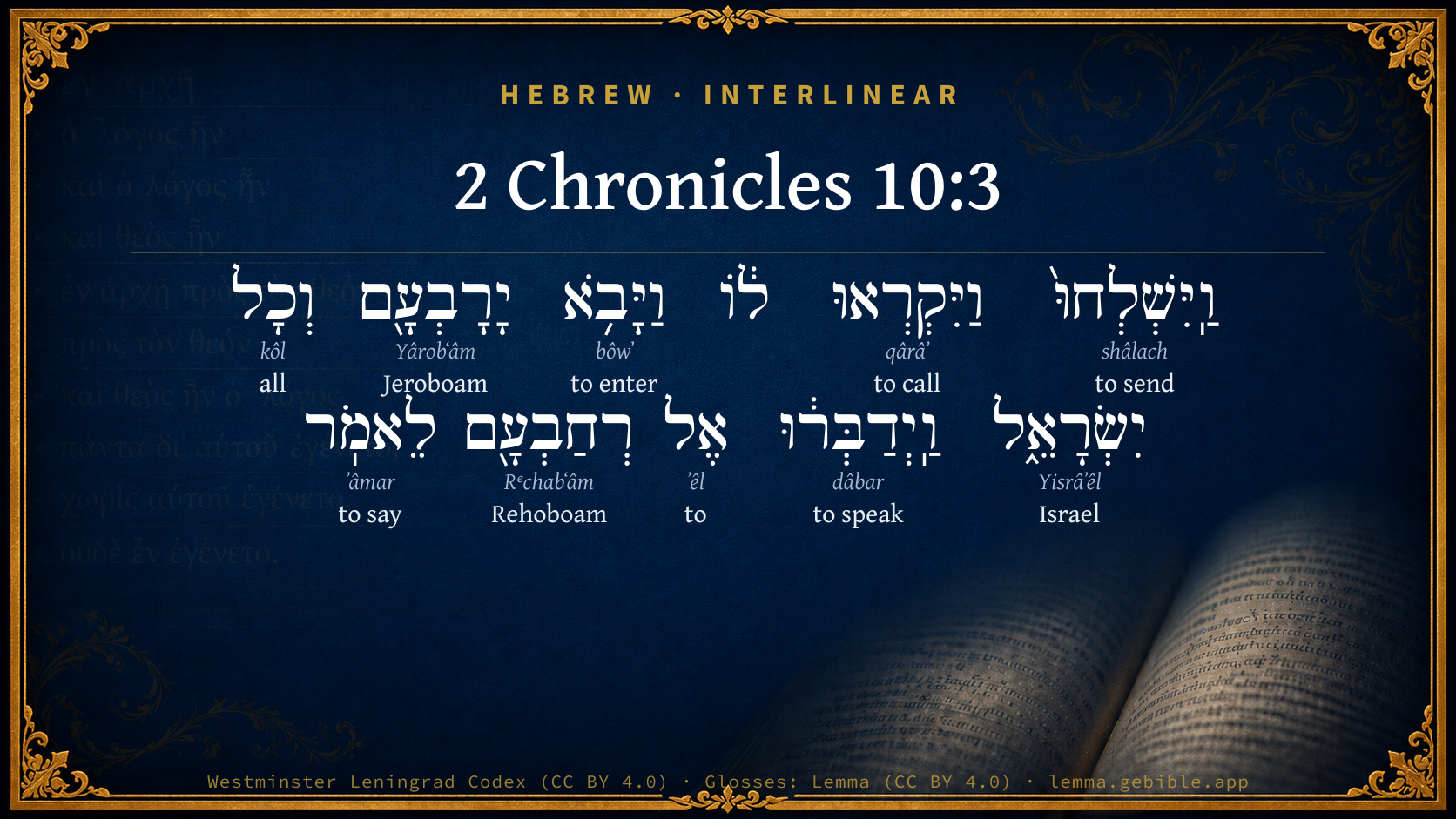
2 Chronicles 10:3

Hebrew (Westminster Leningrad Codex) 2 Chronicles 10:3 appears in the Hebrew Old Testament. The text above is from the Westminster Leningrad Codex. Each word links to its Strong’s number, a concise gloss, and parsing drawn from the Open Scriptures Hebrew Bible morphology. Click any word for its full Brown-Driver-Briggs (BDB) entry.
Download image
Cite this verse

2 Chronicles 10:3 (World English Bible). Public Domain. Lemma interlinear Bible study tool, https://lemma.gebible.app/v/2-chronicles/10/3.

Show BibTeX & RIS
BibTeX
RIS
English Translation
They sent and called him; and Jeroboam and all Israel came, and they spoke to Rehoboam, saying,
World English Bible · Public Domain
Download a study sheet

One document with this verse’s original text, its word-by-word gloss line, the meaning frame, cross-references with their text, attributed commentary, and full source and license credits — printable, and it pastes into notes with its structure intact.

This verse Autodidact and up

Study sheet (.html) Plain text (.txt)

A passage Seminary Student

Up to 50 verses in one chapter. A passage sheet keeps up to 6 commentary sources and 12 cross-references per verse, in the order this page ranks them, and says so on the sheet whenever that leaves anything out. Ask for a single verse and you get the Autodidact verse sheet above.

Everything on this page stays free to read, with no account — the sheet is a download of what is already on screen, not access to it.

Want to remove ads? Support Godless Engineer
Compare translations 3

The same verse in 3 English versions, stacked beneath the original-language interlinear above. Click any original word for its lexicon entry.

Each is an independent rendering of the whole verse — the interlinear is not word-aligned to these translations.

Highlighted words mark where these versions differ — a whole-verse word diff, not a word-by-word alignment.

  • World English Bible Public Domain
    They sent and called him; and Jeroboam and all Israel came, and they spoke to Rehoboam, saying,
  • King James Version Public Domain
    And they sent and called him. So Jeroboam and all Israel came and spake to Rehoboam, saying,
  • unfoldingWord Literal Text CC BY-SA 4.0
    And they sent and they called to him, and Jeroboam and all Israel came. And they spoke to Rehoboam, saying,

unfoldingWord Literal Text — © unfoldingWord, licensed CC BY-SA 4.0. Word-aligned USFM3 via Door43 (git.door43.org/unfoldingWord/en_ult).

Versions to compare (up to 4)

3 of 4 selected

Show all 18 translations

Every available English version of this verse, each an independent rendering of the whole verse.

  • World English Bible Public Domain
    They sent and called him; and Jeroboam and all Israel came, and they spoke to Rehoboam, saying,
  • Berean Standard Bible Public Domain
    So they sent for Jeroboam, and he and all Israel came to Rehoboam and said,
  • Majority Standard Bible Public Domain
    So they sent for Jeroboam, and he and all Israel came to Rehoboam and said,
  • King James Version Public Domain
    And they sent and called him. So Jeroboam and all Israel came and spake to Rehoboam, saying,
  • American Standard Version (1901) Public Domain
    And they sent and called him; and Jeroboam and all Israel came, and they spake to Rehoboam, saying,
  • Revised Version (1885) Public Domain
    And they sent and called him; and Jeroboam and all Israel came, and they spake to Rehoboam, saying,
  • Geneva Bible (1599) Public Domain
    And they sent and called him: so came Ieroboam and all Israel, and communed with Rehoboam, saying,
  • Douay-Rheims (1899) Public Domain
    And they sent for him, and he came with all Israel, and they spoke to Roboam, saying:
  • Young's Literal Translation Public Domain
    and they send and call for him, and Jeroboam cometh in, and all Israel, and speak unto Rehoboam, saying,
  • Literal Standard Version CC BY-SA 4.0
    and they send and call for him, and Jeroboam comes in, and all of Israel, and they speak to Rehoboam, saying,
  • Unlocked Literal Bible CC BY-SA 4.0
    So they sent and called him, and Jeroboam and all Israel came; they spoke to Rehoboam and said,
  • unfoldingWord Literal Text CC BY-SA 4.0
    And they sent and they called to him, and Jeroboam and all Israel came. And they spoke to Rehoboam, saying,
  • Darby Bible Public Domain
    And they sent and called him; and Jeroboam and all Israel came and spoke to Rehoboam saying,
  • World Messianic Bible Public Domain
    They sent and called him; and Jeroboam and all Israel came, and they spoke to Rehoboam, saying,
  • Webster's Bible Public Domain
    And they sent and called him. So Jeroboam and all Israel came and spoke to Rehoboam, saying,
  • Free Bible Version CC BY-SA 4.0
    The Israelite leaders sent for him. Jereboam and all the Israelites went to talk with Rehoboam.
  • Bible in Basic English Public Domain
    And they sent for him; and Jeroboam and all Israel came to Rehoboam and said,
  • JPS Tanakh (1917) Public Domain
    And they sent and called him; and Jeroboam and all Israel came, and they spoke to Rehoboam, saying:

Literal Standard Version (2020), Covenant Press — licensed CC BY-SA 4.0. Text via the HelloAO Bible API (eBible.org). Unlocked Literal Bible (unfoldingWord) — licensed CC BY-SA 4.0. Text via the HelloAO Bible API (eBible.org). unfoldingWord Literal Text — © unfoldingWord, licensed CC BY-SA 4.0. Word-aligned USFM3 via Door43 (git.door43.org/unfoldingWord/en_ult). Free Bible Version, Dr. Jonathan Gallagher — licensed CC BY-SA 4.0. Text via the HelloAO Bible API (eBible.org).

Word by word

More ways to search: Search by grammar → Find every occurrence → Compare this word →

Practice this passage: Drill this verse → Learn its vocabulary →

רְחַבְעָ֖ם
Rᵉchabʻâm
H7346
“Rehoboam”
Noun, Proper
Part of Speech
Noun
Type
Proper
Full BDB Definition

Origin: from H7337 and H5971

TWOT: None

Rehoboam = "a people has enlarged" - son of Solomon and the 1st king of Judah after the split up of the kingdom of Israel
  1. וַֽיִּשְׁלְחוּ֙ shâlach H7971 “and · to send” Conjunction + Verb, Qal, Sequential Imperfect, 3rd Person, Masculine, Plural
  2. וַיִּקְרְאוּ qârâʼ H7121 “and · to call” Conjunction + Verb, Qal, Sequential Imperfect, 3rd Person, Masculine, Plural
  3. וַיָּבֹ֥א bôwʼ H935 “and · to enter” Conjunction + Verb, Qal, Sequential Imperfect, 3rd Person, Masculine, Singular
  4. יָרָבְעָ֖ם Yârobʻâm H3379 “Jeroboam” Noun, Proper
  5. וְכָל kôl H3605 “and · all of” Conjunction + Noun, Common, Masculine, Singular, Construct
  6. יִשְׂרָאֵ֑ל Yisrâʼêl H3478 “Israel” Noun, Proper
  7. וַֽיְדַבְּר֔וּ dâbar H1696 “and · to speak” Conjunction + Verb, Piel, Sequential Imperfect, 3rd Person, Masculine, Plural
  8. אֶל ʼêl H413 “to” Preposition
  9. לֵאמֹֽר ʼâmar H559 “to say” Preposition + Verb, Qal, Infinitive Construct

About this verse

These counts appear in no published source. They are computed here, from the morphology-tagged text and Lemma’s own curated glosses. What Lemma adds →

11
words
10
distinct lemmas
Historical
section

Shared distinctive vocabulary

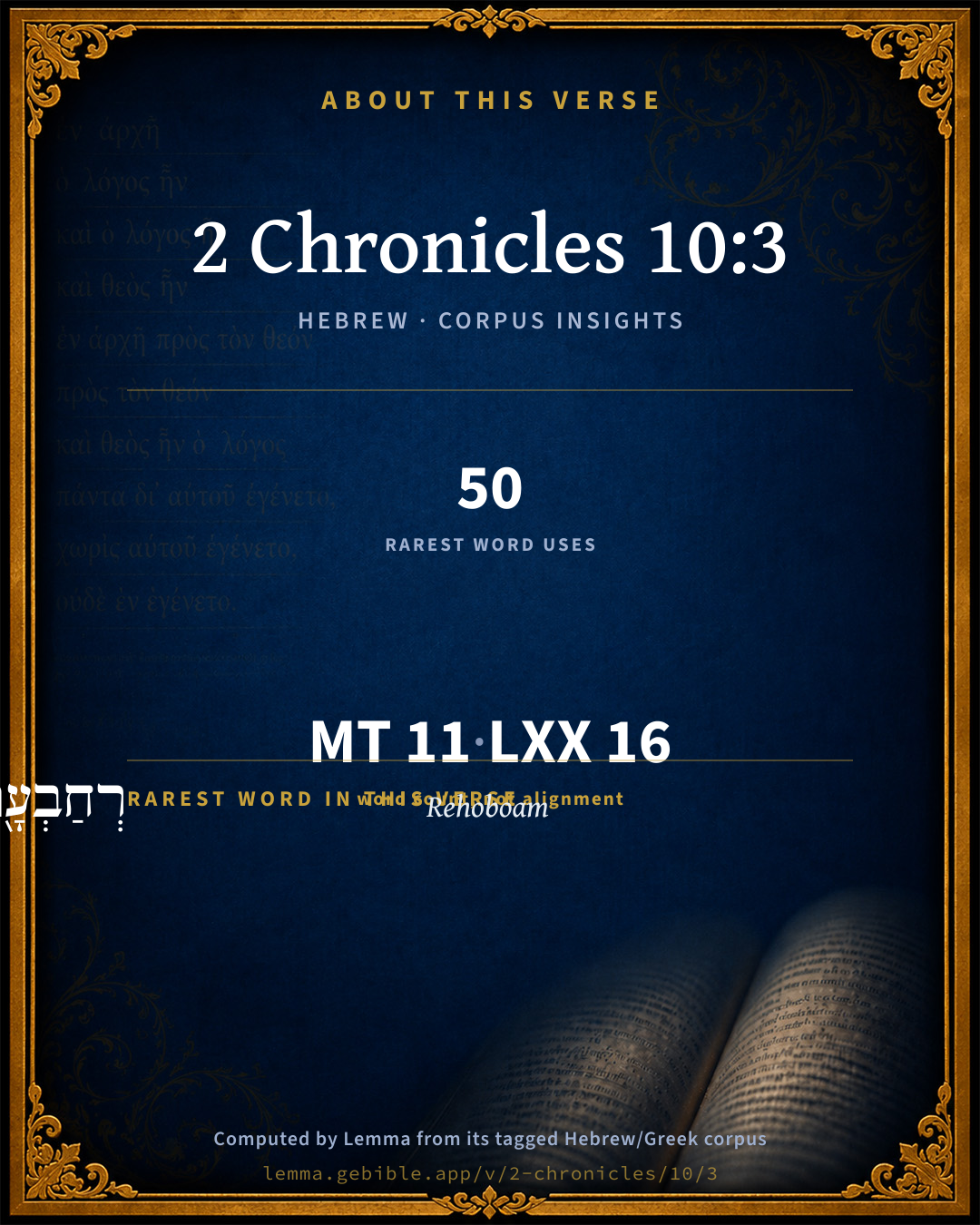
רְחַבְעָ֖ם Rehoboam H7346 occurs in 41 verses of the Hebrew Bible. Also found in:

Grammatical profile

  • 5 verbs
  • 4 nouns
  • 2 prepositions

Verb forms

  • וַֽיִּשְׁלְחוּ֙ Qal · Sequential Imperfect
  • וַיִּקְרְאוּ Qal · Sequential Imperfect
  • וַיָּבֹ֥א Qal · Sequential Imperfect
  • וַֽיְדַבְּר֔וּ Piel · Sequential Imperfect
  • לֵאמֹֽר Qal · Infinitive Construct

Hebrew & Septuagint length

In English translation the verse runs 17 words from the Hebrew and 16 from the Septuagint (LXX English) — closely comparable.

A rough comparison of the two English renderings, which tokenize alike — not a word-level alignment.

Word counts can differ between the Hebrew and the Greek without any difference in meaning — e.g. the Hebrew direct-object marker אֵת has no separate Greek word, and Greek often adds the article ὁ.

In the original languages it is 11 Hebrew tokens and 16 Greek tokens — but the two are counted differently (Hebrew bundles its prefixes and suffixes into one token; the Greek is in lemma form), so that isn’t a like-for-like length.

Cross-references

1

Topical passages linked to 2 Chronicles 10:3 in the Treasury of Scripture Knowledge — connected by theme and wording, ordered by reader-vote popularity; previews shown in the World English Bible.

  • 1 Kings 12:3 and they sent and called him), that Jeroboam and all the assembly of Israel came, and spoke to Rehoboam, saying,

Cross-references courtesy of OpenBible.info (CC BY 4.0).

Hebrew and Greek witnesses Masoretic Hebrew ↔ Greek Septuagint

The same verse in the two great witnesses to the Old Testament, shown verse-for-verse.

These are two independent witnesses, not word-aligned to each other, and the Septuagint is shown in lemma (dictionary) form.

Hebrew 2 Chronicles 10:3 Masoretic · Westminster Leningrad Codex

וַֽיִּשְׁלְחוּ֙ וַיִּקְרְאוּ ל֔וֹ וַיָּבֹ֥א יָרָבְעָ֖ם וְכָל יִשְׂרָאֵ֑ל וַֽיְדַבְּר֔וּ אֶל רְחַבְעָ֖ם לֵאמֹֽר

They sent and called him; and Jeroboam and all Israel came, and they spoke to Rehoboam, saying,

World English Bible · Public Domain

Greek LXX 2 Chronicles 10:3 Septuagint · lemma form

καί ἀποστέλλω καί καλέω αὐτός καί ἔρχομαι ιεροβοαμ καί πᾶς ὁ ἐκκλησία ἰσραήλ πρός ροβοαμ λέγω

And they sent and called him: and Jeroboam and all the congregation came to Roboam, saying,

LXX2012 (modern English Septuagint) · Public Domain

Hebrew: Westminster Leningrad Codex (CC BY 4.0). Greek: Septuagint (public domain); English from LXX2012 (modern English Septuagint) (Public Domain). How the Septuagint differs from the Hebrew →

Commentary

Notes on 2 Chronicles 10:3 from classic Christian and Jewish commentators (each source and its license shown beneath its notes). The classic Christian expositions comment on the surrounding passage and are grouped to its opening verse, so a note may address several verses; the Jewish commentaries on the Tanakh (Rashi and others) are per-verse, so they appear only where the commentator wrote on this verse.

Lemma curates 59 commentaries, every one of them public domain or Creative Commons licensed, each selected and text-cleaned for this edition rather than reprinted as found. About our sources →

Jamieson, Fausset & Brown

Robert Jamieson, A. R. Fausset & David Brown

And they sent--rather, "for they had sent," &c. This is stated as the reason of Jeroboam's return from Egypt.

Jamieson, Fausset & Brown — Commentary Critical and Explanatory on the Whole Bible (1871) — public domain (CC PDM 1.0). Text via the HelloAO Bible API.

Ellicott's Commentary for English Readers

(3) And they sent and called him.—To the assembly. (Comp. 1Ki_12:20.)

All Israel.—Chron. omits assembly of. “Came,” singular; Kings, plural.

A Bible Commentary for English Readers, edited by Charles John Ellicott (1878–1897) — public domain. Text from a community e-Sword module.

Matthew Poole's English Annotations

And they sent; or, for (as that particle is oft used, as hath been noted before) they had sent, &c. So this is the reason why he returned, as was said, 2Ch 10:2.

Matthew Poole's English Annotations on the Holy Bible (1683–1685) — public domain. Text from a community e-Sword/MySword module.

The Pulpit Commentary

Vers. 3-19.

The loss of a kingdom.

I A REASONABLE REQUEST PREFERRED, (Vers. 3, 4.)

1. A public grievance stated. The northern tribes, through Jeroboam, complained to Rehoboam that Solomon had made their yoke grievous. Whether this was tree or not has been much debated.

(1) That it was largely used as a pretext to justify their subsequent behaviour is not without support. In the first place, it was put forward by tribes already disaffected, and through the medium of one who had formerly shown himself a traitor. Then, that Solomon, in making a levy of his subjects for carrying on his numerous buildings, was only acting in accordance with the custom of Oriental monarchs generally from Egypt to Babylon, must be conceded. Besides, it may be assumed that no more oppressive tasks were laid on the northern than on the southern tribes, from none of which complaint was heard. Further, if heavier burdens than before were placed upon the people by Solomon, that was largely inevitable from the magnificence of his court and the extensive building operations demanded by the safety as well as glory of the kingdom. And finally, if the people were heavily burdened under Solomon, they still enjoyed considerable advantages of peace and prosperity.

(2) In support of the assertion made by the tribes, attention may be called to the facts that neither Rehoboam nor his counsellors denied, but rather both undisguisedly admitted, its truth (ver. 11); that the complaint was not that of the house of Joseph alone, but of "all Israel;" and that the circumstance of Judah and. Benjamin refusing to back it up is not sufficient to demonstrate its falsehood.

2. A measure of relief demanded. "Make the heavy yoke of thy father lighter." Not only was this reasonable, but it should, have been a point in their favour, that they sought redress for their grievance by the peaceful method of conference rather than by immediately resorting to the sword. Instead, however, of granting their request, Rehoboam temporized, put them off, asked for three days to consider the matter, promising at the end of that time to give them a definite and final answer. Never before had there been in Israel"s history such a critical "three days," unless, perhaps, "the three days start on leaving Egypt, (Exo_8:27, Exo_8:28) or the three days" preparation for the conquest. (Jos_1:11) The issue of this "three days deliberation on the part of Rehoboam was momentous. According as it should be should likewise be the after-course of history, not for Israel alone, but for the world, Almost always dangerous, delay was in this case disastrous.

II A GOOD COUNSEL REJECTED. (Vers. 6-8.)

1. The kings aged advisers. It argued some sense on the part of Rehoboam that he first solicited advice from the experienced statesmen of the kingdom, and the privy councillors of his late father perhaps for a moment he was of opinion that "days should speak, and multitude of years should teach wisdom"; (Job_32:7) it proved him possessed of little sense that he closed his ears against their prudent suggestions. (Pro_23:9)

1. The kings best course. "The accumulated wisdom of the Solomonic era recommended concession, The old councillors gave just such advice as might have been found in the Book of Proverbs" (Stanley). They advised acquiescence in the popular demand. They urged the king to win the

2. people by kindness. The beautiful antithesis of the Book of Kings, "If thou wilt be a servant unto this people, and wilt save them then they will be thy servants for ever", (1Ki_12:7) is here awanting, but the sentiment is the same. The aged senators believed that kindness held the key to the human heart, and that "a soft answer turneth away wrath" (Pro_15:1 Pro_25:15) as much in nations as in individuals; they knew that one must often stoop to conquer, and that he who would be served by others should ever exhibit a readiness to serve others; (Mat_7:12) nay, that the true function of a king is to serve his people a thought happily expressed by the Ich dien of the Prince of Wales"s crest.

3. The kings consummate folly. "He forsook the counsel of the old men." Had he not been a fool, for whom wisdom is too high, (Pro_24:7) in whose eyes his own way is always right, (Pro_12:15) and who, as a consequence, walketh in darkness, (Ecc_2:14) he might have discerned that the situation was critical, that rebellion was in the air, and that the old experienced statesmen of the last reign were the only pilots competent to steer the ship of state through the breakers. Unlike the men of Issachar, who were men that had "understanding of the times to know what Israel ought to do", (1Ch_12:32) Rehoboam was "a strong ass", (Gen_49:14) impatient of control and incapable of guiding either himself or others. Some men never see the right thing to do until it is too late.

III AN EVIL POLICY ADOPTED. (Vers. 9-11.)

1. Its proposers. "The young men that were grown up with him either the statesmen of the new reign whom Rehoboam had appointed from among his own companions, or young courtiers who had danced attendance on his person while heir-apparent to the crown, and now clung to the steps of the throne in the hope of preferment. Though afterwards spoken of as young, (2Ch_13:7) Rehoboam was at this time over forty years of age.

2. Its proposals. Not concession, but coercion, should be the order of the day. Their complaints should be silenced, not removed. Their appeal for lighter service should be answered by a heavier yoke. For Solomon"s whips they should have Rehoboam"s scorpions. Other rulers besides Rehoboam have tried to still the complaints of their subjects by more and heavier oppression; e.g. Pharaoh, (Exo_5:15-19) and the Stuarts of England, not to mention others.

3. Its pursuance. Rehoboam hearkened to the counsel of the young men, and at the close of the stipulated three days answered Jeroboam and his co-deputies "roughly," in the terms put into his mouth by his hot-headed advisers. "It was the speech of a despotic tyrant, not of a shepherd and ruler appointed by God over his people" (Keil). It undid in a moment the work of centuries. It shattered the kingdom which David"s sword and Solomon"s wisdom had built.

IV A DIVINE COUNSEL FULFILLED. (Ver. 15.)

1. The Divine purpose. The division of the kingdom. Foretold by Ahijah, (1Ki_11:31) the hour had struck for its accomplishment. Jehovah doeth according to his will in the army of heaven and among the inhabitants of earth. (Dan_4:35) Yet all the free actions of men have their places in his world-embracing plan. Man"s actions may seem contingent; God"s purposes are not. What he determines he can effect.

1. The Divine instrumentality. The foolishness of Rehoboam. Not that Rehoboam was under any internal or supernatural compulsion to act as he did any more than were Pharaoh (Exo_14:4; Rom_9:17) and (Mat_26:25) to act as they did. Simply, Jehovah decreed to permit Rehoboam"s folly as a means of furthering his own designs. Divine sovereignty and human freedom not contradictory, though mysterious.

2. A NATIONAL REVOLT CONSUMMATED. (Vers. 16, 17.)

1. With popular enthu siasm. "All Israel," with the exception of those members of the northern kingdom who dwelt in Judaean cities, joined in the cry, "What portion have we in David," etc.? The unanimity of the movement showed that it was not without ground.

2. With fierce indignation. The cry which had once before been heard in Israel (2Sa_20:1) expressed the people"s sense of wrong in being cast off by Rehoboam, treated no longer as free subjects, but as conquered slaves. It proclaimed the deep-seated contempt they now cherished for the son of Jesse, as they now designate the dynasty of David.

1. With implacable resentment. "Struck by the king"s words as by an iron hammer, and grieved at them," the people rejected his friendly overtures for reconciliation conveyed through Hadoram. If this was the son of David"s tribute officer, (2Sa_20:24) he must have been at this time an old man about eighty. Hence he was probably the Adoniram, son of Abda, who was over the levy. (1Ki_4:6) Though not likely that he

2. advanced towards the people with a small force as if to enforce submission (Bertheau, Ewald), but rather that he approached them alone (Josephus), a more unfortunate selection of one to act as ambassador could scarcely have been made. Most likely one of the older counsellors who recommended moderation, Hadoram was yet the man who was "over the tribute," i.e. was the tax-collector of Rehoboam, and as such could hardly fail to be obnoxious to the angry multitude. Regarding him as an enemy, they sprang upon him with murderous fury: "they stoned him with stones till he died," thus inflicting on him a death usually reserved for traitors and blasphemers. This was the one dark spot which marked what would otherwise have been a bloodless revolution.

3. With final decision. The murder of his plenipotentiary convinced Rehoboam that the opportunity for parley was over, that fair speeches would no longer suffice to quell the insurrection, and that the revolt of Israel was an accomplished, most likely a permanent, fact. Mounting his chariot in haste, and with alarm for his safety, the king who had come to Shechem to obtain a crown returned to Jerusalem, having lost a kingdom.

LESSONS.

1. The danger of oppression. (Ecc_7:7)

2. "In the multitude of counsellors is safety", (Pro_11:14) only when all are wise, (Pro_12:5) and he who is counselled is not a. (Pro_12:15)

1. He that hesitates is lost exemplified in the case of Rehoboam.

2. The rashness of youth shown in the second company.of the king"s advisers.

3. Quem dens vult perdere prius dementat.

4. "Better is a wise child than a foolish king". (Ecc_4:13)

5. Good men often suffer for the sins of others, and even lose their liveswhen working for the good of others illustrated in Hadoram.

6. Wicked men would often like to flee from the sight, and much morefrom the consequences, of their own wickedness. W.

The Pulpit Commentary (1880–1919), ed. H.D.M. Spence-Jones & Joseph S. Exell — public domain. Text from a community e-Sword module.

unfoldingWord translationNotes

Door43 World Missions Community

they sent and called him

"the men of Israel sent for Jeroboam"

Jeroboam and all Israel came

"Jeroboam and all Israel came to Rehoboam"

all Israel came

Here "Israel" is a metonym for the men of Israel. The word "all" is a generalization. AT: "the men of Israel came" (See: Metonymy and Hyperbole and Generalization)

made our yoke difficult

A difficult yoke is a metaphor for very difficult labor and cruel treatment. AT: "treated us cruelly" or "forced us to work very hard" (See: Metaphor)

make your father's hard work easier, and lighten the heavy yoke that he put on us

These two phrases mean the same thing. The yoke metaphor emphasizes the fact that Solomon had treated them harshly. AT: "make the hard work that your father gave us easier, and do not treat us as harshly as he did" (See: Parallelism and Metaphor)

after three days

"after 3 days" (See: Numbers)

translationWords

send

call

yoke

works

servant

unfoldingWord translationNotes — © Distant Shores Media and the Door43 World Missions Community, licensed CC BY-SA 4.0. Source: git.door43.org/Door43/en_tn.

Rashi

Rabbi Shlomo Yitzchaki (Rashi)

And they sent and called him, and...came All this was to let us know the will of the Holy One, blessed be He, that even Jeroboam himself came to make Rehoboam king, but the Holy One, blessed be He, reversed his words [i.e., Jeroboam’s intention,] until Jeroboam reigned.

Rashi on the Tanakh — English translations: “The Judaica Press complete Tanach with Rashi, translated by A. J. Rosenberg” (CC BY 4.0); “Pentateuch with Rashi's commentary by M. Rosenbaum and A.M. Silbermann, 1929-1934” (public domain); “The Metsudah Tanach series, Lakewood, N.J” (CC BY 4.0); and “The Book of Joshua, Metsudah Publications, 1997” (CC BY 4.0). Text via Sefaria.

Lesson kit

Teaching starters — assembled from the data on this page, not authored interpretation. Every prompt links to the verse data it draws on. Edit before teaching.

2 Chronicles, in the Historical, opens this verse with 11 words (10 distinct Hebrew lemmas). Its most distinctive word is Rᵉchabʻâm (“Rehoboam”). A historical commentator’s framing appears above. Read the whole chapter for the surrounding context.

Discussion questions

  1. How does “Rehoboam” (Rᵉchabʻâm) shape what this verse is saying?
  2. 1 Kings 11:43 shares the word «Rehoboam» with this verse. How do the two illuminate each other?
  3. These translations render this verse differently; the difference is in the English rendering, not the original. What questions does that raise?
  4. The verb «וַֽיִּשְׁלְחוּ֙» is Qal Sequential Imperfect. How does its form color the action?
  5. Reading how Jamieson, Fausset & Brown and Ellicott's Commentary for English Readers read this verse, where do the two commentators agree and where do they part?

Things to notice

Reading settings

Reading text

Shown beneath each verse's original-language words.

Old Testament
Old Testament edition

Read the OT as the Masoretic Hebrew (MT) or the Greek Septuagint (LXX).

English shown for the Greek Septuagint (in the Hebrew ↔ Greek comparison).

Comparing translations? Open the Compare panel on any verse page to stack up to four side by side.