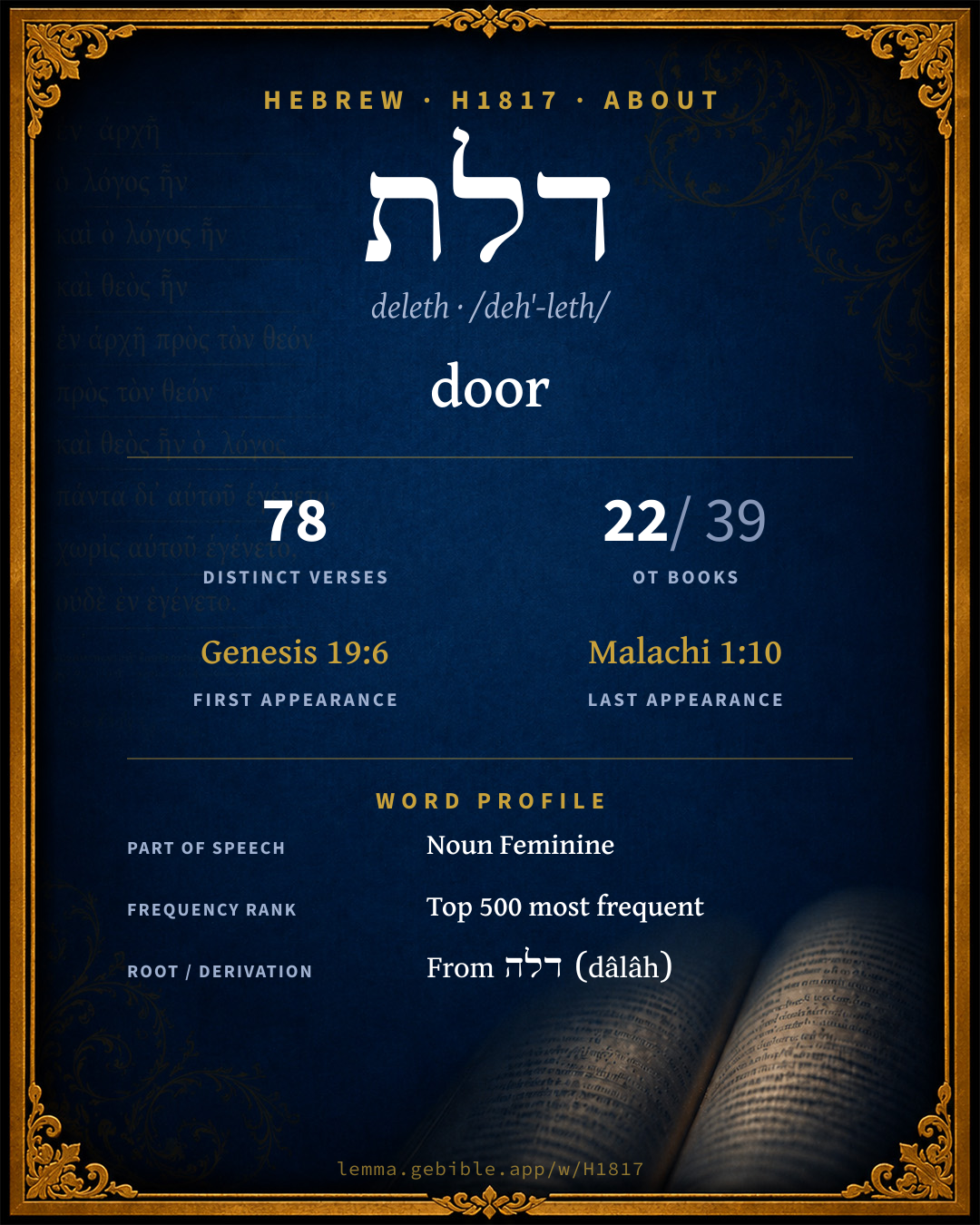
דֶּ֫לֶת
door
‘door’ is one of 3 main senses fuller range ↓
Full lexicon entry — Brown-Driver-Briggs (BDB)
From Brown-Driver-Briggs (BDB)
Where this word appears
See every Construct-state word in the Hebrew Bible →
Grammar key — what these labels mean
Part of speech
- Noun
- A naming word — a person, place, thing, or idea.
Noun type
- Common
- A common noun — a general class of person, place, or thing (“king,” “city,” “water”), not a specific name.
State
- Construct
- A noun bound to a following noun in a possessive / “of” relationship (the construct chain).
- Absolute
- The independent form of a noun, not bound to a following word.
Gender
- Feminine
- Grammatically feminine.
- Masculine
- Grammatically masculine.
Number
- Plural
- More than one (in Hebrew, generally three or more).
- Singular
- One.
- Dual
- Exactly two — for natural pairs and some measures of time.
Grammatical forms
- Noun, Common, Feminine, Plural, Construct 32 times (36%)
- Noun, Common, Feminine, Singular, Absolute 21 times (24%)
- Noun, Common, Feminine, Dual, Absolute 11 times (12%)
- Noun, Common, Feminine, Plural, Absolute 11 times (12%)
- Noun, Common, Feminine, Dual, Construct 11 times (12%)
- Noun, Common, Feminine, Singular, Construct 2 times (2%)
- Noun, Common, Masculine, Singular, Construct 1 time (1%)
Parsed forms decoded from the imported morphology (morphhb / Westminster Leningrad Codex — WLC text public domain, morphhb tagging CC BY 4.0), counted across 89 parsed occurrences — not distinct verses.
Every verse where H1817 appears — 78 distinct verses across 22 books. Click any verse to open its interlinear word-by-word view. Verse text shown in the World English Bible for context — . Each verse’s Hebrew form is shown with its reference; the English is not keyword-highlighted, since the data carries no word-level English alignment. Use “Compare translations” on any verse to read it across multiple English versions. This concordance covers the Hebrew Bible; Septuagint (Greek Old Testament) occurrences are not indexed here.
Genesis 3 verses
- Genesis 19:6 וְ/הַ/דֶּ֖לֶת conj + ptcl def.art + n c fs Lot went out to them to the door, and shut the door after him.
- Genesis 19:9 הַ/דָּֽלֶת ptcl def.art + n c fs They said, "Stand back!" They said, "This one fellow came in to live as a foreigner, and he appoints himself a judge. Now will we deal worse with you, than with them!" They pressed hard on the man, even Lot, and drew near to break the door.
- Genesis 19:10 הַ/דֶּ֖לֶת ptcl def.art + n c fs But the men put forth their hand, and brought Lot into the house to them, and shut the door.
Exodus 1 verse
Deuteronomy 2 verses
- Deuteronomy 3:5 דְּלָתַ֣יִם n c fd All these were cities fortified with high walls, gates, and bars; besides the unwalled towns a great many.
- Deuteronomy 15:17 וּ/בַ/דֶּ֔לֶת conj + prep det + n c fs then you shall take an awl, and thrust it through his ear to the door, and he shall be your servant forever. Also to your maid-servant you shall do likewise.
Joshua 2 verses
- Joshua 2:19 מִ/דַּלְתֵ֨י prep + n c fd cs It shall be, that whoever shall go out of the doors of your house into the street, his blood shall be on his head, and we shall be guiltless: and whoever shall be with you in the house, his blood shall be on our head, if any hand be on him.
- Joshua 6:26 דְּלָתֶֽי/הָ n c fd cs + sfx pers 3fs Joshua charged them with an oath at that time, saying, Cursed be the man before Yahweh, that rises up and builds this city Jericho: with the loss of his firstborn shall he lay the foundation of it, and with the loss of his youngest son shall he set up the gates of it.
Judges 7 verses
- Judges 3:23 דַּלְת֧וֹת n c fp cs Then Ehud went forth into the porch, and shut the doors of the upper room on him, and locked them.
- Judges 3:24 דַּלְת֥וֹת n c fp cs Now when he was gone out, his servants came; and they saw, and, behold, the doors of the upper room were locked; and they said, Surely he is covering his feet in the upper chamber.
- Judges 3:25 דַּלְת֣וֹת n c fp cs They waited until they were ashamed; and, behold, he didn't open the doors of the upper room: therefore they took the key, and opened [them], and, behold, their lord was fallen down dead on the earth.
- Judges 11:31 מִ/דַּלְתֵ֤י prep + n c fd cs then it shall be, that whatever comes forth from the doors of my house to meet me, when I return in peace from the children of Ammon, it shall be Yahweh's, and I will offer it up for a burnt offering.
- Judges 16:3 בְּ/דַלְת֤וֹת prep + n c fp cs Samson lay until midnight, and arose at midnight, and laid hold of the doors of the gate of the city, and the two posts, and plucked them up, bar and all, and put them on his shoulders, and carried them up to the top of the mountain that is before Hebron.
- Judges 19:22 הַ/דָּ֑לֶת ptcl def.art + n c fs As they were making their hearts merry, behold, the men of the city, certain base fellows, beset the house round about, beating at the door; and they spoke to the master of the house, the old man, saying, Bring forth the man who came into your house, that we may know him.
- Judges 19:27 דַּלְת֣וֹת n c fp cs Her lord rose up in the morning, and opened the doors of the house, and went out to go his way; and, behold, the woman his concubine was fallen down at the door of the house, with her hands on the threshold.
1 Samuel 3 verses
- 1 Samuel 3:15 דַּלְת֣וֹת n c fp cs Samuel lay until the morning, and opened the doors of the house of Yahweh. Samuel feared to show Eli the vision.
- 1 Samuel 21:13 דַּלְת֣וֹת n c fp cs He changed his behavior before them, and feigned himself mad in their hands, and scrabbled on the doors of the gate, and let his spittle fall down on his beard.
- 1 Samuel 23:7 דְּלָתַ֥יִם n c fd It was told Saul that David was come to Keilah. Saul said, God has delivered him into my hand; for he is shut in, by entering into a town that has gates and bars.
2 Samuel 2 verses
- 2 Samuel 13:17 הַ/דֶּ֖לֶת ptcl def.art + n c fs Then he called his servant who ministered to him, and said, Put now this woman out from me, and bolt the door after her.
- 2 Samuel 13:18 הַ/דֶּ֖לֶת ptcl def.art + n c fs She had a garment of various colors on her; for with such robes were the king's daughters who were virgins dressed. Then his servant brought her out, and bolted the door after her.
1 Kings 5 verses
- 1 Kings 6:31 דַּלְת֣וֹת n c fp cs For the entrance of the oracle he made doors of olive-wood: the lintel [and] door-posts were a fifth part [of the wall].
- 1 Kings 6:32 דַּלְת֣וֹת n c fp cs So [he made] two doors of olive-wood; and he carved on them carvings of cherubim and palm trees and open flowers, and overlaid them with gold; and he spread the gold on the cherubim, and on the palm trees.
- 1 Kings 6:34 דַלְת֖וֹת הַ/דֶּ֤לֶת הַ/דֶּ֥לֶת n c fp cs ptcl def.art + n c fs ptcl def.art + n c fs and two doors of fir-wood: the two leaves of the one door were folding, and the two leaves of the other door were folding.
- 1 Kings 7:50 לְ/דַלְתוֹת֩ לְ/דַלְתֵ֥י prep + n c fp cs prep + n c fd cs and the cups, and the snuffers, and the basins, and the spoons, and the fire pans, of pure gold; and the hinges, both for the doors of the inner house, the most holy place, and for the doors of the house, [to wit], of the temple, of gold.
- 1 Kings 16:34 דְּלָתֶ֔י/הָ n c fd cs + sfx pers 3fs In his days did Hiel the Bethelite build Jericho: he laid the foundation of it with the loss of Abiram his firstborn, and set up the gates of it with the loss of his youngest son Segub, according to the word of Yahweh, which he spoke by Joshua the son of Nun.
2 Kings 8 verses
- 2 Kings 4:4 הַ/דֶּ֨לֶת֙ ptcl def.art + n c fs You shall go in, and shut the door on you and on your sons, and pour out into all those vessels; and you shall set aside that which is full.
- 2 Kings 4:5 הַ/דֶּ֔לֶת ptcl def.art + n c fs So she went from him, and shut the door on her and on her sons; they brought [the vessels] to her, and she poured out.
- 2 Kings 4:33 הַ/דֶּ֖לֶת ptcl def.art + n c fs He went in therefore, and shut the door on them both, and prayed to Yahweh.
- 2 Kings 6:32 הַ/דֶּ֨לֶת֙ בַּ/דֶּ֔לֶת ptcl def.art + n c fs prep det + n c fs But Elisha was sitting in his house, and the elders were sitting with him; and [the king] sent a man from before him: but before the messenger came to him, he said to the elders, See you how this son of a murderer has sent to take away my head? behold, when the messenger comes, shut the door, and hold the door fast against him: isn't the sound of his master's feet behind him?
- 2 Kings 9:3 הַ/דֶּ֛לֶת ptcl def.art + n c fs Then take the vial of oil, and pour it on his head, and say, Thus says Yahweh, I have anointed you king over Israel. Then open the door, and flee, and don't wait.
- 2 Kings 9:10 הַ/דֶּ֖לֶת ptcl def.art + n c fs The dogs shall eat Jezebel in the portion of Jezreel, and there shall be none to bury her. He opened the door, and fled.
- 2 Kings 12:9 בְּ/דַלְתּ֑/וֹ prep + n c fs cs + sfx pers 3ms But Jehoiada the priest took a chest, and bored a hole in the lid of it, and set it beside the altar, on the right side as one comes into the house of Yahweh: and the priests who kept the threshold put therein all the money that was brought into the house of Yahweh.
- 2 Kings 18:16 דַּלְת֨וֹת n c fp cs At that time did Hezekiah cut off [the gold from] the doors of the temple of Yahweh, and [from] the pillars which Hezekiah king of Judah had overlaid, and gave it to the king of Assyria.
1 Chronicles 1 verse
2 Chronicles 8 verses
- 2 Chronicles 3:7 וְ/דַלְתוֹתָ֖י/ו conj + n c fp cs + sfx pers 3ms He overlaid also the house, the beams, the thresholds, and the walls of it, and the doors of it, with gold; and engraved cherubim on the walls.
- 2 Chronicles 4:9 וּ/דְלָת֧וֹת וְ/דַלְתוֹתֵי/הֶ֖ם conj + n c fp conj + n c fp cs + sfx pers 3mp Furthermore he made the court of the priests, and the great court, and doors for the court, and overlaid the doors of them with brass.
- 2 Chronicles 4:22 דַּלְתוֹתָ֨י/ו וְ/דַלְתֵ֥י n c fp cs + sfx pers 3ms conj + n c fd cs and the snuffers, and the basins, and the spoons, and the fire pans, of pure gold: and as for the entry of the house, the inner doors of it for the most holy place, and the doors of the house, [to wit], of the temple, were of gold.
- 2 Chronicles 8:5 דְּלָתַ֥יִם n c fd Also he built Beth Horon the upper, and Beth Horon the lower, fortified cities, with walls, gates, and bars;
- 2 Chronicles 14:7 דְּלָתַ֣יִם n c fd For he said to Judah, Let us build these cities, and make about them walls, and towers, gates, and bars; the land is yet before us, because we have sought Yahweh our God; we have sought him, and he has given us rest on every side. So they built and prospered.
- 2 Chronicles 28:24 דַּלְת֣וֹת n c fp cs Ahaz gathered together the vessels of the house of God, and cut in pieces the vessels of the house of God, and shut up the doors of the house of Yahweh; and he made him altars in every corner of Jerusalem.
- 2 Chronicles 29:3 דַּלְת֥וֹת n c fp cs He in the first year of his reign, in the first month, opened the doors of the house of Yahweh, and repaired them.
- 2 Chronicles 29:7 דַּלְת֣וֹת n c fp cs Also they have shut up the doors of the porch, and put out the lamps, and have not burned incense nor offered burnt offerings in the holy place to the God of Israel.
Nehemiah 11 verses
- Nehemiah 3:1 דַּלְתֹתָ֑י/ו n c fp cs + sfx pers 3ms Then Eliashib the high priest rose up with his brothers the priests, and they built the sheep gate; they sanctified it, and set up the doors of it; even to the tower of Hammeah they sanctified it, to the tower of Hananel.
- Nehemiah 3:3 דַּלְתֹתָ֔י/ו n c fp cs + sfx pers 3ms The fish gate did the sons of Hassenaah build; they laid the beams of it, and set up the doors of it, the bolts of it, and the bars of it.
- Nehemiah 3:6 דַּלְתֹתָ֔י/ו n c fp cs + sfx pers 3ms The old gate repaired Joiada the son of Paseah and Meshullam the son of Besodeiah; they laid the beams of it, and set up the doors of it, and the bolts of it, and the bars of it.
- Nehemiah 3:13 דַּלְתֹתָ֔י/ו n c fp cs + sfx pers 3ms The valley gate repaired Hanun, and the inhabitants of Zanoah; they built it, and set up the doors of it, the bolts of it, and the bars of it, and one thousand cubits of the wall to the dung gate.
- Nehemiah 3:14 דַּלְתֹתָ֔י/ו n c fp cs + sfx pers 3ms The dung gate repaired Malchijah the son of Rechab, the ruler of the district of Beth Haccherem; he built it, and set up the doors of it, the bolts of it, and the bars of it.
- Nehemiah 3:15 דַּלְתֹתָ֔י/ו n c fp cs + sfx pers 3ms The spring gate repaired Shallun the son of Colhozeh, the ruler of the district of Mizpah; he built it, and covered it, and set up the doors of it, the bolts of it, and the bars of it, and the wall of the pool of Shelah by the king's garden, even to the stairs that go down from the city of David.
- Nehemiah 6:1 דְּלָת֖וֹת n c fp Now it happened, when it was reported to Sanballat and Tobiah, and to Geshem the Arabian, and to the rest of our enemies, that I had built the wall, and that there was no breach left therein; (though even to that time I had not set up the doors in the gates;)
- Nehemiah 6:10 דַּלְת֣וֹת n c fp cs I went to the house of Shemaiah the son of Delaiah the son of Mehetabel, who was shut up; and he said, Let us meet together in the house of God, within the temple, and let us shut the doors of the temple: for they will come to kill you; yes, in the night will they come to kill you.
- Nehemiah 7:1 הַ/דְּלָת֑וֹת ptcl def.art + n c fp Now it happened, when the wall was built, and I had set up the doors, and the porters and the singers and the Levites were appointed,
- Nehemiah 7:3 הַ/דְּלָת֖וֹת ptcl def.art + n c fp I said to them, Don't let the gates of Jerusalem be opened until the sun be hot; and while they stand [on guard], let them shut the doors, and bar you them: and appoint watches of the inhabitants of Jerusalem, everyone in his watch, and everyone [to be] over against his house.
- Nehemiah 13:19 הַ/דְּלָת֔וֹת ptcl def.art + n c fp It came to pass that, when the gates of Jerusalem began to be dark before the Sabbath, I commanded that the doors should be shut, and commanded that they should not be opened until after the Sabbath: and some of my servants set I over the gates, that there should no burden be brought in on the Sabbath day.
Job 5 verses
- Job 3:10 דַּלְתֵ֣י n c fd cs Because it didn't shut up the doors of my mother's womb, Nor did it hide trouble from my eyes.
- Job 31:32 דְּ֝לָתַ֗/י n c fd cs + sfx pers 1cs (The foreigner has not lodged in the street; But I have opened my doors to the traveler);
- Job 38:8 בִּ/דְלָתַ֣יִם prep + n c fd "Or who shut up the sea with doors, When it broke forth from the womb,
- Job 38:10 וּ/דְלָתָֽיִם conj + n c fd Marked out for it my bound, Set bars and doors,
- Job 41:14 דַּלְתֵ֣י n c fd cs Who can open the doors of his face? Around his teeth is terror.
Psalms 3 verses
- Psalms 78:23 וְ/דַלְתֵ֖י conj + n c fd cs Yet he commanded the skies above, And opened the doors of heaven.
- Psalms 107:16 דַּלְת֣וֹת n c fp cs For he has broken the gates of brass, And cut through bars of iron.
- Psalms 141:3 דַּ֥ל n c ms cs Set a watch, Yahweh, before my mouth. Keep the door of my lips.
Proverbs 2 verses
Ecclesiastes 1 verse
Song of Solomon 1 verse
Isaiah 4 verses
- Isaiah 26:20 דלתי/ך דְּלָתְ/ךָ֖ n c fp cs + sfx pers 2ms n c fs cs + sfx pers 2ms Come, my people, enter you into your chambers, and shut your doors about you: hide yourself for a little moment, until the indignation be past.
- Isaiah 45:1 דְּלָתַ֔יִם n c fd Thus says Yahweh to his anointed, to Cyrus, whose right hand I have held, to subdue nations before him, and I will loose the loins of kings; to open the doors before him, and the gates shall not be shut:
- Isaiah 45:2 דַּלְת֤וֹת n c fp cs I will go before you, and make the rough places smooth; I will break in pieces the doors of brass, and cut in sunder the bars of iron;
- Isaiah 57:8 הַ/דֶּ֨לֶת֙ ptcl def.art + n c fs Behind the doors and the posts have you set up your memorial: for you have uncovered [yourself] to another than me, and are gone up; you have enlarged your bed, and made you a covenant with them: you loved their bed where you saw it.
Jeremiah 2 verses
- Jeremiah 36:23 דְּלָתוֹת֮ n c fp It happened, when Jehudi had read three or four leaves, that [the king] cut it with the penknife, and cast it into the fire that was in the brazier, until all the scroll was consumed in the fire that was in the brazier.
- Jeremiah 49:31 דְלָתַ֧יִם n c fd Arise, go up to a nation that is at ease, that dwells without care, says Yahweh; that have neither gates nor bars, that dwell alone.
Ezekiel 5 verses
- Ezekiel 26:2 דַּלְת֥וֹת n c fp cs Son of man, because Tyre has said against Jerusalem, Aha, she is broken: the gate of the peoples; she is turned to me; I shall be replenished, now that she is laid waste:
- Ezekiel 38:11 וּ/דְלָתַ֖יִם conj + n c fd and you shall say, I will go up to the land of unwalled villages; I will go to those who are at rest, who dwell securely, all of them dwelling without walls, and having neither bars nor gates;
- Ezekiel 41:23 דְּלָת֛וֹת n c fp The temple and the sanctuary had two doors.
- Ezekiel 41:24 דְּלָת֖וֹת לַ/דְּלָת֑וֹת דְּלָת֔וֹת לְ/דֶ֣לֶת דְלָת֖וֹת n c fp prep det + n c fp n c fp prep + n c fs n c fp The doors had two leaves [apiece], two turning leaves: two [leaves] for the one door, and two leaves for the other.
- Ezekiel 41:25 דַּלְת֤וֹת n c fp cs There were made on them, on the doors of the temple, cherubim and palm trees, like as were made on the walls; and there was a threshold of wood on the face of the porch outside.
Zechariah 1 verse
Malachi 1 verse
About this entry
At a glance — auto-summarized from this page’s data, not written by a person. Every figure links to its source below. This summary describes the numbers; it doesn’t interpret them.
The Hebrew noun דלת centers on the idea of “door.” Its earliest occurrence is Genesis 19:6. It appears 78 verses across 22 books of the Hebrew Bible, among its moderately common vocabulary. Its meaning spans more than one sense — see its full sense range. It clusters with דלה, דלה and דלי under a shared root. Dig into 78-verse concordance and the renderings breakdown below.
Gloss history
Strong's 1890 vs modern scholarship
About this word
Strong's H1817 catalogs a Hebrew word from the Hebrew Old Testament.
These counts are not copied from any lexicon or concordance. They are computed here, from the morphology-tagged Hebrew Old Testament. What Lemma adds →
- 78
- distinct verses
- The word appears in 78 distinct verses.
- 22 / 39
- OT books
- The word appears in 22 of 39 Old Testament books.
- #466
- by frequency
- Top 500 most frequent Hebrew words (rank 466 of 8,640 Hebrew words by occurrence).
View all 78 occurrences in the concordance →
Most concentrated in
- Nehemiah 11 verses 14%
- 2 Kings 8 verses 10%
- 2 Chronicles 8 verses 10%
By section of the Old Testament
By traditional corpus
Conventional, traditional groupings — biblical authorship is debated, so this is a traditional corpus grouping, not an authorship claim. Each share is this word’s portion of its verses in that division of the Hebrew canon. Each figure is a share of the word’s 78 distinct verses.
- Prophets (Nevi'im) 40 verses · 51%
- Writings (Ketuvim) 32 verses · 41%
- Torah (Pentateuch) 6 verses · 8%
How translations render this word
Counts come from each version’s own published word-to-Strong’s tagging or interlinear alignment — an approximate guide to how each version renders this word, not a word-level alignment the data otherwise carries. Because each total is that version’s own tagged count, the per-version totals vary from one another and need not match the appearance or distinct-verse counts above. These counts may also differ from a printed concordance because Lemma counts each distinctly tagged rendering and does not collapse phrase taggings into a single head-word total. This is a fixed set of word-tagged versions (KJV, ASV, BSB, ULT) and does not change with the reading translation you choose elsewhere. Each version’s license is shown beside its name below (and on Sources).
BDB lists this Strong’s number as 8 distinct words (homographs). Each count above pools all of them and is not split by sense — see the Senses section below. A low-frequency rendering may belong to a different one of those words, not the primary meaning.
- King James Version†: Doors 42×, Door 20×, Gates 10×
- American Standard Version†: Doors 37×, Door 15×, Gates 7×
- Berean Standard Bible†: Doors 39×, Door 22×, Gates 9×
- unfoldingWord Literal Text†: Doors 31×, Doors of 22×, Door 21×
King James Version Public Domain
Renders H1817 across 88† tagged occurrences — most commonly:
Plus 12 renderings that appear only once — usually multi-word phrases or single function words the recovered tagging swept in, not distinct renderings.
American Standard Version Public Domain
Renders H1817 across 90† tagged occurrences — most commonly:
Plus 17 renderings that appear only once — usually multi-word phrases or single function words the recovered tagging swept in, not distinct renderings.
Berean Standard Bible Public Domain
Renders H1817 across 84† tagged occurrences — most commonly:
Plus 12 renderings that appear only once — usually multi-word phrases or single function words the recovered tagging swept in, not distinct renderings. Not rendered by a distinct English word in 4 further occurrences.
unfoldingWord Literal Text CC BY-SA 4.0
Renders H1817 across 92† tagged occurrences — most commonly:
Plus 11 renderings that appear only once — usually multi-word phrases or single function words the recovered tagging swept in, not distinct renderings.
Senses in the full BDB
Hebrew verbs can shift meaning by stem (binyan): Qal is the basic action, Niphal is often passive or reflexive, Piel often intensifies or makes it factitive, and Hiphil is typically causative. The senses below are grouped under the stem BDB assigns to each.
What do BDB’s symbols mean?
BDB uses these scholarly abbreviations:
| Symbol | Meaning |
|---|---|
| 𝔊 | the Septuagint (the ancient Greek translation, LXX) |
| 𝔙 | the Vulgate (the Latin translation) |
| 𝔖 | the Syriac version (the Peshitta) |
| 𝔗 | the Targum (the Aramaic translation) |
| ψ | the Psalms |
| √ | root (the underlying root or stem) |
| ‖ | parallel passage (a synonymous or contrasted parallel) |
| † | the dagger: every passage where the word occurs is cited |
The 6 senses and sub-senses the full Brown-Driver-Briggs lexicon distinguishes for this word, in lexicon order (not ranked by frequency), with BDB’s own verbatim wording and sub-sense lettering. Shown in Hebrew script with BDB’s own scholarly abbreviations. The condensed entry is in the Lexicon Entry tab. See also the Forms in the corpus table below.
דלת I door, v. sub דלה.
דלת II draw (water) (NH id., Aramaic דְּלָא, ܕܠܴܐ Arabic دَلَا pull up bucket
Qal
- Pf. דָּלָה Ex 2:19; Impf. 3 ms. sf. יִדְלֶ֑נָּה Pr 20:5; 3 f. pl. וַתִּדְלֶנָה Ex 2:16; Inf. abs. דָּלֹה Ex 2:19;—draw (water, but no obj. expr.) Ex 2:16, 19(×2); fig. of drawing counsel (עֵצָה) out of heart, c. acc. (sf.) Pr 20:5.—דַּלְיוּ Pr 26:7 is difficult; read perhaps 3 m. pl. דָּלָיוּ intrans., a lame man’s legs hang down (helpless) so Ew Sta§ 413 a; other views in De Now. e.g. Exodus 2:19
Piel
- Pf. 2 ms. sf. דִּלִּיתָ֑נִי ψ 30:2 fig. (cf. Pa. in Syriac) subj. י׳ thou hast drawn me up (out of Shee’ôl cf. v 4). e.g. Psalms 30:2
דלת III [m.] door (Ph. דל) only fig. cstr. דַּל שְׂפָתָ֑י ψ 141
דלת IV door, only Qr דְּלָֽתְךָ (Kt דלתיך) Is 26
דלת V
- 1. door of house (disting. from door-way, cf. 1 K 6:31 פֶּתַח Gn 19:6) Gn 19:9, 10 Ex 21:6 (all JE) Dt 15:17 Jos 2:19 (JE) Ju 11:31; 19:22, 27 1 S 21:14 (דלתות השׁער) 2 K 4:4, 5; 6:32(×2) Is 57:8 Jb 31:32; so fig. of wisdom’s house Pr 8:34 לִשְׁקֹד עַל־דַּלְתֹתַי; partic. doors of house of י׳ 1 S 3:15 (הֵיכַל י׳ v 3); temple 1 K 6:34(×3); 7:50 2 K 18:16 1 Ch 22:3 2 Ch 3:7; 4:22; 28:24; 29:3 Ne 6:10 Mal 1:10; so of Ezek.’s temple, Ez 41:23, 24(×5), 25. e.g. 1 Kings 6:31
- 2. door of room Ju 3:23, 24, 25 2 S 13:17, 18 2 K 4:33; 9:3, 10, especially doors of דביר or ק׳ קדשׁים 1 K 6:31, 32; 7:50 2 Ch 4:22 cf. also Ez 41:23; also of court עֲזָרָה 2 Ch 4:9(×2), and of porch אוּלָם 2 Ch 29:7. e.g. Judges 3:23
- 3. gates of city Dt 3:5 Jos 6:26 (cf. 1 K 16:34) Ju 16:3 1 S 23:7 2 Ch 8:5; 14:6 Ne 3:1, 6, 13, 14, 15; 6:1; 7:1 (ד׳ then generally distinct from שׁער, wh. denotes the whole structure of gate, incl. posts, open space, etc., while ד׳ is swinging door), 7:3; 13:19 (where also sense narrower than ‖ שׁער) Is 45:1 (‖ שׁערים) cf. v 2 and ψ 107:16; Je 49:31 Ez 38:11. e.g. Deuteronomy 3:5
- 4. in other senses (mostly fig.): door (prob. lid) of chest 2 K 12:10; aperture of womb Jb 3:10 (ד׳ בטני); jaws of crocodile Jb 41:6 (ד׳ פניו); lips of man Ec 12:4; doors enclosing and shutting off sea Jb 38:8, 10; doors of heaven through wh. comes rain ψ 78:23 (cf. אֲרֻבֹּת השׁ׳ Gn 7:11); of column of Ms.. (from shape) Je 36:23; fig. of easily accessible woman, Ct 8:9; in simile Pr 26:14; of Jerus. as gate of people Ez 26:2; of Lebanon Zc 11:1. e.g. 2 Kings 12:10
דלת VI low, weak, poor, thin (especially common in Wisd. lit. and poet.)
Senses from the full Brown-Driver-Briggs lexicon (Brown, Driver, Briggs; Oxford 1906 — public domain), digitized via Sefaria, supplemented by the OpenScriptures HebrewLexicon (CC BY 4.0). Full attribution on Sources.
Word origin
I. n. door, v. sub דלה.
I. vb. draw (water) (NH id., Aramaic דְּלָא, ܕܠܴܐ Arabic دَلَا pull up bucket; ii, iv let down; v hang down; cf. دَلْوٌ bucket; Ethiopic ደለወ weigh; Assyrian dalû, draw water, cf. Dl§ 108 C AdlerPAOS Oct. 1888, xcix.; also dilûtu, bucket, Idib., dalâni COTGloss.)—
II. n.[m.] door (Ph. דל) only fig. cstr. דַּל שְׂפָתָ֑י ψ 141:3.
II. n.f. door, only Qr דְּלָֽתְךָ (Kt דלתיך) Is 26:20 fig., door of chamber in which people (personified) hide (cf. also דֶּלֶת du.).
I. n.f. (? m. Ne 13:19) door (NH id.; Assyrian daltu(m) StrmAV 1843 SchrCOT Gloss.; Ph. pl. דלהת CISi, 7, 3;—according to BaZMG 1887, 607 from √ ידל, Assyrian edilu, to bolt, bar)—דֶּלֶת (always abs., and c. art. except Ct 8:9 + Ez 41:24 but here Co art.) Gn 19:10 + 18 times; דָּ֑לֶת Gn 19:9 Ju 19:22; sf. דַּלְתּוֹ 2 K 12:10; Du דְּלָתַיִם (cf. Ges§ 93 n) Dt 3:5 + 9 times, דְּלָתָ֑יִם Jb 38:10; cstr. דַּלְתֵי Jos 2:19 + 6 times + Ez 26:2 Co; sf. דְּלָתַי Jb 31:32, דְּלָתֶיךָ Zc 11:1 + Is 26:20 Kt (cf. דָּלָה n.f.), דְּלָתֶיהָ Jos 6:26 1 K 16:34; pl. דְּלָתוֹת Je 36:23 + 10 times; cstr. דַּלְתוֹת Ju 3:23 + 19 times + Ez 26:2 (Co דלתי); sf. דַּלְתֹתַי Pr 8:34, דַּלְתוֹתָיו 2 Ch 3:7; 4:22; דַּלְתֹתָיו Ne 3:1, 3, 6, 13, 14, 15; דַּלְתוֹתֵיהֶם 2 Ch 4:9;
II. adj. low, weak, poor, thin (especially common in Wisd. lit. and poet.)—דַּל Lv 14:21 + 8 times, דָּל֑ Ex 23:3 + 17 times + דָּל֥ ψ 82:3; דַּלִּים Am 2:7 + 17 times; דַּלּוֹת Gn 41:19;—weak, thin, of kine Gn 41:19 (E); of Amnon 2 S 13:4; weak, of family of Saul 2 S 3:1 (opp. חָזֵק) cf. Ju 6:15; reduced, poor (opp. rich) Lv 14:21 (P) Ru 3:10 (opp. עָשִׁיר) Je 5:4 (opp. to הגדולים, v 5) Pr 28:15 Zp 3:12 (עַם עָנִי וָדָל֑); mostly subst., a poor (man), the poor Ex 23:3 (JE); opp. to עָשִׁיר Ex 30:15 (P) Pr 10:15; 22:16; 28:11; opp. הוֹן Pr 19:4; ‖ אביון 1 S 2:8 Jb 5:16 ψ 72:13; 82:4; 113:7 Pr 14:31 Is 14:30; 25:4 Am 4:1; 8:6; cf. also Jb 20:10, 19 Pr 22:9 Je 39:10; reduced, weak, helpless (‖ עני) Jb 34:28 ψ 82:3 (‖ also יתום), Pr 22:22 Is 10:2; 11:4; 26:6 Am 2:7; ‖ אלמנה Jb 31:16; opp. שׁוֹעַ Jb 34:19;—cf. also ψ 41:2 Pr 19:17; 21:13; 28:3, 8; 29:7, 14.
— Brown-Driver-Briggs (Oxford 1906, public domain), digitized via Sefaria, supplemented by the OpenScriptures HebrewLexicon (CC BY 4.0). See Sources.
Derived from דלה (dâlâh) (H1802) — to draw.
Jastrow Dictionary
A second Hebrew/Aramaic lexicon for comparison, covering Aramaic and post-biblical (Talmudic, Targumic, Midrashic) usage that the biblical-Hebrew BDB does not. Matched by lemma rather than by Strong’s number, so a lemma may carry more than one Jastrow headword (shown separately below), and the entries cover usage well beyond the Bible.
דֶּלֶת
- door, lid on hinges, shutter. Erub. 101ᵃ, v. אַלְמָנָה.—נעל ד׳ בפני לוין to shut the door to borrowers, to render credit difficult. Snh. 32ᵃ; a. fr.—B. Kam. 80ᵇ ד׳ הננעלת וכ׳ a door once shut is not easily opened, i.e. it requires ardent prayer to regain divine grace after a calamity has set in; a. fr.—Tosef. Kel. B. Mets. VI, 7 של ד׳ on hinges, v. מַסְחֵיט.—Pl. דְּלָתוֹת, constr. דַּלְתוֹת. Sabb. XVII, 1. Lev. R. s. 14 יש ד׳ וכ׳ a woman’s womb has doors (muscles, ref. to Job III, 10); a. fr.—Par. III, 2; Tosef. ib. III (II), 2 על גביהן ד׳ a seat of boards on hinges upon the backs of the oxen; Succ. 21ᵃ.—Yoma 9ᵇ כד׳ vacillating like doors, v. דַּלּוּת. [Y. Kidd. I, 59ᵈ top, v. דְּלַעַת.] e.g. Job 3:10
A Dictionary of the Targumim, the Talmud Babli and Yerushalmi, and the Midrashic Literature (Marcus Jastrow; London, Luzac, 1903) — Public Domain. Digitized via Sefaria. Digitized via Sefaria. Full attribution on Sources.
Forms in the corpus
The 61 distinct written forms H1817 takes in the Hebrew Bible, most frequent first — each parse links to that state’s occurrences in the concordance. Hebrew forms include their vowel points and cantillation, so a single lemma takes many written forms.
The 60 most common forms are shown; 1 rarer form follow in the full concordance.
Same root — word family
Other BDB entries built from the same root as H1817, grouped by Strong’s listed origin. These share a root / origin per the lexicon — not necessarily a shared meaning. Each links to that word’s own entry.
Derives from
Shares the same root
Proper names from this root
People and places named from this root — a name, not an additional meaning of the word.
Compare all same-root words → Showing 4 of 7 — not the complete family. 1 of the same-root words is a proper name (a person or place). They share a root, not necessarily a meaning.
Septuagint verse parallels
This word appears in 64 verses that also exist in the Greek Old Testament (Septuagint), out of the 78 Hebrew verses it occurs in. You can read those verses in Greek by switching the Old Testament edition to the Septuagint.
Read these verses in the Septuagint
- Genesis 19:6
- Exodus 21:6
- Deuteronomy 3:5
- Joshua 2:19
- Judges 3:23
- 1 Samuel 3:15
- 2 Samuel 13:17
- 1 Kings 6:31
- 2 Kings 4:4
- 1 Chronicles 22:3
- 2 Chronicles 3:7
- Job 3:10
This is a verse-level parallel only — the same verses exist in both the Hebrew and Greek Old Testaments. No word-level Hebrew↔Greek correspondence is claimed: the data carries no such alignment, so no Greek word is shown as this Hebrew word’s translation. Coverage is not total — the Septuagint omits the deuterocanon and renumbers the Psalms, so some Hebrew verses have no direct Greek parallel.