
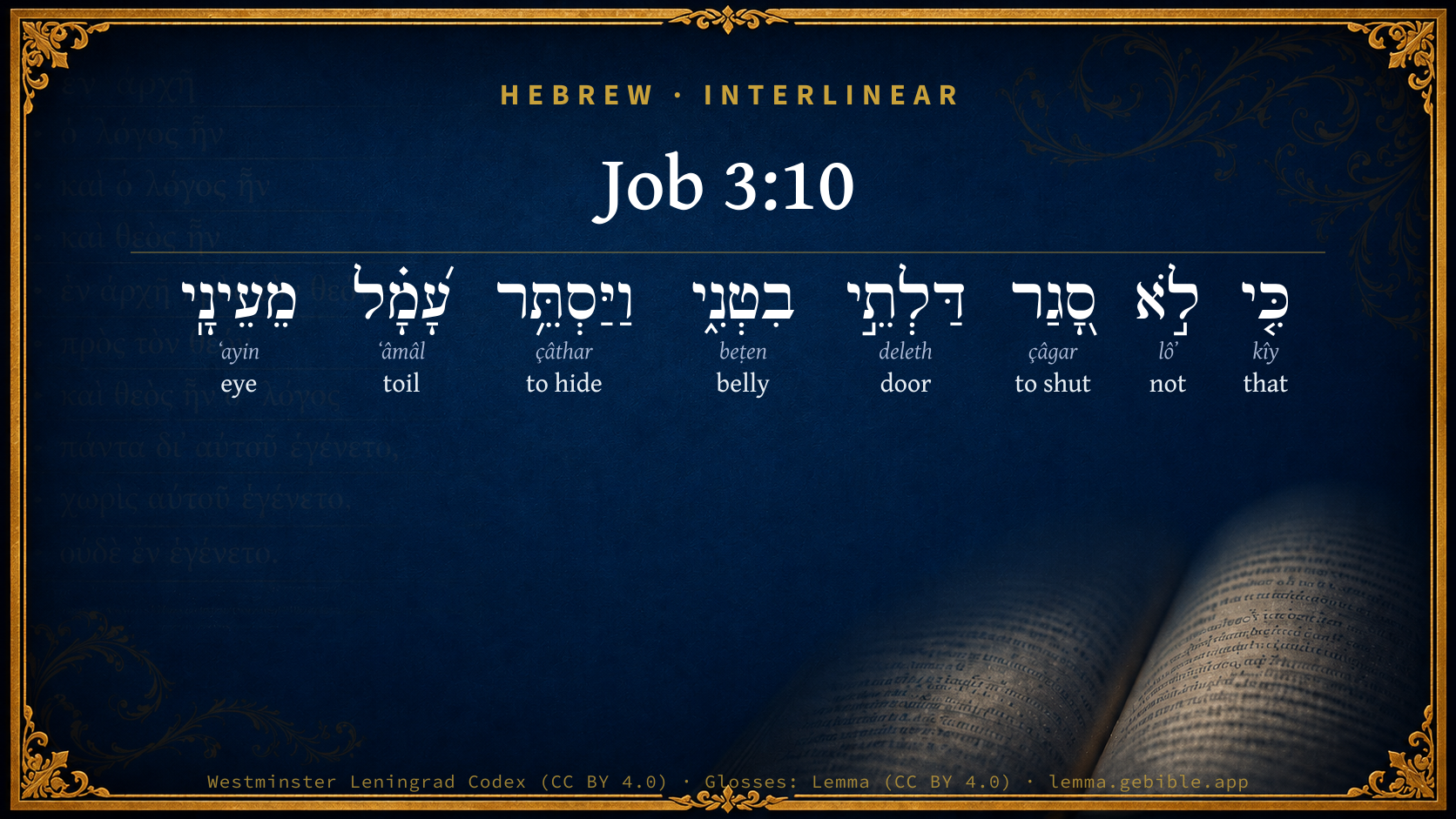
Job 3:10

Hebrew (Westminster Leningrad Codex) Job 3:10 appears in the Hebrew Old Testament. The text above is from the Westminster Leningrad Codex. Each word links to its Strong’s number, a concise gloss, and parsing drawn from the Open Scriptures Hebrew Bible morphology. Click any word for its full Brown-Driver-Briggs (BDB) entry.
Download image
Cite this verse

Job 3:10 (World English Bible). Public Domain. Lemma interlinear Bible study tool, https://lemma.gebible.app/v/job/3/10.

Show BibTeX & RIS
BibTeX
RIS
English Translation
Because it didn't shut up the doors of my mother's womb, Nor did it hide trouble from my eyes.
World English Bible · Public Domain
Download a study sheet

One document with this verse’s original text, its word-by-word gloss line, the meaning frame, cross-references with their text, attributed commentary, and full source and license credits — printable, and it pastes into notes with its structure intact.

This verse Autodidact and up

Study sheet (.html) Plain text (.txt)

A passage Seminary Student

Up to 50 verses in one chapter. A passage sheet keeps up to 6 commentary sources and 12 cross-references per verse, in the order this page ranks them, and says so on the sheet whenever that leaves anything out. Ask for a single verse and you get the Autodidact verse sheet above.

Everything on this page stays free to read, with no account — the sheet is a download of what is already on screen, not access to it.

Want to remove ads? Support Godless Engineer
Compare translations 3

The same verse in 3 English versions, stacked beneath the original-language interlinear above. Click any original word for its lexicon entry.

Each is an independent rendering of the whole verse — the interlinear is not word-aligned to these translations.

Highlighted words mark where these versions differ — a whole-verse word diff, not a word-by-word alignment.

  • World English Bible Public Domain
    Because it didn't shut up the doors of my mother's womb, Nor did it hide trouble from my eyes.
  • King James Version Public Domain
    Because it shut not up the doors of my mother's womb, nor hid sorrow from mine eyes.
  • unfoldingWord Literal Text CC BY-SA 4.0
    because it did not close the doors of my womb and hide trouble from my eyes.

unfoldingWord Literal Text — © unfoldingWord, licensed CC BY-SA 4.0. Word-aligned USFM3 via Door43 (git.door43.org/unfoldingWord/en_ult).

Versions to compare (up to 4)

3 of 4 selected

Show all 18 translations

Every available English version of this verse, each an independent rendering of the whole verse.

  • World English Bible Public Domain
    Because it didn't shut up the doors of my mother's womb, Nor did it hide trouble from my eyes.
  • Berean Standard Bible Public Domain
    For that night did not shut the doors of the womb to hide the sorrow from my eyes.
  • Majority Standard Bible Public Domain
    For that night did not shut the doors of the womb to hide the sorrow from my eyes.
  • King James Version Public Domain
    Because it shut not up the doors of my mother's womb, nor hid sorrow from mine eyes.
  • American Standard Version (1901) Public Domain
    Because it shut not up the doors of my `mother's' womb, Nor hid trouble from mine eyes.
  • Revised Version (1885) Public Domain
    Because it shut not up the doors of my mother’s womb, nor hid trouble from mine eyes.
  • Geneva Bible (1599) Public Domain
    Because it shut not vp the dores of my mothers wombe: nor hid sorowe from mine eyes.
  • Douay-Rheims (1899) Public Domain
    Because it shut not up the doors of the womb that bore me, nor took away evils from my eyes.
  • Young's Literal Translation Public Domain
    Because it hath not shut the doors Of the womb that was mine! And hide misery from mine eyes.
  • Literal Standard Version CC BY-SA 4.0
    Because it has not shut the doors || Of the womb that was mine! And hide misery from my eyes.
  • Unlocked Literal Bible CC BY-SA 4.0
    because it did not shut up the doors of my mother's womb, and because it did not hide trouble from my eyes.
  • unfoldingWord Literal Text CC BY-SA 4.0
    because it did not close the doors of my womb and hide trouble from my eyes.
  • Darby Bible Public Domain
    Because it shut not up the doors of the womb that bore me, and hid not trouble from mine eyes.
  • World Messianic Bible Public Domain
    because it didn’t shut up the doors of my mother’s womb, nor did it hide trouble from my eyes.
  • Webster's Bible Public Domain
    Because it prevented not my birth, nor hid sorrow from my eyes.
  • Free Bible Version CC BY-SA 4.0
    for it did not shut my mother's womb to prevent me from seeing trouble.
  • Bible in Basic English Public Domain
    Because it did not keep the doors of my mother's body shut, so that trouble might be veiled from my eyes.
  • JPS Tanakh (1917) Public Domain
    Because it shut not up the doors of my mother's womb, nor hid trouble from mine eyes.

Literal Standard Version (2020), Covenant Press — licensed CC BY-SA 4.0. Text via the HelloAO Bible API (eBible.org). Unlocked Literal Bible (unfoldingWord) — licensed CC BY-SA 4.0. Text via the HelloAO Bible API (eBible.org). unfoldingWord Literal Text — © unfoldingWord, licensed CC BY-SA 4.0. Word-aligned USFM3 via Door43 (git.door43.org/unfoldingWord/en_ult). Free Bible Version, Dr. Jonathan Gallagher — licensed CC BY-SA 4.0. Text via the HelloAO Bible API (eBible.org).

Word by word

More ways to search: Search by grammar → Find every occurrence → Compare this word →

Practice this passage: Drill this verse → Learn its vocabulary →

About this verse

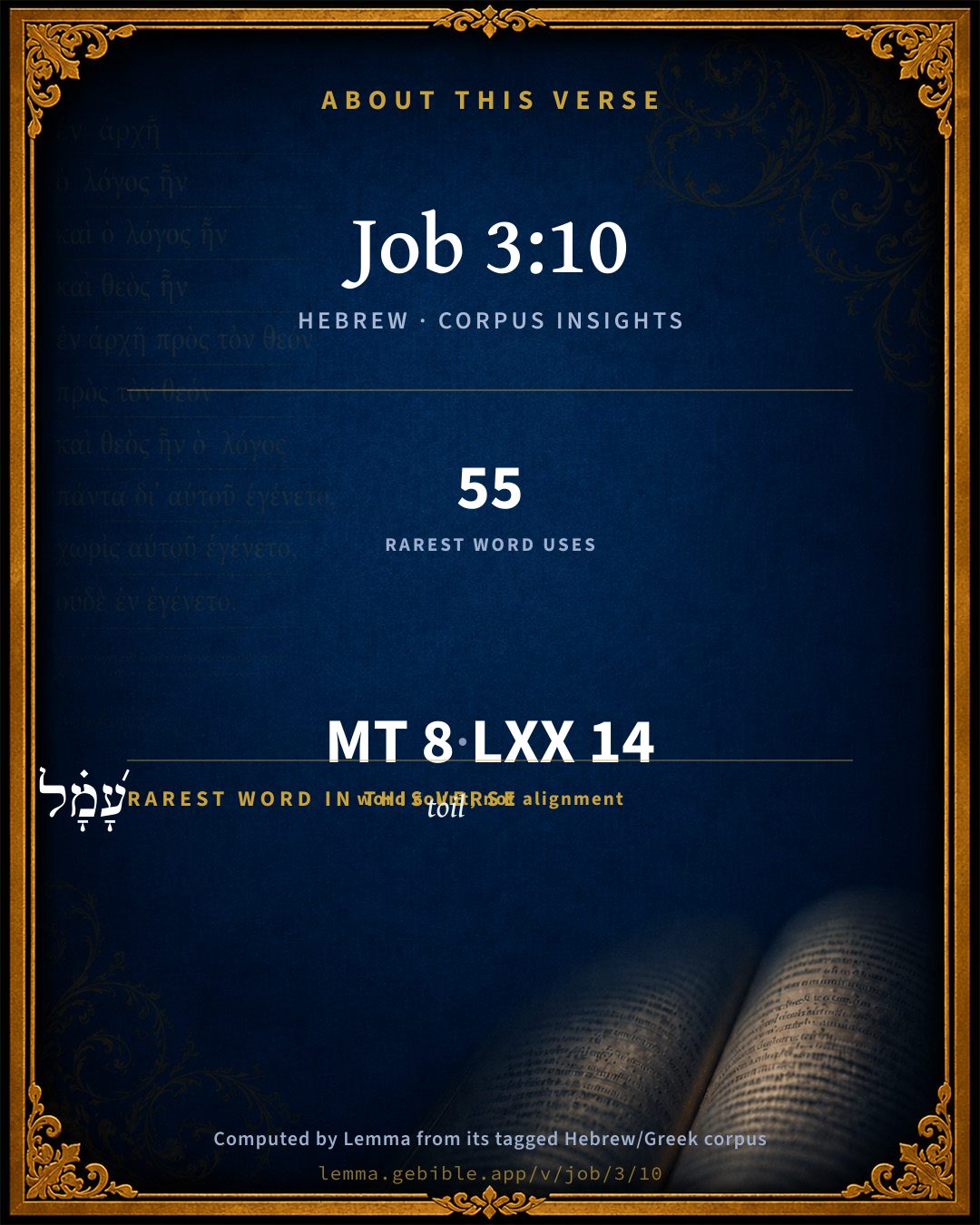
These counts appear in no published source. They are computed here, from the morphology-tagged text and Lemma’s own curated glosses. What Lemma adds →

8
words
8
distinct lemmas
Wisdom
section

Shared distinctive vocabulary

עָ֝מָ֗ל toil H5999 occurs in 54 verses of the Hebrew Bible. Also found in:

Grammatical profile

  • 2 verbs
  • 4 nouns
  • 1 conjunction
  • 1 particle

Verb forms

  • סָ֭גַר Qal · Perfect
  • וַיַּסְתֵּ֥ר Hiphil · Sequential Imperfect

Hebrew & Septuagint length

In English translation the verse runs 19 words from the Hebrew and 21 from the Septuagint (LXX English) — closely comparable.

A rough comparison of the two English renderings, which tokenize alike — not a word-level alignment.

Word counts can differ between the Hebrew and the Greek without any difference in meaning — e.g. the Hebrew direct-object marker אֵת has no separate Greek word, and Greek often adds the article ὁ.

In the original languages it is 8 Hebrew tokens and 14 Greek tokens — but the two are counted differently (Hebrew bundles its prefixes and suffixes into one token; the Greek is in lemma form), so that isn’t a like-for-like length.

Cross-references

10

Topical passages linked to Job 3:10 in the Treasury of Scripture Knowledge — connected by theme and wording, ordered by reader-vote popularity; previews shown in the World English Bible.

  • Genesis 20:18 For Yahweh had closed up tight all the wombs of the house of Abimelech, because of Sarah, Abraham's wife.
  • Ecclesiastes 6:3–5 If a man fathers a hundred children, and lives many years, so that the days of his years are many, but his soul is not filled with good, and moreover he has no burial; I say, that an untimely birth is better than he:
  • Jeremiah 20:17 because he didn't kill me from the womb; and so my mother would have been my grave, and her womb always great.
  • Genesis 29:31 Yahweh saw that Leah was hated, and he opened her womb, but Rachel was barren.
  • 1 Samuel 1:5 but to Hannah he gave a double portion; for he loved Hannah, but Yahweh had shut up her womb.
  • Job 6:2–3 "Oh that my anguish were weighed, And all my calamity laid in the balances!
  • Job 10:1 "My soul is weary of my life; I will give free course to my complaint. I will speak in the bitterness of my soul.
  • Job 23:2 "Even today is my complaint rebellious. His hand is heavy in spite of my groaning.
  • Ecclesiastes 11:10 Therefore remove sorrow from your heart, And put away evil from your flesh; For youth and the dawn of life are vanity.
  • Job 10:18–19 "'Why, then, have you brought me forth out of the womb? I wish I had given up the spirit, and no eye had seen me.

Cross-references courtesy of OpenBible.info (CC BY 4.0).

Hebrew and Greek witnesses Masoretic Hebrew ↔ Greek Septuagint

The same verse in the two great witnesses to the Old Testament, shown verse-for-verse.

These are two independent witnesses, not word-aligned to each other, and the Septuagint is shown in lemma (dictionary) form.

Hebrew Job 3:10 Masoretic · Westminster Leningrad Codex

כִּ֤י לֹ֣א סָ֭גַר דַּלְתֵ֣י בִטְנִ֑י וַיַּסְתֵּ֥ר עָ֝מָ֗ל מֵעֵינָֽי

Because it didn't shut up the doors of my mother's womb, Nor did it hide trouble from my eyes.

World English Bible · Public Domain

Greek LXX Job 3:10 Septuagint · lemma form

ὅτι οὐ συνκλείω πύλη γαστήρ μήτηρ ἐγώ ἀποἀλλάσσω γάρ ἄν πόνος ἀπό ὀφθαλμός ἐγώ

because it shut not up the gates of my mother's womb, for so it would have removed sorrow from my eyes.

LXX2012 (modern English Septuagint) · Public Domain

On this verse, Haydock's Catholic Bible Commentary discusses the Septuagint’s reading. Read the note in Commentary ↓

Hebrew: Westminster Leningrad Codex (CC BY 4.0). Greek: Septuagint (public domain); English from LXX2012 (modern English Septuagint) (Public Domain). How the Septuagint differs from the Hebrew →

Commentary

Notes on Job 3:10 from classic Christian and Jewish commentators (each source and its license shown beneath its notes). The classic Christian expositions comment on the surrounding passage and are grouped to its opening verse, so a note may address several verses; the Jewish commentaries on the Tanakh (Rashi and others) are per-verse, so they appear only where the commentator wrote on this verse.

Lemma curates 59 commentaries, every one of them public domain or Creative Commons licensed, each selected and text-cleaned for this edition rather than reprinted as found. About our sources →

Trapp's Complete Commentary

John Trapp

Job 3:10 Because it shut not up the doors of my [mother’s] womb, nor hid sorrow from mine eyes.

Ver. 10. Because it shut not up the doors of my mother’s womb] Lest this curse should seem causeless, and he mad without reason, he telleth you here why he thus poureth out his passion; and complaineth so heavily against the day of his birth and night of his conception, which yet were harmless, and had not deserved to be thus charged, cursed. "Because it shut not up," &c. But how could the night do that? Is it not of God alone to shut or open the womb? Gen 20:18; Gen 29:31. And was it not he that took David thence? Psa 18:23. This Job could tell well enough at another time, but now he is quite out of all reason; beating himself with his passions, as the lion doth with his own tail; yea, like some sullen bird in a cage, he could almost find in his heart to beat himself to death. We use to say, - Res est ingeniosa dolor, Grief is an ingenious thing; yet it maketh a man foolish (the excess of it), as it did Job here; yea, it maketh a wise man mad, as Solomon saith of oppression, Ecc 7:7, and we see it exemplified in Job, especially if the words be thus read, as they may, Because he (that is, God) shut not up the doors, &c.

Nor hid sorrow from mine eyes] In Scripture, to see good or evil is to feel it, Psa 34:12 Jer 17:6 Isa 65:16 Job 33:17. He meaneth, that he had missed those evils which now he met with since his coming into the world, if those doors, being shut, had shut him out of the world. Man is no sooner born than born to trouble, Job 5:7, yea, man that is born (or conceived) of a woman is of few days, and full of trouble, Job 14:1. Miserable he is even as soon as he is warm in the womb, as David phraseth it, Psa 51:5. If he live to see the light, he comes crying into the world, and an untimely birth may be better than he, Ecc 5:3. The Hebrews call him Enosh, that is, sorry man; or doleful, miserable, and desperately diseased man, whose living is but to lie a dying. The Greeks, when they would set forth one extremely wretched, they call him πρισανθρωπον, thrice a man, that is, thrice miserable. And, What is man? saith Seneca (Ad Mar. cap. 11). He answereth, Morbidum, putre, cassum, a fletu vitam auspicatum; a diseased, rotten, empty thing, beginning his life with tears, as if he wept to think upon what a shore of trouble he is landed; or rather, into what a sea of sorrows he is launching; not unlike the Straits of Magellan, a sea of that nature, say geographers, that which way soever a man bend his course, he shall be sure to have the wind against him.

John Trapp, A Commentary or Exposition upon All the Books of the Old and New Testament (1647–1656) — public domain. Text from a community e-Sword module.

Joseph Benson's Commentary

Job 3:10. Because it shut not up my mother’s womb — Because it did not confine me to the dark prison of the womb, but suffered me to escape from thence; nor hid sorrow from mine eyes — Because it did not keep me from entering into this miserable life, and seeing or experiencing those bitter sorrows under which I now groan.

Joseph Benson's Commentary on the Old and New Testaments (1811–1818) — public domain. Text from a community e-Sword module.

Tyndale Open Study Notes

Tyndale Open Resources

3:10 shut my mother’s womb: Closing or opening the womb sometimes refers to conception (Gen 16:2; 20:18; 29:31; 30:22; 1 Sam 1:5-6), but here it refers to birth (see also Job 38:8).

Tyndale Open Study Notes — © Tyndale Open Resources, licensed CC BY-SA 4.0. Text via the HelloAO Bible API.

Adam Clarke's Commentary

Verse 10. Because it shut not up the doors] Here is the reason why he curses the day and the night in which he was conceived and born; because, had he never been brought into existence, he would never have seen trouble. It seems, however, very harsh that he should have wished the destruction of his mother, in order that his birth might have been prevented; and I rather think Job's execration did not extend thus far. The Targum understands the passage as speaking of the umbilical cord, by which the foetus is nourished in its mother's womb: had this been shut up, there must have been a miscarriage, or he must have been dead born; and thus sorrow would have been hidden from his eyes. This seeming gloss is much nearer the letter and spirit of the Hebrew than is generally imagined. I shall quote the words: כי לא סגר דלתי בטני ki lo sagar dalthey bitni, because it did not shut up the doors of my belly. This is much more consistent with the feelings of humanity, than to wish his mother's womb to have been his grave.

Adam Clarke's Commentary on the Bible (1810–1826) — public domain. Text from a community e-Sword/MySword module.

The Cambridge Bible for Schools and Colleges

gen. ed. J. J. S. Perowne

10. the doors of my mother’s womb] to hinder conception or fruitfulness, Gen_20:18; 1Sa_1:5. The crime of the night is deferred to the last, and the curse closes with the mention of it.

The Cambridge Bible for Schools and Colleges (gen. ed. J. J. S. Perowne; Cambridge University Press, 1878–1918) — public domain. Text from a community e-Sword module.

John Gill's Exposition

Because it shut not up the doors of my mother's womb,.... Or "of my belly" (m), or "womb"; which Aben Ezra interprets of the navel, by which the infant receives its food and nourishment before it is born, and which, if closed, he must have died in embryo; but rather it is to be understood of his mother's womb, called his, because he was conceived and bore in it, and was brought forth from it; and the sense is, that he complains of the night, either that it did not close his mother's womb, and hinder the conception of him, as Gersom, Sephorno, Bar Tzemach, and others, and is the usual sense of the phrase of closing the womb, and which is commonly ascribed to God, Gen 20:17 Sa1 1:5; which Job here attributes to the night, purposely avoiding to make mention of the name of God, that he might not seem to complain of him, or directly point at him; or else the blame laid on that night is, that it did not so shut up the doors of his mother's womb, that he might not have come out from thence into the world, wishing that had been his grave, and his mother always big with him, as Jarchi, and which sense is favoured by Jer 20:17; a wish cruel to his mother, as well as unnatural to himself:

nor hid sorrow from mine eyes; which it would have done, had it done that which is complained of it did not; had it he could not have perceived it experimentally, endured the sorrows and afflictions he did from the Chaldeans and Sabeans, from Satan, his wife, and friends; and had never known the trouble of loss of substance, children, and health, and felt those pains of body and anguish of mind he did; these are the reasons of his cursing the day of his birth, and the night of his conception.

(m) "ventris mei", Mercerus, Piscator, Schmidt, Schuitens, Michaelis; "uteri mei", Pagninus, Montanus, Junius & Tremellius, Cocceius.

John Gill's Exposition of the Whole Bible (1746–1763) — public domain (CC PDM 1.0). Text via the HelloAO Bible API.

Albert Barnes' Notes on the Bible

Because it shut not up ... - That is, because the accursed day and night did not do it. Aben Ezra supposes that God is meant here, and that the complaint of Job is that he did not close his mother’s womb. But the more natural interpretation is to refer it to the Νυχθήμεροι Nuchthēmeroi - the night and the day which he had been cursing, on which he was born. Throughout the description the day and the night are personified, and are spoken of as active in introducing him into the world. He here curses them because they did not wholly prevent his birth.

Nor hid sorrow from mine eyes - By preventing my being born. The meaning is, that he would not have known sorrow if he had then died.

Albert Barnes' Notes on the Bible (1834–1885) — public domain. Text from a community e-Sword/MySword module.

Haydock's Catholic Bible Commentary

Nor took. Septuagint, "for it would then have freed my eyes from labour."

George Leo Haydock (1774–1849), Haydock's Catholic Family Bible and Commentary, 1859 edition — public domain. Excludes Psalms (Douay-Rheims chapter numbering differs from Protestant) and Deuterocanonical books (Catholic canon only).

Matthew Poole's English Annotations

Because it shut not up, to wit, the night or the day; to which those things are ascribed which were done by others in them, as is frequent in poetical writings, such as this is. Or, he, i.e. God; whom in modesty and reverence he forbears to name. Yet he doth not curse God for his birth, as the devil presaged, but only wisheth that the day of his birth might have manifest characters of a curse impressed upon it. Shut not up the doors; that it might either never have conceived me, or at least never have brought me forth.

Mother’s; which word is here fitly supplied, both out of Job 1:21; 31:18, where it is expressed; and by comparing other places where it is necessarily to be understood, though the womb only be mentioned, as Job 10:19; Psa 58:3; Isa 48:8; Jer 1:5.

Nor hid sorrow from mine eyes, because it did not keep me from entering into this miserable life, and seeing, i.e. feeling, or experiencing, (as that word is oft used,) those bitter sorrows under which I now groan.

Matthew Poole's English Annotations on the Holy Bible (1683–1685) — public domain. Text from a community e-Sword/MySword module.

The Pulpit Commentary

Because it shut not up the doors of my mother"s womb; literally, of my womb; i.e. "of the womb which bare me." By a stretch of imagination, the night is supposed to have power to open or shut wombs, and is blamed for not having shut up the womb in which Job was conceived. Nor hid sorrow from mine eyes; i.e. "and did not so prevent all the sorrows that have befallen me."

The Pulpit Commentary (1880–1919), ed. H.D.M. Spence-Jones & Joseph S. Exell — public domain. Text from a community e-Sword module.

John Wesley's Explanatory Notes

It - The night or the day: to which those things are ascribed which were done by others in them, as is frequent in poetical writings. Womb - That it might never have brought me forth. Nor hid - Because it did not keep me from entering into this miserable life, and seeing, or experiencing, these bitter sorrows.

John Wesley, Explanatory Notes Upon the Whole Bible (1754–1765) — public domain. Text via the GEBible commentary corpus.

Keil & Delitzsch

C. F. Keil & F. Delitzsch

10 Because it did not close the doors of my mother's womb,

Nor hid sorrow from my eyes.

11 Why did I not die from the womb,

Come forth from the womb and expire?

12 Why have the knees welcomed me?

And why the breasts, that I should suck?

The whole strophe contains strong reason for his cursing the night of his conception or birth. It should rather have closed (i.e., make the womb barren, to be explained according to Sa1 1:5; Gen 16:2) the doors of his womb (i.e., the womb that conceived concepit him), and so have withdrawn the sorrow he now experiences from his unborn eyes (on the extended force of the negative, vid., Ges. 152, 3). Then why, i.e., to what purpose worth the labour, is he then conceived and born? The four questions, Job 3:11., form a climax: he follows the course of his life from its commencement in embryo (מרהם, to be explained according to Jer 20:17, and Job 10:18, where, however, it is מן local, not as here, temporal) to the birth, and from the joy of his father who took the new-born child upon his knees (comp. Gen 50:23) to the first development of the infant, and he curses this growing life in its four phases (Arnh., Schlottm.). Observe the consecutio temp. The fut. אמוּת has the signification moriebar, because taken from the thought of the first period of his conception and birth; so also ואגוע, governed by the preceding perf., the signification et exspirabam (Ges. 127, 4, c). Just so אינק, but modal, ut sugerem ea.

Keil & Delitzsch — Biblical Commentary on the Old Testament (1861–1891) — public domain (CC PDM 1.0). Text via the HelloAO Bible API. (Old Testament only.)

Rashi

Rabbi Shlomo Yitzchaki (Rashi)

For He did not shut He Who was able to shut. This too is one of the verses that resemble “the night when one said” (verse 2).

the doors of my womb from which I emerged, for had He done so, He would have hidden trouble from my eyes.

Rashi on the Tanakh — English translations: “The Judaica Press complete Tanach with Rashi, translated by A. J. Rosenberg” (CC BY 4.0); “Pentateuch with Rashi's commentary by M. Rosenbaum and A.M. Silbermann, 1929-1934” (public domain); “The Metsudah Tanach series, Lakewood, N.J” (CC BY 4.0); and “The Book of Joshua, Metsudah Publications, 1997” (CC BY 4.0). Text via Sefaria.

Lesson kit

Teaching starters — assembled from the data on this page, not authored interpretation. Every prompt links to the verse data it draws on. Edit before teaching.

Job, in the Wisdom, opens this verse with 8 words (8 distinct Hebrew lemmas). Its most distinctive word is ʻâmâl (“toil”). A historical commentator’s framing appears above. Read the whole chapter for the surrounding context.

Discussion questions

  1. How does “toil” (ʻâmâl) shape what this verse is saying?
  2. How does Genesis 41:51, which shares the word «toil», read alongside this verse?
  3. These translations render this verse differently; the difference is in the English rendering, not the original. What questions does that raise?
  4. «סָ֭גַר» is a Qal Perfect verb. How does that grammatical form shape the action described?
  5. Compare how Trapp's Complete Commentary and Joseph Benson's Commentary read this verse. Where do they agree or differ?

Things to notice

Reading settings

Reading text

Shown beneath each verse's original-language words.

Old Testament
Old Testament edition

Read the OT as the Masoretic Hebrew (MT) or the Greek Septuagint (LXX).

English shown for the Greek Septuagint (in the Hebrew ↔ Greek comparison).

Comparing translations? Open the Compare panel on any verse page to stack up to four side by side.