
Ezekiel 41:23

Hebrew (Westminster Leningrad Codex) Ezekiel 41:23 appears in the Hebrew Old Testament. The text above is from the Westminster Leningrad Codex. Each word links to its Strong’s number, a concise gloss, and parsing drawn from the Open Scriptures Hebrew Bible morphology. Click any word for its full Brown-Driver-Briggs (BDB) entry.
Download image
Cite this verse

Ezekiel 41:23 (World English Bible). Public Domain. Lemma interlinear Bible study tool, https://lemma.gebible.app/v/ezekiel/41/23.

Show BibTeX & RIS
BibTeX
RIS
English Translation
The temple and the sanctuary had two doors.
World English Bible · Public Domain
Download a study sheet

One document with this verse’s original text, its word-by-word gloss line, the meaning frame, cross-references with their text, attributed commentary, and full source and license credits — printable, and it pastes into notes with its structure intact.

This verse Autodidact and up

Study sheet (.html) Plain text (.txt)

A passage Seminary Student

Up to 50 verses in one chapter. A passage sheet keeps up to 6 commentary sources and 12 cross-references per verse, in the order this page ranks them, and says so on the sheet whenever that leaves anything out. Ask for a single verse and you get the Autodidact verse sheet above.

Everything on this page stays free to read, with no account — the sheet is a download of what is already on screen, not access to it.

Want to remove ads? Support Godless Engineer
Compare translations 3

The same verse in 3 English versions, stacked beneath the original-language interlinear above. Click any original word for its lexicon entry.

Each is an independent rendering of the whole verse — the interlinear is not word-aligned to these translations.

Highlighted words mark where these versions differ — a whole-verse word diff, not a word-by-word alignment.

  • World English Bible Public Domain
    The temple and the sanctuary had two doors.
  • King James Version Public Domain
    And the temple and the sanctuary had two doors.
  • unfoldingWord Literal Text CC BY-SA 4.0
    There were double doors for the holy place and the most holy place.

unfoldingWord Literal Text — © unfoldingWord, licensed CC BY-SA 4.0. Word-aligned USFM3 via Door43 (git.door43.org/unfoldingWord/en_ult).

Versions to compare (up to 4)

3 of 4 selected

Show all 18 translations

Every available English version of this verse, each an independent rendering of the whole verse.

  • World English Bible Public Domain
    The temple and the sanctuary had two doors.
  • Berean Standard Bible Public Domain
    Both the outer sanctuary and the inner sanctuary had double doors,
  • Majority Standard Bible Public Domain
    Both the outer sanctuary and the inner sanctuary had double doors,
  • King James Version Public Domain
    And the temple and the sanctuary had two doors.
  • American Standard Version (1901) Public Domain
    And the temple and the sanctuary had two doors.
  • Revised Version (1885) Public Domain
    And the temple and the sanctuary had two doors.
  • Geneva Bible (1599) Public Domain
    And the Temple and the Sanctuarie had two doores.
  • Douay-Rheims (1899) Public Domain
    And there were two doors in the temple, and in the sanctuary.
  • Young's Literal Translation Public Domain
    And two doors `are' to the temple and to the sanctuary;
  • Literal Standard Version CC BY-SA 4.0
    And the temple and the sanctuary had two doors;
  • Unlocked Literal Bible CC BY-SA 4.0
    There were double doors for the holy place and the most holy place.
  • unfoldingWord Literal Text CC BY-SA 4.0
    There were double doors for the holy place and the most holy place.
  • Darby Bible Public Domain
    And the temple and the sanctuary had two doors.
  • World Messianic Bible Public Domain
    The temple and the sanctuary had two doors.
  • Webster's Bible Public Domain
    And the temple and the sanctuary had two doors.
  • Free Bible Version CC BY-SA 4.0
    The Temple and the sanctuary both had hinged double doors.
  • Bible in Basic English Public Domain
    The Temple had two doors.
  • JPS Tanakh (1917) Public Domain
    And the temple and the sanctuary had two doors.

Literal Standard Version (2020), Covenant Press — licensed CC BY-SA 4.0. Text via the HelloAO Bible API (eBible.org). Unlocked Literal Bible (unfoldingWord) — licensed CC BY-SA 4.0. Text via the HelloAO Bible API (eBible.org). unfoldingWord Literal Text — © unfoldingWord, licensed CC BY-SA 4.0. Word-aligned USFM3 via Door43 (git.door43.org/unfoldingWord/en_ult). Free Bible Version, Dr. Jonathan Gallagher — licensed CC BY-SA 4.0. Text via the HelloAO Bible API (eBible.org).

Word by word

More ways to search: Search by grammar → Find every occurrence → Compare this word →

Practice this passage: Drill this verse → Learn its vocabulary →

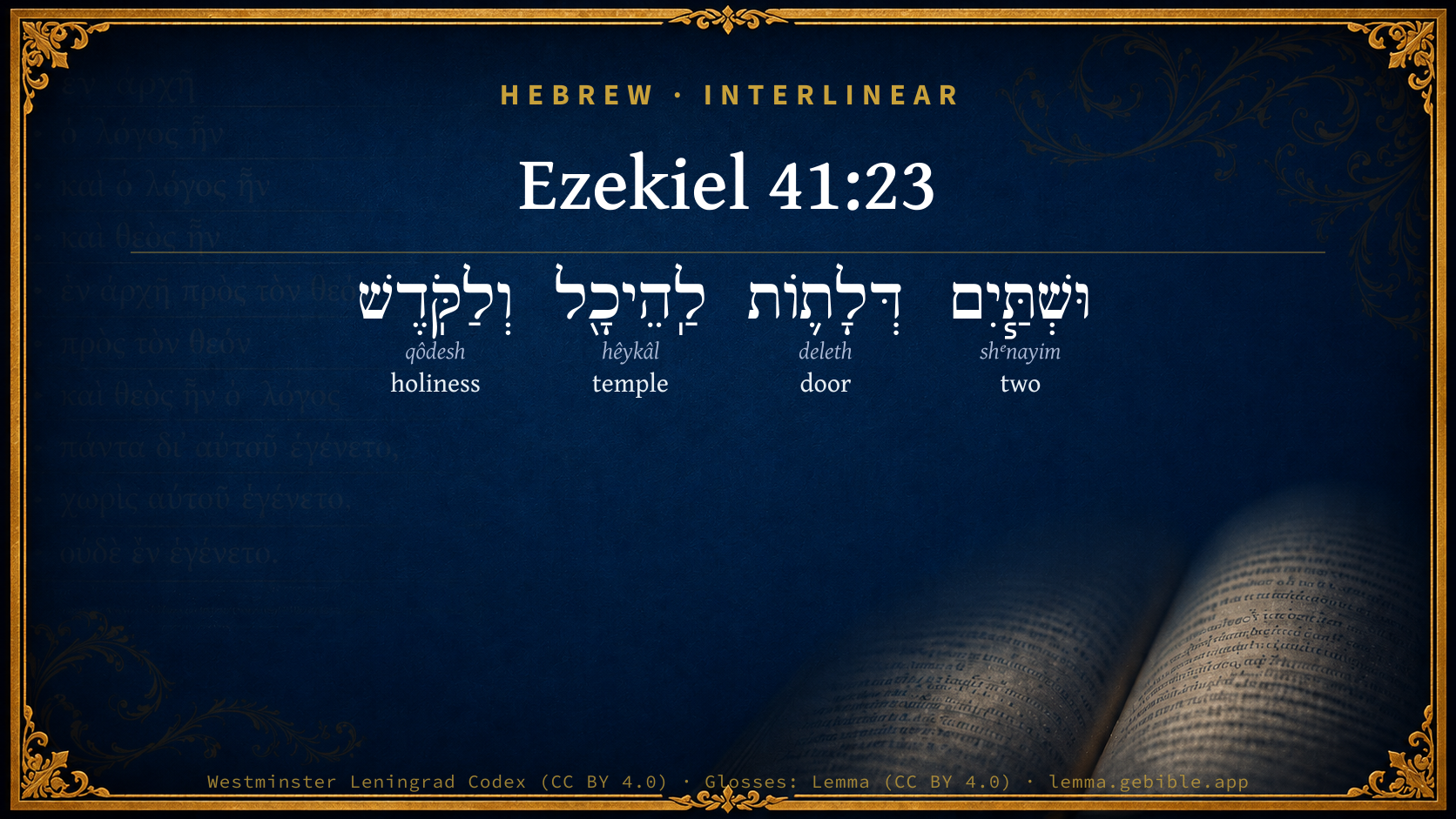
לַֽהֵיכָ֖ל
hêykâl
H1964
“to/for the · temple”
Preposition, Determined + Noun, Common, Masculine, Singular, Absolute
Part of Speech
Preposition + Noun
Type
Common
Gender
Masculine
Number
Singular
State
Absolute
Full BDB Definition

Origin: probably from H3201 (in the sense of capacity)

TWOT: 493

palace, temple, nave, sanctuary - palace - temple (palace of God as king) - hall, nave (of Ezekiel's temple) - temple (of heavenly temple)
  1. וּשְׁתַּ֧יִם shᵉnayim H8147 “and · two” Conjunction + Adjective, Cardinal number, Feminine, Dual, Absolute
  2. דְּלָת֛וֹת deleth H1817 “doors” Noun, Common, Feminine, Plural, Absolute
  3. וְלַקֹּֽדֶשׁ qôdesh H6944 “and · to/for the · holiness” Conjunction + Preposition, Determined + Noun, Common, Masculine, Singular, Absolute

About this verse

These counts appear in no published source. They are computed here, from the morphology-tagged text and Lemma’s own curated glosses. What Lemma adds →

4
words
4
distinct lemmas
Prophets
section

Grammatical profile

  • 3 nouns
  • 1 adjective

Hebrew & Septuagint length

In English translation the verse runs 8 words from the Hebrew and 17 from the Septuagint (LXX English) — the Septuagint runs noticeably longer here. See the side-by-side →

A rough comparison of the two English renderings, which tokenize alike — not a word-level alignment.

Word counts can differ between the Hebrew and the Greek without any difference in meaning — e.g. the Hebrew direct-object marker אֵת has no separate Greek word, and Greek often adds the article ὁ.

Cross-references

3

Topical passages linked to Ezekiel 41:23 in the Treasury of Scripture Knowledge — connected by theme and wording, ordered by reader-vote popularity; previews shown in the World English Bible.

  • 1 Kings 6:31–35 For the entrance of the oracle he made doors of olive-wood: the lintel [and] door-posts were a fifth part [of the wall].
  • 2 Chronicles 4:22 and the snuffers, and the basins, and the spoons, and the fire pans, of pure gold: and as for the entry of the house, the inner doors of it for the most holy place, and the doors of the house, [to wit], of the temple, were of gold.
  • Ezekiel 41:1 He brought me to the temple, and measured the posts, six cubits broad on the one side, and six cubits broad on the other side, which was the breadth of the tent.

Cross-references courtesy of OpenBible.info (CC BY 4.0).

Hebrew and Greek witnesses Masoretic Hebrew ↔ Greek Septuagint

The same verse in the two great witnesses to the Old Testament, shown verse-for-verse.

Here the Septuagint runs noticeably longer than the Hebrew — LXX2012 (modern English Septuagint) 17 words vs World English Bible 8. A rough length comparison of the two English translations, not a word-level alignment — read both below.

These are two independent witnesses, not word-aligned to each other, and the Septuagint is shown in lemma (dictionary) form.

Hebrew Ezekiel 41:23 Masoretic · Westminster Leningrad Codex

וּשְׁתַּ֧יִם דְּלָת֛וֹת לַֽהֵיכָ֖ל וְלַקֹּֽדֶשׁ

The temple and the sanctuary had two doors.

World English Bible · Public Domain

Greek LXX Ezekiel 41:23 Septuagint · lemma form

καί δύο θύρωμα ὁ ναός καί ὁ ἅγιος

And the temple had two doors, and the sanctuary had two doors, with two turning leaves apiece;

LXX2012 (modern English Septuagint) · Public Domain

Hebrew: Westminster Leningrad Codex (CC BY 4.0). Greek: Septuagint (public domain); English from LXX2012 (modern English Septuagint) (Public Domain). How the Septuagint differs from the Hebrew →

Targum (Aramaic paraphrase)

1

The Targum is the ancient Jewish Aramaic paraphrase of the Hebrew Scriptures — an interpretive translation, not the Hebrew text itself. Onkelos (literal) and Pseudo-Jonathan (expansive) render the Torah, and Jonathan the Prophets. Coverage is partial: where no permissively-licensed English translation exists for a verse, only the Aramaic is shown. This is verse-level text, not a word-by-word alignment to the Hebrew.

  1. Targum Jonathan Prophets (Joshua–Malachi)
    וְתַרְתֵּין דָשִׁין לְהֵיכָלָא וּלְבֵית כִּפּוֹרֵי:

    (no public-domain English translation for this verse)

    Targum Jonathan — Aramaic: “Mikraot Gedolot” (public domain). English: “Sefaria Community Translation” (CC0 1.0 (public-domain dedication)); “London "Chaldee Paraphrase," 1871” (public domain). Text via Sefaria.

Commentary

Notes on Ezekiel 41:23 from classic Christian and Jewish commentators (each source and its license shown beneath its notes). The classic Christian expositions comment on the surrounding passage and are grouped to its opening verse, so a note may address several verses; the Jewish commentaries on the Tanakh (Rashi and others) are per-verse, so they appear only where the commentator wrote on this verse.

Lemma curates 59 commentaries, every one of them public domain or Creative Commons licensed, each selected and text-cleaned for this edition rather than reprinted as found. About our sources →

Trapp's Complete Commentary

John Trapp

Eze 41:23 And the temple and the sanctuary had two doors.

Ver. 23. Had two doors.] Understand hereby the means of grace, and ministers dispensing the same, whereby souls are brought home to Christ.

John Trapp, A Commentary or Exposition upon All the Books of the Old and New Testament (1647–1656) — public domain. Text from a community e-Sword module.

Joseph Benson's Commentary

Eze 41:23-25. And the temple and the sanctuary had two doors — Each of them had a double, or folding-door. And the doors had two leaves apiece — The two doors being exceedingly large, that of the outward sanctuary ten cubits broad, and that of the inner six, (see Eze 41:2-3,) and of a height proportionable; each of them had two leaves, that they might be more easily opened, and each leaf had a wicket in it. And there were made on them, &c., cherubims and palm-trees — Namely, on the doors both of the outward and inward sanctuary. And there were thick planks upon the face of the porch without — There was a wainscot work of boards fastened to the end of the great beams, which came out beyond the wall of the porch. These were laid so as to make a frieze-work over the entrance of the eastern porch.

Joseph Benson's Commentary on the Old and New Testaments (1811–1818) — public domain. Text from a community e-Sword module.

The Cambridge Bible for Schools and Colleges

gen. ed. J. J. S. Perowne

23. two doors] i.e. each had a double or two-leaved door.

23–26. The doors of the holy place and the holiest.

The temple or holy place and the holiest had each a two-leaved door; and each of the leaves was again divided into two leaves.

The Cambridge Bible for Schools and Colleges (gen. ed. J. J. S. Perowne; Cambridge University Press, 1878–1918) — public domain. Text from a community e-Sword module.

John Gill's Exposition

And the temple and the sanctuary had two doors. Or the house of propitiatory, as the Targum; that is, the most holy place; not two doors apiece, but each had one door, which made two; the door of the temple was ten cubits broad, and the door of the most holy place six cubits, Eze 41:2 showing the door is wider, and more enter into the outward visible church, or less perfect state, even some bad, as well as good, than the door of the Jerusalem church state, or heavenly glory, into which fewer enter.

showing the door is wider, and more enter into the outward visible church, or less perfect state, even some bad, as well as good, than the door of the Jerusalem church state, or heavenly glory, into which fewer enter.

Ezekiel 41:24

eze 41:24

eze 41:24

eze 41:24And the doors had two leaves apiece, two turning leaves,.... Each of these doors had two leaves, which met in a middle post, and might be opened either singly or together, as occasion required; See Gill on Eze 40:48,

two leaves for the one door, and two leaves for the other door; two for the door of the temple, and two for the door of the most holy place; or each leaf of both doors had two foldings; as there were two leaves in a door, there were two foldings in every leaf; so that the door might be opened wider or narrower, as was thought fit; denoting the greater number of persons let in, and the greater light and knowledge had, at one time than at another; see Kg1 6:31.

John Gill's Exposition of the Whole Bible (1746–1763) — public domain (CC PDM 1.0). Text via the HelloAO Bible API.

Albert Barnes' Notes on the Bible

See the marginal reference.

Eze 41:25

Thick planks - Others render it: leaves in wood (and in Eze 41:26).

Albert Barnes' Notes on the Bible (1834–1885) — public domain. Text from a community e-Sword/MySword module.

Haydock's Catholic Bible Commentary

Sanctuary. One folding door opened into it, the other into the temple.

George Leo Haydock (1774–1849), Haydock's Catholic Family Bible and Commentary, 1859 edition — public domain. Excludes Psalms (Douay-Rheims chapter numbering differs from Protestant) and Deuterocanonical books (Catholic canon only).

Matthew Poole's English Annotations

Each had one door, so there were two doors, and they were folding doors, or two-leaved doors.

Matthew Poole's English Annotations on the Holy Bible (1683–1685) — public domain. Text from a community e-Sword/MySword module.

Whedon's Commentary on the Bible

Daniel D. Whedon

23-26. The temple and inner sanctuary had folding doors (1Ki_6:31) carved with cherubs and palms (see Eze_41:18; Eze_41:20), and “there was a wooden ab (an unknown construction) in front of the porch without, and there were closed windows and palm trees on both side walls of the porch” (Eze_41:25-26, Toy). The closing words of the verse are very obscure. Professor John P. Peters thinks them to be a marginal note indicating the general contents of the passage.

Daniel D. Whedon (gen. ed.), Commentary on the Old and New Testaments (1874–1909) — public domain. Text from a community e-Sword module.

The Pulpit Commentary

Vers. 23-26The doors of the temple and of the sanctuary form the next subject for description. Again as in the Solomonic edifice, (1Ki_6:31, etc.) the holy place and the holy of holies had two doors; i.e. each had one door composed of two turning (or, folding) leaves, ornamented, like the walls of the house, with carvings of cherubim and palms. On the face of the porch without were thick planks, by which Ewald understands "foliage" or "leafwork," but which, with greater likelihood, were either as Keil renders, "moldings of wood" for the threshold; or "cornicings," as Kliefoth translates; if not, as Smend suggests, projecting beams to afford shelter to one standing in the porch; or as Hengstenberg and Plumptre say, "steps." The last verse states that narrow or closed (as in ver. 16) windows admitted light into the porch, while carvings of palm trees adorned its walls on each side. The cherubic figures, Plumptre hints, were absent, because the porch was a place of less sanctity than the temple. Hengstenberg notes that the words, "thick planks," "thick beams," or "steps," as he translates, fitly close this description, "as placing the extreme east over against the extreme west with which it began."

The Pulpit Commentary (1880–1919), ed. H.D.M. Spence-Jones & Joseph S. Exell — public domain. Text from a community e-Sword module.

John Wesley's Explanatory Notes

Two doors - Each had one.

John Wesley, Explanatory Notes Upon the Whole Bible (1754–1765) — public domain. Text via the GEBible commentary corpus.

Rashi

Rabbi Shlomo Yitzchaki (Rashi)

And...two doors to each entrance, closing one opposite the other, one on the northern doorpost and one on the southern doorpost.

Rashi on the Tanakh — English translations: “The Judaica Press complete Tanach with Rashi, translated by A. J. Rosenberg” (CC BY 4.0); “Pentateuch with Rashi's commentary by M. Rosenbaum and A.M. Silbermann, 1929-1934” (public domain); “The Metsudah Tanach series, Lakewood, N.J” (CC BY 4.0); and “The Book of Joshua, Metsudah Publications, 1997” (CC BY 4.0). Text via Sefaria.

Lesson kit

Teaching starters — assembled from the data on this page, not authored interpretation. Every prompt links to the verse data it draws on. Edit before teaching.

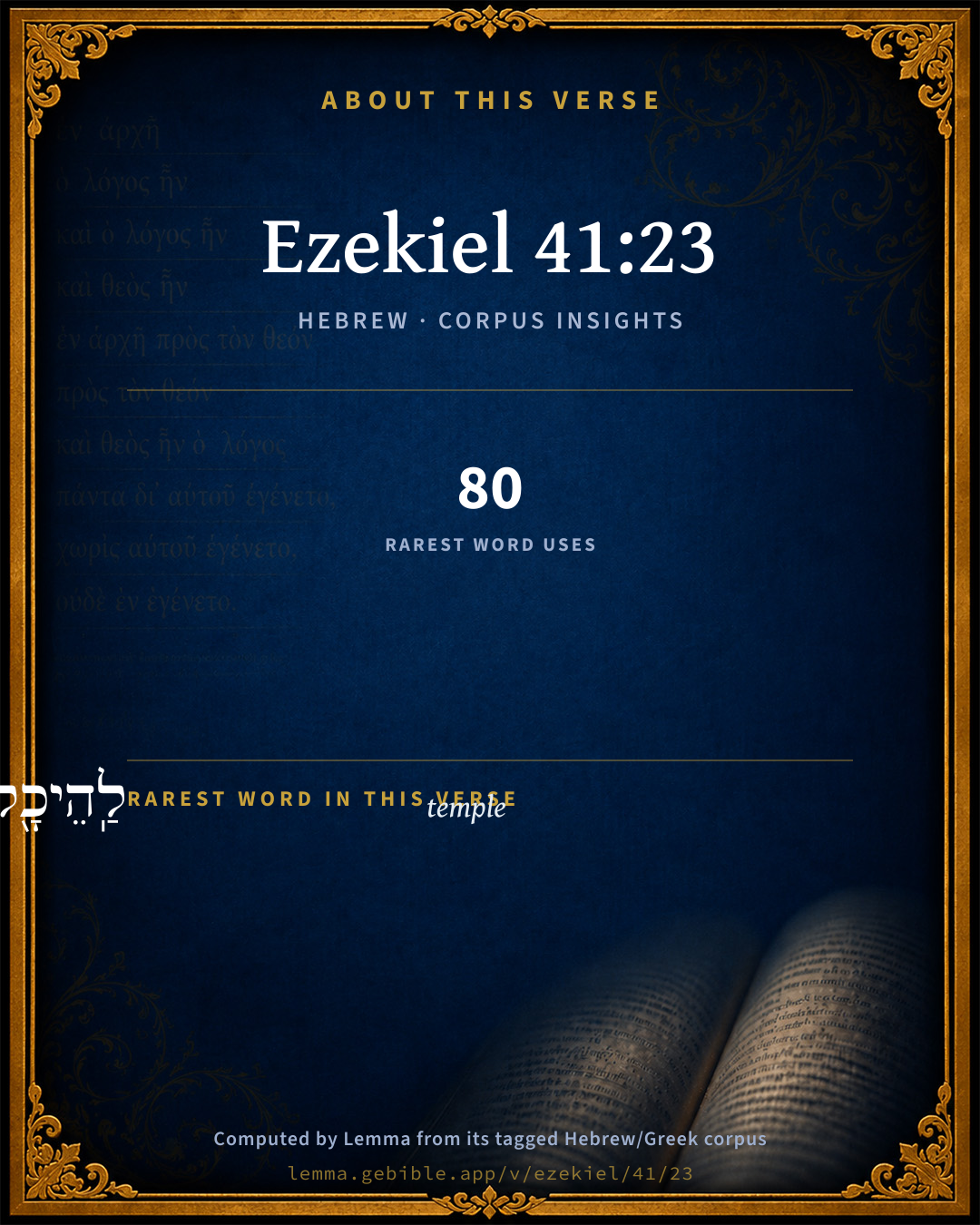
Ezekiel, in the Prophets, opens this verse with 4 words (4 distinct Hebrew lemmas). Its most distinctive word is hêykâl (“temple”). The Greek Septuagint runs longer here. A historical commentator’s framing appears above. Read the whole chapter for the surrounding context.

Discussion questions

  1. How does “temple” (hêykâl) shape what this verse is saying?
  2. How does 1 Kings 6:31–35, which shares this passage’s theme, read alongside this verse?
  3. The Septuagint runs longer here than the Hebrew. What might account for the difference?
  4. These translations render this verse differently; the difference is in the English rendering, not the original. What questions does that raise?
  5. Compare how Trapp's Complete Commentary and Joseph Benson's Commentary read this verse. Where do they agree or differ?

Things to notice

Reading settings

Reading text

Shown beneath each verse's original-language words.

Old Testament
Old Testament edition

Read the OT as the Masoretic Hebrew (MT) or the Greek Septuagint (LXX).

English shown for the Greek Septuagint (in the Hebrew ↔ Greek comparison).

Comparing translations? Open the Compare panel on any verse page to stack up to four side by side.