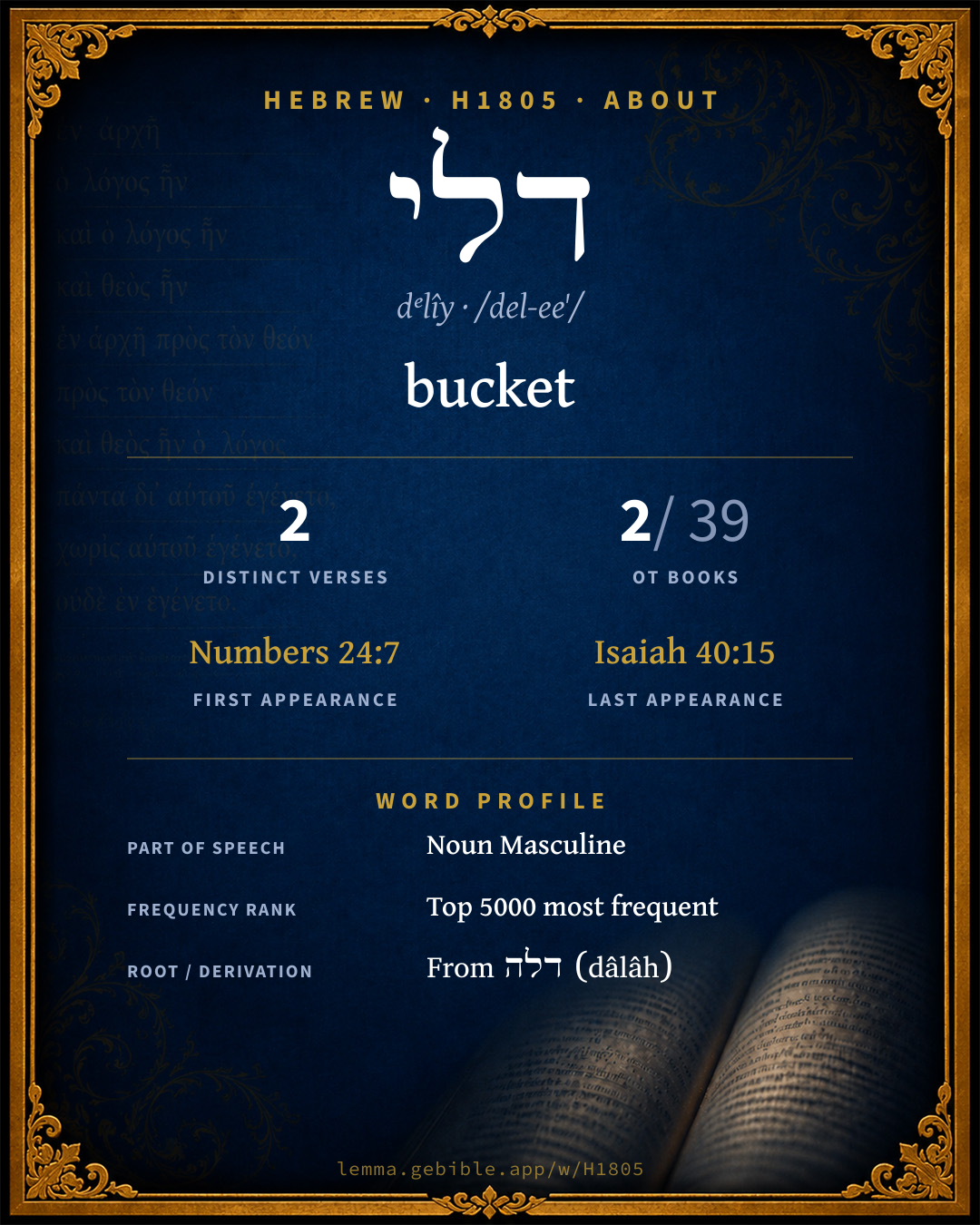
דְּלִי
bucket
Full lexicon entry — Brown-Driver-Briggs (BDB)
From Brown-Driver-Briggs (BDB)
Where this word appears
See every Absolute-state word in the Hebrew Bible →
Grammar key — what these labels mean
Noun type
- Common
- A common noun — a general class of person, place, or thing (“king,” “city,” “water”), not a specific name.
State
- Construct
- A noun bound to a following noun in a possessive / “of” relationship (the construct chain).
- Absolute
- The independent form of a noun, not bound to a following word.
Gender
- Masculine
- Grammatically masculine.
Number
- Dual
- Exactly two — for natural pairs and some measures of time.
- Singular
- One.
Grammatical forms
- Noun, Common, Masculine, Dual, Construct 1 time (50%)
- Noun, Common, Masculine, Singular, Absolute 1 time (50%)
Parsed forms decoded from the imported morphology (morphhb / Westminster Leningrad Codex — WLC text public domain, morphhb tagging CC BY 4.0), counted across 2 parsed occurrences — not distinct verses.
Every verse where H1805 appears — 2 distinct verses across 2 books. Click any verse to open its interlinear word-by-word view. Verse text shown in the World English Bible for context — . Each verse’s Hebrew form is shown with its reference; the English is not keyword-highlighted, since the data carries no word-level English alignment. Use “Compare translations” on any verse to read it across multiple English versions. This concordance covers the Hebrew Bible; Septuagint (Greek Old Testament) occurrences are not indexed here.
Numbers 1 verse
Isaiah 1 verse
About this entry
At a glance — auto-summarized from this page’s data, not written by a person. Every figure links to its source below. This summary describes the numbers; it doesn’t interpret them.
דלי — transliterated dᵉlîy — is a Hebrew noun carrying the sense “bucket.” It is rare — just 2 verses in the entire Hebrew Bible. More than half of its appearances fall in Numbers. Its earliest occurrence is Numbers 24:7. It shares a root with דלה, דלה and דליה. Each statement above links to its evidence; the full detail follows below.
Gloss history
Strong's 1890 vs modern scholarship
About this word
Strong's H1805 catalogs a Hebrew word from the Hebrew Old Testament.
These counts are not copied from any lexicon or concordance. They are computed here, from the morphology-tagged Hebrew Old Testament. What Lemma adds →
- 2
- distinct verses
- The word appears in 2 distinct verses.
- 2 / 39
- OT books
- The word appears in 2 of 39 Old Testament books.
- #4,807
- by frequency
- Top 5000 most frequent Hebrew words (rank 4,807 of 8,640 Hebrew words by occurrence).
View all 2 occurrences in the concordance →
By traditional corpus
Conventional, traditional groupings — biblical authorship is debated, so this is a traditional corpus grouping, not an authorship claim. Each share is this word’s portion of its verses in that division of the Hebrew canon. Each figure is a share of the word’s 2 distinct verses.
- Torah (Pentateuch) 1 verse · 50%
- Prophets (Nevi'im) 1 verse · 50%
How translations render this word
Counts come from each version’s own published word-to-Strong’s tagging or interlinear alignment — an approximate guide to how each version renders this word, not a word-level alignment the data otherwise carries. Because each total is that version’s own tagged count, the per-version totals vary from one another and need not match the appearance or distinct-verse counts above. These counts may also differ from a printed concordance because Lemma counts each distinctly tagged rendering and does not collapse phrase taggings into a single head-word total. This is a fixed set of word-tagged versions (KJV, ASV, BSB, ULT) and does not change with the reading translation you choose elsewhere. Each version’s license is shown beside its name below (and on Sources).
- King James Version: Bucket 1×, Buckets 1×
- American Standard Version: Bucket 1×, Buckets 1×
- Berean Standard Bible: Bucket 1×, Buckets 1×
- unfoldingWord Literal Text: Bucket 1×, Buckets 1×
King James Version Public Domain
Renders H1805 across 2 tagged occurrences — most commonly:
American Standard Version Public Domain
Renders H1805 across 2 tagged occurrences — most commonly:
Berean Standard Bible Public Domain
Renders H1805 across 2 tagged occurrences — most commonly:
unfoldingWord Literal Text CC BY-SA 4.0
Renders H1805 across 2 tagged occurrences — most commonly:
Senses in BDB
The 1 sense BDB distinguishes for this word, in lexicon order (not ranked by frequency or importance). The full entry — with sub-senses — is in the Lexicon Entry tab.
- bucket
Word origin
Derived from דלה (dâlâh) (H1802) — to draw.
Jastrow Dictionary
A second Hebrew/Aramaic lexicon for comparison, covering Aramaic and post-biblical (Talmudic, Targumic, Midrashic) usage that the biblical-Hebrew BDB does not. Matched by lemma rather than by Strong’s number, so a lemma may carry more than one Jastrow headword (shown separately below), and the entries cover usage well beyond the Bible.
דלי
- [to be suspended, swing; denom. דֳּלִי; whence]
- 1. to draw water. Gen. R. s. 93; Cant. R. to I, 1. Ex. R. s. 1 אנשים דּוֹלִים וכ׳ men draw the water and women water the flock; a. fr.—Yoma 28ᵇ (play on ד̇מ̇ש̇ק̇, Gen. XV, 2) שדּוֹֹלֶה ומ̇ש̇ק̇ה וכ׳ he (Eliezer) drew and gave to drink of his master’s teachings.—2) to lift up, relieve. Midr. Till. to Ps. I, 3 וכשיִדְלֵנִי וכ׳ and when the Lord shall lift me up out of the depths of suffering. Cant. R. to II, 1. e.g. Genesis 15:2
- 1. to draw water, to irrigate. B. Kam. 51ᵇ המַדְלֶה מים וכ׳ he who draws water (to irrigate his field &c.); ואני אַדְלֶה and I will &c.; a. fr.
- 2. (denom. of דָּלִית) to suspend, to train a plant to an espalier &c. Succ. I, 4 ה׳ עליה וכ׳ if he trained a vine over the festive wreath. Kil. VI, 4; a. fr.—Part. pass. מוּדְלֶה, f. מוּדְלָה. Ib. Midd. III, 8. Y. B. Mets. X, 12ᶜ, v. דָּלִית.—Bab. ib. 91ᵇ במוּדָלוֹת Ms. F. (ed. במודלית) when figs and grapes overhang one another. [Y. Shebi. II, 33ᶜ bot. מודלה, v. מִדְלַעַת.]
- to sprinkle. Part. מְדַלֶּה, pl. מְדַלִּין. M. Kat. 4ᵃ sq., v. דָּלַל.
דְּלֵי
- 1. to be suspended. Part. pl. דַּלְיָין suspended. Targ. Esth. I, 6.
- 2. to draw, raise. Targ. Ex. II, 19. Targ. II Esth. I, 2 buckets דדלו אבנא which draw stone; a. fr. [Targ. Y. Num. XIV, 14 read מַדְלֵי Af.] [Pes. 40ᵃ מדלייהו, v. מַדְלָא.]
- 3. to lift up. B. Kam. 92ᵇ דַּלְיַת, דְּלִינָא, v. דּוּרָא IV.—Ber. 18ᵃ דַּלְיֵיה (Yalk. Koh. 979; Yalk. Sam. 152 סלקיה) lift it (the cloak) up. Kidd. 81ᵃ דַלְיֵיה וכ׳ he carried it by himself.—Yeb. 92ᵇ; B. Mets. 17ᵇ אי לאו דדְלָאִי לך וכ׳ had I not taken up (removed) the sherd for thee, thou wouldst never have found the pearl under it, i.e. but for my intimation you would not have reached the conclusion &c.; Macc. 21ᵇ.—M. Kat. 28ᵇ, v. דְּלַל.
- (v. דלל)
- 1. to relieve, lighten. Targ. Y. Deut. XXXII, 51 ולא דַּלּוּ מיניה (Var. דָּלוּ, fr. דְּלַל) and they would not relieve him (give him a respite). Ib. דַּלִּי מיני (Var. דְּלִי) respite me.—Meg. 13ᵃ דַּלֵּי כרגא he lightened the taxes (Esth. II, 18). e.g. Esther 2:18
- 2. to lift up. Ber. 6ᵇ דַּלּוּיֵי lifting up the voice at funerals, v. דְּלַל.
- to lift, suspend. Sot. 34ᵃ טעונא דמַדְלֵי וכ׳ a load which one can lift up and put on his shoulders, is the third portion of the weight he can carry.
- 1. to be suspended. Y. Sabb. XVI, end, 15ᵈ, a. e. בגדך מִדְּלֵי (sub. אַתְּ) doest thou depend on thy good luck?, v. גַּדָּא.
- 2. to be elevated, high. Pes. 8ᵃ דמִידַּלְיָא (a bed) which stands on high legs (leaving space under it).
- 3. to be relieved. B. Bath. 16ᵇ; Yalk. Gen. 106 (prov.) (מִידְּלֵי) א׳ יומא א׳ קצירא when the day (sun) is high, the sick man is relieved.
דֳּלִי
- 1. bucket, also used as cover of the well. B. Kam. 51ᵇ משימסור לו דָּלְיוֹ from the moment he delivers his bucket (Rashi: cover) to him; Y. Kidd. I, 60ᵇ top; Y. B. Bath. III, beg. 13ᵈ דָּלְייוֹ. Tosef. Ber. IV, 16 ד׳ של צונן a bucket of cold water; a. fr.—Pl. דֳּלָיִים. Gen. R. s. 45, v. בַּנְרִיּוֹת. [Y. B. Bath. l. c. (perhaps) דָּלְיָיו].
- 2. Aquarius, a sign of the zodiac., a sign of the zodiac. Yalk. Ex. 418.
- 3. בֵּית ד׳ pr. n. pl. Beth Doli. Yeb. XVI, 7; Eduy. VIII, 5 (Ms. M. מדלי).
- 4. tangle, v. דָּלִיל.
*מַדְלָא II
- , pl. (דְּלֵי) מַדְלַיָּיא drawing, resorbing. Pes. 40ᵃ כל אגב מַדְלַיְּיהוּ וכ׳ as long as the grains absorb liquid, they do not ferment; v. מִזְּלָא.
A Dictionary of the Targumim, the Talmud Babli and Yerushalmi, and the Midrashic Literature (Marcus Jastrow; London, Luzac, 1903) — Public Domain. Digitized via Sefaria. Digitized via Sefaria. Full attribution on Sources.
Forms in the corpus
The 2 distinct written forms H1805 takes in the Hebrew Bible, most frequent first — each parse links to that state’s occurrences in the concordance. Hebrew forms include their vowel points and cantillation, so a single lemma takes many written forms.
| Form | Parsing | Example | Uses |
|---|---|---|---|
| מִ/דְּלִ֔י | Noun, Common, Masculine, Singular, Absolute | Isaiah 40:15 | 1 |
| מִ/דָּ֣לְיָ֔/ו | Noun, Common, Masculine, Dual, Construct | Numbers 24:7 | 1 |
Same root — word family
Other BDB entries built from the same root as H1805, grouped by Strong’s listed origin. These share a root / origin per the lexicon — not necessarily a shared meaning. Each links to that word’s own entry.
Derives from
Shares the same root
Proper names from this root
People and places named from this root — a name, not an additional meaning of the word.
Compare all same-root words → Showing 4 of 7 — not the complete family. 1 of the same-root words is a proper name (a person or place). They share a root, not necessarily a meaning.
Septuagint verse parallels
This word appears in 2 verses that also exist in the Greek Old Testament (Septuagint), out of the 2 Hebrew verses it occurs in. You can read those verses in Greek by switching the Old Testament edition to the Septuagint.
Read these verses in the Septuagint
This is a verse-level parallel only — the same verses exist in both the Hebrew and Greek Old Testaments. No word-level Hebrew↔Greek correspondence is claimed: the data carries no such alignment, so no Greek word is shown as this Hebrew word’s translation. Coverage is not total — the Septuagint omits the deuterocanon and renumbers the Psalms, so some Hebrew verses have no direct Greek parallel.