2 Chronicles 4:9

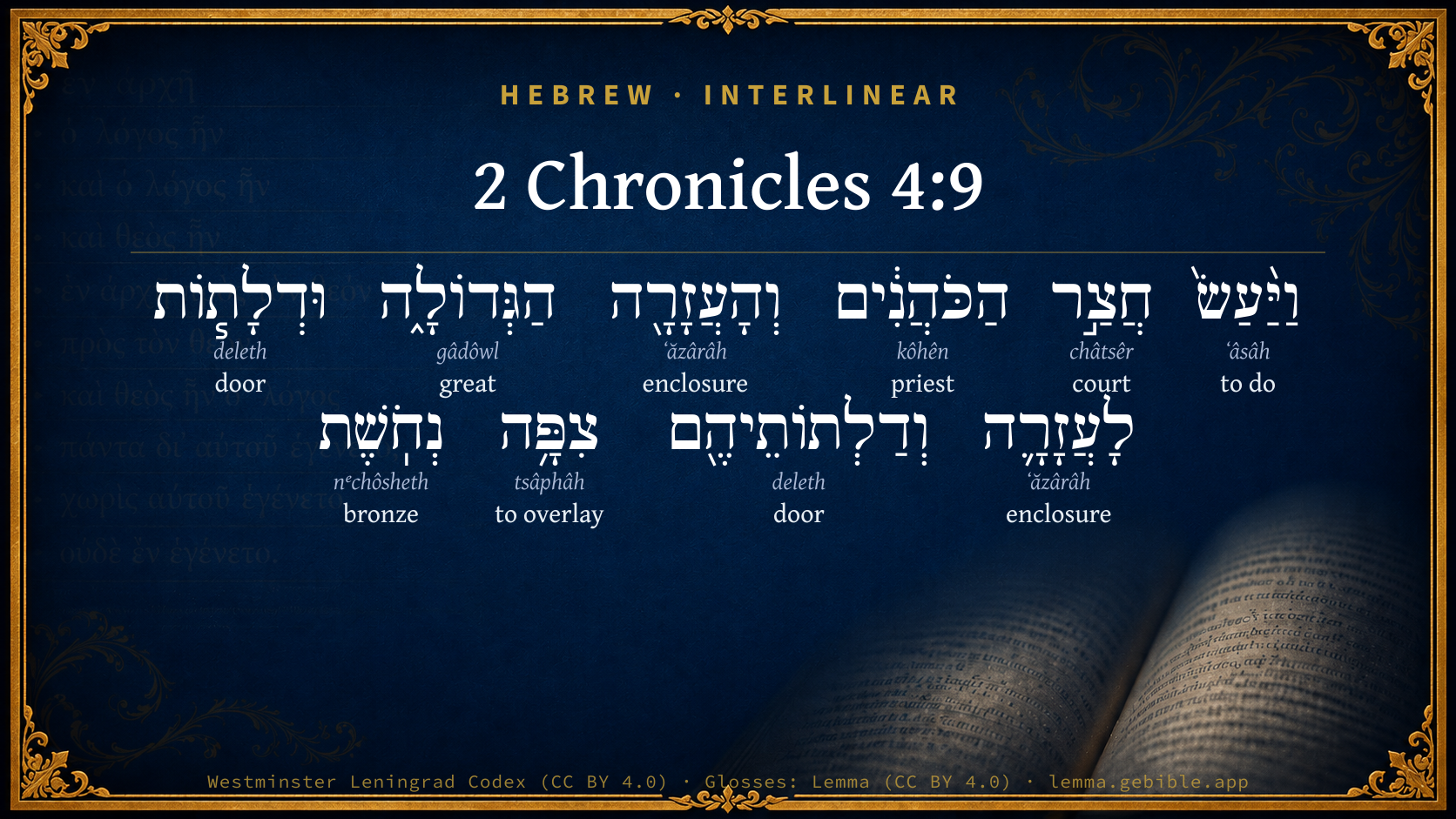
Hebrew (Westminster Leningrad Codex) 2 Chronicles 4:9 appears in the Hebrew Old Testament. The text above is from the Westminster Leningrad Codex. Each word links to its Strong’s number, a concise gloss, and parsing drawn from the Open Scriptures Hebrew Bible morphology. Click any word for its full Brown-Driver-Briggs (BDB) entry.
Download image
Cite this verse

2 Chronicles 4:9 (World English Bible). Public Domain. Lemma interlinear Bible study tool, https://lemma.gebible.app/v/2-chronicles/4/9.

Show BibTeX & RIS
BibTeX
RIS
English Translation
Furthermore he made the court of the priests, and the great court, and doors for the court, and overlaid the doors of them with brass.
World English Bible · Public Domain
Highlights
  • 1 first appearance in the Hebrew Bible
Full analysis ↓
Download a study sheet

One document with this verse’s original text, its word-by-word gloss line, the meaning frame, cross-references with their text, attributed commentary, and full source and license credits — printable, and it pastes into notes with its structure intact.

This verse Autodidact and up

Study sheet (.html) Plain text (.txt)

A passage Seminary Student

Up to 50 verses in one chapter. A passage sheet keeps up to 6 commentary sources and 12 cross-references per verse, in the order this page ranks them, and says so on the sheet whenever that leaves anything out. Ask for a single verse and you get the Autodidact verse sheet above.

Everything on this page stays free to read, with no account — the sheet is a download of what is already on screen, not access to it.

Want to remove ads? Support Godless Engineer
Compare translations 3

The same verse in 3 English versions, stacked beneath the original-language interlinear above. Click any original word for its lexicon entry.

Each is an independent rendering of the whole verse — the interlinear is not word-aligned to these translations.

Highlighted words mark where these versions differ — a whole-verse word diff, not a word-by-word alignment.

  • World English Bible Public Domain
    Furthermore he made the court of the priests, and the great court, and doors for the court, and overlaid the doors of them with brass.
  • King James Version Public Domain
    Furthermore he made the court of the priests, and the great court, and doors for the court, and overlaid the doors of them with brass.
  • unfoldingWord Literal Text CC BY-SA 4.0
    And he made the courtyard of the priests, and the great court and the doors for the court and their doors he overlaid with bronze.

unfoldingWord Literal Text — © unfoldingWord, licensed CC BY-SA 4.0. Word-aligned USFM3 via Door43 (git.door43.org/unfoldingWord/en_ult).

Versions to compare (up to 4)

3 of 4 selected

Show all 18 translations

Every available English version of this verse, each an independent rendering of the whole verse.

  • World English Bible Public Domain
    Furthermore he made the court of the priests, and the great court, and doors for the court, and overlaid the doors of them with brass.
  • Berean Standard Bible Public Domain
    He made the courtyard of the priests and the large court with its doors, and he overlaid the doors with bronze.
  • Majority Standard Bible Public Domain
    He made the courtyard of the priests and the large court with its doors, and he overlaid the doors with bronze.
  • King James Version Public Domain
    Furthermore he made the court of the priests, and the great court, and doors for the court, and overlaid the doors of them with brass.
  • American Standard Version (1901) Public Domain
    Furthermore he made the court of the priests, and the great court, and doors for the court, and overlaid the doors of them with brass.
  • Revised Version (1885) Public Domain
    Furthermore he made the court of the priests, and the great court, and doors for the court, and overlaid the doors of them with brass.
  • Geneva Bible (1599) Public Domain
    And he made the court of the Priests, and the great court and doores for the court, and ouerlayd the doores thereof with brasse.
  • Douay-Rheims (1899) Public Domain
    Moreover also ten tables: and he set them in the temple, five on the right side, and five on the left. Also a hundred bowls of gold.
  • Young's Literal Translation Public Domain
    And he maketh the court of the priests, and the great court, and doors for the court, and their doors he hath overlaid with brass.
  • Literal Standard Version CC BY-SA 4.0
    And he makes the court of the priests, and the great court, and doors for the court, and he has overlaid their doors with bronze.
  • Unlocked Literal Bible CC BY-SA 4.0
    Furthermore he made the courtyard of the priests, and the great court and the doors for the court and overlaid their doors with bronze.
  • unfoldingWord Literal Text CC BY-SA 4.0
    And he made the courtyard of the priests, and the great court and the doors for the court and their doors he overlaid with bronze.
  • Darby Bible Public Domain
    And he made the court of the priests, and the great court, and doors for the court, and overlaid the doors thereof with bronze.
  • World Messianic Bible Public Domain
    Furthermore he made the court of the priests, the great court, and doors for the court, and overlaid their doors with bronze.
  • Webster's Bible Public Domain
    Furthermore he made the court of the priests, and the great court, and doors for the court, and overlaid the doors of them with brass.
  • Free Bible Version CC BY-SA 4.0
    Solomon also built a courtyard of the priests, and the large courtyard and doors for the courtyard, and he covered the doors with bronze.
  • Bible in Basic English Public Domain
    Then he made the open space for the priests, and the great open space and its doors, plating the doors with brass.
  • JPS Tanakh (1917) Public Domain
    Furthermore he made the court of the priests, and the great court, and doors for the court, and overlaid the doors of them with brass.

Literal Standard Version (2020), Covenant Press — licensed CC BY-SA 4.0. Text via the HelloAO Bible API (eBible.org). Unlocked Literal Bible (unfoldingWord) — licensed CC BY-SA 4.0. Text via the HelloAO Bible API (eBible.org). unfoldingWord Literal Text — © unfoldingWord, licensed CC BY-SA 4.0. Word-aligned USFM3 via Door43 (git.door43.org/unfoldingWord/en_ult). Free Bible Version, Dr. Jonathan Gallagher — licensed CC BY-SA 4.0. Text via the HelloAO Bible API (eBible.org).

Word by word

More ways to search: Search by grammar → Find every occurrence → Compare this word →

Practice this passage: Drill this verse → Learn its vocabulary →

וְהָעֲזָרָ֖ה
ʻăzârâh
H5835
“and · the · enclosure”
Conjunction + Particle, Definite Article + Noun, Common, Feminine, Singular, Absolute
Part of Speech
Conjunction + Particle + Noun
Type
Common
Gender
Feminine
Number
Singular
State
Absolute
Full BDB Definition

Origin: from H5826 in its original meaning of surrounding

TWOT: 1599a

enclosure - ledge (surrounding Ezekiel's altar) - court (outer one of temple)
  1. וַיַּ֨עַשׂ֙ ʻâsâh H6213 “and · to do” Conjunction + Verb, Qal, Sequential Imperfect, 3rd Person, Masculine, Singular
  2. חֲצַ֣ר châtsêr H2691 “court of” Noun, Common, Both, Singular, Construct
  3. הַכֹּהֲנִ֔ים kôhên H3548 “the · priests” Particle, Definite Article + Noun, Common, Masculine, Plural, Absolute
  4. הַגְּדוֹלָ֑ה gâdôwl H1419 “the · great” Particle, Definite Article + Adjective, Adjective, Feminine, Singular, Absolute
  5. וּדְלָת֧וֹת deleth H1817 “and · doors” Conjunction + Noun, Common, Feminine, Plural, Absolute
  6. לָעֲזָרָ֛ה ʻăzârâh H5835 “to/for the · enclosure” Preposition, Determined + Noun, Common, Feminine, Singular, Absolute
  7. וְדַלְתוֹתֵיהֶ֖ם deleth H1817 “and · doors · their” Conjunction + Noun, Common, Feminine, Plural, Construct + Suffix, Personal, 3rd Person, Masculine, Plural
  8. צִפָּ֥ה tsâphâh H6823 “to overlay” Verb, Piel, Perfect, 3rd Person, Masculine, Singular
  9. נְחֹֽשֶׁת nᵉchôsheth H5178 “bronze” Noun, Common, Feminine, Singular, Absolute

About this verse

These counts appear in no published source. They are computed here, from the morphology-tagged text and Lemma’s own curated glosses. What Lemma adds →

10
words
8
distinct lemmas
Historical
section

Notable vocabulary

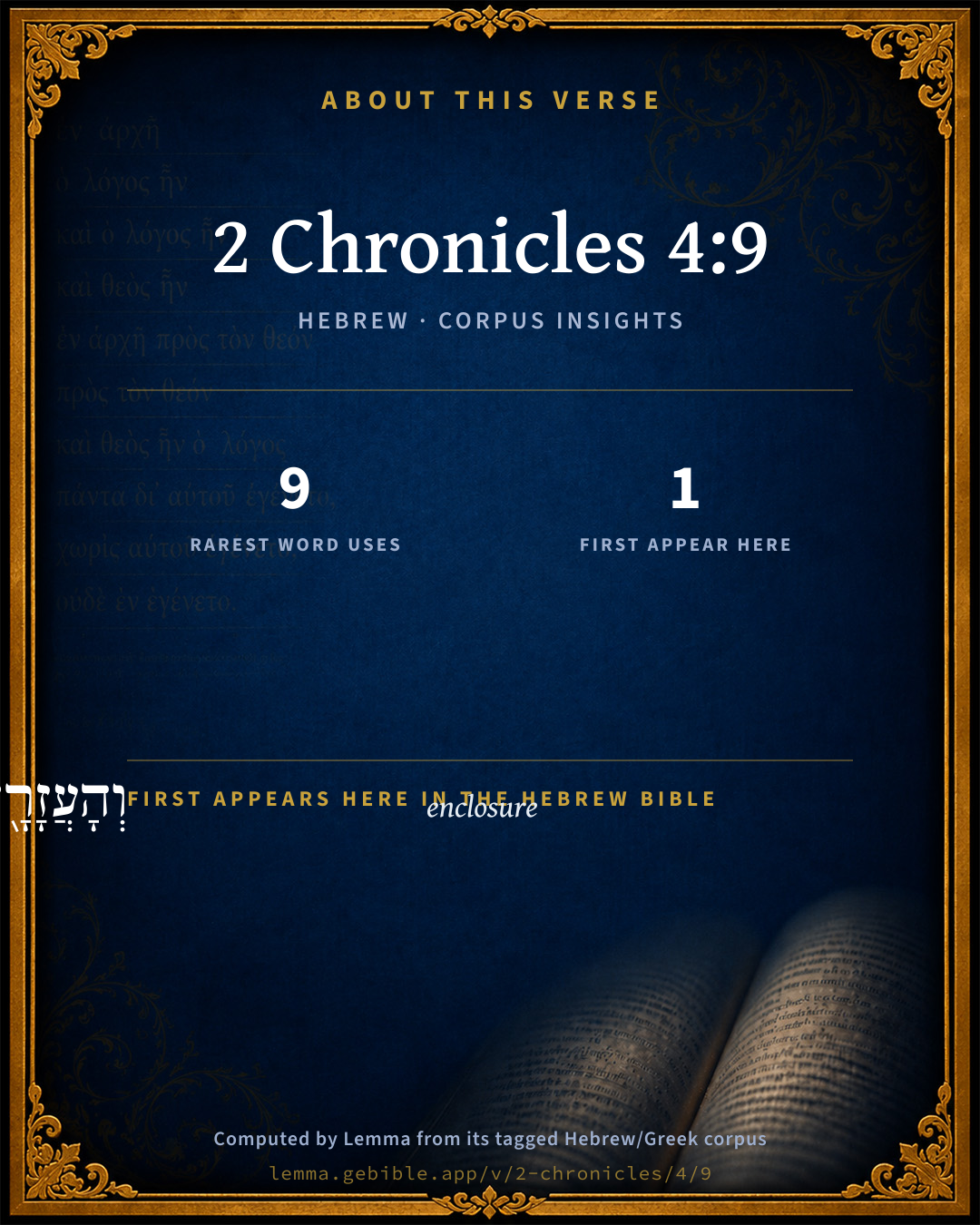
The rarest word here is וְהָעֲזָרָ֖ה enclosure H5835 — appearing just 9 times in the whole Hebrew Bible.

First appearance in Scripture

This word makes its first canonical appearance in the Hebrew Bible here:

  • וְהָעֲזָרָ֖ה enclosure H5835

Shared distinctive vocabulary

וְהָעֲזָרָ֖ה enclosure H5835 occurs in 6 verses of the Hebrew Bible. Also found in:

Grammatical profile

  • 2 verbs
  • 7 nouns
  • 1 adjective

Verb forms

  • וַיַּ֨עַשׂ֙ Qal · Sequential Imperfect
  • צִפָּ֥ה Piel · Perfect

Repetition

Words recur within this verse — often emphatic in Hebrew:

  • וְהָעֲזָרָ֖ה enclosure H5835 ×2
  • וּדְלָת֧וֹת door H1817 ×2

Hebrew & Septuagint length

In English translation the verse runs 25 words from the Hebrew and 22 from the Septuagint (LXX English) — closely comparable.

A rough comparison of the two English renderings, which tokenize alike — not a word-level alignment.

Word counts can differ between the Hebrew and the Greek without any difference in meaning — e.g. the Hebrew direct-object marker אֵת has no separate Greek word, and Greek often adds the article ὁ.

Cross-references

3

Topical passages linked to 2 Chronicles 4:9 in the Treasury of Scripture Knowledge — connected by theme and wording, ordered by reader-vote popularity; previews shown in the World English Bible.

  • 1 Kings 6:36 He built the inner court with three courses of hewn stone, and a course of cedar beams.
  • 2 Kings 21:5 He built altars for all the host of the sky in the two courts of the house of Yahweh.
  • 1 Kings 7:12 The great court round about had three courses of hewn stone, and a course of cedar beams; like as the inner court of the house of Yahweh, and the porch of the house.

Cross-references courtesy of OpenBible.info (CC BY 4.0).

Hebrew and Greek witnesses Masoretic Hebrew ↔ Greek Septuagint

The same verse in the two great witnesses to the Old Testament, shown verse-for-verse.

These are two independent witnesses, not word-aligned to each other, and the Septuagint is shown in lemma (dictionary) form.

Hebrew 2 Chronicles 4:9 Masoretic · Westminster Leningrad Codex

וַיַּ֨עַשׂ֙ חֲצַ֣ר הַכֹּהֲנִ֔ים וְהָעֲזָרָ֖ה הַגְּדוֹלָ֑ה וּדְלָת֧וֹת לָעֲזָרָ֛ה וְדַלְתוֹתֵיהֶ֖ם צִפָּ֥ה נְחֹֽשֶׁת

Furthermore he made the court of the priests, and the great court, and doors for the court, and overlaid the doors of them with brass.

World English Bible · Public Domain

Greek LXX 2 Chronicles 4:9 Septuagint · lemma form

καί ποιέω ὁ αὐλή ὁ ἱερεύς καί ὁ αὐλή ὁ μέγας καί θύρα ὁ αὐλή καί θύρωμα αὐτός καταχαλκόω χαλκοῦς

Also he made the priests' court, and the great court, and doors to the court, and their panels were overlaid with brass.

LXX2012 (modern English Septuagint) · Public Domain

On this verse, Ellicott's Commentary for English Readers discusses the Septuagint’s reading. Read the note in Commentary ↓

Hebrew: Westminster Leningrad Codex (CC BY 4.0). Greek: Septuagint (public domain); English from LXX2012 (modern English Septuagint) (Public Domain). How the Septuagint differs from the Hebrew →

Commentary

Notes on 2 Chronicles 4:9 from classic Christian and Jewish commentators (each source and its license shown beneath its notes). The classic Christian expositions comment on the surrounding passage and are grouped to its opening verse, so a note may address several verses; the Jewish commentaries on the Tanakh (Rashi and others) are per-verse, so they appear only where the commentator wrote on this verse.

Lemma curates 59 commentaries, every one of them public domain or Creative Commons licensed, each selected and text-cleaned for this edition rather than reprinted as found. About our sources →

Trapp's Complete Commentary

John Trapp

2Ch 4:9 Furthermore he made the court of the priests, and the great court, and doors for the court, and overlaid the doors of them with brass.

Ver. 9. Furthermore he made the court.] See 1Ki 6:30.

And the great court,] i.e., The people’s court, called here gnazarah: {a} haply because here God helped the people, when he heard their prayers, or when here they took sanctuary.

{a} Forte ex azar fit azirum, et inde asilum.

John Trapp, A Commentary or Exposition upon All the Books of the Old and New Testament (1647–1656) — public domain. Text from a community e-Sword module.

Geneva Bible (1599)

Geneva Bible translators

Called also the porch of Solomon, Act 3:11. It is also taken for the Temple where Christ preached, Matt. 21:23.

Geneva Bible (1599) marginal notes — public domain. Text via Bolls.life.

Adam Clarke's Commentary

Verse 9. He made the court of the priests] This was the inner court.

And the great court] This was the outer court, or place for the assembling of the people.

Adam Clarke's Commentary on the Bible (1810–1826) — public domain. Text from a community e-Sword/MySword module.

Ellicott's Commentary for English Readers

(9) The court of the priests.—See 1Ki_6:36; 1Ki_7:12, “the inner court;” Jer_36:10, “the higher court.”

And the great court.—‘Azârâh, “court,” a late word, common in the Targums for the classical hâqçr, which has just occurred. The ‘azârâh was the outer court of the temple. It is not mentioned at all in the parallel narrative. The LXX. calls it “the great court;” the Vulg., “the great basilica.” The Syriac renders the whole verse: “And he made one great court for the priests and Levites, and covered the doors and bolts with bronze.” (Comp. Note on 2Ch_4:3 for this plating of the doors with bronze.) The bronze plated doors of Shalmaneser’s palace at Balawat were twenty-two feet high, and each leaf was six feet wide.

A Bible Commentary for English Readers, edited by Charles John Ellicott (1878–1897) — public domain. Text from a community e-Sword module.

The Cambridge Bible for Schools and Colleges

gen. ed. J. J. S. Perowne

9, 10. The Two Courts

9. the court of the priests, and the great court] There is a difficulty in this mention of two Temple courts by the Chronicler, for it may be doubted whether Solomon’s Temple, strictly speaking, had more than one court, for in “the other court” stood Solomon’s house (1Ki_7:8). This “other court” seems to be called the “middle court” (2Ki_20:4), and the “higher court” (Jer_36:10). The “great court” (1Ki_7:12) was perhaps a third court containing not only the king’s house, but all the royal buildings as well. The Heb. word for “court” in all the above passages is ḥâçer, but here the “court (ḥâççr) of the priests” is distinguished from a court called the “great court” (Heb. “great Azârâh”). Perhaps the Chronicler wishes to make the same distinction when he says that Solomon’s great prayer was offered (2Ch_6:13) in “the court” (Heb. Azârâh).

The Cambridge Bible for Schools and Colleges (gen. ed. J. J. S. Perowne; Cambridge University Press, 1878–1918) — public domain. Text from a community e-Sword module.

Haydock's Catholic Bible Commentary

Hall, (basilicam.) Septuagint use the same term (Greek: aule) as just before is rendered court; and the Protestants make no distinction, though the Hebrew terms be different. Septuagint render chatsar, "the court" of the people. There, we know, that Solomon had his tribune, chap. vi. 13. Ezechiel (xliii. 14.) distinguishes two; the great, lower or outward, (Calmet chatsar) or court, and that of the priests, (Haydock) which he styles the less, &c. The principal door lay to the east.

George Leo Haydock (1774–1849), Haydock's Catholic Family Bible and Commentary, 1859 edition — public domain. Excludes Psalms (Douay-Rheims chapter numbering differs from Protestant) and Deuterocanonical books (Catholic canon only).

The Pulpit Commentary

The court of the priests. (comp. 1Ki_6:36, where this court is denominated the inner court, and any other court an outer one, i.e. the great court only implicated thereby) The construction of this court of the priests, withheld here, given there, leaves it ambiguous whether the "three rows of hewed stones and one row of cedar beams "intends a description of fence, as the Septuagint seems to have taken it, or of a higher floor with which the part in question was dignified. The citation, Jer_36:10, though probably pointing to this same court, can scarcely be adduced as any support of J. D. Michaelis" suggestion of this latter, as its wOyl (translated "higher") does not really carry the idea of the comparative degree at all. For once that it is so translated (and even then probably incorrectly), there are twenty occurrences of it as the superlative excellentiae. The introduction just here of any statement of these courts at all, which seems at first inopportune, is probably accounted for by the desire to speak in this connection of their doors and the brass overlaying of them. (1Ki_7:12 2Ki_23:12; Eze_40:28; Condor"s "Handbook to the Bible," p. 370) It is worthy of note that the word employed in our text, as also 2Ch_6:13, is not the familiar word rxej of all previous similar occasions, but hrz a word of the later Hebrew, occurring also several times in Ezekiel, though not in exactly the same sense, and the elementary signification of the verb-root of which is "to gird," or "surround."

The Pulpit Commentary (1880–1919), ed. H.D.M. Spence-Jones & Joseph S. Exell — public domain. Text from a community e-Sword module.

Keil & Delitzsch

C. F. Keil & F. Delitzsch

The two courts are not further described. For the court of the priests, see on Kg1 6:36 and Kg1 7:12. As to the great or outer court, the only remark made is that it had doors, and its doors, i.e., the folds or leaves of the doors, were overlaid with copper. In Ch2 4:10 we have a supplementary statement as to the position of the brazen sea, which coincides with Kg1 7:39; see on the passage. In Ch2 4:11 the heavier brazen (copper) utensils, belonging to the altar of burnt-offering, are mentioned: סידות, pots for the removal of the ashes; יעים, shovels, to take the ashes out from the altar; and מזרקות, basins to catch and sprinkle the sacrificial blood. This half verse belongs to the preceding, notwithstanding that Huram is mentioned as the maker. This is clear beyond doubt, from the fact that the same utensils are again introduced in the summary catalogue which follows (Ch2 4:16).

Keil & Delitzsch — Biblical Commentary on the Old Testament (1861–1891) — public domain (CC PDM 1.0). Text via the HelloAO Bible API. (Old Testament only.)

Scofield Reference Notes

C. I. Scofield

court

The tabernacle had no "court of priests."

The Scofield Reference Bible (1917 edition), notes by C. I. Scofield — public domain. Text from a community e-Sword module.

Kretzmann's Popular Commentary

Paul E. Kretzmann

The Vessels of Brass and of Gold

v. 9. Furthermore he made the court of the priests, the inner court, in which the altar of burnt offering was situated, and the Great Court, the Court of Israel, where the worshiping people assembled, and doors for the court, and overlaid the doors of them with brass.

v. 10. And he set the sea on the right side of the east end, over against the south, southeast of the altar of burnt offering.

v. 11. And Huram made the pots and the shovels and the basins, the pots for carrying away the ashes, the shovels for removing the ashes from the great altar, the bowls for receiving and sprinkling the blood of the sacrifices. And Huram finished the work that he was to make for King Solomon for the house of God, a catalog now following like 1Ki 7:40-47;

v. 12. to wit, the two pillars, and the pommels, the rounded part of the capitals or just beneath them, and the chapiters which were on the top of the two pillars, and the two wreaths, the network of garlands, to cover the two pommels of the chapiters which were on the top of the pillars;

v. 13. and four hundred pomegranates on the two wreaths; two rows of pomegranates on each wreath to cover the two pommels of the chapiters which were upon the pillars.

v. 14. He made also bases, movable holders, and lavers, in the form of large caldrons, or kettles, made he upon the bases;

v. 15. one sea, and twelve oxen under it.

v. 16. The pots also, and the shovels, and the flesh-hooks, the large forks used in preparing the sacrificial meat, and all their instruments did Huram, his father, rather, the master, the chief artisan, make to King Solomon for the house of the Lord of bright brass.

v. 17. In the Plain of Jordan did the king cast them, in the clay ground, which was particularly adapted for the molds used in casting, between Succoth and Zeredathah (or Zarthan), 1Ki 7:46.

v. 18. Thus Solomon made all these vessels in great abundance, for the weight of the brass could not be found out.

v. 19. And Solomon made all the vessels that were for the house of God, the golden altar also, the altar of incense which stood next to the veil of the Most Holy Place, and the tables whereon the showbread was set only one being in use at one time, however, 1Ki 7:48;

v. 20. moreover, the candlesticks with their lamps, that they should burn after the manner, as prescribed by the Law, Exo 27:20-21, before the Oracle, the Most Holy Place, of pure gold;

v. 21. and the flowers, the ornaments on the candlesticks in the shape of almond-blossoms, and the lamps, and the tongs, the snuffers used for these lamps, made he of gold, and that perfect gold;

v. 22. and the snuffers, the knives for cleaning the wicks, and the basins, probably those used on the Great Day of Atonement, and the spoons, trays or holders for the incense, and the censers, the pans for holding coals when offering incense, of pure gold; and the entry of the house, the inner doors thereof for the Most Holy Place, and the doors of the house of the Temple, those leading into the Holy Place, were of gold. All this outward magnificence, however, cannot compare with the inward beauty of the Church of Christ, decorated, as she is, with the righteousness of her Savior.

Paul E. Kretzmann, Popular Commentary of the Bible (1921–1924) — public domain. Text from a community e-Sword module.

unfoldingWord translationNotes

Door43 World Missions Community

he made the courtyard ... and overlaid ... He placed

Here "he" refers to Solomon. The readers should understand that Solomon probably commanded other people to do the actual work. AT: "Solomon's workers made ... they overlaid ... They placed" (See: Metonymy)

the great court

"the large court"

on the east side of the temple, facing toward the south

"next to the southeast corner of the temple"

translationWords

court

unfoldingWord translationNotes — © Distant Shores Media and the Door43 World Missions Community, licensed CC BY-SA 4.0. Source: git.door43.org/Door43/en_tn.

Rashi

Rabbi Shlomo Yitzchaki (Rashi)

And he made the priests’ court This is known as the ְעֶזרַת הַכֹּהֲנִים.

and the large court This is the court of the Israelites.

Rashi on the Tanakh — English translations: “The Judaica Press complete Tanach with Rashi, translated by A. J. Rosenberg” (CC BY 4.0); “Pentateuch with Rashi's commentary by M. Rosenbaum and A.M. Silbermann, 1929-1934” (public domain); “The Metsudah Tanach series, Lakewood, N.J” (CC BY 4.0); and “The Book of Joshua, Metsudah Publications, 1997” (CC BY 4.0). Text via Sefaria.

Lesson kit

Teaching starters — assembled from the data on this page, not authored interpretation. Every prompt links to the verse data it draws on. Edit before teaching.

2 Chronicles, in the Historical, opens this verse with 10 words (8 distinct Hebrew lemmas). Its most distinctive word is ʻăzârâh (“enclosure”). A historical commentator’s framing appears above. Read the whole chapter for the surrounding context.

Discussion questions

  1. What does “enclosure” (ʻăzârâh) contribute to the verse as a whole?
  2. This is the first place “enclosure” appears in Scripture (first appears here). What does its debut here establish?
  3. How does 2 Chronicles 6:13, which shares the word «enclosure», read alongside this verse?
  4. What does the repetition of “enclosure” (2× in this one verse) do in this verse?
  5. These translations render this verse differently. What is at stake in choosing one wording over another?
  6. «וַיַּ֨עַשׂ֙» is a Qal Sequential Imperfect verb. How does that grammatical form shape the action described?
  7. Compare how Trapp's Complete Commentary and Geneva Bible (1599) read this verse. Where do they agree or differ?

Things to notice

  • 1 word makes its first canonical appearance in Scripture here.
  • These translations choose different wording for 4 words in this verse.
  • “enclosure” occurs 2× in this single verse.
  • 8 distinct Hebrew lemmas span 10 words in this verse.

Reading settings

Reading text

Shown beneath each verse's original-language words.

Old Testament
Old Testament edition

Read the OT as the Masoretic Hebrew (MT) or the Greek Septuagint (LXX).

English shown for the Greek Septuagint (in the Hebrew ↔ Greek comparison).

Comparing translations? Open the Compare panel on any verse page to stack up to four side by side.