

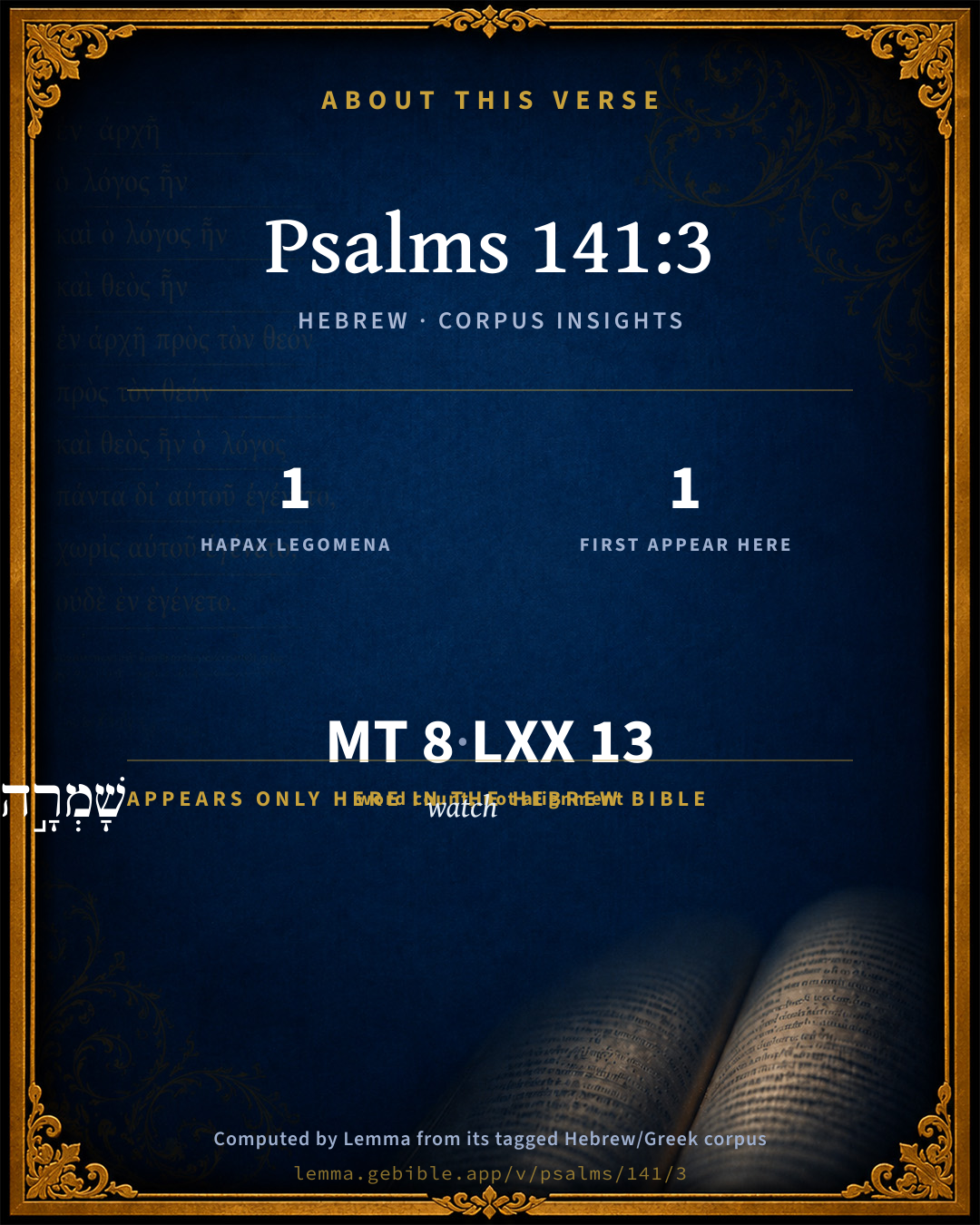
Psalms 141:3

Hebrew (Westminster Leningrad Codex) Psalms 141:3 appears in the Hebrew Old Testament. The text above is from the Westminster Leningrad Codex. Each word links to its Strong’s number, a concise gloss, and parsing drawn from the Open Scriptures Hebrew Bible morphology. Click any word for its full Brown-Driver-Briggs (BDB) entry.
Download image
Cite this verse

Psalms 141:3 (World English Bible). Public Domain. Lemma interlinear Bible study tool, https://lemma.gebible.app/v/psalms/141/3.

Show BibTeX & RIS
BibTeX
RIS
English Translation
Set a watch, Yahweh, before my mouth. Keep the door of my lips.
World English Bible · Public Domain
Highlights
  • 1 hapax legomenon — only here in the Hebrew Bible
  • 1 first appearance in the Hebrew Bible
Full analysis ↓
Download a study sheet

One document with this verse’s original text, its word-by-word gloss line, the meaning frame, cross-references with their text, attributed commentary, and full source and license credits — printable, and it pastes into notes with its structure intact.

This verse Autodidact and up

Study sheet (.html) Plain text (.txt)

A passage Seminary Student

Up to 50 verses in one chapter. A passage sheet keeps up to 6 commentary sources and 12 cross-references per verse, in the order this page ranks them, and says so on the sheet whenever that leaves anything out. Ask for a single verse and you get the Autodidact verse sheet above.

Everything on this page stays free to read, with no account — the sheet is a download of what is already on screen, not access to it.

Want to remove ads? Support Godless Engineer
Compare translations 3

The same verse in 3 English versions, stacked beneath the original-language interlinear above. Click any original word for its lexicon entry.

Each is an independent rendering of the whole verse — the interlinear is not word-aligned to these translations.

Highlighted words mark where these versions differ — a whole-verse word diff, not a word-by-word alignment.

  • World English Bible Public Domain
    Set a watch, Yahweh, before my mouth. Keep the door of my lips.
  • King James Version Public Domain
    Set a watch, O LORD, before my mouth; keep the door of my lips.
  • unfoldingWord Literal Text CC BY-SA 4.0
    Yahweh, place a guard over my mouth; guard the door of my lips.

unfoldingWord Literal Text — © unfoldingWord, licensed CC BY-SA 4.0. Word-aligned USFM3 via Door43 (git.door43.org/unfoldingWord/en_ult).

Versions to compare (up to 4)

3 of 4 selected

Show all 18 translations

Every available English version of this verse, each an independent rendering of the whole verse.

  • World English Bible Public Domain
    Set a watch, Yahweh, before my mouth. Keep the door of my lips.
  • Berean Standard Bible Public Domain
    Set a guard, O LORD, over my mouth; keep watch at the door of my lips.
  • Majority Standard Bible Public Domain
    Set a guard, O LORD, over my mouth; keep watch at the door of my lips.
  • King James Version Public Domain
    Set a watch, O LORD, before my mouth; keep the door of my lips.
  • American Standard Version (1901) Public Domain
    Set a watch, O Jehovah, before my mouth; Keep the door of my lips.
  • Revised Version (1885) Public Domain
    Set a watch, O LORD, before my mouth; keep the door of my tips.
  • Geneva Bible (1599) Public Domain
    Set a watch, O Lord, before my mouth, and keepe the doore of my lips.
  • Douay-Rheims (1899) Public Domain
    Who have devised iniquities in their hearts: all the day long they designed battles.
  • Young's Literal Translation Public Domain
    Set, O Jehovah, a watch for my mouth, Watch Thou over the door of my lips.
  • Literal Standard Version CC BY-SA 4.0
    Set, O YHWH, a watch for my mouth, || Watch over the door of my lips.
  • Unlocked Literal Bible CC BY-SA 4.0
    Yahweh, place a guard over my mouth; guard the door of my lips.
  • unfoldingWord Literal Text CC BY-SA 4.0
    Yahweh, place a guard over my mouth; guard the door of my lips.
  • Darby Bible Public Domain
    Set a watch, O Jehovah, before my mouth; keep the door of my lips.
  • World Messianic Bible Public Domain
    Set a watch, LORD, before my mouth. Keep the door of my lips.
  • Webster's Bible Public Domain
    Set a watch, O LORD, before my mouth; keep the door of my lips.
  • Free Bible Version CC BY-SA 4.0
    Lord, make sure I don't say anything I shouldn't—keep a watch over my conversations.
  • Bible in Basic English Public Domain
    O Lord, keep a watch over my mouth; keep the door of my lips.
  • JPS Tanakh (1917) Public Domain
    Set a guard, O LORD, to my mouth; keep watch at the door of my lips.

Literal Standard Version (2020), Covenant Press — licensed CC BY-SA 4.0. Text via the HelloAO Bible API (eBible.org). Unlocked Literal Bible (unfoldingWord) — licensed CC BY-SA 4.0. Text via the HelloAO Bible API (eBible.org). unfoldingWord Literal Text — © unfoldingWord, licensed CC BY-SA 4.0. Word-aligned USFM3 via Door43 (git.door43.org/unfoldingWord/en_ult). Free Bible Version, Dr. Jonathan Gallagher — licensed CC BY-SA 4.0. Text via the HelloAO Bible API (eBible.org).

Word by word

More ways to search: Search by grammar → Find every occurrence → Compare this word →

Practice this passage: Drill this verse → Learn its vocabulary →

About this verse

These counts appear in no published source. They are computed here, from the morphology-tagged text and Lemma’s own curated glosses. What Lemma adds →

8
words
8
distinct lemmas
Wisdom
section

Notable vocabulary

1 hapax legomenon — a word that appears only here in the entire Hebrew Bible:

  • שָׁמְרָ֣ה watch H8108

First appearance in Scripture

This word makes its first canonical appearance in the Hebrew Bible here:

  • שָׁמְרָ֣ה watch H8108

Grammatical profile

  • 2 verbs
  • 5 nouns
  • 1 preposition

Verb forms

  • שִׁיתָ֣ה Qal · Imperative
  • נִ֝צְּרָ֗ה Qal · Imperative

Hebrew & Septuagint length

In English translation the verse runs 13 words from the Hebrew and 15 from the Septuagint (LXX English) — closely comparable.

A rough comparison of the two English renderings, which tokenize alike — not a word-level alignment.

Word counts can differ between the Hebrew and the Greek without any difference in meaning — e.g. the Hebrew direct-object marker אֵת has no separate Greek word, and Greek often adds the article ὁ.

In the original languages it is 8 Hebrew tokens and 13 Greek tokens — but the two are counted differently (Hebrew bundles its prefixes and suffixes into one token; the Greek is in lemma form), so that isn’t a like-for-like length.

Cross-references

7

Topical passages linked to Psalms 141:3 in the Treasury of Scripture Knowledge — connected by theme and wording, ordered by reader-vote popularity; previews shown in the World English Bible.

  • James 1:26 If anyone among you thinks himself to be religious while he doesn't bridle his tongue, but deceives his heart, this man's religion is worthless.
  • Psalms 39:1 I said, "I will watch my ways, so that I don't sin with my tongue. I will keep my mouth with a bridle while the wicked is before me."
  • Micah 7:5 Don't trust in a neighbor. Don't put confidence in a friend. With the woman lying in your embrace, Be careful of the words of your mouth!
  • Psalms 34:13 Keep your tongue from evil, And your lips from speaking lies.
  • James 3:2 For in many things we all stumble. If anyone doesn't stumble in word, the same is a perfect man, able to bridle the whole body also.
  • Psalms 71:8 My mouth shall be filled with your praise, With your honor all the day.
  • Psalms 17:3–5 You have proved my heart; you have visited me in the night; You have tried me, and found nothing; I have resolved that my mouth shall not disobey.

Cross-references courtesy of OpenBible.info (CC BY 4.0).

Hebrew and Greek witnesses Masoretic Hebrew ↔ Greek Septuagint

The same verse in the two great witnesses to the Old Testament, shown verse-for-verse.

You’re reading Greek Psalm 140 (Hebrew Psalm 141). The Septuagint counts the superscription, so verse numbers can differ from the Hebrew — chapter-level alignment, not verse-by-verse. Numbering follows Rahlfs.

These are two independent witnesses, not word-aligned to each other, and the Septuagint is shown in lemma (dictionary) form.

Hebrew Psalms 141:3 Masoretic · Westminster Leningrad Codex

שִׁיתָ֣ה יְ֭הוָה שָׁמְרָ֣ה לְפִ֑י נִ֝צְּרָ֗ה עַל דַּ֥ל שְׂפָתָֽי

Set a watch, Yahweh, before my mouth. Keep the door of my lips.

World English Bible · Public Domain

Greek LXX Greek Psalm 140:3 Septuagint · lemma form

τίθημι κύριος φυλακή ὁ στόμα ἐγώ καί θύρα περιοχή περί ὁ χεῖλος ἐγώ

Set a watch, O Lord, on my mouth, and a strong door about by lips.

LXX2012 (modern English Septuagint) · Public Domain

On this verse, Keil & Delitzsch discusses the Septuagint’s reading. Read the note in Commentary ↓

Hebrew: Westminster Leningrad Codex (CC BY 4.0). Greek: Septuagint (public domain); English from LXX2012 (modern English Septuagint) (Public Domain). How the Septuagint differs from the Hebrew →

Commentary

Notes on Psalms 141:3 from classic Christian and Jewish commentators (each source and its license shown beneath its notes). The classic Christian expositions comment on the surrounding passage and are grouped to its opening verse, so a note may address several verses; the Jewish commentaries on the Tanakh (Rashi and others) are per-verse, so they appear only where the commentator wrote on this verse.

Lemma curates 59 commentaries, every one of them public domain or Creative Commons licensed, each selected and text-cleaned for this edition rather than reprinted as found. About our sources →

Trapp's Complete Commentary

John Trapp

Psa 141:3 Set a watch, O LORD, before my mouth; keep the door of my lips.

Ver. 3. Set a watch, O Lord, before my mouth] Orat pro patientia, saith one, here he prayeth for patience; lest by giving himself leave to overlash, he make the matter much worse. The best patience, long tried and hard put to it, may miscarry, to its cost.

Keep the door of my lips] That it move not creaking, and complaining, as on rusty hinges, for want of the oil of joy and gladness, Dal pro Deleth per Apocopen poetieam. David had somewhat to do with his tongue, as we see, Psa 39:1; Psa 39:3, and when he had carted the ark, how untowardly spake he, as if the fault were more in God than himself, that there was such a breach made in Uzzah, 1Ch 15:2. It was but need, therefore, thus to pray,

John Trapp, A Commentary or Exposition upon All the Books of the Old and New Testament (1647–1656) — public domain. Text from a community e-Sword module.

The Biblical Illustrator

Joseph S. Exell

Psa_141:3

Set a watch, O Lord, before my mouth; keep the door of my lips.

The regulation of the tongue

I. Importance of the subject. The use of speech is seldom considered morally. Unless on some very particular occasions, people imagine that it is perfectly optional with them what they speak and how they speak--saying, with those in the time of David, Our lips are our own; who is Lord over us? Hence numberless words are daily uttered with indifference, and never thought of again; and if ever people confess or pray, speech never makes an article either in their confessions or prayers

II. Danger of transgression.

1. From the depravity of our nature. The stream will always resemble the fountain.

2. From the contagion of example.

3. From the frequency of speech.

4. From the extent of our obligation.

(1) There is the law of prudence. This condemns silliness and folly--for no one has a licence to talk nonsense. This condemns all that is impertinent and unsuited to the place, the company, and the season.

(2) There is the law of purity. This forbids all ribaldry: and not only everything that is grossly offensive, but all indecent allusions and insinuations, however artfully veiled.

(3) There is the law of veracity. This condemns everything spoken with a view to deceive; or spoken so as to occasion deception; and which may be done by a confusion of circumstances; by an omission of circumstances; by an addition of circumstances.

(4) There is the law of kindness. This condemns all calumny and tale-bearing; the circulation of whatever may be injurious to the reputation of another. This requires, that if you must speak--if you must speak--of anothers fault, you do it without aggravation; that you do it, not with pleasure, but pain; and that if you censure, you do it as a judge would pass sentence upon his son.

(5) There is the law of utility. This requires that we should not scandalize another by anything in our speech; but contribute to his benefit by rendering our discourse instructive, or reproving, or consolatory.

(6) There is the law of piety. This requires that we should never take Gods name in vain; never speak lightly of His Word, nor His worship; never charge Him foolishly; never murmur under any of His dispensations. It requires that we extol His perfections, and recommend His service.

III. Inability to preserve himself.

1. This conviction is well founded. Without Me ye can do nothing.

2. This conviction is continually increasing. As the Christian, in the course of his experience, is learning to cease from man, so is be also taught to cease from himself.

3. It is a conviction the most happy. You need not be afraid of it. This self-acquaintance will only reduce you to the proper condition of a creature, and prepare you for the reception of Divine supplies. Our misery is from our self-sufficiency; it is pride that ruins us.

IV. The wisdom of applying to God for the assistance we need.

1. God is equal to our preservation. However great our danger, He can keep us from falling. Whatever difficulties we have to encounter, or duties to perform, His grace is sufficient for us.

2. His succours are not to be obtained without prayer. He has a right to determine in what way He will communicate His own favours; he is infinitely capable of knowing what method is most consistent with His own glory and conducive to our good--and He has revealed it; and however freely He has promised His influences, He has said (Eze_36:37).

3. Prayer always brings the assistance it implores (Isa_45:19; Mat_7:7). (W. Jay.)

Sins of the tongue

I. Foolish talking (Eph_5:4).

1. Some persons are so indisposed to sobriety of thought, and have so long accustomed themselves to regard seriousness as bordering upon stupidity or gloom, that the gravest concerns lose in their conversation every symptom of importance. The wisest reflections are encountered with unmeaning laughter; and conclusions of the highest moment are repelled by a paltry effort at a jest.

2. Of another class, more numerous, and, if it be possible, equally thoughtless, the conversation is altogether and uniformly idle. Day after day, at home and abroad, you hear nothing drop from their lips which manifests a cultivated mind, or a desire of mental improvement. Everything is trifling.

II. Those which arise from impatience and discontent.

1. Of this description is hasty and peevish language in common life. Thus domestic comfort is perpetually invaded by little uneasinesses, little bickerings, little disagreements; and at length perhaps falls a sacrifice to the multiplication of inconsiderable wounds. Is this to be kindly affectioned, tender-hearted one towards another? Is this to walk in love? Is this to imitate the gentleness of Christ?

2. But some men advance to bolder manifestations of impatience and discontent. Not only is their fretfulness querulous, vehement, and acrimonious in domestic and in social life; but, after tormenting man, it shrinks not from insulting God. They repine at His dispensations: they murmur against His providence. Having received so much is this your gratitude, to be indignant that you have not obtained more? Does not He who knows all things discern whether it is better that you should enjoy a greater or a less portion of His gifts?

III. Those which may be regarded as the offspring of contention. Be ye angry, and sin not If anger in its lowest degree overtake you, beware of transgression. Sin after sin is the usual consequence of anger; and among the first sins which arise from anger are sins of the tongue. The irritated mind unburdens itself in passionate language. When the heart glows with resentment, heat and vehemence of language betray the inward flame. The tongue of rage blazes fiercer and fiercer; and abstains from no injury towards man or towards God. Is this to be the disciple of the meek and holy Jesus? Is this to imitate Him who, when He was reviled, reviled not again, etc.? Wily does the Almighty permit provocations to assail thee, but to prove thee, to know what is in thine heart, whether thou wilt keep His commandments or no; whether thou wilt obey the headlong impulse of wrath; or strive through the grace of thy God, and for the sake of pleasing Him, to remain unmoved?

IV. Those sins of the tongue which owe their origin to vanity and pride. The boastful man speaketh of himself and seeketh his own glory. His heart is lifted up; his mouth uttereth proud things; he giveth not the honour unto God; he vaunteth himself against the Most High. Not unfrequently wickedness itself becomes his boast. He openly triumphs in the violence with which he has borne down an opponent. Solicitous in every circumstance of life to magnify himself, he speaks contemptuously and degradingly of others; and the more contemptuously and degradingly in proportion as he apprehends that they may be advantageously compared with him, or may stand in the way of his enterprises and projects.

V. Censoriousness. Some persons are censorious through carelessness; some through selfishness; some through anger; some through malice; some through envy. According to the difference of the sources from which censoriousness springs, its guilt is more or less flagrant. But even when it arises from carelessness, deem it not a trifling sin. You are not careless concerning your own character, your own welfare. Are you not to love your neighbour as yourself?

VI. Those sins of the lips which originate in a busy and meddling spirit; sins which, if not in themselves of a deeper hue than some which have already been mentioned, often prove more extensively destructive to the peace of society (Ecc_10:11; Pro_11:13; Pro_17:9; Pro_18:18; Pro_26:20; Lev_19:16; 1Pe_4:15; 1Th_4:11).

VII. Those offences which fall under the general description of deceit. Of these the most prominent is open falsehood. The liar destroys the foundation of all confidence, whether in the public dealings of men one with another, or in the retirement of domestic life. The falsehood, however, of the lips frequently shows itself in the form of slander, which is but a more refined, and therefore more mischievous, mode of lying. What were the engines of sin by which ruin was brought upon mankind? An open falsehood and a disguised slander. As the imitators, the slaves, the children of the devil, all liars, whether they deal in open falsehood or in lurking slander, are objects of detestation to Almighty God (Pro_6:17; Pro_12:22; Rev_21:8).

VIII. Violations of modesty (Col_3:8; Eph_5:3-4). There is no sin which is more odious in its nature, more expressive of a depraved and polluted heart. Christ hath called you unto holiness. You are required to be holy, as He was holy; pure, as He was pure.

IX. Profaneness. This sin comprehends every irreverent expression concerning the Deity, His titles, His attributes, His providence, His revelation, His judgments. (T. Gisborne, M. A.)

The Biblical Illustrator, edited by Joseph S. Exell (c. 1880s–1900s) — public domain. Text from a community e-Sword module.

Joseph Benson's Commentary

Psa 141:3-4. Set a watch before my mouth — That I may not, through mine own infirmity, and the great provocation of mine enemies, break forth into any unadvised speeches, or any expressions of impatience, distrust, envy, or malice; keep the door, &c. — My lips, which are the door of my mouth, whence words come forth. Incline not my heart — Suffer it not to be inclined, either by the temptations of the devil, the world, or the flesh, to any evil thing — Whatever inclination there may be in me to sin, let it be not only restrained but mortified by divine grace; and keep me, not only from wicked words and works, but from all evil motions of the heart, which might otherwise draw me to join with wicked men in sinful courses, or to act wickedly as they do. And let me not eat of their dainties — Let me not partake of the pleasures or advantages which they gain by their wickedness. My troubles and afflictions are more desirable than such prosperity.

Joseph Benson's Commentary on the Old and New Testaments (1811–1818) — public domain. Text from a community e-Sword module.

Keil & Delitzsch

C. F. Keil & F. Delitzsch

The prayer now begins to be particularized, and that in the first instance as a petition fore the grace of silence, calling to mind old Davidic passages like Psa 39:2; Psa 34:14. The situation of David, the betrayed one, requires caution in speaking; and the consciousness of having sinned, not indeed against the rebels, but against God, who would not visit him thus without his deserving it, stood in the way of any outspoken self-vindication. In pone custodiam ori meo שׁמרה is ἅπ. λεγ., after the infinitive form דּבקה, עזבה, עצמה. In Psa 141:3 דּל is ἅπ. λεγ. for דּלת; cf. "doors of the mouth" in Mic 7:5, and πύλαι στόματος in Euripides. נצּרה might be imper. Kal: keep I pray, with Dag. dirimens as in Pro 4:13. But נצר על is not in use; and also as the parallel word to שׁמרה, which likewise has the appearance of being imperative, נצּרה is explicable as regards its pointing by a comparison of יקּהה in Gen 49:10, דּבּרה in Deu 33:3, and קרבה in Psa 73:28. The prayer for the grace of silence is followed in Psa 141:4 by a prayer for the breaking off of all fellowship with the existing rulers. By a flight of irony they are called אישׁים, lords, in the sense of בּני אישׁ, Psa 4:3 (cf. the Spanish hidalgos = hijos d'algo, sons of somebody). The evil thing (רע דּבר, with Pasek between the two ר, as in Num 7:13; Deu 7:1 between the two מ, and in Ch1 22:3 between the two )ל, to which Jahve may be pleased never to incline his heart (תּט, fut. apoc. Hiph. as in Psa 27:9), is forthwith more particularly designated: perpetrare facinora maligne cum dominis, etc. עללות of great achievements in the sense of infamous deeds, also occurs in Psa 14:1; Psa 99:8. Here, however, we have the Hithpo. התעלל, which, with the accusative of the object עללות, signifies: wilfully to make such actions the object of one's acting (cf. Arab. ta‛allala b-'l-š', to meddle with any matter, to amuse, entertain one's self with a thing). The expression is made to express disgust as strongly as possible; this poet is fond of glaring colouring in his language. In the dependent passage neve eorum vescar cupediis, לחם is used poetically for אכל, and בּ is the partitive Beth, as in Job 21:25. מנעמּים is another hapaxlegomenon, but as being a designation of dainties (from נעם, to be mild, tender, pleasant), it may not have been an unusual word. It is a well-known thing that usurpers revel in the cuisine and cellars of those whom they have driven away.

Psalms 141:5

psa 141:5

Thus far the Psalm is comparatively easy of exposition; but now it becomes difficult, yet not hopelessly so. David, thoroughly conscious of his sins against God and of his imperfection as a monarch, says, in opposition to the abuse which he is now suffering, that he would gladly accept any friendly reproof: "let a righteous man smite in kindness and reprove me - head-oil (i.e., oil upon the head, to which such reproof is likened) shall my head not refuse." So we render it, following the accents, and not as Hupfeld, Kurtz, and Hitzig do: "if a righteous man smites me, it is love; if he reproves me, an anointing of the head is it unto me;" in connection with which the designation of the subject with היא would be twice wanting, which is more than is admissible. צדּיק stands here as an abstract substantive: the righteous man, whoever he may be, in antithesis, namely, to the rebels and to the people who have joined them. Amyraldus, Maurer, and Hengstenberg understand it of God; but it only occurs of God as an attribute, and never as a direct appellation. חסד, as in Jer 31:3, is equivalent to בּחסד, cum benignitate = benigne. What is meant is, as in Job 6:14, what Paul (Gal 6:1) styles πνεῦμα πραΰ́τητος. and הלם, tundere, is used of the strokes of earnest but well-meant reproof, which is called "the blows of a friend" in Pro 27:6. Such reproof shall be to him as head-oil (Psa 23:5; Psa 133:2), which his head does not despise. יני, written defectively for יניא, like ישּׁי, in Psa 55:16, אבי, Kg1 21:29 and frequently; הניא (root נא, Arab. n', with the nasal n, which also expresses the negation in the Indo-Germanic languages) here signifies to deny, as in Psa 33:10 to bring to nought, to destroy. On the other hand, the lxx renders μὴ λιπανάτω τὴν κεφαλήν μου, which is also followed by the Syriac and Jerome, perhaps after the Arabic nawiya, to become or to be fat, which is, however, altogether foreign to the Aramaic, and is, moreover, only used of fatness of the body, and in fact of camels. The meaning of the figure is this: well-meant reproof shall be acceptable and spiritually useful to him. The confirmation כּי־עוד וגו follows, which is enigmatical both in meaning and expression. This עוד is the cipher of a whole clause, and the following ו is related to this עוד as the Waw that introduces the apodosis, not to כּי as in Ch2 24:20, since no progression and connection is discernible if כי is taken as a subordinating quia. We interpret thus: for it is still so (the matter still stands thus), that my prayer is against their wickednesses; i.e., that I use no weapon but that of prayer against these, therefore let me always be in that spiritual state of mind which is alive to well-meant reproof. Mendelssohn's rendering is similar: I still pray, whilst they practise infamy. On עוד ו cf. Zac 8:20 עוד אשׁר (vid., Khler), and Pro 24:27 אחר ו. He who has prayed God in Psa 141:3 to set a watch upon his mouth is dumb in the presence of those who now have dominion, and seeks to keep himself clear of their sinful doings, whereas he willingly allows himself to be chastened by the righteous; and the more silent he is towards the world (see Amo 5:13), the more constant is he in his intercourse with God. But there will come a time when those who now behave as lords shall fall a prey to the revenge of the people who have been misled by them; and on the other hand, the confession of the salvation, and of the order of the salvation, of God, that has hitherto been put to silence, will again be able to make itself freely heard, and find a ready hearing.

As Psa 141:6 says, the new rulers fall a prey to the indignation of the people and are thrown down the precipices, whilst the people, having again come to their right mind, obey the words of David and find them pleasant and beneficial (vid., Pro 15:26; Pro 16:24). נשׁמטוּ is to be explained according to Kg2 9:33. The casting of persons down from the rock was not an unusual mode of execution (Ch2 25:12). ידי־סלע are the sides (Psa 140:6; Jdg 11:26) of the rock, after which the expression ἐχόμενα πέτρας of the lxx, which has been misunderstood by Jerome, is intended to be understood;

(Note: Beda Pieringer in his Psalterium Romana Lyra Radditum (Ratisbonae 1859) interprets κατεπόθησαν ἐχόμενα πέτρας οἱ κραταιοὶ τὐτῶν, absorpti, i.e., operti sunt loco ad petram pertinente signiferi turpis consilii eorum.)

they are therefore the sides of the rock conceived of as it were as the hands of the body of rock, if we are not rather with Bttcher to compare the expressions בּידי and על־ידי construed with verbs of abandoning and casting down, Lam 1:14; Job 16:11, and frequently. In Psa 141:7 there follows a further statement of the issue on the side of David and his followers: instar findentis et secantis terram (בּקע with Beth, elsewhere in the hostile signification of irrumpere) dispersa sunt ossa nostra ad ostium (לפי as in Pro 8:3) orci; Symmachus: ὥσπερ γεωργὸς ὅταν ῥήσσῃ τὴν τὴν, οὕτως ἐσκορπίσθη τὰ ὀστᾶ ἡμῶν εἰς στόμα ᾅδου; Quinta: ὡς καλλιεργῶν καὶ σκάπτων ἐν τῇ γῇ κ. τ. λ. Assuming the very extreme, it is a look of hope into the future: should his bones and the bones of his followers be even scattered about the mouth of Shel (cf. the Syrian picture of Shel: "the dust upon its threshold ‛al-escûfteh," Deutsche Morgenlnd. Zeitschrift, xx. 513), their soul below, their bones above - it would nevertheless be only as when on in ploughing cleaves the earth; i.e., they do not lie there in order that they may continue lying, but that they may rise up anew, as the seed that is sown sprouts up out of the upturned earth. lxx Codd. Vat. et Sinait. τὰ ὀστᾶ ἡμῶν, beside which, however, is found the reading αὐτῶν (Cod. Alex. by a second hand, and the Syriac, Arabic, and Aethiopic versions), as Bttcher also, pro ineptissimo utcunque, thinks עצמינו must be read, understanding this, according to Ch2 25:12 extrem., of the mangled bodies of those cast down from the rock. We here discern the hope of a resurrection, if not directly, at least (cf. Oehler in Herzog's Real-Encyclopdie, concluding volume, S. 422) as am emblem of victory in spite of having succumbed. That which authorizes this interpretation lies in the figure of the husbandman, and in the conditional clause (Psa 141:8), which leads to the true point of the comparison; for as a complaint concerning a defeat that had been suffered: "so are our bones scattered for the mouth of the grave (in order to be swallowed up by it)," Psa 141:7, would be alien and isolated with respect to what precedes and what follows.

Psalms 141:8

psa 141:8

If Psa 141:7 is not merely an expression of the complaint, but at the same time of hope, we now have no need to give the כּי the adversative sense of imo, but we may leave it its most natural confirmatory signification namque. From this point the Psalm gradually dies away in strains comparatively easy to be understood and in perfect keeping with the situation. In connection with Psa 141:8 one is reminded of Psa 25:15; Psa 31:2; with Psa 141:9., of Psa 7:16; Psa 69:23, and other passages. In "pour not out (תּער with sharpened vowel instead of תּער, Ges. ֗75, rem. 8) my soul," ערה, Piel, is equivalent to the Hiph. הערה in Isa 53:12. ידי פח are as it were the hands of the seizing and capturing snare; and יקשׂוּ לּי is virtually a genitive: qui insidias tendunt mihi, since one cannot say יקשׁ פח, ponere laqueum. מכמרים, nets, in Psa 141:10 is another hapaxlegomenon; the enallage numeri is as in Psa 62:5; Isa 2:8; Isa 5:23, - the singular that slips in refers what is said of the many to each individual in particular. The plural מקשׁות for מקשׁים, Psa 18:6; Psa 64:6, also occurs only here. יחד is to be explained as in 4:9: it is intended to express the coincidence of the overthrow of the enemies and the going forth free of the persecuted one. With יחד אנכי the poet gives prominence to his simultaneous, distinct destiny: simul ego dum (עד as in Job 8:21, cf. Job 1:18) praetereo h.e. evado. The inverted position of the כּי in Psa 18:10-12 may be compared; with Psa 120:7 and Kg2 2:14, however (where instead of אף־הוּא it is with Thenius to be read אפוא), the case is different.

Next: Psalms Chapter 142

Keil & Delitzsch — Biblical Commentary on the Old Testament (1861–1891) — public domain (CC PDM 1.0). Text via the HelloAO Bible API. (Old Testament only.)

J. A. Alexander on Psalms

Joseph Addison Alexander

3. (Psa 141:3) Set, O Jehovah, a guard at my mouth; watch over the door of my lips. The prayer, for which he had bespoken audience and acceptance, was a prayer against the power of temptation, and first with reference to sins of speech. See above, on Psa 39:1. The words translated watch and door are forms occurring only here, but etymologically near akin to others which are in common use.

Joseph Addison Alexander, The Psalms Translated and Explained (1850) — public domain. Text from a community e-Sword module.

Tyndale Open Study Notes

Tyndale Open Resources

141:3-5 Wisdom sometimes requires protection from oneself. One could say or think things that lead to the evil path (Prov 13:3; 21:23). • Wisdom opens itself to correction from godly people (see Prov 3:11; 9:8; 15:31; 19:25).

Tyndale Open Study Notes — © Tyndale Open Resources, licensed CC BY-SA 4.0. Text via the HelloAO Bible API.

Geneva Bible (1599)

Geneva Bible translators

He desireth God to keep his thoughts and ways either from thinking or executing vengeance.

Geneva Bible (1599) marginal notes — public domain. Text via Bolls.life.

Adam Clarke's Commentary

Verse 3. Set a watch, O Lord, before my mouth] While there are so many spies on my actions and words, I have need to be doubly guarded, that my enemies may have no advantage against me. Some think the prayer is against impatience; but if he were now going to Gath, it is more natural to suppose that he was praying to be preserved from dishonouring the truth, and from making sinful concessions in a heathen land; and at a court where, from his circumstances, it was natural to suppose he might be tempted to apostasy by the heathen party. The following verse seems to support this opinion.

Adam Clarke's Commentary on the Bible (1810–1826) — public domain. Text from a community e-Sword/MySword module.

John Calvin's Commentaries

3. Set a watch, O Jehovah! upon my mouth. As David was liable to be hurt at the unbridled and unprincipled rage of his enemies, so as to be tempted to act in a manner that might not be justifiable, he prays for divine direction, and not that he might be kept back from manual violence merely, but that his tongue might be restrained from venting reproach, or words of complaint. Even persons of the most self-possessed temper, if unwarrantably injured, will some — times proceed to make retaliation, through their resenting the unbecoming conduct of their enemies. David prays accordingly that his tongue might be restrained by the Lord from uttering any word which was out of joint. Next he seeks that his heart be kept back from every mischievous device that might issue in revenge. The words added — that I may not eat of their delicacies, are to be understood figuratively, as a petition that he might not be tempted by the prosperity which they enjoyed in sin to imitate their conduct. The three things mentioned in the context are to be connected; and it may be advisable to consider each of them more particularly. Nothing being more difficult than for the victims of unjust persecution to bridle their speech, and submit silently and without complaint to injuries, David needed to pray that his mouth might be closed and guarded — that the door of his mouth might be kept shut by God, as one who keeps the gate watches the ingress and egress — נצרה, nitsrah, being the imperative of the verb, rather than a noun. He next subjoins that God would not incline his heart to an evil thing; for דבר, dabar, is here, as in many other places, used to signify a thing. Immediately after he explains himself to mean, that he would not desire to strive with them in wickedness, and thus make himself like his enemies. Had that monk of whom Eusebius makes mention duly reflected upon this resolution of David, he would not have fallen into the silly fallacy of imagining that he had shown himself the perfect scholar by observing silence for a whole term of seven years. Hearing that the regulation of the tongue was a rare virtue, he betook himself to a distant solitude, from which he did not return to his master for seven years; and being asked the cause of his long absence, replied that he had been meditating upon what he had learned from this verse. It would have been proper to have asked him at the same time, whether during the interim he had thought none, as well as spoken none. For the two things stand connected the being silent, and the being free from the charge of evil thoughts. It is very possible that although he observed silence, he had many ungodly thoughts, and these are worse than vain words. We have simply alluded in passing to this foolish notion, as what may convince the reader of the possibility of persons running away with a word torn from its connection, and overlooking the scope of the writer. In committing himself to the guidance of God, both as to thoughts and words, David acknowledges the need of the influence of the Spirit for the regulation of his tongue and of his mind, particularly when tempted to be exasperated by the insolence of opposition. If, on the one hand, the tongue be liable to slip and too fast of utterance, unless continually watched and guarded by God; on the other, there are disorderly affections of an inward kind which require to be restrained. What a busy workshop is the heart of man, and what a host of devices is there manufactured every moment! If God do not watch over our heart and tongue, there will confessedly be no bounds to words and thoughts of a sinful kind, — so rare a gift of the Spirit is moderation in language, while Satan is ever making suggestions which will be readily and easily complied with, unless God prevent. It need not seem absurd to speak of God inclining our hearts to evil, since these are in his hand, to turn them whithersoever he willeth at his pleasure. Not that he himself prompts them to evil desires, but as according to his secret judgments he surrenders and effectually gives over the wicked to Satan’s tyranny, he is properly said to blind and harden them. The blame of their sins rests with men themselves, and the lust which is in them; and, as they are carried out to good or evil by a natural desire, it is not from any external impulse that they incline to what is evil, but spontaneously and of their own corruption. I have read — to work the works of iniquity; others read — to think the thoughts of iniquity. The meaning is the same, and it is needless to insist upon the preference to be given. By מנעמים, manammim, translated delicacies, is meant the satisfaction felt by the ungodly when their sins are connived at through the divine forbearance. While their insolence in such a case becomes more presumptuous, even the Lord’s people are in danger of being deceived by the prosperity they see enjoying, and to take liberties themselves. David had reason therefore to pray for the secret restraints of the Holy Spirit, that he might be kept from feasting on their delicacies; that is, being intoxicated into license or sinful pleasure through anything debasing, flattering, or agreeable in outward circumstances. “C’est a dire qu’il ne s’enyure de la vaine douceur qu’ils out en se desbordant a mal, et qu’ainsi il ne s’esgaye en pechez.” — Fr.

John Calvin's Commentaries (1540-1563) — public domain. Text from the Calvin Translation Society English edition (1840s-50s) via the Christian Classics Ethereal Library (ccel.org). Calvin's coverage is partial (roughly two-thirds of the Bible); uncommented books and verses are honest gaps, never fabricated. The 19th-century editor's footnotes and remarks are omitted so the notes are faithfully Calvin's own voice.

Ellicott's Commentary for English Readers

(3) Watch.—The image drawn from the guard set at city gates at night seems to indicate the evening as the time of composition of the psalm.

Door of my lips.—Comp. “doors of thy mouth” (Mic_7:5), and so in Euripides, πύλαι στόματος. For the probable motive of the prayer, see Introduction. The poet’s feeling is that of Xenocrates: “I have often repented of having spoken, but never of having been silent.”

A Bible Commentary for English Readers, edited by Charles John Ellicott (1878–1897) — public domain. Text from a community e-Sword module.

The Cambridge Bible for Schools and Colleges

gen. ed. J. J. S. Perowne

3. Cp. Psa_34:13; Psa_39:1; Pro_13:3; Pro_21:23. The special point of the prayer is that he may be guarded from adopting the profane language of the ungodly men by whom he is surrounded. Cp. Psa_73:8 ff. This verse is apparently quoted in Sir_22:27, “Who shall set a watch over my mouth?”

keep the door of my lips] Parallelism and construction suggest the reading, a guard over the door of my lips. For the figure cp. Mic_7:5.

3–5. Prayer for grace to resist the temptation to sin in word and thought and deed.

The Cambridge Bible for Schools and Colleges (gen. ed. J. J. S. Perowne; Cambridge University Press, 1878–1918) — public domain. Text from a community e-Sword module.

John Gill's Exposition

Set a watch, O Lord, before my mouth,.... While praying, as Jarchi and Kimchi; that he might not utter any rash, unguarded, and unbecoming word; but take and use the words which God gives, even the taught words of the Holy Ghost; or lest, being under affliction and oppression, he should speak unadvisedly with his lips, and utter any impatient murmuring and repining word against God; or express any fretfulness at the prosperity of the wicked, or speak evil of them; especially of Saul, the Lord's anointed, for the ill usage of him;

keep the door of my lips; which are as a door that opens and shuts: this he desires might be kept as with a bridle, especially while the wicked were before him; lest he should say anything they would use against him, and to the reproach of religion; and that no corrupt communication, or any foolish and filthy talk, or idle and unprofitable words, might proceed from them. The phrase signifies the same as the other; he was sensible of his own inability to keep a proper watch and guard over his words, as was necessary, and therefore prays the Lord to do it; see Psa 39:1.

John Gill's Exposition of the Whole Bible (1746–1763) — public domain (CC PDM 1.0). Text via the HelloAO Bible API.

Albert Barnes' Notes on the Bible

Set a watch, O Lord, before my mouth - That I may not say anything rashly, unadvisedly, improperly. Compare Psa 39:1. The prayer here is, that God would guard him from the temptation to say something wrong. To this he seems to have been prompted by the circumstances of the case, and by the advice of those who were with him. See introduction to the psalm. Compare the notes at Psa 11:1.

Keep the door of my lips - That my lips or mouth may not open except when it is proper and right; when something good and true is to be said. Nothing can be more proper than “this” prayer; nothing more desirable than that God should keep us from saying what we ought not to say.

Albert Barnes' Notes on the Bible (1834–1885) — public domain. Text from a community e-Sword/MySword module.

Matthew Poole's English Annotations

That I may not through mine own infirmity, and the great provocations of mine enemies, break forth into any unadvised speeches, or any expressions of impatience, or distrust, or envy, or malice, &c.

My lips, which are the door of my mouth whence words come forth.

Matthew Poole's English Annotations on the Holy Bible (1683–1685) — public domain. Text from a community e-Sword/MySword module.

The Treasury of David

Charles H. Spurgeon

Ver. 3. Set a watch, O LORD, before my mouth. That mouth had been used in prayer, it would be a pity it should ever be defiled with untruth, or pride, or wrath; yet so it will become unless carefully watched, for these intruders are ever lurking about the door. David feels that with all his own watchfulness he may be surprised into sin, and so he begs the Lord himself to keep him. When Jehovah sets the watch the city is well guarded: when the Lord becomes the guard of our mouth the whole man is well garrisoned. Keep the door of my lips. God has made our lips the door of the mouth, but we cannot keep that door of ourselves, therefore do we entreat the Lord to take the rule of it. O that the Lord would both open and shut our lips, for we can do neither the one nor the other aright if left to ourselves. In times of persecution by ungodly men we are peculiarly liable to speak hastily, or evasively, and therefore we should be specially anxious to be preserved in that direction from every form of sin. How condescending is the Lord! We are ennobled by being door keepers for him, and yet he deigns to be a door keeper for us.

Incline not my heart to any evil thing. It is equivalent to the petition, "Lead us not into temptation." O that nothing may arise in providence which would excite our desires in a wrong direction. The Psalmist is here careful of his heart. He who holds the heart is lord of the man: but if the tongue and the heart are under God's care all is safe. Let us pray that he may never leave us to our own inclinations, or we shall soon decline from the right.

To practise wicked works with men that work iniquity. The way the heart inclines the life soon tends: evil things desired bring forth wicked things practised. Unless the fountain of life is kept pure the streams of life will soon be polluted. Alas, there is great power in company: even good men are apt to be swayed by association; hence the fear that we may practise wicked works when we are with wicked workers. We must endeavour not to be with them lest we sin with them. It is bad when the heart goes the wrong way alone, worse when the life runs in the evil road alone; but it is apt to increase unto a high degree of ungodliness when the backslider runs the downward path with a whole horde of sinners around him. Our practice will be our perdition if it be evil: it is an aggravation of sin rather than an excuse for it to say that it is our custom and our habit. It is God's practice to punish all who make a practice of iniquity. Good men are horrified at the thought of sinning as others do; the fear of it drives them to their knees. Iniquity, which, being interpreted, is a want of equity, is a thing to be shunned as we would avoid an infectious disease. And let me not eat of their dainties. If we work with them we shall soon eat with them. They will bring out their sweet morsels, and delicate dishes, in the hope of binding us to their service by the means of our palates. The trap is baited with delicious meats that we may be captured and become meat for their malice. If we would not sin with men we had better not sit with them, and if we would not share their wickedness we must not share their wantonness.

Ver. 3. Set a watch, O LORD, before my mouth, etc. 1. A man would never use this language without a conviction of the importance of the subject...Everything is transacted by speech, in natural, civil, and religious concerns: how much, therefore, depends on the good or evil management of the tongue! What an ardour of holy love and friendship, or of anger and malice, may a few words fan into a flame! The tongue is the principal instrument in the cause of God; and it is the chief engine of the devil; give him this, and lie asks no more there is no mischief or misery he will not accomplish by it. The use, the influence of it, therefore, is inexpressible; and words are never to be considered only as effects, but as causes, the operation of which can never be fully imagined. Let us suppose a case, a case, I fear, but too common. You drop, in the thoughtlessness of conversation, or for the sake of argument or wit, some irreligious, sceptical, expressionit lodges in the memory of a child, or a servantit takes root in a soil favourable to such seedit gradually springs up, and brings forth fruit, in the profanation of the Sabbath; the neglect of the means of grace; in the reading of improper books; in the choice of dangerous companions; who can tell where it will end? But there is a Being who knows where it began. It will be acknowledged that some have it in their power, by reason of their office, talents, and influence, to do much more injury than others; but none are so insignificant as to be harmless.

2. A man would never use this language without a conviction that he is in danger of transgression. And if David was conscious of a liableness to err, shall we ever presume on our safety? Our danger arises from the depravity of our nature. "The heart is deceitful above all things, and desperately wicked"; and "who can bring a clean thing out of an unclean?" Our danger arises from the contagion of example. There is nothing in which mankind are more universally culpable than in the disorders of speech. Yet with these we are constantly surrounded; and to these we have been accustomed from our impressible infancy. We are in danger from the frequency of speech. "In the multitude of words there wanteth not sin." We must of necessity speak often; but we often speak without necessity. Duty calls us to intermingle much with our fellow creatures; but we are too little in the closet, and too much in the crowdand when we are in company we forget the admonition, "Let every man be swift to hear, and slow to speak."

3. A man would never use this language without a conviction of inability to preserve himself. The Bible teaches us this truth, not only doctrinally, but historically. The examples of good men, and men eminent in godliness, confirm it in the very article before us. Moses, the meekest man in the earth, "spake unadvisedly with his lips." You have heard of the patience of Job, but he "cursed the day of his birth"; and Jeremiah, the prophet of the Lord, did the same. Peter said, "Though all men should be offended because of thee, I will never be offended; though I should die with thee, yet will I not deny thee." But how did he use his tongue a few hours after? Then "began he to curse and to swear, saying, I know not the man!"

4. A man would never use this language without a conviction of the wisdom of applying to God for the assistance he needs. Prayer is the effect of our weakness, and the expression of our dependence. It confesses the agency of God. 1. In the first placeGod is equal to our preservation. 2. His succours are not to be obtained without prayer. 3. Prayer always brings the assistance it implores. Condensed from W. Jay's Sermon on "The Regulation of the Tongue."

Ver. 3. Set a watch, O LORD, before my mouth, etc. Watching and prayer are often joined together. We are best kept when recommended into God's hand. I do observe here, First, That unadvised and passionate speeches do easily drop from us in our troubles, especially in our persecution. Secondly, That a godly, conscientious man is very tender of these, as of all evil. He that would live in communion with God for the present, and hope to appear with comfort before him hereafter, is sensible of the least thing that tends to God's displeasure, and God's dishonour: this is the true spirit of one that will be owned by Christ at the last day. Thirdly, There is no way to prevent being provoked to impatience and rashness of speech, or any evil, but by keeping a watch, and renewing our obligations to God. Fourthly, Whoever would keep a watch must call in the aid and assistance of God's grace; "Lord, set a watch before my mouth." Thomas Manton.

Ver. 3. Set a watch, O Lord, before my mouth, etc. Thus holy men have kept the sessions at home, and made their hearts the foremen of the jury, and examined themselves as we examine others. The fear of the Lord stood at the door of their souls, to examine every thought before it went in, and at the door of their lips, to examine every word before it went out, whereby they escaped a thousand sins which we commit, as though we had no other work. Henry Smith.

Ver. 3. Set a watch, O Lord, before my mouth. Nature having made my lips to be a door to my words, let grace keep that door, that no word may be suffered to go out which may any way tend to the dishonour of God, or the hurt of others. Matthew Henry.

Ver. 3. Set a watch, etc. Let a seal for words not to be spoken lie on the tongue. A watch over words is better than over wealth. Lucian.

Ver. 3. Keep the door of my lips. That it move not creaking and complaining, as on rusty hinges, for want of the oil of joy and gladness. David had somewhat to do with his tongue, as we see (Ps 39:1, 3); and when he had carted the ark, how untowardly he spake, as if the fault were more in God than himself, that there was such a breach made in Uzzah (1Ch 13:12). It was but need thus to pray. John Trapp.

Ver. 3.

1. The mouth a door.

2. A watchman needed.

3. The Lord fulfilling that office.

Psalms 141:4*

Charles H. Spurgeon's The Treasury of David (1869–1885) — public domain. Psalms only. Text from a community e-Sword/MySword module.

Whedon's Commentary on the Bible

Daniel D. Whedon

3. Keep the door of my lips—The “lips” are but the “door” of the heart, through which, from within, escape words. Here he would have a sentinel placed. He had need of a guarded speech in view of his relations to Saul and the Hebrew public, of his enemies among whom he lived, and of his sacred character as the anointed and beloved of God, against whose providences he might be tempted to complain.

Daniel D. Whedon (gen. ed.), Commentary on the Old and New Testaments (1874–1909) — public domain. Text from a community e-Sword module.

The Pulpit Commentary

Set a watch, O Lord, before my mouth; keep the door of my lips. (comp. Psa_39:1) David"s was a hasty, impetuous temper, which required sharp control. He strove to "keep his own mouth with a bridle to "be dumb with silence, and hold his peace but this was not always possible for him of his own unassisted strength. He therefore makes his prayer to God for the Divine help.

"Keep the door of my lips.

How needed is a sentinel and guard at the door! For lack of it, what mischief has been wrought! Who can recount all the ills of unguarded speech?

I LIP-SINS: THEIR CAUSE.

1. Impulsive temperament. Like as a stroke from the whip, which would only make the common cart-horse slowly shake his head, but would send the thorough-bred flying over the hedge in a very tornado of rage, so there are men who are never roused to hasty speech, they never get into trouble that way; whilst others, quick-witted, agile-minded, swift to see what can be said on any given subject, they are apt to think that all that can be said must be said, and with sad unwisdom they haste to say it. These are the "good talkers;" unhappy ones, they should rather be called.

2. Vanity. A liking to show off, coupled with the consciousness that they can do so if they choose.

3. Want of self-control. There are times when even cautious, well-balanced men are driven out of their wonted self-restraint, so great is the provocation they have received; but there are others who never seem to put any check upon themselves, but yield to every impulse and follow at once every prompting of their uncontrolled thoughts; they need no great provocation, but will pour out their multitude of words on any and every occasion, whether wise or otherwise.

4. Evil temper and mere thoughtlessness are other causes of much of the unguarded and hasty speech with which the world is afflicted; and so is:

5. The lack of real religion, of the fear of God, and of the sense of the seriousness of life and conduct.

II THEIR CONSEQUENCES.

1. To the speaker himself.

(1) "In the multitude of words there wanteth not sin." The man who lets his tongue run on unrestrained is sure to say something that will bring guilt on his soul and burden on his conscience.

(2) Weakening of the character and will. The invaluable blessing of strength of will is only won by diligent self-restraint and watchful self-recollection; but it is sapped and wasted by unguarded and multitudinous speech.

(3) Loss of reputation. Men reckon one another up, and a man of many words never wins their confidence; they almost instinctively distrust him. Thus the man may do himself real harm, and lessen his influence, and misrepresent his own character.

(4) Such loose unrestrained talk rarely bears reflection; it is generally followed by much regret and sadness and repentance.

2. To the hearer of such unguarded speech. Great harm may be done. "You drop, in the thoughtlessness of conversation, or for the sake of argument or wit, some irreligious, skeptical expression; it lodges in the memory of a child or a servant; it takes root in a soil favorable to such seed; it gradually springs up and brings forth fruit in disregard of religious duty, neglect of the means of grace, and the various steps of a downward course, the end of which no one can tell. This is all too common a case. But there is a Being who knows where it began." We little know what great things from little ones may rise. And how often, in loose unrestrained speech, we inflict cruel and needless pain I We did not think to do harm, but it is done all the same. And what an ill example we set to those who hear us; and one so apt to be followed!

3. And to those spoken of. They are likely to be misrepresented. From careless good nature we may commend some who, if we do not censure and warn against them, we, at least, should be silent concerning them. Or, on the other hand, and a more likely case, those of whom we speak so carelessly are likely to be injured, and perhaps seriously, and a false impression given of them, which they by no means deserve. How repeatedly the Scriptures give warning on this subject! (see Pro_18:21 Pro_15:2, 7 Mat_13:36, 37 Jam_1:26, etc.)

III ITS CURE.

1. Prayer. The text is a prayer. It will be God"s special grace that alone can conquer this too common sin.

2. Cultivate the habit of thoughtfulness and self-recollection. Lift up your heart to God for his aid in this matter, when you go into company where temptation to this sin is likely to beset you.

3. Vows of silence for given periods. These will tend to strengthen the habit of self-control.

4. Seek and cherish love to your fellow-men to do to them as you would they should do to you.

5. And because as the tree is so will be its fruits, therefore seek the grace of God, that you yourself may be possessed and sanctified and kept of the Holy Spirit. Then shall ways and works and words be alike good. S.C.

Our lip-watchman.

Our lips are poetically presented as the door of our mouth. A man"s heart is not to be trusted as an inspirer of speech. Every man needs to have the speech examined and tested before it is let pass the door of his lips. The psalmist feels that he cannot trust himself to examine, criticize, qualify his own speech, especially in times of excitement. And yet he must do this work himself. No one but himself can know what he is inwardly urged to say. In asking God to set a sentinel at the door of his lips, the psalmist does but, in a figure, ask God to give him quietness and self-control, so that he may be able to judge the wisdom of what he is moved to speak. For if any man asks God to "set a watch at the door of his lips," God will answer the prayer by making the man his own sentinel, and giving him that most valuable power, the power of self-criticism. Why do we need a watchman?

I BECAUSE OF OUR NATURAL.DISPOSITIONS. Many are nervously excitable; oversensitive; quick to reply; impulsive; ready to suspect evil; or passionate. And many have no keen sense of the befitting or the becoming. Some are talkative, and readily carried by excitement beyond the bounds of prudence. What all such persons really need is not to be put into bonds and limitations, but by Divine grace to be helped to gain control of themselves. Their life-work is in their own dispositions; and God"s grace is ready for the strain and conflict of that life-work.

II BECAUSE OF OUR PARTICULAR CIRCUMSTANCES. The psalmist was suffering persecution; he was misunderstood and slandered, and was afraid of himself lest he should speak, under excitement, rash and bitter words. Our circumstances of peril are:

1. When anger rises within.

2. When those we address are angry.

3. When speaking of those against whom we are prejudiced.

4. When in the presence of those who may wrongly report us.

5. When we have reason to fear that the innocent may be injured.

6. When we have reason to doubt our own motives. In this matter of watching speech, God helps those who help themselves. R.T.

The power of human speech for good and evil.

There is, perhaps, no other power given us by God which more evidently distinguishes us from the beasts, than the power of intelligent speech. And perhaps we have no power that can do more to help and bless others. And yet this also is true no other faculty is more degraded by sin. One is led even to exclaim, "What shall be done unto thee, O thou deceitful tongue, thou lovest all devouring words!

I THE POWER OF MAN"S SPEECH FOR GOOD. Describe the power of Demosthenes to sway an Athenian audience to patriotic enterprise; or Peter the Hermit calling for a Crusade; or Father Mathew pleading the temperance claims. Show what a gentle-voiced, sympathetic woman can do at the bedside of the sufferer. "Words, sweet words; A blessing comes softly from kindly lips.

II THE POWER OF MAN"S SPEECH FOR INJURY. The few words of a king, a ruler a statesman, have often loosed the dogs of hateful war. The lecturer can persuade young souls to deny God and righteousness and truth. Men, and women too, can by the blandishments of speech, become tempters, drawing others into sin. The Bible has metaphors suggesting the good and evil of our speech. "The words of a man"s mouth are as deep waters;" A word fitly spoken is like apples of gold in framings of silver;" "A wholesome tongue is a tree of life;" My speech shall drop as the rain, and distil as the dew;" "There is that speaketh like the piercings of a sword;" "Their tongue is an arrow shot out, it speaketh deceit; one speaketh peaceably to his neighbor, but in heart he layeth in wait." The Apostle St. James makes the bad tongue to be a "spark of hell, lighting upon earth the flames of perdition." Everything else may be tamed, but the "tongue can no man tame;" it is an unruly evil, full of deadly poison.

III THE PRACTICAL POWER OF CHRISTIANITY ON MAN"S SPEECH.

1. The foundation of the restraint of speech is a change and renewal of the heart.

2. Then there should be formed a very resolute and sincere purpose to win the rule of it. The matter should come forcibly before us. The habits we have formed must be considered; the indulgences of the tongue must be tested; our life in the light of our speech must be judged. And there must be constant watchfulness, with keen recognition of occasions of failure. Prayer may well be directed to winning power over our tongue. R.T.

The Pulpit Commentary (1880–1919), ed. H.D.M. Spence-Jones & Joseph S. Exell — public domain. Text from a community e-Sword module.

unfoldingWord translationNotes

Door43 World Missions Community

place a guard over my mouth

The psalmist speaks as if evil words were prisoners trying to escape from his mouth. AT: "please help me not to say things that are evil" (See: Metaphor)

place a guard over

"tell someone to guard"

guard the door of my lips

The psalmist speaks as if evil words were prisoners trying to escape from his mouth. AT: "please help me not to say things when I should not" (See: Metaphor)

participate in sinful activities

"do sinful deeds"

their delicacies

"their special foods"

translationWords

heart

evil

sin

unfoldingWord translationNotes — © Distant Shores Media and the Door43 World Missions Community, licensed CC BY-SA 4.0. Source: git.door43.org/Door43/en_tn.

Rashi

Rabbi Shlomo Yitzchaki (Rashi)

O Lord, place a guard for my mouth when I pray before You, that I should speak poetically, that it should be acceptable.

the portal of my lips That is the upper lip (like portals of my lips).

Rashi on the Tanakh — English translations: “The Judaica Press complete Tanach with Rashi, translated by A. J. Rosenberg” (CC BY 4.0); “Pentateuch with Rashi's commentary by M. Rosenbaum and A.M. Silbermann, 1929-1934” (public domain); “The Metsudah Tanach series, Lakewood, N.J” (CC BY 4.0); and “The Book of Joshua, Metsudah Publications, 1997” (CC BY 4.0). Text via Sefaria.

Lesson kit

Teaching starters — assembled from the data on this page, not authored interpretation. Every prompt links to the verse data it draws on. Edit before teaching.

Psalms, in the Wisdom, opens this verse with 8 words (8 distinct Hebrew lemmas). Its most distinctive word is shomrâh (“watch”). A historical commentator’s framing appears above. Read the whole chapter for the surrounding context.

Discussion questions

  1. How does “watch” (shomrâh) shape what this verse is saying?
  2. 1 word here appears nowhere else in the Hebrew Bible. Why might the author reach for such rare wording?
  3. This is the first place “watch” appears in Scripture (first appears here). What does its debut here establish?
  4. How does James 1:26, which shares this passage’s theme, read alongside this verse?
  5. The translations on this page render this verse differently — a whole-verse word diff, not a word-by-word alignment. What might account for the different wordings?
  6. «שִׁיתָ֣ה» is a Qal Imperative verb. How does that grammatical form shape the action described?
  7. Compare how Trapp's Complete Commentary and The Biblical Illustrator read this verse. Where do they agree or differ?

Things to notice

Reading settings

Reading text

Shown beneath each verse's original-language words.

Old Testament
Old Testament edition

Read the OT as the Masoretic Hebrew (MT) or the Greek Septuagint (LXX).

English shown for the Greek Septuagint (in the Hebrew ↔ Greek comparison).

Comparing translations? Open the Compare panel on any verse page to stack up to four side by side.