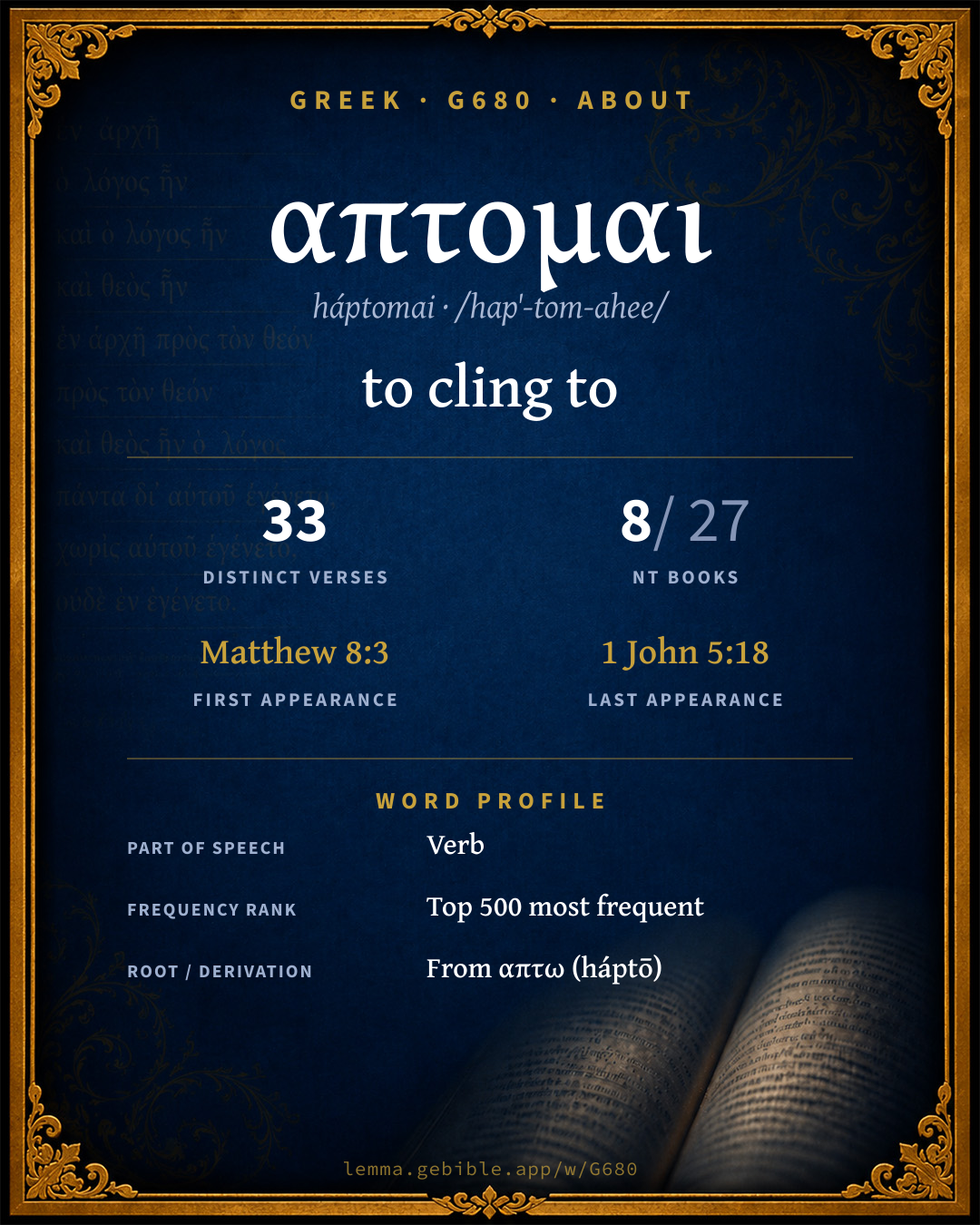
ἅπτομαι
to cling to
Full lexicon entry — Thayer's Greek Lexicon
From Thayer's Greek Lexicon
Where this word appears
Grammar key — what these labels mean
Part of speech
- Verb
- An action or state-of-being word.
Tense
- Aorist
- Action viewed as a simple whole, without regard to duration — often past (perfective aspect).
- Present
- Ongoing or general action in present time (imperfective aspect).
Voice
- Middle deponent
- Middle in form but active in meaning.
- Middle
- The subject acts on or for itself, or with special interest in the action.
Mood
- Indicative
- States a fact or asks a factual question (the mood of reality).
- Participle
- A verbal adjective (“writing,” “having written”).
- Subjunctive
- Expresses probability, purpose, or possibility (the mood of contingency).
- Infinitive
- A verbal noun (“to write”), unmarked for person or number.
- Imperative
- Expresses a command or request.
Case
- Nominative
- The case of the subject (and the predicate nominative).
Person
- 3rd person
- The one spoken about (“he / she / it / they”).
- 1st person
- The speaker (“I / we”).
- 2nd person
- The one addressed (“you”).
Gender
- Masculine
- Grammatically masculine.
Number
- Singular
- One.
- Plural
- More than one.
Every verse where G680 appears in the Book of 1 Corinthians — 1 distinct verse. Click any verse to open its interlinear word-by-word view. Verse text shown in the World English Bible for context — . Each verse’s Greek form is shown with its reference; the English is not keyword-highlighted, since the data carries no word-level English alignment. Use “Compare translations” on any verse to read it across multiple English versions. This concordance covers the Greek New Testament; Septuagint (Greek Old Testament) occurrences of this word are not indexed here.
1 Corinthians
About this entry
At a glance — auto-summarized from this page’s data, not written by a person. Every figure links to its source below. This summary describes the numbers; it doesn’t interpret them.
The Greek verb απτομαι centers on the idea of “to cling to.” Its earliest occurrence is Matthew 8:3. Spanning 33 verses in 8 books, it ranks among the moderately common words of the Greek New Testament. Mark dominates its distribution — 10 of 33 verses. Related forms include απτω and αφη. For the data behind this summary, explore the sense tree and the renderings breakdown below.
Gloss history
Strong's 1890 vs modern scholarship

About this word
Strong's G680 catalogs a Greek word from the Greek New Testament.
These counts are not copied from any lexicon or concordance. They are computed here, from the morphology-tagged Greek New Testament. What Lemma adds →
- 33
- distinct verses
- The word appears in 33 distinct verses.
- 8 / 27
- NT books
- The word appears in 8 of 27 New Testament books.
- #419
- by frequency
- Top 500 most frequent Greek words (rank 419 of 5,347 Greek words by occurrence).
View all 33 occurrences in the concordance →
By section of the New Testament
By traditional corpus
Conventional, traditional groupings — biblical authorship is debated, so this is a traditional corpus grouping, not an authorship claim. Some books belong to more than one corpus (Luke is in both the Gospels and the Lukan corpus, and so on), so these shares overlap and need not total 100%. Each figure is a share of the word’s 33 distinct verses.
- Gospels 29 verses · 88%
- Lukan (Luke–Acts) 10 verses · 30%
- Pauline corpus 3 verses · 9%
- Johannine 2 verses · 6%
- General (Catholic) Epistles 1 verse · 3%
How translations render this word
Counts come from each version’s own published word-to-Strong’s tagging or interlinear alignment — an approximate guide to how each version renders this word, not a word-level alignment the data otherwise carries. Because each total is that version’s own tagged count, the per-version totals vary from one another and need not match the appearance or distinct-verse counts above. These counts may also differ from a printed concordance because Lemma counts each distinctly tagged rendering and does not collapse phrase taggings into a single head-word total. This is a fixed set of word-tagged versions (KJV, ASV, BSB, ULT) and does not change with the reading translation you choose elsewhere. Each version’s license is shown beside its name below (and on Sources).
- King James Version: Touched 16×, Touch 9×, He touched 2×
- American Standard Version: Touched 10×, Touch 9×, He should touch 2×
- Berean Standard Bible: Touched 17×, Touch 4×, He touched 2×
King James Version Public Domain
Renders G680 across 38 tagged occurrences — most commonly:
Plus 9 renderings that appear only once — usually multi-word phrases or single function words the recovered tagging swept in, not distinct renderings.
American Standard Version Public Domain
Renders G680 across 37 tagged occurrences — most commonly:
Plus 10 renderings that appear only once — usually multi-word phrases or single function words the recovered tagging swept in, not distinct renderings.
Berean Standard Bible Public Domain
Renders G680 across 35 tagged occurrences — most commonly:
Plus 6 renderings that appear only once — usually multi-word phrases or single function words the recovered tagging swept in, not distinct renderings.
Senses in Thayer's
The 1 sense Thayer's distinguishes for this word, in lexicon order (not ranked by frequency or importance). The full entry — with sub-senses — is in the Lexicon Entry tab.
- to fasten one's self to, adhere to, cling to
Word origin
Derived from απτω (háptō) (G681) — to adhere to.
Reflexive of G681 ; properly to attach oneself to that is to touch (in many implied relations): - touch.
— Strong’s Exhaustive Concordance (1890), public domain.
Forms in the corpus
The 14 distinct written forms G680 takes in the Greek New Testament, most frequent first — each parse links to that tense’s occurrences in the concordance.
Same root — word family
Other Thayer's entries built from the same root as G680, grouped by Strong’s listed origin. These share a root / origin per the lexicon — not necessarily a shared meaning. Each links to that word’s own entry.
Derives from
Derived from this word
Compare all same-root words → They share a root, not necessarily a meaning.
Septuagint usage
The same Greek word απτομαι appears 112 times in the Greek Old Testament (Septuagint), across 103 verses in 25 books.
- 112
- LXX occurrences
- Tagged occurrences of this Greek word in the Septuagint.
- 103
- verses
- Distinct Septuagint verses containing this word.
- 25 / 39
- OT books
- The word appears in 25 of the 39 Old Testament books.
Sample Septuagint occurrences
- Genesis 3:3 ἅπτομαι
- Exodus 19:12 ἅπτομαι
- Leviticus 5:2 ἅπτομαι
- Numbers 3:10 ἅπτομαι
- Deuteronomy 14:8 ἅπτομαι
- Joshua 9:19 ἅπτομαι
- Judges 6:21 ἅπτομαι
- Ruth 2:9 ἅπτομαι
- 1 Samuel 6:9 ἅπτομαι
- 2 Samuel 5:8 ἅπτομαι
- 1 Kings 6:27 ἅπτομαι
- 2 Kings 13:21 ἅπτομαι
Septuagint occurrences (same lexeme)
Every verse where the same Strong’s number (G680) appears in the Greek Septuagint — showing the first 50 of 103. Verse text shown in the World English Bible for context; the Greek form is the matched word — the English is not keyword-highlighted.
- Genesis 3:3 ἅπτομαι but of the fruit of the tree which is in the midst of the garden, God has said, 'You shall not eat of it, neither shall you touch it, lest you die.'"
- Genesis 20:4 ἅπτομαι Now Abimelech had not come near her. He said, "Lord, will you kill even a righteous nation?
- Genesis 20:6 ἅπτομαι God said to him in the dream, "Yes, I know that in the integrity of your heart you have done this, and I also withheld you from sinning against me. Therefore I didn't allow you to touch her.
- Genesis 26:11 ἅπτομαι Abimelech charged all the people, saying, "He who touches this man or his wife will surely be put to death."
- Genesis 32:26 ἅπτομαι The man said, "Let me go, for the day breaks." Jacob said, "I won't let you go, unless you bless me."
- Genesis 32:33 ἅπτομαι
- Exodus 19:12 ἅπτομαι You shall set bounds to the people round about, saying, 'Be careful that you don't go up onto the mountain, or touch its border. Whoever touches the mountain shall be surely put to death.
- Exodus 19:13 ἅπτομαι No hand shall touch him, but he shall surely be stoned or shot through; whether it is animal or man, he shall not live.' When the trumpet sounds long, they shall come up to the mountain."
- Exodus 29:37 ἅπτομαι Seven days you shall make atonement for the altar, and sanctify it: and the altar shall be most holy; whatever touches the altar shall be holy.
- Exodus 30:29 ἅπτομαι You shall sanctify them, that they may be most holy. Whatever touches them shall be holy.
- Leviticus 5:2 ἅπτομαι "'Or if anyone touches any unclean thing, whether it is the carcass of an unclean animal, or the carcass of unclean cattle, or the carcass of unclean creeping things, and it is hidden from him, and he is unclean, then he shall be guilty.
- Leviticus 5:3 ἅπτομαι "'Or if he touches the uncleanness of man, whatever his uncleanness is with which he is unclean, and it is hidden from him; when he knows of it, then he shall be guilty.
- Leviticus 6:11 ἅπτομαι He shall take off his garments, and put on other garments, and carry the ashes outside the camp to a clean place.
- Leviticus 6:20 ἅπτομαι "This is the offering of Aaron and of his sons, which they shall offer to Yahweh in the day when he is anointed: the tenth part of an ephah of fine flour for a meal offering perpetually, half of it in the morning, and half of it in the evening.
- Leviticus 7:19 ἅπτομαι "'The flesh that touches any unclean thing shall not be eaten. It shall be burned with fire. As for the flesh, everyone who is clean may eat it;
- Leviticus 7:21 ἅπτομαι When anyone touches any unclean thing, the uncleanness of man, or an unclean animal, or any unclean abomination, and eats some of the flesh of the sacrifice of peace offerings, which belong to Yahweh, that soul shall be cut off from his people.'"
- Leviticus 11:8 ἅπτομαι Of their flesh you shall not eat, and their carcasses you shall not touch; they are unclean to you.
- Leviticus 11:24 ἅπτομαι "'By these you will become unclean: whoever touches the carcass of them shall be unclean until the evening.
- Leviticus 11:26 ἅπτομαι "'Every animal which parts the hoof, and is not cloven-footed, nor chews the cud, is unclean to you. Everyone who touches them shall be unclean.
- Leviticus 11:27 ἅπτομαι Whatever goes on its paws, among all animals that go on all fours, they are unclean to you. Whoever touches their carcass shall be unclean until the evening.
- Leviticus 11:31 ἅπτομαι These are they which are unclean to you among all that creep. Whoever touches them when they are dead, shall be unclean until the evening.
- Leviticus 11:36 ἅπτομαι Nevertheless a spring or a cistern in which water is a gathered shall be clean: but that which touches their carcass shall be unclean.
- Leviticus 11:39 ἅπτομαι "'If any animal, of which you may eat, dies; he who touches its carcass shall be unclean until the evening.
- Leviticus 12:4 ἅπτομαι She shall continue in the blood of purification thirty-three days. She shall not touch any holy thing, nor come into the sanctuary, until the days of her purifying are completed.
- Leviticus 15:5 ἅπτομαι Whoever touches his bed shall wash his clothes, and bathe himself in water, and be unclean until the evening.
- Leviticus 15:7 ἅπτομαι "'He who touches the body of him who has the discharge shall wash his clothes, and bathe himself in water, and be unclean until the evening.
- Leviticus 15:10 ἅπτομαι Whoever touches anything that was under him shall be unclean until the evening. He who carries those things shall wash his clothes, and bathe himself in water, and be unclean until the evening.
- Leviticus 15:11 ἅπτομαι "'Whoever he who has the discharge touches, without having rinsed his hands in water, he shall wash his clothes, and bathe himself in water, and be unclean until the evening.
- Leviticus 15:12 ἅπτομαι "'The earthen vessel, which he who has the discharge touches, shall be broken; and every vessel of wood shall be rinsed in water.
- Leviticus 15:19 ἅπτομαι "'If a woman has a discharge, and her discharge in her flesh is blood, she shall be in her impurity seven days: and whoever touches her shall be unclean until the evening.
- Leviticus 15:21 ἅπτομαι Whoever touches her bed shall wash his clothes, and bathe himself in water, and be unclean until the evening.
- Leviticus 15:22 ἅπτομαι Whoever touches anything that she sits on shall wash his clothes, and bathe himself in water, and be unclean until the evening.
- Leviticus 15:23 ἅπτομαι If it is on the bed, or on anything whereon she sits, when he touches it, he shall be unclean until the evening.
- Leviticus 15:27 ἅπτομαι Whoever touches these things shall be unclean, and shall wash his clothes, and bathe himself in water, and be unclean until the evening.
- Leviticus 22:4 ἅπτομαι "'Whoever of the seed of Aaron is a leper or has an issue; he shall not eat of the holy things, until he is clean. Whoever touches anything that is unclean by the dead, or a man whose seed goes from him;
- Leviticus 22:5 ἅπτομαι or whoever touches any creeping thing, whereby he may be made unclean, or a man of whom he may take uncleanness, whatever uncleanness he has;
- Leviticus 22:6 ἅπτομαι the person that touches any such shall be unclean until the evening, and shall not eat of the holy things, unless he bathe his body in water.
- Numbers 3:10 ἅπτομαι You shall appoint Aaron and his sons, and they shall keep their priesthood. The stranger who comes near shall be put to death."
- Numbers 3:38 ἅπτομαι Those who encamp before the tabernacle eastward, in front of the Tent of Meeting toward the sunrise, shall be Moses, and Aaron and his sons, keeping the charge of the sanctuary for the charge of the children of Israel. The stranger who comes near shall be put to death.
- Numbers 4:15 ἅπτομαι "When Aaron and his sons have finished covering the sanctuary, and all the furniture of the sanctuary, as the camp moves forward; after that, the sons of Kohath shall come to carry it: but they shall not touch the sanctuary, lest they die. These things are the burden of the sons of Kohath in the Tent of Meeting.
- Numbers 16:26 ἅπτομαι He spoke to the congregation, saying, Depart, I pray you, from the tents of these wicked men, and touch nothing of theirs, lest you be consumed in all their sins.
- Numbers 17:28 ἅπτομαι
- Numbers 19:11 ἅπτομαι He who touches the dead body of any man shall be unclean seven days:
- Numbers 19:13 ἅπτομαι Whoever touches a dead person, the body of a man who has died, and doesn't purifies himself, defiles the tent of Yahweh; and that soul shall be cut off from Israel: because the water for impurity was not sprinkled on him, he shall be unclean; his uncleanness is yet on him.
- Numbers 19:16 ἅπτομαι Whoever in the open field touches one who is slain with a sword, or a dead body, or a bone of a man, or a grave, shall be unclean seven days.
- Numbers 19:18 ἅπτομαι and a clean person shall take hyssop, and dip it in the water, and sprinkle it on the tent, and on all the vessels, and on the persons who were there, and on him who touched the bone, or the slain, or the dead, or the grave:
- Numbers 19:21 ἅπτομαι It shall be a perpetual statute to them: and he who sprinkles the water for impurity shall wash his clothes, and he who touches the water for impurity shall be unclean until even.
- Numbers 19:22 ἅπτομαι Whatever the unclean person touches shall be unclean; and the soul that touches it shall be unclean until even.
- Numbers 31:19 ἅπτομαι Encamp you outside of the camp seven days: whoever has killed any person, and whoever has touched any slain, purify yourselves on the third day and on the seventh day, you and your captives.
- Deuteronomy 14:8 ἅπτομαι The pig, because it has a split hoof but doesn't chew the cud, is unclean to you: of their flesh you shall not eat, and their carcasses you shall not touch.
These are occurrences of the same Greek lexeme (G680) in the Septuagint — not a translation of any one Hebrew word. The store carries no word-level Hebrew↔Greek alignment, so no Hebrew original is asserted here. Counts come from the recovered LXX Strong's tagging — high-frequency vocabulary is well covered, while rare or late forms may be untagged — so they reflect tagged occurrences and may slightly undercount.