Colossians 2:21

Greek (Tischendorf 8th ed.) Colossians 2:21 appears in the Greek New Testament. The text above is from the Tischendorf 8th edition. Each word links to its Strong’s number and a concise gloss. Click any word for its full Thayer’s Greek Lexicon entry.
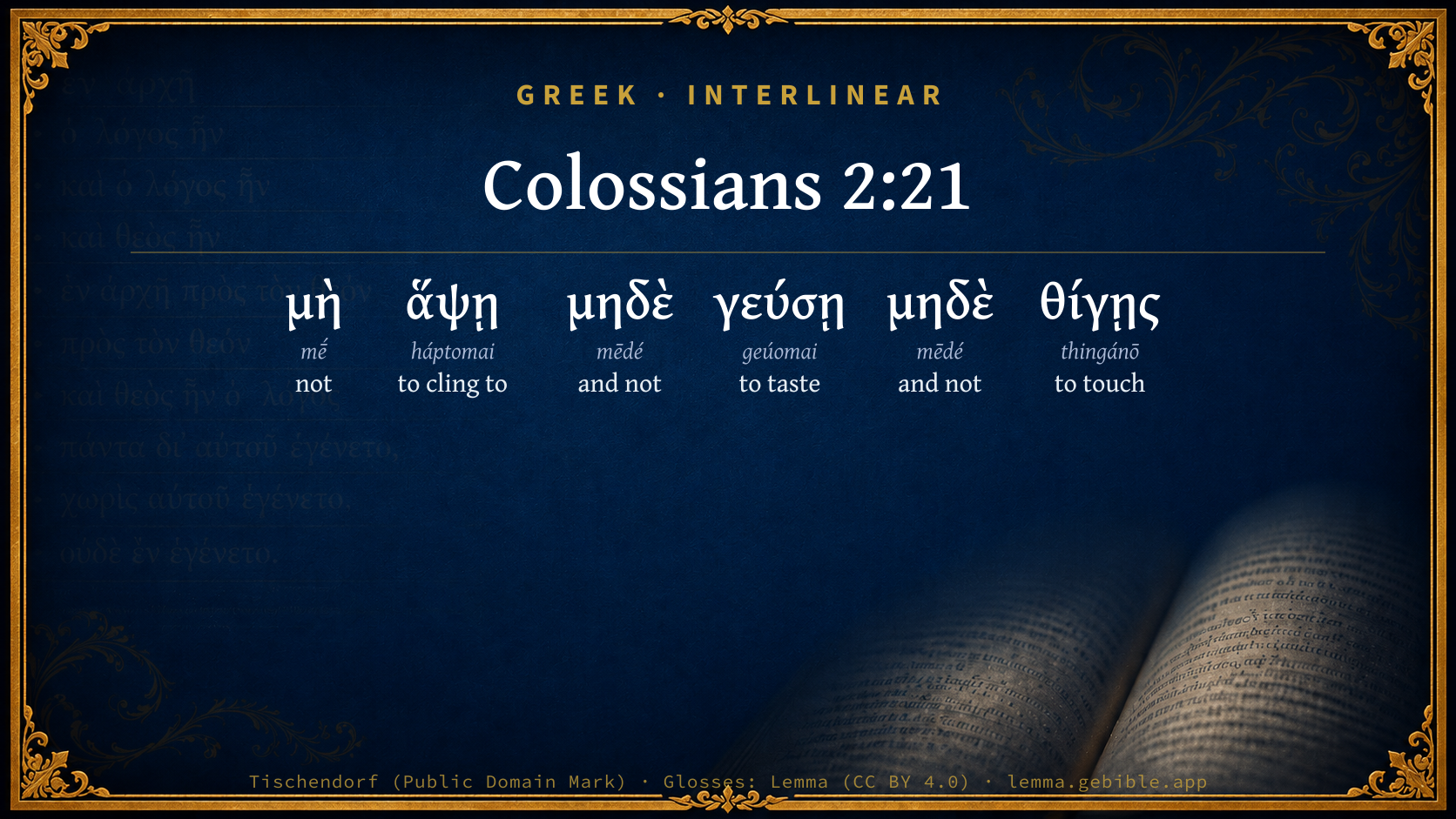
Download image
Cite this verse

Colossians 2:21 (World English Bible). Public Domain. Lemma interlinear Bible study tool, https://lemma.gebible.app/v/colossians/2/21.

Show BibTeX & RIS
BibTeX
RIS
English Translation
"Don't handle, nor taste, nor touch"
World English Bible · Public Domain
Highlights
  • 1 first appearance in the Greek New Testament
Full analysis ↓
Download a study sheet

One document with this verse’s original text, its word-by-word gloss line, the meaning frame, cross-references with their text, attributed commentary, and full source and license credits — printable, and it pastes into notes with its structure intact.

This verse Autodidact and up

Study sheet (.html) Plain text (.txt)

A passage Seminary Student

Up to 50 verses in one chapter. A passage sheet keeps up to 6 commentary sources and 12 cross-references per verse, in the order this page ranks them, and says so on the sheet whenever that leaves anything out. Ask for a single verse and you get the Autodidact verse sheet above.

Everything on this page stays free to read, with no account — the sheet is a download of what is already on screen, not access to it.

Want to remove ads? Support Godless Engineer
Compare translations 3

The same verse in 3 English versions, stacked beneath the original-language interlinear above. Click any original word for its lexicon entry.

Each is an independent rendering of the whole verse — the interlinear is not word-aligned to these translations.

Highlighted words mark where these versions differ — a whole-verse word diff, not a word-by-word alignment.

  • World English Bible Public Domain
    "Don't handle, nor taste, nor touch"
  • King James Version Public Domain
    (Touch not; taste not; handle not;
  • unfoldingWord Literal Text CC BY-SA 4.0
    “You may not handle, nor taste, nor touch!”

unfoldingWord Literal Text — © unfoldingWord, licensed CC BY-SA 4.0. Word-aligned USFM3 via Door43 (git.door43.org/unfoldingWord/en_ult).

Versions to compare (up to 4)

3 of 4 selected

Show all 19 translations

Every available English version of this verse, each an independent rendering of the whole verse.

  • World English Bible Public Domain
    "Don't handle, nor taste, nor touch"
  • Berean Standard Bible Public Domain
    “Do not handle, do not taste, do not touch!”?
  • Majority Standard Bible Public Domain
    “Do not handle, do not taste, do not touch!”?
  • King James Version Public Domain
    (Touch not; taste not; handle not;
  • American Standard Version (1901) Public Domain
    Handle not, nor taste, nor touch
  • Revised Version (1885) Public Domain
    Handle not, nor taste, nor touch
  • Geneva Bible (1599) Public Domain
    As, Touch not, Taste not, Handle not.
  • Douay-Rheims (1899) Public Domain
    Touch not, taste not, handle not:
  • Young's Literal Translation Public Domain
    -- thou mayest not touch, nor taste, nor handle --
  • Literal Standard Version CC BY-SA 4.0
    you may not touch, nor taste, nor handle—
  • Unlocked Literal Bible CC BY-SA 4.0
    “Do not handle, nor taste, nor touch”?
  • unfoldingWord Literal Text CC BY-SA 4.0
    “You may not handle, nor taste, nor touch!”
  • Darby Bible Public Domain
    Do not handle, do not taste, do not touch,
  • World Messianic Bible Public Domain
    “Don’t handle, nor taste, nor touch”
  • Webster's Bible Public Domain
    (Touch not; taste not; handle not;
  • Free Bible Version CC BY-SA 4.0
    Things like: don't handle that, don't taste that, don't touch that!
  • Bible in Basic English Public Domain
    Which say there may be no touching, tasting, or taking in your hands,
  • Text-Critical English NT CC BY 4.0
    “Do not handle, do not taste, do not touch”?
  • Tyndale New Testament (1534) Public Domain
    Touche not tast not handell not:

Literal Standard Version (2020), Covenant Press — licensed CC BY-SA 4.0. Text via the HelloAO Bible API (eBible.org). Unlocked Literal Bible (unfoldingWord) — licensed CC BY-SA 4.0. Text via the HelloAO Bible API (eBible.org). unfoldingWord Literal Text — © unfoldingWord, licensed CC BY-SA 4.0. Word-aligned USFM3 via Door43 (git.door43.org/unfoldingWord/en_ult). Free Bible Version, Dr. Jonathan Gallagher — licensed CC BY-SA 4.0. Text via the HelloAO Bible API (eBible.org).

Word by word

More ways to search: Search by grammar → Find every occurrence → Compare this word →

Practice this passage: Drill this verse → Learn its vocabulary →

About this verse

These counts appear in no published source. They are computed here, from the morphology-tagged text and Lemma’s own curated glosses. What Lemma adds →

6
words
5
distinct lemmas
Pauline Epistles
section

Notable vocabulary

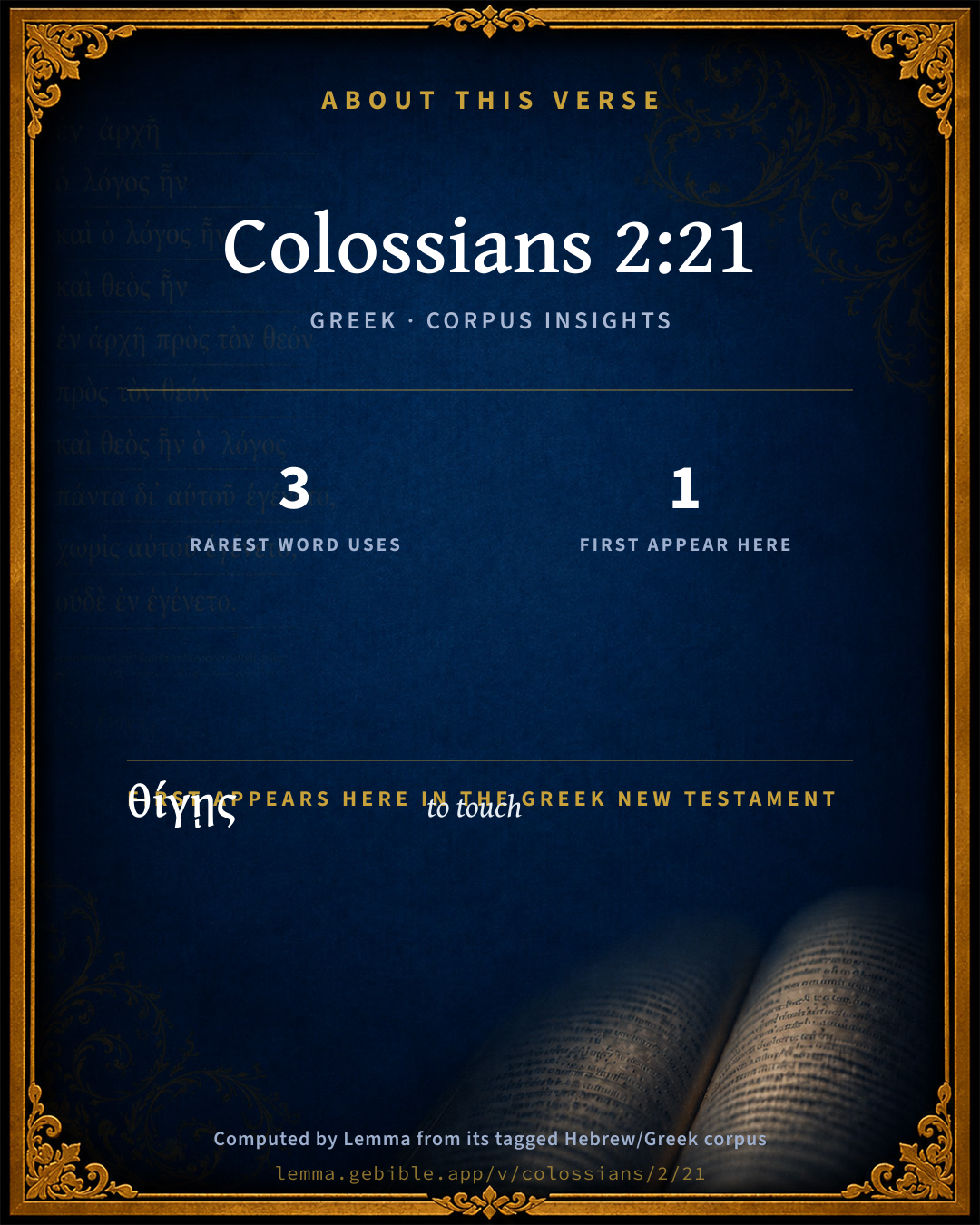
The rarest word here is θίγῃς to touch G2345 — appearing just 3 times in the whole Greek New Testament.

First appearance in Scripture

This word makes its first canonical appearance in the Greek New Testament here:

  • θίγῃς to touch G2345

Shared distinctive vocabulary

θίγῃς to touch G2345 occurs in 3 verses of the Greek New Testament. Also found in:

Repetition

A word recurs within this verse:

  • μηδὲ and not G3366 ×2

Cross-references

4

Topical passages linked to Colossians 2:21 in the Treasury of Scripture Knowledge — connected by theme and wording, ordered by reader-vote popularity; previews shown in the World English Bible.

  • 1 Timothy 4:3 forbidding marriage and commanding to abstain from foods which God created to be received with thanksgiving by those who believe and know the truth.
  • Isaiah 52:11 Depart you, depart you, go you out from there, touch no unclean thing; go you out of the midst of her; cleanse yourselves, you who bear the vessels of Yahweh.
  • Genesis 3:3 but of the fruit of the tree which is in the midst of the garden, God has said, 'You shall not eat of it, neither shall you touch it, lest you die.'"
  • 2 Corinthians 6:17 Therefore, "'Come out from among them, And be separate,' says the Lord, 'Touch no unclean thing. I will receive you.

Cross-references courtesy of OpenBible.info (CC BY 4.0).

Commentary

Notes on Colossians 2:21 from classic Christian and Jewish commentators (each source and its license shown beneath its notes). The classic Christian expositions comment on the surrounding passage and are grouped to its opening verse, so a note may address several verses; the Jewish commentaries on the Tanakh (Rashi and others) are per-verse, so they appear only where the commentator wrote on this verse.

Lemma curates 59 commentaries, every one of them public domain or Creative Commons licensed, each selected and text-cleaned for this edition rather than reprinted as found. About our sources →

Bengel's Gnomon

Johann Albrecht Bengel

Col 2:21. Μὴ, not) Thus the dogmatists commonly spoke.—ἅψῃ, touch) The genus; the species are, to taste (γεύσῃ) with the tongue, and to handle (θίγῃς) with the hand.

Bengel's Gnomon of the New Testament — English translation (T&T Clark, Edinburgh, 1860) — public domain. Text from a community e-Sword module.

Expositor's Greek Testament

ed. W. Robertson Nicoll

Col 2:21 . The precepts here quoted are those of the false teachers, and are, of course, quoted to be condemned, though their meaning is frequently misunderstood. It is not said what things are thus prohibited, but the context supports the reference to meats and drinks, and is confirmed by μηδὲ γεύσῃ . There is no reason whatever to suppose that there is any reference to a prohibition of sexual relations. μὴ ἅψῃ μηδὲ γεύσῃ μηδὲ θίγῃς . “Handle not, nor taste, nor even touch.” There is perhaps a gradation in the order from coarser to more refined contact.

The Expositor's Greek Testament, edited by W. Robertson Nicoll (1897–1910) — public domain. Text from a community e-Sword module.

Geneva Bible (1599)

Geneva Bible translators

An imitation in the person of these superstitious men, rightly expressing their nature and use of speech.

Geneva Bible (1599) marginal notes — public domain. Text via Bolls.life.

Jamieson, Fausset & Brown

Robert Jamieson, A. R. Fausset & David Brown

Compare Col 2:16, "meat . . . drink." He gives instances of the "ordinances" (Col 2:20) in the words of their imposers. There is an ascending climax of superstitious prohibitions. The first Greek word (hapse) is distinguished from the third (thiges), in that the former means close contact and retention: the latter, momentary contact (compare Co1 7:1; Joh 20:17, Greek, "Hold me not"; cling not to me"). Translate, "Handle not, neither taste, nor even touch." The three refer to meats. "Handle not" (a stronger term than "nor even touch"), "nor taste" with the tongue, "nor even touch," however slight the contact.

Jamieson, Fausset & Brown — Commentary Critical and Explanatory on the Whole Bible (1871) — public domain (CC PDM 1.0). Text via the HelloAO Bible API.

Adam Clarke's Commentary

Verse 21. Touch not; taste not; handle not] These are forms of expression very frequent among the Jews. In Maccoth, fol. xxi. 1: "If they say to a Nazarite, Don't drink, don't drink; and he, notwithstanding, drinks; he is guilty. If they say, Don't shave, don't shave; and he shaves, notwithstanding; he is guilty. If they say, Don't put on these clothes, don't put on these clothes; and he, notwithstanding, puts on heterogeneous garments; he is guilty." See more in Schoettgen.

Adam Clarke's Commentary on the Bible (1810–1826) — public domain. Text from a community e-Sword/MySword module.

John Calvin's Commentaries

21. Eat not, taste not. Hitherto this has been rendered — Handle not, but as another word immediately follows, which signifies the same thing, every one sees how cold and absurd were such a repetition. Farther, the verb ἅπτεσθαι is employed by the Greeks, among its other significations, in the sense of eating, in accordance with the rendering that I have given. Plutarch makes use of it in the life of Caesar, when he relates that his soldiers, in destitution of all things, ate animals which they had not been accustomed previously to use as food. And this arrangement is both in other respects natural and is also most in accordance with the connection of the passage; for Paul points out, (μιμητικῶς,) by way of imitation, to what length the waywardness of those who bind consciences by their laws is wont to proceed. From the very commencement they are unduly rigorous: hence he sets out with their prohibition — not simply against eating, but even against slightly partaking. After they have obtained what they wish they go beyond that command, so that they afterwards declare it to be unlawful to taste of what they do not wish should be eaten. At length they make it criminal even to touch. In short, when persons have once taken upon them to tyrannize over men’s souls, there is no end of new laws being daily added to old ones, and new enactments starting up from time to time. How bright a mirror there is as to this in Popery! Hence Paul acts admirably well in admonishing us that human traditions are a labyrinth, in which consciences are more and more entangled; nay more, are snares, which from the beginning bind in such a way that in course of time they strangle in the end.

John Calvin's Commentaries (1540-1563) — public domain. Text from the Calvin Translation Society English edition (1840s-50s) via the Christian Classics Ethereal Library (ccel.org). Calvin's coverage is partial (roughly two-thirds of the Bible); uncommented books and verses are honest gaps, never fabricated. The 19th-century editor's footnotes and remarks are omitted so the notes are faithfully Calvin's own voice.

Ellicott's Commentary for English Readers

(21) Touch not; taste not; handle not.—The first and last of these renderings should be inverted. There is in the commands a climax of strictness. “Handle not” (the unclean thing), “taste it not,” “touch it not” with one of your fingers. It will be noted that all these commands are negative, not positive. They are marked by the ordinary ascetic preference of spiritual restraint to spiritual energy.

A Bible Commentary for English Readers, edited by Charles John Ellicott (1878–1897) — public domain. Text from a community e-Sword module.

The Cambridge Bible for Schools and Colleges

gen. ed. J. J. S. Perowne

21. (touch not; taste not; handle not;] Better (discarding the bracket here), Handle thou not, nor taste, nor touch. This rendering represents exactly the construction of the Greek, and is truer to the shades of meaning of the first and last of the three Greek verbs. The last verb denotes a lighter and less deliberate touch than the first, and so here conveys a climax of prohibition.

The prohibitions in question would be those of the Mosaic law, developed and exaggerated by the Pharisaic schools. Schoettgen (Horœ Hebr. in N. T.) quotes from the Talmud just such precepts: “Touch not a vessel, till thou hast washed hands and feet from (its) brim;” “They say to a Nazirite, Drink not … shave not … &c.” “The Latin commentators, Hilary and Pelagius, suppose these prohibitions to be the Apostle’s own, thus making a complete shipwreck of the sense” (Lightfoot). In much more modern comments the same mistake appears.

Our Lord’s teaching (e.g. Mat_15:1-20) takes the exactly opposite direction to this system of prohibitions, and is a lasting warning to His Church on all kindred subjects. Cp. also 1 Corinthians 8; 1Ti_4:3.

The Cambridge Bible for Schools and Colleges (gen. ed. J. J. S. Perowne; Cambridge University Press, 1878–1918) — public domain. Text from a community e-Sword module.

John Gill's Exposition

Touch not, taste not, handle not. This the apostle says, not of himself, but in the person of the Jewish doctors; who urging the use of the ceremonial law, to which they added decrees and constitutions of their own, said, "touch not" the dead body of any man, the bone of a man, or a grave, any man or woman in their uncleanness; not only their flesh, but the bed they lay on, or the seat they sat on; or any creature that was by the law unclean; of a Gentile, or any notorious sinner, or common man: hence the Pharisees used to wash themselves when they returned from market, lest they should have been by any means accidentally defiled by touching any thing unclean. There is a treatise in their Misna, called Oholot, which gives many rules, and is full of decrees about things , "that defile by touching". And so they likewise said, "taste not", neither the fat, nor the blood of any creature which might be eaten itself, nor swine's flesh, nor the flesh of any creature that chewed the cud, or divided the hoof; nor might the Nazarites taste wine, or strong drink, or vinegar made of either, or moist grapes, or even the kernels and husks; and if a man ate but the quantity of an olive of any of the above things, he was, according to the Jewish canons, to be cut off, or beaten (x): and they also said, "handle not"; or, as the Syriac and Arabic read, "do not come near", or "draw not nigh", to a Gentile, to one of another nation, or any unclean person, to whom they forbid any near approach or conversation; or "handle not" any of the above things. Some think that these several rules have respect only to meats; as "touch not", that is, do not eat of things forbidden ever so little; nay, "taste not", do not let anything of them come within your lips; yea, "handle not", do not so much as touch them with your fingers. Others think that touch not regards abstinence from women; see Co1 7:1; and respects the prohibition of marriage by some in those times; and "taste not", the forbearance of certain meats, at certain times, which God had not restrained any from; and "handle not", that is, make no use of, or enjoy your own goods, and so designs that voluntary poverty which some entered into under the direction of false teachers,

(x) Maimon. Maacolot Asurot, c. 7. sect. 1. & c. 14. sect. 2. & Nezirut, c. 5. sect. 3.

John Gill's Exposition of the Whole Bible (1746–1763) — public domain (CC PDM 1.0). Text via the HelloAO Bible API.

Trapp's Complete Commentary

John Trapp

21 (Touch not; taste not; handle not;

Ver. 21. Touch not, taste not, &c.] The words of those impostors, which are here mimetically, or by way of imitation, related. See the like Ecc 10:14, where the wise man graphically describeth the fool’s tautologies, "A man cannot tell what shall be, and what shall be, who can tell?" As for the sense, an excellent textman gives it thus: "Touch not;" viz. a woman, 1Co 7:1; "Taste not;" viz. meat. "Handle not;" viz. money, meddle not with secular contracts. (Dr Sclater.) This was that holy hypocrisy practised by these ancient seducers, and still commended by the Popish padres to their novices, and that with much eagerness, "touch not, taste not, handle not," without a copulative. The Capuchin friars in this day may not take or touch silver. This metal is as very anathema to these, as the wedge of gold to Achan, at the offer whereof they start back, as Moses from the serpent; yet they have ever a boy with them, that takes and carries it, and never complains of either metal or measure. In the year of grace 1453, John Capistranus, a Minorite, was sent by Pope Nicolas into Germany, and other countries, to preach and persuade obedience to the see of Rome; and that he might win authority to his doctrine, he strictly forbade feasting and sporting, and other civil exercises, lawful to be used; by which holy hypocrisy (as they call it) he gained the reputation of a very pious man, when he was nothing less. (Funccius.) But these things have a show of wisdom in neglecting the body, &c., and silly souls are much taken with such shows, as children are with gaudies and gewgaws. {a}

{a} A gaudy trifle, plaything, or ornament, a pretty thing of little value, a toy or bauble. ŒD

John Trapp, A Commentary or Exposition upon All the Books of the Old and New Testament (1647–1656) — public domain. Text from a community e-Sword module.

Albert Barnes' Notes on the Bible

Tough not; taste not; handle not - These words seem intended as a specimen of the kind of ordinances which the apostle refers to, or an imitation of the language of the Jewish teachers in regard to various kinds of food and drink. “Why are ye subject to ordinances of various kinds, such as this - Touch not, taste not, handle not?” That is, such as prohibit you from even touching certain kinds of food, or tasting certain kinds of drink, or handling certain prohibited things. The rapid succession of the words here, without any connecting particle, is supposed to denote the eagerness of the persons who imposed this injunction, and their earnestness in warning others from contaminating themselves with the prohibited things. Many injunctions of this kind are found in the writings of the Jewish rabbis; and the ancient Jewish sect of the Essenes (Notes, Mat 3:7) abounded in precepts of this kind.

See Schoetgen, and Pict. Bib. in loc. “They allowed themselves no food that was pleasant to the taste, but ate dry, coarse bread, and drank only water. Many of them ate nothing until sunset, and, if anyone touched them who did not belong to their sect, they washed themselves as if they had been most deeply defiled. Perhaps there was at Colossae a society of this kind, as there were in many other places out of Judea; and, if there was, it is not improbable that many Christians imitated them in the uniqueness of their rules and observances;” compare Jenning’s Jew. Ant. i. 471, and Ros. Alt. u. neu. Morgenland, in loc. If this be the correct interpretation, then these are not the words of the apostle, forbidding Christians to have anything to do with these ordinances, but are introduced as a specimen of the manner in which they who enjoined the observance of those ordinances pressed the subject on others.

There were certain things which they prohibited, in conformity with what they understood to be the law of Moses; and they were constantly saying, in regard to them, “do not touch them, taste them, handle them.” These words are often used as a kind of motto in reference to the use of intoxicating drinks. They express very well what is held by the friends of total abstinence; but it is obvious that they had no such reference as used by the apostle, nor should they be alleged as an authority, or as an argument, in the question about the propriety or impropriety of the use of spirituous liquors. They may as well be employed in reference to anything else as that, and would have no authority in either case. Intoxicating drinks should be abstained from; but the obligation to do it should be made to rest on solid arguments, and not on passages of Scripture like this. This passage could with more plausibility be pressed into the service of the enemies of the total abstinence societies, than into their support; but it really has nothing to do with the subject, one way or the other.

Albert Barnes' Notes on the Bible (1834–1885) — public domain. Text from a community e-Sword/MySword module.

Haydock's Catholic Bible Commentary

Touch not, &c. That is, why do you permit yourselves to be taught in this manner by those Jewish doctors: why do you touch or eat this, lest you be unclean? such superstitious observations, now at least, when there is no necessity nor obligation for you to observe them, tend to destruction, &c. (Witham) --- The meaning is, that Christians should not subject themselves, either to the ordinances of the old law, forbidding touching or tasting things unclean: or to the superstitious inventions of heretics, imposing such restraints, under pretence of wisdom, humility, or mortification. (Challoner)

George Leo Haydock (1774–1849), Haydock's Catholic Family Bible and Commentary, 1859 edition — public domain. Excludes Psalms (Douay-Rheims chapter numbering differs from Protestant) and Deuterocanonical books (Catholic canon only).

Matthew Poole's English Annotations

Which he doth here by way of imitation, upbraiding of them, elegantly recite in the words, phrases, or sense of those imposing dogmatists, whose superstition and lust of domineering over the consciences of Christians is taxed, in the gradation which the well skilled in the Greek judge to be in the original. For though the first, and which we render

touch not, be sometimes so rendered, yet, considering here the coincidency or tautology will, so rendered, make with the last, the sense of it, as the most judicious and learned have evidenced, seems to be, eat not, as noting they did forbid the eating, i.e. using certain meats at their ordinary meals; (against the reviving of which imposition above, Col 2:16, as will bring in a new one of like import, the apostle elsewhere expresseth himself, Rom 14:17; 1Co 8:8; 1Ti 4:3); obtaining which, they proceeded to forbid the not tasting, and then the not handling, or touching of them with the hand, as if that would defile. It being more not to taste than not to eat, and likewise more not to touch with the finger than not to taste. Expressing the ingenuity of such superstitious imposers, that they heap up one thing upon another to the burdening of consciences, not knowing where to make an end in their new invented external devotions and observances, which, as snares, do first bind fast, and in tract of time strangle. He speaks of these as distinct from those, Col 2:16, they being for antiquated rites which had been of God’s appointment, these for innovations of man’s invention, as is apparent from the last verse.

Matthew Poole's English Annotations on the Holy Bible (1683–1685) — public domain. Text from a community e-Sword/MySword module.

Whedon's Commentary on the Bible

Daniel D. Whedon

21. Touch… not—These expressions are quoted from the false teacher, as specimens of the ordinances referred to.

Daniel D. Whedon (gen. ed.), Commentary on the Old and New Testaments (1874–1909) — public domain. Text from a community e-Sword module.

The Pulpit Commentary

Ver. 21 gives examples of the decrees which the Colossians are blamed for regarding and in this respect more than in any other they seem to have yielded to the demands of the false teacher. "Do not handle, nor taste, nor touch (vers. 16, 23; 1Co_6:12, 13 8:8 10:25-27, 30; Rom_14:14-17; 1Ti_4:3-5; Tit_1:15) These rules form part of a prohibitory regimen by which sinful tendencies to bodily pleasure were to be repressed (ver. 23), and spiritual truths symbolically enforced (ver. 17; see note on "circumcision," ver. 11): comp. Philo, "On Concupiscence;" also "On Victims," Qighv the last of the three verbs, appears to be the strongest, forbidding the slightest con tact. Ayh is better rendered "handle" (comp.; Joh_20:17) by itself it will scarcely bear the meaning it has in 1Co_7:1. The next verse seems to imply that all three verbs relate to matters of diet. Ambrose and other Latin Fathers of ascetic tendencies put these prohibitions into the mouth of St. Patti himself, reversing his meaning.

The Pulpit Commentary (1880–1919), ed. H.D.M. Spence-Jones & Joseph S. Exell — public domain. Text from a community e-Sword module.

John Wesley's Explanatory Notes

Touch not - An unclean thing. Taste not - Any forbidden meat. Handle not - Any consecrated vessel.

John Wesley, Explanatory Notes Upon the Whole Bible (1754–1765) — public domain. Text via the GEBible commentary corpus.

The People's New Testament

B. W. Johnson

21. Touch not, etc. Why are you subject to prohibitions of food and drink which command you to “touch not?” etc.

B. W. Johnson's The People's New Testament with Notes (1889–1891) — public domain. Electronic text from the Christian Classics Ethereal Library (CCEL) ThML edition.

Cambridge Greek Testament for Schools and Colleges

21. Μὴ ἅψῃ μηδὲ γεύσῃ μηδὲ θίγῃς, “Handle not, nor taste, nor touch.”

On the force of the aor. subj. in prohibitions, and its infrequency in St Paul’s Epp., see Moulton, Gram. Proleg. 1906, pp. 122–126.

The three prohibitions indicate the nature of the δόγματα, and are on a scale both descending, apparently, in material appropriation and ascending in religious scrupulosity.

On the relation of ἅπτομαι to θιγγάνω see Trench, Synon. § xvii.

Apparently foods are the chief object of the prohibition (cf. Col 2:16), and it is not impossible that it concerns them exclusively. In this case “handle” may refer primarily to taking food from the dish as they still do in the East, “taste” to perhaps eating anything above the size of an olive, “touch” to even grazing the forbidden food. Compare Wetstein’s quotation from Xen. Cyr. I. 3. 5, ὅταν μὲν τοῦ ἄρτου ἅψῃ, εἰς οὐδὲν τὴν χεῖρα ἀποψώμενον· ὅταν δὲ τούτων τινὸς θίγῃς, εὐθὺς ἀποκαθαίρεις χεῖρα εἰς τὰ χειρόμακτρα.

Cambridge Greek Testament for Schools and Colleges (Cambridge University Press, 1896; 21 vols, various authors incl. Carr, Maclear, Plummer, Farrar, Lumby, Moule, M. R. James, Simcox) — public domain. Text from a community e-Sword module.

International Critical Commentary

21. “μὴ ἅψῃ μηδὲ γεύσῃ μηδὲ θίγῃς.” Examples of the δόγματα, “Handle not, neither taste, nor touch.” ἅπτεσθαι is stronger than θιγγάνειν, suggesting rather “taking hold of” than merely “touching.” Thus Themist. Paraphr. Arist. 94, ἡ τῶν ζώων ἁφὴ κρίσις ἐστὶ καὶ ἀντίληψις τοῦ θιγγάνοντος. Compare Xen. Cyrop. i. 3. 5, ὅτι σε, φάναι, ὁρῶ, ὅταν μὲν τοῦ ἄρτου ἅψῃ, εἰς οὐδὲν τὴν χεῖρα ἀποψώμενον, ὅταν δὲ τούτων τινὸς θίγῃς εὐθὺς ἀποκαθαίρει τὴν χεῖρα εἰς τὰ χειρόμακτρα. In the N.T. comp. Mat 8:3, ἥψατο αὐτοῦ ὁ Ἰησοῦς: ib. 15, τῆς χειρὸς αὐτῆς: Joh 20:17, μή μου ἅπτου (often in the Gospel): 1Co 7:1, γυναικὸς μὴ ἅπτεσθαι: 2Co 6:17, ἀκαθάρτου μὴ ἅπτεσθε. θιγγάνειν occurs in N.T. only here and Heb 11:28, Heb 12:20 (a quotation). Hence there is a climax of prohibitions, reversed in the AV., following perhaps (through Tyndale) the Latin, which has “tangere” for ἅπτεσθαι, and “contrectare” for θιγεῖν. Coverdale renders well (except as to the order), “as when they say, touch not this, taste not that, handle not that.” There were such prohibitions in the Mosaic law, and these were, doubtless, not only re-enacted, but exaggerated by the Colossian false teachers, as they had been by the Jewish. The form of the Rabbinical precepts was just that here given. The Essenes also abstained from the use of wine, oil, and animal food, and would not touch food prepared by defiled hands.

Some commentators have suggested a special object for each of the three verbs; for example, for ἅψῃ (γυναικός), which others have supplied to θίγῃς. This form of asceticism, which also was practised by the Essenes, is referred to in 1Ti 4:3, κωλυόντων γαμεῖν; but it is not suggested by anything in the present context, and would hardly be referred to so obscurely. Other suggestions have been offered which do not deserve mention, since it is clear that St. Paul is only citing typical forms of prohibition. For the same reason we must not suppose the prohibitions limited to food.

It is a singular illustration of the asceticism of a later date, that some Latin commentators (Ambrose, Hilary, Pelagius) regarded these prohibitions as the apostle’s own. In the words of Augustine, who argues against this view: “tanquam praeceptum putatur apostoli, nescio quid tangere, gustare, attaminare, prohibentis” (Epist. cxix., ii. p. 412). Jerome gives the correct interpretation, which he illustrates from the Talmud, i. 84.

International Critical Commentary — older volumes (1896–1929), various authors — public domain. Text from a community e-Sword module.

Vincent's Word Studies in the New Testament

Marvin R. Vincent

Touch - taste - handle [αψη - γευση - θιγης] . %Aptomai, A. V., touch, is properly to fasten one's self to or cling to. So Joh 20:17 (note). Frequently rendered touch in the New Testament, and used in most cases of Christ 's touching or being touched by the diseased. To get hands on so as to injure, 1Jo 5:18. To have intercourse with, 1Co 7:1; 2Co 6:17. Thus, in every case, the contact described exerts a modifying influence, and a more permanent contact or effect of contact is often implied than is expressed by touch. "The idea of a voluntary or conscious effort is often involved." No single English word will express all these phases of meaning. Handle comes, perhaps, as near as any other, especially in its sense of treatment, as when we say that a speaker or writer handles a subject; or that a man is roughly handled by his enemies. This wider and stronger sense does not attach to qigganein A. V., handl

Marvin R. Vincent, Word Studies in the New Testament (1887–1900) — public domain. Text from a community e-Sword/MySword module.

Lightfoot's Colossians and Philemon

J. B. Lightfoot

δογματίζεσθε] ‘are ye overridden with precepts, ordinances.’ In the LXX the verb δογματίζειν is used several times, meaning ‘to issue a decree,’ Esth. iii. 9, 1 Esdr. vi. 33, 2 Macc. x. 8, xv. 36, 3 Macc. iv. 11. Elsewhere it is applied most commonly to the precepts of philosophers; e.g. Justin Apol. i. 7 οἱ ἐν Ἕλλησι τὰ αὐτοῖς ἀρεστὰ δογματίσαντες ἐκ παντὸς τῷ ἑνὶ ὀνόματι φιλοσοφίας προσαγορεύονται (comp. § 4), Epict. iii. 7. 17 sq. εἰ θέλεις εἶναι φιλόσοφος ... δογματίζων τὰ αἰσχρά. Here it would include alike the δόγματα of the Mosaic law (ver. 14) and the δόγματα of the ‘philosophy’ denounced above (ver. 8). Both are condemned; the one as superseded though once authoritative, the other as wholly vexatious and unwarrantable. Examples are given in the following verse, μὴ ἅψῃ κ.τ.λ. For the construction here, where the more remote object, which would stand in the dative with the active voice (2 Macc. x. 8 ἐδογμάτισαν ... τῷ τῶν Ἰουδαίων ἔθνει), becomes the nominative of the passive, compare χρηματίζεσθαι Matt. ii. 12, 22, διακονεῖσθαι Mark x. 45, and see Winer § xxxix. p. 326, A. Buttmann p. 163, Kühner § 378, II. p. 109.

21. Μὴ ἅψῃ κ.τ.λ.] The Apostle disparagingly repeats the prohibitions of the false teachers in their own words, ‘Handle not, neither taste, neither touch.’ The rabbinical passages quoted in Schöttgen show how exactly St Paul’s language reproduces, not only the spirit, but even the form, of these injunctions. The Latin commentators, Hilary and Pelagius, suppose these prohibitions to be the Apostle’s own, thus making a complete shipwreck of the sense. So too St Ambrose de Noe et Arca 25 (I. p. 267), de Abr. i. 6 (I. p. 300). We may infer from the language of St Augustine who argues against it, that this was the popular interpretation in his day: Epist. cxix. (II. p. 512) ‘tanquam præceptum putatur apostoli, nescio quid tangere, gustare, attaminare, prohibentis.’ The ascetic tendency of the age thus fastened upon a slight obscurity in the Greek and made the Apostle recommend the very practices which he disparaged. For a somewhat similar instance of a misinterpretation commonly received see the note on τοῖς δόγμασιν ver. 14. Jerome however (I. p. 878) had rightly interpreted the passage, illustrating it by the precepts of the Talmud. At a still earlier date Tertullian, Adv. Marc. v. 19, gives the correct interpretation.

These prohibitions relate to defilement contracted in divers ways by contact with impure objects. Some were doubtless reenactments of the Mosaic law; while others would be exaggerations or additions of a rigorous asceticism, such as we find among the Essene prototypes of these Colossian heretics, e.g. the avoidance of oil, of wine, or of flesh-meat, the shunning of contact with a stranger or a religious inferior, and the like; see pp. 85 sq. For the religious bearing of this asceticism, as springing from the dualism of these heretical teachers, see above pp. 79, 104 sq.

J. B. Lightfoot, St Paul's Epistles to the Colossians and Philemon: a revised text with introductions, notes and dissertations (London: Macmillan, 1875) — public domain. Electronic text from Project Gutenberg (ebook #50857). Covers Colossians and Philemon only (the verse-by-verse notes; introductions and dissertations are omitted); Lightfoot's companion Galatians and Philippians volumes are not included, as the available public-domain scans carry garbled Greek that cannot be faithfully reproduced.

Lesson kit

Teaching starters — assembled from the data on this page, not authored interpretation. Every prompt links to the verse data it draws on. Edit before teaching.

Colossians, in the Pauline Epistles, opens this verse with 6 words (5 distinct Greek lemmas). Its most distinctive word is thingánō (“to touch”). A historical commentator’s framing appears above. Read the whole chapter for the surrounding context.

Discussion questions

  1. What does “to touch” (thingánō) contribute to the verse as a whole?
  2. This is the first place “to touch” appears in Scripture (first appears here). What does its debut here establish?
  3. How does Hebrews 11:28, which shares the word «to touch», read alongside this verse?
  4. What does the repetition of “and not” (2× in this one verse) do in this verse?
  5. These translations render this verse differently. What is at stake in choosing one wording over another?
  6. Compare how Bengel's Gnomon and Expositor's Greek Testament read this verse. Where do they agree or differ?

Things to notice

  • 1 word makes its first canonical appearance in Scripture here.
  • These translations choose different wording for 3 words in this verse.
  • “and not” occurs 2× in this single verse.
  • 5 distinct Greek lemmas span 6 words in this verse.

Reading settings

Reading text

Shown beneath each verse's original-language words.

Old Testament
Old Testament edition

Read the OT as the Masoretic Hebrew (MT) or the Greek Septuagint (LXX).

English shown for the Greek Septuagint (in the Hebrew ↔ Greek comparison).

Comparing translations? Open the Compare panel on any verse page to stack up to four side by side.