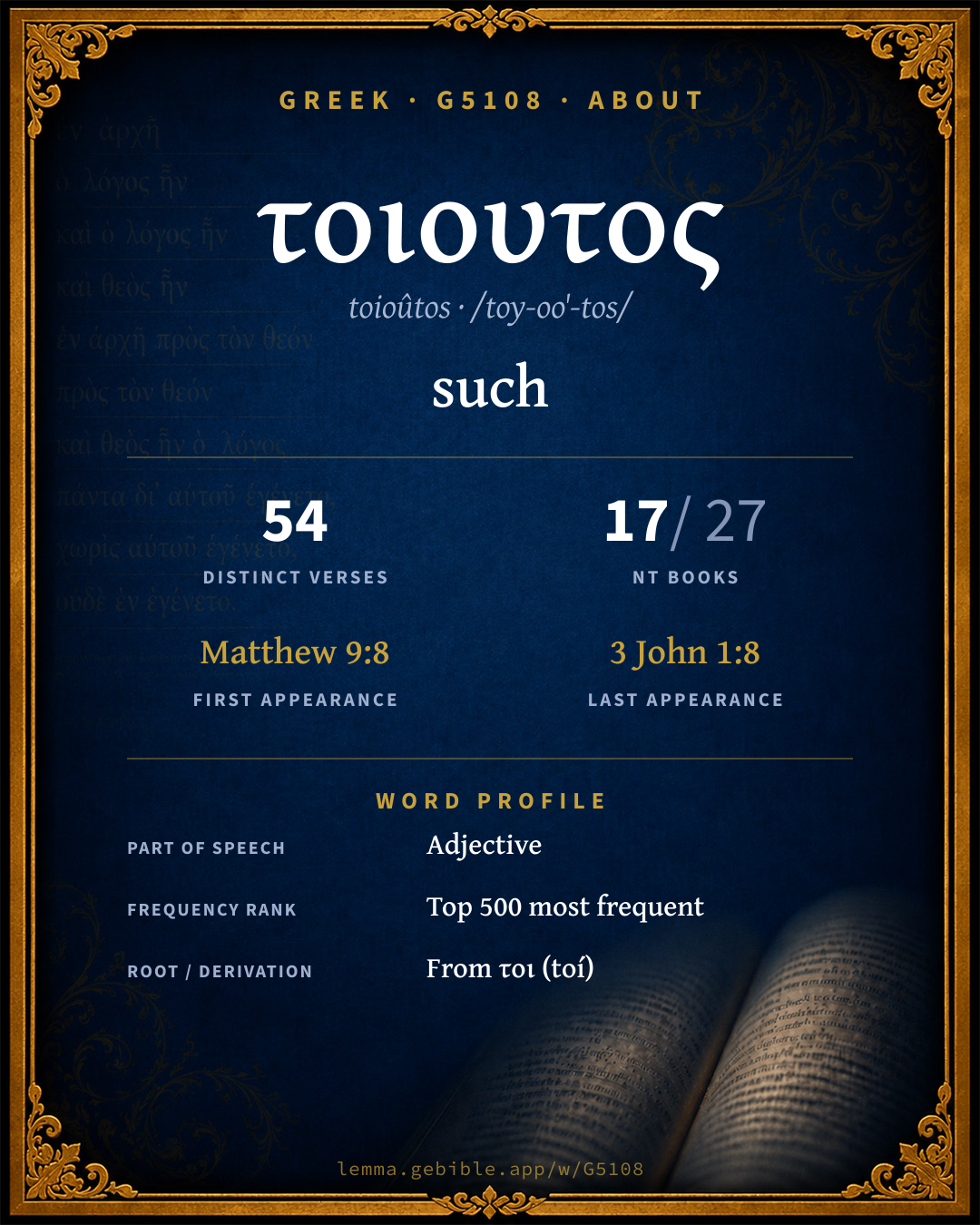
τοιοῦτος
such
Full lexicon entry — Thayer's Greek Lexicon
From Thayer's Greek Lexicon
Where this word appears
See every Accusative-case word in the Greek New Testament →
Grammar key — what these labels mean
Part of speech
- Demonstrative pronoun
- Points something out (“this,” “that”).
Case
- Accusative
- The case of the direct object and of extent.
- Nominative
- The case of the subject (and the predicate nominative).
- Genitive
- The case of source, possession, or “of” — answers “whose / from what.”
- Dative
- The case of the indirect object, means, or location — “to / for / with / in.”
Gender
- Neuter
- Grammatically neuter.
- Feminine
- Grammatically feminine.
- Masculine
- Grammatically masculine.
Number
- Plural
- More than one.
- Singular
- One.
Grammatical forms 16 distinct
- Demonstrative pronoun, Accusative, Plural, Neuter 9 times (16%)
- Demonstrative pronoun, Accusative, Singular, Feminine 6 times (11%)
- Demonstrative pronoun, Accusative, Singular, Masculine 6 times (11%)
- Demonstrative pronoun, Nominative, Plural, Masculine 6 times (11%)
- Demonstrative pronoun, Accusative, Plural, Masculine 5 times (9%)
- Demonstrative pronoun, Genitive, Plural, Neuter 5 times (9%)
- Demonstrative pronoun, Nominative, Singular, Masculine 5 times (9%)
- Demonstrative pronoun, Nominative, Singular, Feminine 3 times (5%)
+8 more forms (11 occurrences)
Parsed forms decoded from the imported morphology (Robinson–Tischendorf, public domain), counted across 56 parsed occurrences — not distinct verses.
Every verse where G5108 appears — 54 distinct verses across 17 books. Click any verse to open its interlinear word-by-word view. Verse text shown in the World English Bible for context — . Each verse’s Greek form is shown with its reference; the English is not keyword-highlighted, since the data carries no word-level English alignment. Use “Compare translations” on any verse to read it across multiple English versions. This concordance covers the Greek New Testament; Septuagint (Greek Old Testament) occurrences of this word are not indexed here.
Matthew 3 verses
- Matthew 9:8 τοιαύτην dem.pron acc sg fem But when the multitudes saw it, they marveled and glorified God, who had given such authority to men.
- Matthew 18:5 τοιοῦτο dem.pron acc sg neut Whoever receives one such little child in my name receives me,
- Matthew 19:14 τοιούτων dem.pron gen pl neut But Jesus said, "Allow the little children, and don't forbid them to come to me; for to such belongs the Kingdom of Heaven."
Mark 5 verses
- Mark 4:33 τοιαύταις dem.pron dat pl fem With many such parables he spoke the word to them, as they were able to hear it.
- Mark 6:2 τοιαῦται dem.pron nom pl fem When the Sabbath had come, he began to teach in the synagogue, and many hearing him were astonished, saying, "Where did this man get these things?" and, "What is the wisdom that is given to this man, that such mighty works come about by his hands?
- Mark 7:13 τοιαῦτα dem.pron acc pl neut making void the word of God by your tradition, which you have handed down. You do many things like this."
- Mark 10:14 τοιούτων dem.pron gen pl neut But when Jesus saw it, he was moved with indignation, and said to them, "Allow the little children to come to me! Don't forbid them, for the Kingdom of God belongs to such as these.
- Mark 13:19 τοιαύτη dem.pron nom sg fem For in those days there will be oppression, such as there has not been the like from the beginning of the creation which God created until now, and never will be.
Luke 2 verses
- Luke 9:9 τοιαῦτα dem.pron acc pl neut Herod said, "John I beheaded, but who is this, about whom I hear such things?" He sought to see him.
- Luke 18:16 τοιούτων dem.pron gen pl neut Jesus summoned them, saying, "Allow the little children to come to me, and don't hinder them, for the Kingdom of God belongs to such as these.
John 3 verses
- John 4:23 τοιούτους dem.pron acc pl masc But the hour comes, and now is, when the true worshippers will worship the Father in spirit and truth, for the Father seeks such to be his worshippers.
- John 8:5 τοιαύτας dem.pron acc pl fem Now in our law, Moses commanded us to stone such. What then do you say about her?"
- John 9:16 τοιαῦτα dem.pron acc pl neut Some therefore of the Pharisees said, "This man is not from God, because he doesn't keep the Sabbath." Others said, "How can a man who is a sinner do such signs?" There was division among them.
Acts 4 verses
- Acts 16:24 τοιαύτην dem.pron acc sg fem who, having received such a charge, threw them into the inner prison, and secured their feet in the stocks.
- Acts 19:25 τοιαῦτα dem.pron acc pl neut whom he gathered together, with the workmen of like occupation, and said, "Sirs, you know that by this business we have our wealth.
- Acts 22:22 τοιοῦτον dem.pron acc sg masc They listened to him until he said that; then they lifted up their voice, and said, "Rid the earth of this fellow, for he isn't fit to live!"
- Acts 26:29 τοιούτους dem.pron acc pl masc Paul said, "I pray to God, that whether with little or with much, not only you, but also all that hear me this day, might become such as I am, except for these bonds."
Romans 4 verses
- Romans 1:32 τοιαῦτα dem.pron acc pl neut who, knowing the ordinance of God, that those who practice such things are worthy of death, not only do the same, but also approve of those who practice them.
- Romans 2:2 τοιαῦτα dem.pron acc pl neut We know that the judgment of God is according to truth against those who practice such things.
- Romans 2:3 τοιαῦτα dem.pron acc pl neut Do you think this, O man who judges those who practice such things, and do the same, that you will escape the judgment of God?
- Romans 16:18 τοιοῦτοι dem.pron nom pl masc For those who are such don't serve our Lord, Jesus Christ, but their own belly; and by their smooth and flattering speech, they deceive the hearts of the innocent.
1 Corinthians 9 verses
- 1 Corinthians 5:1 τοιαύτη dem.pron nom sg fem It is actually reported that there is sexual immorality among you, and such sexual immorality as is not even named among the Gentiles, that one has his father's wife.
- 1 Corinthians 5:5 τοιοῦτον dem.pron acc sg masc are to deliver such a one to Satan for the destruction of the flesh, that the spirit may be saved in the day of the Lord Jesus.
- 1 Corinthians 5:11 τοιούτῳ dem.pron dat sg masc But as it is, I wrote to you not to associate with anyone who is called a brother who is a sexual sinner, or covetous, or an idolater, or a slanderer, or a drunkard, or an extortioner. Don't even eat with such a person.
- 1 Corinthians 7:15 τοιούτοις dem.pron dat pl neut Yet if the unbeliever departs, let there be separation. The brother or the sister is not under bondage in such cases, but God has called us in peace.
- 1 Corinthians 7:28 τοιοῦτοι dem.pron nom pl masc But if you marry, you have not sinned. If a virgin marries, she has not sinned. Yet such will have oppression in the flesh, and I want to spare you.
- 1 Corinthians 11:16 τοιαύτην dem.pron acc sg fem But if any man seems to be contentious, we have no such custom, neither do God's assemblies.
- 1 Corinthians 15:48 τοιοῦτοι τοιοῦτοι dem.pron nom pl masc dem.pron nom pl masc As is the one made of dust, such are those who are also made of dust; and as is the heavenly, such are they also that are heavenly.
- 1 Corinthians 16:16 τοιούτοις dem.pron dat pl masc that you also be in subjection to such, and to everyone who helps in the work and labors.
- 1 Corinthians 16:18 τοιούτους dem.pron acc pl masc For they refreshed my spirit and yours. Therefore acknowledge those who are like that.
2 Corinthians 9 verses
- 2 Corinthians 2:6 τοιούτῳ dem.pron dat sg masc Sufficient to such a one is this punishment which was inflicted by the many;
- 2 Corinthians 2:7 τοιοῦτος dem.pron nom sg masc so that on the contrary you should rather forgive him and comfort him, lest by any means such a one should be swallowed up with his excessive sorrow.
- 2 Corinthians 3:4 τοιαύτην dem.pron acc sg fem Such confidence we have through Christ toward God;
- 2 Corinthians 3:12 τοιαύτην dem.pron acc sg fem Having therefore such a hope, we use great boldness of speech,
- 2 Corinthians 10:11 τοιοῦτος τοιοῦτοι dem.pron nom sg masc dem.pron nom pl masc Let such a person consider this, that what we are in word by letters when we are absent, such are we also in deed when we are present.
- 2 Corinthians 11:13 τοιοῦτοι dem.pron nom pl masc For such men are false apostles, deceitful workers, masquerading as Christ's apostles.
- 2 Corinthians 12:2 τοιοῦτον dem.pron acc sg masc I know a man in Christ, fourteen years ago (whether in the body, I don't know, or whether out of the body, I don't know; God knows), such a one caught up into the third heaven.
- 2 Corinthians 12:3 τοιοῦτον dem.pron acc sg masc I know such a man (whether in the body, or outside of the body, I don't know; God knows),
- 2 Corinthians 12:5 τοιούτου dem.pron gen sg masc On behalf of such a one I will boast, but on my own behalf I will not boast, except in my weaknesses.
Galatians 3 verses
- Galatians 5:21 τοιαῦτα dem.pron acc pl neut envyings, murders, drunkenness, orgies, and things like these; of which I forewarn you, even as I also forewarned you, that those who practice such things will not inherit the Kingdom of God.
- Galatians 5:23 τοιούτων dem.pron gen pl neut gentleness, and self-control. Against such things there is no law.
- Galatians 6:1 τοιοῦτον dem.pron acc sg masc Brothers, even if a man is caught in some fault, you who are spiritual must restore such a one in a spirit of gentleness; looking to yourself so that you also aren't tempted.
Ephesians 1 verse
Philippians 1 verse
2 Thessalonians 1 verse
Titus 1 verse
Philemon 1 verse
Hebrews 5 verses
- Hebrews 7:26 Τοιοῦτος dem.pron nom sg masc For such a high priest was fitting for us: holy, guiltless, undefiled, separated from sinners, and made higher than the heavens;
- Hebrews 8:1 τοιοῦτον dem.pron acc sg masc Now in the things which we are saying, the main point is this. We have such a high priest, who sat down on the right hand of the throne of the Majesty in the heavens,
- Hebrews 11:14 τοιαῦτα dem.pron acc pl neut For those who say such things make it clear that they are seeking after a country of their own.
- Hebrews 12:3 τοιαύτην dem.pron acc sg fem For consider him who has endured such contradiction of sinners against himself, that you don't grow weary, fainting in your souls.
- Hebrews 13:16 τοιαύταις dem.pron dat pl fem But don't forget to be doing good and sharing, for with such sacrifices God is well pleased.
James 1 verse
3 John 1 verse
About this entry
At a glance — auto-summarized from this page’s data, not written by a person. Every figure links to its source below. This summary describes the numbers; it doesn’t interpret them.
τοιουτος — transliterated toioûtos — is a Greek adjective carrying the sense “such.” Debuting at Matthew 9:8, it then recurs through the corpus. With 54 verses in 17 books, it is a moderately common word in the Greek New Testament. Sharing its root, it stands alongside τοι, τοιγαρουν and τοινυν. See the sense tree, 54-verse concordance, and the renderings breakdown below.
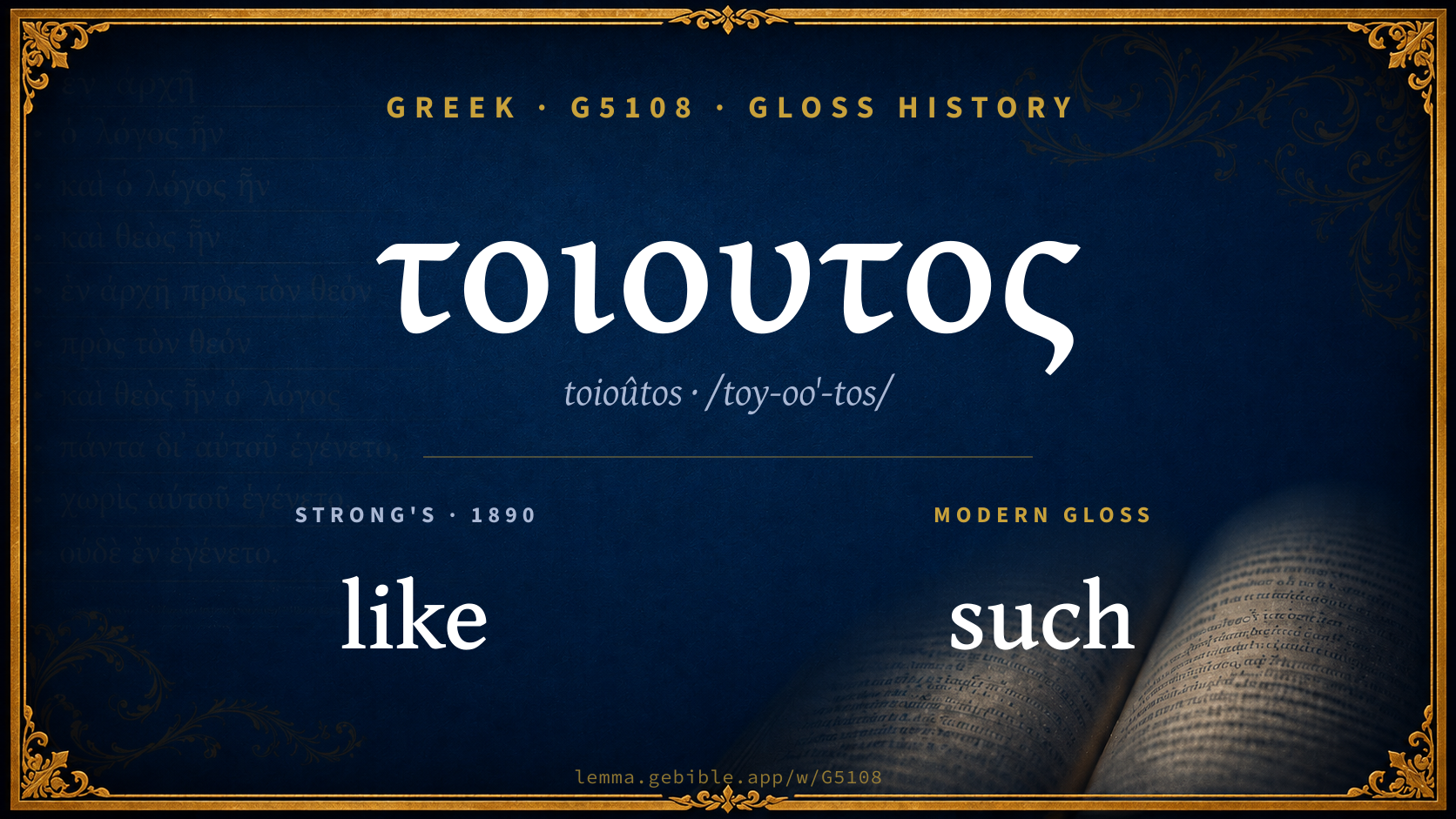
Gloss history
Strong's 1890 vs modern scholarship
About this word
Strong's G5108 catalogs a Greek word from the Greek New Testament.
These counts are not copied from any lexicon or concordance. They are computed here, from the morphology-tagged Greek New Testament. What Lemma adds →
- 54
- distinct verses
- The word appears in 54 distinct verses.
- 17 / 27
- NT books
- The word appears in 17 of 27 New Testament books.
- #286
- by frequency
- Top 500 most frequent Greek words (rank 286 of 5,347 Greek words by occurrence).
View all 54 occurrences in the concordance →
Most concentrated in
- 1 Corinthians 9 verses 17%
- 2 Corinthians 9 verses 17%
- Mark 5 verses 9%
By section of the New Testament
By traditional corpus
Conventional, traditional groupings — biblical authorship is debated, so this is a traditional corpus grouping, not an authorship claim. Some books belong to more than one corpus (Luke is in both the Gospels and the Lukan corpus, and so on), so these shares overlap and need not total 100%. Each figure is a share of the word’s 54 distinct verses.
- Pauline corpus 30 verses · 56%
- Gospels 13 verses · 24%
- Lukan (Luke–Acts) 6 verses · 11%
- Hebrews 5 verses · 9%
- Johannine 4 verses · 7%
- General (Catholic) Epistles 2 verses · 4%
How translations render this word
Counts come from each version’s own published word-to-Strong’s tagging or interlinear alignment — an approximate guide to how each version renders this word, not a word-level alignment the data otherwise carries. Because each total is that version’s own tagged count, the per-version totals vary from one another and need not match the appearance or distinct-verse counts above. These counts may also differ from a printed concordance because Lemma counts each distinctly tagged rendering and does not collapse phrase taggings into a single head-word total. This is a fixed set of word-tagged versions (KJV, ASV, BSB, ULT) and does not change with the reading translation you choose elsewhere. Each version’s license is shown beside its name below (and on Sources).
- King James Version: Such 38×, One 8×, Things 7×
- American Standard Version: Such 34×, One 8×, Things 7×
- Berean Standard Bible: Such 19×, Things 5×, These 4×
- unfoldingWord Literal Text: Such 20×, Things 9×, These 5×
King James Version Public Domain
Renders G5108 across 61 tagged occurrences — most commonly:
Plus 4 renderings that appear only once — usually multi-word phrases or single function words the recovered tagging swept in, not distinct renderings.
American Standard Version Public Domain
Renders G5108 across 59 tagged occurrences — most commonly:
Plus 8 renderings that appear only once — usually multi-word phrases or single function words the recovered tagging swept in, not distinct renderings.
Berean Standard Bible Public Domain
Renders G5108 across 49 tagged occurrences — most commonly:
Plus 10 renderings that appear only once — usually multi-word phrases or single function words the recovered tagging swept in, not distinct renderings. Not rendered by a distinct English word in 7 further occurrences.
unfoldingWord Literal Text CC BY-SA 4.0
Renders G5108 across 64 tagged occurrences — most commonly:
Plus 6 renderings that appear only once — usually multi-word phrases or single function words the recovered tagging swept in, not distinct renderings.
Senses in Thayer's
The 1 sense Thayer's distinguishes for this word, in lexicon order (not ranked by frequency or importance). The full entry — with sub-senses — is in the Lexicon Entry tab.
- such as this, of this kind or sort
Word origin
Derived from τοι (toí) (G5104) — truly.
Forms in the corpus
The 16 distinct written forms G5108 takes in the Greek New Testament, most frequent first — each parse links to that case’s occurrences in the concordance.
Same root — word family
Other Thayer's entries built from the same root as G5108, grouped by Strong’s listed origin. These share a root / origin per the lexicon — not necessarily a shared meaning. Each links to that word’s own entry.
Derives from
Shares the same root
Compare all same-root words → Showing 4 of 5 — not the complete family. They share a root, not necessarily a meaning.
Septuagint usage
The same Greek word τοιουτος appears 49 times in the Greek Old Testament (Septuagint), across 48 verses in 17 books.
- 49
- LXX occurrences
- Tagged occurrences of this Greek word in the Septuagint.
- 48
- verses
- Distinct Septuagint verses containing this word.
- 17 / 39
- OT books
- The word appears in 17 of the 39 Old Testament books.
Sample Septuagint occurrences
- Genesis 39:11 τοιοῦτος
- Exodus 9:18 τοιοῦτος
- Numbers 15:13 τοιοῦτος
- Deuteronomy 4:32 τοιοῦτος
- Joshua 10:14 τοιοῦτος
- 1 Samuel 4:7 τοιοῦτος
- 2 Samuel 14:13 τοιοῦτος
- 1 Kings 10:12 τοιοῦτος
- 2 Chronicles 9:11 τοιοῦτος
- Ezra 5:11 τοιοῦτος
- Job 8:18 τοιοῦτος
- Proverbs 6:14 τοιοῦτος
Septuagint occurrences (same lexeme)
Every verse where the same Strong’s number (G5108) appears in the Greek Septuagint. Verse text shown in the World English Bible for context; the Greek form is the matched word — the English is not keyword-highlighted.
- Genesis 39:11 τοιοῦτος It happened about this time, that he went into the house to do his work, and there were none of the men of the house inside.
- Genesis 41:19 τοιοῦτος and, behold, seven other cattle came up after them, poor and very ill-favored and lean-fleshed, such as I never saw in all the land of Egypt for ugliness.
- Genesis 41:38 τοιοῦτος Pharaoh said to his servants, "Can we find such a one as this, a man in whom is the Spirit of God?"
- Exodus 9:18 τοιοῦτος Behold, tomorrow about this time I will cause it to rain a very grievous hail, such as has not been in Egypt since the day it was founded even until now.
- Exodus 9:24 τοιοῦτος So there was very severe hail, and lightning mixed with the hail, such as had not been in all the land of Egypt since it became a nation.
- Exodus 10:14 τοιοῦτος The locusts went up over all the land of Egypt, and rested in all the borders of Egypt. They were very grievous. Before them there were no such locusts as they, neither after them shall be such.
- Exodus 11:6 τοιοῦτος There shall be a great cry throughout all the land of Egypt, such as there has not been, nor shall be any more.
- Numbers 15:13 τοιοῦτος All who are home-born shall do these things after this manner, in offering an offering made by fire, of a sweet savor to Yahweh.
- Deuteronomy 4:32 τοιοῦτος For ask now of the days that are past, which were before you, since the day that God created man on the earth, and from the one end of the sky to the other, whether there has been [any such thing] as this great thing is, or has been heard like it?
- Joshua 10:14 τοιοῦτος There was no day like that before it or after it, that Yahweh listened to the voice of a man: for Yahweh fought for Israel.
- 1 Samuel 4:7 τοιοῦτος The Philistines were afraid, for they said, God is come into the camp. They said, Woe to us! for there has not been such a thing heretofore.
- 2 Samuel 14:13 τοιοῦτος The woman said, Why then have you devised such a thing against the people of God? for in speaking this word the king is as one who is guilty, in that the king does not bring home again his banished one.
- 1 Kings 10:12 τοιοῦτος The king made of the almug trees pillars for the house of Yahweh, and for the king's house, harps also and psalteries for the singers: there came no such almug trees, nor were seen, to this day.
- 2 Chronicles 9:11 τοιοῦτος The king made of the algum trees terraces for the house of Yahweh, and for the king's house, and harps and psalteries for the singers: and there were none such seen before in the land of Judah.
- 2 Chronicles 30:26 τοιοῦτος So there was great joy in Jerusalem; for since the time of Solomon the son of David king of Israel there was not the like in Jerusalem.
- Ezra 5:11 τοιοῦτος Thus they returned us answer, saying, We are the servants of the God of heaven and earth, and are building the house that was built these many years ago, which a great king of Israel built and finished.
- Job 8:18 τοιοῦτος If he is destroyed from his place, Then it shall deny him, saying, 'I have not seen you.'
- Job 8:19 τοιοῦτος Behold, this is the joy of his way: Out of the earth shall others spring.
- Job 15:4 τοιοῦτος Yes, you do away with fear, And hinder devotion before God.
- Job 15:13 τοιοῦτος That you turn your spirit against God, And let such words go out of your mouth?
- Job 16:2 τοιοῦτος "I have heard many such things. Miserable comforters are you all!
- Job 32:14 τοιοῦτος For he has not directed his words against me; Neither will I answer him with your speeches.
- Job 33:16 τοιοῦτος Then he opens the ears of men, And seals their instruction,
- Job 40:4 τοιοῦτος "Behold, I am of small account. What shall I answer you? I lay my hand on my mouth.
- Proverbs 6:14 τοιοῦτος In whose heart is perverseness, Who devises evil continually, Who always sows discord.
- Proverbs 20:3 τοιοῦτος It is an honor for a man to keep aloof from strife; But every fool will be quarreling.
- Proverbs 23:2 τοιοῦτος Put a knife to your throat, If you are a man given to appetite.
- Proverbs 28:21 τοιοῦτος To show partiality is not good; Yet a man will do wrong for a piece of bread.
- Proverbs 28:26 τοιοῦτος One who trusts in himself is a fool; But one who walks in wisdom, he is kept safe.
- Proverbs 30:20 τοιοῦτος So is the way of an adulterous woman: She eats and wipes her mouth, And says, 'I have done nothing wrong.'
- Proverbs 31:10 τοιοῦτος Who can find a worthy woman? For her price is far above rubies.
- Proverbs 31:11 τοιοῦτος The heart of her husband trusts in her. He shall have no lack of gain.
- Isaiah 58:6 τοιοῦτος Isn't this the fast that I have chosen: to loose the bonds of wickedness, to undo the bands of the yoke, and to let the oppressed go free, and that you break every yoke?
- Isaiah 66:8 τοιοῦτος Who has heard such a thing? who has seen such things? Shall a land be born in one day? shall a nation be brought forth at once? for as soon as Zion travailed, she brought forth her children.
- Jeremiah 2:10 τοιοῦτος For pass over to the isles of Kittim, and see; and send to Kedar, and consider diligently; and see if there has been such a thing.
- Jeremiah 5:9 τοιοῦτος Shall I not visit for these things? says Yahweh; and shall not my soul be avenged on such a nation as this?
- Jeremiah 5:29 τοιοῦτος Shall I not visit for these things? says Yahweh; shall not my soul be avenged on such a nation as this?
- Jeremiah 9:8 τοιοῦτος Their tongue is a deadly arrow; it speaks deceit: one speaks peaceably to his neighbor with his mouth, but in his heart he lays wait for him.
- Jeremiah 10:16 τοιοῦτος The portion of Jacob is not like these; for he is the former of all things; and Israel is the tribe of his inheritance: Yahweh of Hosts is his name.
- Jeremiah 18:13 τοιοῦτος Therefore thus says Yahweh: Ask you now among the nations, who has heard such things; the virgin of Israel has done a very horrible thing.
- Jeremiah 28:19 τοιοῦτος
- Jeremiah 37:7 τοιοῦτος Thus says Yahweh, the God of Israel, Thus shall you tell the king of Judah, who sent you to me to inquire of me: Behold, Pharaoh's army, which is come forth to help you, shall return to Egypt into their own land.
- Ezekiel 3:6 τοιοῦτος not to many peoples of a strange speech and of a hard language, whose words you can not understand. Surely, if I sent you to them, they would listen to you.
- Ezekiel 21:31 τοιοῦτος I will pour out my indignation on you; I will blow on you with the fire of my wrath; and I will deliver you into the hand of brutish men, skillful to destroy.
- Ezekiel 21:32 τοιοῦτος You shall be for fuel to the fire; your blood shall be in the midst of the land; you shall be no more remembered: for I, Yahweh, have spoken it.
- Ezekiel 31:8 τοιοῦτος The cedars in the garden of God could not hide it; the fir trees were not like its boughs, and the plane trees were not as its branches; nor was any tree in the garden of God like it in its beauty.
- Daniel 2:10 τοιοῦτος The Chaldeans answered before the king, and said, There is not a man on the earth who can show the king's matter, because no king, lord, or ruler, has asked such a thing of any magician, or enchanter, or Chaldean.
- Joel 1:2 τοιοῦτος Hear this, you elders, And listen, all you inhabitants of the land. Has this ever happened in your days, Or in the days of your fathers?
These are occurrences of the same Greek lexeme (G5108) in the Septuagint — not a translation of any one Hebrew word. The store carries no word-level Hebrew↔Greek alignment, so no Hebrew original is asserted here. Counts come from the recovered LXX Strong's tagging — high-frequency vocabulary is well covered, while rare or late forms may be untagged — so they reflect tagged occurrences and may slightly undercount.