Galatians 5:23

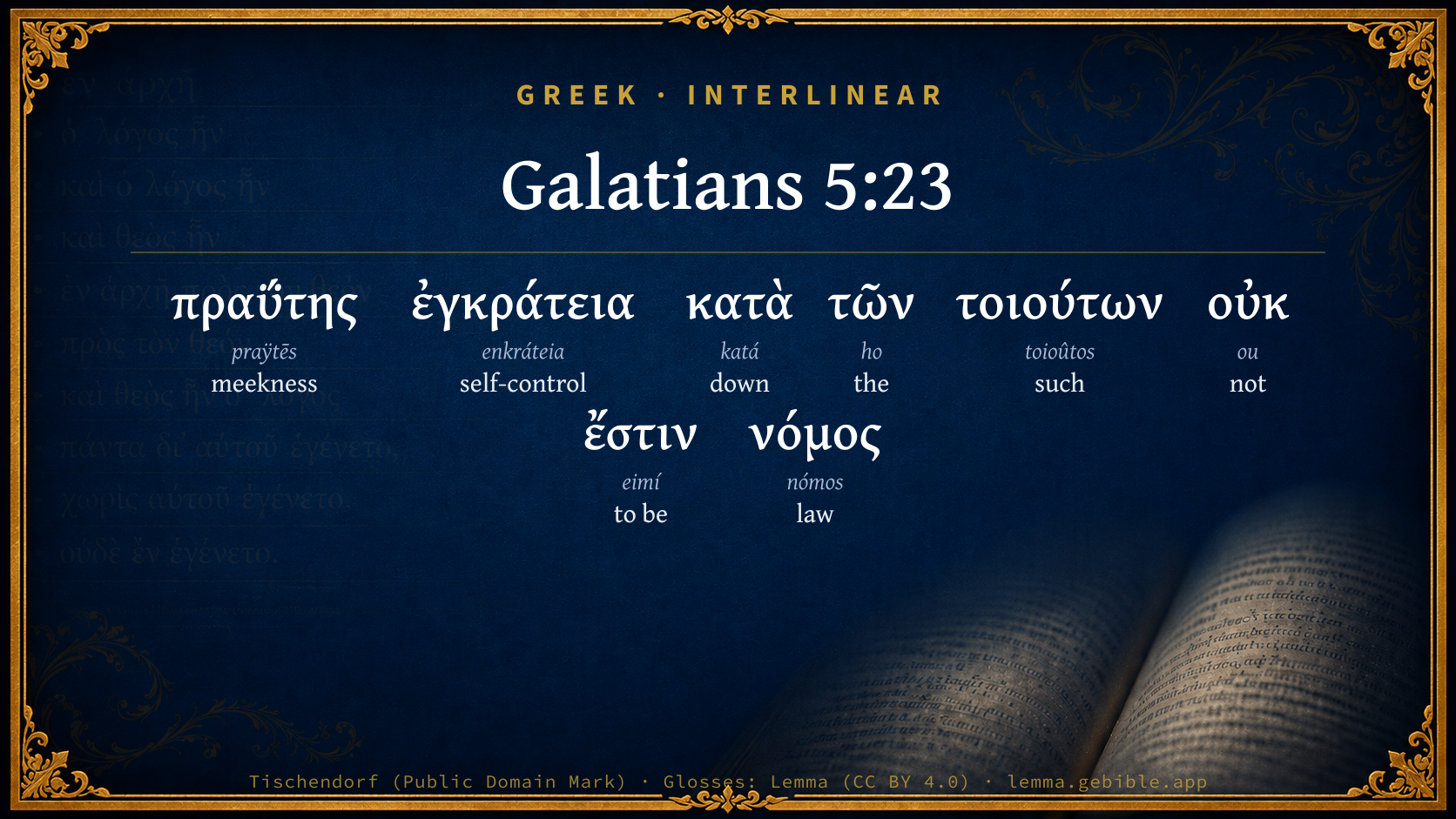
Greek (Tischendorf 8th ed.) Galatians 5:23 appears in the Greek New Testament. The text above is from the Tischendorf 8th edition. Each word links to its Strong’s number and a concise gloss. Click any word for its full Thayer’s Greek Lexicon entry.
Download image
Cite this verse

Galatians 5:23 (World English Bible). Public Domain. Lemma interlinear Bible study tool, https://lemma.gebible.app/v/galatians/5/23.

Show BibTeX & RIS
BibTeX
RIS
English Translation
gentleness, and self-control. Against such things there is no law.
World English Bible · Public Domain
Download a study sheet

One document with this verse’s original text, its word-by-word gloss line, the meaning frame, cross-references with their text, attributed commentary, and full source and license credits — printable, and it pastes into notes with its structure intact.

This verse Autodidact and up

Study sheet (.html) Plain text (.txt)

A passage Seminary Student

Up to 50 verses in one chapter. A passage sheet keeps up to 6 commentary sources and 12 cross-references per verse, in the order this page ranks them, and says so on the sheet whenever that leaves anything out. Ask for a single verse and you get the Autodidact verse sheet above.

Everything on this page stays free to read, with no account — the sheet is a download of what is already on screen, not access to it.

Want to remove ads? Support Godless Engineer
Compare translations 3

The same verse in 3 English versions, stacked beneath the original-language interlinear above. Click any original word for its lexicon entry.

Each is an independent rendering of the whole verse — the interlinear is not word-aligned to these translations.

Highlighted words mark where these versions differ — a whole-verse word diff, not a word-by-word alignment.

  • World English Bible Public Domain
    gentleness, and self-control. Against such things there is no law.
  • King James Version Public Domain
    Meekness, temperance: against such there is no law.
  • unfoldingWord Literal Text CC BY-SA 4.0
    gentleness, self-control; against such things there is no law.

unfoldingWord Literal Text — © unfoldingWord, licensed CC BY-SA 4.0. Word-aligned USFM3 via Door43 (git.door43.org/unfoldingWord/en_ult).

Versions to compare (up to 4)

3 of 4 selected

Show all 19 translations

Every available English version of this verse, each an independent rendering of the whole verse.

  • World English Bible Public Domain
    gentleness, and self-control. Against such things there is no law.
  • Berean Standard Bible Public Domain
    gentleness, and self-control. Against such things there is no law.
  • Majority Standard Bible Public Domain
    gentleness, and self-control. Against such things there is no law.
  • King James Version Public Domain
    Meekness, temperance: against such there is no law.
  • American Standard Version (1901) Public Domain
    meekness, self-control; against such there is no law.
  • Revised Version (1885) Public Domain
    meekness, temperance: against such there is no law.
  • Geneva Bible (1599) Public Domain
    Meekenesse, temperancie: against such there is no lawe.
  • Douay-Rheims (1899) Public Domain
    Mildness, faith, modesty, continency, chastity. Against such there is no law.
  • Young's Literal Translation Public Domain
    meekness, temperance: against such there is no law;
  • Literal Standard Version CC BY-SA 4.0
    meekness, [and] self-control. Against such there is no law;
  • Unlocked Literal Bible CC BY-SA 4.0
    gentleness, and self-control; against such things there is no law.
  • unfoldingWord Literal Text CC BY-SA 4.0
    gentleness, self-control; against such things there is no law.
  • Darby Bible Public Domain
    meekness, self-control: against such things there is no law.
  • World Messianic Bible Public Domain
    gentleness, and self-control. Against such things there is no law.
  • Webster's Bible Public Domain
    Meekness, temperance: against such there is no law.
  • Free Bible Version CC BY-SA 4.0
    gentleness, self-control—and there's no law against these kinds of things!
  • Bible in Basic English Public Domain
    Gentle behaviour, control over desires: against such there is no law.
  • Text-Critical English NT CC BY 4.0
    gentleness, and self-control; against such things there is no law.
  • Tyndale New Testament (1534) Public Domain
    meknes temperancye. Agaynst suche ther is no lawe.

Literal Standard Version (2020), Covenant Press — licensed CC BY-SA 4.0. Text via the HelloAO Bible API (eBible.org). Unlocked Literal Bible (unfoldingWord) — licensed CC BY-SA 4.0. Text via the HelloAO Bible API (eBible.org). unfoldingWord Literal Text — © unfoldingWord, licensed CC BY-SA 4.0. Word-aligned USFM3 via Door43 (git.door43.org/unfoldingWord/en_ult). Free Bible Version, Dr. Jonathan Gallagher — licensed CC BY-SA 4.0. Text via the HelloAO Bible API (eBible.org).

Word by word

More ways to search: Search by grammar → Find every occurrence → Compare this word →

Practice this passage: Drill this verse → Learn its vocabulary →

About this verse

These counts appear in no published source. They are computed here, from the morphology-tagged text and Lemma’s own curated glosses. What Lemma adds →

8
words
8
distinct lemmas
Pauline Epistles
section

Notable vocabulary

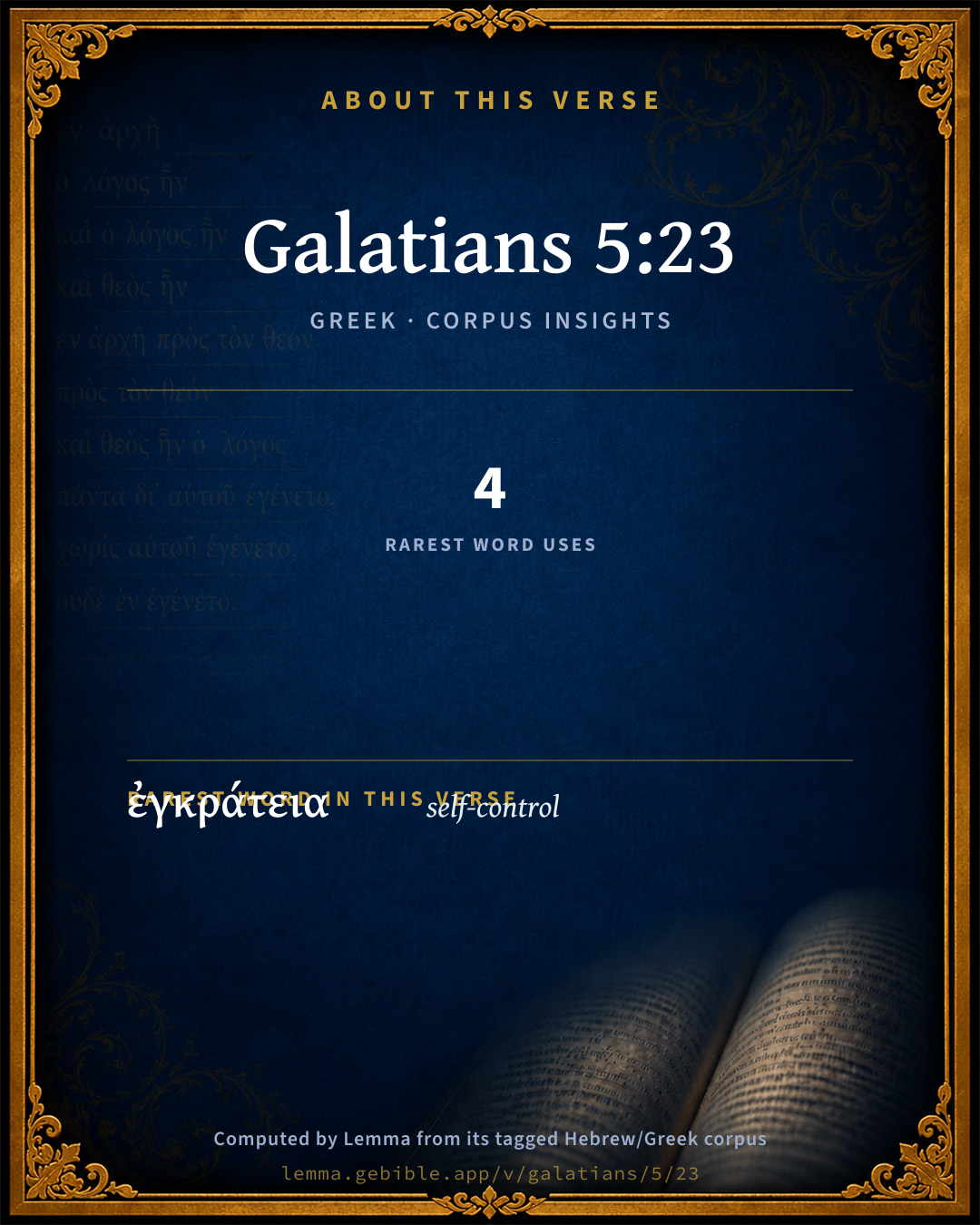
The rarest word here is ἐγκράτεια self-control G1466 — appearing just 4 times in the whole Greek New Testament.

Shared distinctive vocabulary

ἐγκράτεια self-control G1466 occurs in 3 verses of the Greek New Testament. Also found in:

Cross-references

5

Topical passages linked to Galatians 5:23 in the Treasury of Scripture Knowledge — connected by theme and wording, ordered by reader-vote popularity; previews shown in the World English Bible.

  • 1 Timothy 1:9 as knowing this, that law is not made for a righteous man, but for the lawless and insubordinate, for the ungodly and sinners, for the unholy and profane, for murderers of fathers and murderers of mothers, for manslayers,
  • Acts 24:25 As he reasoned about righteousness, self-control, and the judgment to come, Felix was terrified, and answered, "Go your way for this time, and when it is convenient for me, I will summon you."
  • Titus 2:2 that older men should be temperate, sensible, sober-minded, sound in faith, in love, and in patience:
  • Titus 1:8 but given to hospitality, as a lover of good, sober-minded, fair, holy, self-controlled;
  • 1 Corinthians 9:25 Every man who strives in the games exercises self-control in all things. Now they do it to receive a corruptible crown, but we an incorruptible.

Cross-references courtesy of OpenBible.info (CC BY 4.0).

Commentary

Notes on Galatians 5:23 from classic Christian and Jewish commentators (each source and its license shown beneath its notes). The classic Christian expositions comment on the surrounding passage and are grouped to its opening verse, so a note may address several verses; the Jewish commentaries on the Tanakh (Rashi and others) are per-verse, so they appear only where the commentator wrote on this verse.

Lemma curates 59 commentaries, every one of them public domain or Creative Commons licensed, each selected and text-cleaned for this edition rather than reprinted as found. About our sources →

Tyndale Open Study Notes

Tyndale Open Resources

5:23 Gentleness is antithetical to the vices of 5:20 and requires strength (see Prov 15:1, 4; Matt 11:28-29; Eph 4:2). • self-control: The Holy Spirit does not give moral license but empowers people to avoid sin (cp. Gal 5:13; Rom 6:14-18; 1 Thes 4:3-7; 1 Pet 2:16; see also Acts 24:25; Titus 1:8). • There is no law against these things! Paul is stating the obvious, but also making the point that those who are virtuous by the Spirit do not need law to govern them.

Tyndale Open Study Notes — © Tyndale Open Resources, licensed CC BY-SA 4.0. Text via the HelloAO Bible API.

Bengel's Gnomon

Johann Albrecht Bengel

Gal 5:23. Τῶν τοιούτων, against such [persons]) This is the same, as if he had added, after temperance, the expression, and things similar to these; although the very want of the copulative conjunction [the asyndeton] has this force, Mat 15:19, note: τῶν τοιούτων is in the masculine; with which comp. Gal 5:18; Gal 5:21, at the end; where πράσσοντες is added, which is now as it were compensated for by τοιούτων [such persons]: 1Ti 1:9-10, at the beginning.—οὐκ ἔστι νόμος, there is no law) The law itself commands love. [And therefore the kingdom of God is judged not to be unworthy of such persons.—V. g.]

Bengel's Gnomon of the New Testament — English translation (T&T Clark, Edinburgh, 1860) — public domain. Text from a community e-Sword module.

Meyer's Critical & Exegetical Commentary

Heinrich August Wilhelm Meyer

Gal_5:23. Just as τὰ τοιαῦτα in Gal_5:21 (haec talia: see Engelhardt, ad Plat. Lach. p. 14; Kühner, ad Xen. Mem. i. 5. 2), τῶν τοιούτων in this passage is also neuter, applying to the virtues previously mentioned among the fruits of the Spirit (Irenaeus, Jerome, Augustine, Pelagius, Calvin, Beza, yet doubtfully, Castalio, Cornelius a Lapide, and most expositors), and not masculine, as it is understood by Chrysostom, Theodoret, Theophylact, Oecumenius, Erasmus, Luther, Grotius, Bengel, and many of the older expositors; also by Koppe, Rosenmüller, Rückert, Hofmann.[244] It is, moreover, quite unsuitable to assume (with Beza, Estius, Rosenmüller, Flatt, and others) a μείωσις (non adversatur, sed commendat, and the like; so also de Wette); for Paul wishes only to illustrate the οὐκ ΕἾΝΑΙ ὙΠῸ ΝΌΜΟΝ, which he has said in Gal_5:18 respecting those who are led by the Spirit. This he does by first exhibiting, for the sake of the contrast, the works of the flesh, and expressing a judgment upon the doers of them; and then by exhibiting the fruit of the Spirit, and saying: against virtues and states of this kind there is no law. Saying this, however, is by no means more than superfluous (Hofmann), but is intended to make evident how it is that, by virtue of this their moral frame, those who are led by the Spirit are not subject to the Mosaic law.[245] For whosoever is so constituted that a law is not against him, over such a one the law has no power. Comp. 1Ti_1:9 f.

[244] So also Bäumlein, in the Stud. u. Krit. 1862, p. 551 f. The objection that the singular ὁ καρπός in ver. 22 forbids the neuter interpretation (Hofmann), is quite groundless both in itself and because καρπός is collective.

[245] The fundamental idea of the whole epistlethe freedom of the Christian from the Mosaic lawis thus fully displayed in its moral nature and truth. Comp. Sieffert, in the Jahrb. f. D. Theol. 1869, p. 264.

Meyer — Critical and Exegetical Commentary on the New Testament — English translation by Peter Christie, edited by Frederick Crombie (T&T Clark, 1880) — public domain. Text from a community e-Sword module.

Expositor's Greek Testament

ed. W. Robertson Nicoll

Gal 5:23 . πραΰτης : Meekness is the outcome of true humility, the bearing towards others which results from a lowly estimate of ourselves. ἐγκράτεια : Self-control comprehends every form of temperance, and includes the mastery of all appetites, tempers and passions.

The Expositor's Greek Testament, edited by W. Robertson Nicoll (1897–1910) — public domain. Text from a community e-Sword module.

Geneva Bible (1599)

Geneva Bible translators

Lest that any man should object, that Paul played the Sophister, as one who urging the Spirit, urgeth nothing but that which the Law commandeth, he showeth that he requireth not that liberal and outward obedience, but spiritual, which proceedeth not from the Law, but from the Spirit of Christ, which doth beget us again, and must and ought to be the ruler and guider of life.

Geneva Bible (1599) marginal notes — public domain. Text via Bolls.life.

Jamieson, Fausset & Brown

Robert Jamieson, A. R. Fausset & David Brown

temperance--The Greek root implies self-restraint as to one's desires and lusts.

against such--not persons, but things, as in Gal 5:21.

no law--confirming Gal 5:18, "Not under the law" (Ti1 1:9-10). The law itself commands love (Gal 5:14); so far is it from being "against such."

Jamieson, Fausset & Brown — Commentary Critical and Explanatory on the Whole Bible (1871) — public domain (CC PDM 1.0). Text via the HelloAO Bible API.

Adam Clarke's Commentary

Verse 23. Meekness] πραοτης. Mildness, indulgence toward the weak and erring, patient suffering of injuries without feeling a spirit of revenge, an even balance of all tempers and passions, the entire opposite to anger.

Temperance] εγκρατεια. Continence, self-government, or moderation, principally with regard to sensual or animal appetites. Moderation in eating, drinking, sleeping, &c.

Several very respectable MSS., as D*EFG, with the Vulgate, most copies of the Itala and several of the fathers, add αγνεια, chastity. This we are sure cannot be separated from the genuine Christian character, though it may be included in the word εγκρατεια, continence or moderation, immediately preceding.

Against such there is no law.] Those, whose lives are adorned by the above virtues, cannot be condemned by any law, for the whole purpose and design of the moral law of God is fulfilled in those who have the Spirit of God, producing in their hearts and lives the preceding fruits.

Adam Clarke's Commentary on the Bible (1810–1826) — public domain. Text from a community e-Sword/MySword module.

John Calvin's Commentaries

23. Against such there is no law. Some understand these words as meaning simply that the law is not directed against good works, “from evil manners have sprung good laws.” But Paul’s real meaning is deeper and less obvious; namely, that, where the Spirit reigns, the law has no longer any dominion. By moulding our hearts to his own righteousness, the Lord delivers us from the severity of the law, so that our intercourse with himself is not regulated by its covenant, nor our consciences bound by its sentence of condemnation. Yet the law continues to teach and exhort, and thus performs its own office; but our subjection to it is withdrawn by the Spirit of adoption. He thus ridicules the false apostles, who, while they enforced subjection to the law, were not less eager to release themselves from its yoke. The only way, he tells us, in which this is accomplished, is, when the Spirit of God obtains dominion, from which we are led to conclude that they had no proper regard to spiritual righteousness.

John Calvin's Commentaries (1540-1563) — public domain. Text from the Calvin Translation Society English edition (1840s-50s) via the Christian Classics Ethereal Library (ccel.org). Calvin's coverage is partial (roughly two-thirds of the Bible); uncommented books and verses are honest gaps, never fabricated. The 19th-century editor's footnotes and remarks are omitted so the notes are faithfully Calvin's own voice.

Ellicott's Commentary for English Readers

(23) Meekness, temperance.—”Meekness” is something more than “mildness,” which has been suggested as an alternative translation. “Mildness” would represent that side of the virtue which is turned towards men; but it has also another side, which is turned towards God—a gentle submissiveness to the divine will. By “temperance” is meant, in a general sense, “self-control”—a firm control over the passions.

Against such—i.e., “against such things;” not, as it was understood by many of the older commentators, “against such men.”

There is no law.—For such things law has no condemnation, and therefore they are removed beyond the sphere of law. This is the first and obvious meaning; it may be noticed, however, that these delicate Christian graces are above law as well as beyond. The ruder legal system of commands, sanctioned by punishment, would have no power to produce them; they can only grow in a more genial and softer soil, under the direct influence of the Spirit.

A Bible Commentary for English Readers, edited by Charles John Ellicott (1878–1897) — public domain. Text from a community e-Sword module.

John Gill's Exposition

And they that are Christ's,.... Not all as yet that are secretly so, who are chosen in him, and by him, are given by the Father to him in covenant, and whom he has purchased by his blood, and considers as his people, his sheep, and his children, though as yet they are not called by his grace; of these, as yet, what follows cannot be said, and therefore must mean such as are openly Christ's, whom he has laid hold on as his own in the effectual calling, who have his Spirit as a spirit of regeneration and sanctification, who have truly believed in Christ, and have given up themselves unto him.

have crucified the flesh with the affections and lusts: by the flesh is meant, not the natural body to be macerated and afflicted with fastings, watchings, &c. but the corruption of nature, the old man and carnal heart. The Vulgate Latin version reads, "their own flesh"; and so do the Syriac and Ethiopic versions; their concern lying with their own, and not with the corruptions, affections, and lusts of others. By "the affections and lusts" are intended, not the natural affections and passions of the soul, and the desires of it; but its vile and inordinate affections, its corrupt inclinations, evil desires, and deceitful lusts; all which are "crucified" first "with Christ", as the Arabic version reads; see Rom 6:6 and which are so abolished, done away, and destroyed, by the sacrifice of Christ, that the damning power of them over his people is entirely gone. And in consequence of this crucifixion of the body of sin, with Christ upon the cross, when he finished and made an end of it, sin, with its passions and lusts, is crucified by the Spirit of God in regeneration and sanctification; so that it loses its governing power, and has not the dominion it had before: not but that the flesh, or corrupt nature, with its evil affections, and carnal lusts, are still in being, and are alive; as a person fastened to a cross may be alive, though he cannot act and move as before, being under restraints, so the old man, though crucified, and under the restraints of mighty grace, and cannot reign and govern as before, yet is alive, and acts, and operates, and oftentimes has great sway and influence; but whereas he is deprived of his reigning power, he is said to be crucified: and though this act is ascribed to them that are Christ's, yet not as done by them in their own strength, who are not able to grapple with one corruption, but as under the influence of the grace of Christ, and through the power of his Spirit; see Rom 8:13.

John Gill's Exposition of the Whole Bible (1746–1763) — public domain (CC PDM 1.0). Text via the HelloAO Bible API.

Trapp's Complete Commentary

John Trapp

23 Meekness, temperance: against such there is no law.

Ver. 23. Meekness, temperance] Queen Elizabeth was famous for these two virtues. King Edward VI called her by no other name than his sweet sister Temperance. (Camd. Elizab.) She did seldom eat but one sort of meat, rose ever with an appetite, and lived about 70 years. Next to the Holy Scripture she preferred (as the best piece) Seneca’s book of Clemency. When she said, that book had done her much good; yea, said one, but it hath done your subjects much hurt. (Sir W. Vaughan, Mr Heyrick’s Three Sermons.)

Against such there is no law] 1Ti 1:9. As for the works of the flesh, there is no gospel. The righteous need no law to compel them, therefore they shall have none to condemn them. The law confineth them to live in that element where they would live; as if one should be confined to Paradise, where he would be, though there be no such law.

John Trapp, A Commentary or Exposition upon All the Books of the Old and New Testament (1647–1656) — public domain. Text from a community e-Sword module.

Albert Barnes' Notes on the Bible

Meekness - See the note at Mat 5:5.

Temperance - The word used here, (ἐγκράτεια egkrateia), means properly “self-control, continence.” It is derived from ἐν en and κράτος kratos, “strength,” and has reference to the power or ascendancy which we have over exciting and evil passions of all kinds. It denotes the self-rule which a man has over the evil propensities of his nature. Our word temperance we use now in a much more limited sense, as referring mainly to abstinence from intoxicating drinks. But the word here used is employed in a much more extended signification. It includes the dominion over all evil propensities, and may denote continence, chastity, self-government, moderation in regard to all indulgences as well as abstinence from intoxicating drinks. See the word explained in the notes at Act 24:25. The sense here is, that the influences of the Holy Spirit on the heart make a man moderate in all indulgences; teach him to restrain his passions, and to govern himself; to control his evil propensities, and to subdue all inordinate affection.

The Christian will not only abstain from intoxicating drinks, but from all exciting passions; he will be temperate in his manner of living, and in the government of his temper. This may be applied to temperance properly so called with us; but it should not be limited to that. A Christian must be a temperate man; and if the effect of his religion is not to produce this, it is false and vain. Abstinence from intoxicating drinks, as well as from all improper excitement, is demanded by the very genius of his religion, and on this subject there is no danger of drawing the cords too close. No one was ever injured by the strictest temperance, by total abstinence from ardent spirits, and from wine as a beverage; no man is certainly safe who does not abstain; no man, it is believed, can be in a proper frame of mind for religious duties who indulges in the habitual use of intoxicating drinks. Nothing does more scandal to religion than such indulgences; and, other things being equal, he is the most under the influence of the Spirit of God who is the most thoroughly a person of temperance.

Against such there is no law - That is, there is no law to condemn such persons. These are not the things which the Law denounces. These, therefore, are the true freemen; free from the condemning sentence of the Law, and free in the service of God. Law condemns sin; and they who evince the spirit here referred to are free from its denunciations.

Albert Barnes' Notes on the Bible (1834–1885) — public domain. Text from a community e-Sword/MySword module.

Matthew Poole's English Annotations

Meekness; forbearance of passion, rash anger, and hastiness of spirit:

temperance; a sober use of meats, drinks, apparel, or any thing wherein our senses are delighted. Many of these are moral virtues, and such as some have attained to by moral discipline, the cultivating of their natures by education, and moral philosophy: yet they are also the fruits of the Spirit of God; such as it doth always work in the souls wherein it dwelleth (though in different measures and degrees): only the moral man thus comporteth himself from principles of reason, showing him the beauty and comeliness of such a conversation, and aims no Ligher in it, than a happiness of converse in this life, his own honour and reputation. But the spiritual man, doing the same things, aimeth at a higher end (the glorifying of God, and saving his own soul); and doth these things from a fear of God, out of love to him, and out of faith, as seeing in them the will of God.

Against such (saith the apostle) there is no law; no law to accuse or to condemn them; for these are things which the law commandeth to be done, and are acts of obedience to the law. So as those who do these things are led by the Spirit, and are not under the condemning power or curse of the law.

Matthew Poole's English Annotations on the Holy Bible (1683–1685) — public domain. Text from a community e-Sword/MySword module.

Whedon's Commentary on the Bible

Daniel D. Whedon

23. Meekness—The reverse of arrogance, gentle, unassuming firmness.

Temperance—Self-control in the gratification of appetites. See note on Act_24:25.

No law—So that those who possess these graces by the power of the Spirit come in collision with no moral obligation. They are lawless by doing without law all that the law requires.

We suppose that these lists of vices and virtues were prescriptions carefully prepared and adjusted to meet the case of the Galatians, enumerating the faults to which they were liable, and the graces by which they might best be corrected.

Daniel D. Whedon (gen. ed.), Commentary on the Old and New Testaments (1874–1909) — public domain. Text from a community e-Sword module.

The Pulpit Commentary

Meekness (praothv). (On this, see last note.) The humble submissiveness to the teachings of Divine revelation, to which this term probably points, stands in contrast with that self-reliant, headstrong impetuosity which in the temperament of the Celt is apt to hurry him into the adoption of novel ideas which tie has not taken the trouble seriously to weigh. It may, however, stand in antithesis to self-reliant arrogance in general. Temperance (ajgkrateia); or, self-control. This stands opposed both to the "fornication, uncleanness, lasciviousness," and to the "drunkenness and revellings "before mentioned. Against such there is no Law (katatwn oujk esti nomov); against such things as these the Law is not; or, there is no Law. As the apostle does not write "against these things," it seems that he viewed the foregoing list of graces as one of samples only and not as exhaustive; which fact is likewise indicated by the absence of the copulative conjunction; (cf. Mat_15:19) so that kata twn toioutwn represents "and things the like to these; against which," etc. If we render, with the Authorized Version, there is no Law," we must suppose still that the apostle means that the Law which all along he has been speaking of is in particular not against them." "Against;" as in Gal_3:21. The Law finds nothing to condemn in these things, and therefore no ground for condemning those who live in the practice of them; the same idea as is more explicitly brought Rom_8:1-4. There is a tone of meiosis, of suppressed triumph in this sentence. "Who shall lay anything to the charge of God"s chosen ones?"

The Pulpit Commentary (1880–1919), ed. H.D.M. Spence-Jones & Joseph S. Exell — public domain. Text from a community e-Sword module.

John Wesley's Explanatory Notes

Meekness - Holding all the affections and passions in even balance.

John Wesley, Explanatory Notes Upon the Whole Bible (1754–1765) — public domain. Text via the GEBible commentary corpus.

Luther on Galatians

Martin Luther

VERSE 23. Against such there is no law.

There is a law, of course, but it does not apply to those who bear these fruits of the Spirit. The Law is not given for the righteous man. A true Christian conducts himself in such a way that he does not need any law to warn or to restrain him. He obeys the Law without compulsion. The Law does not concern him. As far as he is concerned there would not have to be any Law.

Martin Luther — Commentary on the Epistle to the Galatians (1535), English translation by Theodore Graebner (Zondervan, 1939) — public domain (U.S. copyright not renewed). Text from a community e-Sword module.

McGarvey & Pendleton's Commentaries

J. W. McGarvey

meekness, self-control; against such there is no law. [Contrast between light and darkness is no more definite and distinct than that between these two catalogues which represent carnal and spiritual desires. All those who do these works of God, find no law of God interfering with them in the exercise of their labors.]

J. W. McGarvey (with Philip Y. Pendleton), Commentaries on the New Testament (The Fourfold Gospel, 1914; Acts; and the epistles) — public domain. Text from a community e-Sword/MySword module.

The People's New Testament

B. W. Johnson

23. Against such there is no law. Those who bear these fruits find no law interfering with them.

B. W. Johnson's The People's New Testament with Notes (1889–1891) — public domain. Electronic text from the Christian Classics Ethereal Library (CCEL) ThML edition.

Cambridge Greek Testament for Schools and Colleges

23. ἐγκράτεια. The “western” authorities D*G with some inferior MSS. of the Vulgate, the Latin translations of Irenaeus and Origen, with Cyprian and Ambrosiaster, add ἁγνεία.

23. πραΰτης, “meekness,” here towards men, Col 3:12 note.

ἐγκράτεια, Act 24:25; 2Pe 1:6 bis[150]; cf. ἐγκρατεύομαι 1Co 7:9; 1Co 9:25[151]; ἐγκρατής, Tit 1:8[152]; “self-mastery,” especially against sensual pleasures. It is the opposite of ἀκρασία 1Co 7:5. See notes on Textual Criticism.

[150] Is affixed to a word it means that all the passages are mentioned where that word occurs in the New Testament.

[151] Is affixed to a word it means that all the passages are mentioned where that word occurs in the New Testament.

[152] Is affixed to a word it means that all the passages are mentioned where that word occurs in the New Testament.

The last clause of this verse is difficult. It is frequently interpreted as a platitude, that the Law is not against the good qualities named in Gal 5:22: cf. 1Ti 1:9. But St Paul must mean more than this, and is in fact recalling Gal 5:18.

κατὰ τῶν τοιούτων. (1) Hardly masc. in contrast to πράσσοντες, Gal 5:21, cf. also Gal 5:24, as though Law, or the Law, loses its power, or claim, over the godly: cf. Rom 8:31-34; Col 2:14. (2) But neuter in contrast to τὰ τοιαῦτα, Gal 5:21. Law, or the Law, has no power to prevent the development of these qualities, as it did by “causing the offence to abound,” Rom 5:20; cf. Rom 7:9-12, for they are produced by the Spirit.

οὐκ ἔστιν νόμος. That νόμος may in certain cases mean “the Law” has been shown at Gal 2:16, but it is questionable whether this is so here. It is on the whole safer to be content with the translation “there is no law,” i.e. there is nothing having the force of law (even in its highest example the Law of Moses).

St Paul, that is to say, having in earlier parts of the Epistle shown the powerlessness of the Law to produce good, and even the hindrance that it was in attaining righteousness (Gal 2:21), now says that the preceding good qualities are produced in us as the fruit of the Spirit in spite of all the hindrances that the Law, or any other law, can make.

Cambridge Greek Testament for Schools and Colleges (Cambridge University Press, 1896; 21 vols, various authors incl. Carr, Maclear, Plummer, Farrar, Lumby, Moule, M. R. James, Simcox) — public domain. Text from a community e-Sword module.

Alford’s Greek Testament

Henry Alford

23.] πραΰτης seems to be well represented by meekness,—again, towards God and man: and ἐγκρ. by temperance,—the holding in of the lusts and desires.

τῶν τοιούτ. answers to τὰ τοιαῦτα above, and should therefore be taken as neuter, not masculine, as Chrys., al. This verse (see above on ver. 18) substantiates οὐκ ἐστὲ ὑπὸ νόμον—for if you are led by the Spirit, these are its fruits in you, and against these the law has nothing to say: see 1Ti 1:9, 1Ti 1:10.

Henry Alford, The Greek Testament (1849–1861) — public domain. Text from a community e-Sword module.

Vincent's Word Studies in the New Testament

Marvin R. Vincent

Meekness [πραυτης] . See on meek, Mt 5:5.

Temperance [εγκρατεια] . Only here by Paul. He alone uses ejgkrateuesqai to have continency, 1Co 7:9; 1Co 9:25. See on is temperate, 1 Corinthians 9; 25. The word means self - control, holding in hand the passions and desires. So Xen. Mem 1 2, 1, of Socrates, who was ejgkratestatov most temperate as to sexual pleasures and pleasures of the appetite.

Such [τοιουτων] . Such things, not persons.

There is no law [ουκ εστιν νομος] . Against such virtues there is no law to condemn them. The law can bring no charge against them. Comp. 1Ti 1:9, 10.

Marvin R. Vincent, Word Studies in the New Testament (1887–1900) — public domain. Text from a community e-Sword/MySword module.

Lesson kit

Teaching starters — assembled from the data on this page, not authored interpretation. Every prompt links to the verse data it draws on. Edit before teaching.

Galatians, in the Pauline Epistles, opens this verse with 8 words (8 distinct Greek lemmas). Its most distinctive word is enkráteia (“self-control”). A historical commentator’s framing appears above. Read the whole chapter for the surrounding context.

Discussion questions

  1. What does “self-control” (enkráteia) contribute to the verse as a whole?
  2. Acts 24:25 shares the word «self-control» with this verse. How do the two illuminate each other?
  3. The translations on this page render this verse differently — a whole-verse word diff, not a word-by-word alignment. What might account for the different wordings?
  4. Reading how Tyndale Open Study Notes and Bengel's Gnomon read this verse, where do the two commentators agree and where do they part?

Things to notice

Reading settings

Reading text

Shown beneath each verse's original-language words.

Old Testament
Old Testament edition

Read the OT as the Masoretic Hebrew (MT) or the Greek Septuagint (LXX).

English shown for the Greek Septuagint (in the Hebrew ↔ Greek comparison).

Comparing translations? Open the Compare panel on any verse page to stack up to four side by side.