
2 Corinthians 11:13

Greek (Tischendorf 8th ed.) 2 Corinthians 11:13 appears in the Greek New Testament. The text above is from the Tischendorf 8th edition. Each word links to its Strong’s number and a concise gloss. Click any word for its full Thayer’s Greek Lexicon entry.
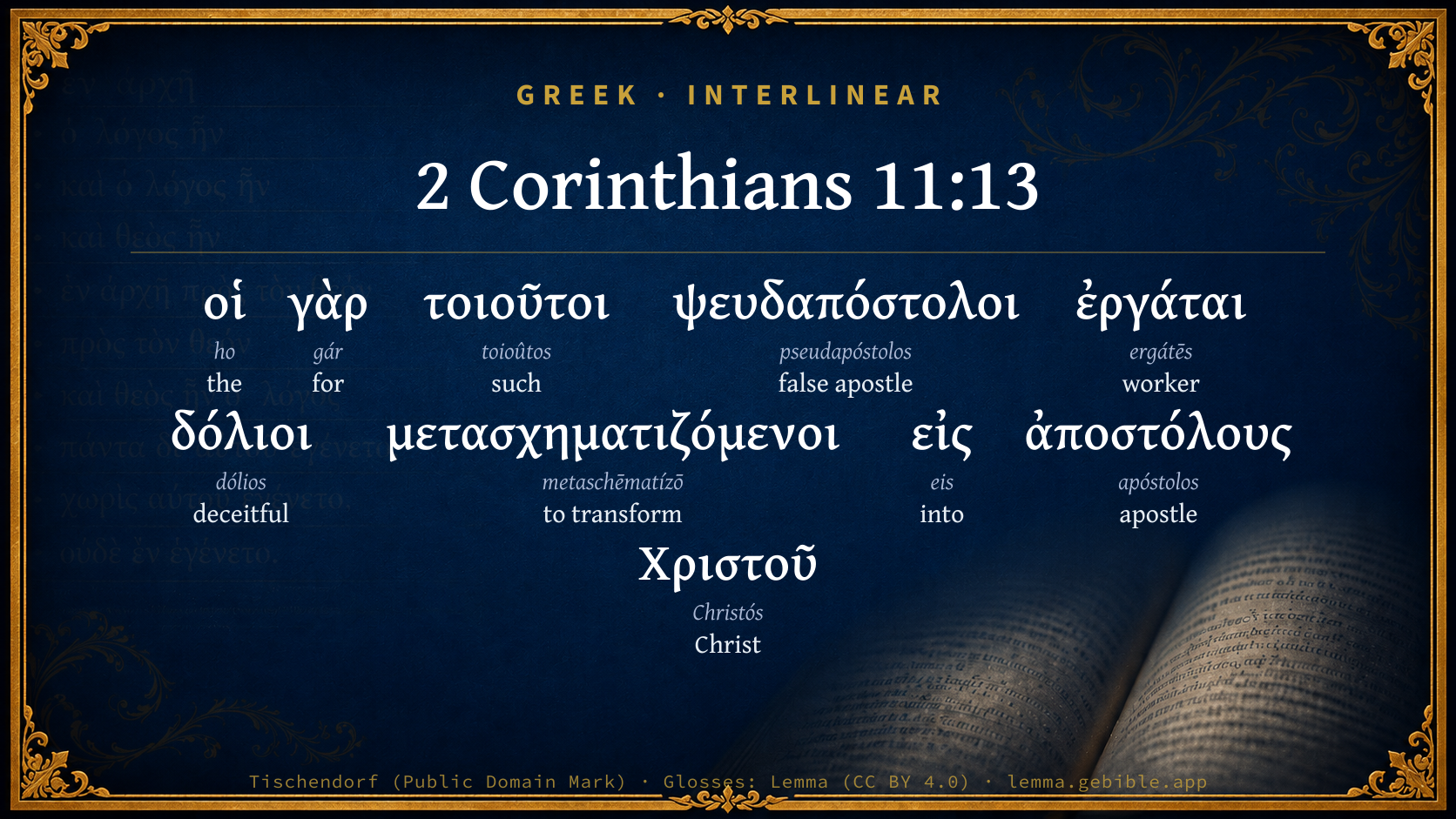
Download image
Cite this verse

2 Corinthians 11:13 (World English Bible). Public Domain. Lemma interlinear Bible study tool, https://lemma.gebible.app/v/2-corinthians/11/13.

Show BibTeX & RIS
BibTeX
RIS
English Translation
For such men are false apostles, deceitful workers, masquerading as Christ's apostles.
World English Bible · Public Domain
Highlights
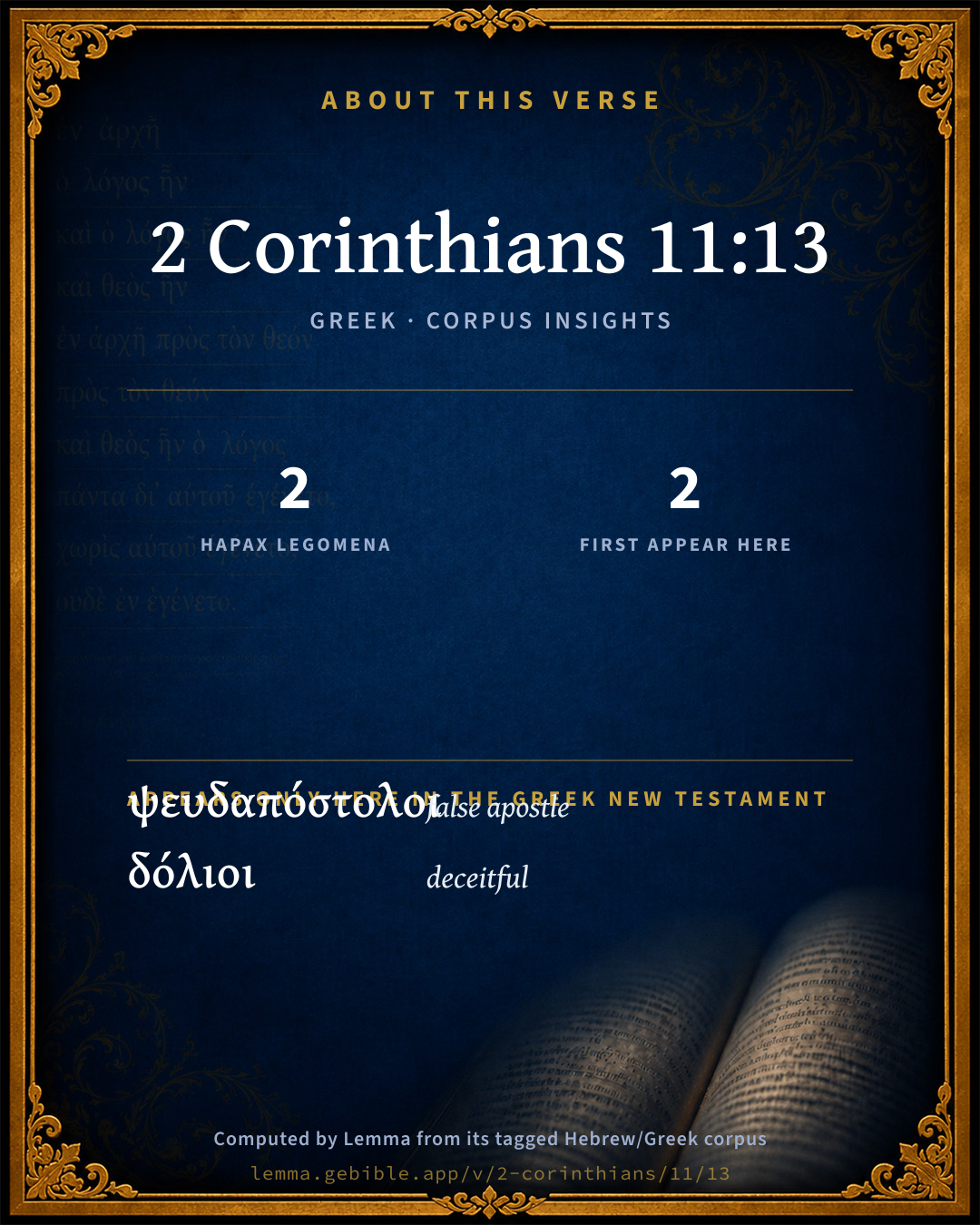
  • 2 hapax legomena — only here in the Greek New Testament
  • 2 first appearances in the Greek New Testament
Full analysis ↓
Download a study sheet

One document with this verse’s original text, its word-by-word gloss line, the meaning frame, cross-references with their text, attributed commentary, and full source and license credits — printable, and it pastes into notes with its structure intact.

This verse Autodidact and up

Study sheet (.html) Plain text (.txt)

A passage Seminary Student

Up to 50 verses in one chapter. A passage sheet keeps up to 6 commentary sources and 12 cross-references per verse, in the order this page ranks them, and says so on the sheet whenever that leaves anything out. Ask for a single verse and you get the Autodidact verse sheet above.

Everything on this page stays free to read, with no account — the sheet is a download of what is already on screen, not access to it.

Want to remove ads? Support Godless Engineer
Compare translations 3

The same verse in 3 English versions, stacked beneath the original-language interlinear above. Click any original word for its lexicon entry.

Each is an independent rendering of the whole verse — the interlinear is not word-aligned to these translations.

Highlighted words mark where these versions differ — a whole-verse word diff, not a word-by-word alignment.

  • World English Bible Public Domain
    For such men are false apostles, deceitful workers, masquerading as Christ's apostles.
  • King James Version Public Domain
    For such are false apostles, deceitful workers, transforming themselves into the apostles of Christ.
  • unfoldingWord Literal Text CC BY-SA 4.0
    For the ones of such kind false apostles, deceitful workers, disguising themselves apostles of Christ.

unfoldingWord Literal Text — © unfoldingWord, licensed CC BY-SA 4.0. Word-aligned USFM3 via Door43 (git.door43.org/unfoldingWord/en_ult).

Versions to compare (up to 4)

3 of 4 selected

Show all 19 translations

Every available English version of this verse, each an independent rendering of the whole verse.

  • World English Bible Public Domain
    For such men are false apostles, deceitful workers, masquerading as Christ's apostles.
  • Berean Standard Bible Public Domain
    For such men are false apostles, deceitful workers, masquerading as apostles of Christ.
  • Majority Standard Bible Public Domain
    For such men are false apostles, deceitful workers, masquerading as apostles of Christ.
  • King James Version Public Domain
    For such are false apostles, deceitful workers, transforming themselves into the apostles of Christ.
  • American Standard Version (1901) Public Domain
    For such men are false apostles, deceitful workers, fashioning themselves into apostles of Christ.
  • Revised Version (1885) Public Domain
    For such men are false apostles, deceitful workers, fashioning themselves into apostles of Christ.
  • Geneva Bible (1599) Public Domain
    For such false apostles are deceitfull workers, and transforme themselues into the Apostles of Christ.
  • Douay-Rheims (1899) Public Domain
    For such false apostles are deceitful workmen, transforming themselves into the apostles of Christ.
  • Young's Literal Translation Public Domain
    for those such `are' false apostles, deceitful workers, transforming themselves into apostles of Christ,
  • Literal Standard Version CC BY-SA 4.0
    for those such [are] false apostles, deceitful workers, transforming themselves into apostles of Christ,
  • Unlocked Literal Bible CC BY-SA 4.0
    For such people are false apostles and deceitful workers. They disguise themselves as apostles of Christ.
  • unfoldingWord Literal Text CC BY-SA 4.0
    For the ones of such kind false apostles, deceitful workers, disguising themselves apostles of Christ.
  • Darby Bible Public Domain
    For such [are] false apostles, deceitful workers, transforming themselves into apostles of Christ.
  • World Messianic Bible Public Domain
    For such men are false emissaries, deceitful workers, masquerading as Messiah’s emissaries.
  • Webster's Bible Public Domain
    For such are false apostles, deceitful workers, transforming themselves into the apostles of Christ.
  • Free Bible Version CC BY-SA 4.0
    These people are false apostles, dishonest workers, who pretend to be apostles of Christ.
  • Bible in Basic English Public Domain
    For such men are false Apostles, workers of deceit, making themselves seem like Apostles of Christ.
  • Text-Critical English NT CC BY 4.0
    For such men are false apostles and deceitful workers, disguising themselves as apostles of Christ.
  • Tyndale New Testament (1534) Public Domain
    For these falce apostles are disceatefull workers and fassion them selves lyke vnto the apostles of Christ.

Literal Standard Version (2020), Covenant Press — licensed CC BY-SA 4.0. Text via the HelloAO Bible API (eBible.org). Unlocked Literal Bible (unfoldingWord) — licensed CC BY-SA 4.0. Text via the HelloAO Bible API (eBible.org). unfoldingWord Literal Text — © unfoldingWord, licensed CC BY-SA 4.0. Word-aligned USFM3 via Door43 (git.door43.org/unfoldingWord/en_ult). Free Bible Version, Dr. Jonathan Gallagher — licensed CC BY-SA 4.0. Text via the HelloAO Bible API (eBible.org).

Word by word

More ways to search: Search by grammar → Find every occurrence → Compare this word →

Practice this passage: Drill this verse → Learn its vocabulary →

About this verse

These counts appear in no published source. They are computed here, from the morphology-tagged text and Lemma’s own curated glosses. What Lemma adds →

10
words
10
distinct lemmas
Pauline Epistles
section

Notable vocabulary

2 hapax legomena — words that appear only here in the entire Greek New Testament:

  • ψευδαπόστολοι false apostle G5570
  • δόλιοι deceitful G1386

First appearance in Scripture

These words make their first canonical appearance in the Greek New Testament here:

  • ψευδαπόστολοι false apostle G5570
  • δόλιοι deceitful G1386

Shared distinctive vocabulary

μετασχηματιζόμενοι to transform G3345 occurs in 5 verses of the Greek New Testament. Also found in:
Cross-references

33

Topical passages linked to 2 Corinthians 11:13 in the Treasury of Scripture Knowledge — connected by theme and wording, ordered by reader-vote popularity; previews shown in the World English Bible.

  • Galatians 1:7 and there isn't another gospel. Only there are some who trouble you, and want to pervert the Gospel of Christ.
  • Revelation 2:2 "I know your works, and your toil and perseverance, and that you can't tolerate evil men, and have tested those who call themselves apostles, and they are not, and found them false.
  • Philippians 3:2 Beware of the dogs, beware of the evil workers, beware of the false circumcision.
  • 1 John 4:1 Beloved, don't believe every spirit, but test the spirits, whether they are of God, because many false prophets have gone out into the world.
  • Galatians 2:4 This was because of the false brothers secretly brought in, who stole in to spy out our liberty which we have in Christ Jesus, that they might bring us into bondage;
  • Acts 20:30 Men will arise from among your own selves, speaking perverse things, to draw away the disciples after them.
  • 2 Corinthians 11:15 It is no great thing therefore if his ministers also masquerade as servants of righteousness, whose end will be according to their works.
  • Ephesians 4:14 that we may no longer be children, tossed back and forth and carried about with every wind of doctrine, by the trickery of men, in craftiness, after the wiles of error;
  • Colossians 2:4 Now this I say that no one may delude you with persuasiveness of speech.
  • Colossians 2:8 Be careful that you don't let anyone rob you through his philosophy and vain deceit, after the tradition of men, after the elements of the world, and not after Christ.
  • Revelation 19:20 The beast was taken, and with him the false prophet who worked the signs in his sight, with which he deceived those who had received the mark of the beast and those who worshiped his image. These two were thrown alive into the lake of fire that burns with sulfur.
  • Romans 16:18 For those who are such don't serve our Lord, Jesus Christ, but their own belly; and by their smooth and flattering speech, they deceive the hearts of the innocent.
  • 1 Timothy 6:3–5 If anyone teaches a different doctrine, and doesn't consent to sound words, the words of our Lord Jesus Christ, and to the doctrine which is according to godliness,
  • Titus 1:10–11 For there are also many unruly men, vain talkers and deceivers, especially those of the circumcision,
  • 1 John 2:18 Little children, these are the end times, and as you heard that the Antichrist is coming, even now many antichrists have arisen. By this we know that it is the end times.
  • 2 John 1:7–11 For many deceivers have gone out into the world, those who don't confess that Jesus Christ came in the flesh. This is the deceiver and the Antichrist.
  • Jude 1:4 For there are certain men who crept in secretly, even those who were long ago written about for this condemnation: ungodly men, turning the grace of our God into lasciviousness, and denying our only Master, God, and Lord, Jesus Christ.
  • Revelation 2:9 "I know your works, oppression, and your poverty (but you are rich), and the blasphemy of those who say they are Jews, and they are not, but are a synagogue of Satan.
  • Revelation 2:20 But I have this against you, that you tolerate your woman, Jezebel, who calls herself a prophetess. She teaches and seduces my servants to commit sexual immorality, and to eat things sacrificed to idols.
  • Acts 15:24 Because we have heard that some who went out from us have troubled you with words, unsettling your souls, saying, 'You must be circumcised and keep the law,' to whom we gave no commandment;
  • 2 Corinthians 4:2 But we have renounced the hidden things of shame, not walking in craftiness, nor handling the word of God deceitfully; but by the manifestation of the truth commending ourselves to every man's conscience in the sight of God.
  • Galatians 6:12 As many as desire to look good in the flesh, they compel you to be circumcised; only that they may not be persecuted for the cross of Christ.
  • Philippians 1:15–16 Some indeed preach Christ even out of envy and strife, and some also out of good will.
  • 2 Peter 2:1–3 But there also arose false prophets among the people, as among you also there will be false teachers, who will secretly bring in destructive heresies, denying even the Master who bought them, bringing on themselves swift destruction.
  • Acts 15:1 Some men came down from Judea and taught the brothers, "Unless you are circumcised after the custom of Moses, you can't be saved."
  • 2 Corinthians 2:17 For we are not as so many, peddling the word of God. But as of sincerity, but as of God, in the sight of God, we speak in Christ.
  • Galatians 4:17 They zealously seek you in no good way. No, they desire to alienate you, that you may seek them.
  • 1 Timothy 1:4–7 neither to pay attention to myths and endless genealogies, which cause disputes, rather than God's stewardship, which is in faith--
  • 1 Timothy 4:1–3 But the Spirit says expressly that in later times some will fall away from the faith, paying attention to seducing spirits and doctrines of demons,
  • 2 Timothy 2:17–19 and their word will consume like gangrene, of whom is Hymenaeus and Philetus;
  • 2 Timothy 3:5–9 holding a form of godliness, but having denied the power thereof. Turn away from these, also.
  • 2 Timothy 4:3–4 For the time will come when they will not listen to the sound doctrine, but, having itching ears, will heap up for themselves teachers after their own lusts;
  • Matthew 25:24 "He also who had received the one talent came and said, 'Lord, I knew you that you are a hard man, reaping where you did not sow, and gathering where you did not scatter.

Cross-references courtesy of OpenBible.info (CC BY 4.0).

Commentary

Notes on 2 Corinthians 11:13 from classic Christian and Jewish commentators (each source and its license shown beneath its notes). The classic Christian expositions comment on the surrounding passage and are grouped to its opening verse, so a note may address several verses; the Jewish commentaries on the Tanakh (Rashi and others) are per-verse, so they appear only where the commentator wrote on this verse.

Lemma curates 59 commentaries, every one of them public domain or Creative Commons licensed, each selected and text-cleaned for this edition rather than reprinted as found. About our sources →

Joseph Benson's Commentary

2Co 11:13-15. For such are false apostles — Whatever they may pretend to the contrary, being destitute of that divine mission which all the true apostles have; deceitful workers — Pretending to great disinterestedness in their work, while their only design is to promote their own interest; transforming themselves into the appearance of apostles of Christ — By pretending to preach the gospel without reward. And no marvel they assume that appearance; for Satan himself — In subordination to whom they act, can put on such deceitful appearances, and be transformed into an angel of light — Wearing, on certain occasions, a mask of sanctity and religion, in his attempts to deceive and insnare the souls of men, so that one would imagine his suggestions to be of a celestial and divine original. “In this manner, it may be supposed, Satan transformed himself, when he tempted our Lord in the wilderness; and in like manner also when he tempted our first mother Eve. Evil spirits are called angels of darkness, because they employ themselves in promoting error and wickedness, which is spiritual darkness. Whereas, good angels are called angels of light, because they employ themselves in promoting truth and virtue, which is spiritual light.” Therefore, it is no great thing — Nothing extraordinary; if his ministers also, under his influence, be transformed — That is, make themselves to appear; as ministers of righteousness — False teachers are justly called ministers of Satan, because they are employed in disseminating error, whereby Satan’s kingdom is supported in the world. And, on the other hand, with equal propriety are the teachers of true doctrine called ministers of righteousness, because of the efficacy of true doctrine to promote righteousness in them who receive it: whose end — Notwithstanding all their disguises; shall be according to their works — Here the end, as in Rom 6:21, signifies the final issue of a course of action; consequently the retribution which shall be made to the actor.

Joseph Benson's Commentary on the Old and New Testaments (1811–1818) — public domain. Text from a community e-Sword module.

Whedon's Commentary on the Bible

Daniel D. Whedon

4. Unmasking of their hypocrisy, and apologetic announcement of the measurement, 2Co_11:13-21.

For one brief moment St. Paul brings the detractors from the shade into the foreground, and gives them a terrible characterization.

13. For—I will give them no occasion, for the following reason.

False apostles—As, above, they were overmuch apostles.

Deceitful workers— Treacherous machinators; one of whose twofold machinations we have described above.

Daniel D. Whedon (gen. ed.), Commentary on the Old and New Testaments (1874–1909) — public domain. Text from a community e-Sword module.

Tyndale Open Study Notes

Tyndale Open Resources

11:13-15 Paul fiercely condemns the false teachers in Corinth (cp. Gal 1:6-9). Although the false teachers wanted to claim that their work was just like Paul’s (2 Cor 11:12), they were in fact false apostles and deceitful workers (cp. Phil 3:2). Just as Satan changed himself into an angel of light to deceive Eve (as described in the Jewish apocryphal book The Life of Adam and Eve), so his servants also disguise themselves as servants of righteousness. Satan’s servants claim to be God’s servants, but their deeds are wicked, and their punishment is sure (cp. 2 Cor 5:10).

Tyndale Open Study Notes — © Tyndale Open Resources, licensed CC BY-SA 4.0. Text via the HelloAO Bible API.

Bengel's Gnomon

Johann Albrecht Bengel

2Co 11:13. Οἱ γὰρ τοιοῦτοι, for such) The reason is herein given, [aetiologia] why he is unwilling, that they should be thought like him.—ψευδαπόστολοι, false apostles) This is now part of the predicate; the antithesis is at 2Co 11:5. At length he calls a spade a spade. Δόλιοι, deceitful, presently afterwards, is in conformity with it. [This is remarkable severity of language. Not a few have been of opinion: Such men are of a disposition not altogether to be despised, and it was not proper, that they should be so invidiously covered with disgrace: viz., They saw Christ, and now give their daily testimony to Him; they therefore ought to hold some place among others. But the cause of truth is most delicate; and the Indifferentism, which is so pleasant to many in the present day, was not cultivated by Paul. (Er war kein so gefälliger Toleranz-Prediger. He was no pleasant preacher of toleration.) There is this to be taken into account, that when his life was frequently in danger, the zeal of the apostle continued without showing any symptoms of weakness.—V. g.]—εἰς ἀποστόλους Χριστοῦ, as the apostles of Christ) They a not altogether deny Christ, but they did not preach Him truly, 2Co 11:23.

Bengel's Gnomon of the New Testament — English translation (T&T Clark, Edinburgh, 1860) — public domain. Text from a community e-Sword module.

Meyer's Critical & Exegetical Commentary

Heinrich August Wilhelm Meyer

2Co_11:13. Justification of the aforesaid ἵνα ἐν ᾧ καυχῶνται, εὑρεθ. καθὼς κ. ἡμεῖς. Not without ground do I intend that they shall, in that of which they boast, be found to be as we; for the part, which these men play, is lying and deceit.

Those who take καθὼς κ. ἡμεῖς in 2Co_11:12 : not better than we, must forcibly procure a connection by arbitrarily supplying something; as e.g. Rückert: that in the heart of the apostle not better than we had the meaning: but rather worse, and that this is now illustrated. Hofmann, in consequence of his view of ἵνα ἐν ᾧ καυχ. κ.τ.λ. 2Co_11:12, interpolates the thought: for the rest they have understood how to demean themselves as Christs messenger.

οἱ γὰρ τοιοῦτοι κ.τ.λ.] for people of that kind are false apostles, etc., so that ψευδαπόστολοι is the predicate.[330] So also de Wette and Ewald. Usually, after the Vulgate (also Flatt, Billroth, Rückert, Hofmann), ψευδαπόστολοι is made the subject: for such false apostles are, etc. But it should, in fact, be rather put: for the false apostles of that kind (in distinction from other false apostles; comp. 2Co_12:3; Soph. O. R. 674; Polyb. viii. 2, 5, xvi. 11, 2) are, etc.,which would be quite appropriate. Besides, the ψευδαπόστολοι, disclosing entirely at length the character of the enemies, would lose its emphasis. On the contemptuous sense of τοιοῦτος, comp. Ellendt, Lex. Soph. II. p. 843.

ἐργάται δόλιοι] comp. Php_3:2. They were workers, in so far certainly as they by teaching and other activity were at work in the church; but they were deceitful workers (dealt in δολίαις βουλαῖς, Eur. Med. 413, δολίοις ἐπέεσσιν, Hom. ix. 282, and δολίαις τέχναισι, Pind. Nem. iv. 93), since they wished only to appear to further the true Christian salvation of the church, while at bottom they pursued their own selfish and passionate aims (2Co_11:20). For the opposite of an ἐργάτης δόλιος, see 2Ti_2:15.

μετασχηματιζ. εἰς ἀποστ. Χ.] transforming themselves into apostles of Christ. Their essential form is not that of apostles of Christ, for they are servants of Satan; in order to appear as the former, they thus assume another form than they really have, present themselves otherwise than they really are. In working against Paul in doctrine and act, they hypocritically assumed the mask of apostle, though they were the opposite of a true apostle (Gal_1:1; Rom_15:18 ff.; 2Co_12:12).

[330] Bengel says aptly: Haec jam pars praedicati, antitheton, ver. 5. Nunc tandem scapham scapham dicit. On the idea of ψευδαπόστολοι, Erasmus rightly remarks: Apostolus enim ejus agit negotium a quo missus est, isti suis commodis serviunt. Without doubt the people maintained for themselves their claim with equal, nay, with better right than Paul, to the name of apostle, which they probably conceded to Paul only in the wider sense (Act_14:4; Act_14:14; 1Co_15:7).

Meyer — Critical and Exegetical Commentary on the New Testament — English translation by Peter Christie, edited by Frederick Crombie (T&T Clark, 1880) — public domain. Text from a community e-Sword module.

Expositor's Greek Testament

ed. W. Robertson Nicoll

2Co 11:13 . οἱ γὰρ τοιοῦτοι κ . τ . λ .: for such men (this explains the ground of his determination in 2Co 11:12 not to give opportunity for cavil) are false apostles ( cf. Rev 2:2 . This speedy appearance of false teachers was one of the most remarkable features of the Apostolic age; cf. Gal 2:4 , Phi 1:15 ; Phi 3:18 , Tit 1:10 , 2Pe 2:1 , 1Jn 4:1 ), crafty workers ( cf. Phi 3:2 ), fashioning themselves into Apostles of Christ, i.e. , laying special claim to that great title ( cf. chap. 2Co 10:7 ). μετασχηματίζειν τι is to change the outward appearance ( σχῆμα ) of a thing, the thing itself in essence ( μορφή ) remaining unchanged (see reff.).

The Expositor's Greek Testament, edited by W. Robertson Nicoll (1897–1910) — public domain. Text from a community e-Sword module.

Geneva Bible (1599)

Geneva Bible translators

Now at length he pointeth out these fellows in their colors, forewarning that it will come to pass, that they will at length betray themselves, what countenance soever they make of zeal that they have to God’s glory.

Geneva Bible (1599) marginal notes — public domain. Text via Bolls.life.

Jamieson, Fausset & Brown

Robert Jamieson, A. R. Fausset & David Brown

For--reason why he is unwilling they should be thought like him [BENGEL].

such--they and those like them.

false apostles--those "overmuch apostles" (see on Co2 11:5) are no apostles at all.

deceitful workers--pretending to be "workmen" for the Lord, and really seeking their own gain.

Jamieson, Fausset & Brown — Commentary Critical and Explanatory on the Whole Bible (1871) — public domain (CC PDM 1.0). Text via the HelloAO Bible API.

Adam Clarke's Commentary

Verse 13. For such are false apostles] Persons who pretend to be apostles, but have no mission from Christ.

Deceitful workers] They do preach and labour, but they have nothing but their own emolument in view.

Transforming themselves] Assuming as far as they possibly can, consistently with their sinister views, the habit, manner, and doctrine of the apostles of Christ.

Adam Clarke's Commentary on the Bible (1810–1826) — public domain. Text from a community e-Sword/MySword module.

John Calvin's Commentaries

13. For such are false Apostles While he has already taken away from them what they chiefly desired, yet, not contented with having put himself on a level with them with respect to that in which they were desirous to excel, he leaves them nothing for which they deserve any commendation. It was apparently a laudable thing to despise money, but he says, that they make use of a pretense for the purpose of deceiving, exactly as if a harlot were to borrow the apparel of a decent matron. For it was necessary to pull off the mask, which obscured the glory of God.

They are deceitful workers, says he, that is — they do not discover their wickedness at first view, but artfully insinuate themselves under some fair pretext. Hence they require to be carefully and thoroughly sifted, lest we should receive persons as servants of Christ, as soon as any appearance of excellence is discovered. Nor does Paul in malice and envy put an unfavorable construction upon what might be looked upon as an excellence, but, constrained by their dishonesty, he unfolds to view the evil that lay hid, because there was a dangerous profanation of virtue in pretending to burn with greater zeal than all the servants of Christ.

John Calvin's Commentaries (1540-1563) — public domain. Text from the Calvin Translation Society English edition (1840s-50s) via the Christian Classics Ethereal Library (ccel.org). Calvin's coverage is partial (roughly two-thirds of the Bible); uncommented books and verses are honest gaps, never fabricated. The 19th-century editor's footnotes and remarks are omitted so the notes are faithfully Calvin's own voice.

Ellicott's Commentary for English Readers

(13) For such are false apostles . . .—St. Paul’s estimate of the character of his rivals is now given in unsparing language as the reason why he desires to deprive them of any claim which may give them an adventitious superiority to him. In the term “false apostles” we have the explanation of the “apostles extraordinary” of 2Co_11:5. These “crafty workers” were carrying on a system of imposture, trying to assume the character of being, in a higher sense than he was, “Apostles of Christ.” This again throws light both on the words “if any man trusts that he is Christ’s” of 2Co_10:7, and on the “I am of Christ” of 1Co_1:12.

A Bible Commentary for English Readers, edited by Charles John Ellicott (1878–1897) — public domain. Text from a community e-Sword module.

The Cambridge Bible for Schools and Colleges

gen. ed. J. J. S. Perowne

13. For such] The link of connection is as follows. You cannot believe them in their boasting. They are false and deceitful in all their doings. They have not your interest at heart, but their own. Cf. ch. 2Co_2:17.

false apostles] See Rev_2:2; also note on 2Co_11:26.

deceitful workers] St Paul is indirectly aiming at such persons in ch. 2Co_4:2, as well as more directly in ch. 2Co_2:17. Cf. Rom_16:17-18; Php_3:2. The word workers is in the original equivalent to our word workmen or artisans. The reference is to workmen who shirk, or as it is called ‘scamp’ their work, instead of dealing fairly by their employer.

The Cambridge Bible for Schools and Colleges (gen. ed. J. J. S. Perowne; Cambridge University Press, 1878–1918) — public domain. Text from a community e-Sword module.

John Gill's Exposition

For such are false apostles,.... Such as those he had in view, who sought an occasion to depress him, and exalt themselves, and to get money from the Corinthians; these were "false apostles", or apostles falsely so called; they had the name, but not the thing; they were not called and sent forth by Christ; they had not the grace of apostleship, or gifts qualifying them for that high office; the power and authority they exercised was usurped by them; they could not prove their mission by true and real miracles; nor had they any seals of their apostleship, as those who were sent by Christ had:

deceitful workers; they went by the name of labourers in Christ's vineyard, when they were loiterers in it; they pretended to work, but did not; and to work for Christ, when they only served themselves, and their own bellies; they took upon them to interpret the Scriptures, but in a very fallacious manner; they walked in craftiness, and handled the word of God deceitfully, and lay in wait to deceive men; and were masters of so much art and cunning, that, if it was possible, they would have deceived the very elect:

transforming themselves into the apostles of Christ: not so much by putting on a like garb or dress, but by pretending to be of the same principles, and to follow their practices, and to pursue the same good ends in their ministrations.

John Gill's Exposition of the Whole Bible (1746–1763) — public domain (CC PDM 1.0). Text via the HelloAO Bible API.

Trapp's Complete Commentary

John Trapp

13 For such are false apostles, deceitful workers, transforming themselves into the apostles of Christ.

Ver. 13. Deceitful workers] They seemed to labour, but indeed they loitered, or worse; seeking to set up themselves in the hearts of God’s people.

Transforming themselves, &c.] The Manichees derived their name of manna, because they held that whatsoever they taught was to be received as food from heaven. Montanus said he was the Comforter, &c. Novatus called himself Moses, and a brother that he had, Aaron. The family of love set out their Evangelium regni. Kingdom of the Gospel. The Swenckfeldians (Stinckfeldians Luther called them, from the ill savour of their opinions) entitled themselves with that glorious name, The confessors of the glory of Christ. (Schlussenburg.)

John Trapp, A Commentary or Exposition upon All the Books of the Old and New Testament (1647–1656) — public domain. Text from a community e-Sword module.

Albert Barnes' Notes on the Bible

For such are false apostles - They have no claim to the apostolic office. They are deceivers. They pretend to be apostles; but they have no divine commission from the Redeemer. Paul had thus far argued the case without giving them an explicit designation as deceivers. But here he says that people who had conducted thus; who attempted to impose on the people; who had brought another gospel, whatever pretences they might have - and he was not disposed to deny that there was much that was plausible - were really impostors and the enemies of Christ. It is morally certain, from 2Co 11:22, that these people were Jews; but why they had engaged in the work of preaching, or why they had gone to Corinth, cannot with certainty be determined.

Deceitful workers - Impostors. People who practice various arts to impose on others. They were crafty, and fraudulent, and hypocritical. It is probable that they were people who saw that great advantage might be taken of the new religion; people who saw the power which it had over the people, and who saw the confidence which the new converts were inclined to repose in their teachers; perhaps people who had seen the disciples to the Christian faith commit all their property to the hands of the apostles, or who had heard of their doing it (compare Act 4:34-35), and who supposed that by pretending to be apostles also they might come in for a share of this confidence, and avail themselves of this disposition to commit their property to their spiritual guides. To succeed, it was needful as far as possible to undermine the influence of the true apostles, and take their place in the confidence of the people. Thence they were “deceitful (δόλιοι dolioi) workers,” full of trick, and cunning, and of plausible arts to impose on others.

Transforming themselves ... - Pretending to be apostles. Hypocritical and deceitful, they yet pretended to have been sent by Christ. This is a direct charge of hypocrisy. They knew they were deceivers; and yet they assumed the high claims of apostles of the Son of God.

Albert Barnes' Notes on the Bible (1834–1885) — public domain. Text from a community e-Sword/MySword module.

Matthew Poole's English Annotations

For such are false apostles; that is, persons pretending to be sent of Christ, but were indeed never sent of him.

Deceitful workers; persons whose work is but to cheat and deceive you; and that both with reference to their call and authority which they pretend to, and also to the doctrine which they bring.

Transforming themselves into the apostles of Christ; they were never apostles of Christ, only they put themselves into such a shape and form, that they might have more advantage to deceive.

Matthew Poole's English Annotations on the Holy Bible (1683–1685) — public domain. Text from a community e-Sword/MySword module.

The Pulpit Commentary

Ver. 13. For such are false apostles. This, with 1Th_2:14-16 and Php_3:2, is one of St. Paul"s most passionate outbursts of plain speaking. "Now at length" says Bengel, "he calls a spade a spade." They were "false apostles", (Rev_2:2) because a true apostle delivers the message of another, while these cared only for self. (Rom_16:18) Deceitful workers. Workmen who cheat their employers. (2Co_2:17 2Co_4:2) Transforming themselves. The verb is the same as in 1Co_4:6 and Php_3:21, and does not occur elsewhere in the New Testament.

Vers. 13-15.

Self-misrepresentation.

such are false apostles, deceitful workers, transforming themselves into the apostles of Christ. And no marvel; for Satan himself is transformed into an angel of light. Therefore it is no great thing it fits ministers also be transformed as the ministers of righteousness; whose end shall be according to their works." Three thoughts are suggested by these words.

I MAN HAS THE POWER OF MISREPRESENTING HIS CHARACTER TO OTHERS. Naturalists tell us of animals which have the power to appear what they really are not. Some feign sleep and death. Be this as it may, man has this power in an eminent degree he can disguise himself and live in masquerade. Hence our Saviour speaks of "wolves in sheep"s clothing." In fact, throughout all circles and populations those who appear to be what they really are have ever been in a miserable minority. As a rule men are not what they seem.

II IN THE EXERCISE OF THIS POWER MAN CAN INVEST EVIL WITS THE HIGHEST FORMS OF GOOD. The "false apostles," to whom reference is here made, seem to have done so. Paul speaks of them as "deceitful workers, transforming themselves into the apostles of Christ. And no marvel; for Satan himself is transformed into an angel of light." The worse a man is the stronger the temptation he has to assume the forms of goodness. Were corrupt men to show the state of their hearts to their contemporaries, they would recoil from them with horror and disgust, and they would be utterly unable to enjoy social intercourse or to transact their worldly business. As a rule, the worse a man is the more strenuous his efforts to assume the habiliments of virtue. Selfishness robes itself in the garbs of benevolence, error speaks in the language of truth. Hence it does not follow that a man is a true apostle or minister of Christ because he appears in the character. Some of the worst men on the earth have been deacons and priests, occupied pulpits and preached sermons. "No marvel," says the apostle; "for Satan himself is transformed into an angel of light." Hence it behoves us all to look well into the real moral character of those who set themselves up as the representatives of Christ and the teachers of religion. "Beloved, believe not every spirit, but try the spirits whether they are of God: because many false prophets are gone out into the world.

III HE WHO EXERCISES THIS POWER IN THIS WAY RENDERS HIMSELF LIABLE TO TERRIBLE PUNISHMENT. "Whose end shall be according to their works." Of all characters the hypocrite is the most guilty and abhorrent. More terrible and more frequent were the denunciations Christ hurled against such than against the voluptuary, the gross sensualist, or the sordid worldling. "Woe unto you, scribes and Pharisees, hypocrites!" etc.. (see Mat_23:13-33) As such are the greatest sinners, such will have the most terrible end; the "end shall be according to their works." They will reap the fruit of their own doings.

CONCLUSION. Learn:

1. The duty of self-truthfulness. Let us seek to be such true men, so true to self, society, and God, that we may have no temptation whatever to play the hypocrite or to appear to others what we are not.

To thine own self be true, And it must follow, as the night the day, Thou canst not then be false to any man.

2. The duty of social caution. Do not let us estimate men by their appearances, ant take them into the circle of our confidence and friendship merely on account of what they appear to be. Often those whose outward garb is the most holy are inwardly the most corrupt, who outwardly move as angels of light are inwardly the greatest devils. Let us learn to take off the mask, to disrobe corruption of its external robes of purity, and to give neither our trust nor our sympathy until we are convinced that they have truth in the "inward parts.

Vers. 13-15.

Character of these teachers.

Indications of a marked change in the apostle respecting these intruders at Corinth appear in the tenth chapter. Recent circumstances had aroused his attention to their acrid and persistent hostility as directed against him and the spiritual welfare of the Church. From the first he had not misjudged them. Under all their specious arts he had detected a low and carnal spirit, calculated to affect these volatile Corinthians and obstruct the progress of his ministry. Meantime they had increased in boldness and audacity, and assailed him with more impetuous virulence. Evidently, then, there was a growth in his convictions as to their mischief-making power, and of late these convictions had become very strong. The growth is apparent both in his thought and feeling, and in such a mind as St. Paul"s it could not be long in reaching his will and shaping itself in a resolute purpose to put down the evil. So long as it was mainly a personal vexation, he had borne it patiently; but the hour had come when, while true to "the meekness and gentleness of Christ," he must show "the rod." Very clearly is the military attitude of his mind exhibited in the previous chapter, he speaks of "weapons," of their might to overthrow "strongholds" and "cast down imaginations," and of his readiness at the proper moment "to revenge all disobedience." This deepening intensity finds utterance in the paragraph now under consideration. Unable to repress his feelings any longer, he gives them expression in the most forcible form his language could assume as it regarded the religious pretensions of these men. They are "false apostles, deceitful workers, transforming themselves by their own act into the apostles of Christ." Looking at the matter from St. Paul"s point of view, nothing worse could be said of them. What his description involved quickly appears. "No marvel;" how could there be any room for surprise? It was characteristic of him, the great adversary, to send just such "apostles;" for "Satan himself transforms himself into an angel of light." Perfectly natural; sender and sent are one; and the union is seen in the transforming power. No great thing if "his ministers" should so fashion themselves as to seem "ministers of righteousness." And having stated who and what they were, he announces their future doom: "whose end shall be according to their works." We see now why he mentioned his fear in the opening of the chapter, and referred to Eve as led into sin by the subtlety of the serpent, and we see also why he spoke of their bearing with these hypocrites. Hitherto some of the Church had been deceived by the plausible devices of these persons. But he had opened their eyes to the danger, and, if they continued to listen to these ministers of Satan, they themselves would be willing dupes and participants in their guilt "whose end shall be according to their works." The passage has a deep spiritual meaning. It shows us the great power of Satan in adapting himself to circumstances and using means suited to times and occasions. It shows him versatile, adroit, untiring in inventiveness as well as in energy, and able to impart to others this transforming or fashioning power which he pre-eminently possesses. Not only does the Pauline theology recognize the inherency of sin in our nature, but in addition thereunto it recognizes a mighty agent who employs the utmost skill and a prodigious strength of will and passion to call out and direct this indwelling evil. And it shows this Satanic agency working in the Church, and even counterfeiting the apostleship. The passage is full and explicit. Its force cannot be evaporated in rhetoric; its truth is the sternest reality in most earnest speech. A critical occasion had arisen, one of momentous interest in the history of Christianity, one that presented a turning point in St. Paul"s career, and he met this occasion by exposing the diabolical source of their conduct. From his course of action we may learn a very useful lesson. His way of dealing with. sin looked to a personal agent beyond the sinner one with the sinner and yet distinct and separate, and this agent exerting his tremendous ability in exciting all the latency of evil as unconscious to the sinner, and with it all his conscious susceptibility, so as to accomplish his eternal ruin. Too often with us this Satanic power in men is not duly estimated. In trying to save men, we should remember from whom we are delivering them, and what an awful hold Satan"s tyranny has upon their souls. As a practical fact, this is a matter of vast importance. And, accordingly, we find the Lord Jesus impressing on the apostles that the Holy Ghost was not only to convince the world of "sin" and of "righteousness," but also of "judgment the prince of this world is judged." How else, indeed, could the work of conviction be consummated? Precisely here the Spirit perfects his gracious office as the Divine Convincer; and precisely here we must labour with all diligence and prayerfulness in order to convince men that they are by nature the subjects of this prince, and that only Christ, who has "judged" him, can deliver them from his bondage. No closeness of contact with man as mere man will meet the requirements of the case. It is man, the servant of sin because the slave of the devil, with whom the preacher of the gospel has to do, and unless he realize as far as may be the fearful import of Christ"s words, "Ye are of your father the devil," it is not likely he will cooperate with the Holy Ghost in bringing men to that depth and thoroughness of repentance which go tar to determine the stability and worth of future Christian character. Depend upon it, our danger at this point is real and serious. What is the human nature with which we are struggling in the daily endeavours of thought and in special sabbath efforts, praying, wrestling, agonizing, that it may be rescued from unbelief and restored to its Father? Inspiration is never content to portray it as merely far gone from original righteousness, dead in trespasses and sins, but the very phraseology takes its deepest import from ideas and images originally associated with Satan. If detached from Satan, such terms as "subtlety," "blindness," "deceitfulness," "bewitched," "craftiness," "beguiled," "wiles," "snares," "captivity," "bondage," would lose the peculiar force which always accompanies them in the Scriptures. And with this use of language the spirit of the New Testament accords when its writers are setting forth human depravity in its special relations to Christ"s mediatorial work. Is Judas about to negotiate for the betrayal of Jesus of Nazareth? "Satan entered into him." Is St. Peter over confident, proud of his devotion to Jesus, full of daring? "Simon, Simon, behold, Satan hath desired to have you, that he may sift you as wheat." St. John: "he that committeth sin is of the devil." St. Peter: "Your adversary, the devil." St. James: "Resist the devil." St. Paul: "Recover themselves out of the snare of the devil." Surely, then, this uniform tenor of scriptural language, coupled with Christ"s most emphatic declaration as to man"s incapacity to see Satanic agency in its true light except through the convicting office of the Holy Ghost; surely, we say, this should impress us very deeply as to the urgent need of making prominent in our preaching and teaching the fact of Satan"s enormous power over the human soul. Time was when this truth was felt far more profoundly than now, or at least when it filled a much larger space in pulpit thought and Christian literature. And the fruits of it appeared everywhere, not only in a higher order of religious sentiment, but in the amenability of folly and vice to that moral fear which no community can afford to lose. Wickedness abounded then, as now, and yet wickedness was open to the probing of its conscience and to the disturbance of its sensibilities, nor did it commonly have the complacent hardness and the defiant attitude towards the solemn hereafter which it now wears as its familiar aspect. Communities had convictions then on moral and religious subjects, but only sections of communities (speaking generally) have such convictions now. Men of convictions were sure of an audience. Savonarola could not but be heard. Luther had an intense realization of an evil spirit; less of it would have made him less of a reformer. Milton and Bunyan, the two names that Englishmen would choose as the finest representatives of English genius and manhood in the literary spheres they filled, wrote as men who realized that Satan was something more in the affairs of the world than a subject for artistic treatment. We have come to the closing quarter of the nineteenth century, and within the century the land of Luther has given us "Faust" with Mephistopheles, and the England of Milton and Bunyan has gives us "Festus" with Lucifer. Insensibly to itself, the pulpit has caught the effeminate spirit of the age, and it discusses sin much more than it grapples with Satan in sin. "For this purpose the Son of God was manifested, that he might destroy the works of the devil." If the most tender and loving soul among inspired thinkers could lay such an emphasis on this truth, assuredly there is a way for this doctrine to be strenuously preached, free from every taint of extravagance and morbid imagination. Depend upon it, when we throw this doctrine into the background of set purpose, or when we let it lapse from our grasp by casual infirmity, we have nothing left but a fragmentary Christ and a depleted ethical Christianity. L.

Vers. 13-15.

Hypocrisy.

Like his Divine Master, the Apostle Paul, although compassionate to the penitent, was severe with the hypocritical. The vehement language he here uses with reference to his opponents and detractors is not to be attributed to personal resentment, but to a stern and righteous indignation against those who sought to undermine his just influence, and so to hinder the progress of his gospel.

I THE MANIFESTATIONS OF HYPOCRISY.

1. What these hypocrites professed to be: "ministers of righteousness," and"apostles of Christ." They posed as such, and with many of the guileless and unwary they passed as such. As far as profession, pretension, and language went, all was well.

2. What they really were: "false apostles," and "deceitful workers." Theyhad no real grasp of Christian truth; they gave no real evidence of Christian principle; they consequently could do no real spiritual work for the good of the people.

II THE MOTIVE OF HYPOCRISY. Some characters seem to find a pleasure in dissimulation and deception for their own sake; but usually the motive is

(1) to gain influence over others, and enjoy their respect and support; and

(2) in this way to exalt themselves and secure their own selfish ends.

III THE GREAT PROTOTYPE OF HYPOCRISY. This is to be found in Satan himself, who "fashioneth himself into an angel of light." It is the wont of the tempter, the adversary of souls, to proceed by fraud, to invent specious pretexts for sin, and to give to vice the semblance of virtue. It is wise to bear in mind that, whilst we have sometimes to resist the devil and his open assaults, we have at other times to be wise as serpents, that we may "not be ignorant of his devices.

IV THE DISCOMFITURE AND EXPOSURE OF HYPOCRISY. Hypocritical teachers of religion and pretenders to authority may for a time escape detection by their fellow men, and may for a time be suffered by an overruling Providence to lead astray, if possible, the very elect. But the day is coming which shall test every man and shall try every man"s work. The earthly course of the hypocrites may be according to their words, according to appearances. But their "end shall be according to their works." By these they must be judged, and, since these are evil, by these they shall be condemned. T.

The Pulpit Commentary (1880–1919), ed. H.D.M. Spence-Jones & Joseph S. Exell — public domain. Text from a community e-Sword module.

Godbey's Commentary on the New Testament

William B. Godbey

THE DEVIL’S PREACHERS

13. “For such are false apostles, deceitful workers, transforming themselves into the apostles of Christ.” This verse confirms the conclusion that the apostolic office was not confined to the Twelve, because not only were James the Third, Jude, Barnabas, Paul, Apollos and Matthias bona fide apostles besides the original Twelve, but the very fact that we see here a lot of counterfeits claiming to be the apostles of Christ, is confirmatory proof that others besides the original Twelve were recognized as apostles; because it is impossible for us to conclude that Paul here makes allusion to any of the original Twelve, or of the others above mentioned, who had preached at Corinth with his full approval and appreciation. The conclusion is inevitable that a lot of counterfeits were actually claiming to be the apostles of Christ, whose claim could have received no popular plausibility if it had been understood that the number was restricted to twelve. History is still repeating itself. All ages have been cursed with counterfeit apostles, especially in the capacity of party leaders which really verify the definition of apostle, i. e., “one that enters a new field, or makes a new departure.” These parties seeking the fleece instead of the flock have figured conspicuously in all the bygone ages, and to this day, leading the blind awfully to the confusion of the unspiritual.

14. “For it is no wonder, for Satan himself transforms himself into an angel of light.” The devil was the great archangel Lucifer in Heaven before he fell (Isa 14:12). As the god of this world, he is this day doing wonderful execution in the capacity of an angel of light, thus passing himself for God, deceiving preachers and people in every land. As he long lived an angel in Heaven, he well understands how to play the angel. Those he can not devour as a roaring lion through the vulgar vices, he captures in the capacity of an angel of light, deceiving them with the delusion that he is God, or a glorified angel, thus leading them on through the worldly churches till he can dump them into Hell.

15. “Then no wonder if indeed his ministers transform themselves as the ministers of righteousness, whose end shall be according to their works.” God calls and sends His own ministers. We have multitudes of preachers standing high in metropolitan pulpits who even deny that there is any such a thing as a Divine call, and, of course, do not claim to have any themselves. You see it follows as a logical sequence, if God does not call and send them, they must call and send themselves, i. e., thus “transforming themselves as the ministers of righteousness,” while they are really wolves in sheep’s clothing, Satan’s preachers sent forth by him for the delusion and damnation of souls. From the simple fact that they are personally ignorant of God’s saving grace, judging others by themselves, they think they are a true sample of Christianity. They are deceived by the devil, so that they think they are right, and in all probability will never know the difference till the devils come after them to take them to Hell, while they are looking for the angels to come and take them to Heaven. William Bramwell, a bright and loving contemporary of John Wesley, had become enamored of one of these sleek, nice, high-toned doctors of divinity occupying a city pulpit, and so carried away that in the honesty of his heart he was asking the Lord to make him such a preacher as this man whom lie had taken for his paragon while studying for the ministry in he Episcopal Church. One bright summer day, having eaten dinner, he is lying in a hammock under a green tree, reading a good book. Falling asleep, he is awakened by the frightful visage and awful scream of that favorite preacher, exclaiming: “I am in Hell.” Awakened by the vision, he leaps from the hammock, and, facing the sidewalk, sees a man passing by, who exclaims: “Oh! Dr. dropped dead in his study a few minutes ago.” Bramwell took alarm, went to hear the Methodists, got converted and wonderfully sanctified, and became a hero in the Wesleyan Holiness Movement. These Scriptures are terrifically ominous of the awful doom awaiting Satan’s preachers, whose name is legion, and they are beneath every sky. Reader, pray for them, and be sure that they do not catch you.

William B. Godbey, Commentary on the New Testament (1896–1900) — public domain. Text from a community e-Sword module.

McGarvey & Pendleton's Commentaries

J. W. McGarvey

For such men are false apostles, deceitful workers, fashioning themselves into apostles of Christ . [Thus he declares plainly that these men are not apostles, that they maintained their false position by imposture, and that they assumed the name and office of apostles, though never having been called to be such by Christ.]

J. W. McGarvey (with Philip Y. Pendleton), Commentaries on the New Testament (The Fourfold Gospel, 1914; Acts; and the epistles) — public domain. Text from a community e-Sword/MySword module.

The People's New Testament

B. W. Johnson

13–15. Such are false apostles. He now tears off the mask. These men are not real, but false apostles, deceitful workers, pretending to be Christ's apostles.

B. W. Johnson's The People's New Testament with Notes (1889–1891) — public domain. Electronic text from the Christian Classics Ethereal Library (CCEL) ThML edition.

Cambridge Greek Testament for Schools and Colleges

13. οἱ γὰρ τοιοῦτοι ψευδαπόστολοι, ἐργάται δόλιοι. For such men are false apostles, deceitful workers. The γάρ implies some such thought as, ‘I am justified in saying these severe things, for people of that kind (Rom 16:18) are most dangerous deceivers.’ No doubt οἱ τοιοῦτοι is subject, and the rest are predicates; yet the Vulgate adds ψευδαπόστολοι to the subject; nam ejusmodi pseudoapostoli sunt operarii subdoli; and Luther adds ἐργ. δόλιοι also to the subject; denn solche falsche Apostel und trügliche Arbeiter verstellen sich zu Christi Aposteln. Comp. ψευδόχριστοι καὶ ψευδοπροφῆται (Mat 24:24; Mar 13:22), and ψευδάδελφοι (2Co 11:26); also τοὺς φάσκοντας εἶναι ἀποστόλους καὶ οὐκ εἰσι (Rev 2:2). They were δόλιοι in pretending to work for Christ, when they worked for their own ends (2Co 2:17). The adjective is frequent in Psalms and Proverbs and elsewhere in the LXX., but occurs nowhere else in the N.T. In classical Greek it is mostly poetical. With the asyndeton comp. 2Co 8:23.

μετασχηματιζόμενοι εἰς ἀποστόλους Χριστοῦ. Fashioning themselves into Apostles of Christ. A less real change is meant than that which is implied by μεταμορφοῦσθαι (2Co 3:18), the word used of the Transfiguration (Mat 17:2; Mar 9:2), and of moral change (Rom 12:2). ‘Transform’ is too strong, and there is no article before ἀποστόλους: see on 2Co 2:16. For μετασχηματίζειν comp. 1Co 4:6 and Php 3:21; see Lightfoot’s detached note on Php 2:7; also Trench, Syn. § LXX.

Cambridge Greek Testament for Schools and Colleges (Cambridge University Press, 1896; 21 vols, various authors incl. Carr, Maclear, Plummer, Farrar, Lumby, Moule, M. R. James, Simcox) — public domain. Text from a community e-Sword module.

Alford’s Greek Testament

Henry Alford

13.] For (see above: the γάρ implying also that the choice of the above line of conduct has been made in a conviction of their falsehood and its efficacy to detect it) such men are false Apostles (not, as Vulg. and most expositors, ‘such false Apostles are ἐργ. δόλ.,’ which destroys the whole emphasis of the sentence, wherein the ὑπερλίαν ἀπόστολοι of ver. 5 are pronounced now to be ψευδαπόστολοι: and besides, suggests an irrelevant comparison between οἱ τοιοῦτοι ψ. and ψ. of some other kind.

On the sense, see Rev 2:2.

ὁ τοιοῦτος is a familiar designation with the Apostle, see reff.),—dishonest workmen (in that they pretend to be teachers of the Gospel, and are in the mean time subserving their own ends),—changing themselves into (in appearance: the pres. participle indicates their habit and continual endeavours to assume the shape) Apostles of Christ. By a fair comparison between us, this mask will be stript off;—by the abundance of my sufferings, and distinctions vouchsafed by the Lord, my Apostolicity will be fully proved, and their Pseudapostolism shewn.

14,

Henry Alford, The Greek Testament (1849–1861) — public domain. Text from a community e-Sword module.

International Critical Commentary

13. οἱ γὰρ τοιοῦτοι ψευδαπόστολοι, ἐργάται δόλιοι. ‘I must beware of allowing them any advantage, for persons of this kind are spurious apostles, deceitful workers.’ Nunc tandem scapham scapham dicit (Beng.). Both the Sixtine and the Clementine Vulg. have nam ejusmodi pseudoapostoli sunt operarii subdoli, making ψευδαπόστολοι part of the subject, which is certainly wrong, and the best MSS. show that the sunt is an interpolation. Luther goes further into error by including ἐργάται δόλιοι in the subject; ‘for such false apostles and deceitful workers fashion themselves into Apostles of Christ.’ Cf. of οἱ γὰρ τοιοῦτοι τῷ Κυρίῳ ἡμῶν Χριστῷ οὐ δουλεύουσιν, ἀλλὰ τῇ ἑαυτῶν κοιλίᾳ (Rom 16:18), which means that, like the Judaizers at Corinth, they worked for their own advantage. Cf. τοὺς λέγοντας ἑαυτοὺς ἀποστόλους, καὶ οὐκ εἰσίν (Rev 2:2). In v. 26 we have ψευδάδελφοι, and Mar 13:22 ψευδόχριστοι καὶ ψευδοπροφῆται. Such compounds are freq. in late Greek, but not in classical ψενδόμαντις occurs in Hdt., Aesch., Soph., Eur., and ψευδοπάρθενος in Hdt. Δόλιος, freq. in LXX, esp. in Psalms and Proverbs, but found nowhere else in N.T., is in class. Grk. mosily poetical. The epithet explains ψευδαπόστολοι. Workers they certainly were, and they did an immense amount of mischief, but their devotion to the cause of Christ was a sham; what they really worked for was their own profit. See on 2:17. Apotolus enim ejus agit negotium a quo missus est, isti suis commodis serviunt (Erasmus). Contrast ἐργάτην ἁνεπαίσχυντον. ὀρθοτομοῦντα τὸν λόγον τῆς ἀληθείας (2Ti 2:15); also ἀπόστολοι ἐκκλησιῶν, δόξα Χριστοῦ (8:23), where we have a similar asyndeton.

μετασχηματιζόμενοι εἰς ἀποστόλους Χριστοῦ. ‘Fashioning themselves into Apostles of Christ.’ They change their appearance, they masquerade as such. In 70 the verb occurs once (4 Macc. 9:22), in N.T. three times, all in Paul, and in each place with a different meaning; here of sham apostles fashioning themselves into genuine Apostles, as the devil fashions himself into an Angel of light; in Php 3:21 of the glorious change of our body of humiliation; and in 1Co 4:6 in quite another sense (see note there). ‘Transform’ implies a greater change than is meant here, and ‘transfigure’ should be kept for μεταμορφόομαι (see on 3:18), the verb used in connexion with the Transfiguration. See on Rom 12:2 and Php 2:7; Trench, Syn. § lxx.; Lightfoot, Philippians, pp. 127 f. Συνσχηματίζομας (Rom 12:2; 1Pe 1:14) means ‘acquire an outward form in accordance with.’

International Critical Commentary — older volumes (1896–1929), various authors — public domain. Text from a community e-Sword module.

Vincent's Word Studies in the New Testament

Marvin R. Vincent

Transforming themselves [μετασχηματιζομενοι] . Rev., better, fashioning, thus preserving the distinctive force of schma outward fashion, which forms part of the compound verb. See on Mt 17:2; 1Co 4:6.

Marvin R. Vincent, Word Studies in the New Testament (1887–1900) — public domain. Text from a community e-Sword/MySword module.

Lesson kit

Teaching starters — assembled from the data on this page, not authored interpretation. Every prompt links to the verse data it draws on. Edit before teaching.

2 Corinthians, in the Pauline Epistles, opens this verse with 10 words (10 distinct Greek lemmas). Its most distinctive word is pseudapóstolos (“false apostle”). A historical commentator’s framing appears above. Read the whole chapter for the surrounding context.

Discussion questions

  1. How does “false apostle” (pseudapóstolos) shape what this verse is saying?
  2. This verse holds 2 words here found nowhere else in the Greek New Testament. What might the rare words draw attention to?
  3. 2 words here appear for the first time in Scripture. What is being introduced at this debut?
  4. 1 Corinthians 4:6 shares the word «to transform» with this verse. How do the two illuminate each other?
  5. The translations on this page render this verse differently — a whole-verse word diff, not a word-by-word alignment. What might account for the different wordings?
  6. Reading how Joseph Benson's Commentary and Whedon's Commentary on the Bible read this verse, where do the two commentators agree and where do they part?

Things to notice

  • 2 words in this verse appear nowhere else in the Greek New Testament.
  • 2 words make their first canonical appearance in Scripture here.
  • These translations choose different wording for 10 words in this verse.
  • 10 distinct Greek lemmas span 10 words in this verse.

Reading settings

Reading text

Shown beneath each verse's original-language words.

Old Testament
Old Testament edition

Read the OT as the Masoretic Hebrew (MT) or the Greek Septuagint (LXX).

English shown for the Greek Septuagint (in the Hebrew ↔ Greek comparison).

Comparing translations? Open the Compare panel on any verse page to stack up to four side by side.