Jeremiah 5:29

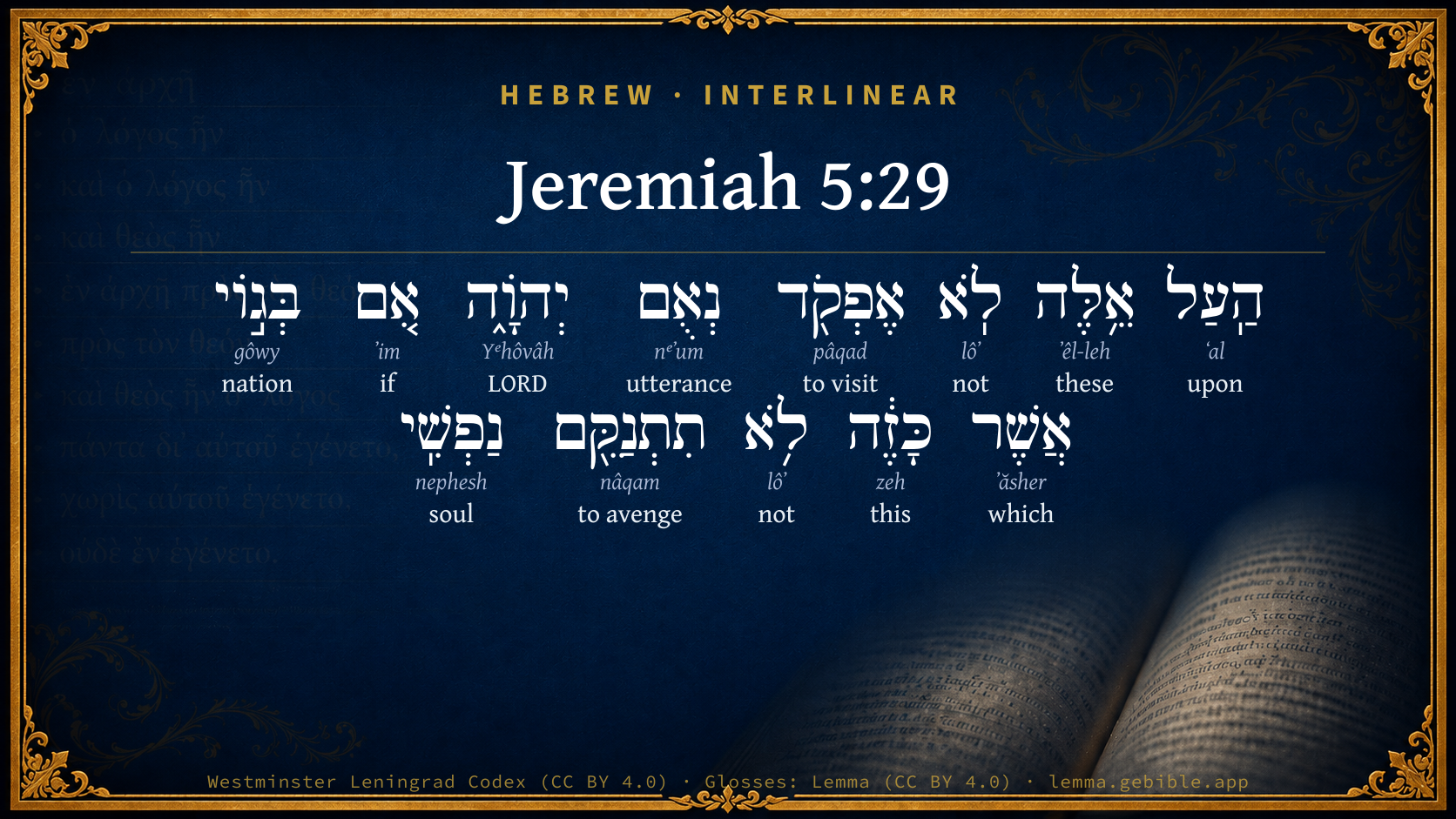
Hebrew (Westminster Leningrad Codex) Jeremiah 5:29 appears in the Hebrew Old Testament. The text above is from the Westminster Leningrad Codex. Each word links to its Strong’s number, a concise gloss, and parsing drawn from the Open Scriptures Hebrew Bible morphology. Click any word for its full Brown-Driver-Briggs (BDB) entry.
Download image
Cite this verse

Jeremiah 5:29 (World English Bible). Public Domain. Lemma interlinear Bible study tool, https://lemma.gebible.app/v/jeremiah/5/29.

Show BibTeX & RIS
BibTeX
RIS
English Translation
Shall I not visit for these things? says Yahweh; shall not my soul be avenged on such a nation as this?
World English Bible · Public Domain
Download a study sheet

One document with this verse’s original text, its word-by-word gloss line, the meaning frame, cross-references with their text, attributed commentary, and full source and license credits — printable, and it pastes into notes with its structure intact.

This verse Autodidact and up

Study sheet (.html) Plain text (.txt)

A passage Seminary Student

Up to 50 verses in one chapter. A passage sheet keeps up to 6 commentary sources and 12 cross-references per verse, in the order this page ranks them, and says so on the sheet whenever that leaves anything out. Ask for a single verse and you get the Autodidact verse sheet above.

Everything on this page stays free to read, with no account — the sheet is a download of what is already on screen, not access to it.

Want to remove ads? Support Godless Engineer
Compare translations 3

The same verse in 3 English versions, stacked beneath the original-language interlinear above. Click any original word for its lexicon entry.

Each is an independent rendering of the whole verse — the interlinear is not word-aligned to these translations.

Highlighted words mark where these versions differ — a whole-verse word diff, not a word-by-word alignment.

  • World English Bible Public Domain
    Shall I not visit for these things? says Yahweh; shall not my soul be avenged on such a nation as this?
  • King James Version Public Domain
    Shall I not visit for these things? saith the LORD: shall not my soul be avenged on such a nation as this?
  • unfoldingWord Literal Text CC BY-SA 4.0
    Why, on account of these things should I not punish? —The declaration of Yahweh— against a nation that like this should my soul not avenge itself? ts\*

unfoldingWord Literal Text — © unfoldingWord, licensed CC BY-SA 4.0. Word-aligned USFM3 via Door43 (git.door43.org/unfoldingWord/en_ult).

Versions to compare (up to 4)

3 of 4 selected

Show all 18 translations

Every available English version of this verse, each an independent rendering of the whole verse.

  • World English Bible Public Domain
    Shall I not visit for these things? says Yahweh; shall not my soul be avenged on such a nation as this?
  • Berean Standard Bible Public Domain
    Should I not punish them for these things?” declares the LORD. “Should I not avenge Myself on such a nation as this?
  • Majority Standard Bible Public Domain
    Should I not punish them for these things?” declares the LORD. “Should I not avenge Myself on such a nation as this?
  • King James Version Public Domain
    Shall I not visit for these things? saith the LORD: shall not my soul be avenged on such a nation as this?
  • American Standard Version (1901) Public Domain
    Shall I not visit for these things? saith Jehovah; shall not my soul be avenged on such a nation as this?
  • Revised Version (1885) Public Domain
    shall I not visit for these things? saith the LORD: shall not my soul be avenged on such a nation as this?
  • Geneva Bible (1599) Public Domain
    Shall I not visite for these things, sayth the Lord? or shall not my soule be auenged on such a nation as this?
  • Douay-Rheims (1899) Public Domain
    Shall I not visit for these things, saith the Lord? or shall not my soul take revenge on such a nation?
  • Young's Literal Translation Public Domain
    For these do not I inspect, an affirmation of Jehovah, On a nation such as this, Doth not My soul avenge itself?
  • Literal Standard Version CC BY-SA 4.0
    Do I not inspect for these,” || A declaration of YHWH, || “On a nation such as this, || Does My soul not avenge itself?
  • Unlocked Literal Bible CC BY-SA 4.0
    Should I not punish them for these things—this is Yahweh's declaration— and will I not take vengeance for myself on a nation like this?
  • unfoldingWord Literal Text CC BY-SA 4.0
    Why, on account of these things should I not punish? —The declaration of Yahweh— against a nation that like this should my soul not avenge itself? ts\*
  • Darby Bible Public Domain
    Shall I not visit for these things? saith Jehovah; shall not my soul be avenged on such a nation as this?
  • World Messianic Bible Public Domain
    “Shouldn’t I punish for these things?” says the LORD. “Shouldn’t my soul be avenged on such a nation as this?
  • Webster's Bible Public Domain
    Shall I not visit for these things? saith the LORD: shall not my soul be avenged on such a nation as this?
  • Free Bible Version CC BY-SA 4.0
    Shouldn't I punish them for all this? declares the Lord. Shouldn't I retaliate for what this nation has done?
  • Bible in Basic English Public Domain
    Am I not to give punishment for these things? says the Lord: will not my soul take payment from such a nation as this?
  • JPS Tanakh (1917) Public Domain
    Shall I not punish for these things? saith the LORD; Shall not My soul be avenged on such a nation as this?

Literal Standard Version (2020), Covenant Press — licensed CC BY-SA 4.0. Text via the HelloAO Bible API (eBible.org). Unlocked Literal Bible (unfoldingWord) — licensed CC BY-SA 4.0. Text via the HelloAO Bible API (eBible.org). unfoldingWord Literal Text — © unfoldingWord, licensed CC BY-SA 4.0. Word-aligned USFM3 via Door43 (git.door43.org/unfoldingWord/en_ult). Free Bible Version, Dr. Jonathan Gallagher — licensed CC BY-SA 4.0. Text via the HelloAO Bible API (eBible.org).

Word by word

More ways to search: Search by grammar → Find every occurrence → Compare this word →

Practice this passage: Drill this verse → Learn its vocabulary →

תִתְנַקֵּ֖ם
nâqam
H5358
“to avenge”
Verb, Hithpael, Imperfect, 3rd Person, Feminine, Singular
Part of Speech
Verb
Stem
Hithpael
Form
Imperfect
Person
3rd Person
Gender
Feminine
Number
Singular
Full BDB Definition

Origin: a primitive root

TWOT: 1413

to avenge, take vengeance, revenge, avenge oneself, be avenged, be punished - (Qal) - to avenge, take vengeance - to entertain revengeful feelings - (Niphal) - to avenge oneself - to suffer vengeance - (Piel) to avenge - (Hophal) to be avenged, vengeance be taken (for blood) - (Hithpael) to avenge oneself
  1. הַֽעַל ʻal H5921 “upon” Particle, Interrogative + Preposition
  2. אֵ֥לֶּה ʼêl-leh H428 “these” Pronoun, Demonstrative, Common, Plural
  3. לֹֽא lôʼ H3808 “not” Particle, Negative
  4. אֶפְקֹ֖ד pâqad H6485 “to visit” Verb, Qal, Imperfect, 1st Person, Common, Singular
  5. נְאֻם nᵉʼum H5002 “utterance of” Noun, Common, Masculine, Singular, Construct
  6. יְהֹוָ֑ה Yᵉhôvâh H3068 “LORD” Noun, Proper
  7. אִ֚ם ʼim H518 “if” Conjunction
  8. בְּג֣וֹי gôwy H1471 “in/at · nation” Preposition + Noun, Common, Masculine, Singular, Absolute
  9. אֲשֶׁר ʼăsher H834 “which” Particle, Relative
  10. כָּזֶ֔ה zeh H2088 “like/as · this” Preposition + Pronoun, Demonstrative, Masculine, Singular
  11. לֹ֥א lôʼ H3808 “not” Particle, Negative
  12. נַפְשִֽׁי nephesh H5315 “soul · my” Noun, Common, Both, Singular, Construct + Suffix, Personal, 1st Person, Common, Singular

About this verse

These counts appear in no published source. They are computed here, from the morphology-tagged text and Lemma’s own curated glosses. What Lemma adds →

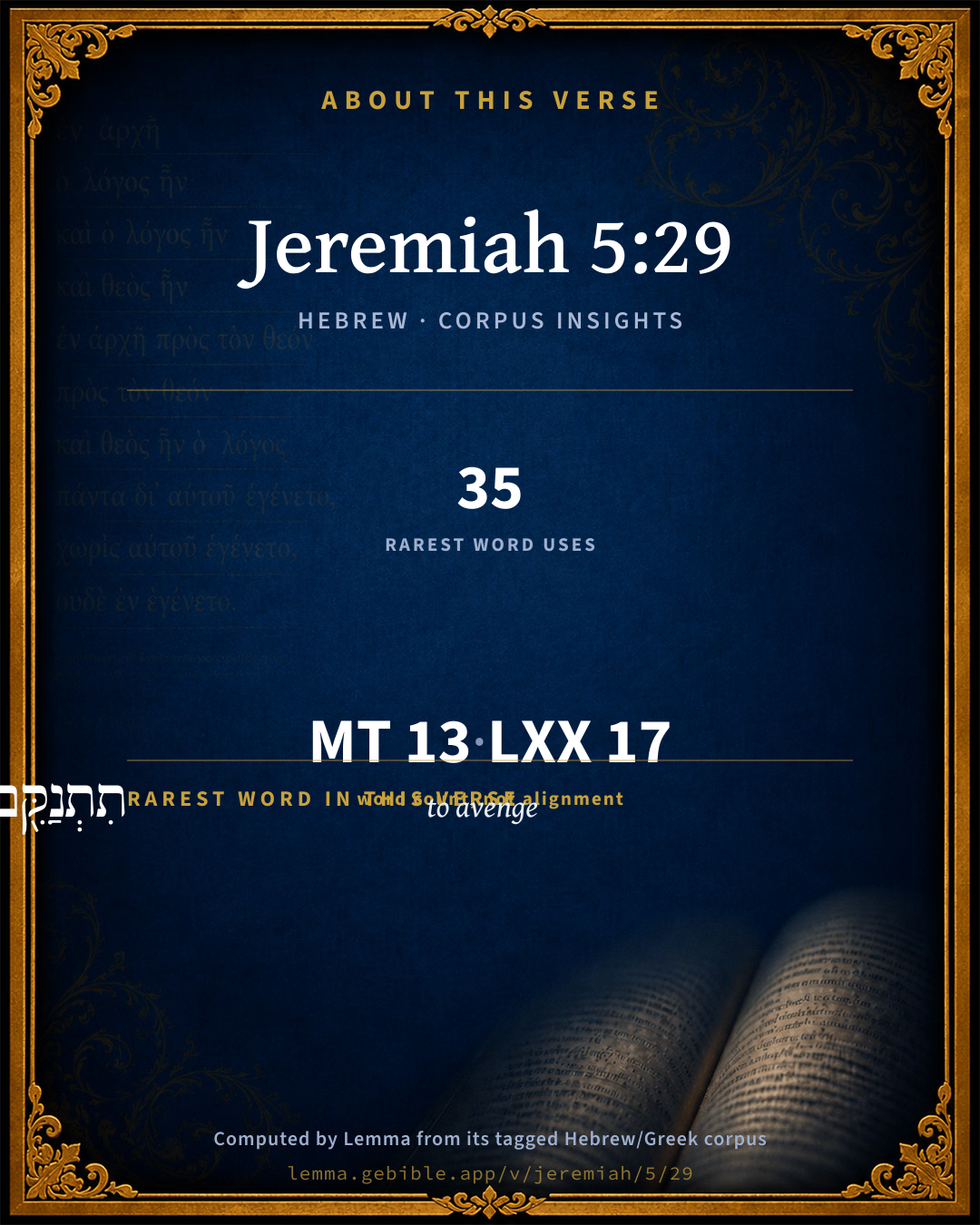
13
words
12
distinct lemmas
Prophets
section

Shared distinctive vocabulary

תִתְנַקֵּ֖ם to avenge H5358 occurs in 31 verses of the Hebrew Bible. Also found in:

Grammatical profile

  • 2 verbs
  • 4 nouns
  • 2 pronouns
  • 1 preposition
  • 1 conjunction
  • 3 particles

Verb forms

  • אֶפְקֹ֖ד Qal · Imperfect
  • תִתְנַקֵּ֖ם Hithpael · Imperfect

Repetition

A word recurs within this verse — often emphatic in Hebrew:

Hebrew & Septuagint length

In the original languages it is 13 Hebrew tokens and 17 Greek tokens — but the two are counted differently (Hebrew bundles its prefixes and suffixes into one token; the Greek is in lemma form), so that isn’t a like-for-like length.

Cross-references

4

Topical passages linked to Jeremiah 5:29 in the Treasury of Scripture Knowledge — connected by theme and wording, ordered by reader-vote popularity; previews shown in the World English Bible.

  • Jeremiah 5:9 Shall I not visit for these things? says Yahweh; and shall not my soul be avenged on such a nation as this?
  • Malachi 3:5 I will come near to you to judgment; and I will be a swift witness against the sorcerers, and against the adulterers, and against the perjurers, and against those who oppress the hireling in his wages, the widow, and the fatherless, and who deprive the foreigner of justice, and don't fear me," says Yahweh of Hosts.
  • James 5:4 Behold, the wages of the laborers who mowed your fields, which you have kept back by fraud, cry out, and the cries of those who reaped have entered into the ears of the Lord of Hosts.
  • Jeremiah 9:9 Shall I not visit them for these things? says Yahweh; shall not my soul be avenged on such a nation as this?

Cross-references courtesy of OpenBible.info (CC BY 4.0).

Hebrew and Greek witnesses Masoretic Hebrew ↔ Greek Septuagint

The same verse in the two great witnesses to the Old Testament, shown verse-for-verse.

These are two independent witnesses, not word-aligned to each other, and the Septuagint is shown in lemma (dictionary) form.

Hebrew Jeremiah 5:29 Masoretic · Westminster Leningrad Codex

הַֽעַל אֵ֥לֶּה לֹֽא אֶפְקֹ֖ד נְאֻם יְהֹוָ֑ה אִ֚ם בְּג֣וֹי אֲשֶׁר כָּזֶ֔ה לֹ֥א תִתְנַקֵּ֖ם נַפְשִֽׁי

Shall I not visit for these things? says Yahweh; shall not my soul be avenged on such a nation as this?

World English Bible · Public Domain

Greek LXX Structure differs

In the Septuagint, Jeremiah is about an eighth shorter than the Hebrew and arranges its material differently — the Oracles Against the Nations (Hebrew chapters 46–51) appear in the middle of the Greek book, after 25:13. Because the chapter and verse boundaries do not line up, a verse-for-verse comparison with the Hebrew is not shown.

A verse-for-verse comparison isn’t shown here because the chapters and verses don’t line up. Switch to the LXX edition with the MT / LXX toggle above to read the Greek directly.

Hebrew: Westminster Leningrad Codex (CC BY 4.0). Greek: Septuagint (public domain); English from a public-domain English Septuagint. How the Septuagint differs from the Hebrew →

Targum (Aramaic paraphrase)

1

The Targum is the ancient Jewish Aramaic paraphrase of the Hebrew Scriptures — an interpretive translation, not the Hebrew text itself. Onkelos (literal) and Pseudo-Jonathan (expansive) render the Torah, and Jonathan the Prophets. Coverage is partial: where no permissively-licensed English translation exists for a verse, only the Aramaic is shown. This is verse-level text, not a word-by-word alignment to the Hebrew.

  1. Targum Jonathan Prophets (Joshua–Malachi)
    הַעַל אִלֵין לָא אַסְעַר לְאַיְתָאָה עֲלֵיהוֹן בִּישָׁא אֲמַר יְיָ אִם מִן עַמָא דִכְדֵין עוֹבָדוֹהִי לָא אִתְפְּרַע מִנְהוֹן כִּרְעוּתִי:

    (no public-domain English translation for this verse)

    Targum Jonathan — Aramaic: “Mikraot Gedolot” (public domain). English: “Sefaria Community Translation” (CC0 1.0 (public-domain dedication)); “London "Chaldee Paraphrase," 1871” (public domain). Text via Sefaria.

Commentary

Notes on Jeremiah 5:29 from classic Christian and Jewish commentators (each source and its license shown beneath its notes). The classic Christian expositions comment on the surrounding passage and are grouped to its opening verse, so a note may address several verses; the Jewish commentaries on the Tanakh (Rashi and others) are per-verse, so they appear only where the commentator wrote on this verse.

Lemma curates 59 commentaries, every one of them public domain or Creative Commons licensed, each selected and text-cleaned for this edition rather than reprinted as found. About our sources →

Trapp's Complete Commentary

John Trapp

Jer 5:29 Shall I not visit for these [things]? saith the LORD: shall not my soul be avenged on such a nation as this?

Ver. 29. Shall I not visit?] See Jer 5:9.

John Trapp, A Commentary or Exposition upon All the Books of the Old and New Testament (1647–1656) — public domain. Text from a community e-Sword module.

Tyndale Open Study Notes

Tyndale Open Resources

5:29-31 The people’s sins (5:26-28) fully justified the Lord’s punishment, but the religious leaders committed several more. The prophets told lies and called them prophecies from the Lord (14:14; Ezek 13:6). The priests, assigned to serve the people, had become tyrants who dominated the people with an iron hand. Amazingly, the people approved of their leaders’ new roles, even though this situation left them unprepared for the doom descending upon them (Mic 2:11).

Tyndale Open Study Notes — © Tyndale Open Resources, licensed CC BY-SA 4.0. Text via the HelloAO Bible API.

Jamieson, Fausset & Brown

Robert Jamieson, A. R. Fausset & David Brown

(Jer 5:9; Mal 3:5).

Jamieson, Fausset & Brown — Commentary Critical and Explanatory on the Whole Bible (1871) — public domain (CC PDM 1.0). Text via the HelloAO Bible API.

John Calvin's Commentaries

He repeats what we have before noticed, so there is no need of an explanation. But the repetition is not without its use; for the Jews had become so torpid, that all reproofs and threatenings were regarded with indifference. Hence God rouses them with great vehemence, Shall I not, he says, visit for these things? He takes it for granted, that we ought to be fully persuaded, that he is the judge of the world. It is the proper office of a judge to punish the wicked, and also to relieve the helpless and the oppressed, and to check the audacity of those who allow themselves every liberty. God then reasons here from his own nature and office, as though he had said, “Since I am God, can I suffer so much impiety and wantonness to prevail unpunished among my people?” Then he adds —

On such a nation as this, shall not avenged be my soul?

God transfers here to himself, as we have said elsewhere, what does not strictly belong to him; but it is the same as though he had said, “There is no one among earthly judges so void of feeling as to bear such indignities; for when the judge sees that he is treated with contempt by the wicked, is he not provoked?” Avenged then shall be my soul; as though he said, that he is not so soft, or so slothful, or so careless, as not to take vengeance on such wanton contempt. It follows —

John Calvin's Commentaries (1540-1563) — public domain. Text from the Calvin Translation Society English edition (1840s-50s) via the Christian Classics Ethereal Library (ccel.org). Calvin's coverage is partial (roughly two-thirds of the Bible); uncommented books and verses are honest gaps, never fabricated. The 19th-century editor's footnotes and remarks are omitted so the notes are faithfully Calvin's own voice.

The Cambridge Bible for Schools and Colleges

gen. ed. J. J. S. Perowne

29. The refrain taken up again from Jer_5:9.

The Cambridge Bible for Schools and Colleges (gen. ed. J. J. S. Perowne; Cambridge University Press, 1878–1918) — public domain. Text from a community e-Sword module.

John Gill's Exposition

Shall I not visit for these things?.... See Gill on Jer 5:9.

.

Jeremiah 5:30

jer 5:30

jer 5:30

jer 5:30A wonderful and horrible thing is committed in the land. What may justly raise admiration in some, and horror in others, or both in all: it is so amazing that it can hardly be conceived of, and so shameful and filthy as not to be expressed; what it is follows:

John Gill's Exposition of the Whole Bible (1746–1763) — public domain (CC PDM 1.0). Text via the HelloAO Bible API.

Haydock's Catholic Bible Commentary

Nation? It is contrary to God’s justice not to punish the guilty. (Worthington)

George Leo Haydock (1774–1849), Haydock's Catholic Family Bible and Commentary, 1859 edition — public domain. Excludes Psalms (Douay-Rheims chapter numbering differs from Protestant) and Deuterocanonical books (Catholic canon only).

Matthew Poole's English Annotations

It is expressed as a thing taken for granted, he certainly will. Can I be a God, and wink at such things? It cannot be. See this explained Jer 5:9.

Matthew Poole's English Annotations on the Holy Bible (1683–1685) — public domain. Text from a community e-Sword/MySword module.

The Pulpit Commentary

A repetition of ver. 9 in the manner of a refrain.

The Pulpit Commentary (1880–1919), ed. H.D.M. Spence-Jones & Joseph S. Exell — public domain. Text from a community e-Sword module.

Lesson kit

Teaching starters — assembled from the data on this page, not authored interpretation. Every prompt links to the verse data it draws on. Edit before teaching.

Jeremiah, in the Prophets, opens this verse with 13 words (12 distinct Hebrew lemmas). Its most distinctive word is nâqam (“to avenge”). A historical commentator’s framing appears above. Read the whole chapter for the surrounding context.

Discussion questions

  1. How does “to avenge” (nâqam) shape what this verse is saying?
  2. How does Genesis 4:15, which shares the word «to avenge», read alongside this verse?
  3. What does the repetition of “not” (2× in this one verse) do in this verse?
  4. The translations on this page render this verse differently — a whole-verse word diff, not a word-by-word alignment. What might account for the different wordings?
  5. «אֶפְקֹ֖ד» is a Qal Imperfect verb. How does that grammatical form shape the action described?
  6. Compare how Trapp's Complete Commentary and Tyndale Open Study Notes read this verse. Where do they agree or differ?

Things to notice

Reading settings

Reading text

Shown beneath each verse's original-language words.

Old Testament
Old Testament edition

Read the OT as the Masoretic Hebrew (MT) or the Greek Septuagint (LXX).

English shown for the Greek Septuagint (in the Hebrew ↔ Greek comparison).

Comparing translations? Open the Compare panel on any verse page to stack up to four side by side.