Proverbs 30:20

Hebrew (Westminster Leningrad Codex) Proverbs 30:20 appears in the Hebrew Old Testament. The text above is from the Westminster Leningrad Codex. Each word links to its Strong’s number, a concise gloss, and parsing drawn from the Open Scriptures Hebrew Bible morphology. Click any word for its full Brown-Driver-Briggs (BDB) entry.
Download image
Cite this verse

Proverbs 30:20 (World English Bible). Public Domain. Lemma interlinear Bible study tool, https://lemma.gebible.app/v/proverbs/30/20.

Show BibTeX & RIS
BibTeX
RIS
English Translation
So is the way of an adulterous woman: She eats and wipes her mouth, And says, 'I have done nothing wrong.'
World English Bible · Public Domain
Download a study sheet

One document with this verse’s original text, its word-by-word gloss line, the meaning frame, cross-references with their text, attributed commentary, and full source and license credits — printable, and it pastes into notes with its structure intact.

This verse Autodidact and up

Study sheet (.html) Plain text (.txt)

A passage Seminary Student

Up to 50 verses in one chapter. A passage sheet keeps up to 6 commentary sources and 12 cross-references per verse, in the order this page ranks them, and says so on the sheet whenever that leaves anything out. Ask for a single verse and you get the Autodidact verse sheet above.

Everything on this page stays free to read, with no account — the sheet is a download of what is already on screen, not access to it.

Want to remove ads? Support Godless Engineer
Compare translations 3

The same verse in 3 English versions, stacked beneath the original-language interlinear above. Click any original word for its lexicon entry.

Each is an independent rendering of the whole verse — the interlinear is not word-aligned to these translations.

Highlighted words mark where these versions differ — a whole-verse word diff, not a word-by-word alignment.

  • World English Bible Public Domain
    So is the way of an adulterous woman: She eats and wipes her mouth, And says, 'I have done nothing wrong.'
  • King James Version Public Domain
    Such is the way of an adulterous woman; she eateth, and wipeth her mouth, and saith, I have done no wickedness.
  • unfoldingWord Literal Text CC BY-SA 4.0
    Thus the way of a woman who commits adultery: She eats and wipes her mouth and says, ‘I have not done iniquity.’

unfoldingWord Literal Text — © unfoldingWord, licensed CC BY-SA 4.0. Word-aligned USFM3 via Door43 (git.door43.org/unfoldingWord/en_ult).

Versions to compare (up to 4)

3 of 4 selected

Show all 18 translations

Every available English version of this verse, each an independent rendering of the whole verse.

  • World English Bible Public Domain
    So is the way of an adulterous woman: She eats and wipes her mouth, And says, 'I have done nothing wrong.'
  • Berean Standard Bible Public Domain
    This is the way of an adulteress: She eats and wipes her mouth and says, ‘I have done nothing wrong.’
  • Majority Standard Bible Public Domain
    This is the way of an adulteress: She eats and wipes her mouth and says, ‘I have done nothing wrong.’
  • King James Version Public Domain
    Such is the way of an adulterous woman; she eateth, and wipeth her mouth, and saith, I have done no wickedness.
  • American Standard Version (1901) Public Domain
    So is the way of an adulterous woman; She eateth, and wipeth her mouth, And saith, I have done no wickedness.
  • Revised Version (1885) Public Domain
    So is the way of an adulterous woman; she eateth, and wipeth her mouth, and saith, I have done no wickedness.
  • Geneva Bible (1599) Public Domain
    Such is ye way also of an adulterous woman: she eateth and wipeth her mouth, and sayth, I haue not committed iniquitie.
  • Douay-Rheims (1899) Public Domain
    Such is also the way of an adulterous woman, who eateth, and wipeth her mouth, and saith: I have done no evil.
  • Young's Literal Translation Public Domain
    So -- the way of an adulterous woman, She hath eaten and hath wiped her mouth, And hath said, `I have not done iniquity.'
  • Literal Standard Version CC BY-SA 4.0
    So—the way of an adulterous woman, || She has eaten and has wiped her mouth, || And has said, “I have not done iniquity.”
  • Unlocked Literal Bible CC BY-SA 4.0
    This is the way of an adulteress: she eats and she wipes her mouth and says, “I have done nothing wrong.”
  • unfoldingWord Literal Text CC BY-SA 4.0
    Thus the way of a woman who commits adultery: She eats and wipes her mouth and says, ‘I have not done iniquity.’
  • Darby Bible Public Domain
    Such is the way of an adulterous woman: she eateth, and wipeth her mouth, and saith, I have done no wickedness.
  • World Messianic Bible Public Domain
    “So is the way of an adulterous woman: She eats and wipes her mouth, and says, ‘I have done nothing wrong.’
  • Webster's Bible Public Domain
    Such is the way of an adulterous woman; she eateth, and wipeth her mouth, and saith, I have done no wickedness.
  • Free Bible Version CC BY-SA 4.0
    This is the way of a woman who commits adultery: she eats, she wipes her mouth, and then says, “I haven't done anything wrong!”
  • Bible in Basic English Public Domain
    This is the way of a false wife; she takes food, and, cleaning her mouth, says, I have done no wrong.
  • JPS Tanakh (1917) Public Domain
    So is the way of an adulterous woman; she eateth, and wipeth her mouth, and saith: 'I have done no wickedness.'

Literal Standard Version (2020), Covenant Press — licensed CC BY-SA 4.0. Text via the HelloAO Bible API (eBible.org). Unlocked Literal Bible (unfoldingWord) — licensed CC BY-SA 4.0. Text via the HelloAO Bible API (eBible.org). unfoldingWord Literal Text — © unfoldingWord, licensed CC BY-SA 4.0. Word-aligned USFM3 via Door43 (git.door43.org/unfoldingWord/en_ult). Free Bible Version, Dr. Jonathan Gallagher — licensed CC BY-SA 4.0. Text via the HelloAO Bible API (eBible.org).

Word by word

More ways to search: Search by grammar → Find every occurrence → Compare this word →

Practice this passage: Drill this verse → Learn its vocabulary →

מְנָ֫אָ֥פֶת
nâʼaph
H5003
“committing adultery”
Verb, Piel, Participle Active, Feminine, Singular, Absolute
Part of Speech
Verb
Stem
Piel
Form
Participle Active
Gender
Feminine
Number
Singular
State
Absolute
Full BDB Definition

Origin: a primitive root

TWOT: 1273

to commit adultery - (Qal) - to commit adultery - usually of man - always with wife of another - adultery (of women) (participle) - idolatrous worship (figuratively) - (Piel) - to commit adultery - of man - adultery (of women) (participle) - idolatrous worship (figuratively)
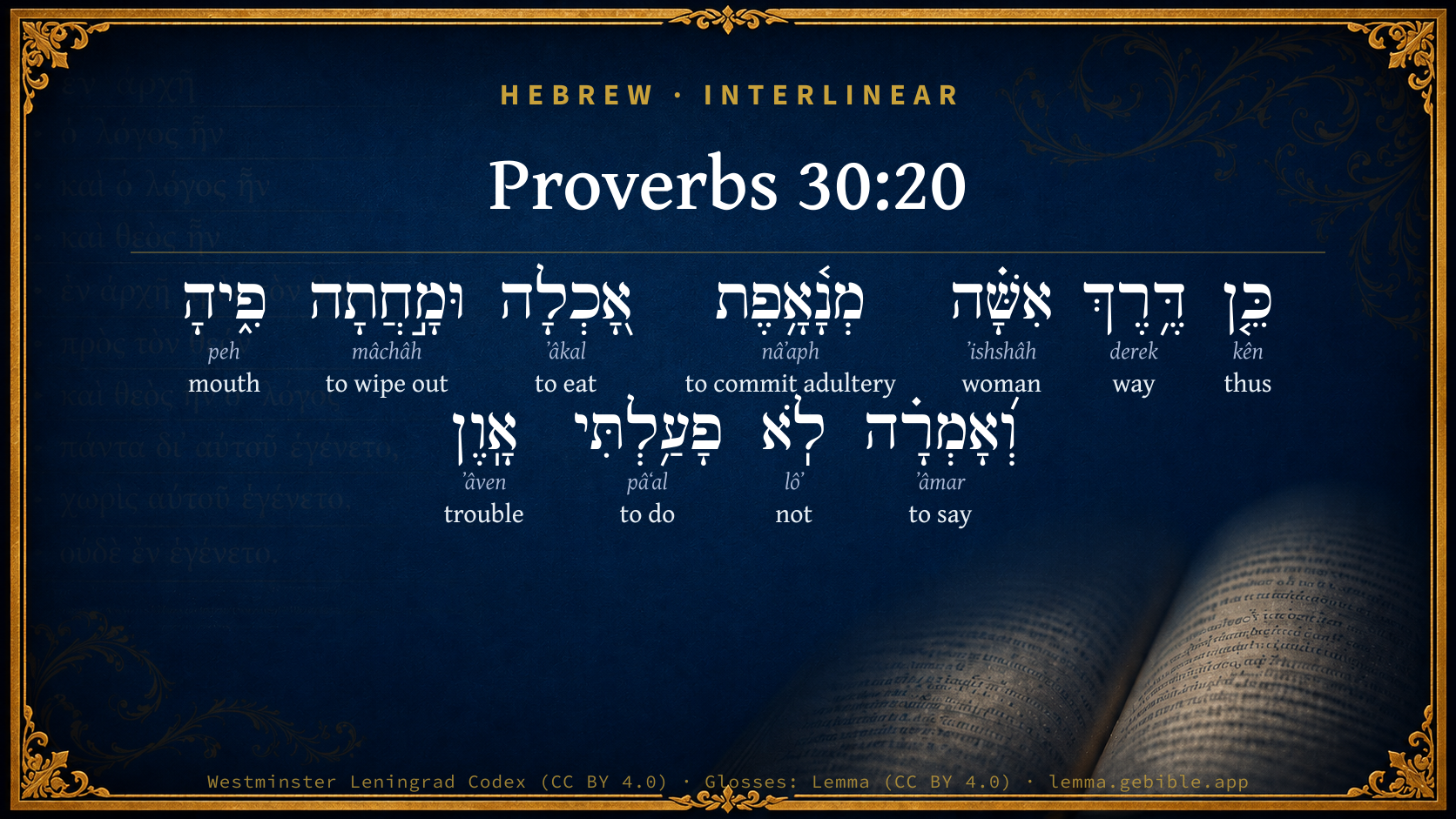
  1. כֵּ֤ן kên H3651 “thus” Particle, Demonstrative
  2. דֶּ֥רֶךְ derek H1870 “way of” Noun, Common, Both, Singular, Construct
  3. אִשָּׁ֗ה ʼishshâh H802 “woman” Noun, Common, Feminine, Singular, Absolute
  4. אָ֭כְלָה ʼâkal H398 “to eat” Verb, Qal, Perfect, 3rd Person, Feminine, Singular
  5. וּמָ֣חֲתָה mâchâh H4229 “and · to wipe out” Conjunction + Verb, Qal, Sequential Perfect, 3rd Person, Feminine, Singular
  6. פִ֑יהָ peh H6310 “mouth · her” Noun, Common, Masculine, Singular, Construct + Suffix, Personal, 3rd Person, Feminine, Singular
  7. וְ֝אָמְרָ֗ה ʼâmar H559 “and · to say” Conjunction + Verb, Qal, Sequential Perfect, 3rd Person, Feminine, Singular
  8. לֹֽא lôʼ H3808 “not” Particle, Negative
  9. פָעַ֥לְתִּי pâʻal H6466 “to do” Verb, Qal, Perfect, 1st Person, Common, Singular
  10. אָֽוֶן ʼâven H205 “trouble” Noun, Common, Masculine, Singular, Absolute

About this verse

These counts appear in no published source. They are computed here, from the morphology-tagged text and Lemma’s own curated glosses. What Lemma adds →

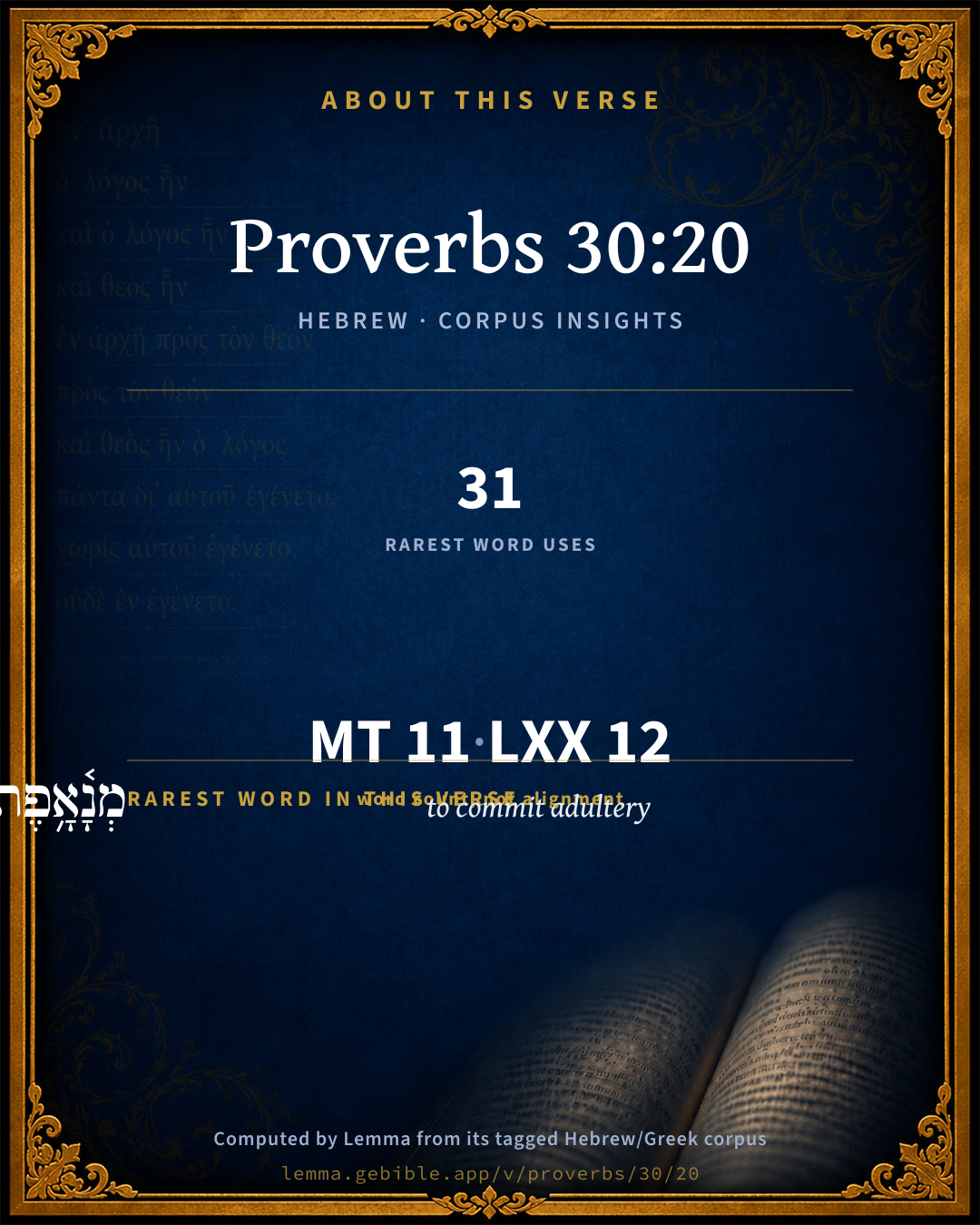
11
words
11
distinct lemmas
Wisdom
section

Shared distinctive vocabulary

מְנָ֫אָ֥פֶת to commit adultery H5003 occurs in 26 verses of the Hebrew Bible. Also found in:

Grammatical profile

  • 5 verbs
  • 4 nouns
  • 2 particles

Verb forms

  • מְנָ֫אָ֥פֶת Piel · Participle Active
  • אָ֭כְלָה Qal · Perfect
  • וּמָ֣חֲתָה Qal · Sequential Perfect
  • וְ֝אָמְרָ֗ה Qal · Sequential Perfect
  • פָעַ֥לְתִּי Qal · Perfect

Hebrew & Septuagint length

In English translation the verse runs 21 words from the Hebrew and 23 from the Septuagint (LXX English) — closely comparable.

A rough comparison of the two English renderings, which tokenize alike — not a word-level alignment.

Word counts can differ between the Hebrew and the Greek without any difference in meaning — e.g. the Hebrew direct-object marker אֵת has no separate Greek word, and Greek often adds the article ὁ.

In the original languages it is 11 Hebrew tokens and 12 Greek tokens — but the two are counted differently (Hebrew bundles its prefixes and suffixes into one token; the Greek is in lemma form), so that isn’t a like-for-like length.

Cross-references

3

Topical passages linked to Proverbs 30:20 in the Treasury of Scripture Knowledge — connected by theme and wording, ordered by reader-vote popularity; previews shown in the World English Bible.

  • Proverbs 5:6 She gives no thought to the way of life. Her ways are crooked, and she doesn't know it.
  • Proverbs 7:13–23 So she caught him, and kissed him. With an impudent face she said to him:
  • Numbers 5:11–30 Yahweh spoke to Moses, saying,

Cross-references courtesy of OpenBible.info (CC BY 4.0).

Hebrew and Greek witnesses Masoretic Hebrew ↔ Greek Septuagint

The same verse in the two great witnesses to the Old Testament, shown verse-for-verse.

These are two independent witnesses, not word-aligned to each other, and the Septuagint is shown in lemma (dictionary) form.

Hebrew Proverbs 30:20 Masoretic · Westminster Leningrad Codex

כֵּ֤ן דֶּ֥רֶךְ אִשָּׁ֗ה מְנָ֫אָ֥פֶת אָ֭כְלָה וּמָ֣חֲתָה פִ֑יהָ וְ֝אָמְרָ֗ה לֹֽא פָעַ֥לְתִּי אָֽוֶן

So is the way of an adulterous woman: She eats and wipes her mouth, And says, 'I have done nothing wrong.'

World English Bible · Public Domain

Greek LXX Proverbs 30:20 Septuagint · lemma form

τοιοῦτος ὁδός γυνή μοιχαλίς ὅς ὅταν πράσσω ἀπονίπτω οὐδείς φημί πράσσω ἄτοπος

Such is the way of an adulterous woman, who having washed herself from what she has done, says she has done nothing amiss.

LXX2012 (modern English Septuagint) · Public Domain

On this verse, The Pulpit Commentary discusses the Septuagint’s reading. Read the note in Commentary ↓

Hebrew: Westminster Leningrad Codex (CC BY 4.0). Greek: Septuagint (public domain); English from LXX2012 (modern English Septuagint) (Public Domain). How the Septuagint differs from the Hebrew →

Commentary

Notes on Proverbs 30:20 from classic Christian and Jewish commentators (each source and its license shown beneath its notes). The classic Christian expositions comment on the surrounding passage and are grouped to its opening verse, so a note may address several verses; the Jewish commentaries on the Tanakh (Rashi and others) are per-verse, so they appear only where the commentator wrote on this verse.

Lemma curates 59 commentaries, every one of them public domain or Creative Commons licensed, each selected and text-cleaned for this edition rather than reprinted as found. About our sources →

Trapp's Complete Commentary

John Trapp

Pro 30:20 Such [is] the way of an adulterous woman; she eateth, and wipeth her mouth, and saith, I have done no wickedness.

Ver. 20. So is the way of an adulterous woman.] The strumpet, when she hath eaten stolen bread, hath such dexterity in wiping her lips, that not the least crumb shall stick to them for discovery. So that Agur here shows it to be as hard to find it out as the way of an eagle in the air, the way of a serpent on a rock, &c. Unless taken in the manner, she stoutly denies the action. And if so taken, yet

“ Nihil est audacius illis,

Deprensis, iram atque animos a crimine sumunt. ”

- Juvenal, Satyr. 6.

John Trapp, A Commentary or Exposition upon All the Books of the Old and New Testament (1647–1656) — public domain. Text from a community e-Sword module.

Joseph Benson's Commentary

Pro 30:20. Such — So secret and undiscernible; is the way of an adulterous woman — Of one that secretly lives in the sin of adultery. As “artful men insinuate themselves into the affections of young women, and seduce them to their ruin, by an almost infinity of stratagems, which can never be all unravelled, so also the adulterous wife uses much ingenuity to impose on her husband, to shun detection, and to escape shame and punishment, by schemes and devices which cannot all be enumerated. Every new crime intended, or committed, gives rise to some new artifice; as the ship, in some degree, deviates every time from the course which it steered before. The object of the seducer is to prevail over his prey, and that of the adulteress to conceal her guilt; and the whole extent of their subtlety and ingenuity is employed to effect those purposes.” — Scott.

Joseph Benson's Commentary on the Old and New Testaments (1811–1818) — public domain. Text from a community e-Sword module.

Tyndale Open Study Notes

Tyndale Open Resources

30:20 The writer expresses horror at sex outside of marriage.

Tyndale Open Study Notes — © Tyndale Open Resources, licensed CC BY-SA 4.0. Text via the HelloAO Bible API.

Geneva Bible (1599)

Geneva Bible translators

She hath her desires, and after counterfeiteth as though she were an honest woman.

Geneva Bible (1599) marginal notes — public domain. Text via Bolls.life.

Jamieson, Fausset & Brown

Robert Jamieson, A. R. Fausset & David Brown

she eateth . . . mouth--that is, she hides the evidences of her shame and professes innocence.

Jamieson, Fausset & Brown — Commentary Critical and Explanatory on the Whole Bible (1871) — public domain (CC PDM 1.0). Text via the HelloAO Bible API.

Ellicott's Commentary for English Readers

(20) Such is the way of an adulterous woman.—As there is no proof of her guilt, she flatly denies it.

A Bible Commentary for English Readers, edited by Charles John Ellicott (1878–1897) — public domain. Text from a community e-Sword module.

The Cambridge Bible for Schools and Colleges

gen. ed. J. J. S. Perowne

20. The “four things” of the two preceding verses find their moral in this verse. So lightly does the abandoned woman think of the consequences of her sin; so does it pass away when committed and leave no mark behind. It is but to eat and wipe the lips, and all trace of the food is gone.

The Cambridge Bible for Schools and Colleges (gen. ed. J. J. S. Perowne; Cambridge University Press, 1878–1918) — public domain. Text from a community e-Sword module.

John Gill's Exposition

Such is the way of an adulterous woman,.... It is equally unknown as the way of a man with a maid; it is difficult to detect her, she takes so much care and caution, and uses so many artful methods to conceal her wickedness from her husband; though she lives in adultery, it is in a most private manner, and carried on so secretly and artfully that she is not easily discovered;

she eateth, and wipeth her mouth; like one that eats what he should not, wipes his mouth that it might not be known or suspected he had ate anything; so such an adulteress commits the sin of adultery; and when she has done looks as grave and demure, and carries it so to her husband and all her friends, as if she was the chastest person upon earth. The allusion may be to harlots, who after an impure congress used to wash themselves (a), and had servants to wait upon them and serve them with water, called from hence "aquarioli" (b);

and saith, I have done no wickedness; she says by her behaviour, by her demure looks; and if suspected and challenged with it utterly denies it. This is an emblem of the antichristian whore of Rome, who, though the mother of harlots, and abominations of the earth; though guilty of the foulest adultery, that is, the grossest idolatry, yet pretends to be the pure and chaste spouse of Christ; and, under the guise of purity and holiness, and with all deceivableness of unrighteousness, seduces the minds of many; see Rev 17:1.

(a) "Dedecus hoc sumpta dissimulavit aqua", Ovid. Amor. l. 3. Eleg. 6. in fine. (b) Tertull. Apolog. c. 43. Vid. Turnebi Adversar. l. 14. c. 12.

John Gill's Exposition of the Whole Bible (1746–1763) — public domain (CC PDM 1.0). Text via the HelloAO Bible API.

Matthew Poole's English Annotations

Such, so secret and undiscernible,

is the way of an adulterous woman; of her who, though she be called and accounted a maid yet in truth is an adulteress: not a common strumpet, for of such the following words are not true, but one that secretly lives in the sin of adultery or fornication.

She eateth, to wit, the bread of deceit in secret, by which is understood the act of filthiness, Pro 9:17; 20:17, which such persons do as greedily desire, and as delightfully feed upon, as hungry persons do upon bread. Thus chastely doth the Holy Ghost express the most filthy actions, to teach us to avoid all immodest and obscene speeches as well as actions.

Wipeth her mouth, as a child doth when it hath eaten some forbidden food, and would not be discovered.

Saith, I have done no wickedness; denies the fact, and avoweth her innoceney.

Matthew Poole's English Annotations on the Holy Bible (1683–1685) — public domain. Text from a community e-Sword/MySword module.

Whedon's Commentary on the Bible

Daniel D. Whedon

20. Such — כן, (ken,) so, a particle of comparison establishing a connexion with the preceding, and expressing the similitude between the way of an adulteress and the things just mentioned. “Just as incomprehensible in a moral view is the violation of the sacredness of marital rights by the adulteress, and her hardened indifference to the guilt of the crime.” — Conant.

She eateth, and wipeth — Indulges her appetite, and removes all indication of guilt.

And saith — By her manner, “I am innocent.” One moral of the passage may be a caution against implicit confidence in external or first appearances.

Daniel D. Whedon (gen. ed.), Commentary on the Old and New Testaments (1874–1909) — public domain. Text from a community e-Sword module.

The Pulpit Commentary

This verse is a kind of gloss or illustration of the last thought of the preceding verse, and seems not to have formed an original part of the numerical proverb. It might well be placed in a parenthesis. Many commentators consider it to be an interpolation. Such is the way of an adulterous woman. What Agur had said of a man above, he now applies to the practised adulteress, whose sin cannot be traced. She eateth. This is an euphemism for the sin which she commits, "Stolen waters are sweet, and bread eaten in secret is pleasant". (Pro_9:17; comp. Pro_5:15) And wipeth her mouth, as if to leave no trace of her illicit repast. And saith, I have done no wickedness. As she has sinned in secret, and there is no outward proof of her guilt, she boldly denies it. Septuagint, "Such is the way of an adulterous woman, who, when she has committed the act, having washed herself, says she has done nothing amiss." She forgets him who seeth in secret, and is quite content to escape detection at man"s eyes, and to assume the character of a virtuous wife, which popular report assigns to her.

The Pulpit Commentary (1880–1919), ed. H.D.M. Spence-Jones & Joseph S. Exell — public domain. Text from a community e-Sword module.

John Wesley's Explanatory Notes

Such is - So secret and undiscernible. Eateth - The bread of deceit in secret.

John Wesley, Explanatory Notes Upon the Whole Bible (1754–1765) — public domain. Text via the GEBible commentary corpus.

unfoldingWord translationNotes

Door43 World Missions Community

she eats and she wipes her mouth

This seems to be both a euphemism and a metaphor for committing adultery and then taking a bath. (See: Euphemism and Metaphor)

translationWords

adultery

unfoldingWord translationNotes — © Distant Shores Media and the Door43 World Missions Community, licensed CC BY-SA 4.0. Source: git.door43.org/Door43/en_tn.

Rashi

Rabbi Shlomo Yitzchaki (Rashi)

and [she] wipes Heb. ומחתה she turns over her lower orifice, as it is written (II Kings 21:13): “as one wipes (ימחה) a dish, he wipes (מחה) and turns it upside down.”

she eats Scripture speaks euphemistically.

Rashi on the Tanakh — English translations: “The Judaica Press complete Tanach with Rashi, translated by A. J. Rosenberg” (CC BY 4.0); “Pentateuch with Rashi's commentary by M. Rosenbaum and A.M. Silbermann, 1929-1934” (public domain); “The Metsudah Tanach series, Lakewood, N.J” (CC BY 4.0); and “The Book of Joshua, Metsudah Publications, 1997” (CC BY 4.0). Text via Sefaria.

Lesson kit

Teaching starters — assembled from the data on this page, not authored interpretation. Every prompt links to the verse data it draws on. Edit before teaching.

Proverbs, in the Wisdom, opens this verse with 11 words (11 distinct Hebrew lemmas). Its most distinctive word is nâʼaph (“to commit adultery”). A historical commentator’s framing appears above. Read the whole chapter for the surrounding context.

Discussion questions

  1. The word nâʼaph carries the sense “to commit adultery.” How does it shape the verse?
  2. Exodus 20:14 shares the word «to commit adultery» with this verse. How do the two illuminate each other?
  3. These translations render this verse differently; the difference is in the English rendering, not the original. What questions does that raise?
  4. The verb «מְנָ֫אָ֥פֶת» is Piel Participle Active. How does its form color the action?
  5. Reading how Trapp's Complete Commentary and Joseph Benson's Commentary read this verse, where do the two commentators agree and where do they part?

Things to notice

Reading settings

Reading text

Shown beneath each verse's original-language words.

Old Testament
Old Testament edition

Read the OT as the Masoretic Hebrew (MT) or the Greek Septuagint (LXX).

English shown for the Greek Septuagint (in the Hebrew ↔ Greek comparison).

Comparing translations? Open the Compare panel on any verse page to stack up to four side by side.