
Ezekiel 31:8

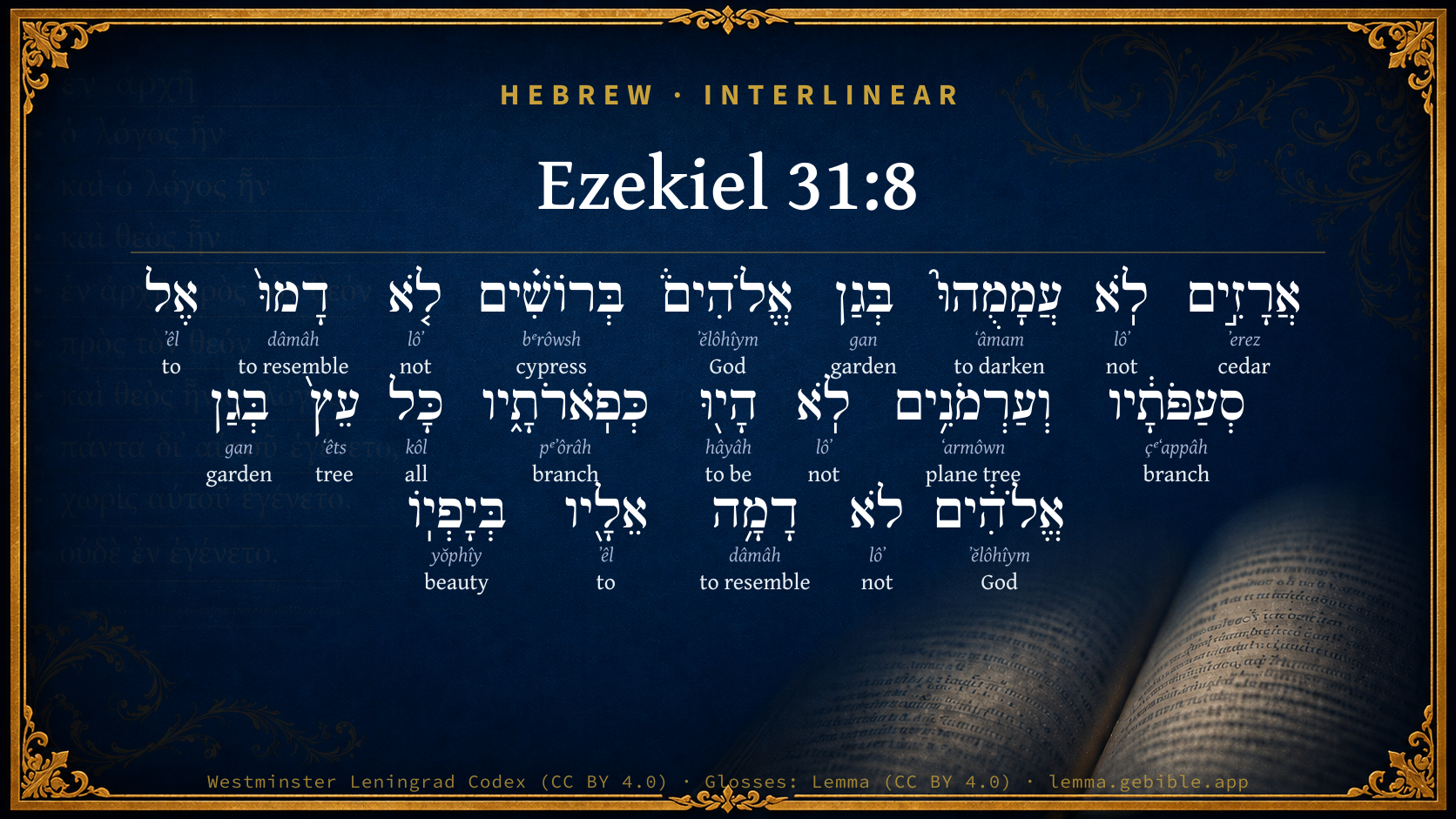
Hebrew (Westminster Leningrad Codex) Ezekiel 31:8 appears in the Hebrew Old Testament. The text above is from the Westminster Leningrad Codex. Each word links to its Strong’s number, a concise gloss, and parsing drawn from the Open Scriptures Hebrew Bible morphology. Click any word for its full Brown-Driver-Briggs (BDB) entry.
Download image
Cite this verse

Ezekiel 31:8 (World English Bible). Public Domain. Lemma interlinear Bible study tool, https://lemma.gebible.app/v/ezekiel/31/8.

Show BibTeX & RIS
BibTeX
RIS
English Translation
The cedars in the garden of God could not hide it; the fir trees were not like its boughs, and the plane trees were not as its branches; nor was any tree in the garden of God like it in its beauty.
World English Bible · Public Domain
Download a study sheet

One document with this verse’s original text, its word-by-word gloss line, the meaning frame, cross-references with their text, attributed commentary, and full source and license credits — printable, and it pastes into notes with its structure intact.

This verse Autodidact and up

Study sheet (.html) Plain text (.txt)

A passage Seminary Student

Up to 50 verses in one chapter. A passage sheet keeps up to 6 commentary sources and 12 cross-references per verse, in the order this page ranks them, and says so on the sheet whenever that leaves anything out. Ask for a single verse and you get the Autodidact verse sheet above.

Everything on this page stays free to read, with no account — the sheet is a download of what is already on screen, not access to it.

Want to remove ads? Support Godless Engineer
Compare translations 3

The same verse in 3 English versions, stacked beneath the original-language interlinear above. Click any original word for its lexicon entry.

Each is an independent rendering of the whole verse — the interlinear is not word-aligned to these translations.

Highlighted words mark where these versions differ — a whole-verse word diff, not a word-by-word alignment.

  • World English Bible Public Domain
    The cedars in the garden of God could not hide it; the fir trees were not like its boughs, and the plane trees were not as its branches; nor was any tree in the garden of God like it in its beauty.
  • King James Version Public Domain
    The cedars in the garden of God could not hide him: the fir trees were not like his boughs, and the chestnut trees were not like his branches; nor any tree in the garden of God was like unto him in his beauty.
  • unfoldingWord Literal Text CC BY-SA 4.0
    Cedars in the garden of God could not equal it. None among the cypress trees matched its branches, and the plane tree could not equal its boughs. There was no other tree in the garden of God that was like it in its beauty.

unfoldingWord Literal Text — © unfoldingWord, licensed CC BY-SA 4.0. Word-aligned USFM3 via Door43 (git.door43.org/unfoldingWord/en_ult).

Versions to compare (up to 4)

3 of 4 selected

Show all 18 translations

Every available English version of this verse, each an independent rendering of the whole verse.

  • World English Bible Public Domain
    The cedars in the garden of God could not hide it; the fir trees were not like its boughs, and the plane trees were not as its branches; nor was any tree in the garden of God like it in its beauty.
  • Berean Standard Bible Public Domain
    The cedars in the garden of God could not rival it; the cypresses could not compare with its branches, nor the plane trees match its boughs. No tree in the garden of God could compare with its beauty.
  • Majority Standard Bible Public Domain
    The cedars in the garden of God could not rival it; the cypresses could not compare with its branches, nor the plane trees match its boughs. No tree in the garden of God could compare with its beauty.
  • King James Version Public Domain
    The cedars in the garden of God could not hide him: the fir trees were not like his boughs, and the chestnut trees were not like his branches; nor any tree in the garden of God was like unto him in his beauty.
  • American Standard Version (1901) Public Domain
    The cedars in the garden of God could not hide it; the fir-trees were not like its boughs, and the plane-trees were not as its branches; nor was any tree in the garden of God like unto it in its beauty.
  • Revised Version (1885) Public Domain
    The cedars in the garden of God could not hide him: the fir trees were not like his boughs, and the plane trees were not as his branches; nor was any tree in the garden of God like unto him in his beauty.
  • Geneva Bible (1599) Public Domain
    The cedars in the garden of God coulde not hide him: no firre tree was like his branches, and the chessenut trees were not like his boughes: all the trees in the garden of God were not like vnto him in his beautie.
  • Douay-Rheims (1899) Public Domain
    The cedars in the paradise of God wars not higher than he, the fir trees did not equal his top, neither were the plane trees to be compared with him for branches: no tree in the paradise of God was like him in his beauty.
  • Young's Literal Translation Public Domain
    Cedars have not hid him in the garden of God, Firs have not been like unto his boughs, And chesnut-trees have not been as his branches, No tree in the garden of God hath been like unto him in his beauty,
  • Literal Standard Version CC BY-SA 4.0
    Cedars have not hid him in the garden of God, || Firs have not been like to his boughs, || And plane-trees have not been as his branches, || No tree in the garden of God has been like to him in his beauty,
  • Unlocked Literal Bible CC BY-SA 4.0
    Cedars in the garden of God could not equal it. None among the cypress trees matched its branches, and the plane tree could not equal its boughs. There was no other tree in the garden of God that was like it in its beauty.
  • unfoldingWord Literal Text CC BY-SA 4.0
    Cedars in the garden of God could not equal it. None among the cypress trees matched its branches, and the plane tree could not equal its boughs. There was no other tree in the garden of God that was like it in its beauty.
  • Darby Bible Public Domain
    The cedars in the garden of God could not hide him; the cypresses were not like his boughs, and the plane-trees were not as his branches: no tree in the garden of God was like unto him in his beauty.
  • World Messianic Bible Public Domain
    The cedars in the garden of God could not hide it. The cypress trees were not like its branches. The pine trees were not like its branches; nor was any tree in the garden of God like it in its beauty.
  • Webster's Bible Public Domain
    The cedars in the garden of God could not hide him: the fir-trees were not like his boughs, and the chesnut-trees were not like his branches; not any tree in the garden of God was like to him in his beauty.
  • Free Bible Version CC BY-SA 4.0
    The cedars in God's garden were no match for it. No pine tree had such great branches, nor did any plane tree. No tree in God's garden was as beautiful.
  • Bible in Basic English Public Domain
    No cedars were equal to it in the garden of God; the fir-trees were not like its branches, and plane-trees were as nothing in comparison with its arms; no tree in the garden of God was so beautiful.
  • JPS Tanakh (1917) Public Domain
    The cedars in the garden of God could not hide it; the cypress-trees were not like its boughs, and the plane-trees were not as its branches; nor was any tree in the garden of God like unto it in its beauty.

Literal Standard Version (2020), Covenant Press — licensed CC BY-SA 4.0. Text via the HelloAO Bible API (eBible.org). Unlocked Literal Bible (unfoldingWord) — licensed CC BY-SA 4.0. Text via the HelloAO Bible API (eBible.org). unfoldingWord Literal Text — © unfoldingWord, licensed CC BY-SA 4.0. Word-aligned USFM3 via Door43 (git.door43.org/unfoldingWord/en_ult). Free Bible Version, Dr. Jonathan Gallagher — licensed CC BY-SA 4.0. Text via the HelloAO Bible API (eBible.org).

Word by word

More ways to search: Search by grammar → Find every occurrence → Compare this word →

Practice this passage: Drill this verse → Learn its vocabulary →

סְעַפֹּתָ֔יו
çᵉʻappâh
H5589
“branches · his”
Noun, Common, Feminine, Plural, Construct + Suffix, Personal, 3rd Person, Masculine, Singular
Part of Speech
Noun
Type
Common
Gender
Feminine
Number
Plural
State
Construct
Full BDB Definition

Origin: from H5585

TWOT: 1527b

bough, branch
  1. אֲרָזִ֣ים ʼerez H730 “cedars” Noun, Common, Masculine, Plural, Absolute
  2. לֹֽא lôʼ H3808 “not” Particle, Negative
  3. עֲמָמֻהוּ֮ ʻâmam H6004 “to darken · him” Verb, Qal, Perfect, 3rd Person, Common, Plural + Suffix, Personal, 3rd Person, Masculine, Singular
  4. בְּגַן gan H1588 “in/at · garden of” Preposition + Noun, Common, Both, Singular, Construct
  5. אֱלֹהִים֒ ʼĕlôhîym H430 “God(s)” Noun, Common, Masculine, Plural, Absolute
  6. בְּרוֹשִׁ֗ים bᵉrôwsh H1265 “cypresses” Noun, Common, Masculine, Plural, Absolute
  7. לֹ֤א lôʼ H3808 “not” Particle, Negative
  8. דָמוּ֙ dâmâh H1819 “to resemble” Verb, Qal, Perfect, 3rd Person, Common, Plural
  9. אֶל ʼêl H413 “to” Preposition
  10. וְעַרְמֹנִ֥ים ʻarmôwn H6196 “and · plane trees” Conjunction + Noun, Common, Masculine, Plural, Absolute
  11. לֹֽא lôʼ H3808 “not” Particle, Negative
  12. הָי֖וּ hâyâh H1961 “to be” Verb, Qal, Perfect, 3rd Person, Common, Plural
  13. כְּפֹֽארֹתָ֑יו pᵉʼôrâh H6288 “like/as · branches · his” Preposition + Noun, Common, Feminine, Plural, Construct + Suffix, Personal, 3rd Person, Masculine, Singular
  14. כָּל kôl H3605 “all of” Noun, Common, Masculine, Singular, Construct
  15. עֵץ֙ ʻêts H6086 “tree” Noun, Common, Masculine, Singular, Absolute
  16. בְּגַן gan H1588 “in/at · garden of” Preposition + Noun, Common, Both, Singular, Construct
  17. אֱלֹהִ֔ים ʼĕlôhîym H430 “God(s)” Noun, Common, Masculine, Plural, Absolute
  18. לֹא lôʼ H3808 “not” Particle, Negative
  19. דָמָ֥ה dâmâh H1819 “to resemble” Verb, Qal, Perfect, 3rd Person, Masculine, Singular
  20. אֵלָ֖יו ʼêl H413 “to · him” Preposition + Suffix, Personal, 3rd Person, Masculine, Singular
  21. בְּיָפְיֽוֹ yŏphîy H3308 “in/at · beauty · his” Preposition + Noun, Common, Masculine, Singular, Construct + Suffix, Personal, 3rd Person, Masculine, Singular

About this verse

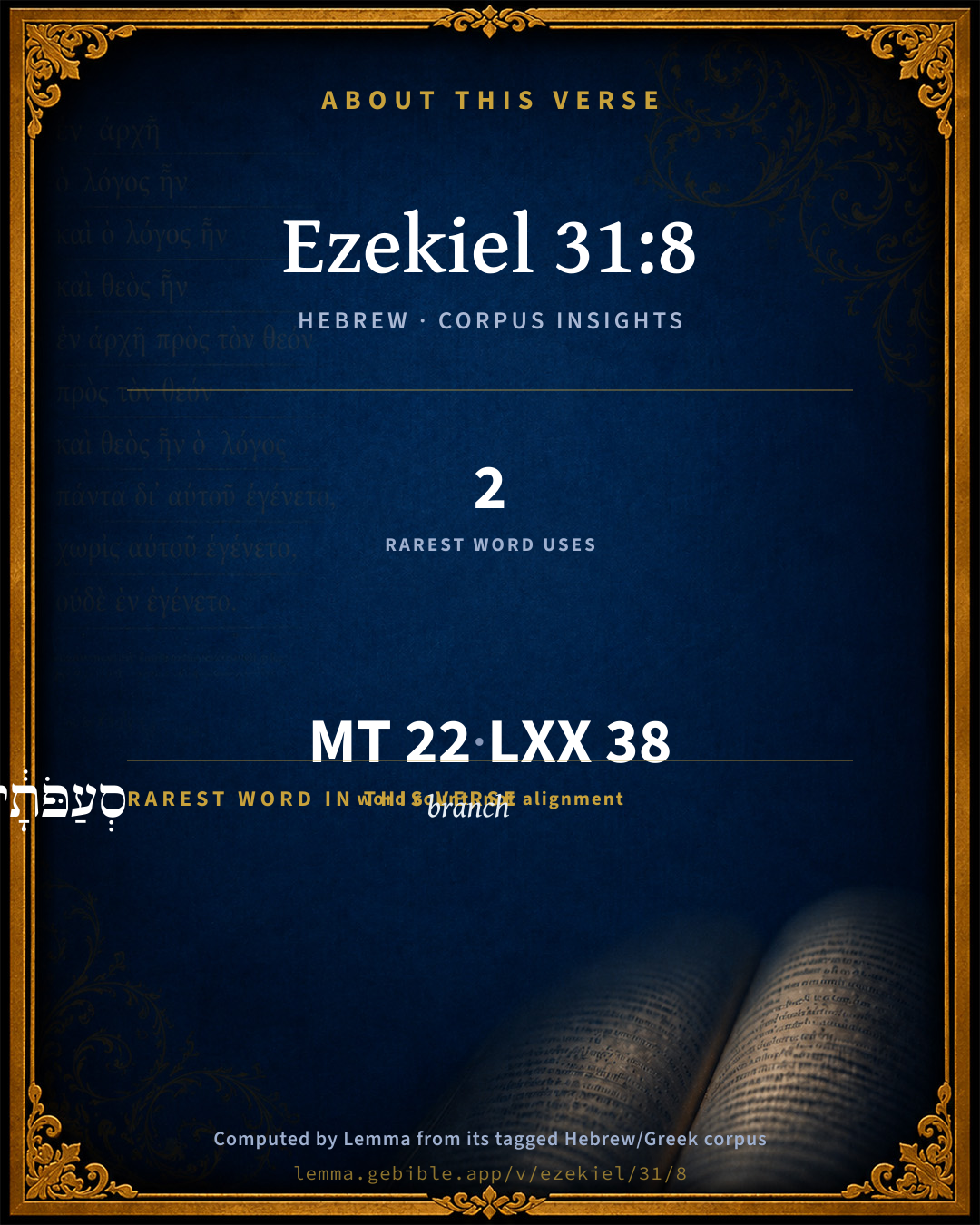
These counts appear in no published source. They are computed here, from the morphology-tagged text and Lemma’s own curated glosses. What Lemma adds →

22
words
15
distinct lemmas
Prophets
section

Notable vocabulary

The rarest word here is סְעַפֹּתָ֔יו branch H5589 — appearing just 2 times in the whole Hebrew Bible.

Shared distinctive vocabulary

סְעַפֹּתָ֔יו branch H5589 occurs in 2 verses of the Hebrew Bible. Also found in:

Grammatical profile

  • 4 verbs
  • 12 nouns
  • 2 prepositions
  • 4 particles

Verb forms

  • עֲמָמֻהוּ֮ Qal · Perfect
  • דָמוּ֙ Qal · Perfect
  • הָי֖וּ Qal · Perfect
  • דָמָ֥ה Qal · Perfect

Repetition

Words recur within this verse — often emphatic in Hebrew:

  • בְּגַן garden H1588 ×2
  • אֱלֹהִים֒ God H430 ×2
  • דָמוּ֙ to resemble H1819 ×2
  • לֹֽא not H3808 ×4
  • אֶל to H413 ×2

Hebrew & Septuagint length

In English translation the verse runs 42 words from the Hebrew and 40 from the Septuagint (LXX English) — closely comparable.

A rough comparison of the two English renderings, which tokenize alike — not a word-level alignment.

Word counts can differ between the Hebrew and the Greek without any difference in meaning — e.g. the Hebrew direct-object marker אֵת has no separate Greek word, and Greek often adds the article ὁ.

In the original languages it is 22 Hebrew tokens and 38 Greek tokens — but the two are counted differently (Hebrew bundles its prefixes and suffixes into one token; the Greek is in lemma form), so that isn’t a like-for-like length.

Cross-references

11

Topical passages linked to Ezekiel 31:8 in the Treasury of Scripture Knowledge — connected by theme and wording, ordered by reader-vote popularity; previews shown in the World English Bible.

  • Ezekiel 28:13 You were in Eden, the garden of God; every precious stone adorned you: ruby, topaz, emerald, chrysolite, onx, jasper, sapphire, turquoise, and beryl. Gold work of tambourines and of pipes was in you. In the day that you were created they were prepared.
  • Genesis 13:10 Lot lifted up his eyes, and saw all the plain of the Jordan, that it was well watered every where, before Yahweh destroyed Sodom and Gomorrah, like the garden of Yahweh, like the land of Egypt, as you go to Zoar.
  • Psalms 80:10 The mountains were covered with its shadow. Its boughs were like God's cedars.
  • Isaiah 51:3 For Yahweh has comforted Zion; he has comforted all her waste places, and has made her wilderness like Eden, and her desert like the garden of Yahweh; joy and gladness shall be found therein, thanksgiving, and the voice of melody.
  • Genesis 2:8–9 Yahweh God planted a garden eastward, in Eden, and there he put the man whom he had formed.
  • Ezekiel 31:16 I made the nations to shake at the sound of his fall, when I cast him down to Sheol with those who descend into the pit; and all the trees of Eden, the choice and best of Lebanon, all that drink water, were comforted in the lower parts of the earth.
  • Ezekiel 31:18 To whom are you thus like in glory and in greatness among the trees of Eden? yet shall you be brought down with the trees of Eden to the lower parts of the earth: you shall lie in the midst of the uncircumcised, with those who are slain by the sword. This is Pharaoh and all his multitude, says the Lord Yahweh.
  • Psalms 37:35 I have seen the wicked in great power, Spreading himself like a green tree in its native soil.
  • Isaiah 10:7–14 However he doesn't mean so, neither does his heart think so; but it is in his heart to destroy, and to cut off not a few nations.
  • Isaiah 36:4–18 Rabshakeh said to them, Say you now to Hezekiah, Thus says the great king, the king of Assyria, What confidence is this in which you trust?
  • Isaiah 37:11–13 Behold, you have heard what the kings of Assyria have done to all lands, by destroying them utterly: and shall you be delivered?

Cross-references courtesy of OpenBible.info (CC BY 4.0).

Hebrew and Greek witnesses Masoretic Hebrew ↔ Greek Septuagint

The same verse in the two great witnesses to the Old Testament, shown verse-for-verse.

These are two independent witnesses, not word-aligned to each other, and the Septuagint is shown in lemma (dictionary) form.

Hebrew Ezekiel 31:8 Masoretic · Westminster Leningrad Codex

אֲרָזִ֣ים לֹֽא עֲמָמֻהוּ֮ בְּגַן אֱלֹהִים֒ בְּרוֹשִׁ֗ים לֹ֤א דָמוּ֙ אֶל סְעַפֹּתָ֔יו וְעַרְמֹנִ֥ים לֹֽא הָי֖וּ כְּפֹֽארֹתָ֑יו כָּל עֵץ֙ בְּגַן אֱלֹהִ֔ים לֹא דָמָ֥ה אֵלָ֖יו בְּיָפְיֽוֹ

The cedars in the garden of God could not hide it; the fir trees were not like its boughs, and the plane trees were not as its branches; nor was any tree in the garden of God like it in its beauty.

World English Bible · Public Domain

Greek LXX Ezekiel 31:8 Septuagint · lemma form

κυπάρισσος τοιοῦτος οὐ γίγνομαι ἐν ὁ παράδεισος ὁ θεός καί πίτυς οὐ ὅμοιος ὁ παραφυάς αὐτός καί ἐλάτη οὐ γίγνομαι ὅμοιος ὁ κλάδος αὐτός πᾶς ξύλον ἐν ὁ παράδεισος ὁ θεός οὐ ὁμοιόω αὐτός ἐν ὁ κάλλος αὐτός

And such cypresses as this were in the paradise of God; and there were no pines like his shoots, and there were no firs like his branches: no tree in the paradise of God was like him in his beauty,

LXX2012 (modern English Septuagint) · Public Domain

On this verse, Whedon's Commentary on the Bible discusses the Septuagint’s reading. Read the note in Commentary ↓

Hebrew: Westminster Leningrad Codex (CC BY 4.0). Greek: Septuagint (public domain); English from LXX2012 (modern English Septuagint) (Public Domain). How the Septuagint differs from the Hebrew →

Targum (Aramaic paraphrase)

1

The Targum is the ancient Jewish Aramaic paraphrase of the Hebrew Scriptures — an interpretive translation, not the Hebrew text itself. Onkelos (literal) and Pseudo-Jonathan (expansive) render the Torah, and Jonathan the Prophets. Coverage is partial: where no permissively-licensed English translation exists for a verse, only the Aramaic is shown. This is verse-level text, not a word-by-word alignment to the Hebrew.

  1. Targum Jonathan Prophets (Joshua–Malachi)
    מַלְכִין תַּקִיפִין לָא אִתְנְצָחוּ לְקִבְלֵהּ בִּתְקוֹף גְבוּרָא דַהֲוַת עִמֵהּ מִן קֳדָם יְיָ שִׁלְטוֹנִין לָא קָמוּ קֳדָם מַשִׁרְיָתֵיהּ וְגִבָּרִין לָא יָכִילוּ כְּסִימְכְוָתֵיהּ בִּתְקוֹף גְבוּרָא דַהֲוַת עִמֵיהּ מִן קֳדָם יְיָ לָא דָמֵיהּ לֵיהּ בְּתוּקְפֵיהּ:

    (no public-domain English translation for this verse)

    Targum Jonathan — Aramaic: “Mikraot Gedolot” (public domain). English: “Sefaria Community Translation” (CC0 1.0 (public-domain dedication)); “London "Chaldee Paraphrase," 1871” (public domain). Text via Sefaria.

Commentary

Notes on Ezekiel 31:8 from classic Christian and Jewish commentators (each source and its license shown beneath its notes). The classic Christian expositions comment on the surrounding passage and are grouped to its opening verse, so a note may address several verses; the Jewish commentaries on the Tanakh (Rashi and others) are per-verse, so they appear only where the commentator wrote on this verse.

Lemma curates 59 commentaries, every one of them public domain or Creative Commons licensed, each selected and text-cleaned for this edition rather than reprinted as found. About our sources →

Trapp's Complete Commentary

John Trapp

Eze 31:8 The cedars in the garden of God could not hide him: the fir trees were not like his boughs, and the chesnut trees were not like his branches; nor any tree in the garden of God was like unto him in his beauty.

Ver. 8. The cedars in the garden of God.] No kingdom in the world was comparable to the Assyrian for thirteen hundred years together.

John Trapp, A Commentary or Exposition upon All the Books of the Old and New Testament (1647–1656) — public domain. Text from a community e-Sword module.

Geneva Bible (1599)

Geneva Bible translators

Signifying, that there was no greater power in the world than his was.

Geneva Bible (1599) marginal notes — public domain. Text via Bolls.life.

Jamieson, Fausset & Brown

Robert Jamieson, A. R. Fausset & David Brown

cedars . . . could not hide him--could not outtop him. No other king eclipsed him.

were not like--were not comparable to.

garden of God--As in the case of Tyre (Eze 28:13), the imagery, that is applied to the Assyrian king, is taken from Eden; peculiarly appropriate, as Eden was watered by rivers that afterwards watered Assyria (Gen 2:10-14). This cedar seemed to revive in itself all the glories of paradise, so that no tree there outtopped it.

Jamieson, Fausset & Brown — Commentary Critical and Explanatory on the Whole Bible (1871) — public domain (CC PDM 1.0). Text via the HelloAO Bible API.

Adam Clarke's Commentary

Verse 8. The cedars in the garden of God] Egypt was one of the most eminent and affluent of all the neighbouring nations.

Adam Clarke's Commentary on the Bible (1810–1826) — public domain. Text from a community e-Sword/MySword module.

Ellicott's Commentary for English Readers

(8) The garden of God.—See Eze_31:9; Eze_31:16; Eze_31:18; also Eze_28:13. This is not a representation of Assyria as being in the garden of God, as in the case of Tyre in Eze_28:13, but only a further expression of its greatness by a comparison of the tree representing it with the trees of Paradise. Yet this comparison may have been suggested by the fact that the traditionary site of Eden was within the bounds of the Assyrian Empire. Fir trees are generally understood to be cypresses, and chestnut to be plane-trees.

A Bible Commentary for English Readers, edited by Charles John Ellicott (1878–1897) — public domain. Text from a community e-Sword module.

The Cambridge Bible for Schools and Colleges

gen. ed. J. J. S. Perowne

8. could not hide him] Probably: equal him, compare with him (cf. the common particle “over against” or “alongside of,” Eze_1:20, Eze_48:13, &c.).

chesnut trees] Probably: plane trees, Gen_30:37; cf. Psa_104:16; Num_24:6. The trees in the garden of God are naturally the most lofty.

The Cambridge Bible for Schools and Colleges (gen. ed. J. J. S. Perowne; Cambridge University Press, 1878–1918) — public domain. Text from a community e-Sword module.

John Gill's Exposition

The cedars in the garden of God could not hide him,.... That is, could not rise so high as this cedar, and overtop him, and obscure his glory; even those that were most excellent, which grew in Eden, near to which Babylon stood, and where a mighty king dwelt. The sense is, that the greatest kings and potentates in the whole world, which is like a garden planted by the Lord, were not equal to the king of Assyria, and much less exceeded him in grandeur, wealth, and power:

the fir trees were not like his boughs: lesser kings and princes, comparable to fir trees for the beauty, regularity, order, and flourishing condition of their kingdoms; yet these were but petty states, and not to be compared even with the provinces of the king of Assyria:

and the chesnut trees were not like his branches; lesser states still: which, though well set, and well spread, and full of people, yet not answerable to some countries that were in the provinces that belonged to the Assyrian empire:

not any tree in the garden of God was like unto him in his beauty; no king, prince, or potentate whatever in the whole world, was to be compared to him for royal majesty and greatness. The Targum is,

"mighty kings could not prevail against him, because of the strength of his power, which he had from the Lord; rulers could not stand before his army, and mighty men could not prevail against his auxiliaries, because of the strength of power he had from the Lord; there is none like to him in his strength.''

John Gill's Exposition of the Whole Bible (1746–1763) — public domain (CC PDM 1.0). Text via the HelloAO Bible API.

Matthew Poole's English Annotations

The cedars; kings, the greatest and most magnificent.

In the garden of God; either in the most fruitful gardens, or in Judah and Israel; not David, not Solomon, Jehoshaphat, or Hezekiah, could top and shade him.

The fir trees; a meaner sort of trees, emblem of lesser kings and kingdoms; these were but like his boughs, though they grow to great height and bulk. The chesnut trees; the same in another allusion. Kings, like chesnut trees, great when by themselves, yet, compared with this Assyrian, were but as branches of his boughs; all which see in Isaiah’s words, Eze 10:7,8. There was some truth, though more pride, in this speech of the Assyrian, which the prophet reports.

Nor any tree in the garden of God; all summed up, none like him in all the kingdoms of the world.

Matthew Poole's English Annotations on the Holy Bible (1683–1685) — public domain. Text from a community e-Sword/MySword module.

Whedon's Commentary on the Bible

Daniel D. Whedon

8, 9. This was the greatest of all trees, its twigs being greater than fir trees (or, cypress; compare Eze_27:5), and its great branches reaching farther than the chestnut (or, “plane,” LXX.; Gen_30:37). For garden of God and Eden, see Eze_28:13.

Daniel D. Whedon (gen. ed.), Commentary on the Old and New Testaments (1874–1909) — public domain. Text from a community e-Sword module.

The Pulpit Commentary

The cedars in the garden of God. As in Eze_28:13, the thoughts of the prophet dwell on the picture of Eden in Gen_2:8. Far above all other trees, the cedar of Assyria rose high in majesty. All the trees that were in the garden of God envied him. The trees specially chosen for comparison are

(1) the fir tress probably, as in Eze_27:5, the cypresses; and

(2) the chestnut trees, for which the Revised Version, following the Vulgate and the LXX of Gen_30:9, gives the "plane," which held a high place in the admiration of Greek and Roman writers. Of this we have a special instance in the story of Xerxes, who decorated a plane tree near the Meander with ornaments of gold (Herod., 7:31; "AElicon," 5:14; also comp. Ecc 24:14; Virg., "Georg.," 4:146; Cicero, "De Ont.," 1:7, 28).

Vers. 8, 9. The garden of God.

garden of God," standing, as it does, for the ideal region in which man in his perfection was placed when God was" well pleased with "him, may be taken as a picture of human society itself as it once was for however brief a period, and as it shall be again when the purposes of the Redeemer are fulfilled.

I A REGION ABOUNDING IN FRUITFULNESS. In the first garden of God there grew every tree that was "good for food." The ideal state of human society is one in which all conceivable fruitfulness will be found; there will be ready for the hand of the Husbandman the fruits of faith, of devotion, of love, of sacred joy, of helpfulness, of calm contentment, of happy and unquestioning obedience. From all hearts and lives these fair fruits will spring.

II A SCENE OF EXQUISITE BEAUTY. "The garden of God" must be, quite independently of all reference to Eden, a place of perfect beauty. Its trees and shrubs, its herbs and flowers, its lawns and paths must together present the appearance of perfect pleasantness to the eye. Such should, such (one day) shall our human societies, our communities, and our Churches be; they will be scenes where there is every form of human loveliness. There must be no unnatural monotony. As in our gardens we like to have vegetation of every possible variety of size and shape and hue, so in "the garden of God" shall there be every manifestation of moral worth, of spiritual beauty. One will not say to another, "There is no need of your particular excellence;" but each will rejoice in the manifold graces which are to be seen on every hand.

III THE SPHERE OF HAPPY CULTURE. Our first parents were placed in Eden "to dress it and to keep it." Even "the garden of God" requires attention, planting, culture. So, certainly, does the most refined and Christianized human society. There may be much knowledge and there may be excellent habits within it, but it will always need careful and diligent culture much seed-sowing; some weeding; some pruning and occasional transplanting. We may learn:

1. That it is better to be the humblest herb in the garden of God than the stateliest cedar outside it; better be utterly obscure in the right place than very prominent in the wrong one.

2. That each particular flower in the garden of God lends its own fragrance to the air; the garden would not be complete without it.

3. That not only does it behoove us to be as a flower in the garden of God, but it also befits us to be as a gardener extending the grounds, or planting or tending within its bounds. C.

The Pulpit Commentary (1880–1919), ed. H.D.M. Spence-Jones & Joseph S. Exell — public domain. Text from a community e-Sword module.

John Wesley's Explanatory Notes

The cedars - The greatest kings. Garden of God - In the most fruitful gardens. Hide - Could not ever top, and shade him. The fir-trees - Lesser kings, and kingdoms, were not equal to his boughs. Nor any tree - All summed up, none like him in all the kingdoms of the world.

John Wesley, Explanatory Notes Upon the Whole Bible (1754–1765) — public domain. Text via the GEBible commentary corpus.

unfoldingWord translationNotes

Door43 World Missions Community

General Information:

Yahweh's parable about the cedar continues.

Cedars in the garden of God could not equal it

Since these were God's words to Pharaoh, it can also be translated with the first person. AT: "The cedar trees in my garden were not as great as that tree" (See: First, Second, or Third Person)

the garden of God

This is another way of referring to "the garden of Eden."

None among the cypress trees matched its branches

Yahweh was comparing how many branches the trees had. AT: "None of the cypress trees had as many branches as the cedar" (See: Assumed Knowledge and Implicit Information)

cypress trees

Cypress trees have very many branches. They can grow very tall. See how you translated "cypress" in Ezekiel 27:5.

the plane tree could not equal its boughs

It was implied Yahweh was comparing the long branches of the cedar tree with the long branches of the plane tree. AT: "the plane tree did not have branches like the cedar tree" or "no plane tree had branches as long as the branches of the cedar tree" (See: Assumed Knowledge and Implicit Information)

plane tree

A plane tree was a large, leafy tree with strong branches. It is similar to a sycamore tree. (See: Translate Unknowns)

was like it in its beauty

"was as beautiful as the cedar tree"

I made it beautiful with its many branches

"I made the cedar beautiful by giving it many long branches"

envied it

"were jealous of the cedar tree"

translationWords

Eden

envy

unfoldingWord translationNotes — © Distant Shores Media and the Door43 World Missions Community, licensed CC BY-SA 4.0. Source: git.door43.org/Door43/en_tn.

Rashi

Rabbi Shlomo Yitzchaki (Rashi)

did not dim it They did not dim its form; i.e., none among them surpassed it in beauty.

in the garden of God i.e., in the entire world.

and chestnut trees [Heb. ועֲרְמֹנִים,] chastaniyers, chastaneyrs in Old French [chataigniers in Modern French].

Rashi on the Tanakh — English translations: “The Judaica Press complete Tanach with Rashi, translated by A. J. Rosenberg” (CC BY 4.0); “Pentateuch with Rashi's commentary by M. Rosenbaum and A.M. Silbermann, 1929-1934” (public domain); “The Metsudah Tanach series, Lakewood, N.J” (CC BY 4.0); and “The Book of Joshua, Metsudah Publications, 1997” (CC BY 4.0). Text via Sefaria.

Lesson kit

Teaching starters — assembled from the data on this page, not authored interpretation. Every prompt links to the verse data it draws on. Edit before teaching.

Ezekiel, in the Prophets, opens this verse with 22 words (15 distinct Hebrew lemmas). Its most distinctive word is çᵉʻappâh (“branch”). A historical commentator’s framing appears above. Read the whole chapter for the surrounding context.

Discussion questions

  1. How does “branch” (çᵉʻappâh) shape what this verse is saying?
  2. How does Ezekiel 31:6, which shares the word «branch», read alongside this verse?
  3. What does the repetition of “garden” (2× in this one verse) do in this verse?
  4. The translations on this page render this verse differently — a whole-verse word diff, not a word-by-word alignment. What might account for the different wordings?
  5. «עֲמָמֻהוּ֮» is a Qal Perfect verb. How does that grammatical form shape the action described?
  6. Compare how Trapp's Complete Commentary and Geneva Bible (1599) read this verse. Where do they agree or differ?

Things to notice

Reading settings

Reading text

Shown beneath each verse's original-language words.

Old Testament
Old Testament edition

Read the OT as the Masoretic Hebrew (MT) or the Greek Septuagint (LXX).

English shown for the Greek Septuagint (in the Hebrew ↔ Greek comparison).

Comparing translations? Open the Compare panel on any verse page to stack up to four side by side.