Ezekiel 21:32

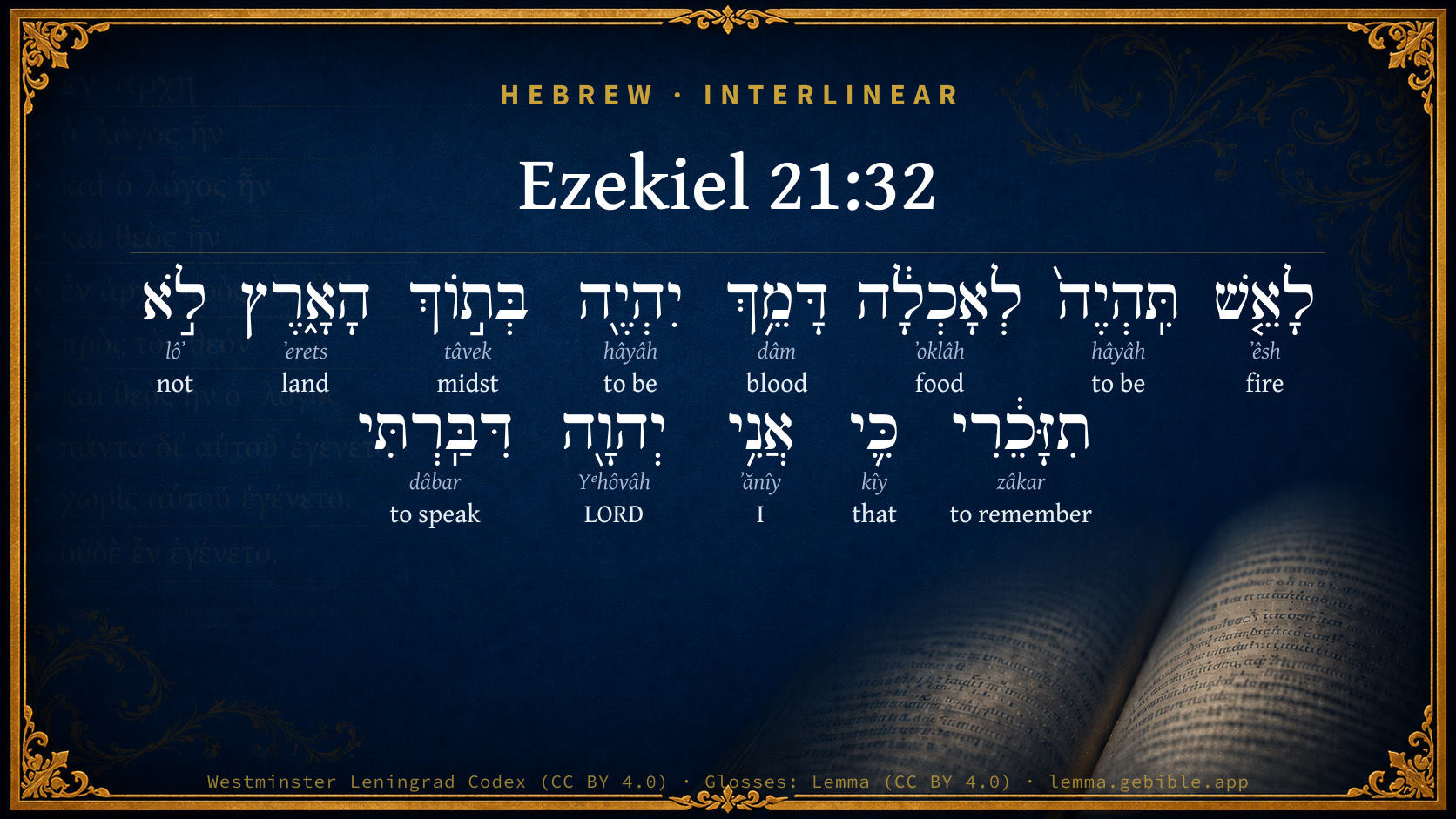
Hebrew (Westminster Leningrad Codex) Ezekiel 21:32 appears in the Hebrew Old Testament. The text above is from the Westminster Leningrad Codex. Each word links to its Strong’s number, a concise gloss, and parsing drawn from the Open Scriptures Hebrew Bible morphology. Click any word for its full Brown-Driver-Briggs (BDB) entry.
Download image
Cite this verse

Ezekiel 21:32 (World English Bible). Public Domain. Lemma interlinear Bible study tool, https://lemma.gebible.app/v/ezekiel/21/32.

Show BibTeX & RIS
BibTeX
RIS
English Translation
You shall be for fuel to the fire; your blood shall be in the midst of the land; you shall be no more remembered: for I, Yahweh, have spoken it.
World English Bible · Public Domain
Download a study sheet

One document with this verse’s original text, its word-by-word gloss line, the meaning frame, cross-references with their text, attributed commentary, and full source and license credits — printable, and it pastes into notes with its structure intact.

This verse Autodidact and up

Study sheet (.html) Plain text (.txt)

A passage Seminary Student

Up to 50 verses in one chapter. A passage sheet keeps up to 6 commentary sources and 12 cross-references per verse, in the order this page ranks them, and says so on the sheet whenever that leaves anything out. Ask for a single verse and you get the Autodidact verse sheet above.

Everything on this page stays free to read, with no account — the sheet is a download of what is already on screen, not access to it.

Want to remove ads? Support Godless Engineer
Compare translations 3

The same verse in 3 English versions, stacked beneath the original-language interlinear above. Click any original word for its lexicon entry.

Each is an independent rendering of the whole verse — the interlinear is not word-aligned to these translations.

Highlighted words mark where these versions differ — a whole-verse word diff, not a word-by-word alignment.

  • World English Bible Public Domain
    You shall be for fuel to the fire; your blood shall be in the midst of the land; you shall be no more remembered: for I, Yahweh, have spoken it.
  • King James Version Public Domain
    Thou shalt be for fuel to the fire; thy blood shall be in the midst of the land; thou shalt be no more remembered: for I the LORD have spoken it.
  • unfoldingWord Literal Text CC BY-SA 4.0
    You will become fuel for the fire! Your blood will be in the midst of the land. You will not be remembered, for I, Yahweh have declared this!’”

unfoldingWord Literal Text — © unfoldingWord, licensed CC BY-SA 4.0. Word-aligned USFM3 via Door43 (git.door43.org/unfoldingWord/en_ult).

Versions to compare (up to 4)

3 of 4 selected

Show all 18 translations

Every available English version of this verse, each an independent rendering of the whole verse.

  • World English Bible Public Domain
    You shall be for fuel to the fire; your blood shall be in the midst of the land; you shall be no more remembered: for I, Yahweh, have spoken it.
  • Berean Standard Bible Public Domain
    You will be fuel for the fire. Your blood will stain your own land. You will not be remembered, for I, the LORD, have spoken.’”
  • Majority Standard Bible Public Domain
    You will be fuel for the fire. Your blood will stain your own land. You will not be remembered, for I, the LORD, have spoken.’”
  • King James Version Public Domain
    Thou shalt be for fuel to the fire; thy blood shall be in the midst of the land; thou shalt be no more remembered: for I the LORD have spoken it.
  • American Standard Version (1901) Public Domain
    Thou shalt be for fuel to the fire; thy blood shall be in the midst of the land; thou shalt be no more remembered: for I, Jehovah, have spoken it.
  • Revised Version (1885) Public Domain
    Thou shalt be for fuel to the fire; thy blood shall be in the midst of the land; thou shalt be no more remembered: for I the LORD have spoken it.
  • Geneva Bible (1599) Public Domain
    Thou shalt bee in the fire to be deuoured: thy blood shall be in the middes of the lande, and thou shalt be no more remembred: for I the Lord haue spoken it.
  • Douay-Rheims (1899) Public Domain
    Thou shalt be fuel for the fire, thy blood shall be in the midst of the land, thou shalt be forgotten: for I the Lord have spoken it.
  • Young's Literal Translation Public Domain
    To the fire thou art for fuel, Thy blood is in the midst of the land, Thou art not remembered, For I, Jehovah, have spoken!'
  • Literal Standard Version CC BY-SA 4.0
    You are fuel for the fire, || Your blood is in the midst of the land, || You are not remembered, || For I, YHWH, have spoken!”
  • Unlocked Literal Bible CC BY-SA 4.0
    You will become fuel for the fire! Your blood will be in the midst of the land. You will not be remembered, for I, Yahweh have declared this!'”
  • unfoldingWord Literal Text CC BY-SA 4.0
    You will become fuel for the fire! Your blood will be in the midst of the land. You will not be remembered, for I, Yahweh have declared this!’”
  • Darby Bible Public Domain
    Thou shalt be for fuel to the fire; thy blood shall be in the midst of the land; thou shalt not be remembered: for I Jehovah have spoken.
  • World Messianic Bible Public Domain
    You will be for fuel to the fire. Your blood will be in the middle of the land. You will be remembered no more; for I, the LORD, have spoken it.”’”
  • Webster's Bible Public Domain
    Thou shalt be for fuel to the fire; thy blood shall be in the midst of the land; thou shalt be no more remembered: for I the LORD have spoken it.
  • Free Bible Version CC BY-SA 4.0
    You will be burned up like firewood. Your blood will be shed where you live. You will be forgotten, for I, the Lord, have spoken.”
  • Bible in Basic English Public Domain
    You will be food for the fire; your blood will be drained out in the land; there will be no more memory of you: for I the Lord have said it.
  • JPS Tanakh (1917) Public Domain
    (21-37) Thou shalt be for fuel to the fire; thy blood shall be in the midst of the land, thou shalt be no more remembered; for I the LORD have spoken it.'

Literal Standard Version (2020), Covenant Press — licensed CC BY-SA 4.0. Text via the HelloAO Bible API (eBible.org). Unlocked Literal Bible (unfoldingWord) — licensed CC BY-SA 4.0. Text via the HelloAO Bible API (eBible.org). unfoldingWord Literal Text — © unfoldingWord, licensed CC BY-SA 4.0. Word-aligned USFM3 via Door43 (git.door43.org/unfoldingWord/en_ult). Free Bible Version, Dr. Jonathan Gallagher — licensed CC BY-SA 4.0. Text via the HelloAO Bible API (eBible.org).

Word by word

More ways to search: Search by grammar → Find every occurrence → Compare this word →

Practice this passage: Drill this verse → Learn its vocabulary →

לְאָכְלָ֔ה
ʼoklâh
H402
“to/for · food”
Preposition + Noun, Common, Feminine, Singular, Absolute
Part of Speech
Preposition + Noun
Type
Common
Gender
Feminine
Number
Singular
State
Absolute
Full BDB Definition

Origin: from H401

TWOT: 85b

food - food, eating - object of devouring, consuming - by wild beasts (figurative) - in fire - of judgment (figurative)
  1. לָאֵ֤שׁ ʼêsh H784 “to/for the · fire” Preposition, Determined + Noun, Common, Both, Singular, Absolute
  2. תִּֽהְיֶה֙ hâyâh H1961 “to be” Verb, Qal, Imperfect, 2nd Person, Masculine, Singular
  3. דָּמֵ֥ךְ dâm H1818 “blood · your” Noun, Common, Masculine, Singular, Construct + Suffix, Personal, 2nd Person, Feminine, Singular
  4. יִהְיֶ֖ה hâyâh H1961 “to be” Verb, Qal, Imperfect, 3rd Person, Masculine, Singular
  5. בְּת֣וֹךְ tâvek H8432 “in/at · midst of” Preposition + Noun, Common, Masculine, Singular, Construct
  6. הָאָ֑רֶץ ʼerets H776 “the · land” Particle, Definite Article + Noun, Common, Both, Singular, Absolute
  7. לֹ֣א lôʼ H3808 “not” Particle, Negative
  8. תִזָּכֵ֔רִי zâkar H2142 “to remember” Verb, Niphal, Imperfect, 2nd Person, Feminine, Singular
  9. כִּ֛י kîy H3588 “that” Conjunction
  10. אֲנִ֥י ʼănîy H589 “I” Pronoun, Personal, 1st Person, Common, Singular
  11. יְהוָ֖ה Yᵉhôvâh H3068 “LORD” Noun, Proper
  12. דִּבַּֽרְתִּי dâbar H1696 “to speak” Verb, Piel, Perfect, 1st Person, Common, Singular

About this verse

These counts appear in no published source. They are computed here, from the morphology-tagged text and Lemma’s own curated glosses. What Lemma adds →

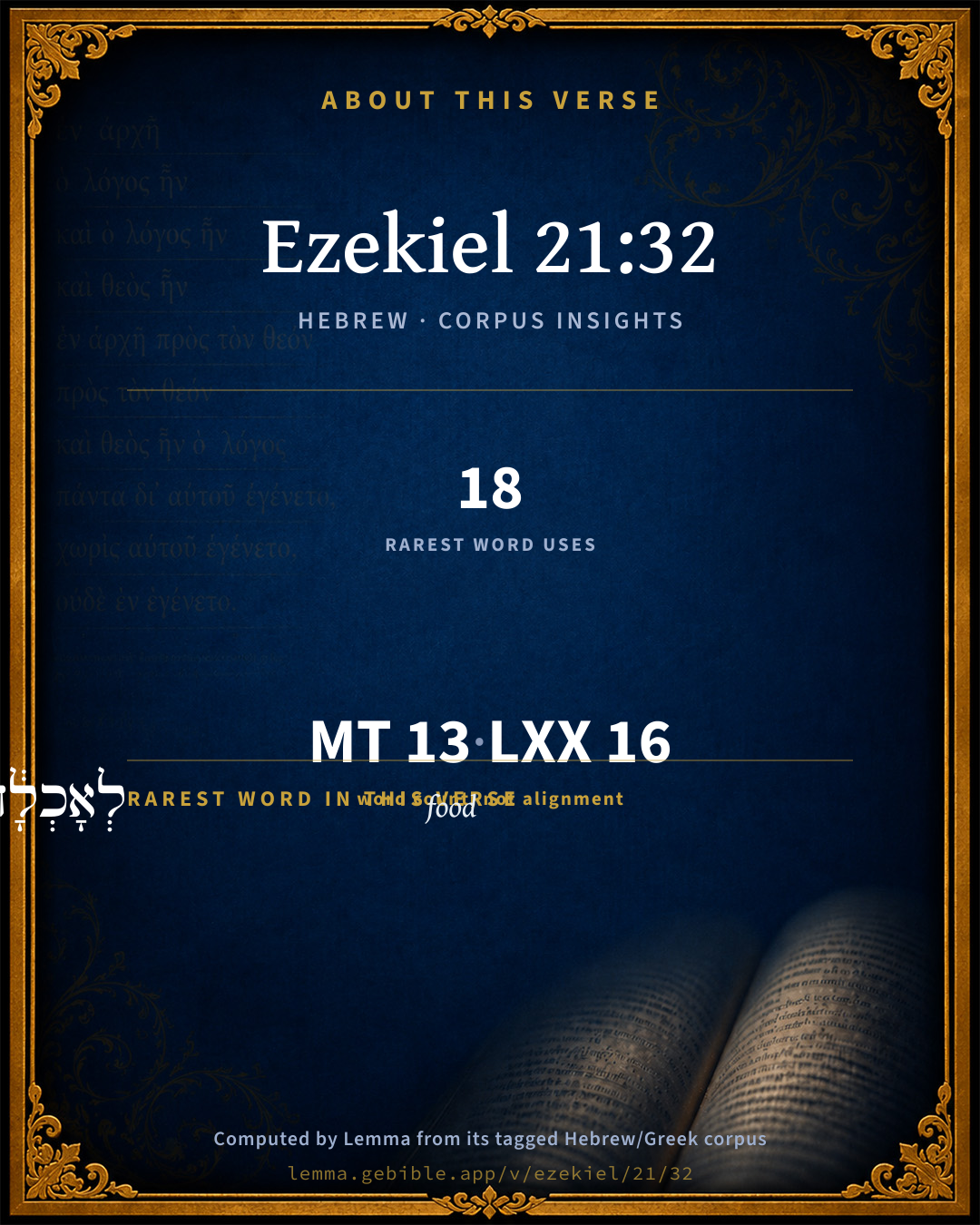
13
words
12
distinct lemmas
Prophets
section

Notable vocabulary

The rarest word here is לְאָכְלָ֔ה food H402 — appearing just 18 times in the whole Hebrew Bible.

Shared distinctive vocabulary

לְאָכְלָ֔ה food H402 occurs in 18 verses of the Hebrew Bible. Also found in:

Grammatical profile

  • 4 verbs
  • 6 nouns
  • 1 pronoun
  • 1 conjunction
  • 1 particle

Verb forms

  • תִּֽהְיֶה֙ Qal · Imperfect
  • יִהְיֶ֖ה Qal · Imperfect
  • תִזָּכֵ֔רִי Niphal · Imperfect
  • דִּבַּֽרְתִּי Piel · Perfect

Repetition

A word recurs within this verse — often emphatic in Hebrew:

  • תִּֽהְיֶה֙ to be H1961 ×2

Hebrew & Septuagint length

In English translation the verse runs 30 words from the Hebrew and 32 from the Septuagint (LXX English) — closely comparable.

A rough comparison of the two English renderings, which tokenize alike — not a word-level alignment.

Word counts can differ between the Hebrew and the Greek without any difference in meaning — e.g. the Hebrew direct-object marker אֵת has no separate Greek word, and Greek often adds the article ὁ.

In the original languages it is 13 Hebrew tokens and 16 Greek tokens — but the two are counted differently (Hebrew bundles its prefixes and suffixes into one token; the Greek is in lemma form), so that isn’t a like-for-like length.

Cross-references

10

Topical passages linked to Ezekiel 21:32 in the Treasury of Scripture Knowledge — connected by theme and wording, ordered by reader-vote popularity; previews shown in the World English Bible.

  • Ezekiel 25:10 to the children of the east, [to go] against the children of Ammon; and I will give them for a possession, that the children of Ammon may not be remembered among the nations.
  • Malachi 4:1 "For, behold, the day comes, it burns as a furnace; and all the proud, and all who work wickedness, will be stubble; and the day that comes will burn them up," says Yahweh of Hosts, "that it shall leave them neither root nor branch.
  • Ezekiel 20:47–48 and tell the forest of the South, Hear the word of Yahweh: Thus says the Lord Yahweh, Behold, I will kindle a fire in you, and it shall devour every green tree in you, and every dry tree: the flaming flame shall not be quenched, and all faces from the south to the north shall be burnt thereby.
  • Numbers 23:19 God is not a man, that he should lie, Neither the son of man, that he should repent: Has he said, and will he not do it? Or has he spoken, and will he not make it good?
  • Isaiah 34:3–7 Their slain also shall be cast out, and the stench of their dead bodies shall come up; and the mountains shall be melted with their blood.
  • Ezekiel 21:30 Cause it to return into its sheath. In the place where you were created, in the land of your birth, will I judge you.
  • Zephaniah 2:9 Therefore as I live, says Yahweh of Hosts, the God of Israel, surely Moab will be as Sodom, and the children of Ammon as Gomorrah, a possession of nettles, and salt pits, and a perpetual desolation. The remnant of my people will plunder them, and the survivors of my nation will inherit them.
  • Matthew 3:10 "Even now the axe lies at the root of the trees. Therefore, every tree that doesn't bring forth good fruit is cut down, and cast into the fire.
  • Matthew 3:12 His winnowing fork is in his hand, and he will thoroughly cleanse his threshing floor. He will gather his wheat into the barn, but the chaff he will burn up with unquenchable fire."
  • Matthew 24:35 Heaven and earth will pass away, but my words will not pass away.

Cross-references courtesy of OpenBible.info (CC BY 4.0).

Hebrew and Greek witnesses Masoretic Hebrew ↔ Greek Septuagint

The same verse in the two great witnesses to the Old Testament, shown verse-for-verse.

These are two independent witnesses, not word-aligned to each other, and the Septuagint is shown in lemma (dictionary) form.

Hebrew Ezekiel 21:32 Masoretic · Westminster Leningrad Codex

לָאֵ֤שׁ תִּֽהְיֶה֙ לְאָכְלָ֔ה דָּמֵ֥ךְ יִהְיֶ֖ה בְּת֣וֹךְ הָאָ֑רֶץ לֹ֣א תִזָּכֵ֔רִי כִּ֛י אֲנִ֥י יְהוָ֖ה דִּבַּֽרְתִּי

You shall be for fuel to the fire; your blood shall be in the midst of the land; you shall be no more remembered: for I, Yahweh, have spoken it.

World English Bible · Public Domain

Greek LXX Ezekiel 21:32 Septuagint · lemma form

ἀδικία ἀδικία τίθημι αὐτός οὐδέ οὗτος τοιοῦτος εἰμί ἕως ὅς ἔρχομαι ὅς καταἥκω καί παραδίδωμι αὐτός

You shall be fuel for fire; your blood shall be in the midst of your land; there shall be no remembrance at all of you: for I the Lord have spoken it.

LXX2012 (modern English Septuagint) · Public Domain

Hebrew: Westminster Leningrad Codex (CC BY 4.0). Greek: Septuagint (public domain); English from LXX2012 (modern English Septuagint) (Public Domain). How the Septuagint differs from the Hebrew →

Targum (Aramaic paraphrase)

1

The Targum is the ancient Jewish Aramaic paraphrase of the Hebrew Scriptures — an interpretive translation, not the Hebrew text itself. Onkelos (literal) and Pseudo-Jonathan (expansive) render the Torah, and Jonathan the Prophets. Coverage is partial: where no permissively-licensed English translation exists for a verse, only the Aramaic is shown. This is verse-level text, not a word-by-word alignment to the Hebrew.

  1. Targum Jonathan Prophets (Joshua–Malachi)
    חוֹבֵיהוֹן דְחָבוּ כְּחוֹבֵיהוֹן אֶתְפְּרַע מִנְהוֹן אַף לְדֵין לָא יִתְקַיֵם לֵיהּ עַד דְאַיְתֵי עֲלוֹהִי פּוֹרְעֲנוּת יִשְׁמָעֵאל בַּר נְתַנְיָה וְאֶמְסְרִינֵיהּ בִּידֵיהּ:

    (no public-domain English translation for this verse)

    Targum Jonathan — Aramaic: “Mikraot Gedolot” (public domain). English: “Sefaria Community Translation” (CC0 1.0 (public-domain dedication)); “London "Chaldee Paraphrase," 1871” (public domain). Text via Sefaria.

Commentary

Notes on Ezekiel 21:32 from classic Christian and Jewish commentators (each source and its license shown beneath its notes). The classic Christian expositions comment on the surrounding passage and are grouped to its opening verse, so a note may address several verses; the Jewish commentaries on the Tanakh (Rashi and others) are per-verse, so they appear only where the commentator wrote on this verse.

Lemma curates 59 commentaries, every one of them public domain or Creative Commons licensed, each selected and text-cleaned for this edition rather than reprinted as found. About our sources →

Trapp's Complete Commentary

John Trapp

Eze 21:32 Thou shalt be for fuel to the fire; thy blood shall be in the midst of the land; thou shalt be no [more] remembered: for I the LORD have spoken [it].

Ver. 32. Thou shalt be no more remembered.] {a} The Ammonites were so rooted out by the Medes and Persians, that besides what we find in the Bible, there is no mention of their name. A type of such as are destroyed for ever in hell, being fuel for that black fire, and eternally forgotten.

{a} Saltem cum benedictione. - Polan.

John Trapp, A Commentary or Exposition upon All the Books of the Old and New Testament (1647–1656) — public domain. Text from a community e-Sword module.

Jamieson, Fausset & Brown

Robert Jamieson, A. R. Fausset & David Brown

thy blood shall be--that is, shall flow.

be no more remembered--be consigned as a nation to oblivion.

Repetition of the charges in the twentieth chapter only that there they were stated in an historical review of the past and present; here the present sins of the nation exclusively are brought forward.

Next: Ezekiel Chapter 22

Jamieson, Fausset & Brown — Commentary Critical and Explanatory on the Whole Bible (1871) — public domain (CC PDM 1.0). Text via the HelloAO Bible API.

Adam Clarke's Commentary

Verse 32. Thou shalt be no more remembered] The empire of the Chaldeans was destroyed, and the power transferred to the Persians; the Persian empire was destroyed, and given to the Greeks; the Grecian empire was destroyed, and given to the Mohammedans; and the destruction of the Mohammedans is at no great distance.

Adam Clarke's Commentary on the Bible (1810–1826) — public domain. Text from a community e-Sword/MySword module.

Ellicott's Commentary for English Readers

(32) Shalt be no more remembered.—Ammon should be utterly destroyed, as fuel in the fire; the life-blood of the nation should be poured out, and her name vanish. For her there should be no future, like that promised to Israel in Eze_21:27.

A Bible Commentary for English Readers, edited by Charles John Ellicott (1878–1897) — public domain. Text from a community e-Sword module.

The Cambridge Bible for Schools and Colleges

gen. ed. J. J. S. Perowne

32. Cf. Eze_25:10. Ammon shall perish in his own land.

The Cambridge Bible for Schools and Colleges (gen. ed. J. J. S. Perowne; Cambridge University Press, 1878–1918) — public domain. Text from a community e-Sword module.

Matthew Poole's English Annotations

Thou; Rabbath, and thy people.

For fuel; which is soon and unavoidably consumed in such a furnace.

Thy blood shall be in the midst of the land; thou shalt no where be safe, or thy blood shall not be covered, nor thou buried.

Thou shalt be no more remembered; thy name shall perish.

Matthew Poole's English Annotations on the Holy Bible (1683–1685) — public domain. Text from a community e-Sword/MySword module.

The Pulpit Commentary

For Ammon there is no hope of a restoration like that which Ezekiel speaks of as possible for Jerusalem, and even for Sodom and Samaria. Its doom is written in the words, it shall be no more remembered. (comp. Eze_25:7)

The Pulpit Commentary (1880–1919), ed. H.D.M. Spence-Jones & Joseph S. Exell — public domain. Text from a community e-Sword module.

unfoldingWord translationNotes

Door43 World Missions Community

General Information:

Yahweh continues giving Ezekiel his message to the people of Ammon.

You will become fuel for the fire

"The fire will burn up your bodies"

Your blood will be in the midst of the land

"Your blood will soak into the ground of your land"

You will not be remembered

This can be stated in active form. AT: "No one will remember you" (See: Active or Passive)

translationWords

blood

declare

unfoldingWord translationNotes — © Distant Shores Media and the Door43 World Missions Community, licensed CC BY-SA 4.0. Source: git.door43.org/Door43/en_tn.

Rashi

Rabbi Shlomo Yitzchaki (Rashi)

A ruin, a ruin Heb. עַוָה, an expression of (Micah 1:6): “a heap (עִי) in the field,” an expression of ruin after ruin, two and three times, I shall make it: It was already taken from Jeconiah and given to Zedekiah, and from Zedekiah it will be given to Gedaliah; this makes twice. Menachem (p. 131) connected עַוָה with (Esther 1:16): “has Vashti the queen done wrong (עָוְתָה)?”; (Ps. 106:5), “we have committed iniquity (הֶעֱוִינוּ) and wickedness.”

this too will not be Also, to Gedaliah it will not remain, [only] until Ishmael the son of Nethaniah [the assassin] comes.

until he who has the judgment Upon whom I placed [the mission] to exact My vengeance and My judgment.

and I will deliver him into his hands.

Rashi on the Tanakh — English translations: “The Judaica Press complete Tanach with Rashi, translated by A. J. Rosenberg” (CC BY 4.0); “Pentateuch with Rashi's commentary by M. Rosenbaum and A.M. Silbermann, 1929-1934” (public domain); “The Metsudah Tanach series, Lakewood, N.J” (CC BY 4.0); and “The Book of Joshua, Metsudah Publications, 1997” (CC BY 4.0). Text via Sefaria.

Lesson kit

Teaching starters — assembled from the data on this page, not authored interpretation. Every prompt links to the verse data it draws on. Edit before teaching.

Ezekiel, in the Prophets, opens this verse with 13 words (12 distinct Hebrew lemmas). Its most distinctive word is ʼoklâh (“food”). A historical commentator’s framing appears above. Read the whole chapter for the surrounding context.

Discussion questions

  1. The word ʼoklâh carries the sense “food.” How does it shape the verse?
  2. How does Genesis 1:29, which shares the word «food», read alongside this verse?
  3. What does the repetition of “to be” (2× in this one verse) do in this verse?
  4. The translations on this page render this verse differently — a whole-verse word diff, not a word-by-word alignment. What might account for the different wordings?
  5. «תִּֽהְיֶה֙» is a Qal Imperfect verb. How does that grammatical form shape the action described?
  6. Compare how Trapp's Complete Commentary and Jamieson, Fausset & Brown read this verse. Where do they agree or differ?

Things to notice

Reading settings

Reading text

Shown beneath each verse's original-language words.

Old Testament
Old Testament edition

Read the OT as the Masoretic Hebrew (MT) or the Greek Septuagint (LXX).

English shown for the Greek Septuagint (in the Hebrew ↔ Greek comparison).

Comparing translations? Open the Compare panel on any verse page to stack up to four side by side.