

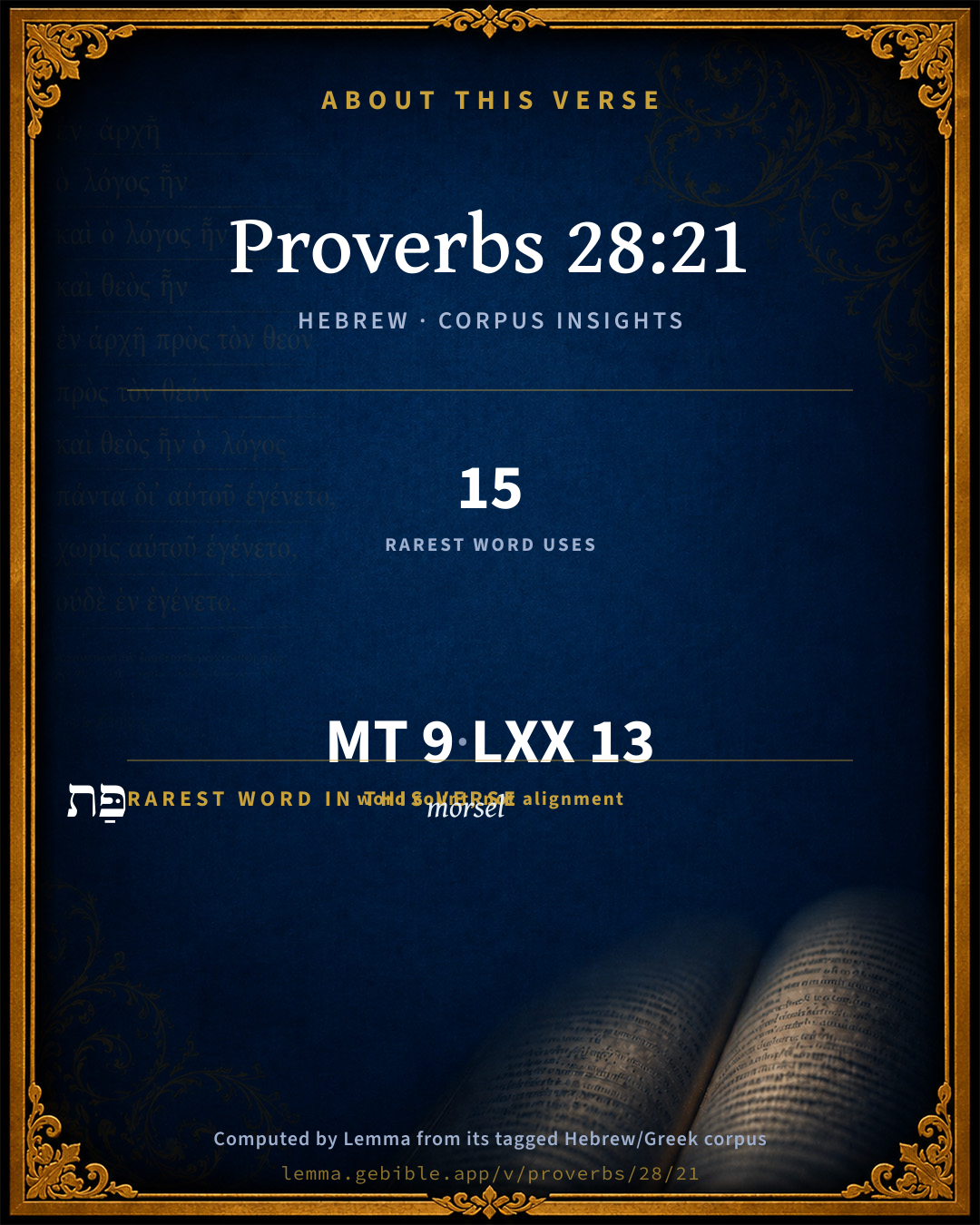
Proverbs 28:21

Hebrew (Westminster Leningrad Codex) Proverbs 28:21 appears in the Hebrew Old Testament. The text above is from the Westminster Leningrad Codex. Each word links to its Strong’s number, a concise gloss, and parsing drawn from the Open Scriptures Hebrew Bible morphology. Click any word for its full Brown-Driver-Briggs (BDB) entry.
Download image
Cite this verse

Proverbs 28:21 (World English Bible). Public Domain. Lemma interlinear Bible study tool, https://lemma.gebible.app/v/proverbs/28/21.

Show BibTeX & RIS
BibTeX
RIS
English Translation
To show partiality is not good; Yet a man will do wrong for a piece of bread.
World English Bible · Public Domain
Download a study sheet

One document with this verse’s original text, its word-by-word gloss line, the meaning frame, cross-references with their text, attributed commentary, and full source and license credits — printable, and it pastes into notes with its structure intact.

This verse Autodidact and up

Study sheet (.html) Plain text (.txt)

A passage Seminary Student

Up to 50 verses in one chapter. A passage sheet keeps up to 6 commentary sources and 12 cross-references per verse, in the order this page ranks them, and says so on the sheet whenever that leaves anything out. Ask for a single verse and you get the Autodidact verse sheet above.

Everything on this page stays free to read, with no account — the sheet is a download of what is already on screen, not access to it.

Want to remove ads? Support Godless Engineer
Compare translations 3

The same verse in 3 English versions, stacked beneath the original-language interlinear above. Click any original word for its lexicon entry.

Each is an independent rendering of the whole verse — the interlinear is not word-aligned to these translations.

Highlighted words mark where these versions differ — a whole-verse word diff, not a word-by-word alignment.

  • World English Bible Public Domain
    To show partiality is not good; Yet a man will do wrong for a piece of bread.
  • King James Version Public Domain
    To have respect of persons is not good: for for a piece of bread that man will transgress.
  • unfoldingWord Literal Text CC BY-SA 4.0
    Recognizing faces not good, yet for a bit of bread a man will transgress.

unfoldingWord Literal Text — © unfoldingWord, licensed CC BY-SA 4.0. Word-aligned USFM3 via Door43 (git.door43.org/unfoldingWord/en_ult).

Versions to compare (up to 4)

3 of 4 selected

Show all 18 translations

Every available English version of this verse, each an independent rendering of the whole verse.

  • World English Bible Public Domain
    To show partiality is not good; Yet a man will do wrong for a piece of bread.
  • Berean Standard Bible Public Domain
    To show partiality is not good, yet a man will do wrong for a piece of bread.
  • Majority Standard Bible Public Domain
    To show partiality is not good, yet a man will do wrong for a piece of bread.
  • King James Version Public Domain
    To have respect of persons is not good: for for a piece of bread that man will transgress.
  • American Standard Version (1901) Public Domain
    To have respect of persons is not good; Neither that a man should transgress for a piece of bread.
  • Revised Version (1885) Public Domain
    To have respect of persons is not good: neither that a man should transgress for a piece of bread.
  • Geneva Bible (1599) Public Domain
    To haue respect of persons is not good: for that man will transgresse for a piece of bread.
  • Douay-Rheims (1899) Public Domain
    He that hath respect to a person in judgment, doth not well: such a man even for a morsel of bread forsaketh the truth.
  • Young's Literal Translation Public Domain
    To discern faces is not good, And for a piece of bread doth a man transgress.
  • Literal Standard Version CC BY-SA 4.0
    [It] is not good to discern faces, || And a man transgresses for a piece of bread.
  • Unlocked Literal Bible CC BY-SA 4.0
    It is not good to show partiality, but for a piece of bread a man will do wrong.
  • unfoldingWord Literal Text CC BY-SA 4.0
    Recognizing faces not good, yet for a bit of bread a man will transgress.
  • Darby Bible Public Domain
    To have respect of persons is not good; but for a piece of bread will a man transgress.
  • World Messianic Bible Public Domain
    To show partiality is not good, yet a man will do wrong for a piece of bread.
  • Webster's Bible Public Domain
    To have respect of persons is not good: for, for a piece of bread that man will transgress.
  • Free Bible Version CC BY-SA 4.0
    Showing favoritism isn't good, but some people will do wrong just for a piece of bread.
  • Bible in Basic English Public Domain
    It is not good to have respect for a man's position: for a man will do wrong for a bit of bread.
  • JPS Tanakh (1917) Public Domain
    To have respect of persons is not good; for a man will transgress for a piece of bread.

Literal Standard Version (2020), Covenant Press — licensed CC BY-SA 4.0. Text via the HelloAO Bible API (eBible.org). Unlocked Literal Bible (unfoldingWord) — licensed CC BY-SA 4.0. Text via the HelloAO Bible API (eBible.org). unfoldingWord Literal Text — © unfoldingWord, licensed CC BY-SA 4.0. Word-aligned USFM3 via Door43 (git.door43.org/unfoldingWord/en_ult). Free Bible Version, Dr. Jonathan Gallagher — licensed CC BY-SA 4.0. Text via the HelloAO Bible API (eBible.org).

Word by word

More ways to search: Search by grammar → Find every occurrence → Compare this word →

Practice this passage: Drill this verse → Learn its vocabulary →

About this verse

These counts appear in no published source. They are computed here, from the morphology-tagged text and Lemma’s own curated glosses. What Lemma adds →

9
words
9
distinct lemmas
Wisdom
section

Notable vocabulary

The rarest word here is פַּת morsel H6595 — appearing just 15 times in the whole Hebrew Bible.

Shared distinctive vocabulary

פַּת morsel H6595 occurs in 15 verses of the Hebrew Bible. Also found in:

Grammatical profile

  • 2 verbs
  • 4 nouns
  • 1 adjective
  • 1 preposition
  • 1 particle

Verb forms

  • הַֽכֵּר Hiphil · Infinitive Absolute
  • יִפְשַׁע Qal · Imperfect

Hebrew & Septuagint length

In English translation the verse runs 17 words from the Hebrew and 24 from the Septuagint (LXX English) — the Septuagint runs noticeably longer here. See the side-by-side →

A rough comparison of the two English renderings, which tokenize alike — not a word-level alignment.

Word counts can differ between the Hebrew and the Greek without any difference in meaning — e.g. the Hebrew direct-object marker אֵת has no separate Greek word, and Greek often adds the article ὁ.

In the original languages it is 9 Hebrew tokens and 13 Greek tokens — but the two are counted differently (Hebrew bundles its prefixes and suffixes into one token; the Greek is in lemma form), so that isn’t a like-for-like length.

Cross-references

10

Topical passages linked to Proverbs 28:21 in the Treasury of Scripture Knowledge — connected by theme and wording, ordered by reader-vote popularity; previews shown in the World English Bible.

  • Proverbs 18:5 To be partial to the faces of the wicked is not good, Nor to deprive the innocent of justice.
  • Proverbs 24:23 These also are sayings of the wise. To show partiality in judgment is not good.
  • Ezekiel 13:19 You have profaned me among my people for handfuls of barley and for pieces of bread, to kill the souls who should not die, and to save the souls alive who should not live, by your lying to my people who listen to lies.
  • Exodus 23:2 You shall not follow a crowd to do evil; neither shall you testify in court to side with a multitude to pervert justice;
  • Exodus 23:8 You shall take no bribe, for a bribe blinds those who have sight and perverts the words of the righteous.
  • Micah 7:3 Their hands are on that which is evil to do it diligently. The ruler and judge ask for a bribe; And the powerful man dictates the evil desire of his soul. Thus they conspire together.
  • Hosea 4:18 Their drink has become sour. They play the prostitute continually. Her rulers dearly love their shameful way.
  • Micah 3:5 Thus says Yahweh concerning the prophets who lead my people astray; for those who feed their teeth, they proclaim, "Peace!" and whoever doesn't provide for their mouths, they prepare war against him:
  • Romans 16:18 For those who are such don't serve our Lord, Jesus Christ, but their own belly; and by their smooth and flattering speech, they deceive the hearts of the innocent.
  • 2 Peter 2:3 In covetousness they will exploit you with deceptive words: whose sentence now from of old doesn't linger, and their destruction will not slumber.

Cross-references courtesy of OpenBible.info (CC BY 4.0).

Hebrew and Greek witnesses Masoretic Hebrew ↔ Greek Septuagint

The same verse in the two great witnesses to the Old Testament, shown verse-for-verse.

Here the Septuagint runs noticeably longer than the Hebrew — LXX2012 (modern English Septuagint) 24 words vs World English Bible 17. A rough length comparison of the two English translations, not a word-level alignment — read both below.

These are two independent witnesses, not word-aligned to each other, and the Septuagint is shown in lemma (dictionary) form.

Hebrew Proverbs 28:21 Masoretic · Westminster Leningrad Codex

הַֽכֵּר פָּנִ֥ים לֹא ט֑וֹב וְעַל פַּת לֶ֝֗חֶם יִפְשַׁע גָּֽבֶר

To show partiality is not good; Yet a man will do wrong for a piece of bread.

World English Bible · Public Domain

Greek LXX Proverbs 28:21 Septuagint · lemma form

ὅς οὐ αἰσχύνω πρόσωπον δίκαιος οὐ ἀγαθός ὁ τοιοῦτος ψωμός ἄρτος ἀποδίδωμι ἀνήρ

He that reverences not the persons of the just is not good: such a one will sell a man for a morsel of bread.

LXX2012 (modern English Septuagint) · Public Domain

On this verse, The Cambridge Bible for Schools and Colleges discusses the Septuagint’s reading. Read the note in Commentary ↓

Hebrew: Westminster Leningrad Codex (CC BY 4.0). Greek: Septuagint (public domain); English from LXX2012 (modern English Septuagint) (Public Domain). How the Septuagint differs from the Hebrew →

Commentary

Notes on Proverbs 28:21 from classic Christian and Jewish commentators (each source and its license shown beneath its notes). The classic Christian expositions comment on the surrounding passage and are grouped to its opening verse, so a note may address several verses; the Jewish commentaries on the Tanakh (Rashi and others) are per-verse, so they appear only where the commentator wrote on this verse.

Lemma curates 59 commentaries, every one of them public domain or Creative Commons licensed, each selected and text-cleaned for this edition rather than reprinted as found. About our sources →

Trapp's Complete Commentary

John Trapp

Pro 28:21 To have respect of persons [is] not good: for for a piece of bread [that] man will transgress.

Ver. 21. To have respect of persons is not good.] {See Trapp on "Pro 24:23"}

For, for a piece of bread.] For a trifle he will transgress, and sell his soul dog cheap for a groat, or less money. Cato in Gellius hits Marcus Coelius in the teeth with his baseness, that for a morsel of bread he would sell either his tongue or his silence. And the false prophets in Ezekiel’s days would do the like. {Eze 13:19}

John Trapp, A Commentary or Exposition upon All the Books of the Old and New Testament (1647–1656) — public domain. Text from a community e-Sword module.

Joseph Benson's Commentary

Pro 28:21. To have respect of persons is not good — It is a fundamental error in the administration of justice, and that which will lead men to many transgressions, to consider the quality of the parties concerned more than the merits of the cause; for a piece of bread that man will transgress — When a man hath once accustomed himself to take bribes, a very small advantage will make him sell justice, and his own soul into the bargain. The design of this proverb is to warn men to take heed of the beginnings of that sin, and consequently of all other sins.

Joseph Benson's Commentary on the Old and New Testaments (1811–1818) — public domain. Text from a community e-Sword module.

Tyndale Open Study Notes

Tyndale Open Resources

28:21 Rendering a wrong verdict based on a bribe is evil (17:23; 22:16).

Tyndale Open Study Notes — © Tyndale Open Resources, licensed CC BY-SA 4.0. Text via the HelloAO Bible API.

Geneva Bible (1599)

Geneva Bible translators

He will be abused for nothing.

Geneva Bible (1599) marginal notes — public domain. Text via Bolls.life.

Matthew Henry's Commentary

Note, 1. It is a fundamental error in the administration of justice, and that which cannot but lead men to abundance of transgression, to consider the parties concerned more than the merits of the cause, so as to favour one because he is a gentleman, a scholar, my countryman, my old acquaintance, has formerly done me a kindness, or may do me one, or is of my party and persuasion, and to bear hard on the other party because he is a stranger, a poor man, has done me an ill turn, is or has been my rival, or is not of my mind, or has voted against me. Judgment is perverted when any consideration of this kind is admitted into the scale, any thing but pure right. 2. Those that are partial will be paltry. Those that have once broken through the bonds of equity, though, at first, it must be some great bribe, some noble present, that would bias them, yet, when they have debauched their consciences, they will, at length, be so sordid that for a piece of bread they will give judgment against their consciences; they will rather play at small game than sit out.

Matthew Henry's Commentary on the Whole Bible (1708–1710) — public domain (CC PDM 1.0). Text via the HelloAO Bible API.

Jamieson, Fausset & Brown

Robert Jamieson, A. R. Fausset & David Brown

respect of persons-- (Pro 24:23). Such are led to evil by the slightest motive.

Jamieson, Fausset & Brown — Commentary Critical and Explanatory on the Whole Bible (1871) — public domain (CC PDM 1.0). Text via the HelloAO Bible API.

Ellicott's Commentary for English Readers

(21) For, for a piece of bread.—A thing proverbially of little value. (Comp. Eze_13:19.)

That man will transgress.—So degrading is the habit of servility.

A Bible Commentary for English Readers, edited by Charles John Ellicott (1878–1897) — public domain. Text from a community e-Sword module.

The Cambridge Bible for Schools and Colleges

gen. ed. J. J. S. Perowne

21. For … that man will transgress] Or, Neither that a man should transgress, R.V. The rendering of A.V., however, which is retained substantially in R.V. marg., has the support both of LXX. and Vulg.

a piece of bread] Dean Plumptre, in Speaker’s Comm., and others quote the words of Cato with reference to M. Cœlius, “frusto panis conduci potest, vel uti taceat, vel uti loquatur,” A. Gell., Noct. Att. i. 15.

transgress] i.e., as the former clause indicates, pervert justice by shewing partiality.

The Cambridge Bible for Schools and Colleges (gen. ed. J. J. S. Perowne; Cambridge University Press, 1878–1918) — public domain. Text from a community e-Sword module.

John Gill's Exposition

To have respect of persons is not good, &c. In courts of judicature, to give a cause or pass sentence in favour of a person, because he is rich, or is a relation, a friend, an acquaintance, or has done a kindness; and against another, because of the reverse, Lev 19:15; nor in religious assemblies, making a difference between the rich and the poor, Jam 2:1; this is not good in itself, nor productive of good effects, and cannot be well pleasing to God, who himself is no respecter of persons;

for for a piece of bread that man will transgress; the laws of God and men; having used himself to such unrighteous methods of proceeding, he will do any base action for a small gain, he will stick at nothing, and do it for anything; as Cato used to say of M. Coelius the tribune,

"that he might be hired, for a morsel of bread, to speak or hold his peace;''

see Eze 13:19.

John Gill's Exposition of the Whole Bible (1746–1763) — public domain (CC PDM 1.0). Text via the HelloAO Bible API.

Albert Barnes' Notes on the Bible

Dishonest partiality leads men who have enslaved themselves to it to transgress, even when the inducement is altogether disproportionate. A “piece of bread” was proverbial at all times as the most extreme point of poverty (compare the marginal reference).

Albert Barnes' Notes on the Bible (1834–1885) — public domain. Text from a community e-Sword/MySword module.

Haydock's Catholic Bible Commentary

Forsaketh. Hebrew, "oppresseth (Septuagint, selleth) a man." (Calmet) --- Neither small nor great bribes must be taken. (Justinian)

George Leo Haydock (1774–1849), Haydock's Catholic Family Bible and Commentary, 1859 edition — public domain. Excludes Psalms (Douay-Rheims chapter numbering differs from Protestant) and Deuterocanonical books (Catholic canon only).

Matthew Poole's English Annotations

When a man hath once vitiated his conscience, and accustomed himself to take bribes, a very small advantage will make him sell justice, and his own soul into the bargain. The design of the proverb is to warn men to take heed of the beginnings of that sin, and consequently of other sins.

Matthew Poole's English Annotations on the Holy Bible (1683–1685) — public domain. Text from a community e-Sword/MySword module.

Whedon's Commentary on the Bible

Daniel D. Whedon

21. To have respect of persons — Literally, to know faces.

For a piece of bread — That is, for the smallest bribe. While this proverb has special application to magistrates, it is also applicable to others. Compare Eze_13:19. Cato said of M. Caelius: “With a crust of bread he can be hired either to speak or to keep silent.” Comp. Pro_6:26; 1Sa_2:36. The Septuagint varies in the first clause: “He that reverences not the person of the just is not good.”

Daniel D. Whedon (gen. ed.), Commentary on the Old and New Testaments (1874–1909) — public domain. Text from a community e-Sword module.

The Pulpit Commentary

The first hemistich occurs a little fuller in Pro_24:23, referring there, as here, to the administration of justice. For a piece of bread that man will transgress. Thus translated, this clause confirms the former, and says that a judge given to favouritism will swerve from right under the smallest temptation. But to bribe a judge with a morsel of bread seems an unlikely idea; and the gnome is of general application, "And for a morsel of bread a man not "that man will transgress." As some men in responsible positions are often swayed by low and unworthy considerations, so in social life a very insignificant cause is sufficient to warp the judgment of some persons, or draw them aside from the line of rectitude. (For "a piece of bread," as denoting abject poverty or a thing of no value, see on Pro_6:26) The commentators cite Aul. Gell., "Noct. Att.," 1:15, "Frusto panis conduci potest vel uti taceat vel uti loquatur." Septuagint, "He that regards not the persons of the just is not good; such a cue will sell a man for a morsel of bread."

The Pulpit Commentary (1880–1919), ed. H.D.M. Spence-Jones & Joseph S. Exell — public domain. Text from a community e-Sword module.

John Wesley's Explanatory Notes

For - When a man hath once accustomed himself to take bribes, a very small advantage will make him sell justice.

John Wesley, Explanatory Notes Upon the Whole Bible (1754–1765) — public domain. Text via the GEBible commentary corpus.

Keil & Delitzsch

C. F. Keil & F. Delitzsch

With a proverb, in the first half of which is repeated the beginning of the second appendix, Pro 24:23, a new group commences:

21 Respect of persons is not good;

And for a morsel of bread a man may become a transgressor.

Line first refers to the administration of justice, and line second - the special generalized - to social life generally. The "morsel of bread," as example of a bribe by means of which the favour of the judge is purchased, is too low a conception. Hitzig well: "even a trifle, a morsel of bread (Sa1 2:36), may, as it awakens favour and dislike within us, thus in general call forth in the will an inclination tending to draw one aside from the line of strict rectitude." Geier compares A Gellius' Noct. Att. i. 15, where Cato says of the Tribune Coelius: Frusto panis conduci potest vel ut taceat vel ut loquatur.

Keil & Delitzsch — Biblical Commentary on the Old Testament (1861–1891) — public domain (CC PDM 1.0). Text via the HelloAO Bible API. (Old Testament only.)

Bridges on Proverbs

Charles Bridges

This Proverb has been more than once repeated.†1 The act itself is not good. It is positive transgression. The principle is worse — sordid selfishness. Here is perhaps a man, not of slavish or of naturally degraded mind, but — such is the debasing influence of lust! — a man of weight and influence; and yet abusing his power for his own ends. It is a rich man, or a relation, or he is under some obligation, and therefore he has respect of judgment. Now what is right to the rich, is right to the poor. Thus to trample the poor under foot, the Judge of all counts rebellion against his own just standard.†2 Principle once overpowered seldom regains its ascendancy. Each successive trial proves its weakness; till he, who once thought himself able to resist a large bribe, for the veriest trifle will break with God and his conscience. For a piece of bread that man will transgress.†3

Is not this, alas! a pulpit sin? Is the Minister never drawn away from godly simplicity by some interested motive? — to transgress his broadly-marked obligation for a piece of bread? In olden times this was a besetting temptation of the sacred office.†4 Let the beacon be solemnly regarded.

In ordinary life, a man’s bread hanging upon favor, is a strong temptation to transgress upright principles. Cowardice and unbelief shelter themselves under the cover of prudence. Christian reproof is neglected from fear of losing custom or advantage. Our interest is preferred to God’s. And a plain scripture obligation is put away for a piece of bread. (Lev 19:17 .) Are Christians wholly guiltless in this matter? Is not conduct sometimes ruled by the fear of man, rather than by "trust in God"? (Pro 29:25 .) Let the temptation be resisted at the first step, manfully, prayerfully, in the Lord’s strength; and the victory is gained.

Footnotes:

†1 Pro 18:5; Pro 24:23, and references.

†2 Transgression in this place is the same word as rebellion. Isa 1:2 . See also 1Ki 12:19 . 2Ki 1:1 ; 2Ki 3:5 .

†3 Amo 2:6. Cato used to say of M. Cœlius the Tribune, that ’he might be hired for a piece of bread to speak, or to hold his peace.’

†4 Eze 13:19. Mic 3:5 . 2Pe 2:3 .

Charles Bridges, An Exposition of the Book of Proverbs (1846) — public domain. Text from a community e-Sword module.

unfoldingWord translationNotes

Door43 World Missions Community

for a piece of bread a man will do wrong

"A piece of bread" here is an exaggeration for a very small bribe or reward. AT: "a man will sin for very little gain" (See: Hyperbole and Generalization)

do wrong

"sin"

A stingy man

"A selfish man." This is a person who does not like to share his possessions or spend money.

hurries after riches

The stingy man is spoken of as if he was chasing after wealth. AT: "is greedy for riches" (See: Idiom)

poverty will come upon him

The result of being stingy is spoken of as if poverty was overtaking the stingy person. The abstract noun "poverty" can be translated as an adjective. AT: "he will suddenly become poor" (See: Idiom and Abstract Nouns)

translationWords

good

partial

bread

unfoldingWord translationNotes — © Distant Shores Media and the Door43 World Missions Community, licensed CC BY-SA 4.0. Source: git.door43.org/Door43/en_tn.

Rashi

Rabbi Shlomo Yitzchaki (Rashi)

a man will sin one who perverts justice.

Rashi on the Tanakh — English translations: “The Judaica Press complete Tanach with Rashi, translated by A. J. Rosenberg” (CC BY 4.0); “Pentateuch with Rashi's commentary by M. Rosenbaum and A.M. Silbermann, 1929-1934” (public domain); “The Metsudah Tanach series, Lakewood, N.J” (CC BY 4.0); and “The Book of Joshua, Metsudah Publications, 1997” (CC BY 4.0). Text via Sefaria.

Lesson kit

Teaching starters — assembled from the data on this page, not authored interpretation. Every prompt links to the verse data it draws on. Edit before teaching.

Proverbs, in the Wisdom, opens this verse with 9 words (9 distinct Hebrew lemmas). Its most distinctive word is path (“morsel”). The Greek Septuagint runs longer here. A historical commentator’s framing appears above. Read the whole chapter for the surrounding context.

Discussion questions

  1. What does “morsel” (path) contribute to the verse as a whole?
  2. Genesis 18:5 shares the word «morsel» with this verse. How do the two illuminate each other?
  3. Compared with the Hebrew, the Septuagint runs longer here. What questions does that raise?
  4. The translations on this page render this verse differently — a whole-verse word diff, not a word-by-word alignment. What might account for the different wordings?
  5. The verb «הַֽכֵּר» is Hiphil Infinitive Absolute. How does its form color the action?
  6. Reading how Trapp's Complete Commentary and Joseph Benson's Commentary read this verse, where do the two commentators agree and where do they part?

Things to notice

Reading settings

Reading text

Shown beneath each verse's original-language words.

Old Testament
Old Testament edition

Read the OT as the Masoretic Hebrew (MT) or the Greek Septuagint (LXX).

English shown for the Greek Septuagint (in the Hebrew ↔ Greek comparison).

Comparing translations? Open the Compare panel on any verse page to stack up to four side by side.