
2 Chronicles 9:11

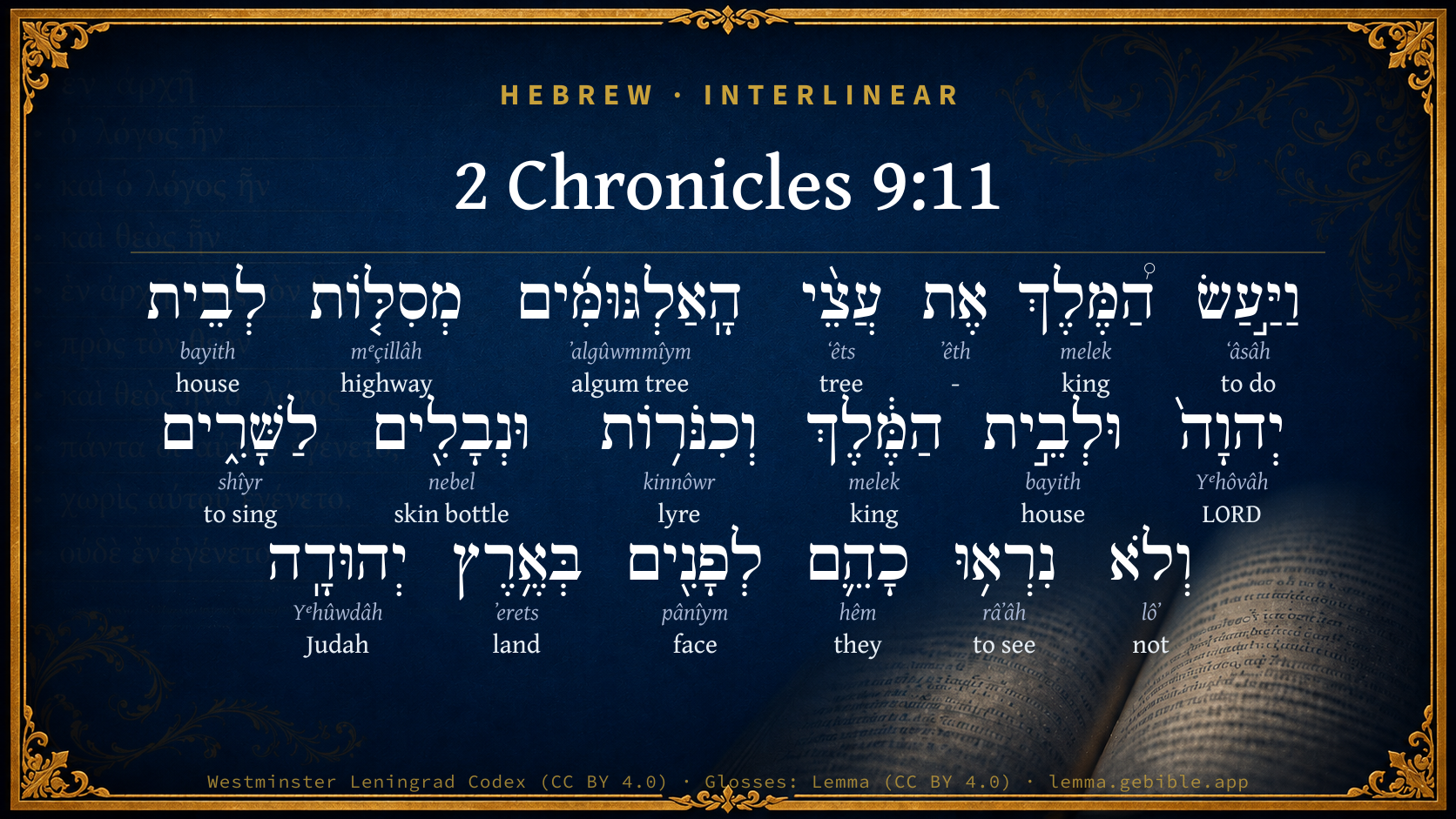
Hebrew (Westminster Leningrad Codex) 2 Chronicles 9:11 appears in the Hebrew Old Testament. The text above is from the Westminster Leningrad Codex. Each word links to its Strong’s number, a concise gloss, and parsing drawn from the Open Scriptures Hebrew Bible morphology. Click any word for its full Brown-Driver-Briggs (BDB) entry.
Download image
Cite this verse

2 Chronicles 9:11 (World English Bible). Public Domain. Lemma interlinear Bible study tool, https://lemma.gebible.app/v/2-chronicles/9/11.

Show BibTeX & RIS
BibTeX
RIS
English Translation
The king made of the algum trees terraces for the house of Yahweh, and for the king's house, and harps and psalteries for the singers: and there were none such seen before in the land of Judah.
World English Bible · Public Domain
Download a study sheet

One document with this verse’s original text, its word-by-word gloss line, the meaning frame, cross-references with their text, attributed commentary, and full source and license credits — printable, and it pastes into notes with its structure intact.

This verse Autodidact and up

Study sheet (.html) Plain text (.txt)

A passage Seminary Student

Up to 50 verses in one chapter. A passage sheet keeps up to 6 commentary sources and 12 cross-references per verse, in the order this page ranks them, and says so on the sheet whenever that leaves anything out. Ask for a single verse and you get the Autodidact verse sheet above.

Everything on this page stays free to read, with no account — the sheet is a download of what is already on screen, not access to it.

Want to remove ads? Support Godless Engineer
Compare translations 3

The same verse in 3 English versions, stacked beneath the original-language interlinear above. Click any original word for its lexicon entry.

Each is an independent rendering of the whole verse — the interlinear is not word-aligned to these translations.

Highlighted words mark where these versions differ — a whole-verse word diff, not a word-by-word alignment.

  • World English Bible Public Domain
    The king made of the algum trees terraces for the house of Yahweh, and for the king's house, and harps and psalteries for the singers: and there were none such seen before in the land of Judah.
  • King James Version Public Domain
    And the king made of the algum trees terraces to the house of the LORD, and to the king's palace, and harps and psalteries for singers: and there were none such seen before in the land of Judah.
  • unfoldingWord Literal Text CC BY-SA 4.0
    And the king made the algum wood into staircases for the house of Yahweh and for the house of the king, and lyres and harps for the singers. And there was not seen like them before in the land of Judah.

unfoldingWord Literal Text — © unfoldingWord, licensed CC BY-SA 4.0. Word-aligned USFM3 via Door43 (git.door43.org/unfoldingWord/en_ult).

Versions to compare (up to 4)

3 of 4 selected

Show all 18 translations

Every available English version of this verse, each an independent rendering of the whole verse.

  • World English Bible Public Domain
    The king made of the algum trees terraces for the house of Yahweh, and for the king's house, and harps and psalteries for the singers: and there were none such seen before in the land of Judah.
  • Berean Standard Bible Public Domain
    The king made the algum wood into steps for the house of the LORD and for the king’s palace, and into lyres and harps for the singers. Never before had anything like them been seen in the land of Judah.)
  • Majority Standard Bible Public Domain
    The king made the algum wood into steps for the house of the LORD and for the king’s palace, and into lyres and harps for the singers. Never before had anything like them been seen in the land of Judah.)
  • King James Version Public Domain
    And the king made of the algum trees terraces to the house of the LORD, and to the king's palace, and harps and psalteries for singers: and there were none such seen before in the land of Judah.
  • American Standard Version (1901) Public Domain
    And the king made of the algum-trees terraces for the house of Jehovah, and for the king's house, and harps and psalteries for the singers: and there were none such seen before in the land of Judah.
  • Revised Version (1885) Public Domain
    And the king made of the algum trees terraces for the house of the LORD, and for the king’s house, and harps and psalteries for the singers; and there were none such seen before in the land of Judah.
  • Geneva Bible (1599) Public Domain
    And the King made of the Algummim wood staires in the house of the Lord, and in the Kings house, and harpes and violes for singers: and there was no such seene before in the lande of Iudah.
  • Douay-Rheims (1899) Public Domain
    And the king made of the thyine trees stairs in the house of the Lord, and in the king's house, and harps and psalteries for the singing men: never were there seen such trees in the land of Juda.
  • Young's Literal Translation Public Domain
    And the king maketh the algum-trees staircases for the house of Jehovah, and for the house of the king, and harps and psalteries for singers; and there have been none seen like these before in the land of Judah.
  • Literal Standard Version CC BY-SA 4.0
    And the king makes the algum-trees [into] staircases for the house of YHWH, and for the house of the king, and harps and psalteries for singers; and there have been none seen like these before in the land of Judah.
  • Unlocked Literal Bible CC BY-SA 4.0
    With the algum wood, the king made steps for the house of Yahweh and for his house, as well as harps and lyres for the musicians. No wood like this had been seen before in the land of Judah.
  • unfoldingWord Literal Text CC BY-SA 4.0
    And the king made the algum wood into staircases for the house of Yahweh and for the house of the king, and lyres and harps for the singers. And there was not seen like them before in the land of Judah.
  • Darby Bible Public Domain
    And the king made of the sandal-wood stairs for the house of Jehovah, and for the king's house, and harps and lutes for the singers. And there were none such seen before in the land of Judah.)
  • World Messianic Bible Public Domain
    The king used algum tree wood to make terraces for the LORD’s house and for the king’s house, and harps and stringed instruments for the singers. There were none like these seen before in the land of Judah.
  • Webster's Bible Public Domain
    And the king made of the algum trees terraces to the house of the LORD, and to the king's palace, and harps and psalteries for singers: and there were none such seen before in the land of Judah.
  • Free Bible Version CC BY-SA 4.0
    The king used the algum wood to make steps for the Temple and for the royal palace, and into lyres and harps for the musicians. Nothing like them had ever been seen before in the land of Judah.)
  • Bible in Basic English Public Domain
    And with the sandal-wood the king made steps for the house of the Lord and for the king's house, and instruments of music for the makers of melody; never before had such been seen in the land of Judah.
  • JPS Tanakh (1917) Public Domain
    And the king made of the sandal-wood paths for the house of the LORD, and for the king's house, and harps and psalteries for the singers; and there were none such seen before in the land of Judah.

Literal Standard Version (2020), Covenant Press — licensed CC BY-SA 4.0. Text via the HelloAO Bible API (eBible.org). Unlocked Literal Bible (unfoldingWord) — licensed CC BY-SA 4.0. Text via the HelloAO Bible API (eBible.org). unfoldingWord Literal Text — © unfoldingWord, licensed CC BY-SA 4.0. Word-aligned USFM3 via Door43 (git.door43.org/unfoldingWord/en_ult). Free Bible Version, Dr. Jonathan Gallagher — licensed CC BY-SA 4.0. Text via the HelloAO Bible API (eBible.org).

Word by word

More ways to search: Search by grammar → Find every occurrence → Compare this word →

Practice this passage: Drill this verse → Learn its vocabulary →

הָֽאַלְגּוּמִּ֜ים
ʼalgûwmmîym
H418
“the · algum trees”
Particle, Definite Article + Noun, Common, Masculine, Plural, Absolute
Part of Speech
Particle + Noun
Type
Common
Gender
Masculine
Number
Plural
State
Absolute
Full BDB Definition

Origin: by transposition for H484

TWOT: 89b

a tree (from Lebanon), algum trees
  1. וַיַּ֣עַשׂ ʻâsâh H6213 “and · to do” Conjunction + Verb, Qal, Sequential Imperfect, 3rd Person, Masculine, Singular
  2. הַ֠מֶּלֶךְ melek H4428 “the · king” Particle, Definite Article + Noun, Common, Masculine, Singular, Absolute
  3. אֶת ʼêth H853 “-” Particle, Direct Object
  4. עֲצֵ֨י ʻêts H6086 “trees of” Noun, Common, Masculine, Plural, Construct
  5. מְסִלּ֤וֹת mᵉçillâh H4546 “highways” Noun, Common, Feminine, Plural, Absolute
  6. לְבֵית bayith H1004 “to/for · house of” Preposition + Noun, Common, Masculine, Singular, Construct
  7. יְהוָה֙ Yᵉhôvâh H3068 “LORD” Noun, Proper
  8. וּלְבֵ֣ית bayith H1004 “and · to/for · house of” Conjunction + Preposition + Noun, Common, Masculine, Singular, Construct
  9. הַמֶּ֔לֶךְ melek H4428 “the · king” Particle, Definite Article + Noun, Common, Masculine, Singular, Absolute
  10. וְכִנֹּר֥וֹת kinnôwr H3658 “and · lyres” Conjunction + Noun, Common, Masculine, Plural, Absolute
  11. וּנְבָלִ֖ים nebel H5035 “and · skin bottles” Conjunction + Noun, Common, Masculine, Plural, Absolute
  12. לַשָּׁרִ֑ים shîyr H7891 “to/for the · singing” Preposition, Determined + Verb, Qal, Participle Active, Masculine, Plural, Absolute
  13. וְלֹא lôʼ H3808 “and · not” Conjunction + Particle, Negative
  14. נִרְא֥וּ râʼâh H7200 “to see” Verb, Niphal, Perfect, 3rd Person, Common, Plural
  15. כָהֵ֛ם hêm H1992 “like/as · they” Preposition + Pronoun, Personal, 3rd Person, Masculine, Plural
  16. לְפָנִ֖ים pânîym H6440 “to/for · face(s)” Preposition + Noun, Common, Both, Plural, Absolute
  17. בְּאֶ֥רֶץ ʼerets H776 “in/at · land of” Preposition + Noun, Common, Both, Singular, Construct
  18. יְהוּדָֽה Yᵉhûwdâh H3063 “Judah” Noun, Proper

About this verse

These counts appear in no published source. They are computed here, from the morphology-tagged text and Lemma’s own curated glosses. What Lemma adds →

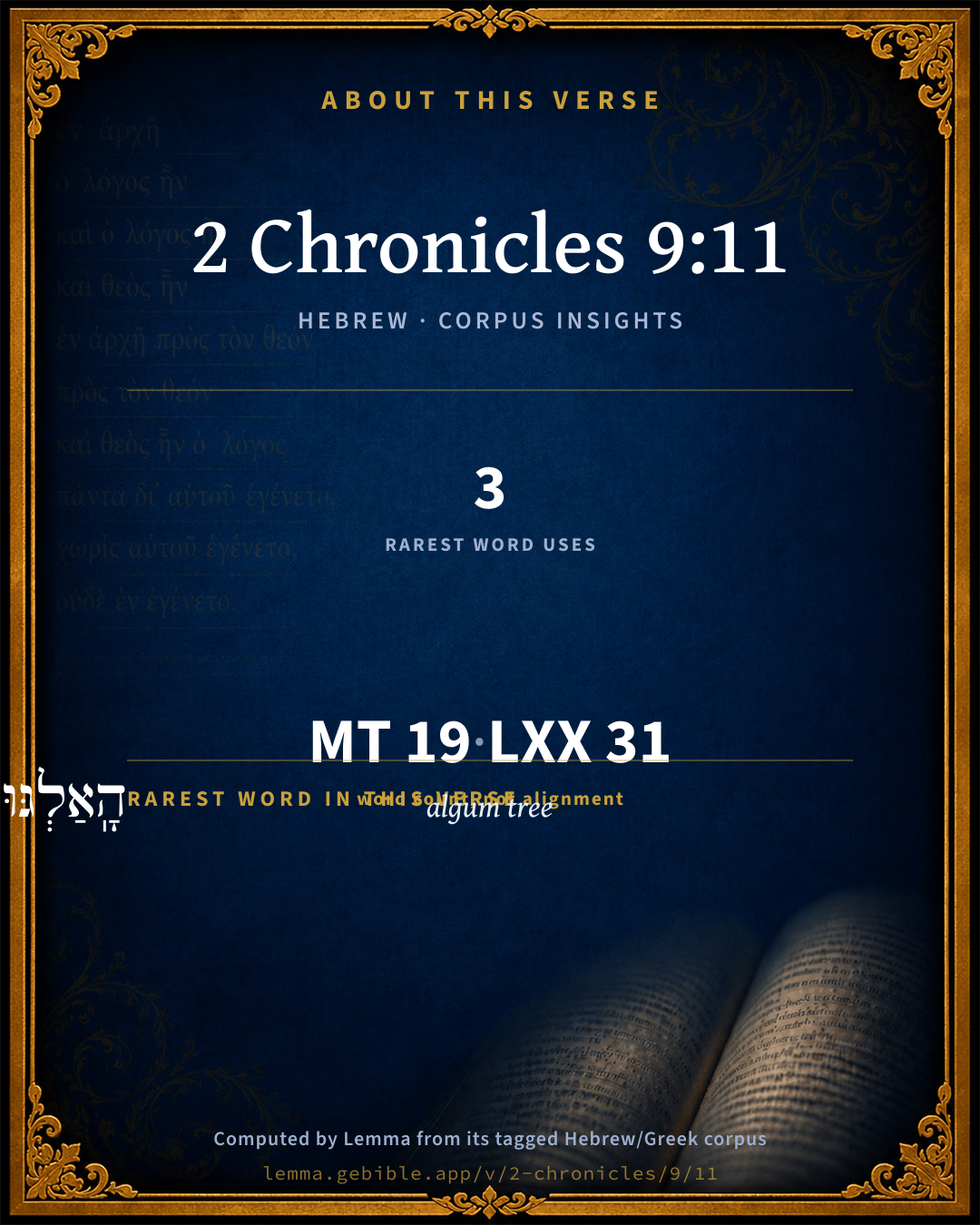
19
words
17
distinct lemmas
Historical
section

Notable vocabulary

The rarest word here is הָֽאַלְגּוּמִּ֜ים algum tree H418 — appearing just 3 times in the whole Hebrew Bible.

Shared distinctive vocabulary

הָֽאַלְגּוּמִּ֜ים algum tree H418 occurs in 3 verses of the Hebrew Bible. Also found in:

Grammatical profile

  • 3 verbs
  • 13 nouns
  • 1 pronoun
  • 2 particles

Verb forms

  • וַיַּ֣עַשׂ Qal · Sequential Imperfect
  • לַשָּׁרִ֑ים Qal · Participle Active
  • נִרְא֥וּ Niphal · Perfect

Repetition

Words recur within this verse — often emphatic in Hebrew:

  • הַ֠מֶּלֶךְ king H4428 ×2
  • לְבֵית house H1004 ×2

Hebrew & Septuagint length

In English translation the verse runs 37 words from the Hebrew and 38 from the Septuagint (LXX English) — closely comparable.

A rough comparison of the two English renderings, which tokenize alike — not a word-level alignment.

Word counts can differ between the Hebrew and the Greek without any difference in meaning — e.g. the Hebrew direct-object marker אֵת has no separate Greek word, and Greek often adds the article ὁ.

In the original languages it is 19 Hebrew tokens and 31 Greek tokens — but the two are counted differently (Hebrew bundles its prefixes and suffixes into one token; the Greek is in lemma form), so that isn’t a like-for-like length.

Cross-references

6

Topical passages linked to 2 Chronicles 9:11 in the Treasury of Scripture Knowledge — connected by theme and wording, ordered by reader-vote popularity; previews shown in the World English Bible.

  • 1 Kings 10:12 The king made of the almug trees pillars for the house of Yahweh, and for the king's house, harps also and psalteries for the singers: there came no such almug trees, nor were seen, to this day.
  • 1 Chronicles 23:5 and four thousand were doorkeepers; and four thousand praised Yahweh with the instruments which I made, [said David], for giving praise.
  • 1 Chronicles 25:1 Moreover, David and the captains of the host set apart for the service certain of the sons of Asaph, and of Heman, and of Jeduthun, who should prophesy with harps, with psalteries, and with cymbals: and the number of those who did the work according to their service was:
  • Psalms 92:1–3 It is a good thing to give thanks to Yahweh, To sing praises to your name, Most High;
  • Psalms 150:3–5 Praise him with the sounding of the trumpet! Praise him with harp and lyre!
  • Revelation 5:8 Now when he had taken the book, the four living creatures and the twenty-four elders fell down before the Lamb, each one having a harp, and golden bowls full of incense, which are the prayers of the saints.

Cross-references courtesy of OpenBible.info (CC BY 4.0).

Hebrew and Greek witnesses Masoretic Hebrew ↔ Greek Septuagint

The same verse in the two great witnesses to the Old Testament, shown verse-for-verse.

These are two independent witnesses, not word-aligned to each other, and the Septuagint is shown in lemma (dictionary) form.

Hebrew 2 Chronicles 9:11 Masoretic · Westminster Leningrad Codex

וַיַּ֣עַשׂ הַ֠מֶּלֶךְ אֶת עֲצֵ֨י הָֽאַלְגּוּמִּ֜ים מְסִלּ֤וֹת לְבֵית יְהוָה֙ וּלְבֵ֣ית הַמֶּ֔לֶךְ וְכִנֹּר֥וֹת וּנְבָלִ֖ים לַשָּׁרִ֑ים וְלֹא נִרְא֥וּ כָהֵ֛ם לְפָנִ֖ים בְּאֶ֥רֶץ יְהוּדָֽה

The king made of the algum trees terraces for the house of Yahweh, and for the king's house, and harps and psalteries for the singers: and there were none such seen before in the land of Judah.

World English Bible · Public Domain

Greek LXX 2 Chronicles 9:11 Septuagint · lemma form

καί ποιέω ὁ βασιλεύς ὁ ξύλον ὁ πεύκινος ἀνάβασις ὁ οἶκος κύριος καί ὁ οἶκος ὁ βασιλεύς καί κιθάρα καί νάβλα ὁ ᾠδός καί οὐ ὁράω τοιοῦτος ἔμπροσθεν ἐν γῆ ἰουδά

And the king made of the pine timber steps to the house of the Lord, and to the king's house, and harps and lutes for the singers: and such were not seen before in the land of Juda.

LXX2012 (modern English Septuagint) · Public Domain

On this verse, Ellicott's Commentary for English Readers discusses the Septuagint’s reading. Read the note in Commentary ↓

Hebrew: Westminster Leningrad Codex (CC BY 4.0). Greek: Septuagint (public domain); English from LXX2012 (modern English Septuagint) (Public Domain). How the Septuagint differs from the Hebrew →

Commentary

Notes on 2 Chronicles 9:11 from classic Christian and Jewish commentators (each source and its license shown beneath its notes). The classic Christian expositions comment on the surrounding passage and are grouped to its opening verse, so a note may address several verses; the Jewish commentaries on the Tanakh (Rashi and others) are per-verse, so they appear only where the commentator wrote on this verse.

Lemma curates 59 commentaries, every one of them public domain or Creative Commons licensed, each selected and text-cleaned for this edition rather than reprinted as found. About our sources →

Geneva Bible (1599)

Geneva Bible translators

Or pillars: meaning, the garnishing, and trimming of the stairs or pillars.

Geneva Bible (1599) marginal notes — public domain. Text via Bolls.life.

Ellicott's Commentary for English Readers

(11) Terraces.—M’sillôth, which usually means highways, that is, raised paths. The word is an interpretation of mis‘âd, which only occurs in 1Ki_11:12. LXX., ἀναβάσεις; Vulg., “gradus;” Arabic, “pillars.”

Singers.—The singers.

And there were none such seen before in the land of Judah.—A shortened paraphrase of, “There came no such almug trees, nor were seen unto this day” (Kings). “The land of Judah” is a phrase which indicates how utterly the northern kingdom was excluded from the redactor’s thought.

A Bible Commentary for English Readers, edited by Charles John Ellicott (1878–1897) — public domain. Text from a community e-Sword module.

The Cambridge Bible for Schools and Colleges

gen. ed. J. J. S. Perowne

11. terraces] Perhaps “raised paths.” In 1Ki_10:12 a different Heb. word is used, which means probably “railings” (“pillars,” A.V.).

psalteries] Cp. 1Ch_13:8 (note).

in the land of Judah] Here the Chronicler speaks as a man of his own age. We should expect, land of Israel.

The Cambridge Bible for Schools and Colleges (gen. ed. J. J. S. Perowne; Cambridge University Press, 1878–1918) — public domain. Text from a community e-Sword module.

Haydock's Catholic Bible Commentary

Stairs. Hebrew, "hands," (Du Hamel) or banisters, from the palace to the temple. (Junius)

George Leo Haydock (1774–1849), Haydock's Catholic Family Bible and Commentary, 1859 edition — public domain. Excludes Psalms (Douay-Rheims chapter numbering differs from Protestant) and Deuterocanonical books (Catholic canon only).

Rashi

Rabbi Shlomo Yitzchaki (Rashi)

a path מְסִלּוֹת, stairs. In I Kings (10:12) it is written מִסְעָד, [a support] after the manner that they make for those who ascend by way of elevated places and stairs. Some say that מִסְעָד and מְסִילָה are one and the same.

and harps and psalteries for the singers Some say (Jonathan and Rashi to Kings) for the Levites who sing with musical instruments, and Rabbi Eliezer explained it to mean: for the singers who stroll before the king. A similar case is (I Kings 5:12): “and his songs were a thousand and five.” These were secular songs that he composed to sing before him, and that is what is meant (below 35:25): “And Jeremiah lamented over Josiah, and all the male singers and the female singers recited in their lamentations, etc.”

Rashi on the Tanakh — English translations: “The Judaica Press complete Tanach with Rashi, translated by A. J. Rosenberg” (CC BY 4.0); “Pentateuch with Rashi's commentary by M. Rosenbaum and A.M. Silbermann, 1929-1934” (public domain); “The Metsudah Tanach series, Lakewood, N.J” (CC BY 4.0); and “The Book of Joshua, Metsudah Publications, 1997” (CC BY 4.0). Text via Sefaria.

Lesson kit

Teaching starters — assembled from the data on this page, not authored interpretation. Every prompt links to the verse data it draws on. Edit before teaching.

2 Chronicles, in the Historical, opens this verse with 19 words (17 distinct Hebrew lemmas). Its most distinctive word is ʼalgûwmmîym (“algum tree”). A historical commentator’s framing appears above. Read the whole chapter for the surrounding context.

Discussion questions

  1. What does “algum tree” (ʼalgûwmmîym) contribute to the verse as a whole?
  2. How does 2 Chronicles 2:8, which shares the word «algum tree», read alongside this verse?
  3. What does the repetition of “king” (2× in this one verse) do in this verse?
  4. These translations render this verse differently. What is at stake in choosing one wording over another?
  5. «וַיַּ֣עַשׂ» is a Qal Sequential Imperfect verb. How does that grammatical form shape the action described?
  6. Compare how Geneva Bible (1599) and Ellicott's Commentary for English Readers read this verse. Where do they agree or differ?

Things to notice

Reading settings

Reading text

Shown beneath each verse's original-language words.

Old Testament
Old Testament edition

Read the OT as the Masoretic Hebrew (MT) or the Greek Septuagint (LXX).

English shown for the Greek Septuagint (in the Hebrew ↔ Greek comparison).

Comparing translations? Open the Compare panel on any verse page to stack up to four side by side.