Revelation 11:3

Greek (Tischendorf 8th ed.) Revelation 11:3 appears in the Greek New Testament. The text above is from the Tischendorf 8th edition. Each word links to its Strong’s number and a concise gloss. Click any word for its full Thayer’s Greek Lexicon entry.
Download image
Cite this verse

Revelation 11:3 (World English Bible). Public Domain. Lemma interlinear Bible study tool, https://lemma.gebible.app/v/revelation/11/3.

Show BibTeX & RIS
BibTeX
RIS
English Translation
I will give power to my two witnesses, and they will prophesy one thousand two hundred sixty days, clothed in sackcloth."
World English Bible · Public Domain
Download a study sheet

One document with this verse’s original text, its word-by-word gloss line, the meaning frame, cross-references with their text, attributed commentary, and full source and license credits — printable, and it pastes into notes with its structure intact.

This verse Autodidact and up

Study sheet (.html) Plain text (.txt)

A passage Seminary Student

Up to 50 verses in one chapter. A passage sheet keeps up to 6 commentary sources and 12 cross-references per verse, in the order this page ranks them, and says so on the sheet whenever that leaves anything out. Ask for a single verse and you get the Autodidact verse sheet above.

Everything on this page stays free to read, with no account — the sheet is a download of what is already on screen, not access to it.

Want to remove ads? Support Godless Engineer
Compare translations 3

The same verse in 3 English versions, stacked beneath the original-language interlinear above. Click any original word for its lexicon entry.

Each is an independent rendering of the whole verse — the interlinear is not word-aligned to these translations.

Highlighted words mark where these versions differ — a whole-verse word diff, not a word-by-word alignment.

  • World English Bible Public Domain
    I will give power to my two witnesses, and they will prophesy one thousand two hundred sixty days, clothed in sackcloth."
  • King James Version Public Domain
    And I will give power unto my two witnesses, and they shall prophesy a thousand two hundred and threescore days, clothed in sackcloth.
  • unfoldingWord Literal Text CC BY-SA 4.0
    And I will grant to my two witnesses, and they will prophesy for 1,260 days, clothed in sackcloth.”

unfoldingWord Literal Text — © unfoldingWord, licensed CC BY-SA 4.0. Word-aligned USFM3 via Door43 (git.door43.org/unfoldingWord/en_ult).

Versions to compare (up to 4)

3 of 4 selected

Show all 19 translations

Every available English version of this verse, each an independent rendering of the whole verse.

  • World English Bible Public Domain
    I will give power to my two witnesses, and they will prophesy one thousand two hundred sixty days, clothed in sackcloth."
  • Berean Standard Bible Public Domain
    And I will empower my two witnesses, and they will prophesy for 1,260 days, clothed in sackcloth.”
  • Majority Standard Bible Public Domain
    And I will empower my two witnesses, and they will prophesy for 1,260 days, clothed in sackcloth.”
  • King James Version Public Domain
    And I will give power unto my two witnesses, and they shall prophesy a thousand two hundred and threescore days, clothed in sackcloth.
  • American Standard Version (1901) Public Domain
    And I will give unto my two witnesses, and they shall prophesy a thousand two hundred and threescore days, clothed in sackcloth.
  • Revised Version (1885) Public Domain
    And I will give unto my two witnesses, and they shall prophesy a thousand two hundred and threescore days, clothed in sackcloth.
  • Geneva Bible (1599) Public Domain
    But I wil giue power vnto my two witnesses, and they shall prophecie a thousande two hundreth and threescore dayes, clothed in sackcloth.
  • Douay-Rheims (1899) Public Domain
    And I will give unto my two witnesses, and they shall prophesy a thousand two hundred sixty days, clothed in sackcloth.
  • Young's Literal Translation Public Domain
    and I will give to My two witnesses, and they shall prophesy days, a thousand, two hundred, sixty, arrayed with sackcloth;
  • Literal Standard Version CC BY-SA 4.0
    and I will give to My two witnesses, and they will prophesy one thousand, two hundred, sixty days, clothed with sackcloth”;
  • Unlocked Literal Bible CC BY-SA 4.0
    I will give my two witnesses authority to prophesy for 1,260 days, clothed in sackcloth.”
  • unfoldingWord Literal Text CC BY-SA 4.0
    And I will grant to my two witnesses, and they will prophesy for 1,260 days, clothed in sackcloth.”
  • Darby Bible Public Domain
    And I will give [power] to my two witnesses, and they shall prophesy a thousand two hundred [and] sixty days, clothed in sackcloth.
  • World Messianic Bible Public Domain
    I will give power to my two witnesses, and they will prophesy one thousand two hundred sixty days, clothed in sackcloth.”
  • Webster's Bible Public Domain
    And I will give power to my two witnesses, and they shall prophesy a thousand two hundred and sixty days, clothed in sackcloth.
  • Free Bible Version CC BY-SA 4.0
    I will give my two witnesses power, and they will prophesy 1,260 days, dressed in sackcloth.”
  • Bible in Basic English Public Domain
    And I will give orders to my two witnesses, and they will be prophets for a thousand, two hundred and sixty days, clothed with haircloth.
  • Text-Critical English NT CC BY 4.0
    And I will give authority to my two witnesses, and they will prophesy for one thousand two hundred sixty days, clothed in sackcloth.”
  • Tyndale New Testament (1534) Public Domain
    And I will geve power vnto my two wytnesses and they shall prophesy.M.iic. and.lx. dayes clothed in sacke cloth.

Literal Standard Version (2020), Covenant Press — licensed CC BY-SA 4.0. Text via the HelloAO Bible API (eBible.org). Unlocked Literal Bible (unfoldingWord) — licensed CC BY-SA 4.0. Text via the HelloAO Bible API (eBible.org). unfoldingWord Literal Text — © unfoldingWord, licensed CC BY-SA 4.0. Word-aligned USFM3 via Door43 (git.door43.org/unfoldingWord/en_ult). Free Bible Version, Dr. Jonathan Gallagher — licensed CC BY-SA 4.0. Text via the HelloAO Bible API (eBible.org).

Word by word

More ways to search: Search by grammar → Find every occurrence → Compare this word →

Practice this passage: Drill this verse → Learn its vocabulary →

σάκκους
sákkos
G4526
“sack”
Noun, Accusative, Plural, Masculine
Part of Speech
Noun
Case
Accusative
Number
Plural
Gender
Masculine
Full Thayer's Definition

Origin: of hebrew origin H8242

TDNT: 07:57,0

1. a sack a. a receptacle for holding or carrying various things, as money, food, etc. b. a course cloth, a dark course stuff made especially from the hair of animals c. a garment of the like material, and clinging to the person like a sack, which was wont to be worn (or drawn over the tunic instead of the cloak or mantle) by mourners, penitents, suppliants and also by those who like the Hebrew prophets, lead an austere life
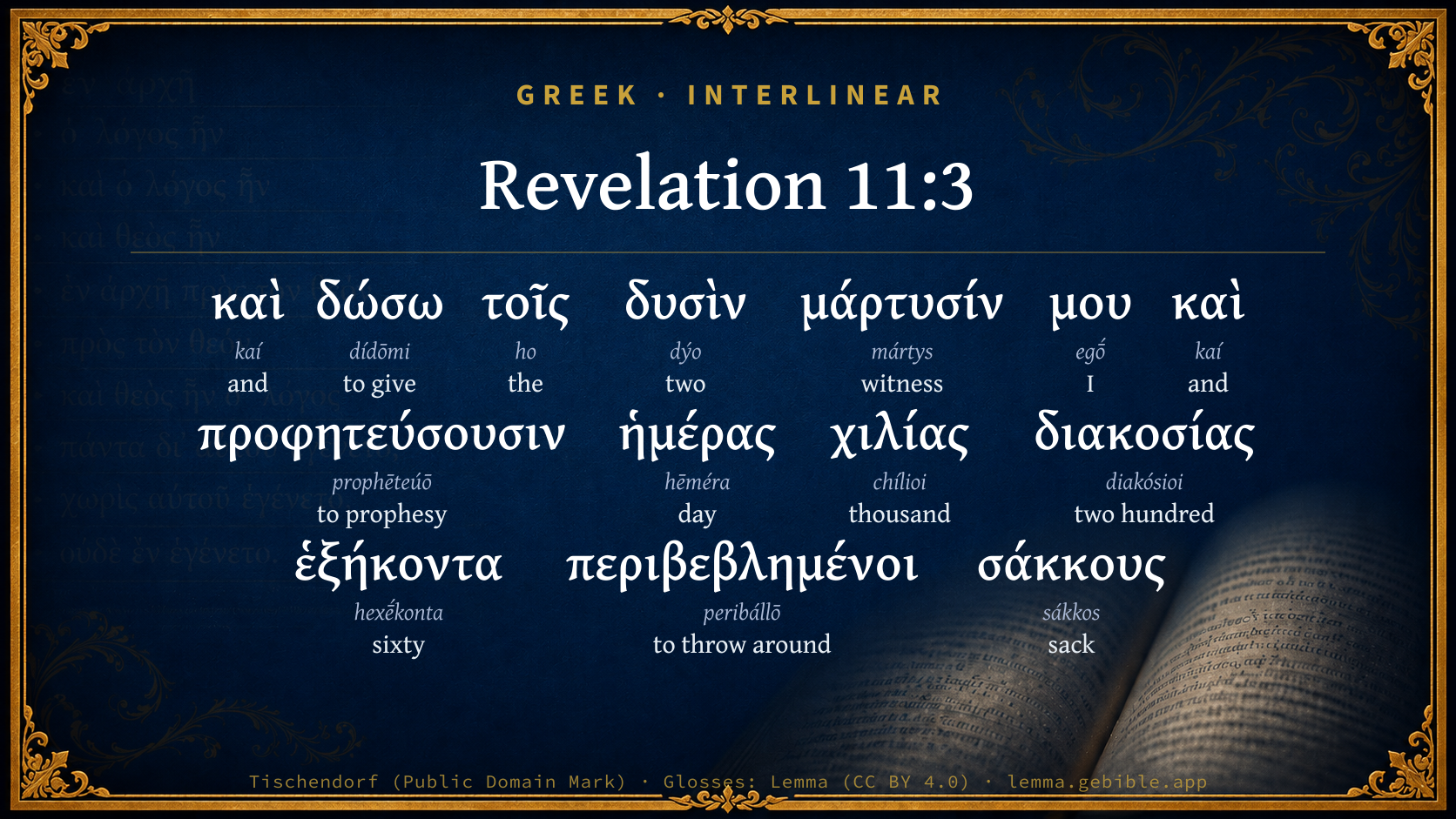
  1. καὶ kaí G2532 “and” Conjunction
  2. δώσω dídōmi G1325 “to give” Verb, Future, Active, Indicative, 1st person, Singular
  3. τοῖς ho G3588 “the” Article, Dative, Plural, Masculine
  4. δυσὶν dýo G1417 “two” Adjective, Dative, Plural, Masculine
  5. μάρτυσίν mártys G3144 “witness” Noun, Dative, Plural, Masculine
  6. μου egṓ G1473 “I” Personal pronoun, 1st person, Genitive, Singular
  7. καὶ kaí G2532 “and” Conjunction
  8. προφητεύσουσιν prophēteúō G4395 “to prophesy” Verb, Future, Active, Indicative, 3rd person, Plural
  9. ἡμέρας hēméra G2250 “day” Noun, Accusative, Plural, Feminine
  10. χιλίας chílioi G5507 “thousand” Adjective, Accusative, Plural, Feminine
  11. διακοσίας diakósioi G1250 “two hundred” Adjective, Accusative, Plural, Feminine
  12. ἑξήκοντα hexḗkonta G1835 “sixty” Adjective, Numeral (indeclinable)
  13. περιβεβλημένοι peribállō G4016 “to throw around” Verb, Perfect, Passive, Participle, Nominative, Plural, Masculine

About this verse

These counts appear in no published source. They are computed here, from the morphology-tagged text and Lemma’s own curated glosses. What Lemma adds →

14
words
13
distinct lemmas
Revelation
section

Notable vocabulary

The rarest word here is σάκκους sack G4526 — appearing just 4 times in the whole Greek New Testament.

Shared distinctive vocabulary

σάκκους sack G4526 occurs in 4 verses of the Greek New Testament. Also found in:

Repetition

A word recurs within this verse:

Cross-references

28

Topical passages linked to Revelation 11:3 in the Treasury of Scripture Knowledge — connected by theme and wording, ordered by reader-vote popularity; previews shown in the World English Bible.

  • Revelation 12:6 The woman fled into the wilderness, where she has a place prepared by God, that there they may nourish her one thousand two hundred sixty days.
  • Revelation 11:2 Leave out the court which is outside of the temple, and don't measure it, for it has been given to the gentiles. They will tread the holy city under foot for forty-two months.
  • Deuteronomy 19:15 One witness shall not rise up against a man for any iniquity, or for any sin, in any sin that he sins: at the mouth of two witnesses, or at the mouth of three witnesses, shall a matter be established.
  • Revelation 13:5 A mouth speaking great things and blasphemy was given to him. Authority to make war for forty-two months was given to him.
  • Genesis 37:34 Jacob tore his clothes, and put sackcloth on his loins, and mourned for his son many days.
  • Isaiah 22:12 In that day did the Lord, Yahweh of Hosts, call to weeping, and to mourning, and to baldness, and to girding with sackcloth:
  • Luke 24:48 You are witnesses of these things.
  • Acts 1:8 But you will receive power when the Holy Spirit has come upon you. You will be witnesses to me in Jerusalem, in all Judea and Samaria, and to the uttermost parts of the earth."
  • Acts 13:31 and he was seen for many days by those who came up with him from Galilee to Jerusalem, who are his witnesses to the people.
  • Numbers 11:26 But there remained two men in the camp, the name of the one was Eldad, and the name of the other Medad: and the Spirit rested on them; and they were of those who were written, but had not gone out to the Tent; and they prophesied in the camp.
  • 1 Chronicles 21:16 David lifted up his eyes, and saw the angel of Yahweh standing between earth and the sky, having a drawn sword in his hand stretched out over Jerusalem. Then David and the elders, clothed in sackcloth, fell on their faces.
  • Esther 4:1–2 Now when Mordecai knew all that was done, Mordecai tore his clothes, and put on sackcloth with ashes, and went out into the midst of the city, and cried with a loud and a bitter cry;
  • Job 16:15 I have sewed sackcloth on my skin, And have thrust my horn in the dust.
  • Lamentations 2:10 The elders of the daughter of Zion sit on the ground, they keep silence; They have cast up dust on their heads; they have girded themselves with sackcloth: The virgins of Jerusalem hang down their heads to the ground.
  • Daniel 12:7 I heard the man clothed in linen, who was above the waters of the river, when he held up his right hand and his left hand to heaven, and swore by him who lives forever that it shall be for a time, times, and a half; and when they have made an end of breaking in pieces the power of the holy people, all these things shall be finished.
  • John 15:27 You will also testify, because you have been with me from the beginning.
  • Acts 2:32 This Jesus God raised up, to which we all are witnesses.
  • 2 Corinthians 13:1 This is the third time I am coming to you. "At the mouth of two or three witnesses shall every word established."
  • Deuteronomy 17:6 At the mouth of two witnesses, or three witnesses, shall he who is to die be put to death; at the mouth of one witness he shall not be put to death.
  • Matthew 18:16 But if he doesn't listen, take one or two more with you, that at the mouth of two or three witnesses every word may be established.
  • Acts 3:15 and killed the Prince of life, whom God raised from the dead, to which we are witnesses.
  • Revelation 1:5 and from Jesus Christ, the faithful witness, the firstborn of the dead, and the ruler of the kings of the earth. To him who loves us, and washed us from our sins by his blood;
  • Revelation 19:10 I fell down before his feet to worship him. He said to me, "Look! Don't do it! I am a fellow bondservant with you and with your brothers who hold the testimony of Jesus. Worship God, for the testimony of Jesus is the Spirit of Prophecy."
  • John 3:5–8 Jesus answered, "Most assuredly I tell you, unless one is born of water and spirit, he can't enter into the Kingdom of God!
  • John 3:27 John answered, "A man can receive nothing, unless it has been given him from heaven.
  • 1 Corinthians 12:28 God has set some in the assembly: first apostles, second prophets, third teachers, then miracle workers, then gifts of healings, helps, governments, and various kinds of languages.
  • Ephesians 4:11 He gave some to be apostles; and some, prophets; and some, evangelists; and some, shepherds and teachers;
  • Revelation 20:4 I saw thrones, and they sat on them, and judgment was given to them. I saw the souls of those who had been beheaded for the testimony of Jesus, and for the word of God, and such as didn't worship the beast nor his image, and didn't receive the mark on their forehead and on their hand. They lived, and reigned with Christ for the thousand years.

Cross-references courtesy of OpenBible.info (CC BY 4.0).

Commentary

Notes on Revelation 11:3 from classic Christian and Jewish commentators (each source and its license shown beneath its notes). The classic Christian expositions comment on the surrounding passage and are grouped to its opening verse, so a note may address several verses; the Jewish commentaries on the Tanakh (Rashi and others) are per-verse, so they appear only where the commentator wrote on this verse.

Lemma curates 59 commentaries, every one of them public domain or Creative Commons licensed, each selected and text-cleaned for this edition rather than reprinted as found. About our sources →

Albert Barnes' Notes on the Bible

And I will give power unto my two witnesses - In respect to this important passage Rev 11:3-13 I propose to pursue the same method which I have pursued all along in this exposition: first, to examine the meaning of the words and phrases in the symbol, with a purpose to ascertain the fair signification of the symbols; and, secondly, to inquire into the application - that is, to inquire whether any events have occurred which, in respect to their character and to the time of their occurrence, can be shown to be a fair fulfillment of the language.

And I will give power - The word “power” is not in the original. The Greek is simply, “I will give” - that is, I will grant to my two witnesses the right or the power of prophesying during the time specified - correctly expressed in the margin, “give unto my two witnesses that they may prophesy.” The meaning is not that he would send two witnesses to prophesy, but rather that these were in fact such “witnesses,” and that he would during that time permit them to exercise their prophetic gifts, or give them the privilege and the strength to enunciate the truth which they were commissioned to communicate as his “witnesses” to mankind. Some word, then, like “power, privilege, opportunity, or boldness,” it is necessary to supply in order to complete the sense.

Unto my two witnesses - The word “two” evidently denotes that the number would be small; and yet it is not necessary to confine it literally to two persons, or to two societies or communities. Perhaps the meaning is, that as, under the law, two witnesses were required, and were enough, to establish any fact (notes on Joh 8:17), such a number would during those times be preserved from apostasy as would be sufficient to keep up the evidence of truth; to testify against the prevailing abominations, errors, and corruptions; to show what was the real church, and to bear a faithful witness against the wickedness of the world. The law of Moses required that there should be two witnesses on a trial, and this, under that law, was deemed a competent number. See Num 35:30; Deu 17:6; Deu 19:15; Mat 18:16; Joh 5:30-33. The essential meaning of this passage then is, that there would be “a competent number” of witnesses in the case; that is, as many as would be regarded as sufficent to establish the points concerning which they would testify, with perhaps the additional idea that the number would be small.

There is no reason for limiting it strictly to two persons, or for supposing that they would appear in pairs, two and two; nor is it necessary to suppose that it refers particularly to two people or nations. The word rendered “witnesses” - μάρτυρί marturi - is that from which we have derived the word “martyr.” It means properly one who bears testimony, either in a judicial sense Mat 18:16; Mat 26:65, or one who can in any way testify to the truth of what he has seen and known, Luk 24:48; Rom 1:9; Phi 1:8; 1Th 2:10; 1Ti 6:12. Then it came to be employed in the sense in which the word “martyr” is now - to denote one who, amidst great sufferings or by his death, bears witness to the truth; that is, one who is so confident of the truth, and so upright, that he will rather lay down his life than deny the truth of what he has seen and known, Act 22:20; Rev 2:13. In a similar sense it comes to denote one who is so thoroughly convinced on a subject that it is not susceptible of being seen and heard, or who is so attached to one that he is willing to lay down his life as the evidence of his conviction and attachment. The word, as used here, refers to those who, during this period of “forty and two months,” would thus be witnesses for Christ in the world; that is, who would bear their testimony to the truth of his religion, to the doctrines which he had revealed, and to what was required of man - who would do this amidst surrounding error and corruption, and when exposed to persecutions and trials on account of their belief. It is not uncommon in the Scriptures to represent the righteous as witnesses for God. See the notes on Isa 43:10, Isa 43:12; Isa 44:8.

And they shall prophesy - The word “prophesy” does not necessarily mean that they would predict future events; but the sense is, that they would give utterance to the truth as God had revealed it. See the notes on Rev 10:11. The sense here is, that they would in some public manner hold up or maintain the truth before the world.

A thousand two hundred and threescore days - The same period as the forty and two months Rev 11:2, though expressed in a different form. Reckoning a day for a year, this period would be twelve hundred and sixty years, or the same as the “time and times and the dividing of time” in Dan 7:25. See the notes on that place; also Editor’s Preface. The meaning of this would be, therefore, that during that long period, in which it is said that “the holy city would be trodden under foot,” there would be those who might be properly called “witnesses” for God, and who would be engaged in holding up his truth before the world; that is, there would be no part of that period in which there would not be found some to whom this appellation could with propriety be given. Though the “holy city” - the church - would seem, to be wholly trodden down, yet there would be a few at least who would assert the great doctrines of true godliness.

Clothed in sackcloth - Sackcloth - σάκκους sakkous - was properly a coarse black cloth commonly made of hair, used for sacks, for straining, and for mourning garments. See the Rev 6:12 note; Isa 3:24 note; and Mat 11:21 note. Here it is an emblem of mourning; and the idea is, that they would prophesy in the midst of grief. This would indicate that the time would be one of calamity, or that, in doing this, there would be occasion for their appearing in the emblems of grief, rather than in robes expressive of joy. The most natural interpretation of this is, that there would be but few who could be regarded as true witnesses for God in the world, and that they would be exposed to persecution.

Albert Barnes' Notes on the Bible (1834–1885) — public domain. Text from a community e-Sword/MySword module.

The Biblical Illustrator

Joseph S. Exell

Rev_11:3-13

I will give power unto My two witnesses.

The preacher a witness and a prophet

1. The prophecy under consideration gives us an undeniable evidence of the Divinity and truth of the gospel.

2. The prophecy under consideration assures us of the continuance of the gospel ministry.

3. We are here taught what is the character of Christs approved ministers, and what are the duties which he requires of them.

(1) They, as witnesses, are to bear testimony to the gospel by professing their own faith in it, by exhibiting the evidences of its Divinity, by defending it against the cavils of unbelievers, by exemplifying the virtues of it in their conversation, and by sacrificing in its cause their worldly interest, and even their lives, if occasion should require.

(2) They, as prophets, must preach the Word with plainness of speech, adapting themselves to common capacities: they must speak with demonstration of the Spirit and with power, commending themselves to every mans conscience in the sight of God: they must declare the whole counsel of God, however disgustful any part of it may be to vicious and corrupt minds: they must reprove prevailing iniquities, and confute licentious errors, whoever may practise the former or patronise the latter.

4. This prophecy teaches us that in times of prevailing infidelity and corruption there is always a pointed opposition to the ministers of the gospel. If men wish to exterminate the religion of Christ, they will first oppose the means of its support; and of these one of the chief is a learned and godly ministry.

5. We are taught in this prophecy from Whence arises the enmity of wicked men against the stated launchers of religion. St. John says that when the witnesses shall be slain, they who dwell on earth shall rejoice over them, because these two prophets tormented them. How did these prophets torment them? Not by persecution; for they possessed neither the power nor the authority to persecute; but merely by proclaiming those solemn truths which condemn the practice, expose the guilt, and announce the punishment of irreclaimable sinners.

6. Another observation which here presents itself to us is that the Christian Church is meek, humble, and peaceable. So she is represented in this prophecy. She suffers persecution from her enemies, but does not persecute them in return. Her deliverances are effected by the hand of God, not by her own hand. The main instruments of her defence are the excellency of her religion, the purity of her works, and the fervour of her prayers. These weapons of her warfare have proved mighty through God to confound the devices and defeat the power of those who sought her overthrow.

7. We are taught the great efficacy of the prayers of good men. (J. Lathrop, D. D.)

The two witnesses

I. The character of the two witnesses. The two witnesses are the Son and Spirit of God; the doctrines of their Divinity, or, more particularly, the justifying righteousness of the one, and the regenerating influence of the other.

1. These are the two principal witnesses of God in the Church. They are witnesses of the highest credibility, and to whom alone God would commit His cause. They are best qualified to give evidence upon a subject in all the particulars of which they have been personally concerned. They are the parties to whose care the whole affairs of the Church have been officially consigned. They alone are acquainted with the whole mind and will of God.

2. They are frequently spoken of as witnesses for God in other parts of the Scripture (Isa_7:14; Isa_55:4; Joh_5:31-32; Joh_15:26; 2Co_1:22; Heb_10:14-15; 1Jn_5:6-10; 1Jn_5:20, etc.).

3. This view of the two witnesses is sustained by the preceding allusion. Their emblems are water and blood. In the court of the temple are the water and the blood. Here are the altar of burnt-offering and the brazen sea; or, in other words, the water and the blood. These are the only furniture of the court. The altar is between the entrance to the court and the brazen sea; and the brazen sea is between the altar and the door of the tabernacle. None without passing by these could enter the holy place.

4. The two witnesses we have named agree with their denomination as prophets. The claim of the Son and the Spirit to the title of the two prophets of God in the Church, above all others, is substantiated by these two Scripture declarations: No man hath seen God at any time; the only begotten Son which is in the bosom of the Father, He hath declared Him, and, When He the Spirit of truth is come, He will guide you into all truth.

5. Our selection of these witnesses accords with the metaphorical illustration of them in the fourth verse. They are the olive trees from which, and the golden pipes through which, the oil of grace is supplied to the Church of God. These olive trees are represented to John as still standing before the God of the earth. Are they not then He who is the same yesterday, and to-day, and for ever, and the Spirit of Christ which testified beforehand the sufferings of Christ and the glory that should follow?

II. The rejection of these witnesses. And I will give unto My two witnesses, and they shall prophesy, clothed in sackcloth. (G. Rogers.)

The continuous witness

The Lord calls forth His faithful witnesses, and makes promise that their voice and testimony shall not be silenced, even though the holy city be trodden underfoot. Mark--

I. The unfailing testimony. Throughout the entire period during which the usurping worldly power shall oppress and tread down the adherents to the truth, the voice of testimony is heard. It cannot be silenced. Forty and two months is the holy city trodden underfoot; a thousand two hundred and three score days do the witnesses prophesy. Not any particular two; but the confirmatory two. The number may be minished; but the voice is clear. One herald is sufficient to make a proclamation.

II. The painfulness of witnessing against evil and threatening judgment is but too obvious. The witnesses prophesy, clothed in sackcloth. So must all who stand in opposition to evil find the painful bitterness of their sad duty.

III. The divine defence of the witnesses. If any man desireth to hurt them, fire proceedeth out of their mouth. The Lord defends His witnesses; His anointed must not be touched. The word of their mouth is itself a penetrating sword of flame; nor can the adversaries of truth escape those external judgments which fire always represents, and which the God of truth uses for the punishment of evildoers, This is further seen in--

IV. Their punitive power. But it is of a nature correspondent to the entire character of the gospel. They shut up heaven. Sad indeed is it for them who stay the holy work of the heavenly witnesses. For if their work be hindered it is as the shutting up of the heavens--no spiritual rain, no teaching. The world is the sufferer. The loss is unspeakable. By the removal of the earth-preserving salt--the Word--a plague is brought upon the earth. Alas! though the testimony is continuous through all the time of the worldly oppression, yet the witnesses are finally slain! Here the vision may be for the comfort of the witnesses to the truth themselves. And we reflect--

V. Upon their temporary destruction and final triumph. They are slain, and so far the world triumphs. So it did with the one faithful and true Witness. Or we may see here a temporary triumph of the evil worldly spirit, and the final supremacy of the truth. Probably the former. But in either case the faithful witnesses to the truth are assured in this, as in many other ways, of the final reward to their fidelity and the final triumph over them who make them their foes. (R. Green.)

The two witnesses, their testimony

I. Why the saints and people of God are called witnesses. Because it is their work and business to bear witness to the truths and ways of Christ, in opposition to the ways of antichrist. This is the work that we are born for: For this cause, saith Christ, was I born, and for this cause came I into the world, that I might bear witness unto the truth. This is the work of our generation, witness-bearing to the truths of Christ in opposition to the ways of antichrist, in anti-christian times. You will say, What shall I do that I may be found faithful in this witness-bearing; what shall I do that I may witness a good confession in these days of ours? Something by way of rule. Be sure that your testimonies do agree. Though there be a hundred witnesses about a business, if their witness does not agree it will be of little worth. And now so it is, Christs witnesses this day are divided into many opinions and persuasions, but they may agree in the main for Christ, they may all agree in opposition unto antichrist. If then you would have your witness valid and good, labour, you that are the witnesses, for unity in your testimony. Again, if you would witness a good confession in these days of ours, then you must be willing to own the truth of Christ, to own it whensoever you are called thereunto. It is said, our Saviour Christ He witnessed a good confession before Pontius Pilate. Pray what kind of witness was it? Was it any long confession, or large? No; but the manner of it was this: when they called Him before them to give an account of any fact, He left them to prove it. When they called Him to give an account of the doctrine that He held, Art thou the King of the Jews? then He owned it. He left them to prove the fact, and He owned the truth; so should we do. If you would witness a good confession in these days of ours, then you must be willing also for to suffer for the truth of Christ. Those that cannot suffer for the truth of Christ and run the hazard of a suffering, they cannot bear their witness fully. See how they go together in Rev_13:10. If you would witness a good confession, then take heed that when you have borne your testimony you do nothing that may revoke the same, either directly or by consequence. Thus by way of rule. And now by way of means. If you would be faithful in bearing your testimony, in bearing witness to the truths of Christ in opposition to the ways of antichrist, observe what the root is that a good confession grows upon, and labour for to strengthen that. Now what is the root that a good confession grows upon, but faith working by love? Labour in the work of self-denial, and use yourself now to deny yourself. In the next place, take heed that you be not scared too much with the scarecrows of the times, but go to God for boldness, that you may be emboldened with the boldness of the Holy Ghost.

II. But then what are these witnesses more expressly in regard of their number, and in regard of their quality? In regard of their number they are two: And I will give power unto My two witnesses. Two is but a few, and yet it is enough to bear witness, for out of the mouths of two or three witnesses shall every word be established. Two, a few, and yet enough. The note is this: Christ will always have enough to bear witness to His truth in the darkest times. But then as for their qualification, For their quality: These are the two olive trees, at Rev_13:4. If you look into Zechariah, from whence this is taken, you will find the two olive trees are the godly magistrates and ministers, by whose assistance the golden oil is emptied into the candlesticks and lamps. But what are the two candlesticks? Our Saviour tells you that the seven golden candlesticks are the seven Churches. They were seven; now in anti-christian times reduced to a lesser company, two candlesticks. Though, as I said before. Christ will lose none in the latter times, yet in anti-christian times reduced unto two. These are the two candlesticks. Christ tells you the candlesticks are the Churches; so then put this together. Would you know what these two olive trees are, and the two candlesticks? They are the godly magistrate and godly minister in conjunction with the saints of God and Churches of Christ. Here we may see who those are that are fit to bear witness of Christ in anti-christian times, to bear their testimony. They are to be a fruitful, profitable people, and a lightsome people, that can hold forth light unto others in some measure.

III. In sackcloth; What is that? If you ask what this sackcloth means, it represents the sad and afflicted condition that the saints and people of God shall be in in anti-christian times. Is it not a sad thing for the saints to be persecuted to the very gates of Zion? And if Christs witnesses shall be in sackcloth 1,260 years, will not you be contented to be in sackcloth three or four years?

IV. Prophesy--what is that, and how did it come to pass that they shall prophesy in the time of their sackcloth? Prophesy--what is that? Why prophesying is sometimes taken in Scripture for the revelation of the mind of God, whereby a man doth foretell things to come. Prophesy is taken for a declaring and making known of the mind and will of God. For, I pray, do but mark, this their prophesying and witness-bearing seems to be all one. I will give power unto My two witnesses, and they shall prophesy in sackcloth. I will give power to them; they shall have their orders to preach from Myself; they shall have power from Me to preach, and to prophesy, and to bear their testimony.

V. But then what is the defence and guard that these witnesses have, whereby they are guarded and defended in their prophesying? The text saith, If any man will hurt them, fire proceedeth out of their mouth and devoureth their enemies. What then is this fire that proceeds out of the mouth of the witnesses but the devouring judgments of God, whereby the enemies of Gods people are destroyed by the prayers and threatenings of the people of God that come out of their mouth.

VI. What are the great things that these witnesses will do in the end of the days of their prophesying and of their sackcloth? These have power to smite the earth with all plagues, as often as they will. (W. Bridge, M. D.)

The Biblical Illustrator, edited by Joseph S. Exell (c. 1880s–1900s) — public domain. Text from a community e-Sword module.

Joseph Benson's Commentary

Rev 11:3-6. And I will give power unto my two witnesses — Here God promises to raise up some true and faithful witnesses to preach and protest against the innovations and inventions which he foresaw would corrupt Christianity, especially in the western parts of Europe. “Of these witnesses,” says Bishop Newton, “there should be, though but a small, yet a competent number; and it was a sufficient reason for making them two witnesses, because that is the number required by the law, and approved by the gospel, Deu 19:15; Mat 18:16; and upon former occasions two have often been joined in commission, as Moses and Aaron in Egypt, Elijah and Elisha in the apostacy of the ten tribes, and Zerubbabel and Joshua after the Babylonish captivity, to whom these witnesses are particularly compared. Our Saviour himself sent forth his disciples, (Luk 10:1,) two and two; and it hath been observed also that the principal reformers have usually appeared, as it were, in pairs; as the Waldenses and Albigenses, John Huss and Jerome of Prague, Luther and Calvin, Cranmer and Ridley, and their followers. Not that I conceive that any two particular men, or two particular churches, were intended by this prophecy; but only that there should be some in every age, though but a few in number, who should bear witness to the truth, and declare against the iniquity and idolatry of their times. They should not be discouraged even by persecution and oppression, but, though clothed in sackcloth, and living in a mourning and afflicted state, should yet prophesy — Should yet preach the sincere word of God, and denounce the divine judgments against the reigning idolatry and wickedness: and this they should continue to do, as long as the grand corruption itself should last, for the space of twelve hundred and sixty days, which is the same space of time with the forty and two months, before mentioned, the period assigned for the tyranny and idolatry of the Church of Rome. The witnesses, therefore, cannot be any two men, or any two churches, but must be a succession of men, and a succession of churches.”

A character is then given of these witnesses, and of the power and effect of their preaching. These are the two olive-trees, and the two candlesticks, &c., Rev 11:4 — That is, they, like Zerubbabel and Joshua, (Zechariah 4.,) are the great instructers and enlighteners of the church. Fire proceedeth out of their mouth, and devoureth their enemies, Rev 11:5 — That is, they are like unto Moses and Elijah, (Numbers 16.; 2 Kings 1.,) who called for fire upon their adversaries. But their fire was real, this is symbolical, and proceedeth out of the mouth of the witnesses, denouncing the divine vengeance on the corrupters and opposers of true religion; much in the same manner as it was said to Jeremiah, (Jer 5:14,) I will make my words in thy mouth fire, and this people wood, and it shall devour them. These have power to shut heaven, that it rain not, &c., Rev 11:6 — That is, they are like Elijah, who foretold a want of rain in the days of Ahab, (1Ki 17:1; Jas 5:17,) and it rained not on the earth for the space of three years and six months, which, mystically understood, is the same space of time as the forty and two months, and the twelve hundred and sixty days, which are allotted for the prophesying of the witnesses. During this time the divine protection and blessing shall be withheld from those men who neglect and despise their preaching and doctrine. They have also power over the waters, &c. — That is, they are like Moses and Aaron, who inflicted these plagues on Egypt; and they may be said to smite the earth with the plagues which they denounce; for, in Scripture language, the prophets are often said to do those things which they declare and foretel. But it is most highly probable that these particulars will receive a more literal accomplishment when the plagues of God, and the vials of his wrath (chap. 16.) shall be fully poured out upon men, in consequence of their having so long resisted the testimony of the witnesses. Their cause and the cause of truth will finally be avenged on all their enemies.

Joseph Benson's Commentary on the Old and New Testaments (1811–1818) — public domain. Text from a community e-Sword module.

Whedon's Commentary on the Bible

Daniel D. Whedon

b. The martyr two witnesses=the faithful few, Rev_11:3-6.

3. Give power—It was to be expected that in the midst of Gentiles these witnesses would hush in silence. Their enemies are thousands, and they are but two. But they have the “gift of power,” and their prophecy will ring through the streets of the city through the whole long, dark period. My— The word implies that the speaker is God, and that these witnesses are claimed as his own. See note Rev_11:1. Hence this word is incorrectly quoted by Dusterdieck as an instance in which an angel abruptly speaks the words of God as his own, as a precedent for such an interpretation of Rev_22:10, where see note.

Prophesy—All true preaching is prophecy, for it predicts man’s future destiny, and comes from a divine power. The whole gospel is a solemn prophecy.

Clothed in sackcloth— An emblematic garb, symbolizing humiliation and grief, especially of the repentant kind. Hence it was worn by the prophets who preached repentance to a guilty generation. The garment represented the humiliation which the sins of the age required. It was usually made of coarse hair. and used for sacks, and also for straining out liquids. Elijah and John the Baptist wore sackcloth. 2Ki_1:8.

Daniel D. Whedon (gen. ed.), Commentary on the Old and New Testaments (1874–1909) — public domain. Text from a community e-Sword module.

Tyndale Open Study Notes

Tyndale Open Resources

11:3 During the period of persecution, God will not abandon the world but will send his two witnesses to proclaim the coming judgment, just as God sent Jonah to Nineveh (Jon 1:2; 4:11). • Clothing made of burlap was symbolic of mourning or repentance (see Gen 37:34; 2 Sam 3:31; Neh 9:1; Esth 4:1; Jon 3:6).

Tyndale Open Study Notes — © Tyndale Open Resources, licensed CC BY-SA 4.0. Text via the HelloAO Bible API.

Bengel's Gnomon

Johann Albrecht Bengel

Rev 11:3. Δώσω, I will give) namely, that they may prophesy. [This is the language of the Lord Jesus respecting His highly distinguished servants.—V. g. Καὶ here follows, with the same which å has in Job 6:9, ויאל אלוה וידכאני: Gen 47:6, ואם ידעת ויש.—τοῖς δυσὶ μάρτυσί μου, to My two witnesses) These are not Moses and Elias, but two illustrious men (as Nic. Selneccer acknowledges, besides other interpreters), at once resembling them, and resembling Joshua and Zerubbabel. But Elias the prophet is certainly to come before the coming of Christ to judgment, just as John the Baptist came before the coming of Christ in the flesh: Mal. 3:23 (Rev 4:5). And the genius and mode of procedure of Elias the prophet bears the same relation to the last coming, which the genius and mode of procedure of John the Baptist bears to the former coming. Comp. Mat 17:12, note.

Bengel's Gnomon of the New Testament — English translation (T&T Clark, Edinburgh, 1860) — public domain. Text from a community e-Sword module.

Meyer's Critical & Exegetical Commentary

Heinrich August Wilhelm Meyer

Rev_11:3. κ. δώσω τοῖς δυσὶν μάρτυσίν μου. The object of δώσω follows here, not in the form of the infin.,[2820] but is described, according to the Hebrew way, in the succeeding clause, καὶ προφητ. Formally and materially incorrect are the additions to δώσω, constancy and wisdom,[2821] the holy city,[2822] which are expressly rejected already by Vitr. Unnecessarily, although in fact not unsuitably, De Wette supplies direction and power.

The art. τοῖς allows us to think only of two definite witnesses, otherwise known already, who, as the entire description until Rev_11:12 establishes, are personal individuals, but not allegories of potencies.[2823] The witnesses are meant[2824] to be witnesses of Christ (μάρτ. μου),[2825] which accordingly is understood in general of itself, because, as all true ΠΡΟΦΗΤΕΊΑ proceeds from Christ,[2826] so also is it actually directed to Christ;[2827] but here it is especially applicable, because the witnesses come forth as preachers of repentance during an essentially Messianic visitation of judgment, and, besides, have to suffer from the same hostility as that by which the Lord himself is brought to the cross, Rev_11:8. But from this it does not follow[2828] that Christ himself is to be regarded as speaking;[2829] but the heavenly voice[2830] speaks only in Christs name.

ἡμέρας χιλίας διακοσίας ἑξήκοντα. The specification of the forty-two months, Rev_11:2, after the days, shows that daily, during this whole time, the prophetic speech of the two witnesses is heard.

περιβ-g0-. σάκκους-g0-. They are thus, above all things, preachers of repentance; for the penitential garb,[2831] which they themselves have adopted,[2832] puts before the eyes of the hearers what the prophetic testimony demands.

[2820] As Rev_6:4, Rev_7:2.

[2821] N. de Lyra, C. a Lap.

[2822] Beza.

[2823] Ebrard, who will in no way concede that they are symbols of individuals.

[2824] Ewald, De Wette, etc.

[2825] Cf. Rev_11:8 : ὁ κύριος αὐτων.

[2826] Cf. Rev_19:10.

[2827] Cf. Rev_10:7.

[2828] Beng., Hengstenb., Ebrard.

[2829] Cf., on the other hand, the ὁ κύρ. αὐτῶν (Rev_11:8).

[2830] Cf. Rev_22:7.

[2831] Jer_4:8; Jon_3:5; Mat_11:21.

[2832] Cf. Mat_3:4.

Meyer — Critical and Exegetical Commentary on the New Testament — English translation by Peter Christie, edited by Frederick Crombie (T&T Clark, 1880) — public domain. Text from a community e-Sword module.

Expositor's Greek Testament

ed. W. Robertson Nicoll

Rev 11:3 . σάκκους , the simple, archaic garb of prophets, especially appropriate to humiliation (reff.). The faithful prophets who withdraw from the local apostacy to the desert in company with Isaiah ( Asc. Isa. ii. 9 f.) are also clothed in this black hair-cloth. The voice of the divine speaker here “melts imperceptibly into the narrative of the vision” (Alford, cf. Rev 11:12 ). Contemporary Jewish belief (4 Esd. 6:26) made these “witnesses” (men “who have not tasted death from their birth,” i.e. , Enoch, Elijah) appear before the final judgment and preach successfully, but the only trace of any analogous feature in rabbinical prophecy seems to be the appearance of Moses and Messiah during the course of the Gog and Magog campaign. The reproduction of this oracle, long after its original period in 70 A.D., would be facilitated by the fact that the visions of Ezekiel and Zechariah, upon which it was modelled, both presupposed the fall of the city and temple in ancient Jerusalem (Abbott, pp. 84 88).

The Expositor's Greek Testament, edited by W. Robertson Nicoll (1897–1910) — public domain. Text from a community e-Sword module.

Geneva Bible (1599)

Geneva Bible translators

I had rather translate it illud than illam, the Temple than the city: for God saith, I will give that Temple, and commit it unto my two witnesses, that is unto the Ministers of the word, who are few indeed, weak and contemptible: but yet two, that is, of such a number as one of them may help another, and one confirm the testimony of another unto all men, that from the mouth of two or three witnesses every word may be made good amongst men, 2 Cor. 13:1.

They shall exercise their office enjoined by me by the space of those thousand two hundred and sixty years, in the midst of afflictions though never so lamentable which is figuratively showed by the mourning garment.

Geneva Bible (1599) marginal notes — public domain. Text via Bolls.life.

Matthew Henry's Commentary

In this time of treading down, God has reserved to himself his faithful witnesses, who will not fail to attest the truth of his word and worship, and the excellency of his ways. Here observe,

I. The number of these witnesses: it is but a small number and yet it is sufficient. 1. It is but small. Many will own and acknowledge Christ in times of prosperity who will desert and deny him in times of persecution; one witness, when the cause is upon trial, is worth many at other times. 2. It is a sufficient number; for in the mouth of two witnesses every cause shall be established. Christ sent out his disciples two by two, to preach the gospel. Some think these two witnesses are Enoch and Elias, who are to return to the earth for a time: others, the church of the believing Jews and that of the Gentiles: it should rather seem that they are God's eminent faithful ministers, who shall not only continue to profess the Christian religion, but to preach it, in the worst of times.

II. The time of their prophesying, or bearing their testimony for Christ. A thousand two hundred and threescore days; that is (as many think), to the period of the reign of antichrist; and, if the beginning of that interval could be ascertained, this number of prophetic days, taking a day for a year, would give us a prospect when the end shall be.

III. Their habit, and posture: they prophesy in sackcloth, as those that are deeply affected with the low and distressed state of the churches and interest of Christ in the world.

IV. How they were supported and supplied during the discharge of their great and hard work: they stood before the God of the whole earth, and he gave them power to prophesy. He made them to be like Zerubbabel and Joshua, the two olive-trees and candlestick in the vision of Zechariah, Zac 4:2, etc. God gave them the oil of holy zeal, and courage, and strength, and comfort; he made them olive-trees, and their lamps of profession were kept burning by the oil of inward gracious principles, which they received from God. They had oil not only in their lamps, but in their vessels - habits of spiritual life, light, and zeal.

V. Their security and defence during the time of their prophesying: If any attempted to hurt them, fire proceeded out of their mouths, and devoured them, Rev 11:5. Some think this alludes to Elias's calling for the fire from heaven, to consume the captains and their companies that came to seize him, Kg2 1:12. God promised the prophet Jeremiah (Jer 5:14), Behold, I will make my words in thy mouth fire, and this people shall be wood, and it shall devour them. By their praying and preaching, and courage in suffering, they shall gall and wound the very hearts and consciences of many of their persecutors, who shall go away self-condemned, and be even terrors to themselves; like Pashur, at the words of the prophet Jeremiah, Jer 20:4. They shall have that free access to God, and that interest in him, that, at their prayers, God will inflict plagues and judgments upon their enemies, as he did on Pharaoh, turning their rivers into blood, and restraining the dews of heaven, shutting heaven up, that no rain shall fall for many days, as he did at the prayers of Elias, Kg1 17:1. God has ordained his arrows for the persecutors, and is often plaguing them while they are persecuting his people; they find it hard work to kick against the pricks.

VI. The slaying of the witnesses. To make their testimony more strong, they must seal it with their blood. Here observe, 1. The time when they should be killed: When they have finished their testimony. They are immortal, they are invulnerable, till their work be done. Some think it ought to be rendered, when they were about to finish their testimony. When they had prophesied in sackcloth the greatest part of the 1260 years, then they should feel the last effect of antichristian malice. 2. The enemy that should overcome and slay them - the beast that ascendeth out of the bottomless pit. Antichrist, the great instrument of the devil, should make war against them, not only with the arms of subtle and sophistical learning, but chiefly with open force and violence; and God would permit his enemies to prevail against his witnesses for a time. 3. The barbarous usage of these slain witnesses; the malice of their enemies was not satiated with their blood and death, but pursued even their dead bodies. (1.) They would not allow them a quiet grave; their bodies were cast out in the open street, the high street of Babylon, or in the high road leading to the city. This city is spiritually called Sodom for monstrous wickedness, and Egypt for idolatry and tyranny; and here Christ in his mystical body has suffered more than in any place in the world. (2.) Their dead bodies were insulted by the inhabitants of the earth, and their death was a matter of mirth and joy to the antichristian world, Rev 11:10. They were glad to be rid of these witnesses, who by their doctrine and example had teased, terrified, and tormented the consciences of their enemies; these spiritual weapons cut wicked men to the heart, and fill them with the greatest rage and malice against the faithful.

VII. The resurrection of these witnesses, and the consequences thereof. Observe, 1. The time of their rising again; after they had lain dead three days and a half (Rev 11:11), a short time in comparison of that in which they had prophesied. Here may be a reference to the resurrection of Christ, who is the resurrection and the life. Thy dead men shall live, together with my dead body shall they arise. Or there may be a reference to the resurrection of Lazarus on the fourth day, when they thought it impossible. God's witnesses may be slain, but they shall rise again: not in their persons, till the general resurrection, but in their successors. God will revive his work, when it seems to be dead in the world. 2. The power by which they were raised: The spirit of life from God entered into them, and they stood upon their feet. God put not only life, but courage into them. God can make the dry bones to life; it is the Spirit of life from God that quickens dead souls, and shall quicken the dead bodies of his people, and his dying interest in the world. 3. The effect of their resurrection upon their enemies: Great fear fell upon them. The reviving of God's work and witnesses will strike terror into the souls of his enemies. Where there is guilt, there is fear; and a persecuting spirit, though cruel, is not a courageous, but a cowardly spirit. Herod feared John the Baptist.

VIII. The ascension of the witnesses into heaven and the consequences thereof, Rev 11:12, Rev 11:13. Observe, 1. Their ascension. By heaven we may understand either some more eminent station in the church, the kingdom of grace in this world, or a high place in the kingdom of glory above. The former seems to be the meaning: They ascended to heaven in a cloud (in a figurative, not in a literal sense) and their enemies saw them. It will be no small part of the punishment of persecutors, both in this world and at the great day, that they shall see the faithful servants of God greatly honoured and advanced. To this honour they did not attempt to ascend, till God called them, and said, Come up hither. The Lord's witnesses must wait for their advancement, both in the church and in heaven, till God calls them; they must not be weary of suffering and service, nor too hastily grasp at the reward; but stay till their Master calls them, and then they may gladly ascend to him. 2. The consequences of their ascension - a mighty shock and convulsion in the antichristian empire and the fall of a tenth part of the city. Some refer this to the beginning of the reformation from popery, when many princes and states fell off from their subjection to Rome. This great work met with great opposition; all the western world felt a great concussion, and the antichristian interest received a great blow, and lost a great deal of ground and interest, (1.) By the sword of war, which was then drawn; and many of those who fought under the banner of antichrist were slain by it. (2.) By the sword of the Spirit: The fear of God fell upon many. They were convinced of their errors, superstition, and idolatry; and by true repentance, and embracing the truth, they gave glory to the God of heaven. Thus, when God's work and witnesses revive, the devil's work and witnesses fall before him.

Matthew Henry's Commentary on the Whole Bible (1708–1710) — public domain (CC PDM 1.0). Text via the HelloAO Bible API.

Jamieson, Fausset & Brown

Robert Jamieson, A. R. Fausset & David Brown

I will give power--There is no "power" in the Greek, so that "give" must mean "give commission," or some such word.

my two witnesses--Greek, "the two witnesses of me." The article implies that the two were well known at least to John.

prophesy--preach under the inspiration of the Spirit, denouncing judgments against the apostate. They are described by symbol as "the two olive trees" and "the two candlesticks," or lamp-stands, "standing before the God of the earth." The reference is to Zac 4:3, Zac 4:12, where two individuals are meant, Joshua and Zerubbabel, who ministered to the Jewish Church, just as the two olive trees emptied the oil out of themselves into the bowl of the candlestick. So in the final apostasy God will raise up two inspired witnesses to minister encouragement to the afflicted, though sealed, remnant. As two candlesticks are mentioned in Rev 11:4, but only one in Zac 4:2, I think the twofold Church, Jewish and Gentile, may be meant by the two candlesticks represented by the two witnesses: just as in Rev 7:1-8 there are described first the sealed of Israel, then those of all nations. But see on Rev 11:4. The actions of the two witnesses are just those of Moses when witnessing for God against Pharaoh (the type of Antichrist, the last and greatest foe of Israel), turning the waters into blood, and smiting with plagues; and of Elijah (the witness for God in an almost universal apostasy of Israel, a remnant of seven thousand, however, being left, as the 144,000 sealed, Rev 7:1-8) causing fire by his word to devour the enemy, and shutting heaven, so that it rained not for three years and six months, the very time (1260 days) during which the two witnesses prophesy. Moreover, the words "witness" and "prophesy" are usually applied to individuals, not to abstractions (compare Psa 52:8). DE BURGH thinks Elijah and Moses will again appear, as Mal 4:5-6 seems to imply (compare Mat 17:11; Act 3:21). Moses and Elijah appeared with Christ at the Transfiguration, which foreshadowed His coming millennial kingdom. As to Moses, compare Deu 34:5-6; Jde 1:9. Elias' genius and mode of procedure bears the same relation to the "second" coming of Christ, that John the Baptist's did to the first coming [BENGEL]. Many of the early Church thought the two witnesses to be Enoch and Elijah. This would avoid the difficulty of the dying a second time, for these have never yet died; but, perhaps, shall be the witnesses slain. Still, the turning the water to blood, and the plagues (Rev 11:6), apply best to "Moses (compare Rev 15:3, the song of Moses"). The transfiguration glory of Moses and Elias was not their permanent resurrection-state, which shall not be till Christ shall come to glorify His saints, for He has precedence before all in rising. An objection to this interpretation is that those blessed departed servants of God would have to submit to death (Rev 11:7-8), and this in Moses' case a second time, which Heb 9:27 denies. See on Zac 4:11-12, on the two witnesses as answering to "the two olive trees." The two olive trees are channels of the oil feeding the Church, and symbols of peace. The Holy Spirit is the oil in them. Christ's witnesses, in remarkable times of the Church's history, have generally appeared in pairs: as Moses and Aaron, the inspired civil and religious authorities; Caleb and Joshua; Ezekiel the priest and Daniel the prophet; Zerubbabel and Joshua.

in sackcloth--the garment of prophets, especially when calling people to mortification of their sins, and to repentance. Their very exterior aspect accorded with their teachings: so Elijah, and John who came in His spirit and power. The sackcloth of the witnesses is a catch word linking this episode under the sixth trumpet, with the sun black as sackcloth (in righteous retribution on the apostates who rejected God's witnesses) under the sixth seal (Rev 6:12).

Jamieson, Fausset & Brown — Commentary Critical and Explanatory on the Whole Bible (1871) — public domain (CC PDM 1.0). Text via the HelloAO Bible API.

Adam Clarke's Commentary

Verse 3. My two witnesses] This is extremely obscure; the conjectures of interpreters are as unsatisfactory as they are endless on this point. Conjecturas conjecturis superstruunt, parum verosimiles, says Rosenmuller: quorum sententias enarrare, meum non est. I say the same. Those who wish to be amused or bewildered, may have recourse both to ancients and moderns on this subject.

Adam Clarke's Commentary on the Bible (1810–1826) — public domain. Text from a community e-Sword/MySword module.

Ellicott's Commentary for English Readers

(3) And I will give . . .—Translate, And I will give (omit “power”) to my two witnesses, and they shall . . . These are the words of God Himself; the omission of the words “and the angel stood” from Rev_11:1 prevents any confusion of thought on this point. Two witnesses were required for competent evidence (Deu_17:6; Deu_19:15, et al.), and there has constantly been a sending forth of God’s chosen messengers in pairs— Moses and Aaron, Elijah and Elisha, besides Joshua and Zerubbabel, alluded to by Zechariah; and in New Testament times our Lord sent forth His disciples “two and two,” as afterwards Paul and Barnabas, or Paul and Silas, went forth to preach. There is, besides the mere mutual support which two can give, a need for the association of two different characters in the same sort of work: the energy and the sympathy, the elucidator of doctrines and the messenger to the conscience, the apologist and the evangelist, the man of thought and the man of action, the Son of Thunder and the Son of Consolation; it is well that in a world-wide work this duality of power should be brought into play. The witnesses prophesy: the word prophesy must surely be allowed a much wider meaning than merely to predict or foretell future events. The compass of their work, as described afterwards, embraces much more than this (see Rev_11:5-7): they work wonders, showing tokens that remind us of the days of Moses and Aaron; their words are mighty; their life is a testimony.

Their prophesying, or witnessing, extends over forty and two months: a symbolical period, as we have seen, but a period corresponding to that during which other witnesses had witnessed for God. Thus long did Elijah bear witness, under rainless heavens, against the idolatries of Israel; thus long did a greater than Elijah offer the water of life to the Jews, and witness against the hard, unspiritual, worldly religionism of the Pharisee and Sadducee; thus, too, must the witnesses, for God bear testimony during the period that the world- power seems dominant. They are clad in sackcloth— the emblem of mourning (2Ki_6:30; Jon_3:4) adopted by the prophets, whose God-taught hearts saw reasons for mourning where shallower minds saw none (Isa_20:2, and Zec_13:2). Compare the garb of Elijah and John the Baptist (2Ki_1:8, and Mat_3:4), whose very apparel and appearance were designed to testify against the evils they saw. “The special witnesses of God, in a luxurious and self-pleasing age, are often marked out from the world by signs of self-denial, of austerity, and even of isolation” (Dr. Vaughan).

(3-14) The Two WITNESSES.—It is the opinion of one able and pre-eminently painstaking commentator that “no solution has ever been given of this portion of the prophecy.” I quote this that none may be disappointed when no satisfactory solution is given here; further light in the knowledge of the Bible, and the light of history, and, above all, the aid of the Holy Spirit, may show what the real solution is. At present it is best to lay down the lines which seem to lead in the direction of such a solution. First, the aim of the present vision must be kept in mind; and secondly, the vision in Zechariah (Zechariah 4, all), on which this is professedly built, must be remembered. Now the aim of our present vision seems to be to explain that in the great progress towards victory the Church itself will suffer through corruptions and worldliness, but that the true Temple—the kernel, so to speak, of the Church—will be unharmed and kept safe in her Master’s hands. But the position of this hidden and enshrined Church will not be one of idle security; in that Temple will be reared in secret, as the rightful king Josiah was, those who will witness undaunted and undefiled for their Lord; throughout the whole of that chequered period of profanation and pain there will never be wanting true witnesses for righteousness and faith. To assure the sacred seer that this would be the ease, to exhibit the nature of their work and its results, is the apparent aim of the vision. If this be so, the witnesses can scarcely be literal individual men, though it is true that many literal individual men have played the part of these witnesses. Turning to the foundation vision in Zechariah, we find that the vision there is designed to encourage the weak and restored exiles in their work of rebuilding the Temple; they are shown that, weak as they are, there is a hidden strength, like a sacred stream of oil, which can make them triumph over all their difficulties: not by might or power, but by God’s Spirit, the mountain would become a plain (Zec_4:6-7), and “Grace! Grace!” would be the triumphant shout when the headstone of the Temple was raised. In both visions, then, our minds are turned to the hidden sources of divine strength; there is a safe and secret place measured off by God, where He gives His children strength—not of ordinary might or power, but strength of grace. This is the grace which made Zerubbabel and Joshua strong to achieve their work; this is the grace which can make the two witnesses strong to do their part in the building of that more glorious spiritual temple which is built on the foundation of Apostles and prophets, Jesus Christ Himself being the chief corner-stone. The witnesses, then, stand as the typical representatives of those who, in the strength of God, have, through the long ages, borne witness for Christ against all wrong and falsehood, against a world in arms or a Church in error, or against a nominal Christianity in danger of becoming as corrupt and as cruel as heathenism. Such witnesses stand, like the two columns Jachin and Boaz, before the true Temple of God.

A Bible Commentary for English Readers, edited by Charles John Ellicott (1878–1897) — public domain. Text from a community e-Sword module.

The Cambridge Bible for Schools and Colleges

gen. ed. J. J. S. Perowne

3. And I will give power] Better, as in the margin, “I will give to My two Witnesses that they may prophesy”—the Hebrew idiom being literally reproduced.

my two witnesses] The traditional view of these, dating from the second century, is that they are Enoch and Elijah—the two prophets who, having (for a time) finished their work on earth, have left it without death: but who, since “it is appointed for all men once to die,” will, as is here revealed, come on earth again, to prophesy and suffer death in the days of Antichrist.

As to Elijah, there seems to be little doubt that this view is true. The prophecy of Mal_4:5 has indeed received a fulfilment in the mission of the Baptist (St Luk_1:17). But St Mat_17:11-12 perhaps implies that this fulfilment is not the final one—especially when compared with St Joh_1:21. Really the plain sense of these passages seems to be, that Elijah will actually be sent before the second Coming of Christ, as one in his spirit and power was before His first.

But the personality of his colleague is more doubtful. Of Enoch we know so little, that internal evidence hardly applies either way: all we can say is, that he was recognised by popular Jewish belief as a seer of apocalypses, and that his character as a prophet and preacher of repentance is recognised by St Jude. This harmonises well enough with his being intended: but the internal evidence of Scripture itself points rather to Moses and Elijah being the two witnesses. Their names are coupled in the prophecy of Mal_4:4-5, as well as in the history of the Transfiguration: and Rev_11:6 ascribes to these prophets the plague actually inflicted by Moses, as well as that by Elijah. This modification of the traditional view was first suggested by the abbot Joachim, the great mediæval commentator on this book; but it has found wide acceptance in modern times. It may be observed, that as Elijah is doubtless still living a supernatural life in the body, so Moses must have been raised to such life for the Transfiguration: but he is not necessarily incapable of death, any more than were Lazarus and others who have been raised from the dead.

1260 days] See on Rev_11:2.

The Cambridge Bible for Schools and Colleges (gen. ed. J. J. S. Perowne; Cambridge University Press, 1878–1918) — public domain. Text from a community e-Sword module.

John Gill's Exposition

And I will give power unto my two witnesses,.... By whom are meant, not Enoch and Elias, as some of the ancient fathers thought, who, they supposed, would come before the appearance of Christ, and oppose antichrist, and be slain by him, which sense the Papists greedily catch at; nor are the Scriptures, the two Testaments, Old and New, designed, though their name and number agree, and also their office, which is to testify of Christ; but then to be clothed in sackcloth, to be killed, and rise again, and ascend to heaven, are things that cannot so well be accommodated to them: but these witnesses intend the ministers of the Gospel and churches of Christ, who have bore testimony for Christ, and against antichrist, ever since he appeared in the world; and particularly the churches and ministers in Piedmont bid fair for this character; who were upon the spot when antichrist arose, always bore their protest against him, and were ever independent of the church of Rome, and subsisted in the midst of the darkness of the apostasy; and suffered much, and very great persecutions, from the Papists; and have stood their ground, and continue to this day; and have been like olive trees and candlesticks, imparting oil and light to others. Though they ought not to be considered exclusive of other ministers and churches, who also have bore, and still do bear a witness for Christ, and against the idolatries of the church of Rome: no two individual persons can be meant, since these witnesses were to prophesy 1260 days, that is, so many years, but a succession of ministers and churches; and these are called two, both on account of the fewness of them, and because the testimony of two is sufficient to confirm any matter; and it may be in allusion to the various instances of two eminent persons being raised up at certain periods of time, as Moses and Aaron, at the deliverance of the children of Israel out of Egypt; Caleb and Joshua, at their entrance into Canaan; Elijah and Elisha in the idolatrous times of Ahab; and Joshua and Zerubbabel at the rebuilding and finishing of the second temple. Now the Angel, and who is Christ, here promises that he will give something to these witnesses: some supply the words, "I will give it"; that is, the holy city, or the church, to them, to be taken care of and defended; others, "I will give" them a mouth and wisdom, which their adversaries shall not be able to resist, according to the promise in Luk 21:15. We supply the words, "I will give power"; that is, authority to preach the Gospel, and strength to profess it, and to continue to bear a testimony to it, signified by prophesying; see Co1 14:1.

And they shall prophesy; that is, "that they may prophesy"; which is supported by the Arabic and Ethiopic versions, the former rendering the words, "I will give to my two witnesses to prophesy", and the latter, "I will give in command to my two witnesses that they may prophesy"; the sense is, that Christ will give to them a mission and commission, sufficient authority, all needful gifts and grace, courage and presence of mind to preach his Gospel, to hold forth his word, and bear a testimony for him during the whole time of the apostasy, even

a thousand two hundred and threescore days; that is, so many years, which, as before observed, is the date of the beast's reign, of the holy city being trodden under foot of the Gentiles, and of the church's retirement into the wilderness: it is observable, that the date of the beast's reign and tyranny is expressed by months, and the date of the church's being in the wilderness, and the prophesying of the witnesses, is signified by days; and the reason which some give is not despicable, as that the beast and his followers are the children of darkness and of the night, over which the moon presides, from whence months are, numbered; and the church and the witnesses are children of the day, over which the sun rules. The habit of these witnesses during their time of prophesying follows,

clothed in sackcloth; expressive either of their outward state and condition, being poor, mean, and abject, while the followers of the beast are clad in silks, and live deliciously; or else of the inward frame of their minds, as mourning for the sad estate of the church of Christ, groaning under the tyranny and persecutions of antichrist.

John Gill's Exposition of the Whole Bible (1746–1763) — public domain (CC PDM 1.0). Text via the HelloAO Bible API.

Trapp's Complete Commentary

John Trapp

3 And I will give power unto my two witnesses, and they shall prophesy a thousand two hundred and threescore days, clothed in sackcloth.

Ver. 3. And I will give unto my two, &c.] sc. Power to purge the Church, and to stand for the truth, all the while it was trodden under foot. Videsis Catalogum Testium veritatis ab Illyrico editum. Zuinglius recordeth that Luther and he (both at one time, the one not knowing nor hearing of the other) began to write against the pope’s indulgences. And of Luther and Melancthon one writes thus,

"Divisae his operae, sed mens fuit unica; pavit

Ore Lutherus oves, flore Melanethon apes."

"This separate works, but the intent was the same, by the mouth Luther feeds the sheep, by the flowers Melanethon feeds the bees."

Unto my two witnesses] The whole succession of faithful preachers, under the tyranny and rage of Antichrist. These are said to be two, that is, few; or two, that is, enough, Deu 17:6; or two, in reference to those noble twos, Moses and Aaron, Elijah and Elisha, Zerubbabel and Joshua, in allusion to whom these witnesses are here described.

Clothed in sackcloth] As calling men to repentance; or as bewailing their blindness; or as lacking better clothing.

John Trapp, A Commentary or Exposition upon All the Books of the Old and New Testament (1647–1656) — public domain. Text from a community e-Sword module.

Haydock's Catholic Bible Commentary

My two witnesses....shall prophesy twelve hundred and sixty days. It is a very common interpretation, that by these two witnesses must be understood Henoch [Enoch] and Elias [Elijah], who are to come before the end of the world. It is true this is what we read in several of the ancient Fathers, insomuch, that Dr. Wells, in his paraphrase, calls it the "consent of the primitive fathers," and in his notes says, it is of "unexceptionable authority." This opinion (at least as to Elias) is grounded on those words of the prophet Malachy [Malachias/Malachi], (Chap. iv. 5.) behold, I will send you Elias, the prophet, before the coming of the great and dreadful day of the Lord; and also on the words of our Saviour, Christ, (Matthew xvii. 11.) where he tells his disciples: Elias indeed shall come, and restore all things. But I cannot say that the consent of the fathers is so unanimous as to Henoch: for we find by St. Hilary, that some thought Jeremy [Jeremias/Jeremiah] was to come with Elias, and he himself thought that with Elias would come Moses. See his commentary on Matt. p. 710, Nov. edit. Secondly, allowing it a received opinion that Henoch and Elias are again to come before the day of judgment, yet it is not the constant doctrine of the ancient fathers, that by these two witnesses in this place of the Apocalypse, must be understood Henoch and Elias. St. Cyprian expounds it of two sorts of martyrs for the Catholic faith; to wit, they who suffer death, and others who only suffered imprisonment, loss of goods, and the like. Others expound it of the testimonies concerning Christ and his Church, of which some are in the Old Testament, some in the New. To these we must join all those interpreters who expound all the visions and predictions in the Apocalypse, till the 20th chapter, of the persecutions raised by the Jews: or by the heathens against the Church, which have already happened. Of these, both as to ancient fathers and later interpreters, see Alcazar in his Prologomena, note 6, p. 33, and note 12, p. 48. (Witham) --- Two witnesses. It is commonly understood of Henoch and Elias. (Challoner)

George Leo Haydock (1774–1849), Haydock's Catholic Family Bible and Commentary, 1859 edition — public domain. Excludes Psalms (Douay-Rheims chapter numbering differs from Protestant) and Deuterocanonical books (Catholic canon only).

Matthew Poole's English Annotations

And I will give power unto my two witnesses: there hath been a great dispute amongst godly and learned men, who these two witnesses should be: some have thought them to be Enoch and Elijah, who, though long since glorified, they have thought (with no great probability, as I suppose any indifferent person will judge) shall come again, and be killed on the earth; yet this is the general notion of the popish writers. Others would have them the two sorts of gospel churches, one of which was made up of native Gentiles, the other of Jews proselyted to the Christian faith. Others have interpreted it of the Old Testament and the New: others, of some two eminent divines; and as to them there have been various guesses: others, of the ministers whom God employed upon the Reformation: others, of a Christian magistracy and ministry. For my own part, the name of witnesses is so often applied to the first ministers of the gospel, Act 1:22; 2:32; 3:15; 4:33; 5:32; 10:41; 22:15; 26:16; 1Pe 5:1; that I cannot but understand it of that faithful part of the ministry, who preach the gospel faithfully during the whole reign of antichrist. Neither do I think that the number two at all relates to their number, but to their witness bearing; two being the number which God ordained as sufficient to establish all civil things, Deu 17:6; Deu 19:15; Mat 18:16; Heb 10:28; unless there be a regard had to those pairs, which all along the Old Testament bare testimony for God; Moses and Aaron, Caleb and Joshua, Elijah and Elisha; and after the captivity, Zerubbabel and Joshua, and the two olive trees, mentioned Zec 4:11,14, to which plainly this text hath relation, Rev 11:4. To which some also add Abraham and Lot, Ezra and Nehemiah, Haggai and Zechariah, Paul and Barnabas, Peter and John; and note, that when Christ first sent out his apostles, Mat 10:1-42, he sent them out two by two.

And they shall prophesy a thousand two hundred and threescore days, clothed in sackcloth: we read before, that the holy city, that is, the true church, should be trodden under foot by the Gentiles forty and two months; we read here, that the witnesses should

prophesy in sackcloth a thousand two hundred and threescore days. It is apparent, that in the prophetical style a day signifies a year, Num 14:34, Forty days, each day for a year, shall ye bear your iniquities, even forty years. So Eze 4:6, I have appointed thee each day for a year. So Dan 9:24, the seventy weeks must signify four hundred and ninety years, (for in seventy weeks there are four hundred and ninety days), or else the promise as to the coming of the Messiah failed. So the prophetical year contains three hundred and sixty years, and the prophetical month thirty years (for they did count thirty days to each month); so forty-two months are just one thousand two hundred and sixty days, that is, one thousand two hundred and sixty years. We shall find, Rev 12:6, that the woman (that is, the church) was in the wilderness just this time, one thousand two hundred and sixty days; and in Rev 13:5, this was also the time of the beast that rose up out of the sea, having seven heads and ten horns, and upon his horns ten crowns: by which it appeareth, that these four things ran all parallel at the same time; the beast arising, and exercising his power; the new Gentiles trampling upon the church, the holy city; the woman’s abiding in the wilderness; and the witnesses prophesying in sackcloth. If we could find out where any one of these began, we should find out the time of all the rest. Those who fix the rise of the beast in or about the year 400, must add to this 1260. Then in 1660 antichrist’s reign should have determined, and also the time of the church’s persecution, and the time when faithful ministers should prophesy in sackcloth: but if the rise of the beast were in the year 500, the expiration must be in 1760; if it be fixed in 600, all these things will determine in 1860; for the same number of days being assigned to all the four, it is manifest that all four began together, and shall end together, and that at the end of a thousand two hundred and sixty years after the beginning of them. For my own part, I look upon it as very hard to determine: but the difficulty lies in finding out the time when the beast first arose; for that being once found out, it is easy to conclude from Scripture, when both the popedom shall have an end, and the calamitous time for the church, especially the ministry of it, shall cease. That which God showeth John in this verse, is only, that his faithful ministers that should truly reveal his will, (which is here called prophesying), should have a mournful time for a thousand two hundred and threescore years.

Matthew Poole's English Annotations on the Holy Bible (1683–1685) — public domain. Text from a community e-Sword/MySword module.

The Pulpit Commentary

We therefore seeAnd I will give power unto my two witnesses. Omit "power." What is given follows, viz. "they shall prophesy," etc. The voice, speaking in the name of Christ, says, "My: The two witnesses of me;" toiv , "the," as though they were well known. There is much diversity of interpretation in regard to "the two witnesses." It seems reasonable to understand the two witnesses as representative of the elect Church of God (embracing both Jewish and Christian) and of the witness which she bears concerning God, especially in the Old and New Testaments. The following considerations seem to support this interpretation:

(1) The vision is evidently founded on that in Zechariah 4., where it is emblematical of the restored temple, which only in the preceding verse (Rev_11:2) is a type of the elect of God"s Church ( vide supra).

(2) The Apocalypse continually represents the Church of God, after the pattern of the life of Christ, in three aspects that of conflict and degradation; that of preservation; that of triumph (see Professor Milligan"s Baird Lectures, "The Revelation of St. John," lect. 2 and 5). This is a summary of the vision here.

(3) Much of the Apocalypse follows our Lord"s description in Mt 24. In that chapter (vers. 13, 14) we have, "He that shall endure unto the end, the same shall be saved. And this gospel of the kingdom shall be preached in all the world for a witness unto all nations; and then shall the end come." Again, a brief description of this vision.

(4) It is not probable that two individuals are meant; for

(a) as we have shown throughout the Apocalypse, the application is invariably to principles and societies, though this may include particular applications in certain cases;

(b) it is inconceivable that Moses and Elias, or any other of the saints of God, should return from Paradise to suffer as these two witnesses;

(c) our Lord expressly explained the reference to the coming of Elias, and declared that he had already come; and

(d) there seems no more reason for interpreting these two witnesses literally of two men, than for interpreting Sodom and Egypt in their ordinary geographical signification in ver. 8.

(5) The details of the fate of the two witnesses agree with the interpretation given the whole vision being understood as symbolical. Thus

(a) the picture of the two witnesses is evidently formed after the pattern of Moses and Elias, on account of the conspicuous witness they bore and the hardship they suffered, as well as their preservation and final vindication. Moreover, Moses and Elias are typical of the Law and the prophets, or the Scriptures the means (as stated above) by which the Church chiefly bears witness of God.

(b) The time during which they prophesy;

(c) the clothing in sackcloth;

(d) the appellation of candlesticks and olive trees;

(e) their power to hurt;

(f) their apparent death;

(g) the torment they cause;

(h) their resuscitation;

(i) their vindication;

(k) the immediate advent of the final judgment; all agree (as shown below) with the interpretation given.

(6) Witness is constantly connected in the Apocalypse and elsewhere with the Church, and generally with suffering, sometimes with triumph. (cf. Rev_1:2, Rev_1:5, 9 6:9 12:11, 17 20:4)

(7) in Rev_19:10 we are told, "The testimony witness of Jesus is the spirit of prophecy," exactly the quality with which the two witnesses are credited (ver. 3), and which is the work of the Church. And they shall prophesy; that is, "prophesy" in its literal meaning of forthtelling God"s will and his judgments on the wicked, and so of preaching repentance. This is emphatically the work of the Church, and is accomplished chiefly through the Scriptures. It is this prophesying that torments (see vers. 5, 10). A thousand two hundred and three score days. Or, forty and two months (ver. 2). During the period of the world"s existence (see on ver. 2) the Church, although "trodden underfoot," will not cease to "prophesy." Clothed in sackcloth. Thus, symbolically, is expressed the same fact as in ver. 2. The Church there is "trodden underfoot" during the period of the world; here it is said that she is to perform her office during this time "clothed in sackcloth." The treatment by the world of both the Church of God and the Word of God is represented by the apparel of mourning and woe, which is the lot of the Church on earth.

Vers. 3-13. The two witnesses.

In the absolute impossibility of certainly ascertaining what definite historical events were in the mind of St. John when he penned these mysterious chapters of his Apocalypse, we are driven, as perhaps it was designed we should be driven, to take them as an inspired parable or allegory, and so gather from them lessons for our own times. We have done so in regard to the "little book" told of in Revelation 10; and in regard to the measuring of temple, altar, and worshippers, told of in the first ten verses of this chapter; and we purpose dealing with this record of the two witnesses in a similar way; for we know of no other in which our consideration of them can be of any service to us. This entire episode, stretching from Rev_10:1 to Rev_11:13, has to do with these witnesses; Revelation 10 showing their preparation by means of the Rev_11:1, 2 showing the people before whom they would witness; and now the vers. 3-13 tell more especially of the witnesses themselves and their witness for God, and then that of God for them. It might seem as if in ver. 4 we had an authoritative explanation of these two witnesses, as it points us back to the prophecy of Zec_4:1-3, and tells us that what he saw was now fulfilled. But Zechariah"s symbol merely tells of the characteristics of these witnesses; that they were to be as the olive trees were supporters and sustainers of the life to which they ministered. The olive trees so ministered to the lamps, and these witnesses so ministered to the people of God. They were also to be as lamps, letting their light shine in such wise as should glorify God. St. John"s word, "These are, etc., therefore means no more than that these are represented by, and correspond to, the two olive trees, etc. But we may, we believe, find the antitypes of those ancient symbols and types of St. John"s allegory in our Lord Jesus Christ and his Church. They are the two witnesses, and are one to the other as the trees and the lamp; but before the world, both witness. Look at the life of our Lord and the history of his Church; all that is told of here may be read therein. Christ himself is called in this book, "The faithful and true Witness;" and he himself said of his Church in her ministry, "This gospel shall be preached for a witness in all nations;" and it is written of old, "Ye are my witnesses, saith the Lord." Hence in Christ and his Church we may find these witnesses, and in what is here recorded of them we may see the mutual fellowship that exists between them. See this

I IN MINISTRY. For both that of Christ and his Church was a ministry:

1. Of prophecy. Not in the sense of predicting the future, but in uttering forth the will of God preaching and proclaiming God"s message to mankind. In both there were works of Divine power, signs and wonders; but these were of but subordinate importance as compared to their ministry of the Word. Our Lord was the great Teacher, and he bade his disciples "preach the gospel.

2. Of brief duration. Who knows what precisely is meant by these mysterious twelve hundred and sixty days? It is the same period of three years and a half whether told of as days here or as months in ver. 1. It is the half of seven, the number denoting completeness and perfection. There may be allusion to the time of our Lord"s ministry on earth, or to that of the investment of Jerusalem by the Romans, or, taking the year day theory, to some twelve hundred and sixty years during which this ministry is to be carried on. We prefer to take the numbers as telling of a time limited and brief. Such was our Lord"s ministry; such the duration of the Church in Jerusalem ere it fled away to Pella; such, in comparison with the eternal ages in which the blessed results of their ministry shall be realized, is the ministry of the Church of today and all past and future days.

3. Characterized by much of sternness and sorrow. "Clothed in sackcloth so is it described. Was it not so with our Lord? He was "the Man of sorrows." And has it not been so with his Church oftentimes, just in proportion as they have been faithful to their Lord? See the life of Paul, of Peter, of the martyr Church in many generations, under both pagan and papal Rome. How can it be otherwise when we think of the ends that are to be secured so momentous and of the tremendous hindrances in the way of securing these? Such ministry is no holiday pastime, no decorous profession merely, but one that for our Lord and his apostles, for his martyrs and for all his faithful, seems oftentimes to be "clothed in sackcloth.

4. But it is of resistless force. Like as was the ministry of Elijah and Moses. Elijah literally called down fire from heaven, and Moses did that which is here said of these witnesses. And in a real, though not literal sense, vers. 5 and 6 are true. Was not our Lord"s word as a fire to his enemies? How it scathed and tormented them! And were not his words fulfilled when Jerusalem was overthrown? And so of the other witness, the Church. What has become of her persecutors Rome, Spain, and many more? Has it been well with those who have hurt the Church of God? "He that toucheth you toucheth the apple of mine eye so hath God said, and historic fact vindicates that word. And so of the withholding of the rain. Elijah did this literally; but was not the righteous and universal judgment on the hardened ones whereby, as our Lord said, "seeing they may see and not perceive, and hearing they may hear and not understand was not this a yet more real and terrible withholding of the rain and shutting of heaven against them? Christ was "set for the fall" as well as "the rise" of many in Israel; they would have it so. And the words of the other witness have had like effects. "Whose sins ye retain, they are retained," said the Lord to his Church. "What thou shalt bind on earth shall be bound in heaven," he also said. And was not this word fulfilled when such as Paul turned from the Jews who had rejected him and went unto the heathen? What would become of a nation, a community, if the good all went away? What became of Sodom when Lot left it; of Jerusalem, when the Church of Christ left it? Parodies of this power of the Church were seen in the interdicts which proud popes and prelates would at times lay on the lands that believed in them. The threat of such interdict seemed like shutting heaven against them, and they dreaded it with a great dread. And the plagues Moses inflicted on Egypt have their counterpart in the sorrows that have come on men in all ages who have sought to hurt the Lord"s anointed ones, and to do his witnesses harm. Yes; this ministry of the witnesses has had resistless force accompanying it, before which its foes have fallen again and again. Let none of us be found fighting against God.

II IN SUFFERING. We seem in vers. 7-13 to have a piece of the gospel history, of the life of our Lord, given to us. For he was met with the hostile rage of hell. The "beast that ascendeth out of the bottomless pit" did make war against him. And for a time hell seemed to have vanquished the Christ. For he was betrayed, condemned, and crucified. And with contempt like to that of refusing burial was our Lord treated. "He was despised and rejected of men." It was their "hour, and the power of darkness." And the Church, his co-witness, has had fellowship in his sufferings, and been once and again "made conformable unto his death." The same foe, the same rage, the same suffering, the same seeming vanquishment, the same scorn, these have been her lot as well as her Lord"s. And over both have been the like short-lived exultation. Herod and Pontius Pilate became friends over the condemned Christ. His enemies breathed more freely when they knew he was dead. How they mocked him as he hung on the cross! Their joy, as well as their hatred and scorn, are clearly audible in those hideous insults which they heaped upon him. And again and again have the persecutors of the Church exulted in imagined success. Pagan and papal, still worse than pagan Rome, have alike flattered themselves, once and again, that heresy as they deemed it was completely put down. They have been "drunk with the blood of saints," and in their wild orgies have rejoiced and made merry as the manner of such is to do. Let us, whose lot has fallen in these quiet days, learn lessons of thankfulness that no such suffering as the Church has had to endure falls to our share, and that, when such suffering had to be borne, grace sufficient for the day was given. What an implied promise of ever present help there is in that! And let us be ashamed to shrink from any suffering allotted to us, seeing how incomparably less it is, which, in witnessing for God, we may be called upon to bear. And let us remember, and be comforted by the remembrance, whence and when such sufferings come. Whence? From hell, and such as were the men of Sodom and Egypt, and the murderers of the Lord. If friendship with such would save us from suffering, would we be their friends? God forbid! And when? It was when the evil they could do could do no harm (see ver. 7). The witnesses had finished their testimony. What a shutting of the door after the horse has been stolen! God"s witnesses had done their work; it did not matter now what their foes might do against or with them. God"s servants are immortal, yea more, are left unhindered, until their work is done.

III IN TRIUMPH. (Ver. 11) Our Lord"s resurrection, the fear which fell on his foes, his ascension, Pentecost and its marvels, are all referred to here as patterns of the triumph of the witnesses. In these great events are found the archetype and model, and not merely the mere illustration, of what St. John tells of. It is easy to see what answers in the history of our Lord to what is here said. He was glorified, declared to be the Son of God with power, by means of them. And in his triumph his people share, so that, in a very real sense, what is said of him can be, and is, said of them. Church revivals, of which there have been many, are instances of fellowship in Christ"s triumph. Often have hell and Satan, and all that are theirs, thought that Christianity and the Church were crushed. Voltaire vowed that it should be his ecraser l"infame, and he thought that by his writings it should surely be done, and in the awful days of the revolutionary terror it seemed as if his vaunt were not vain, but valid. But revival came. In the blessed Reformation times, what a resurrection unto life for the faith and the Church there was! In the Diocletian persecutions it seemed as if all were lost, but in brief while, Constantine avowed himself a Christian, and the faith which was once persecuted was now praised and preferred everywhere. And today in many quarters, it is feared that faith is dead. Perhaps some fear it for themselves. But behold this parable of the witnesses. Over the grave of all such "Resurgam" may, should be, written. "Failure" is a word unknown in the vocabulary of God, but ultimate and complete triumph is absolutely sure.

CONCLUSION. Witnesses for Christ, does not this bid us be of good cheer? Enemies of Christ, does not the word of his witnesses "torment" you? Does it not rankle within you, driving away your peace, refusing to let you alone in your sins, however much you might wish it would? It scorches and burns inwardly, as if the fire unquenchable were already kindled. Blessed be God that the witness of the Word doth torment, pricking you to the heart, and causing perpetual pain. Yield to it, as did Saul the persecutor, who, by yielding, became Paul the apostle. "The Word is quick and powerful;" it goes straight to the conscience, making many a Felix "tremble" and many an Agrippa resolve "almost to be a Christian." But remember, it may do all this and not save your soul. Oh for that one little step which yet remains to be taken! that actual "arising and going to your Father"! that real coming to Christ that you may have life! If the Word torments, it is only that it may arouse you to listen; it is only that you may take it to you as your guide, your light, and your comforter. Trifle not with that Word which must one day judge you. May Christ give it entrance while it is still light and not fire light to cheer and to enlighten, not a fire to burn and to consume"! (Vaughan). S.C.

HOMILIES BY R. GREEN Vers. 3-13. The continuous witness.

The Lord calls forth his faithful witnesses, and makes promise that their voice and testimony shall not be silenced, even though the holy city be trodden underfoot. Mark

I THE UNFAILING TESTIMONY. Throughout the entire period during which the usurping worldly power shall oppress and tread down the adherents to the truth, the voice of testimony is heard. It cannot be silenced. Forty and two months is the holy city trodden underfoot; a thousand two hundred and three score days do the witnesses prophesy. Not any particular two; but the confirmatory two. The number may be minished; but the voice is clear. One herald is sufficient to make a proclamation.

II THE PAINFULNESS OF WITNESSING AGAINST EVIL AND THREATENING JUDGMENT IS BUT TOO OBVIOUS. The witnesses prophesy, "clothed in sackcloth." So must all who stand in opposition to evil find the painful bitterness of their sad duty.

III THE DIVINE DEFENCE OF THE WITNESSES. "If any man desireth to hurt them, fire proceedeth out of their mouth." The Lord defends his witnesses; his anointed must not be touched. The word of their mouth is itself a penetrating sword of flame; nor can the adversaries of the truth escape those external judgments which fire always represents, and which the God of truth uses for the punishment of evil doers. This is further seen in

IV THEIR PUNITIVE POWER. But it is of a nature correspondent to the entire character of the gospel. "They shut up heaven." Sad indeed is it for them who stay the holy work of the heavenly witnesses. For if their work be hindered, it is as the shutting up of the heavens no spiritual rain, no teaching. The world is the sufferer. The loss is unspeakable. By the removal of the earth preserving salt the Word a plague is brought upon the earth. Alas! though the testimony is continuous through all the time of the worldly oppression, yet the witnesses are finally slain! Here the vision may be for the comfort of the witnessss to the truth themselves. And we reflect

V UPON THEIR TEMPORARY DESTRUCTION AND FINAL TRIUMPH. They are slain, and so far the world triumphs. So it did with the one faithful and true Witness. Or we may see here a temporary triumph of the evil worldly spirit, and the final supremacy of the truth. Probably the former. But in either case the faithful witnesses to the truth are assured in this, as in many other ways, of the final reward to their fidelity and the final triumph over them who make them their foes. R.G.

The Pulpit Commentary (1880–1919), ed. H.D.M. Spence-Jones & Joseph S. Exell — public domain. Text from a community e-Sword module.

John Wesley's Explanatory Notes

And I - Christ. Will give to my two witnesses - These seem to be two prophets; two select, eminent instruments. Some have supposed (though without foundation) that they are Moses and Elijah, whom they resemble in several respects. To prophesy twelve hundred and sixty days - Common days, that is, an hundred and eighty weeks. So long will they prophesy, (even while that last and sharp treading of the holy city continues,) both by word and deed, witnessing that Jesus is the Son of God, the heir of all things, and exhorting all men to repent, and fear, and glorify God. Clothed in sackcloth - The habit of the deepest mourners, out of sorrow and concern for the people.

John Wesley, Explanatory Notes Upon the Whole Bible (1754–1765) — public domain. Text via the GEBible commentary corpus.

Burkitt's Expository Notes on the New Testament

William Burkitt

Observe here, 1. That the church of God during Anti-christ’s prevalency, shall not want witnesses or faithful teachers, though removed by persecution into corners.

Observe, 2. By mentioning two only, we may gather the paucity of faithful teachers, during the time of Anti-christ’s prevalency; two are a number, but the least of numbers; we must not have our eye upon the multitude, or conclude that it is not truth which is not embraced and practised by the most; the train of Christ is not large, nor are his ways thronged as they ought, few comparatively there be that walk in them. As they, whom he calls forth to be eminently his witnesses, are not many, therefore called two; so they that received their witnesses are but few, for the world wonders after the beast.

Quest. But who and what are these witnesses?

Ans. The whole succession of faithful ministers, martyrs, and confessors, which Almighty God from time to time has raised up in his church to be the assertors and maintainers of divine truth, and to bear their testimony for Christ against all heresies, blasphemies, idolatries, and usurpations, in the time of Anti-christ’s reign.

Observe, 3. The proper work of these witnesses declared, it is to instruct the people how to worshop God according to his word and will. The manner of their prophesying is said to be in sackcloth; that is, in much affliction and with great lamentation, bewailing the pollutions of the church, by the overspreadings of idolatry; and the time of their prophesying is said to be a thousand two hundred and threescore days; that is, during the time of Anti-christ’s reign, so long the witnesses shall have a mournful time of it; during the whole reign of Anti-christ, God will have a true church, a true ministry, and faithful witnesses, whom, though Anti-christ will fight with, yet he shall never prevail against.

Observe, 4. How God is pleased to own and bear witness to these his witnesses.

1. He calls them his, my two witnesses.

2. He gives them power to prophecy; that is, they have their commission and authority from him, and they are enabled, assisted, and succeeded, by him, in the discharge of their testimony; their resolution and courage is from God, who calls them forth to bear their testimony for him.

Learn hence, That when God calls any of his to a martyr’s fire, he does endue them with a martyr’s faith; he furnishes his ministers and faithful servants with noble endowments, answerable to their great employments; God evermore gives much grace, where he tries grace much. As the command of God makes every duty necessary, so the assistance of God makes every duty easy, and the reward of God makes every duty and service gainful and advantageous.

William Burkitt's Expository Notes on the New Testament (1700–1703) — public domain. Text from a community e-Sword module.

The People's New Testament

B. W. Johnson

3, 4. I will give unto my two witnesses. These two witnesses are witnesses for the Lord. They shall bear witness for 1260 days, the forty-two months the Holy City is trodden down. During this time they shall prophesy in sackcloth, a symbol of sorrow and mourning. It implies that these witnesses shall be in tribulation during the period named.

B. W. Johnson's The People's New Testament with Notes (1889–1891) — public domain. Electronic text from the Christian Classics Ethereal Library (CCEL) ThML edition.

unfoldingWord translationNotes

Door43 World Missions Community

Connecting Statement:

God continues speaking to John.

for 1,260 days

"for one thousand two hundred and sixty days" or "for twelve hundred and sixty days" (See: Numbers)

days, clothed in sackcloth

Why they will wear sackcloth can be made explicit. AT: "days, wearing rough mourning clothes" or "days: they will wear scratchy clothes to show that they are very sad" (See: Translate Unknowns and Assumed Knowledge and Implicit Information)

These witnesses are the two olive trees and the two lampstands that have stood before the Lord of the earth

The two olive trees and the two lampstands symbolize these people, but they are not literally the people. AT: "The two olive trees and the two lampstands that have stood before the Lord of the earth represent these witnesses" (See: Symbolic Language)

the two olive trees and the two lampstands that

John expects his readers to know about them because many years earlier another prophet had written about them. AT: "the two olive trees and the two lampstands, told about in scripture, that" (See: Assumed Knowledge and Implicit Information)

fire comes out of their mouth and devours their enemies

Because this is about future events, it can also be stated in the future tense. AT: "fire will come out of their mouth and devour their enemies"

fire ... devours their enemies

Fire burning and killing people is spoken of as if it were an animal that could eat them up. AT: "fire ... will destroy their enemies" or "fire ... will completely burn up their enemies" (See: Metaphor)

translationWords

testimony

authority

prophet

clothe

sackcloth

olive

lampstand

lord

earth

fire

devour

adversary

unfoldingWord translationNotes — © Distant Shores Media and the Door43 World Missions Community, licensed CC BY-SA 4.0. Source: git.door43.org/Door43/en_tn.

Cambridge Greek Testament for Schools and Colleges

3. περιβεβλημἐνοι with אcC 1. Lach[372] and W. H[373] read περιβεβλημένους with א* AB2P.

[372] Lachmann’s larger edition.

[373] H. Westcott aud Hort.

3. καὶ δώσω τοῖς δυσὶν μάρτυσίν μου, καὶ προφητεύσουσιν. A literal reproduction of Hebrew idiom. The traditional view of the two Witnesses, dating from the second century, is that they are Enoch and Elijah—the two prophets who, having (for a time) finished their work on earth, have left it without death: but who, since “it is appointed for all men once to die,” will, as is here revealed, come on earth again, to prophesy and suffer death in the days of Antichrist.

As to Elijah, there seems to be little doubt that this view is true. The prophecy of Mal 4:5 has indeed received a fulfilment in the mission of the Baptist (St Luk 1:17). But St Mat 17:11-12 perhaps implies that this fulfilment is not the final one—especially when compared with St Joh 1:21. Really the plain sense of these passages seems to be, that Elijah will actually be sent before the second Coming of Christ, as one in his spirit and power was before His first.

But the personality of his colleague is more doubtful. St Victorinus was well-nigh alone in thinking of Jeremiah. Of Enoch we know so little, that internal evidence hardly applies either way: all we can say is, that he was recognised by popular Jewish belief as a seer of apocalypses, and that his character as a prophet and preacher of repentance is recognised by St Jude. This harmonises well enough with his being intended: but the internal evidence of Scripture itself points rather to Moses and Elias being the two witnesses. Their names are coupled in the prophecy of Mal 4:4-5, as well as in the history of the Transfiguration: and Rev 11:6 ascribes to these prophets the plague actually inflicted by Moses, as well as that by Elijah. This modification of the traditional view was first suggested by the abbot Joachim, the great mediæval commentator on this book; but it has found wide acceptance in modern times.

ἡμέρας χιλίας διακοσίας ἑξήκοντα. See on Rev 11:2.

περιβεβλημένοι σάκκους. The well attested reading περιβεβλημένονς might no doubt have arisen from assonance: if not, it must be explained as if καὶ προφ.… ἑξήκοντα were parenthetical and the Seer had written θήσω τοὺς δύο μάρτυρας; if he wrote δώσω τοὺς δ. μ. the accusative was certain to be very early and widely changed to the dative. Perhaps the sackcloth is to be understood as the official dress of prophets (Isa 20:2), rather than a sign that the Witnesses are persecuted or mourn for the sin of Jerusalem.

Cambridge Greek Testament for Schools and Colleges (Cambridge University Press, 1896; 21 vols, various authors incl. Carr, Maclear, Plummer, Farrar, Lumby, Moule, M. R. James, Simcox) — public domain. Text from a community e-Sword module.

Alford’s Greek Testament

Henry Alford

3-13.] The two witnesses: their testimony, death, resurrection, ascension: consequences on the beholders. The remarks just made are here especially applicable. No solution has ever been given of this portion of the prophecy. Either the two witnesses are literal,—two individual men,—or they are symbolical,—two individuals taken as the concentration of principles and characteristics, and this either in themselves, or as representing men who embodied those principles and characteristics. In the following notes I shall point out how far one, how far another of these views, is favoured by the text, and leave the reader to judge. And I will give to my two witnesses (the heavenly voice is still speaking in the name of Christ. That we must not press the μον to the inference that Christ himself speaks, is plain by ὅπου καὶ ὁ κύριος αὐτῶν ἐσταυρώθη below. The art. τοῖς seems as if the two witnesses were well known, and distinct in their individuality. The δυσίν is essential to the prophecy, and is not to be explained away. No interpretation can be right which does not, either in individuals, or in characteristic lines of testimony, retain and bring out this dualism. See further below. As regards the construction, δώσω is followed, not by an infin., but by the less usual apodosis, καὶ προφητεύσουσιν κ.τ.λ. Nothing need be supplied after δώσω, as is done by Lyra and Corn.-a-lap. (“constantiam et sapientiam”) and Beza (“sanctam civitatem,” which is decidedly wrong, seeing it is given to the Gentiles)), and they shall prophesy (προφητεύσουσιν here has generally been taken to mean, shall preach repentance. It may be so: but in ch. 10:11, the verb is used in its later and stricter sense of foretelling events, as in 1Pe 1:10; Jud 1:14. If their testimony consisted in denouncing judgment, the other would necessarily be combined with it) a thousand two hundred and sixty days (Düsterd. remarks that the fact of a period of the same length as the forty-two months being now expressed in days, implies that they will prophesy day by day throughout it. The reader will of course see, that the two questions, of these days being days or years, and of the individuality or the symbolical character of the witnesses, are mutually connected together. He will also bear in mind that it is a pure assumption that the two periods, the forty-two months and the 1260 days, coincide over the same space of time. The duration of time is that during which the power of Elijah’s prophecy shut up the heaven: viz. three years and six months: see Luk 4:25, and more on ver. 6 below) clothed in sackcloth (in token of need of repentance and of approaching judgment: see Isa 22:12; Jer 4:8, Jer 4:6:26; Jon 3:5. Certainly this portion of the prophetic description strongly favours the individual interpretation. For first, it is hard to conceive how whole bodies of men and churches could be thus described: and secondly, the principal symbolical interpreters have left out, or passed very slightly, this important particular. One does not see how bodies of men who lived like other men (their being the victims of persecution is another matter), can be said to have prophesied clothed in sackcloth. It is to be observed that such was the garment of Elijah; see 2Ki 1:8, and cf. Mat 3:4). These are the two olive trees and the two candlesticks which stand before the Lord of the earth (the whole from ref. Zech., to which the art. αἱ refers. But it is to be observed that while in Zech. we have the two ἐλαῖαι, and spoken of in the same terms as here, there is but one λυχνία, with its seven lights, which very seven lights, as there interpreted in ver. 10, are referred to in our ch. 4:5, 5:6. So that it is somewhat difficult to say, whence αἱ δύο λυχνίαι has come. The most probable view is that St. John has taken up and amplified the prophetic symbolism of Zechariah, carrying it on by the well-known figure of lights, as representing God’s testifying servants. Who the two “sons of oil” in the prophet were, whether Zerubbabel and Joshua, or the prophets Zechariah and Haggai, is of no import to our text here): and if any one be minded to harm them, fire goeth forth (the pres., of that which is habitual and settled, though yet future: see also on ver. 7 below) out of their mouth, and devoureth their enemies (so Elijah, 2Ki 1:10 ff.; and so ran the word of promise to Jeremiah (ref.), ἰδοὺ ἐγὼ δέδωκα τοὺς λόγους μου εἰς τὸ στόμα σου πῦρ, καὶ τὸν λαὸν τοῦτον ξύλα, καὶ καταφάγεται αὐτούς: the two being here combined together. Cf. also Sir. 48:1, ἀνέστη Ἠλίας προφήτης ὡς πῦρ, καὶ ὁ λόγος αὐτοῦ ὡς λαμπὰς ἐκαίετο); and if any one be minded to harm them, after this manner (see Sir. 48:3) he must be killed (this whole description is most difficult to apply, on the allegorical interpretation; as is that which follows. And as might have been expected, the allegorists halt and are perplexed exceedingly. The double announcement here seems to stamp the literal sense, and the εἴ τις and δεῖ αὐτὸν ἀποκτανθῆναι are decisive against any mere national application of the words (as Elliott). Individuality could not be more strongly indicated). These have (see on the pres. above) [the] power to shut the heaven, that the rain may not rain during the days of their prophecy (as did Elijah: the duration of the time also corresponding: see reff.): and they have power over the waters to turn them into blood (as had Moses, ref.), and to smite the earth with (the ἐν of investiture. See ref. 1 Kings, from which, applying to the plagues in Egypt, the expression is taken) every plague as often as they shall be minded (all this points out the spirit and power of Moses, combined with that of Elias. And undoubtedly, it is in these two directions that we must look for the two witnesses, or lines of witnesses. The one impersonates the law, the other the prophets. The one reminds us of the prophet whom God should raise up like unto Moses; the other of Elias the prophet, who should come before the great and terrible day of the Lord; ὁ καταγραφεὶς ἐν ἐλεγμοῖς εἰς καιρούς, κοπάσαι ὀργὴν πρὸ θυμοῦ, Sir, 48:10. But whether we are to regard these prophecies as to be fulfilled by individuals, or by lines of testimony, must depend entirely on the indications here given). And when they had finished (τελέσωσιν is a futurus exactus, implying, as plainly as words can imply it, that the whole period of their testimony will be at an end when that which is next said shall happen. All attempts of the allegorical expositors to escape this plain meaning of the words are in vain. Such is that of Mede, “when they shall be about finishing:” of Daubuz, “whilst they shall perform:” of Elliott, “when they shall have completed their testimony,” meaning thereby not the whole course of it, but any one complete delivery of it which others might have followed) their testimony, the wild-beast that cometh up out of the abyss (this is the first mention of the wild-beast; and the whole description, as remarked above, is anticipatory. The pres. part. ἀναβαῖνον gives simply designation, as so often: and is not to be interpreted future, as Elliott, “that is to ascend.” The character of the beast is that he ascendeth out of the abyss; just as the tempter of our Lord is called ὁ πειράζων, Mat 4:3, though the narrative is in the past tense.

This wild-beast is evidently identical with that mentioned in ch. 17:8, of which the same term is used, ὃ μέλλει ἀναβαίνειν ἐκ τῆς ἀβύσσου: and if so, with that also which is introduced ch. 13:1 ff., as ἐκ τῆς θαλάσσης θηρίον ἀναβαῖνον, seeing that the same details, of the seven heads and ten horns, are ascribed to the two. But, though the appellation is anticipatory as far as this book is concerned, the beast spoken of was already familiar to its readers from Dan. 7.: see below) shall make war with them (see ref. Dan.), and shall conquer them and kill them. And their corpse (πτῶμα, das Gesaullene derselben, as Düsterd. gives it: “their wreck.” The singular is used, not for any mystical reason, as Wordsw. imagines (who interprets the two witnesses of the Old and New Testaments, and says, “The two witnesses have but one body. They twain are one flesh. The two Testaments are one”), but simply as above, because πτῶμα does not properly signify a dead body, but that which has fallen, be it of one, or of many. Below, where the context requires the separate corpses to be specified, the less proper meaning of πτῶμα is adopted, and we have the plural) (is) (the present is best to supply, on account of the verbs following, which are in the present, until we come to πέμψουσιν: and with which the portion relating to the corpses is bound up) upon the street (reff.) of the great city (not Jerusalem (see above), which is never called by this name: but the ἡ πόλις ἡ μεγάλη of the succeeding visions, of which this is anticipatory and compendious), namely, that which (ἥτις, not = ἡ, but specifying and particularizing) is called spiritually (i. e. allegorically; in a sense higher than the literal and obvious one. The only other place in which we find this usage of the word is in ref. 1 Cor., which see, and notes there) Sodom and Egypt (those Commentators who maintain that the literal Jerusalem is here meant, allege Isa 1:9 ff., and Eze 16:48, as places where she is called Sodom. But the latter place is no example: for there Jerusalem is compared, in point of sinfulness, with her sisters, Samaria and Sodom, and is not called Sodom at all. And in Isa 1:9 ff., Isa 1:1) it is not Jerusalem, but the Jewish people in general (see also Isa 3:9) that are called by this name: and that 2) not so much in respect of depravity, as of the desolation of Judæa, which (vv. 7-9) almost equalled that of the devoted cities. And even supposing this to be a case in point, no instance can be alleged of Jerusalem being called Egypt, or any thing bearing such an interpretation. Whereas in the subsequent prophecy both these comparisons are naturally suggested with regard to the great city there mentioned: viz. that of Sodom by ch. 19:3, ὁ καπνὸς αὐτῆς ἀναβαίνει εἰς τοὺς αἰῶνας τῶν αἰώνων, compared with Gen 19:28, and that of Egypt, and indeed Sodom also, by ch. 18:4 ff., ἐξέλθατε ἐξ αὐτῆς ὁ λαός μου, κ.τ.λ.), where their Lord also (as well as they: not the specific term ἐσταυρώθη, but the general fact of death by persecution, underlying it, being in the Writer’s mind) was crucified (these words have principally led those who hold the literal Jerusalem to be meant. But if, as I believe I have shewn, such an interpretation is forbidden by the previous words, then we must not fall back on an erroneous view on account of the apparent requirements of these words, but enquire whether by the light of the subsequent prophecy, which is an expansion of this, we may find some meaning for them in accordance with the preceding conditions. And this is surely not difficult to discover. If we compare ch. 18:24, καὶ ἐν αὐτῇ αἷμα προφητῶν κ. ἁγίων εὑρέθη κ. πάντων τῶν ἐσφαγμένων ἐπὶ τῆς γῆς, with Mat 23:35, ὅπως ἔλθῃ ἐφʼ ὑμᾶς πᾶν αἷμα δίκαιον ἐκχυννόμενον ἐπὶ τῆς γῆς, we shall find a wider ground than the mere literal Jerusalem on which to place the Lord’s own martyrdom and that of His saints. It is true, He was crucified at Jerusalem: but it is also true that He was crucified not in, but outside the city, and by the hands, not of Jews, but of Romans. The fact is that the literal Jerusalem, in whom was found the blood of all the saints who had been slain on earth, has been superseded by that wider and greater city, of which this prophecy speaks: and as the temple, in prophetic language, has become the church of God, so the outer city, in the same language, has become the great city which will be the subject of God’s final judgments. For those who consider this, there can be no hesitation in interpreting even this local designation also of this great city). And some from among (construction, see reff.) the peoples and tribes and languages and nations look upon (the prophetic history is carried on in the present, as in ch. 18:11 compared with ib. ver. 9, and elsewhere) their corpse (see above) three days and a half (on this period we may remark, that these 3½ days are connected by analogy with the periods previously mentioned: with the 1260 days and 42 months = 3½ years: and that in each case the half of the mystic number 7 enters. Also, that Elliott’s calculation of this period as 3½ years, by which he makes out that that period elapsed, “precisely, to a day,” between the ninth session of the Lateran council, and the posting up of the theses by Luther at Wittenberg,—and on the accuracy of which he exclaims, “O wonderful prophecy! O the depth of the riches of the wisdom and of the foreknowledge of God!”—labours under this fatal defect:—that whereas his 3 years, from May 5, 1514, to May 5, 1517, are years of 365 days, his half-year, from May 5, 1517, to Oct. 31, of the same year, is “180, or half 360 days:” i. e. wanting 2½ days of the time required according to that reckoning. I may observe, that in his Apocalypsis Alfordiana, p. 128, he has repeated this inconsistency), and do not permit (ἀφίουσιν, as ἤφιεν in Mar 1:34, Mar 11:16, is from the form ἀφίω. The same form occurs in Ecc 2:18; Philo, Leg. ad Cai. § 30, vol. ii., p. 576. See Winer, edn. 6, § 14. 3 [and Moulton’s note, p. 97. 2]) their corpses to be put into a tomb (the following exposition will hardly be credited: but is useful, as shewing how far away men can be led in forcing the sense in favour of a particular view. Wordsw. regards the two witnesses as the Old and New Testaments, and the beast that makes war with them as Papal Rome. On this clause, he says, “the original word here is μνήματα, not τάφους, and is to be rendered not graves, but monuments: i. e. she has laboured that the Two Witnesses may not be committed to the immortal monuments of Editions, Translations, and Expositions.” It will be hardly necessary to remind any N. T. student that μνῆμα never occurs in it in any sense but in the concrete one of a grave or tomb: see reff. The same is true of the LXX, where it occurs fifteen times. And again it is fatal to this strange exposition, that it is not the beast, but ἐκ τῶν λαῶν κ. φυλ. κ. γλ., who will not permit their bodies to be put into a tomb. It may also be remarked, that it is now to a Roman printing press that we owe our only edition of the oldest published codex of the Greek Old and New Testaments). And they that dwell upon the earth (see reff.: the godless world) rejoice over them (at their fall: ἐπί with dat., of the close juxtaposition which connects a mental affection with its object) and are glad and shall send gifts to one another (as on a day of festival, see reff.; and Winer, Realw. i. 411, art. Geschenke), because these two prophets tormented them that dwelt upon the earth (viz. by the plagues above mentioned, vv. 5, 6). And after the three days and half, the Spirit of life (not, a spirit: the whole diction is closely imitated from that used of the dry bones in Eze 37:10, where A reads εἰσῆλθεν εἰς αὐτοὺς νεῦμα ζωῆς: and no inference as to indefiniteness can be drawn from the absence of the art. from such a word as πνεῦμα) from God (may belong to ζωῆς only; but much better to πνεῦμα ζωῆς taken as one word. The art. τό would strictly be required, but may well be wanting in later Greek) entered into them (the ἐν would be a pregnant construction: entered into, so as to be in), and they stood upon their feet (the very words of Ezek. l. c., but with one difference, the accus. πόδας, which, as remarked on ch. 4:2, is characteristic of our Writer at the first mention of a superimposition), and great fear fell upon those who beheld them. And they heard a great voice from heaven saying to them, Come up hither. And they went up to heaven in the cloud (or, as we more commonly say in English, the clouds: viz. the cloud which ordinarily floats in the air; the mist: see ref.: not, as Wordsw., “the cloud of Christ’s glory:” nor needing, as Elliott, identification with any cloud previously mentioned in this book. But the ascension of the witnesses partakes of the character of His ascension. No attempt has been made to explain this ascension by those who interpret the witnesses figuratively of the Old and New Testaments or the like. The modern historical system, which can interpret such a Scripture phrase of “calling up to political ascendancy and power,” surely needs no refutation from me), and their enemies beheld them. And in that hour there was a great earthquake, and the tenth part of the city (the great city, as above) fell, and there were slain in the earthquake names of men (i. e. men themselves, the ὀνόματα shewing that the number is carefully and precisely stated, as if the name of each were recounted: see reff.: and more below) seven thousands (i. e. the number 7000. In every place of the 23 where χιλιάς occurs in the N. T., it signifies simply the numeral 1000, and never a chiliad, or a province, as Elliott, forcing the expression to mean, in his historical interpretation, the seven Dutch united provinces (so also Cocceius), which were lost to the Papacy at the Reformation. He also forces ὀνόματα ἀνθρώπων out of its idiomatic sense to import “titles of dignity and command,” Duchies, Marquislates, Lordships), and the rest (of the inhabitants of the city) became terrified, and gave glory (it would be entirely needsess to contend that ἔδωκαν belongs to the name subject as ἐγένοντο, viz. οἱ λοιποί, had not an attempt been made (Ell. ii. 466) to supply “the ascended witnesses” as a new subject. To say nothing of the inapplicability of the instances cited to justify such a view, our ch. 14:7 is decisive against it, where men are exhorted φοβήθητε τὸν θεὸν καὶ δότε αὐτῷ δόξαν: as also ch. 16:9, where the men tormented οὐ μετενόησαν δοῦναι αὐτῷ δόξαν. In fact, the giving glory to God is not equivalent in the Scriptures to thanking God, but is as Bengel notices, “character conversionis,” or at all events, the recognition of God. The exceptions to this are more apparent than real, e. g. Luk 17:18, where recognition is the main feature: ch. 4:9, where δόξαν does not stand alone. See also LXX, 1Ki 6:5.Jos 7:19Jos 7:19 is a remarkable example of the ordinary meaning of the phrase) to the God of heaven (an expression, see reff., confined to the later books of the O. T.).

Henry Alford, The Greek Testament (1849–1861) — public domain. Text from a community e-Sword module.

Vincent's Word Studies in the New Testament

Marvin R. Vincent

Power. Omit.

Two witnesses. The reader may profitably consult on this point the lectures of Professor Milligan on the Revelation of St. John. He maintains that the conception of the Apocalypse is powerfully molded by John's recollections of the life of Jesus; that there is a close parallelism between the Apocalypse and the delineation of the life of Christ contained in the fourth Gospel; and that the Apocalypse is, in the deeper conceptions which pervade it, a repetition of the Gospel. See pp. 59 - 69.

They shall prophesy [προφητευσουσιν] . See on prophet, Luk 7:26. Commonly explained of preaching repentance, though some take it in the later sense of foretelling future events.

Clothed in sackcloth. The garb of preachers of repentance. Compare Isa 22:12; Jer 4:8; Jon 3:5; Mt 3:4. For sackcloth see on Luk 10:13.

Marvin R. Vincent, Word Studies in the New Testament (1887–1900) — public domain. Text from a community e-Sword/MySword module.

Lesson kit

Teaching starters — assembled from the data on this page, not authored interpretation. Every prompt links to the verse data it draws on. Edit before teaching.

Revelation, in the Revelation, opens this verse with 14 words (13 distinct Greek lemmas). Its most distinctive word is sákkos (“sack”). A historical commentator’s framing appears above. Read the whole chapter for the surrounding context.

Discussion questions

  1. How does “sack” (sákkos) shape what this verse is saying?
  2. Matthew 11:21 shares the word «sack» with this verse. How do the two illuminate each other?
  3. “and” occurs 2× in this one verse. What is the effect of the repetition?
  4. These translations render this verse differently. What is at stake in choosing one wording over another?
  5. Reading how Albert Barnes' Notes on the Bible and The Biblical Illustrator read this verse, where do the two commentators agree and where do they part?

Things to notice

Reading settings

Reading text

Shown beneath each verse's original-language words.

Old Testament
Old Testament edition

Read the OT as the Masoretic Hebrew (MT) or the Greek Septuagint (LXX).

English shown for the Greek Septuagint (in the Hebrew ↔ Greek comparison).

Comparing translations? Open the Compare panel on any verse page to stack up to four side by side.