Acts 21:9

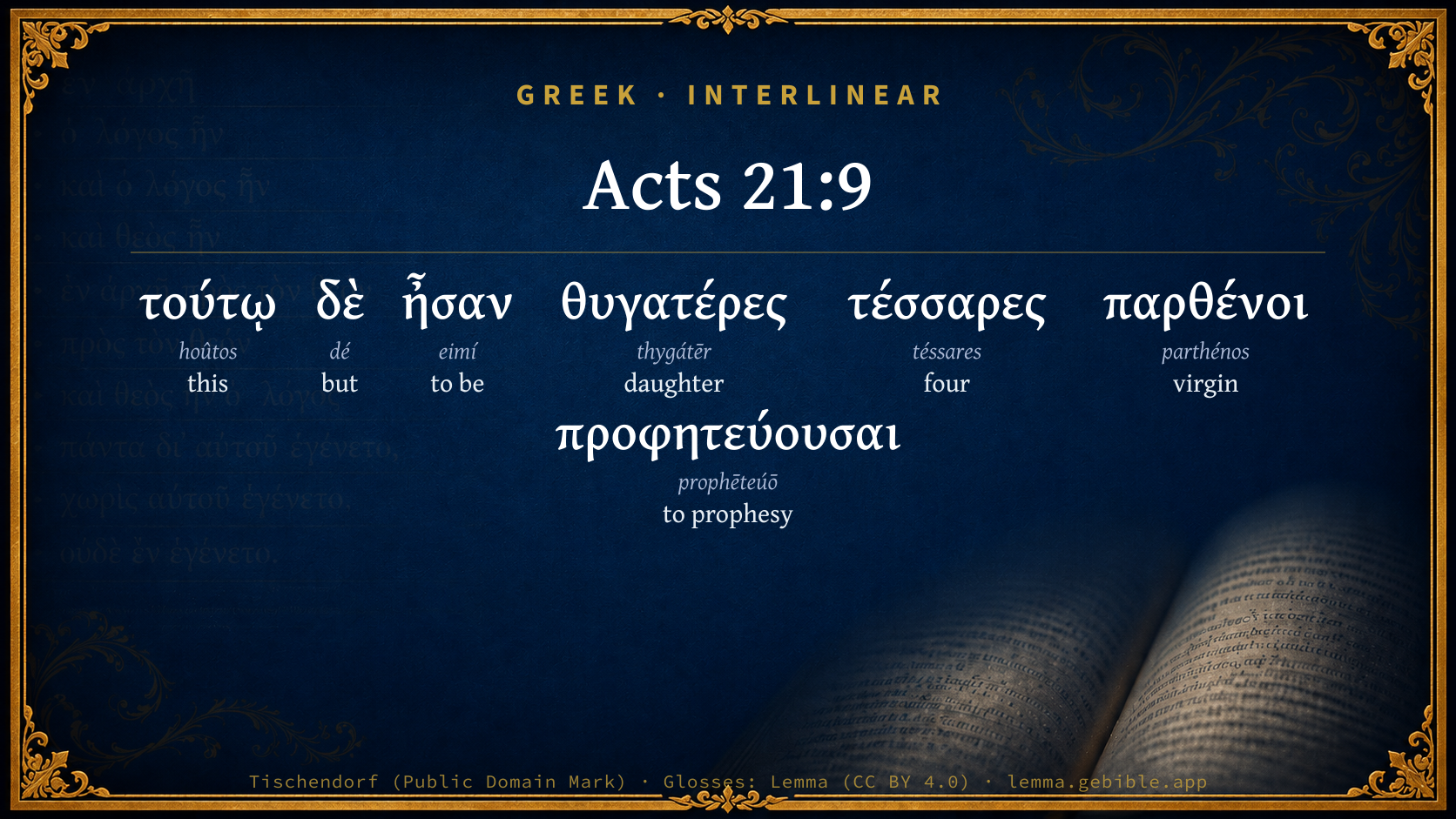
Greek (Tischendorf 8th ed.) Acts 21:9 appears in the Greek New Testament. The text above is from the Tischendorf 8th edition. Each word links to its Strong’s number and a concise gloss. Click any word for its full Thayer’s Greek Lexicon entry.
Download image
Cite this verse

Acts 21:9 (World English Bible). Public Domain. Lemma interlinear Bible study tool, https://lemma.gebible.app/v/acts/21/9.

Show BibTeX & RIS
BibTeX
RIS
English Translation
Now this man had four virgin daughters who prophesied.
World English Bible · Public Domain
Download a study sheet

One document with this verse’s original text, its word-by-word gloss line, the meaning frame, cross-references with their text, attributed commentary, and full source and license credits — printable, and it pastes into notes with its structure intact.

This verse Autodidact and up

Study sheet (.html) Plain text (.txt)

A passage Seminary Student

Up to 50 verses in one chapter. A passage sheet keeps up to 6 commentary sources and 12 cross-references per verse, in the order this page ranks them, and says so on the sheet whenever that leaves anything out. Ask for a single verse and you get the Autodidact verse sheet above.

Everything on this page stays free to read, with no account — the sheet is a download of what is already on screen, not access to it.

Want to remove ads? Support Godless Engineer
Compare translations 3

The same verse in 3 English versions, stacked beneath the original-language interlinear above. Click any original word for its lexicon entry.

Each is an independent rendering of the whole verse — the interlinear is not word-aligned to these translations.

Highlighted words mark where these versions differ — a whole-verse word diff, not a word-by-word alignment.

  • World English Bible Public Domain
    Now this man had four virgin daughters who prophesied.
  • King James Version Public Domain
    And the same man had four daughters, virgins, which did prophesy.
  • unfoldingWord Literal Text CC BY-SA 4.0
    Now to this one were four daughters, virgins, prophesying.

unfoldingWord Literal Text — © unfoldingWord, licensed CC BY-SA 4.0. Word-aligned USFM3 via Door43 (git.door43.org/unfoldingWord/en_ult).

Versions to compare (up to 4)

3 of 4 selected

Show all 19 translations

Every available English version of this verse, each an independent rendering of the whole verse.

  • World English Bible Public Domain
    Now this man had four virgin daughters who prophesied.
  • Berean Standard Bible Public Domain
    He had four unmarried daughters who prophesied.
  • Majority Standard Bible Public Domain
    He had four unmarried daughters who prophesied.
  • King James Version Public Domain
    And the same man had four daughters, virgins, which did prophesy.
  • American Standard Version (1901) Public Domain
    Now this man had four virgin daughters, who prophesied.
  • Revised Version (1885) Public Domain
    Now this man had four daughters, virgins, which did prophesy.
  • Geneva Bible (1599) Public Domain
    Now he had foure daughters virgins, which did prophecie.
  • Douay-Rheims (1899) Public Domain
    And he had four daughters, virgins, who did prophesy.
  • Young's Literal Translation Public Domain
    and this one had four daughters, virgins, prophesying.
  • Literal Standard Version CC BY-SA 4.0
    and this one had four daughters, virgins, prophesying.
  • Unlocked Literal Bible CC BY-SA 4.0
    Now this man had four virgin daughters who prophesied.
  • unfoldingWord Literal Text CC BY-SA 4.0
    Now to this one were four daughters, virgins, prophesying.
  • Darby Bible Public Domain
    Now this man had four virgin daughters who prophesied.
  • World Messianic Bible Public Domain
    Now this man had four virgin daughters who prophesied.
  • Webster's Bible Public Domain
    And the same man had four daughters, virgins, who prophesied.
  • Free Bible Version CC BY-SA 4.0
    Philip had four unmarried daughters who prophesied.
  • Bible in Basic English Public Domain
    And he had four daughters, virgins, who were prophets.
  • Text-Critical English NT CC BY 4.0
    (He had four virgin daughters who prophesied.)
  • Tyndale New Testament (1534) Public Domain
    The same man had fower doughters virges which dyd prophesy.

Literal Standard Version (2020), Covenant Press — licensed CC BY-SA 4.0. Text via the HelloAO Bible API (eBible.org). Unlocked Literal Bible (unfoldingWord) — licensed CC BY-SA 4.0. Text via the HelloAO Bible API (eBible.org). unfoldingWord Literal Text — © unfoldingWord, licensed CC BY-SA 4.0. Word-aligned USFM3 via Door43 (git.door43.org/unfoldingWord/en_ult). Free Bible Version, Dr. Jonathan Gallagher — licensed CC BY-SA 4.0. Text via the HelloAO Bible API (eBible.org).

Word by word

More ways to search: Search by grammar → Find every occurrence → Compare this word →

Practice this passage: Drill this verse → Learn its vocabulary →

About this verse

These counts appear in no published source. They are computed here, from the morphology-tagged text and Lemma’s own curated glosses. What Lemma adds →

7
words
7
distinct lemmas
Acts
section

Notable vocabulary

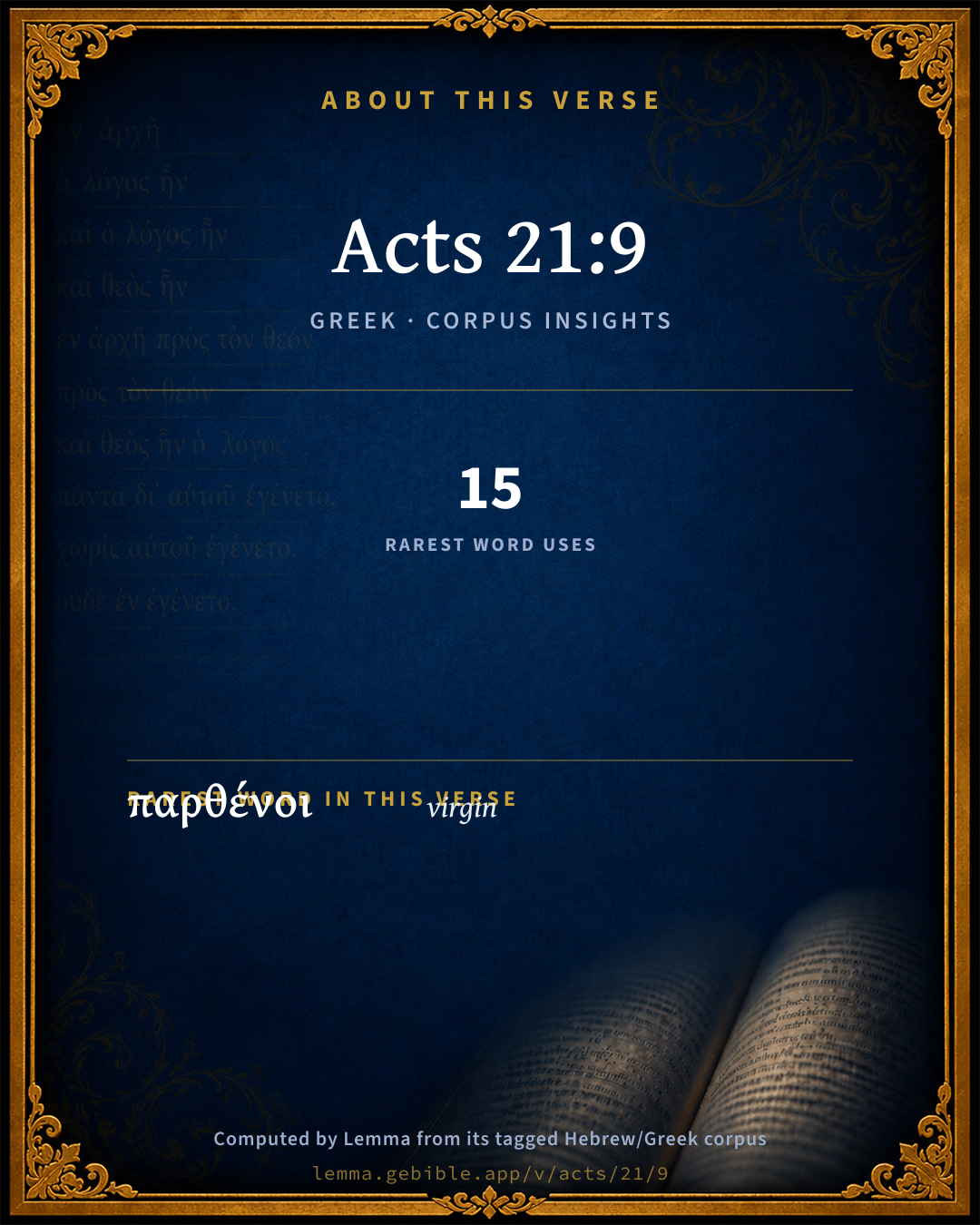
The rarest word here is παρθένοι virgin G3933 — appearing just 15 times in the whole Greek New Testament.

Shared distinctive vocabulary

παρθένοι virgin G3933 occurs in 14 verses of the Greek New Testament. Also found in:

Cross-references

12

Topical passages linked to Acts 21:9 in the Treasury of Scripture Knowledge — connected by theme and wording, ordered by reader-vote popularity; previews shown in the World English Bible.

  • Acts 2:17 'It will be in the last days, says God, That I will pour out my Spirit on all flesh. Your sons and your daughters will prophesy. Your young men will see visions. Your old men will dream dreams.
  • Revelation 2:20 But I have this against you, that you tolerate your woman, Jezebel, who calls herself a prophetess. She teaches and seduces my servants to commit sexual immorality, and to eat things sacrificed to idols.
  • Exodus 15:20 Miriam the prophetess, the sister of Aaron, took a tambourine in her hand; and all the women went out after her with tambourines and with dances.
  • Joel 2:28 "It will happen afterward, that I will pour out my Spirit on all flesh; And your sons and your daughters will prophesy. Your old men will dream dreams. Your young men will see visions.
  • Luke 2:36 There was one Anna, a prophetess, the daughter of Phanuel, of the tribe of Asher (she was of a great age, having lived with a husband seven years from her virginity,
  • Judges 4:4 Now Deborah, a prophetess, the wife of Lappidoth, she judged Israel at that time.
  • 2 Kings 22:14 So Hilkiah the priest, and Ahikam, and Achbor, and Shaphan, and Asaiah, went to Huldah the prophetess, the wife of Shallum the son of Tikvah, the son of Harhas, keeper of the wardrobe (now she lived in Jerusalem in the second quarter); and they talked with her.
  • Nehemiah 6:14 Remember, my God, Tobiah and Sanballat according to these their works, and also the prophetess Noadiah, and the rest of the prophets, that would have put me in fear.
  • Acts 13:1 Now in the assembly that was at Antioch there were some prophets and teachers: Barnabas, Simeon who was called Niger, Lucius of Cyrene, Manaen the foster-brother of Herod the tetrarch, and Saul.
  • 1 Corinthians 11:4–5 Every man praying or prophesying, having his head covered, dishonors his head.
  • 1 Corinthians 7:25–34 Now concerning virgins, I have no commandment from the Lord, but I give my judgment as one who has obtained mercy from the Lord to be trustworthy.
  • 1 Corinthians 7:38 So then both he who gives his own virgin in marriage does well, and he who doesn't give her in marriage does better.

Cross-references courtesy of OpenBible.info (CC BY 4.0).

Commentary

Notes on Acts 21:9 from classic Christian and Jewish commentators (each source and its license shown beneath its notes). The classic Christian expositions comment on the surrounding passage and are grouped to its opening verse, so a note may address several verses; the Jewish commentaries on the Tanakh (Rashi and others) are per-verse, so they appear only where the commentator wrote on this verse.

Lemma curates 59 commentaries, every one of them public domain or Creative Commons licensed, each selected and text-cleaned for this edition rather than reprinted as found. About our sources →

Whedon's Commentary on the Bible

Daniel D. Whedon

6. At Cesarea—Philip and Daughters—Agabus, Act_21:9-14.

9. Virgins—Not nuns, devoted by a vow to celibacy. “Their virginity is probably referred to only as a reason for their being still at home, and not as having any necessary connection with their inspiration. We read of prophetesses under the old economy, not only wives of prophets, (Isa_8:3,) but themselves inspired, from Miriam (Exo_15:20) and Huldah (2Ki_22:14) to Noadiah (Neh_6:14) and Anna, (Luk_2:36.) Joel’s promise of extraordinary spiritual gifts was to servants of both sexes, and to daughters as well as sons.”—Alexander. The prophetic character of the company now at Philip’s house providentially, especially after the arrival of Agabus, attests how high at this time, more than twenty years since the Ascension, was the spiritual life in the Church.

Daniel D. Whedon (gen. ed.), Commentary on the Old and New Testaments (1874–1909) — public domain. Text from a community e-Sword module.

Tyndale Open Study Notes

Tyndale Open Resources

21:9 Philip’s daughters’ gift of prophecy demonstrated the fulfillment of Joel’s prophecy, as Peter had preached at Pentecost (2:17-21; Joel 2:28-32).

Tyndale Open Study Notes — © Tyndale Open Resources, licensed CC BY-SA 4.0. Text via the HelloAO Bible API.

Bengel's Gnomon

Johann Albrecht Bengel

Act 21:9. Προφητεύουσαι, who prophesied) On the part of these women, however, the prediction and representation of the imprisonment (bonds) of Paul would not have been so becoming, as on the part of Agabus. Philip was an Evangelist: his daughters prophesied. A prophet is greater than an Evangelist: Eph 4:11.

Bengel's Gnomon of the New Testament — English translation (T&T Clark, Edinburgh, 1860) — public domain. Text from a community e-Sword module.

Expositor's Greek Testament

ed. W. Robertson Nicoll

Act 21:9 . παρθένοι : an unwedded life might enable them to wait on the Lord without distraction, and thus to be more free for the exercise of their gift of prophecy, but nothing is said of any separate order, or anything to lead us to suppose that they did not share the home life of their father, or that they had devoted themselves to God by any special vow (see however in support of this latter view Felten, Knabenbauer, Plumptre, C. and H.). St. Jerome, Epist. , v., 8, cviii., 8, in relating the story of Paula mentions how she saw at Cæsarea the house of Cornelius now turned into a Christian church, and the humble abode of Philip, and the chambers of his daughters, the four virgins “which did prophesy”. προφητεύουσαι , cf. Joe 2:28-29 , Act 2:17 ; Act 19:6 , 1Co 11:5 ; 1Co 14:24 , although nothing is said of their possessing the power of prediction , or foretelling anything concerning Paul. Since women were forbidden to teach it would seem that the prophet as such was not a teacher; Bigg, Doctrine of the Twelve Apostles , p. 29. But whilst there is no reason to suppose that they prophesied in the church, although even Felten supposes that in Churches not founded by Paul different rules might have prevailed, they would be able to speak and to teach in private or at home especially amongst the women both Jews and Gentiles, to whom in the East men would have had no access (Luckock, Footprints of the Apostles as traced by St. Luke , ii., p. 214). This verse is regarded by Hilgenfeld as an addition made by the “author to Theophilus” (so Renan). Spitta however thinks that something ought to have been said as to the nature of the prophecies uttered by the four daughters, but that instead of this we have the notice of Agabus in Act 21:10 . He therefore believes that the “We” section was interrupted at Act 21:10 , and that the verses following are interpolated from his inferior source B. The reference to weeping in Act 21:13 is much more natural if we presuppose the presence of women, so he therefore reads “they prophesied with tears over the fate of Paul” (p. 339); so somewhat similarly Jüngst (p. 177).

The Expositor's Greek Testament, edited by W. Robertson Nicoll (1897–1910) — public domain. Text from a community e-Sword module.

Geneva Bible (1599)

Geneva Bible translators

They had a peculiar gift of foretelling things to come.

Geneva Bible (1599) marginal notes — public domain. Text via Bolls.life.

Jamieson, Fausset & Brown

Robert Jamieson, A. R. Fausset & David Brown

the same man had four daughters . . . which did prophesy--fulfilling Joe 2:28 (see Act 2:18). This is mentioned, it would seem, merely as a high distinction divinely conferred on so devoted a servant of the Lord Jesus, and probably indicates the high tone of religion in his family.

Jamieson, Fausset & Brown — Commentary Critical and Explanatory on the Whole Bible (1871) — public domain (CC PDM 1.0). Text via the HelloAO Bible API.

Adam Clarke's Commentary

Verse 9. Four daughters, virgins, which did prophesy.] Probably these were no more than teachers in the Church: for we have already seen that this is a frequent meaning of the word prophesy; and this is undoubtedly one thing intended by the prophecy of Joel, quoted Ac 2:17-18, of this book. If Philip's daughters might be prophetesses, why not teachers?

Adam Clarke's Commentary on the Bible (1810–1826) — public domain. Text from a community e-Sword/MySword module.

John Calvin's Commentaries

9. Four daughters. This is added for the commendation of Philip, not only that we might know that his house was well ordered, but also that it was famous and excellent through the blessing of God. For, assuredly, it was no small gift to have four daughters all endowed with the spirit of prophecy.

By this means the Lord meant to beautify the first beginnings of the gospel, when he raised up men and women to foretell things to come. Prophecies had now almost ceased many years among the Jews, to the end they might be more attentive and desirous to hear the new voice of the gospel. Therefore, seeing that prophesying, which was in a manner quite ceased, doth now after long time return again, it was a token of a more perfect state. Notwithstanding, it seemeth that the same was the reason why it ceased shortly after; for God did support the old people with diverse foretellings, until Christ should make an end of all prophecies. Therefore, it was meet that the new kingdom of Christ should be thus furnished and beautified with this furniture, that all men might know that that promised visitation of the Lord was present; and it was also expedient that it should last but for a short time, lest the faithful should always wait for some farther thing, or lest that curious wits might have occasion given to seek or invent some new thing ever now and then. For we know that when that ability and skill was taken away, there were, notwithstanding, many brain-sick fellows, who did boast that they were prophets; and also it may be that the frowardness of men did deprive the Church of this gift. But that one cause ought to be sufficient, in that God, by taking away prophecies, did testify that the end and perfection was present in Christ; and it is uncertain how these maids did execute the office of prophesying, saving that the Spirit of God did so guide and govern them, that he did not overthrow the order which he himself set down. And forasmuch as he doth not suffer women to bear any public office in the Church, it is to be thought that they did prophesy at home, or in some private place, without the common assembly.

John Calvin's Commentaries (1540-1563) — public domain. Text from the Calvin Translation Society English edition (1840s-50s) via the Christian Classics Ethereal Library (ccel.org). Calvin's coverage is partial (roughly two-thirds of the Bible); uncommented books and verses are honest gaps, never fabricated. The 19th-century editor's footnotes and remarks are omitted so the notes are faithfully Calvin's own voice.

Ellicott's Commentary for English Readers

(9) The same man had four daughters, virgins, which did prophesy.—Both elements of the description are full of interest as throwing light on the life of the Apostolic Church. (1) The four daughters were “virgins.” The word then, as afterwards, probably indicated, not merely the bare fact that they were as yet unmarried, but that they had devoted themselves, if not by irrevocable vows, yet by a steadfast purpose, to that form of service. In the organisation of women’s work in the Church they formed apparently a distinct class, the complement of that of the widows of 1Ti_5:10. St. Paul had distinctly sanctioned such a life, as presenting a higher standard of excellence than the duties of domestic life (1Co_7:8), and on grounds which, in their general character, went beyond the “present distress” of a time of persecution (1Co_7:26; 1Co_7:34). It was, indeed, a matter on which he had no commandment from the Lord (1Co_7:25), and in which he was therefore open to the teachings of experience, and these seem to have modified his judgment at a later date, and led him to the conclusion that it was better that the younger “widows” should marry (1Ti_5:14), and that they should only be received into the list of those who were maintained by the Church in return for their services as “widows,” at a more advanced age (1Ti_5:9). The order of “virgin,” however, continued to exist, and the term Virgo, sometimes with Ancilla Domini (the handmaid of the Lord; comp. Rom_16:1) added to it, is found in the inscriptions from the catacombs now in the Museums of the Collegio Romano and the Lateran. So Pliny, in his letter to Trajan (Ep. 10 § 6), speaks of the women who were then called ministræ among the Christians, the latter term being probably used as the equivalent for “deaconesses.” (2) These virgins “prophesied.” The word comprised much more than mere prediction of the future, and included all words that came into the mind of the speaker as an inspiration, and to the hearers as a message from God. (Comp. Notes on Act_2:17; Act_19:6; 1Co_14:24-25.) In other words, they preached. We ask when, and where? Did they prophesy in the assemblies of the Church? It is true that St. Paul had forbidden this at Corinth (1Co_14:34), and forbade it afterwards at Ephesus (1Ti_2:12); but the very prohibition proves that the practice was common (see also 1Co_11:5), and it does not follow that St. Paul’s rules of discipline as yet obtained in all the churches. It is perfectly possible, however, that they may have confined their ministrations to those of their own sex, and, accompanying their father in his missionary journeys, have gained access to women, both among Jews and Gentiles, and brought them to the knowledge of the Truth. It is obvious that the services of women, acting as deaconesses, would be needed as a matter of decorum in the baptism of female converts.

A Bible Commentary for English Readers, edited by Charles John Ellicott (1878–1897) — public domain. Text from a community e-Sword module.

The Cambridge Bible for Schools and Colleges

gen. ed. J. J. S. Perowne

9. And the same man … prophesy] Rev. Ver. “Now this man had, &c.” The family of the Evangelist were walking in their father’s steps. These daughters, instead of resting at home, took upon them the hard duty of publishing the message of the Gospel. The English word “prophesy” has come to have, since about the beginning of the seventeenth century, only the one sense of “to predict what is yet to come.” In the time of Queen Elizabeth “prophesyings” meant “preachings,” and Jeremy Taylor’s famous work on the “Liberty of Prophesying,” was written to uphold the freedom of preaching. These women were, in their degree, Evangelists also.

The Cambridge Bible for Schools and Colleges (gen. ed. J. J. S. Perowne; Cambridge University Press, 1878–1918) — public domain. Text from a community e-Sword module.

John Gill's Exposition

And the same man had four daughters,.... So that he was a married man, which may be observed against the Papists, who forbid marriage to ecclesiastics: and they were,

virgins: not under any vow of virginity, but they had not as yet changed their state of life, and were pure and incorrupt:

which did prophesy; not explain and interpret Scripture, or preach in public assemblies; for these were not allowed women, neither in the Jewish synagogues, nor in Christian assemblies; but they were endowed with a gift of foretelling future events, as was promised such should have in Gospel times, Joe 2:28.

John Gill's Exposition of the Whole Bible (1746–1763) — public domain (CC PDM 1.0). Text via the HelloAO Bible API.

Trapp's Complete Commentary

John Trapp

9 And the same man had four daughters, virgins, which did prophesy.

Ver. 9. Did prophesy] That is, they had the gift of foretelling future things by divine inspiration. This was every way extraordinary.

John Trapp, A Commentary or Exposition upon All the Books of the Old and New Testament (1647–1656) — public domain. Text from a community e-Sword module.

Albert Barnes' Notes on the Bible

Which did prophesy - See the notes on Act 2:17; Act 11:27. That females sometimes partook of the prophetic influence, and foretold future events, is evident from various places in the New Testament. See the notes on Act 2:17.

Albert Barnes' Notes on the Bible (1834–1885) — public domain. Text from a community e-Sword/MySword module.

Haydock's Catholic Bible Commentary

Prophecy. It is supposed that these daughters of St. Philip had made a vow of virginity, or at least remained in that state our of a motive of religion. St. Jerome thinks in reward of this they were gifted with a prophetic spirit. (Lib. i. chap. 24. cont. Jov.) --- Others think that by prophesying is meant interpreting the Scriptures, or singing the praises of God. (Estius)

George Leo Haydock (1774–1849), Haydock's Catholic Family Bible and Commentary, 1859 edition — public domain. Excludes Psalms (Douay-Rheims chapter numbering differs from Protestant) and Deuterocanonical books (Catholic canon only).

Matthew Poole's English Annotations

Virgins; by their father’s and their own voluntary determination, as 1Co 7:37; neither is it said whether they continued in that state, but they were so.

Which did prophesy; not by expounding the prophecies or word of God, for no woman is suffered to teach publicly, 1Co 14:34; 1Ti 2:12; but rather foretelling things to come, which gift God did not debar that sex from; especially it having been promised, Joe 2:28, and in part fulfilled before, in Act 2:17; by which God would show the enlargement of his mercies, and plenty of his Spirit, reserved for the times of the gospel.

Matthew Poole's English Annotations on the Holy Bible (1683–1685) — public domain. Text from a community e-Sword/MySword module.

The Pulpit Commentary

Now this man for and the same man, A.V. Virgins. This certainly conveys the impression that they had dedicated their lives to the service of God. (1Co_7:34-38) Which did prophesy . The question arises Did they exercise their gift of prophecy in the Church or in private? The passage 1Co_11:5 seems to indicate that in the Church of Corinth women did pray and prophesy in the congregation, while, on the other hand, 1Co_14:34, 35 seems peremptorily to forbid women to speak or teach in Church, as does 1Ti_2:11, 1Ti_2:12. How, then, is this apparent contradiction to be reconciled? It must beeither by supposing

(1) that the gift of prophecy spoken of here and in 1Co_11:5 was exercised in private only; or

(2) that the prohibition did not apply to the extraordinary operation of the Holy Spirit speaking by prophet or prophetesses as the ease might be. The latter seems the most probable. (see Act_13:1, note) On the office of prophets in the early Church, see Act_11:27 Act_13:1 Act_15:32 Act_19:6; Rom_12:6; 1Co_12:10, 1Co_12:28, 29 13:2, 8 14:6, 29, etc.; Eph_3:5 Eph_4:11; 1Th_5:20. (see Alford, on Act_11:27) As regards these daughters of Philip, there are conflicting statements in early Church writers. Eusebius ("Eccl. Hist.," 3:30) quotes Clement of Alexandria as saying that both Peter and Philip among the apostles were married and had children, and that Philip moreover gave his daughters in marriage to husbands. But in the next chapter

(3) he quotes Polycrates, Bishop of Ephesus at the end of the second century, as saying that Philip the apostle and his two daughters, who had grown old in their virginity, were buried at Hierapolis; and that another daughter of his, "who had her conversation in the Holy Spirit," was buried at Ephesus. Eusebius himself thinks that these daughters of Philip the evangelist were meant. If they were, it does not necessarily follow that those who, according to Clemens Alexandrinus, were married were of the four mentioned here. They might be sisters. Polycrates seems to speak of three sisters who lived a religious life (in the technical sense); the fourth may have died young. But it is quite possible that Clemens may really be speaking of Philip the apostle, and Polycrates also; the more so as Philip the apostle, according to the tradition recorded by Nicephorns, suffered martyrdom at Hierapolis. However, the confusion between the two Philips is quite certain in the Menaeum (or Calendar) of the Greek Church, where we read, "On the 4th of September is the commemoration of Saint Hermione, one of the four daughters of the Apostle Philip, who baptized the eunuch of Candace. She and her sister Eutychis came into Asia after the death of the Apostle John. She was buried at Ephesus." A fragment of Caius (in Eusebius, "Eccl. Hist.," 3:31) increases the confusion by speaking of" the four daughters of Philip, prophetesses, who were buried in Hierapolis" (see Routh"s "Reliq. Sac.," vol. 1. pp. 378-380).

The Pulpit Commentary (1880–1919), ed. H.D.M. Spence-Jones & Joseph S. Exell — public domain. Text from a community e-Sword module.

MacLaren's Expositions of Holy Scripture

Alexander MacLaren

Acts

DRAWING NEARER TO THE STORM

Act 21:1 - Act 21:15.

Paul’s heroic persistency in disregarding the warnings of ‘bonds and afflictions’ which were pealed into his ears in every city, is the main point of interest in this section. But the vivid narrative abounds with details which fill it with life and colour. We may gather it all round three points-the voyage, Tyre, and Caesarea.

I. The log of the voyage, as given in Act 21:1 - Act 21:3, shows the leisurely way of navigation in those days and in that sea.

Obviously the coaster tied up or anchored in port at night. Running down the coast from Miletus, they stayed overnight, first at the small island of Coos, then stretched across the next day to Rhodes, and on the third struck back to the mainland at Patara, from which, according to one reading, they ran along the coast a little further east to Myra, the usual port of departure for Syria. Ramsay explains that the prevalent favourable wind for a vessel bound for Syria blows steadily in early morning, and dies down towards nightfall, so that there would have been no use in keeping at sea after sundown.

At Patara {or Myra} Paul and his party had to tranship, for their vessel was probably of small tonnage, and only fit to run along the coast. In either port they would have no difficulty in finding some merchantman to take them across to Syria. Accordingly they shifted into one bound for Tyre, and apparently ready to sail. The second part of their voyage took them right out to sea, and their course lay to the west, and then to the south of Cyprus, which Luke mentions as if to remind us of Paul’s visit there when he was beginning his missionary work. How much had passed since that day at Paphos {which they might have sighted from the deck}! He had left Paphos with Barnabas and John Mark-where were they? He had sailed away from Cyprus to carry the Gospel among Gentiles; he sails past it, accompanied by a group of these whom he had won for Christ. There he had begun his career; now the omens indicated that possibly its end was near. Many a thought would be in his mind as he looked out over the blue waters and saw the glittering roofs and groves of Paphos.

Tyre was the first port of call, and there the cargo was to be landed. The travellers had to wait till that was done, and probably another one shipped. The seven days’ stay is best understood as due to that cause; for we find that Paul re-embarked in the same ship, and went in her as far as Ptolemais, at all events, perhaps to Caesarea.

We note that no brethren are mentioned as having been met at any of the ports of call, and no evangelistic work as having been done in them. The party were simple passengers, who had to shape their movements to suit the convenience of the master of the vessel, and were only in port at night, and off again next morning early. No doubt the leisure at sea was as restorative to them as it often is to jaded workers now.

II. Tyre was a busy seaport then, and in its large population the few disciples would make but little show.

They had to be sought out before they were ‘found.’ One can feel how eagerly the travellers would search, and how thankfully they would find themselves again among congenial souls. Since Miletus they had had no Christian communion, and the sailors in such a ship as theirs would not be exactly kindred spirits. So that week in Tyre would be a blessed break in the voyage. We hear nothing of visiting the synagogue, nor of preaching to the non-Christian population, nor of instruction to the little Church.

The whole interest of the stay at Tyre is, for Luke, centred on the fact that here too the same message which had met Paul everywhere was repeated to him. It was ‘through the Spirit.’ Then was Paul flying in the face of divine prohibitions when he held on his way in spite of all that could be said? Certainly not. We have to bring common sense to bear on the interpretation of the words in Act 21:4, and must suppose that what came from ‘the Spirit’ was the prediction of persecutions waiting Paul, and that the exhortation to avoid these by keeping clear of Jerusalem was the voice of human affection only. Such a blending of clear insight and of mistaken deductions from it is no strange experience.

No word is said as to the effect of the Tyrian Christians’ dissuasion. It had none. Luke mentions it in order to show how continuous was the repetition of the same note, and his silence as to the manner of its reception is eloquent. The parting scene at Tyre is like, and yet very unlike, that at Miletus. In both the Christians accompany Paul to the beach, in both they kneel down and pray. It would scarcely have been a Christian parting without that. In both loving farewells are said, and perhaps waved when words could no longer be heard. But at Tyre, where there were no bonds of old comradeship nor of affection to a spiritual father, there was none of the yearning, clinging love that could not bear to part, none of the hanging on Paul’s neck, none of the deep sorrow of final separation. The delicate shades of difference in two scenes so similar tell of the hand of an eye-witness. The touch that ‘all’ the Tyrian Christians went down to the beach, and took their wives and children with them, suggests that they can have been but a small community, and so confirms the hint given by the use of the word ‘found’ in Act 21:4.

III. The vessel ran down the coast to Ptolemais where one day’s stop was made, probably to land and ship cargo, if, as is possible, the further journey to Caesarea was by sea.

But it may have been by land; the narrative is silent on that point. At Ptolemais, as at Tyre, there was a little company of disciples, the brevity of the stay with whom, contrasted with the long halt in Caesarea, rather favours the supposition that the ship’s convenience ruled the Apostle’s movements till he reached the latter place. There he found a haven of rest, and, surrounded by loving friends, no wonder that the burdened Apostle lingered there before plunging into the storm of which he had had so many warnings.

The eager haste of the earlier part of the journey, contrasted with the delay in Caesarea at the threshold of his goal, is explained by supposing that at the beginning Paul’s one wish had been to get to Jerusalem in time for the Feast, and that at Caesarea he found that, thanks to his earlier haste and his good passages, he had a margin to spare. He did not wish to get to the Holy City much before the Feast.

Two things only are told as occurring in Caesarea-the intercourse with Philip and the renewed warnings about going to Jerusalem. Apparently Philip had been in Caesarea ever since we last heard of him {Act 8:1 - Act 8:40}. He had brought his family there, and settled down in the headquarters of Roman government. He had been used by Christ to carry the Gospel to men outside the Covenant, and for a time it seemed as if he was to be the messenger to the Gentiles; but that mission soon ended, and the honour and toil fell to another. But neither did Philip envy Paul, nor did Paul avoid Philip. The Master has the right to settle what each slave has to do, and whether He sets him to high or low office, it matters not.

Philip might have been contemptuous and jealous of the younger man, who had been nobody when he was chosen as one of the Seven, but had so far outrun him now. But no paltry personal feeling marred the Christian intercourse of the two, and we can imagine how much each had to tell the other, with perhaps Cornelius for a third in company, during the considerably extended stay in Caesarea. No doubt Luke too made good use of the opportunity of increasing his knowledge of the first days, and probably derived much of the material for the first chapters of Acts from Philip, either then or at his subsequent longer residence in the same city.

We have heard of the prophet Agabus before {Act 11:28}. Why he is introduced here, as if a stranger, we cannot tell, and it is useless to guess, and absurd to sniff suspicion of genuineness in the peculiarity. His prophecy is more definite than any that preceded it. That is God’s way. He makes things clearer as we go on, and warnings more emphatic as danger approaches. The source of the ‘afflictions’ was now for the first time declared, and the shape which they would take. Jews would deliver Paul to Gentiles, as they had delivered Paul’s Master.

But there the curtain falls. What would the Gentiles do with him? That remained unrevealed. Half the tragedy was shown, and then darkness covered the rest. That was more trying to nerves and courage than full disclosure to the very end would have been. Imagination had just enough to work on, and was stimulated to shape out all sorts of horrors. Similarly incomplete and testing to faith are the glimpses of the future which we get in our own lives. We see but a little way ahead, and then the road takes a sharp turn, and we fancy dreadful shapes hiding round the corner.

Paul’s courage was unmoved both by Agabus’s incomplete prophecy and by the tearful implorings of his companions and of the Caesarean Christians. His pathetic words to them are misunderstood if we take ‘break my heart’ in the modern sense of that phrase, for it really means ‘to melt away my resolution,’ and shows that Paul felt that the passionate grief of his brethren was beginning to do what no fear for himself could do-shake even his steadfast purpose. No more lovely blending of melting tenderness and iron determination has ever been put into words than that cry of his, followed by the great utterance which proclaimed his readiness to bear all things, even death itself, for ‘the name of the Lord Jesus.’ What kindled and fed that noble flame of self-devotion? The love of Jesus Christ, built on the sense that He had redeemed the soul of His servant, and had thereby bought him for His own.

If we feel that we have been ‘bought with a price,’ we too, in our small spheres, shall be filled with that ennobling passion of devoted love which will not count life dear if He calls us to give it up. Let us learn from Paul how to blend the utmost gentleness and tender responsiveness to all love with fixed determination to glorify the Name. A strong will and a loving heart make a marvellously beautiful combination, and should both abide in every Christian.

Alexander MacLaren, Expositions of Holy Scripture (1904–1910) — public domain. Text from a community e-Sword module.

Godbey's Commentary on the New Testament

William B. Godbey

9-14. God has been good to him, giving him four daughters, all happily endued with the gift of prophecy, and efficient helpers in his evangelistic work. While Paul and his comrades enjoy the kind hospitality of the prophet’s mansion seven days, the same prophet, Agabus, mentioned in Chapter 11, eighteen years ago having come from Judea, meets Paul, taking his girdle, binding his feet and hands, said: “These things, saith the Holy Ghost, the man whose girdle this is will the Jews in Jerusalem thus bind and deliver into the hands of the Gentiles.” This prediction powerfully stirred the saints at Caesarea importunately to plead with Paul to desist from going up to Jerusalem, till he finally begs them no longer to break his heart with their tears, because he is ready “even to die in Jerusalem for the name of the Lord Jesus.” Then they acquiesced, saying, “Let the will of the Lord be done.”

William B. Godbey, Commentary on the New Testament (1896–1900) — public domain. Text from a community e-Sword module.

McGarvey & Pendleton's Commentaries

J. W. McGarvey

See notes on verse 8

J. W. McGarvey (with Philip Y. Pendleton), Commentaries on the New Testament (The Fourfold Gospel, 1914; Acts; and the epistles) — public domain. Text from a community e-Sword/MySword module.

Cambridge Greek Testament for Schools and Colleges

9. τούτῳ δὲ ἧσαν θυγατέρες τέσσαρες παρθένοι κ.τ.λ., now this man had four daughters, virgins, which did prophesy. The family of the Evangelist were walking in their father’s steps. These daughters, instead of resting at home, took upon them the hard duty of publishing the message of the Gospel. The English word ‘prophesy’ has come to have, since about the beginning of the seventeenth century, only the one sense of ‘to predict what is yet to come.’ In the time of Queen Elizabeth ‘prophesyings’ meant ‘preachings,’ and Jeremy Taylor’s famous work on the ‘Liberty of Prophesying’ was written to uphold the freedom of preaching. These women were, in their degree, Evangelists also.

Cambridge Greek Testament for Schools and Colleges (Cambridge University Press, 1896; 21 vols, various authors incl. Carr, Maclear, Plummer, Farrar, Lumby, Moule, M. R. James, Simcox) — public domain. Text from a community e-Sword module.

Alford’s Greek Testament

Henry Alford

9.] This notice is inserted apparently without any immediate reference to the history, but to bring so remarkable a circumstance to the knowledge of the readers. The four daughters had the gift of προφητεία: see on ch. 11:27. Eusebius (see, however, his mistake above) gives from Polycrates traditional accounts of them,—that two were buried at Hierapolis, and one at Ephesus. From that passage, and one cited from Clement of Alex. (δύο θυγατέρες αὐτοῦ γεγηρακυῖαι παρθένοι, Polycr., Euseb. iii. 31.… Φίλιππος τὰς θυγατέρας ἀνδράσιν ἐξέδωκε, , iii. 30), it would appear that two were afterwards married, according to tradition.

To find an argument for the so-called ‘honour of virginity’ in this verse, only shews to what resources those will stoop who have failed to apprehend the whole spirit and rule of the gospel in the matter. They are met however on their own ground by an argument built on another misapprehension (that of Philip being a deacon in the ecclesiastical sense): ὥστε οὖν καὶ τῷ κοινωνήσαντι γάμων διακονεῖν ἔξεστι.

Henry Alford, The Greek Testament (1849–1861) — public domain. Text from a community e-Sword module.

Lesson kit

Teaching starters — assembled from the data on this page, not authored interpretation. Every prompt links to the verse data it draws on. Edit before teaching.

Acts, in the Acts, opens this verse with 7 words (7 distinct Greek lemmas). Its most distinctive word is parthénos (“virgin”). A historical commentator’s framing appears above. Read the whole chapter for the surrounding context.

Discussion questions

  1. How does “virgin” (parthénos) shape what this verse is saying?
  2. How does Matthew 1:23, which shares the word «virgin», read alongside this verse?
  3. These translations render this verse differently. What is at stake in choosing one wording over another?
  4. Compare how Whedon's Commentary on the Bible and Tyndale Open Study Notes read this verse. Where do they agree or differ?

Things to notice

Reading settings

Reading text

Shown beneath each verse's original-language words.

Old Testament
Old Testament edition

Read the OT as the Masoretic Hebrew (MT) or the Greek Septuagint (LXX).

English shown for the Greek Septuagint (in the Hebrew ↔ Greek comparison).

Comparing translations? Open the Compare panel on any verse page to stack up to four side by side.