
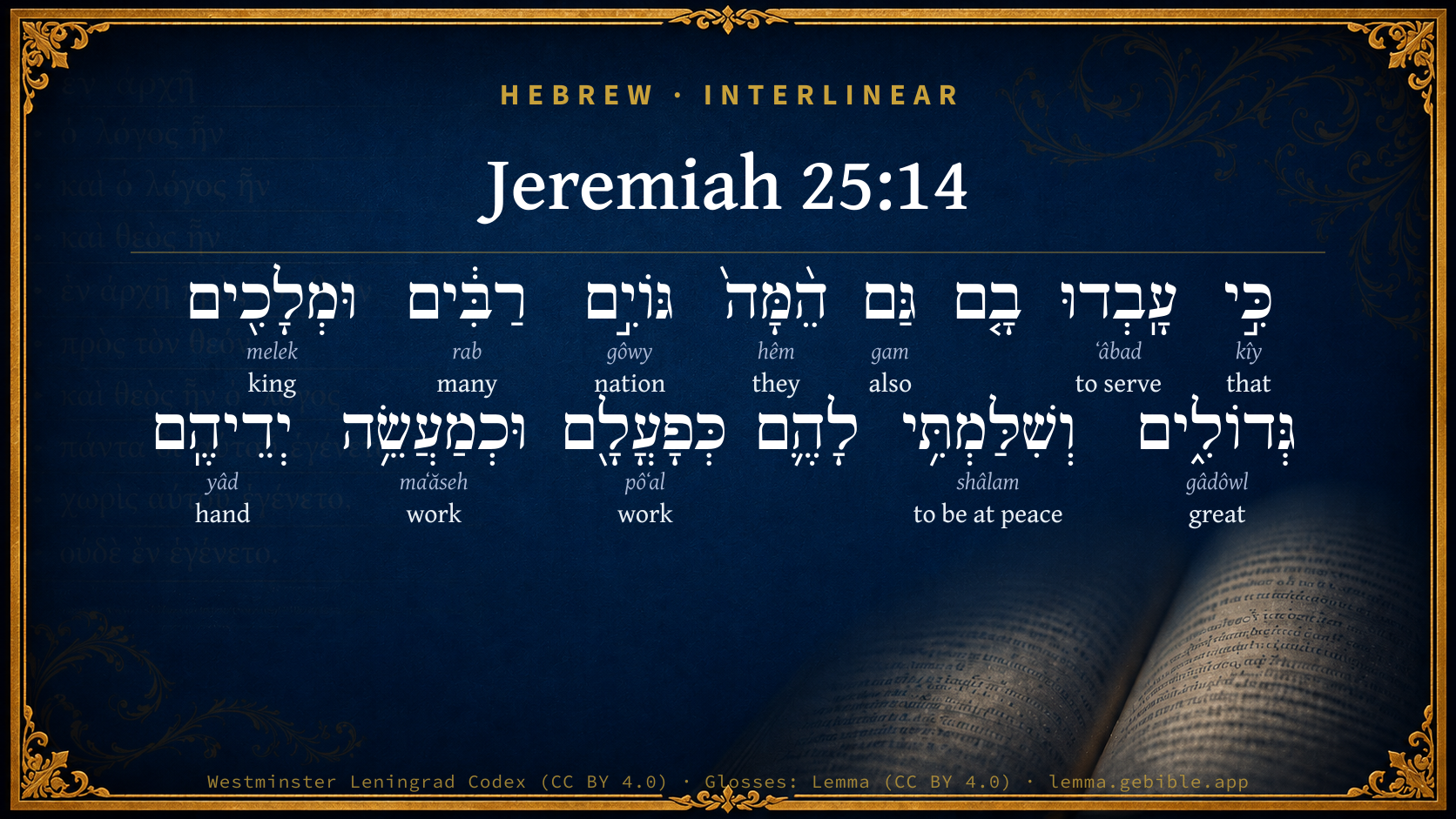
Jeremiah 25:14

Hebrew (Westminster Leningrad Codex) Jeremiah 25:14 appears in the Hebrew Old Testament. The text above is from the Westminster Leningrad Codex. Each word links to its Strong’s number, a concise gloss, and parsing drawn from the Open Scriptures Hebrew Bible morphology. Click any word for its full Brown-Driver-Briggs (BDB) entry.
Download image
Cite this verse

Jeremiah 25:14 (World English Bible). Public Domain. Lemma interlinear Bible study tool, https://lemma.gebible.app/v/jeremiah/25/14.

Show BibTeX & RIS
BibTeX
RIS
English Translation
For many nations and great kings shall make bondservants of them, even of them; and I will recompense them according to their deeds, and according to the work of their hands.
World English Bible · Public Domain
Download a study sheet

One document with this verse’s original text, its word-by-word gloss line, the meaning frame, cross-references with their text, attributed commentary, and full source and license credits — printable, and it pastes into notes with its structure intact.

This verse Autodidact and up

Study sheet (.html) Plain text (.txt)

A passage Seminary Student

Up to 50 verses in one chapter. A passage sheet keeps up to 6 commentary sources and 12 cross-references per verse, in the order this page ranks them, and says so on the sheet whenever that leaves anything out. Ask for a single verse and you get the Autodidact verse sheet above.

Everything on this page stays free to read, with no account — the sheet is a download of what is already on screen, not access to it.

Want to remove ads? Support Godless Engineer
Compare translations 3

The same verse in 3 English versions, stacked beneath the original-language interlinear above. Click any original word for its lexicon entry.

Each is an independent rendering of the whole verse — the interlinear is not word-aligned to these translations.

Highlighted words mark where these versions differ — a whole-verse word diff, not a word-by-word alignment.

  • World English Bible Public Domain
    For many nations and great kings shall make bondservants of them, even of them; and I will recompense them according to their deeds, and according to the work of their hands.
  • King James Version Public Domain
    For many nations and great kings shall serve themselves of them also: and I will recompense them according to their deeds, and according to the works of their own hands.
  • unfoldingWord Literal Text CC BY-SA 4.0
    For many nations and great kings will also make them serve, even them, and I will repay them according to their deed and according to the work of their hands.’”

unfoldingWord Literal Text — © unfoldingWord, licensed CC BY-SA 4.0. Word-aligned USFM3 via Door43 (git.door43.org/unfoldingWord/en_ult).

Versions to compare (up to 4)

3 of 4 selected

Show all 18 translations

Every available English version of this verse, each an independent rendering of the whole verse.

  • World English Bible Public Domain
    For many nations and great kings shall make bondservants of them, even of them; and I will recompense them according to their deeds, and according to the work of their hands.
  • Berean Standard Bible Public Domain
    For many nations and great kings will enslave them, and I will repay them according to their deeds and according to the work of their hands.’”
  • Majority Standard Bible Public Domain
    For many nations and great kings will enslave them, and I will repay them according to their deeds and according to the work of their hands.’”
  • King James Version Public Domain
    For many nations and great kings shall serve themselves of them also: and I will recompense them according to their deeds, and according to the works of their own hands.
  • American Standard Version (1901) Public Domain
    For many nations and great kings shall make bondmen of them, even of them; and I will recompense them according to their deeds, and according to the work of their hands.
  • Revised Version (1885) Public Domain
    For many nations and great kings shall serve themselves of them, even of them: and I will recompense them according to their deeds, and according to the work of their hands.
  • Geneva Bible (1599) Public Domain
    For many nations, and great Kings shall euen serue themselues of them: thus will I recompense them according to their deedes, and according to the workes of their owne handes.
  • Douay-Rheims (1899) Public Domain
    For they have served them, whereas they were many nations, and great kings: and I will repay them according to their deeds, and according to the works of their hands.
  • Young's Literal Translation Public Domain
    For laid service on them -- also them -- have many nations and great kings, and I have given recompence to them according to their doing, and according to the work of their hands.
  • Literal Standard Version CC BY-SA 4.0
    For laid service on them—also them—have many nations and great kings, and I have given repayment to them according to their doing, and according to the work of their hands.”
  • Unlocked Literal Bible CC BY-SA 4.0
    For also many other nations and great kings will make slaves out of these nations. I will repay them for their deeds and the works of their hands.'”
  • unfoldingWord Literal Text CC BY-SA 4.0
    For many nations and great kings will also make them serve, even them, and I will repay them according to their deed and according to the work of their hands.’”
  • Darby Bible Public Domain
    For many nations and great kings shall serve themselves of them also; and I will recompense them according to their deeds, and according to the work of their hands.
  • World Messianic Bible Public Domain
    For many nations and great kings will make bondservants of them, even of them. I will recompense them according to their deeds, and according to the work of their hands.”
  • Webster's Bible Public Domain
    For many nations and great kings shall reduce them to subjection also: and I will recompense them according to their deeds, and according to the works of their own hands.
  • Free Bible Version CC BY-SA 4.0
    Many nations and powerful kings will make slaves of them, the Babylonians, and I will pay them back for the evil they've done.
  • Bible in Basic English Public Domain
    For a number of nations and great kings will make servants of them, even of them: and I will give them the reward of their acts, even the reward of the work of their hands.
  • JPS Tanakh (1917) Public Domain
    For many nations and great kings shall make bondmen of them also; and I will recompense them according to their deeds, and according to the work of their own hands.

Literal Standard Version (2020), Covenant Press — licensed CC BY-SA 4.0. Text via the HelloAO Bible API (eBible.org). Unlocked Literal Bible (unfoldingWord) — licensed CC BY-SA 4.0. Text via the HelloAO Bible API (eBible.org). unfoldingWord Literal Text — © unfoldingWord, licensed CC BY-SA 4.0. Word-aligned USFM3 via Door43 (git.door43.org/unfoldingWord/en_ult). Free Bible Version, Dr. Jonathan Gallagher — licensed CC BY-SA 4.0. Text via the HelloAO Bible API (eBible.org).

Word by word

More ways to search: Search by grammar → Find every occurrence → Compare this word →

Practice this passage: Drill this verse → Learn its vocabulary →

כְּפָעֳלָ֖ם
pôʻal
H6467
“like/as · work · their”
Preposition + Noun, Common, Masculine, Singular, Construct + Suffix, Personal, 3rd Person, Masculine, Plural
Part of Speech
Preposition + Noun
Type
Common
Gender
Masculine
Number
Singular
State
Construct
Full BDB Definition

Origin: from H6466

TWOT: 1792a

work, deed, doing - deed, thing done - work, thing made - wages of work - acquisition (of treasure)
  1. כִּ֣י kîy H3588 “that” Conjunction
  2. עָֽבְדוּ ʻâbad H5647 “to serve” Verb, Qal, Perfect, 3rd Person, Common, Plural
  3. גַּם gam H1571 “also” Particle, Accusative
  4. הֵ֨מָּה֙ hêm H1992 “they” Pronoun, Personal, 3rd Person, Masculine, Plural
  5. גּוֹיִ֣ם gôwy H1471 “nations” Noun, Common, Masculine, Plural, Absolute
  6. רַבִּ֔ים rab H7227 “many” Adjective, Adjective, Masculine, Plural, Absolute
  7. וּמְלָכִ֖ים melek H4428 “and · kings” Conjunction + Noun, Common, Masculine, Plural, Absolute
  8. גְּדוֹלִ֑ים gâdôwl H1419 “great” Adjective, Adjective, Masculine, Plural, Absolute
  9. וְשִׁלַּמְתִּ֥י shâlam H7999 “and · to be at peace” Conjunction + Verb, Piel, Sequential Perfect, 1st Person, Common, Singular
  10. וּכְמַעֲשֵׂ֥ה maʻăseh H4639 “and · like/as · work of” Conjunction + Preposition + Noun, Common, Masculine, Singular, Construct
  11. יְדֵיהֶֽם yâd H3027 “hands · their” Noun, Common, Both, Dual, Construct + Suffix, Personal, 3rd Person, Masculine, Plural

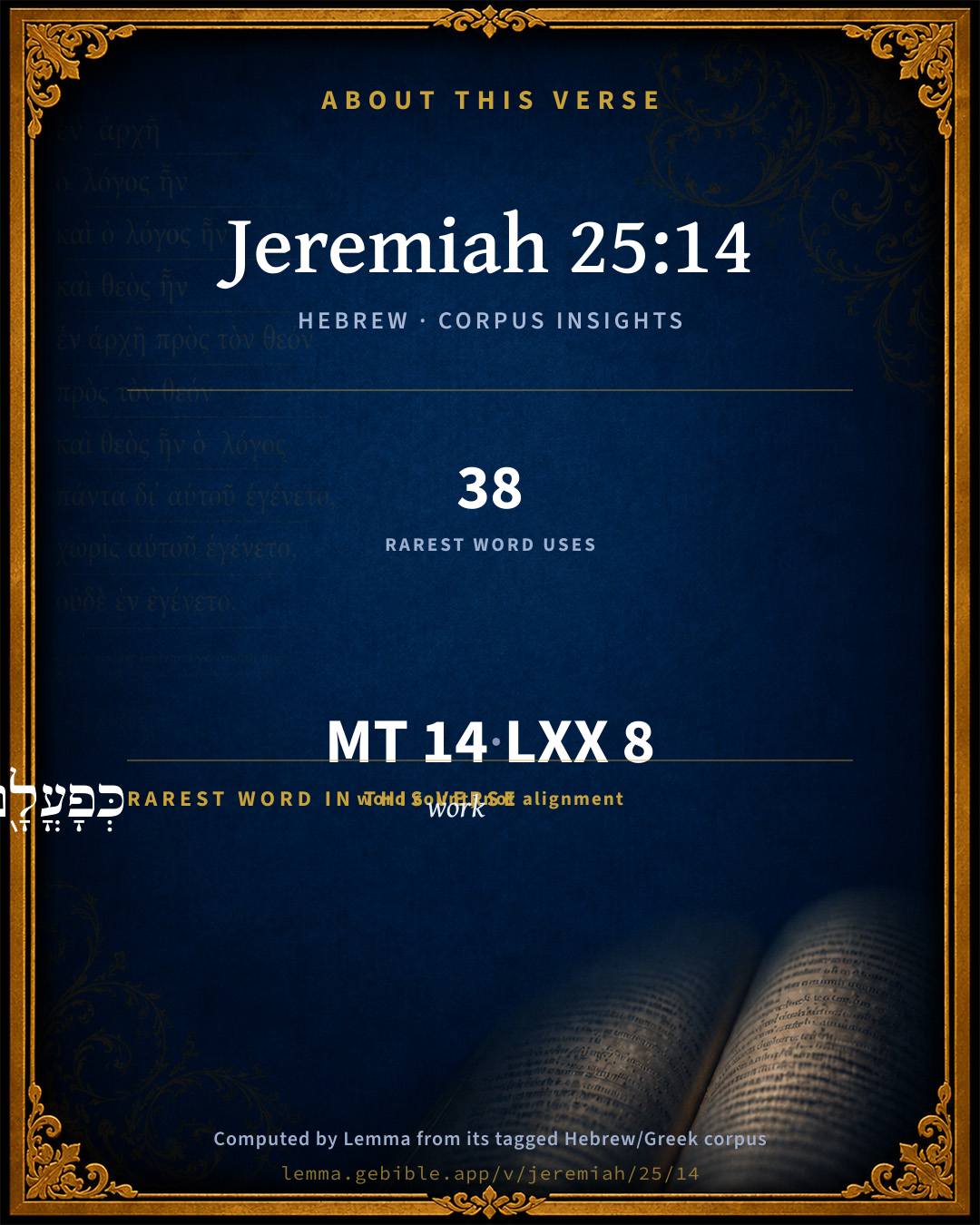
About this verse

These counts appear in no published source. They are computed here, from the morphology-tagged text and Lemma’s own curated glosses. What Lemma adds →

14
words
12
distinct lemmas
Prophets
section

Shared distinctive vocabulary

כְּפָעֳלָ֖ם work H6467 occurs in 38 verses of the Hebrew Bible. Also found in:

Grammatical profile

  • 2 verbs
  • 5 nouns
  • 2 adjectives
  • 1 pronoun
  • 2 prepositions
  • 1 conjunction
  • 1 particle

Verb forms

  • עָֽבְדוּ Qal · Perfect
  • וְשִׁלַּמְתִּ֥י Piel · Sequential Perfect

Hebrew & Septuagint length

In the original languages it is 14 Hebrew tokens and 8 Greek tokens — but the two are counted differently (Hebrew bundles its prefixes and suffixes into one token; the Greek is in lemma form), so that isn’t a like-for-like length.

Cross-references

14

Topical passages linked to Jeremiah 25:14 in the Treasury of Scripture Knowledge — connected by theme and wording, ordered by reader-vote popularity; previews shown in the World English Bible.

  • Jeremiah 51:6 Flee out of the midst of Babylon, and save every man his life; don't be cut off in her iniquity: for it is the time of Yahweh's vengeance; he will render to her a recompense.
  • Jeremiah 27:7 All the nations shall serve him, and his son, and his son's son, until the time of his own land come: and then many nations and great kings shall make him their bondservant.
  • Jeremiah 50:9 For, behold, I will stir up and cause to come up against Babylon a company of great nations from the north country; and they shall set themselves in array against her; from there she shall be taken: their arrows shall be as of an expert mighty man; none shall return in vain.
  • Jeremiah 50:41 Behold, a people comes from the north; and a great nation and many kings shall be stirred up from the uttermost parts of the earth.
  • Isaiah 14:2 The peoples shall take them, and bring them to their place; and the house of Israel shall possess them in the land of Yahweh for servants and for handmaids: and they shall take them captive whose captives they were; and they shall rule over their oppressors.
  • Isaiah 45:1–3 Thus says Yahweh to his anointed, to Cyrus, whose right hand I have held, to subdue nations before him, and I will loose the loins of kings; to open the doors before him, and the gates shall not be shut:
  • Isaiah 66:6 A voice of tumult from the city, a voice from the temple, a voice of Yahweh that renders recompense to his enemies.
  • Psalms 137:8 Daughter of Babylon, doomed to destruction, He will be happy who rewards you, As you have served us.
  • Jeremiah 50:29–34 Call together the archers against Babylon, all those who bend the bow; encamp against her round about; let none of it escape: recompense her according to her work; according to all that she has done, do to her; for she has been proud against Yahweh, against the Holy One of Israel.
  • Jeremiah 51:20–28 You are my battle-axe and weapons of war: and with you will I break in pieces the nations; and with you will I destroy kingdoms;
  • Jeremiah 51:35–41 The violence done to me and to my flesh be on Babylon, shall the inhabitant of Zion say; and, My blood be on the inhabitants of Chaldea, shall Jerusalem say.
  • Daniel 5:28 PERES; your kingdom is divided, and given to the Medes and Persians.
  • Habakkuk 2:8–16 Because you have plundered many nations, all the remnant of the peoples will plunder you, because of men's blood, and for the violence done to the land, to the city and to all who dwell in it.
  • Revelation 18:20–24 Rejoice over her, O heaven, you saints, apostles, and prophets; for God has judged your judgment on her."

Cross-references courtesy of OpenBible.info (CC BY 4.0).

Hebrew and Greek witnesses Masoretic Hebrew ↔ Greek Septuagint

The same verse in the two great witnesses to the Old Testament, shown verse-for-verse.

These are two independent witnesses, not word-aligned to each other, and the Septuagint is shown in lemma (dictionary) form.

Hebrew Jeremiah 25:14 Masoretic · Westminster Leningrad Codex

כִּ֣י עָֽבְדוּ בָ֤ם גַּם הֵ֨מָּה֙ גּוֹיִ֣ם רַבִּ֔ים וּמְלָכִ֖ים גְּדוֹלִ֑ים וְשִׁלַּמְתִּ֥י לָהֶ֛ם כְּפָעֳלָ֖ם וּכְמַעֲשֵׂ֥ה יְדֵיהֶֽם

For many nations and great kings shall make bondservants of them, even of them; and I will recompense them according to their deeds, and according to the work of their hands.

World English Bible · Public Domain

Greek LXX Structure differs

In the Septuagint, Jeremiah is about an eighth shorter than the Hebrew and arranges its material differently — the Oracles Against the Nations (Hebrew chapters 46–51) appear in the middle of the Greek book, after 25:13. Because the chapter and verse boundaries do not line up, a verse-for-verse comparison with the Hebrew is not shown.

A verse-for-verse comparison isn’t shown here because the chapters and verses don’t line up. Switch to the LXX edition with the MT / LXX toggle above to read the Greek directly.

On this verse, Haydock's Catholic Bible Commentary discusses the Septuagint’s reading. Read the note in Commentary ↓

Hebrew: Westminster Leningrad Codex (CC BY 4.0). Greek: Septuagint (public domain); English from a public-domain English Septuagint. How the Septuagint differs from the Hebrew →

Targum (Aramaic paraphrase)

1

The Targum is the ancient Jewish Aramaic paraphrase of the Hebrew Scriptures — an interpretive translation, not the Hebrew text itself. Onkelos (literal) and Pseudo-Jonathan (expansive) render the Torah, and Jonathan the Prophets. Coverage is partial: where no permissively-licensed English translation exists for a verse, only the Aramaic is shown. This is verse-level text, not a word-by-word alignment to the Hebrew.

  1. Targum Jonathan Prophets (Joshua–Malachi)
    אֲרֵי פְלָחוּ בְהוֹן אַף אִינוּן עַמְמִין סַגִיאִין וּמַלְכִין רַבְרְבִין וַאֲשַׁלֵים לְהוֹן כֶּאֱגוֹרֵיהוֹן וּכְעוֹבְדֵי יְדֵיהוֹן:

    (no public-domain English translation for this verse)

    Targum Jonathan — Aramaic: “Mikraot Gedolot” (public domain). English: “Sefaria Community Translation” (CC0 1.0 (public-domain dedication)); “London "Chaldee Paraphrase," 1871” (public domain). Text via Sefaria.

Commentary

Notes on Jeremiah 25:14 from classic Christian and Jewish commentators (each source and its license shown beneath its notes). The classic Christian expositions comment on the surrounding passage and are grouped to its opening verse, so a note may address several verses; the Jewish commentaries on the Tanakh (Rashi and others) are per-verse, so they appear only where the commentator wrote on this verse.

Lemma curates 59 commentaries, every one of them public domain or Creative Commons licensed, each selected and text-cleaned for this edition rather than reprinted as found. About our sources →

Trapp's Complete Commentary

John Trapp

Jer 25:14 For many nations and great kings shall serve themselves of them also: and I will recompense them according to their deeds, and according to the works of their own hands.

Ver. 14. For many nations.] The Medes and Persians, together with the rest that served under them.

And great kings.] Cyrus and Darius especially.

John Trapp, A Commentary or Exposition upon All the Books of the Old and New Testament (1647–1656) — public domain. Text from a community e-Sword module.

Keil & Delitzsch

C. F. Keil & F. Delitzsch

The perfect עבדוּ is to be regarded as a prophetic present. עבד בּ, impose labour, servitude on one, cf. Jer 22:13, i.e., reduce one to servitude. גּם המּה is an emphatic repetition of the pronoun בּם, cf. Gesen. 121, 3. Upon them, too (the Chaldeans), shall many peoples and great kings impose service, i.e., they shall make the Chaldeans bondsmen, reduce them to subjection. With "I will requite them," cf. Jer 50:29; Jer 51:24, where this idea is repeatedly expressed.

(Note: Jer 25:11-14 are pronounced by Hitz., Ew., Graf to be spurious and interpolated; but Hitz. excepts the second half of Jer 25:14, and proposes to set it immediately after the first half of Jer 25:11. Their main argument is the dogmatic prejudice, that in the fourth year of Jehoiakim Jeremiah could not have foretold the fall of Babylon after seventy years' domination. The years foretold, says Hitz., "would coincide by all but two years, or, if Darius the Mede be a historical person, perhaps quite entirely. Such correspondence between history and prophecy would be a surprising accident, or else Jeremiah must have known beforehand the number of years during which the subjection to Babylon would last." Now the seventy years of Babylon's sovereignty are mentioned against in Jer 29:10, where Jeremiah promises the exiles that after seventy years they shall return to their native land, and no doubt is thrown by the above-mentioned critics on this statement; but there the seventy years are said to be a so-called round number, because that prophecy was composed nine years later than the present one. But on the other hand, almost all comm. have remarked that the utterance of Jer 29:10 : "when as for Babylon seventy years are accomplished, will I visit you," points directly back to the prophecy before us (25), and so gives a testimony to the genuineness of our 11th verse. And thus at the same time the assertion is disposed of, that in Jer 29:10 the years given are a round number; for it is not there said that seventy years will be accomplished from the time of that letter addressed by the prophet to those in Babylon, but the terminus a quo of the seventy years is assumed as known already from the present twenty-fifth chap. - The other arguments brought forward by Hitz. against the genuineness of the verse have already been pronounced inconclusive by Ng. Nevertheless Ng. himself asserts the spuriousness, not indeed of Jer 25:11 (the seventy years' duration of Judah's Babylonian bondage), but of Jer 25:12-14, and on the following grounds: - 1. Although in Jer 25:11, and below in Jer 25:26, it is indicated that Babylon itself will not be left untouched by the judgment of the Lord, yet (he says) it is incredible that in the fourth year of Jehoiakim the prophet could have spoken of the fall of Babylon in such a full and emphatic manner as is the case in Jer 25:12-14. But no obvious reason can be discovered why this should be incredible. For though in Jer 25:26 Jeremiah makes use of the name Sheshach for Babylon, it does not hence follow that at that moment he desired to speak of it only in a disguised manner. In the statement that the Jews should serve the king of Babylon seventy years, it was surely clearly enough implied that after the seventy years Babylon's sovereignty should come to an end. Still less had Jeremiah occasion to fear that the announcement of the fall of Babylon after seventy years would confirm the Jews in their defiant determination not to be tributary to Babylon. The prophets of the Lord did not suffer themselves to be regulated in their prophesyings by such reasons of human expediency. - 2. Of more weight are his other two arguments. Jer 25:12 and Jer 25:13 presume the existence of the prophecy against Babylon, Jer 50 and 51, which was not composed till the fourth year of Zedekiah; and the second half of Jer 25:13 presumes the existence of the other prophecies against the nations, and that too as a ספר. And although the greater number of these prophecies are older than the time of the battle at Carchemish, yet we may see (says Ng.) from the relation of apposition in which the second half of Jer 25:13 stands to the first, that here that Sepher against the peoples is meant in which the prophecy against Babylon was already contained. But from all this nothing further follows than that the words: "all that is written in this book and that Jeremiah prophesied against the peoples," were not uttered by Jeremiah in the fourth year of Jehoiakim, but were first appended at the editing of the prophecies or the writing of them down in the book which has come down to us. The demonstrative הזּה does by no means show that he who wrote it regarded the present passage, namely Jer 25, as belonging to the Sepher against the peoples, or that the prophecies against the peoples must have stood in immediate connection with Jer 25. It only shows that the prophecies against the peoples too were found in the book which contained Jer 25. Again, it is true that the first half of Jer 25:14 occurs again somewhat literally in Jer 27:7; but we do not at all see in this reliable evidence that Jeremiah could not have written Jer 25:14. Ng. founds this conclusion mainly on the allegation that the perf. עבדוּ is wrong, whereas in Jer 27:7 it is joined regularly by ו consec. to the indication of time which precedes. But the perfect is here to be regarded as the prophetic present, marking the future as already accomplished in the divine counsel; just as in Jer 27:6 the categorical נתתּי represents as accomplished that which in reality yet awaited its fulfilment. Accordingly we regard none of these arguments as conclusive. On the other hand, the fact that the Alexandrian translators have rendered Jer 25:12 and Jer 25:13, and have made the last clause of Jer 25:13 the heading to the oracles against the peoples, furnishes an unexceptionable testimony to the genuineness of all three verses. Nor is this testimony weakened by the omission in that translation of Jer 25:14; for this verse could not but be omitted when the last clause of Jer 25:13 had been taken as a heading, since the contents of Jer 25:14 were incompatible with that view.)

Keil & Delitzsch — Biblical Commentary on the Old Testament (1861–1891) — public domain (CC PDM 1.0). Text via the HelloAO Bible API. (Old Testament only.)

Geneva Bible (1599)

Geneva Bible translators

That is, of the Babylonians, as Jer. 27:7.

Geneva Bible (1599) marginal notes — public domain. Text via Bolls.life.

Jamieson, Fausset & Brown

Robert Jamieson, A. R. Fausset & David Brown

serve themselves-- (Jer 27:7; Jer 30:8; Jer 34:10). Avail themselves of their services as slaves.

them also--the Chaldees, who heretofore have made other nations their slaves, shall themselves also in their turn be slaves to them. MAURER translates, "shall impose servitude on them, even them."

recompense them--namely, the Chaldees and other nations against whom Jeremiah had prophesied (Jer 25:13), as having oppressed the Jews.

their deeds--rather, "deed," namely, their bad treatment of the Jews (Jer 50:29; Jer 51:6, Jer 51:24; compare Ch2 36:17).

Jamieson, Fausset & Brown — Commentary Critical and Explanatory on the Whole Bible (1871) — public domain (CC PDM 1.0). Text via the HelloAO Bible API.

Adam Clarke's Commentary

Verse 14. Many nations and great kings] The Medes and the Persians, under Cyrus; and several princes, his vassals or allies.

Adam Clarke's Commentary on the Bible (1810–1826) — public domain. Text from a community e-Sword/MySword module.

John Calvin's Commentaries

The beginning of the verse is obscure. When the verb עבד, obed, is followed by ב, beth, they think that it is to be taken actively, and rendered, to force or drive to bondage. It means properly, to serve; but they think that found as here it is a transitive verb. Some render it, “they employed them;” but this is frigid and ambiguous; for friends may be said to employ one another, when the work is mutual; hence the meaning is not sufficiently expressed. But the meaning may be given by a paraphrase, that they “forced them into bondage.” Still the meaning of the Prophet is not yet sufficiently clear; for עבדו, obedu, may be taken either in the past or future tense. It is, indeed, in the past tense; but the past may be taken for the future: thus the meaning may be different. If it be taken in the past tense, then it cannot be applied except to the Babylonians; for they were those who had treated the Israelites as slaves, or had forced them into bondage; and בם, bem, “them,” might be understood of the Israelites; for we know that pronouns are often thus used, when the Church, or God’s elect people, is the subject. Then the Prophet’s words may be thus rendered, “for they have tyrannically ruled over them,” even the Israelites, “and they themselves,” that is, the Israelites, shall in their turn rule, the latter words being understood. But the meaning, as it seems to me, would be more simple, were we to read the whole together in this way, “For they also themselves shall rule over them, even over strong and valiant nations and great kings, and I will recompense them,” etc.

The reason which has constrained me to give this interpretation is this: It is said in the last verse that Jeremiah prophesied against all nations; then follows an explanation, and the Prophet briefly shews, or reminds us, what would be the issue of these prophecies, even that they also would themselves rule over these nations. Then בם, bem, as I think, refers to the Babylonians and other heathen nations; and it is a common thing with the prophets, when they speak of the restoration of the ancient Church, and of Christ’s coming, to promise power to God’s children to hold the whole world under their feet. The sentence also will flow better, when we give this version, “They shall rule.” There is, indeed, a change as to time, but this is a common thing in Hebrew. It is then; For they shall rule over them, that is, the nations. Jeremiah had spoken of all heathen nations; mention had been made of all that he had prophesied against all nations; and he says now what seemed incredible, and hence the particle גם, gam, is introduced, “even these very Israelites,” as though he had said, “Though this shall happen beyond hope, so as to appear strange and fabulous, yet God by the issue will shew that he has not in vain communicated this to me; for they, even the Israelites, shall have their turn to exercise dominion; and they shall constrain all nations to obey them.” And what follows confirms my view; for he adds, over strong nations, גוים רבים, guim rebim, (for the ב, beth, may be repeated here;) or we may render the words “many nations;” for the word רבים, rebim, means both; but as it follows “and great kings,” I am disposed to render the words, “strong nations.” Then he says, “For they shall rule over strong nations and great kings.”

He then subjoins, I will recompense them, that is, both kings and nations, according to their doing, and according to the work of their hands, because they had exercised every kind of cruelty towards the miserable Israelites. Hence the Prophet pursues the same subject, — that God would at length really shew, that though he had been angry with his Church, yet all hope of mercy was not lost, for he was mindful of his covenant. He thus mitigates the severity of what he had previously said; he promises them something far better than what the wretched Jews could have expected in their extreme calamities.

We may again learn from the words of the Prophet, that God so employed Nebuchadnezzar and others, that they performed no service deserving of praise; for had they been without fault, God must doubtless have unjustly punished them. This passage then teaches us, that though the devil and the reprobate execute God’s judgments, they yet deserve no praise for their obedience, for they have no such purpose in view. It now follows, —

John Calvin's Commentaries (1540-1563) — public domain. Text from the Calvin Translation Society English edition (1840s-50s) via the Christian Classics Ethereal Library (ccel.org). Calvin's coverage is partial (roughly two-thirds of the Bible); uncommented books and verses are honest gaps, never fabricated. The 19th-century editor's footnotes and remarks are omitted so the notes are faithfully Calvin's own voice.

Ellicott's Commentary for English Readers

(14) Shall serve themselves of them.—Better, shall make them their servants. The English “serve themselves” (a Gallicism in common use in the seventeenth century), which occurs again in Jer_27:7, is now ambiguous, and hardly conveys the force of the original. What is meant is that the law of retribution will in due time be seen in its action upon those who were now masters of the world. The thought is the same as that expressed in the familiar “Græcia capta ferum victorem cepit” of Horace (Ep II. i., 156).

A Bible Commentary for English Readers, edited by Charles John Ellicott (1878–1897) — public domain. Text from a community e-Sword module.

The Cambridge Bible for Schools and Colleges

gen. ed. J. J. S. Perowne

14. shall serve themselves of them, even of them] lit. shall work by (means of) them, i.e. shall use them as slaves. As the Chaldaeans have done to the people of God, so shall He requite them.

The Cambridge Bible for Schools and Colleges (gen. ed. J. J. S. Perowne; Cambridge University Press, 1878–1918) — public domain. Text from a community e-Sword module.

John Gill's Exposition

For many nations and great kings shall serve themselves of them also,.... Take their cities, seize upon the kingdoms, spoil them of their wealth and riches, and bring them into servitude to them: these "many nations", which should and did do all this, were the Medes and Persians, and those that were subject to them, or were their allies and auxiliaries in this expedition; and the "great kings" were Cyrus and Darius, and those that were confederate with them:

and I will recompense them according to their deeds, and according to the works of their own hands; as they have done to others, it shall be done to them; as they have served themselves of other nations, other nations shall serve themselves of them; as they have cruelly used others, they shall be used with cruelty themselves; and as they have made other countries desolate, their land shall become desolate also; not only their tyranny and cruelty, but all their other sins, shall receive a just recompence of reward.

John Gill's Exposition of the Whole Bible (1746–1763) — public domain (CC PDM 1.0). Text via the HelloAO Bible API.

Albert Barnes' Notes on the Bible

Shall serve themselves of them also - i. e., shall impose forced labor upon the Chaldaeans, and reduce them also to servitude.

Albert Barnes' Notes on the Bible (1834–1885) — public domain. Text from a community e-Sword/MySword module.

Haydock's Catholic Bible Commentary

Kings. They perfidiously joined the Chaldeans, after making a league with Sedecias, chap. xxvii. 3. This is condemned, (Calmet) and not precisely their submitting to Nabuchodonosor, chap. xxviii. 8. Their league with Juda was indeed wrong; but the infringement of it was another crime. Septuagint is here much transposed almost to the end. See Grabe. (Haydock) --- Jeremias had prophesied against the nations, though his words are given, chap. xlvi., &c.

George Leo Haydock (1774–1849), Haydock's Catholic Family Bible and Commentary, 1859 edition — public domain. Excludes Psalms (Douay-Rheims chapter numbering differs from Protestant) and Deuterocanonical books (Catholic canon only).

Matthew Poole's English Annotations

God threateneth the destruction of that monarchy by the Persians, according to the prophecy of this prophet, and declareth that their destruction was of themselves, God did but recompense unto them their own deeds, and the works of their hands; which is not to be restrained to their excesses in executing Divine vengeance, and the cruelty they used to the Israelites, but more generally interpreted of all their wicked courses.

Matthew Poole's English Annotations on the Holy Bible (1683–1685) — public domain. Text from a community e-Sword/MySword module.

Whedon's Commentary on the Bible

Daniel D. Whedon

14. Shall serve themselves — Shall make them, namely, the Chaldeans. their slaves. See Jer_50:29; Jer_51:24.

Daniel D. Whedon (gen. ed.), Commentary on the Old and New Testaments (1874–1909) — public domain. Text from a community e-Sword module.

The Pulpit Commentary

For many nations... shall serve themselves of them else; i.e. put forced labor upon them also. The same phrase is used of the conduct of the Egyptians to the Israelites. (Exo_1:14) Of them also; and "also" suggests that the calamity of the Chaldeans is a retribution, (comp. Isa_66:4) as the next clause, in harmony with Jer_50:29, Jer_51:24, emphatically declares.

The Pulpit Commentary (1880–1919), ed. H.D.M. Spence-Jones & Joseph S. Exell — public domain. Text from a community e-Sword module.

Rashi

Rabbi Shlomo Yitzchaki (Rashi)

For... will enslave them Like ‘For... shall enslave them,’ i.e., shall enslave the people of Babylon.

many nations...too Viz. Media and Persia.

Rashi on the Tanakh — English translations: “The Judaica Press complete Tanach with Rashi, translated by A. J. Rosenberg” (CC BY 4.0); “Pentateuch with Rashi's commentary by M. Rosenbaum and A.M. Silbermann, 1929-1934” (public domain); “The Metsudah Tanach series, Lakewood, N.J” (CC BY 4.0); and “The Book of Joshua, Metsudah Publications, 1997” (CC BY 4.0). Text via Sefaria.

Lesson kit

Teaching starters — assembled from the data on this page, not authored interpretation. Every prompt links to the verse data it draws on. Edit before teaching.

Jeremiah, in the Prophets, opens this verse with 14 words (12 distinct Hebrew lemmas). Its most distinctive word is pôʻal (“work”). A historical commentator’s framing appears above. Read the whole chapter for the surrounding context.

Discussion questions

  1. The word pôʻal carries the sense “work.” How does it shape the verse?
  2. How does Deuteronomy 32:4, which shares the word «work», read alongside this verse?
  3. The translations on this page render this verse differently — a whole-verse word diff, not a word-by-word alignment. What might account for the different wordings?
  4. «עָֽבְדוּ» is a Qal Perfect verb. How does that grammatical form shape the action described?
  5. Compare how Trapp's Complete Commentary and Keil & Delitzsch read this verse. Where do they agree or differ?

Things to notice

Reading settings

Reading text

Shown beneath each verse's original-language words.

Old Testament
Old Testament edition

Read the OT as the Masoretic Hebrew (MT) or the Greek Septuagint (LXX).

English shown for the Greek Septuagint (in the Hebrew ↔ Greek comparison).

Comparing translations? Open the Compare panel on any verse page to stack up to four side by side.