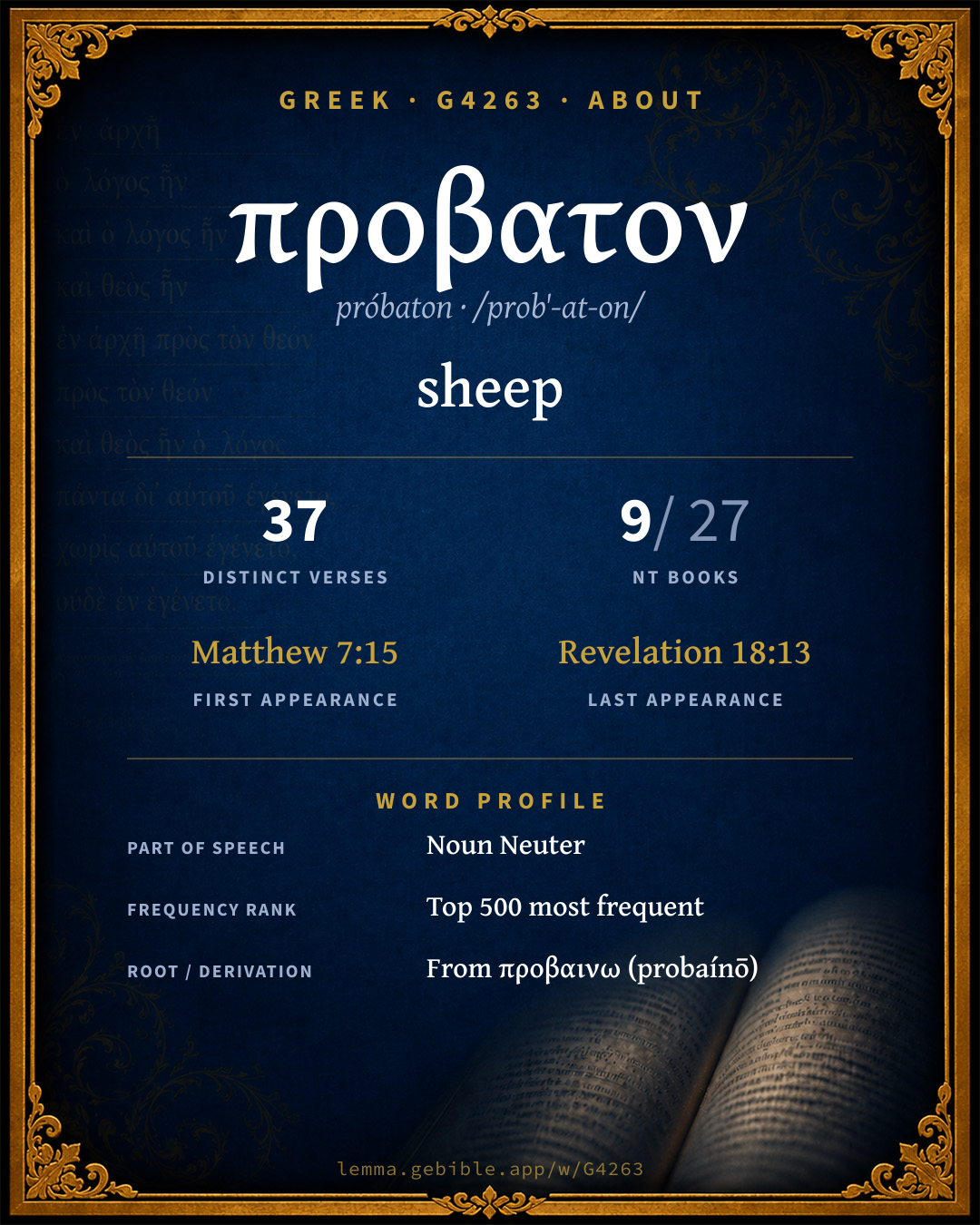
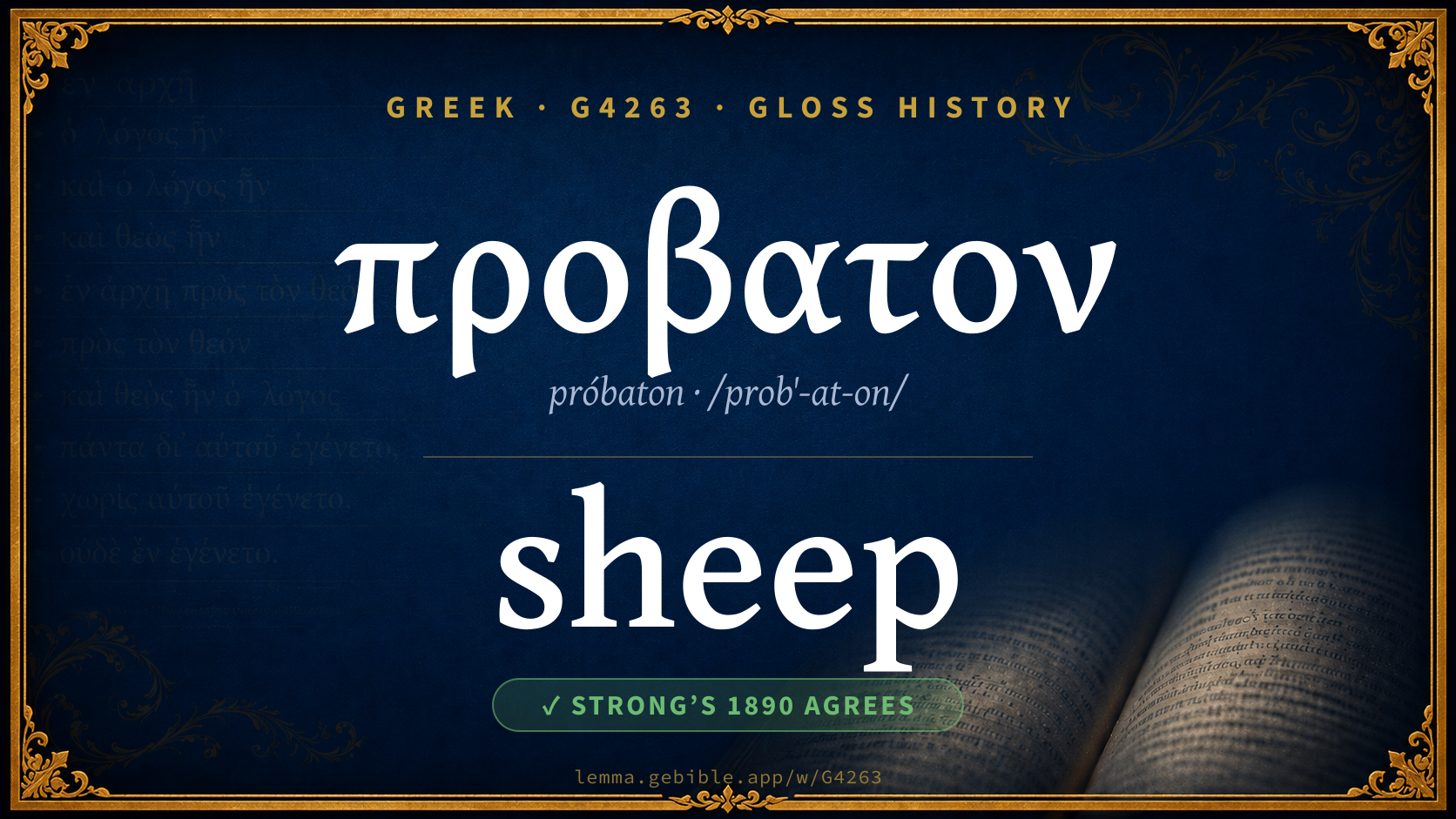
πρόβατον
sheep
Full lexicon entry — Thayer's Greek Lexicon
From Thayer's Greek Lexicon
Where this word appears
Grammar key — what these labels mean
Part of speech
- Noun
- A naming word — a person, place, thing, or idea.
Case
- Accusative
- The case of the direct object and of extent.
- Nominative
- The case of the subject (and the predicate nominative).
- Genitive
- The case of source, possession, or “of” — answers “whose / from what.”
Gender
- Neuter
- Grammatically neuter.
Number
- Plural
- More than one.
- Singular
- One.
Every verse where G4263 appears in the Book of Mark — 2 distinct verses. Click any verse to open its interlinear word-by-word view. Verse text shown in the World English Bible for context — . Each verse’s Greek form is shown with its reference; the English is not keyword-highlighted, since the data carries no word-level English alignment. Use “Compare translations” on any verse to read it across multiple English versions. This concordance covers the Greek New Testament; Septuagint (Greek Old Testament) occurrences of this word are not indexed here.
Mark
- Mark 6:34 πρόβατα n nom pl neut Jesus came out, saw a great multitude, and he had compassion on them, because they were like sheep without a shepherd, and he began to teach them many things.
- Mark 14:27 πρόβατα n nom pl neut Jesus said to them, "All of you will be made to stumble because of me tonight, for it is written, 'I will strike the shepherd, and the sheep will be scattered.'
About this entry
At a glance — auto-summarized from this page’s data, not written by a person. Every figure links to its source below. This summary describes the numbers; it doesn’t interpret them.
The Greek noun προβατον centers on the idea of “sheep.” First canonically at Matthew 7:15, it enters the text early. The Greek New Testament uses it across 37 verses — moderately common. John dominates its distribution — 17 of 37 verses. Related forms include προβαινω and προβατικος. For the data behind this summary, explore the sense tree and the renderings breakdown below.
Gloss history
Strong's 1890 vs modern scholarship
About this word
Strong's G4263 catalogs a Greek word from the Greek New Testament.
These counts are not copied from any lexicon or concordance. They are computed here, from the morphology-tagged Greek New Testament. What Lemma adds →
- 37
- distinct verses
- The word appears in 37 distinct verses.
- 9 / 27
- NT books
- The word appears in 9 of 27 New Testament books.
- #385
- by frequency
- Top 500 most frequent Greek words (rank 385 of 5,347 Greek words by occurrence).
View all 37 occurrences in the concordance →
By section of the New Testament
By traditional corpus
Conventional, traditional groupings — biblical authorship is debated, so this is a traditional corpus grouping, not an authorship claim. Some books belong to more than one corpus (Luke is in both the Gospels and the Lukan corpus, and so on), so these shares overlap and need not total 100%. Each figure is a share of the word’s 37 distinct verses.
- Gospels 32 verses · 86%
- Johannine 18 verses · 49%
- Lukan (Luke–Acts) 3 verses · 8%
- Pauline corpus 1 verse · 3%
- Hebrews 1 verse · 3%
- General (Catholic) Epistles 1 verse · 3%
- Revelation 1 verse · 3%
How translations render this word
Counts come from each version’s own published word-to-Strong’s tagging or interlinear alignment — an approximate guide to how each version renders this word, not a word-level alignment the data otherwise carries. Because each total is that version’s own tagged count, the per-version totals vary from one another and need not match the appearance or distinct-verse counts above. These counts may also differ from a printed concordance because Lemma counts each distinctly tagged rendering and does not collapse phrase taggings into a single head-word total. This is a fixed set of word-tagged versions (KJV, ASV, BSB, ULT) and does not change with the reading translation you choose elsewhere. Each version’s license is shown beside its name below (and on Sources).
- King James Version: Sheep 39×
- American Standard Version: Sheep 35×
- Berean Standard Bible: Sheep 36×
- unfoldingWord Literal Text: Sheep 37×
King James Version Public Domain
Renders G4263 across 41 tagged occurrences — most commonly:
Plus 2 renderings that appear only once — usually multi-word phrases or single function words the recovered tagging swept in, not distinct renderings.
American Standard Version Public Domain
Renders G4263 across 37 tagged occurrences — most commonly:
Plus 2 renderings that appear only once — usually multi-word phrases or single function words the recovered tagging swept in, not distinct renderings. Not rendered by a distinct English word in 1 further occurrence.
Berean Standard Bible Public Domain
Renders G4263 across 39 tagged occurrences — most commonly:
Plus 3 renderings that appear only once — usually multi-word phrases or single function words the recovered tagging swept in, not distinct renderings.
unfoldingWord Literal Text CC BY-SA 4.0
Renders G4263 across 39 tagged occurrences — most commonly:
Plus 2 renderings that appear only once — usually multi-word phrases or single function words the recovered tagging swept in, not distinct renderings.
Senses in Thayer's
The 1 sense Thayer's distinguishes for this word, in lexicon order (not ranked by frequency or importance). The full entry — with sub-senses — is in the Lexicon Entry tab.
- any four footed…
Word origin
Derived from προβαινω (probaínō) (G4260) — to go forward.
Properly the neuter of a presumed derivative of G4260 ; something that walks forward (a quadruped ) that is (specifically) a sheep (literally or figuratively): - sheep ([-fold]).
— Strong’s Exhaustive Concordance (1890), public domain.
Forms in the corpus
The 6 distinct written forms G4263 takes in the Greek New Testament, most frequent first — each parse links to that case’s occurrences in the concordance.
| Form | Parsing | Example | Uses |
|---|---|---|---|
| πρόβατα próbata | Noun, Accusative, Plural, Neuter | Matthew 9:36 | 24 |
| προβάτων probátōn | Noun, Genitive, Plural, Neuter | Matthew 7:15 | 9 |
| πρόβατον próbaton | Noun, Accusative, Singular, Neuter | Matthew 12:11 | 2 |
| προβάτιά probátiá | Noun, Accusative, Plural, Neuter | John 21:16 | 2 |
| προβάτου probátou | Noun, Genitive, Singular, Neuter | Matthew 12:12 | 1 |
| πρόβατόν próbatón | Noun, Accusative, Singular, Neuter | Luke 15:6 | 1 |
Same root — word family
Other Thayer's entries built from the same root as G4263, grouped by Strong’s listed origin. These share a root / origin per the lexicon — not necessarily a shared meaning. Each links to that word’s own entry.
Derives from
Derived from this word
Compare all same-root words → They share a root, not necessarily a meaning.
Septuagint usage
The same Greek word προβατον appears 285 times in the Greek Old Testament (Septuagint), across 254 verses in 27 books.
- 285
- LXX occurrences
- Tagged occurrences of this Greek word in the Septuagint.
- 254
- verses
- Distinct Septuagint verses containing this word.
- 27 / 39
- OT books
- The word appears in 27 of the 39 Old Testament books.
Sample Septuagint occurrences
- Genesis 4:2 πρόβατον
- Exodus 2:16 πρόβατον
- Leviticus 1:2 πρόβατον
- Numbers 11:22 πρόβατον
- Deuteronomy 7:13 πρόβατον
- Joshua 7:24 πρόβατον
- 1 Samuel 14:34 πρόβατον
- 2 Samuel 7:8 πρόβατον
- 1 Kings 1:9 πρόβατον
- 2 Kings 5:26 πρόβατον
- 1 Chronicles 5:21 πρόβατον
- 2 Chronicles 5:6 πρόβατον
Septuagint occurrences (same lexeme)
Every verse where the same Strong’s number (G4263) appears in the Greek Septuagint — showing the first 50 of 254. Verse text shown in the World English Bible for context; the Greek form is the matched word — the English is not keyword-highlighted.
- Genesis 4:2 πρόβατον Again she gave birth, to Cain's brother Abel. Abel was a keeper of sheep, but Cain was a tiller of the ground.
- Genesis 4:4 πρόβατον Abel also brought some of the firstborn of his flock and of the fat of it. Yahweh respected Abel and his offering,
- Genesis 12:16 πρόβατον He dealt well with Abram for her sake. He had sheep, and oxen, and male donkeys, and men-servants, and maid-servants, and female donkeys, and camels.
- Genesis 13:5 πρόβατον Lot also, who went with Abram, had flocks, and herds, and tents.
- Genesis 20:14 πρόβατον Abimelech took sheep and oxen, men-servants and women-servants, and gave them to Abraham, and restored Sarah, his wife to him.
- Genesis 21:27 πρόβατον Abraham took sheep and oxen, and gave them to Abimelech. Those two made a covenant.
- Genesis 21:28 πρόβατον Abraham set seven ewe lambs of the flock by themselves.
- Genesis 21:29 πρόβατον Abimelech said to Abraham, "What do these seven ewe lambs which you have set by themselves mean?"
- Genesis 22:7 πρόβατον Isaac spoke to Abraham his father, and said, "My father?" He said, "Here I am, my son." He said, "Here is the fire and the wood, but where is the lamb for a burnt offering?"
- Genesis 22:8 πρόβατον Abraham said, "God will provide himself the lamb for a burnt offering, my son." So they both went together.
- Genesis 24:35 πρόβατον Yahweh has blessed my master greatly. He has become great. He has given him flocks and herds, silver and gold, men-servants and maid-servants, and camels and donkeys.
- Genesis 26:14 πρόβατον He had possessions of flocks, possessions of herds, and a great household. The Philistines envied him.
- Genesis 27:9 πρόβατον Go now to the flock, and get me from there two good kids of the goats. I will make them savory food for your father, such as he loves.
- Genesis 29:2 πρόβατον He looked, and behold, a well in the field, and, behold, three flocks of sheep lying there by it. For out of that well they watered the flocks. The stone on the well's mouth was great.
- Genesis 29:3 πρόβατον There all the flocks were gathered. They rolled the stone from the well's mouth, and watered the sheep, and put the stone again on the well's mouth in its place.
- Genesis 29:6 πρόβατον He said to them, "Is it well with him?" They said, "It is well. See, Rachel, his daughter, is coming with the sheep."
- Genesis 29:7 πρόβατον He said, "Behold, it is still the middle of the day, not time to gather the cattle together. Water the sheep, and go and feed them."
- Genesis 29:8 πρόβατον They said, "We can't, until all the flocks are gathered together, and they roll the stone from the well's mouth. Then we water the sheep."
- Genesis 29:9 πρόβατον While he was yet speaking with them, Rachel came with her father's sheep, for she kept them.
- Genesis 29:10 πρόβατον It happened, when Jacob saw Rachel the daughter of Laban, his mother's brother, and the sheep of Laban, his mother's brother, that Jacob went near, and rolled the stone from the well's mouth, and watered the flock of Laban his mother's brother.
- Genesis 30:31 πρόβατον He said, "What shall I give you?" Jacob said, "You shall not give me anything. If you will do this thing for me, I will again feed your flock and keep it.
- Genesis 30:32 πρόβατον I will pass through all your flock today, removing from there every speckled and spotted one, and every black one among the sheep, and the spotted and speckled among the goats. This will be my hire.
- Genesis 30:36 πρόβατον He set three days' journey between himself and Jacob, and Jacob fed the rest of Laban's flocks.
- Genesis 30:38 πρόβατον He set the rods which he had peeled opposite the flocks in the gutters in the watering-troughs where the flocks came to drink. They conceived when they came to drink.
- Genesis 30:39 πρόβατον The flocks conceived before the rods, and the flocks brought forth streaked, speckled, and spotted.
- Genesis 30:40 πρόβατον Jacob separated the lambs, and set the faces of the flocks toward the streaked and all the black in the flock of Laban: and he put his own droves apart, and didn't put them into Laban's flock.
- Genesis 30:41 πρόβατον It happened, whenever the stronger of the flock conceived, that Jacob laid the rods before the eyes of the flock in the gutters, that they might conceive among the rods;
- Genesis 30:42 πρόβατον but when the flock were feeble, he didn't put them in. So the feebler were Laban's, and the stronger Jacob's.
- Genesis 31:8 πρόβατον If he said this, 'The speckled will be your wages,' then all the flock bore speckled. If he said this, 'The streaked will be your wages,' then all the flock bore streaked.
- Genesis 31:10 πρόβατον It happened at the time that the flock conceive, that I lifted up my eyes, and saw in a dream, and behold, the male goats which leaped on the flock were streaked, speckled, and grizzled.
- Genesis 31:12 πρόβατον He said, 'Now lift up your eyes, and behold, all the male goats which leap on the flock are streaked, speckled, and grizzled, for I have seen all that Laban does to you.
- Genesis 31:19 πρόβατον Now Laban had gone to shear his sheep: and Rachel stole the teraphim that were her father's.
- Genesis 31:38 πρόβατον These twenty years have I been with you. Your ewes and your female goats have not cast their young, and I haven't eaten the rams of your flocks.
- Genesis 31:41 πρόβατον These twenty years have I been in your house. I served you fourteen years for your two daughters, and six years for your flock, and you have changed my wages ten times.
- Genesis 32:6 πρόβατον The messengers returned to Jacob, saying, "We came to your brother Esau. Not only that, but he comes to meet you, and four hundred men with him."
- Genesis 32:8 πρόβατον and he said, "If Esau comes to the one company, and strikes it, then the company which is left will escape."
- Genesis 32:15 πρόβατον thirty milk camels and their colts, forty cows, ten bulls, twenty she-donkeys and ten foals.
- Genesis 33:13 πρόβατον Jacob said to him, "My lord knows that the children are tender, and that the flocks and herds with me have their young, and if they overdrive them one day, all the flocks will die.
- Genesis 34:28 πρόβατον They took their flocks, their herds, their donkeys, that which was in the city, that which was in the field;
- Genesis 37:2 πρόβατον This is the history of the generations of Jacob. Joseph, being seventeen years old, was feeding the flock with his brothers. He was a boy with the sons of Bilhah and Zilpah, his father's wives. Joseph brought an evil report of them to their father.
- Genesis 37:12 πρόβατον His brothers went to feed their father's flock in Shechem.
- Genesis 37:14 πρόβατον He said to him, "Go now, see whether it is well with your brothers, and well with the flock; and bring me word again." So he sent him out of the valley of Hebron, and he came to Shechem.
- Genesis 38:12 πρόβατον After many days, Shua's daughter, the wife of Judah, died. Judah was comforted, and went up to his sheep-shearers to Timnah, he and his friend Hirah, the Adullamite.
- Genesis 38:13 πρόβατον It was told Tamar, saying, "Behold, your father-in-law is going up to Timnah to shear his sheep."
- Genesis 38:17 πρόβατον He said, "I will send you a kid of the goats from the flock." She said, "Will you give me a pledge, until you send it?"
- Genesis 45:10 πρόβατον You shall dwell in the land of Goshen, and you will be near to me, you, your children, your children's children, your flocks, your herds, and all that you have.
- Genesis 46:34 πρόβατον that you shall say, 'Your servants have been keepers of cattle from our youth even until now, both we, and our fathers:' that you may dwell in the land of Goshen; for every shepherd is an abomination to the Egyptians."
- Genesis 47:3 πρόβατον Pharaoh said to his brothers, "What is your occupation?" They said to Pharaoh, "Your servants are shepherds, both we, and our fathers."
- Genesis 47:17 πρόβατον They brought their cattle to Joseph, and Joseph gave them bread in exchange for the horses, and for the flocks, and for the herds, and for the donkeys: and he fed them with bread in exchange for all their cattle for that year.
- Genesis 50:8 πρόβατον all the house of Joseph, his brothers, and his father's house. Only their little ones, their flocks, and their herds, they left in the land of Goshen.
These are occurrences of the same Greek lexeme (G4263) in the Septuagint — not a translation of any one Hebrew word. The store carries no word-level Hebrew↔Greek alignment, so no Hebrew original is asserted here. Counts come from the recovered LXX Strong's tagging — high-frequency vocabulary is well covered, while rare or late forms may be untagged — so they reflect tagged occurrences and may slightly undercount.