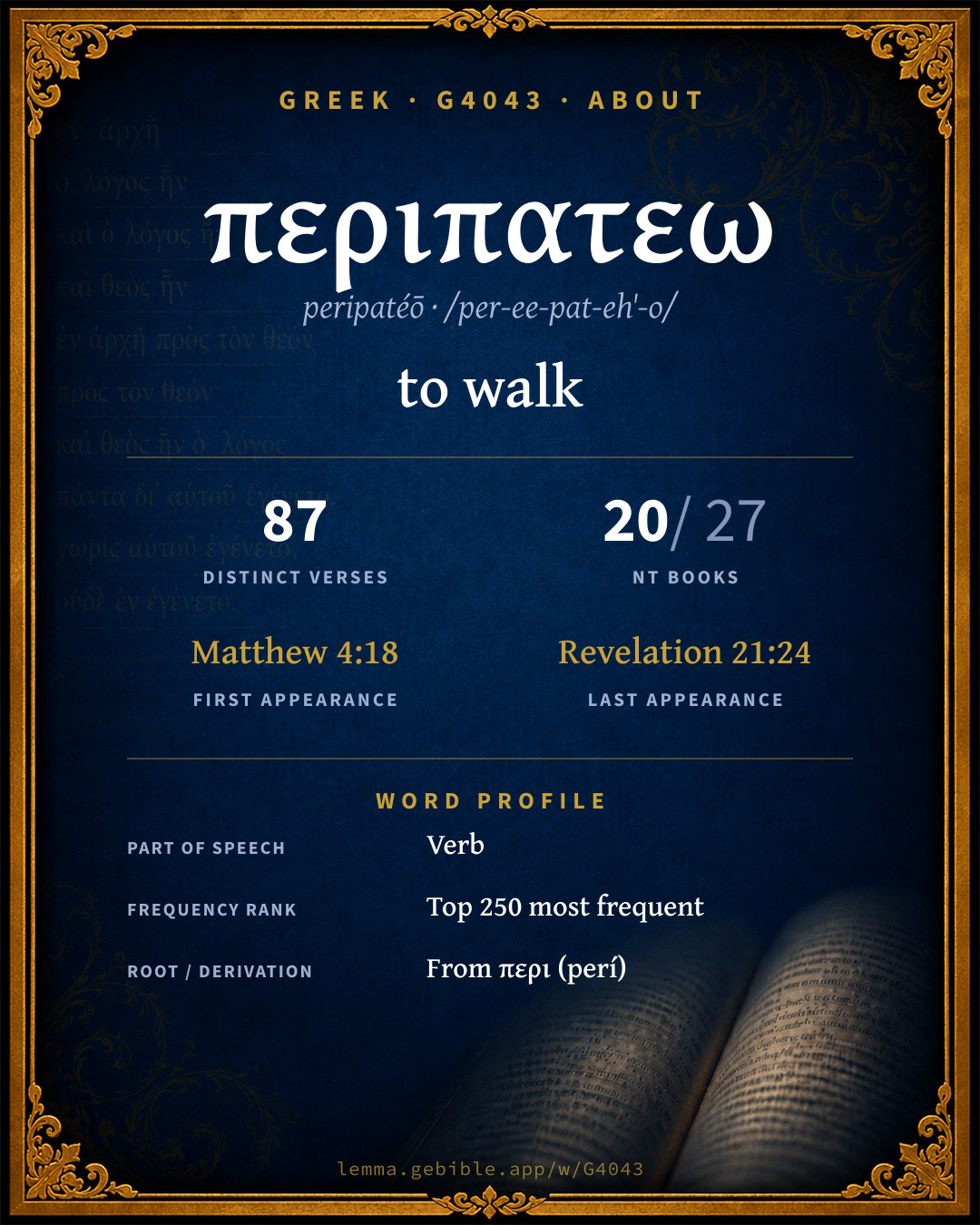
περιπατέω
to walk
‘to walk’ is one of 2 main senses fuller range ↓
Full lexicon entry — Thayer's Greek Lexicon
From Thayer's Greek Lexicon
Where this word appears
See every Present-tense verb in the Greek New Testament →
Grammar key — what these labels mean
Part of speech
- Verb
- An action or state-of-being word.
Tense
- Present
- Ongoing or general action in present time (imperfective aspect).
- Imperfect
- Continuous or repeated action in past time (“was writing”).
- Aorist
- Action viewed as a simple whole, without regard to duration — often past (perfective aspect).
- Future
- Action expected in future time.
Voice
- Active
- The subject performs the action.
Mood
- Infinitive
- A verbal noun (“to write”), unmarked for person or number.
- Indicative
- States a fact or asks a factual question (the mood of reality).
- Imperative
- Expresses a command or request.
- Participle
- A verbal adjective (“writing,” “having written”).
- Subjunctive
- Expresses probability, purpose, or possibility (the mood of contingency).
Case
- Accusative
- The case of the direct object and of extent.
- Nominative
- The case of the subject (and the predicate nominative).
- Dative
- The case of the indirect object, means, or location — “to / for / with / in.”
- Genitive
- The case of source, possession, or “of” — answers “whose / from what.”
Person
- 3rd person
- The one spoken about (“he / she / it / they”).
- 2nd person
- The one addressed (“you”).
- 1st person
- The speaker (“I / we”).
Gender
- Masculine
- Grammatically masculine.
- Neuter
- Grammatically neuter.
Number
- Singular
- One.
- Plural
- More than one.
Grammatical forms 30 distinct
- Verb, Present, Active, Infinitive 10 times (11%)
- Verb, Imperfect, Active, Indicative, 3rd person, Singular 7 times (7%)
- Verb, Present, Active, Imperative, 2nd person, Plural 6 times (6%)
- Verb, Present, Active, Imperative, 2nd person, Singular 6 times (6%)
- Verb, Present, Active, Participle, Accusative, Plural, Masculine 6 times (6%)
- Verb, Present, Active, Participle, Nominative, Singular, Masculine 6 times (6%)
- Verb, Present, Active, Participle, Nominative, Plural, Masculine 5 times (5%)
- Verb, Present, Active, Indicative, 3rd person, Plural 4 times (4%)
+22 more forms (44 occurrences)
Parsed forms decoded from the imported morphology (Robinson–Tischendorf, public domain), counted across 94 parsed occurrences — not distinct verses.
Every verse where G4043 appears — 87 distinct verses across 20 books. Click any verse to open its interlinear word-by-word view. Verse text shown in the World English Bible for context — . Each verse’s Greek form is shown with its reference; the English is not keyword-highlighted, since the data carries no word-level English alignment. Use “Compare translations” on any verse to read it across multiple English versions. This concordance covers the Greek New Testament; Septuagint (Greek Old Testament) occurrences of this word are not indexed here.
Matthew 7 verses
- Matthew 4:18 Περιπατῶν pres act ptcp nom sg masc Walking by the sea of Galilee, he saw two brothers: Simon, who is called Peter, and Andrew, his brother, casting a net into the sea; for they were fishermen.
- Matthew 9:5 περιπάτει pres act impv 2sg For which is easier, to say, 'Your sins are forgiven;' or to say, 'Get up, and walk?'
- Matthew 11:5 περιπατοῦσιν pres act ind 3pl the blind receive their sight, the lame walk, the lepers are cleansed, the deaf hear, the dead are raised up, and the poor have good news preached to them.
- Matthew 14:25 περιπατῶν pres act ptcp nom sg masc In the fourth watch of the night, Jesus came to them, walking on the sea.
- Matthew 14:26 περιπατοῦντα pres act ptcp acc sg masc When the disciples saw him walking on the sea, they were troubled, saying, "It's a ghost!" and they cried out for fear.
- Matthew 14:29 περιεπάτησεν aor act ind 3sg He said, "Come!" Peter stepped down from the boat, and walked on the waters to come to Jesus.
- Matthew 15:31 περιπατοῦντας pres act ptcp acc pl masc so that the multitude wondered when they saw the mute speaking, injured whole, lame walking, and blind seeing--and they glorified the God of Israel.
Mark 8 verses
- Mark 5:42 περιεπάτει impf act ind 3sg Immediately the girl rose up, and walked, for she was twelve years old. They were amazed with great amazement.
- Mark 6:48 περιπατῶν pres act ptcp nom sg masc Seeing them distressed in rowing, for the wind was contrary to them, about the fourth watch of the night he came to them, walking on the sea, and he would have passed by them,
- Mark 6:49 περιπατοῦντα pres act ptcp acc sg masc but they, when they saw him walking on the sea, supposed that it was a ghost, and cried out;
- Mark 7:5 περιπατοῦσιν pres act ind 3pl The Pharisees and the scribes asked him, "Why don't your disciples walk according to the tradition of the elders, but eat their bread with unwashed hands?"
- Mark 8:24 περιπατοῦντας pres act ptcp acc pl masc He looked up, and said, "I see men; for I see them like trees walking."
- Mark 11:27 περιπατοῦντος pres act ptcp gen sg masc They came again to Jerusalem, and as he was walking in the temple, the chief priests, and the scribes, and the elders came to him,
- Mark 12:38 περιπατεῖν pres act inf In his teaching he said to them, "Beware of the scribes, who like to walk in long robes, and to get greetings in the marketplaces,
- Mark 16:12 περιπατοῦσιν pres act ptcp dat pl masc After these things he was revealed in another form to two of them, as they walked, on their way into the country.
Luke 5 verses
- Luke 5:23 περιπάτει pres act impv 2sg Which is easier to say, 'Your sins are forgiven you;' or to say, 'Arise and walk?'
- Luke 7:22 περιπατοῦσιν pres act ind 3pl Jesus answered them, "Go and tell John the things which you have seen and heard: that the blind receive their sight, the lame walk, the lepers are cleansed, the deaf hear, the dead are raised up, and the poor have good news preached to them.
- Luke 11:44 περιπατοῦντες pres act ptcp nom pl masc Woe to you, scribes and Pharisees, hypocrites! For you are like hidden graves, and the men who walk over them don't know it."
- Luke 20:46 περιπατεῖν pres act inf "Beware of the scribes, who like to walk in long robes, and love greetings in the marketplaces, the best seats in the synagogues, and the best places at feasts;
- Luke 24:17 περιπατοῦντες pres act ptcp nom pl masc He said to them, "What are you talking about as you walk, and are sad?"
John 15 verses
- John 1:36 περιπατοῦντι pres act ptcp dat sg masc and he looked at Jesus as he walked, and said, "Behold, the Lamb of God!"
- John 5:8 περιπάτει pres act impv 2sg Jesus said to him, "Arise, take up your mat, and walk."
- John 5:9 περιεπάτει impf act ind 3sg Immediately, the man was made well, and took up his mat and walked. Now it was the Sabbath on that day.
- John 5:11 περιπάτει pres act impv 2sg He answered them, "He who made me well, the same said to me, 'Take up your mat, and walk.'"
- John 5:12 περιπάτει pres act impv 2sg Then they asked him, "Who is the man who said to you, 'Take up your mat, and walk'?"
- John 6:19 περιπατοῦντα pres act ptcp acc sg masc When therefore they had rowed about twenty-five or thirty stadia, they saw Jesus walking on the sea, and drawing near to the boat; and they were afraid.
- John 6:66 περιεπάτουν impf act ind 3pl At this, many of his disciples went back, and walked no more with him.
- John 7:1 περιεπάτει περιπατεῖν impf act ind 3sg pres act inf After these things, Jesus was walking in Galilee, for he wouldn't walk in Judea, because the Jews sought to kill him.
- John 8:12 περιπατήσῃ aor act subj 3sg Again, therefore, Jesus spoke to them, saying, "I am the light of the world. He who follows me will not walk in the darkness, but will have the light of life."
- John 10:23 περιεπάτει impf act ind 3sg It was winter, and Jesus was walking in the temple, in Solomon's porch.
- John 11:9 περιπατῇ pres act subj 3sg Jesus answered, "Aren't there twelve hours of daylight? If a man walks in the day, he doesn't stumble, because he sees the light of this world.
- John 11:10 περιπατῇ pres act subj 3sg But if a man walks in the night, he stumbles, because the light isn't in him."
- John 11:54 περιεπάτει impf act ind 3sg Jesus therefore walked no more openly among the Jews, but departed from there into the country near the wilderness, to a city called Ephraim. He stayed there with his disciples.
- John 12:35 περιπατεῖτε περιπατῶν pres act impv 2pl pres act ptcp nom sg masc Jesus therefore said to them, "Yet a little while the light is with you. Walk while you have the light, that darkness doesn't overtake you. He who walks in the darkness doesn't know where he is going.
- John 21:18 περιεπάτεις impf act ind 2sg Most assuredly I tell you, when you were young, you dressed yourself, and walked where you wanted to. But when you are old, you will stretch out your hands, and another will dress you, and carry you where you don't want to go."
Acts 7 verses
- Acts 3:6 περιπάτει pres act impv 2sg But Peter said, "Silver and gold have I none, but what I have, that I give you. In the name of Jesus Christ of Nazareth, get up and walk!"
- Acts 3:8 περιεπάτει περιπατῶν impf act ind 3sg pres act ptcp nom sg masc Leaping up, he stood, and began to walk. He entered with them into the temple, walking, leaping, and praising God.
- Acts 3:9 περιπατοῦντα pres act ptcp acc sg masc All the people saw him walking and praising God.
- Acts 3:12 περιπατεῖν pres act inf When Peter saw it, he responded to the people, "You men of Israel, why do you marvel at this man? Why do you fasten your eyes on us, as though by our own power or godliness we had made him walk?
- Acts 14:8 περιεπάτησεν aor act ind 3sg At Lystra a certain man sat, impotent in his feet, a cripple from his mother's womb, who never had walked.
- Acts 14:10 περιεπάτει impf act ind 3sg said with a loud voice, "Stand upright on your feet!" He leaped up and walked.
- Acts 21:21 περιπατεῖν pres act inf They have been informed about you, that you teach all the Jews who are among the Gentiles to forsake Moses, telling them not to circumcise their children neither to walk after the customs.
Romans 4 verses
- Romans 6:4 περιπατήσωμεν aor act subj 1pl We were buried therefore with him through baptism to death, that just like Christ was raised from the dead through the glory of the Father, so we also might walk in newness of life.
- Romans 8:4 περιπατοῦσιν pres act ptcp dat pl masc that the ordinance of the law might be fulfilled in us, who walk not after the flesh, but after the Spirit.
- Romans 13:13 περιπατήσωμεν aor act subj 1pl Let us walk properly, as in the day; not in reveling and drunkenness, not in sexual promiscuity and lustful acts, and not in strife and jealousy.
- Romans 14:15 περιπατεῖς pres act ind 2sg Yet if because of food your brother is grieved, you walk no longer in love. Don't destroy with your food him for whom Christ died.
1 Corinthians 2 verses
- 1 Corinthians 3:3 περιπατεῖτε pres act ind 2pl for you are still fleshly. For insofar as there is jealousy, strife, and factions among you, aren't you fleshly, and don't you walk in the ways of men?
- 1 Corinthians 7:17 περιπατείτω pres act impv 3sg Only, as the Lord has distributed to each man, as God has called each, so let him walk. So I command in all the assemblies.
2 Corinthians 5 verses
- 2 Corinthians 4:2 περιπατοῦντες pres act ptcp nom pl masc But we have renounced the hidden things of shame, not walking in craftiness, nor handling the word of God deceitfully; but by the manifestation of the truth commending ourselves to every man's conscience in the sight of God.
- 2 Corinthians 5:7 περιπατοῦμεν pres act ind 1pl for we walk by faith, not by sight.
- 2 Corinthians 10:2 περιπατοῦντας pres act ptcp acc pl masc Yes, I beg you that I may not, when present, show courage with the confidence with which I intend to be bold against some, who consider us to be walking according to the flesh.
- 2 Corinthians 10:3 περιπατοῦντες pres act ptcp nom pl masc For though we walk in the flesh, we don't wage war according to the flesh;
- 2 Corinthians 12:18 περιεπατήσαμεν aor act ind 1pl I exhorted Titus, and I sent the brother with him. Did Titus take any advantage of you? Didn't we walk in the same spirit? Didn't we walk in the same steps?
Galatians 1 verse
Ephesians 7 verses
- Ephesians 2:2 περιεπατήσατε aor act ind 2pl in which you once walked according to the course of this world, according to the prince of the powers of the air, the spirit who now works in the children of disobedience;
- Ephesians 2:10 περιπατήσωμεν aor act subj 1pl For we are his workmanship, created in Christ Jesus for good works, which God prepared before that we would walk in them.
- Ephesians 4:1 περιπατῆσαι aor act inf I therefore, the prisoner in the Lord, beg you to walk worthily of the calling with which you were called,
- Ephesians 4:17 περιπατεῖν περιπατεῖ pres act inf pres act ind 3sg This I say therefore, and testify in the Lord, that you no longer walk as the rest of the Gentiles also walk, in the futility of their mind,
- Ephesians 5:2 περιπατεῖτε pres act impv 2pl Walk in love, even as Christ also loved you, and gave himself up for us, an offering and a sacrifice to God for a sweet-smelling fragrance.
- Ephesians 5:8 περιπατεῖτε pres act impv 2pl For you were once darkness, but are now light in the Lord. Walk as children of light,
- Ephesians 5:15 περιπατεῖτε pres act ind 2pl Therefore watch carefully how you walk, not as unwise, but as wise;
Philippians 2 verses
- Philippians 3:17 περιπατοῦντας pres act ptcp acc pl masc Brothers, be imitators together of me, and note those who walk this way, even as you have us for an example.
- Philippians 3:18 περιπατοῦσιν pres act ind 3pl For many walk, of whom I told you often, and now tell you even weeping, as the enemies of the cross of Christ,
Colossians 4 verses
- Colossians 1:10 περιπατῆσαι aor act inf that you may walk worthily of the Lord, to please him in all respects, bearing fruit in every good work, and increasing in the knowledge of God;
- Colossians 2:6 περιπατεῖτε pres act impv 2pl As therefore you received Christ Jesus, the Lord, walk in him,
- Colossians 3:7 περιεπατήσατέ aor act ind 2pl You also once walked in those, when you lived in them;
- Colossians 4:5 περιπατεῖτε pres act impv 2pl Walk in wisdom toward those who are outside, redeeming the time.
1 Thessalonians 3 verses
- 1 Thessalonians 2:12 περιπατεῖν pres act inf to the end that you should walk worthily of God, who calls you into his own Kingdom and glory.
- 1 Thessalonians 4:1 περιπατεῖν περιπατεῖτε pres act inf pres act ind 2pl Finally then, brothers, we beg and exhort you in the Lord Jesus, that as you received from us how you ought to walk and to please God, that you abound more and more.
- 1 Thessalonians 4:12 περιπατῆτε pres act subj 2pl that you may walk properly toward those who are outside, and may have need of nothing.
2 Thessalonians 2 verses
- 2 Thessalonians 3:6 περιπατοῦντος pres act ptcp gen sg masc Now we command you, brothers, in the name of our Lord Jesus Christ, that you withdraw yourselves from every brother who walks in rebellion, and not after the tradition which they received from us.
- 2 Thessalonians 3:11 περιπατοῦντας pres act ptcp acc pl masc For we hear of some who walk among you in rebellion, who don't work at all, but are busybodies.
Hebrews 1 verse
1 Peter 1 verse
1 John 4 verses
- 1 John 1:6 περιπατῶμεν pres act subj 1pl If we say that we have fellowship with him and walk in the darkness, we lie, and don't tell the truth.
- 1 John 1:7 περιπατῶμεν pres act subj 1pl But if we walk in the light, as he is in the light, we have fellowship with one another, and the blood of Jesus Christ, his Son, cleanses us from all sin.
- 1 John 2:6 περιεπάτησεν περιπατεῖν aor act ind 3sg pres act inf he who says he remains in him ought himself also to walk just like he walked.
- 1 John 2:11 περιπατεῖ pres act ind 3sg But he who hates his brother is in the darkness, and walks in the darkness, and doesn't know where he is going, because the darkness has blinded his eyes.
2 John 2 verses
- 2 John 1:4 περιπατοῦντας pres act ptcp acc pl masc I rejoice greatly that I have found some of your children walking in truth, even as we have been commanded by the Father.
- 2 John 1:6 περιπατῶμεν περιπατῆτε pres act subj 1pl pres act subj 2pl This is love, that we should walk according to his commandments. This is the commandment, even as you heard from the beginning, that you should walk in it.
3 John 2 verses
Revelation 5 verses
- Revelation 2:1 περιπατῶν pres act ptcp nom sg masc To the angel of the assembly in Ephesus write: "He who holds the seven stars in his right hand, he who walks among the seven golden lampstands says these things:
- Revelation 3:4 περιπατήσουσιν fut act ind 3pl Nevertheless you have a few names in Sardis that did not defile their garments. They will walk with me in white, for they are worthy.
- Revelation 9:20 περιπατεῖν pres act inf The rest of mankind, who were not killed with these plagues, didn't repent of the works of their hands, that they wouldn't worship demons, and the idols of gold, and of silver, and of brass, and of stone, and of wood; which can neither see, nor hear, nor walk.
- Revelation 16:15 περιπατῇ pres act subj 3sg "Behold, I come like a thief. Blessed is he who watches, and keeps his clothes, so that he doesn't walk naked, and they see his shame."
- Revelation 21:24 περιπατήσουσιν fut act ind 3pl The nations will walk in its light. The kings of the earth bring the glory and honor of the nations into it.
About this entry
At a glance — auto-summarized from this page’s data, not written by a person. Every figure links to its source below. This summary describes the numbers; it doesn’t interpret them.
The Greek verb περιπατεω centers on the idea of “to walk.” Its earliest occurrence is Matthew 4:18. The Greek New Testament uses it across 87 verses — moderately common. Thayer's distinguishes 2 senses for it. Sharing its root, it stands alongside περι, περιαγω and περιαιρεω. Dig into 87-verse concordance and the renderings breakdown below.
Gloss history
Strong's 1890 vs modern scholarship

About this word
Strong's G4043 catalogs a Greek word from the Greek New Testament.
These counts are not copied from any lexicon or concordance. They are computed here, from the morphology-tagged Greek New Testament. What Lemma adds →
- 87
- distinct verses
- The word appears in 87 distinct verses.
- 20 / 27
- NT books
- The word appears in 20 of 27 New Testament books.
- #181
- by frequency
- Top 250 most frequent Greek words (rank 181 of 5,347 Greek words by occurrence).
View all 87 occurrences in the concordance →
By section of the New Testament
By traditional corpus
Conventional, traditional groupings — biblical authorship is debated, so this is a traditional corpus grouping, not an authorship claim. Some books belong to more than one corpus (Luke is in both the Gospels and the Lukan corpus, and so on), so these shares overlap and need not total 100%. Each figure is a share of the word’s 87 distinct verses.
- Gospels 35 verses · 40%
- Pauline corpus 30 verses · 34%
- Johannine 28 verses · 32%
- Lukan (Luke–Acts) 12 verses · 14%
- General (Catholic) Epistles 9 verses · 10%
- Revelation 5 verses · 6%
- Hebrews 1 verse · 1%
How translations render this word
Counts come from each version’s own published word-to-Strong’s tagging or interlinear alignment — an approximate guide to how each version renders this word, not a word-level alignment the data otherwise carries. Because each total is that version’s own tagged count, the per-version totals vary from one another and need not match the appearance or distinct-verse counts above. These counts may also differ from a printed concordance because Lemma counts each distinctly tagged rendering and does not collapse phrase taggings into a single head-word total. This is a fixed set of word-tagged versions (KJV, ASV, BSB, ULT) and does not change with the reading translation you choose elsewhere. Each version’s license is shown beside its name below (and on Sources).
- King James Version: Walk 37×, Walking 11×, Walked 10×
- American Standard Version: Walk 34×, Walking 13×, Walked 10×
- Berean Standard Bible: Walk 25×, Walking 10×, Walked 5×
- unfoldingWord Literal Text: Walk 33×, Walking 25×, Walked 6×
King James Version Public Domain
Renders G4043 across 97 tagged occurrences — most commonly:
Plus 26 renderings that appear only once — usually multi-word phrases or single function words the recovered tagging swept in, not distinct renderings.
American Standard Version Public Domain
Renders G4043 across 96 tagged occurrences — most commonly:
Plus 26 renderings that appear only once — usually multi-word phrases or single function words the recovered tagging swept in, not distinct renderings.
Berean Standard Bible Public Domain
Renders G4043 across 95 tagged occurrences — most commonly:
Plus 34 renderings that appear only once — usually multi-word phrases or single function words the recovered tagging swept in, not distinct renderings.
unfoldingWord Literal Text CC BY-SA 4.0
Renders G4043 across 103 tagged occurrences — most commonly:
Plus 24 renderings that appear only once — usually multi-word phrases or single function words the recovered tagging swept in, not distinct renderings.
Senses in Thayer's
The 2 senses Thayer's distinguishes for this word, in lexicon order (not ranked by frequency or importance). The full entry — with sub-senses — is in the Lexicon Entry tab.
- to make one's way, progress; to make due use of opportunities
- Hebrew for, to live
Word origin
Derived from περι (perí) (G4012) — about.
Forms in the corpus
The 29 distinct written forms G4043 takes in the Greek New Testament, most frequent first — each parse links to that tense’s occurrences in the concordance.
Same root — word family
Other Thayer's entries built from the same root as G4043, grouped by Strong’s listed origin. These share a root / origin per the lexicon — not necessarily a shared meaning. Each links to that word’s own entry.
Derives from
Shares the same root
- περιαγω periágō G4013 to lead around
- περιαιρεω periairéō G4014 to take away
- περιαστραπτω periastráptō G4015 to shine around
- περιβαλλω peribállō G4016 to throw around
- περιβλεπω periblépō G4017 to look around
- περιδεω peridéō G4019 to bind around
- περιεργαζομαι periergázomai G4020 to bustle about
- περιεργος períergos G4021 busybody
- περιερχομαι periérchomai G4022 to go about
- περιεχω periéchō G4023 to surround
- περιζωννυμι perizṓnnymi G4024 to gird
- περιΐστημι periḯstēmi G4026 to stand around
- περικαθαρμα perikátharma G4027 scum
- περικαλυπτω perikalýptō G4028 to cover up
- περικειμαι períkeimai G4029 to lie around
- περικεφαλαια perikephalaía G4030 helmet
- περικρατης perikratḗs G4031 to have power over
- περικρυπτω perikrýptō G4032 to hide
- περικυκλοω perikyklóō G4033 to encircle
- περιλαμπω perilámpō G4034 to shine around
- περιλειπω perileípō G4035 to remain over
- περιλυπος perílypos G4036 deeply sorrowful
- περιμενω periménō G4037 to wait for
- περιξ périx G4038 round about
+17 more words share this root (not shown).
Compare all same-root words → Showing 4 of 43 — not the complete family. They share a root, not necessarily a meaning.
Septuagint usage
The same Greek word περιπατεω appears 32 times in the Greek Old Testament (Septuagint), across 32 verses in 15 books.
- 32
- LXX occurrences
- Tagged occurrences of this Greek word in the Septuagint.
- 32
- verses
- Distinct Septuagint verses containing this word.
- 15 / 39
- OT books
- The word appears in 15 of the 39 Old Testament books.
Sample Septuagint occurrences
- Genesis 3:8 περιπατέω
- Exodus 21:19 περιπατέω
- Leviticus 26:12 περιπατέω
- Deuteronomy 23:15 περιπατέω
- Judges 21:24 περιπατέω
- 1 Samuel 17:19 περιπατέω
- 2 Samuel 7:6 περιπατέω
- 2 Kings 20:3 περιπατέω
- Esther 2:11 περιπατέω
- Job 1:7 περιπατέω
- Psalms 11:9 περιπατέω
- Proverbs 6:22 περιπατέω
Septuagint occurrences (same lexeme)
Every verse where the same Strong’s number (G4043) appears in the Greek Septuagint. Verse text shown in the World English Bible for context; the Greek form is the matched word — the English is not keyword-highlighted.
- Genesis 3:8 περιπατέω They heard the voice of Yahweh God walking in the garden in the cool of the day, and the man and his wife hid themselves from the presence of Yahweh God among the trees of the garden.
- Genesis 3:10 περιπατέω The man said, "I heard your voice in the garden, and I was afraid, because I was naked; and I hid myself."
- Exodus 21:19 περιπατέω if he rises again and walks around with his staff, then he who struck him shall be cleared: only he shall pay for the loss of his time, and shall provide for his healing until he is thoroughly healed.
- Leviticus 26:12 περιπατέω I will walk among you, and will be your God, and you will be my people.
- Deuteronomy 23:15 περιπατέω You shall not deliver to his master a servant who is escaped from his master to you:
- Judges 21:24 περιπατέω The children of Israel departed there at that time, every man to his tribe and to his family, and they went out from there every man to his inheritance.
- 1 Samuel 17:19 περιπατέω Now Saul, and they, and all the men of Israel, were in the valley of Elah, fighting with the Philistines.
- 2 Samuel 7:6 περιπατέω for I have not lived in a house since the day that I brought up the children of Israel out of Egypt, even to this day, but have walked in a tent and in a tent.
- 2 Samuel 11:2 περιπατέω It happened at evening, that David arose from off his bed, and walked on the roof of the king's house: and from the roof he saw a woman bathing; and the woman was very beautiful to look on.
- 2 Kings 20:3 περιπατέω Remember now, Yahweh, I beg you, how I have walked before you in truth and with a perfect heart, and have done that which is good in your sight. Hezekiah wept sore.
- Esther 2:11 περιπατέω Mordecai walked every day before the court of the women's house, to know how Esther did, and what would become of her.
- Job 1:7 περιπατέω Yahweh said to Satan, "Where have you come from?" Then Satan answered Yahweh, and said, "From going back and forth in the earth, and from walking up and down in it."
- Job 2:2 περιπατέω Yahweh said to Satan, "Where have you come from?" Satan answered Yahweh, and said, "From going back and forth in the earth, and from walking up and down in it."
- Job 9:8 περιπατέω Who alone stretches out the heavens, Treads on the waves of the sea;
- Job 20:25 περιπατέω He draws it forth, and it comes out of his body. Yes, the glittering point comes out of his liver. Terrors are on him.
- Job 38:16 περιπατέω "Have you entered into the springs of the sea? Or have you walked in the recesses of the deep?
- Psalms 11:9 περιπατέω
- Psalms 103:3 περιπατέω Who forgives all your sins; Who heals all your diseases;
- Psalms 113:15 περιπατέω
- Psalms 134:17 περιπατέω
- Proverbs 6:22 περιπατέω When you walk, it will lead you. When you sleep, it will watch over you. When you awake, it will talk with you.
- Proverbs 6:28 περιπατέω Or can one walk on hot coals, And his feet not be scorched?
- Proverbs 8:20 περιπατέω I walk in the way of righteousness, In the midst of the paths of justice;
- Proverbs 23:31 περιπατέω Don't look at the wine when it is red, When it sparkles in the cup, When it goes down smoothly:
- Proverbs 30:31 περιπατέω The greyhound, The male goat also; And the king against whom there is no rising up.
- Ecclesiastes 4:15 περιπατέω I saw all the living who walk under the sun, that they were with the youth, the other, who succeeded him.
- Ecclesiastes 11:9 περιπατέω Rejoice, young man, in your youth, And let your heart cheer you in the days of your youth, And walk in the ways of your heart, And in the sight of your eyes; But know that for all these things God will bring you into judgment.
- Isaiah 8:7 περιπατέω now therefore, behold, the Lord brings up on them the waters of the River, strong and many, [even] the king of Assyria and all his glory: and it shall come up over all its channels, and go over all its banks;
- Isaiah 59:9 περιπατέω Therefore is justice far from us, neither does righteousness overtake us: we look for light, but, behold, darkness; for brightness, but we walk in obscurity.
- Daniel 3:92 περιπατέω
- Daniel 4:22 περιπατέω it is you, O king, that are grown and become strong; for your greatness is grown, and reaches to the sky, and your dominion to the end of the earth.
- Daniel 4:26 περιπατέω Whereas they commanded to leave the stump of the roots of the tree; your kingdom shall be sure to you, after that you shall have known that the heavens do rule.
These are occurrences of the same Greek lexeme (G4043) in the Septuagint — not a translation of any one Hebrew word. The store carries no word-level Hebrew↔Greek alignment, so no Hebrew original is asserted here. Counts come from the recovered LXX Strong's tagging — high-frequency vocabulary is well covered, while rare or late forms may be untagged — so they reflect tagged occurrences and may slightly undercount.