
1 Peter 5:8

Greek (Tischendorf 8th ed.) 1 Peter 5:8 appears in the Greek New Testament. The text above is from the Tischendorf 8th edition. Each word links to its Strong’s number and a concise gloss. Click any word for its full Thayer’s Greek Lexicon entry.
Download image
Cite this verse

1 Peter 5:8 (World English Bible). Public Domain. Lemma interlinear Bible study tool, https://lemma.gebible.app/v/1-peter/5/8.

Show BibTeX & RIS
BibTeX
RIS
English Translation
Be sober and self-controlled. Be watchful. Your adversary the devil, walks around like a roaring lion, seeking whom he may devour.
World English Bible · Public Domain
Highlights
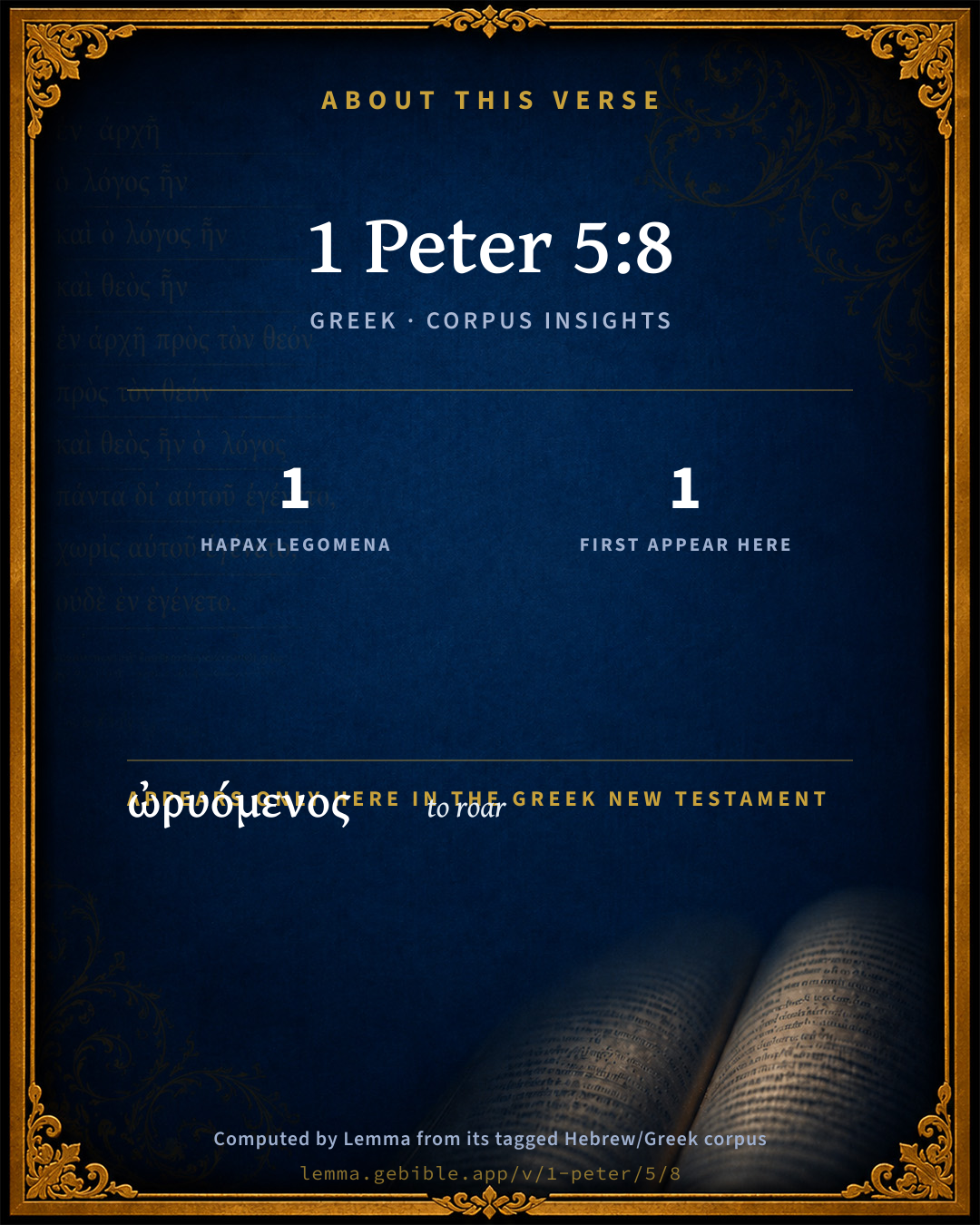
  • 1 hapax legomenon — only here in the Greek New Testament
  • 1 first appearance in the Greek New Testament
Full analysis ↓
Download a study sheet

One document with this verse’s original text, its word-by-word gloss line, the meaning frame, cross-references with their text, attributed commentary, and full source and license credits — printable, and it pastes into notes with its structure intact.

This verse Autodidact and up

Study sheet (.html) Plain text (.txt)

A passage Seminary Student

Up to 50 verses in one chapter. A passage sheet keeps up to 6 commentary sources and 12 cross-references per verse, in the order this page ranks them, and says so on the sheet whenever that leaves anything out. Ask for a single verse and you get the Autodidact verse sheet above.

Everything on this page stays free to read, with no account — the sheet is a download of what is already on screen, not access to it.

Want to remove ads? Support Godless Engineer
Compare translations 3

The same verse in 3 English versions, stacked beneath the original-language interlinear above. Click any original word for its lexicon entry.

Each is an independent rendering of the whole verse — the interlinear is not word-aligned to these translations.

Highlighted words mark where these versions differ — a whole-verse word diff, not a word-by-word alignment.

  • World English Bible Public Domain
    Be sober and self-controlled. Be watchful. Your adversary the devil, walks around like a roaring lion, seeking whom he may devour.
  • King James Version Public Domain
    Be sober, be vigilant; because your adversary the devil, as a roaring lion, walketh about, seeking whom he may devour:
  • unfoldingWord Literal Text CC BY-SA 4.0
    Be sober, be watchful. Your adversary, the devil, is walking around like a roaring lion, seeking someone to devour.

unfoldingWord Literal Text — © unfoldingWord, licensed CC BY-SA 4.0. Word-aligned USFM3 via Door43 (git.door43.org/unfoldingWord/en_ult).

Versions to compare (up to 4)

3 of 4 selected

Show all 19 translations

Every available English version of this verse, each an independent rendering of the whole verse.

  • World English Bible Public Domain
    Be sober and self-controlled. Be watchful. Your adversary the devil, walks around like a roaring lion, seeking whom he may devour.
  • Berean Standard Bible Public Domain
    Be sober-minded and alert. Your adversary the devil prowls around like a roaring lion, seeking someone to devour.
  • Majority Standard Bible Public Domain
    Be sober-minded and alert. Your adversary the devil prowls around like a roaring lion, seeking someone to devour.
  • King James Version Public Domain
    Be sober, be vigilant; because your adversary the devil, as a roaring lion, walketh about, seeking whom he may devour:
  • American Standard Version (1901) Public Domain
    Be sober, be watchful: your adversary the devil, as a roaring lion, walketh about, seeking whom he may devour,
  • Revised Version (1885) Public Domain
    Be sober, be watchful: your adversary the devil, as a roaring lion, walketh about, seeking whom he may devour:
  • Geneva Bible (1599) Public Domain
    Be sober, and watch: for your aduersarie the deuil as a roaring lyon walketh about, seeking whom he may deuoure:
  • Douay-Rheims (1899) Public Domain
    Be sober and watch: because your adversary the devil, as a roaring lion, goeth about seeking whom he may devour.
  • Young's Literal Translation Public Domain
    Be sober, vigilant, because your opponent the devil, as a roaring lion, doth walk about, seeking whom he may swallow up,
  • Literal Standard Version CC BY-SA 4.0
    Be sober, vigilant, because your opponent the Devil walks around as a roaring lion, seeking whom he may swallow up,
  • Unlocked Literal Bible CC BY-SA 4.0
    Be sober, be watchful. Your adversary, the devil, is stalking around like a roaring lion, looking for someone to devour.
  • unfoldingWord Literal Text CC BY-SA 4.0
    Be sober, be watchful. Your adversary, the devil, is walking around like a roaring lion, seeking someone to devour.
  • Darby Bible Public Domain
    Be vigilant, watch. Your adversary [the] devil as a roaring lion walks about seeking whom he may devour.
  • World Messianic Bible Public Domain
    Be sober and self-controlled. Be watchful. Your adversary, the devil, walks around like a roaring lion, seeking whom he may devour.
  • Webster's Bible Public Domain
    Be sober, be vigilant; because your adversary the devil, as a roaring lion, walketh about, seeking whom he may devour:
  • Free Bible Version CC BY-SA 4.0
    Be responsible, and stay alert. The devil, your enemy, is prowling around like a roaring lion looking for someone to devour.
  • Bible in Basic English Public Domain
    Be serious and keep watch; the Evil One, who is against you, goes about like a lion with open mouth in search of food;
  • Text-Critical English NT CC BY 4.0
    Be sober-minded and watchful; your adversary the devil walks around like a roaring lion, seeking someone to devour.
  • Tyndale New Testament (1534) Public Domain
    Be sober and watch for youre adversary the devyll as a rorynge lion walketh about sekynge whom he maye devoure:

Literal Standard Version (2020), Covenant Press — licensed CC BY-SA 4.0. Text via the HelloAO Bible API (eBible.org). Unlocked Literal Bible (unfoldingWord) — licensed CC BY-SA 4.0. Text via the HelloAO Bible API (eBible.org). unfoldingWord Literal Text — © unfoldingWord, licensed CC BY-SA 4.0. Word-aligned USFM3 via Door43 (git.door43.org/unfoldingWord/en_ult). Free Bible Version, Dr. Jonathan Gallagher — licensed CC BY-SA 4.0. Text via the HelloAO Bible API (eBible.org).

Word by word

More ways to search: Search by grammar → Find every occurrence → Compare this word →

Practice this passage: Drill this verse → Learn its vocabulary →

ὠρυόμενος
ōrýomai
G5612
“to roar”
Verb, Present, Middle or Passive deponent, Participle, Nominative, Singular, Masculine
Part of Speech
Verb
Tense
Present
Voice
Middle or Passive deponent
Mood
Participle
Case
Nominative
Number
Singular
Gender
Masculine
Full Thayer's Definition

Origin: middle voice of an apparently primary verb

TDNT: None

1. to roar, to howl (of a lion, wolf, dog, and other beasts) a. of men, to raise a loud and inarticulate cry: either of grief, or of joy 2. to sing with a loud voice
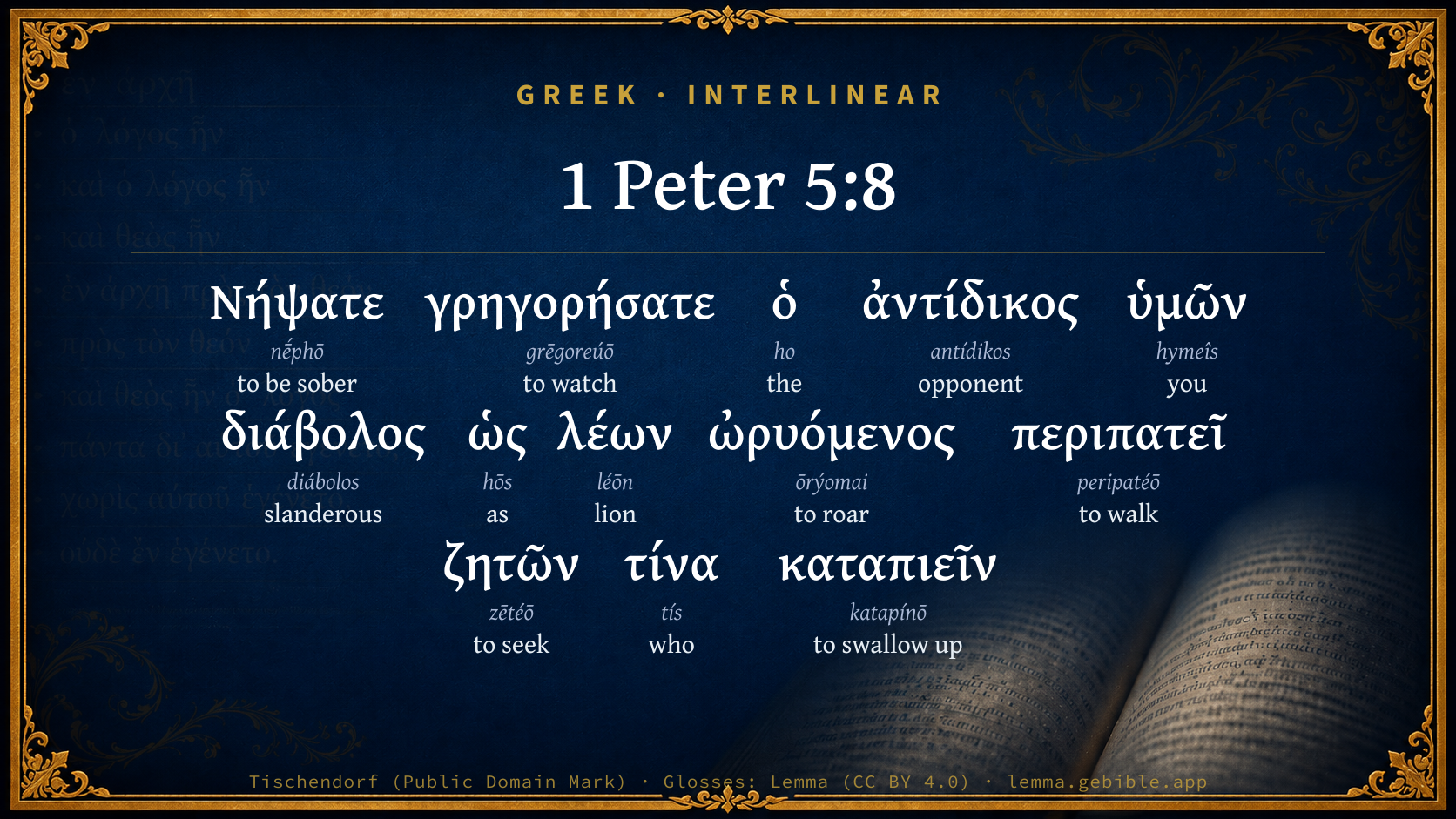
  1. Νήψατε nḗphō G3525 “to be sober” Verb, Aorist, Active, Imperative, 2nd person, Plural
  2. γρηγορήσατε grēgoreúō G1127 “to watch” Verb, Aorist, Active, Imperative, 2nd person, Plural
  3. ὁ ho G3588 “the” Article, Nominative, Singular, Masculine
  4. ἀντίδικος antídikos G476 “opponent” Noun, Nominative, Singular, Masculine
  5. ὑμῶν hymeîs G5210 “you” Personal pronoun, 2nd person, Genitive, Plural
  6. διάβολος diábolos G1228 “slanderous” Adjective, Nominative, Singular, Masculine
  7. ὡς hōs G5613 “as” Adverb
  8. λέων léōn G3023 “lion” Noun, Nominative, Singular, Masculine
  9. περιπατεῖ peripatéō G4043 “to walk” Verb, Present, Active, Indicative, 3rd person, Singular
  10. ζητῶν zētéō G2212 “to seek” Verb, Present, Active, Participle, Nominative, Singular, Masculine
  11. τίνα tís G5101 “who” Interrogative pronoun, Accusative, Singular, Masculine
  12. καταπιεῖν katapínō G2666 “to swallow up” Verb, Aorist, Active, Infinitive

About this verse

These counts appear in no published source. They are computed here, from the morphology-tagged text and Lemma’s own curated glosses. What Lemma adds →

13
words
13
distinct lemmas
General Epistles
section

Notable vocabulary

1 hapax legomenon — a word that appears only here in the entire Greek New Testament:

  • ὠρυόμενος to roar G5612

First appearance in Scripture

This word makes its first canonical appearance in the Greek New Testament here:

  • ὠρυόμενος to roar G5612

Shared distinctive vocabulary

ἀντίδικος opponent G476 occurs in 4 verses of the Greek New Testament. Also found in:
Cross-references

57

Topical passages linked to 1 Peter 5:8 in the Treasury of Scripture Knowledge — connected by theme and wording, ordered by reader-vote popularity; previews shown in the World English Bible.

  • Ephesians 6:11 Put on the whole armor of God, that you may be able to stand against the wiles of the devil.
  • James 4:7 Be subject therefore to God. But resist the devil, and he will flee from you.
  • Ephesians 4:27 neither give place to the devil.
  • Job 2:2 Yahweh said to Satan, "Where have you come from?" Satan answered Yahweh, and said, "From going back and forth in the earth, and from walking up and down in it."
  • 1 Peter 1:13 Therefore, prepare your minds for action, be sober and set your hope fully on the grace that will be brought to you at the revelation of Jesus Christ--
  • 1 Peter 4:7 But the end of all things is near. Therefore be of sound mind, self-controlled, and sober in prayer.
  • 1 John 3:8–10 He who sins is of the devil, for the devil has been sinning from the beginning. To this end the Son of God was revealed, that he might destroy the works of the devil.
  • 1 Thessalonians 5:6–8 so then let's not sleep, as the rest do, but let's watch and be sober.
  • Luke 21:36 Therefore be watchful all the time, asking that you may be counted worthy to escape all these things that will happen, and to stand before the Son of Man."
  • Luke 22:31 The Lord said, "Simon, Simon, behold, Satan asked to have you, that he might sift you as wheat,
  • Romans 13:11–13 Do this, knowing the time, that it is already time for you to awaken out of sleep, for salvation is now nearer to us than when we first believed.
  • Titus 2:12 instructing us to the intent that, denying ungodliness and worldly lusts, we would live soberly, righteously, and godly in this present world;
  • John 8:44 You are of your Father, the devil, and you want to do the desires of your father. He was a murderer from the beginning, and doesn't stand in the truth, because there is no truth in him. When he speaks a lie, he speaks on his own; for he is a liar, and the father of it.
  • Revelation 12:12 Therefore rejoice, heavens, and you who dwell in them. Woe to the earth and to the sea, because the devil has gone down to you, having great wrath, knowing that he has but a short time."
  • Matthew 13:39 The enemy who sowed them is the devil. The harvest is the end of the age, and the reapers are angels.
  • Revelation 12:9 The great dragon was thrown down, the old serpent, he who is called the devil and Satan, the deceiver of the whole world. He was thrown down to the earth, and his angels were thrown down with him.
  • Matthew 24:42 Watch therefore, for you don't know in what hour your Lord comes.
  • Luke 21:34 "So be careful, or your hearts will be loaded down with carousing, drunkenness, and cares of this life, and that day will come on you suddenly.
  • Revelation 20:10 The devil who deceived them was thrown into the lake of fire and sulfur, where the beast and the false prophet are also. They will be tormented day and night forever and ever.
  • Job 1:6–7 Now it happened on the day when the sons of God came to present themselves before Yahweh, that Satan also came among them.
  • Zechariah 3:1 He showed me Joshua the high priest standing before the angel of Yahweh, and Satan standing at his right hand to be his adversary.
  • Titus 1:8 but given to hospitality, as a lover of good, sober-minded, fair, holy, self-controlled;
  • 2 Timothy 4:17 But the Lord stood by me, and strengthened me, that through me the message might be fully proclaimed, and that all the Gentiles might hear; and I was delivered out of the mouth of the lion.
  • Isaiah 14:12–13 How you are fallen from heaven, day-star, son of the morning! How you are cut down to the ground, who laid the nations low!
  • Amos 3:8 The lion has roared. Who will not fear? The Lord Yahweh has spoken. Who can but prophesy?
  • Titus 2:6 Likewise, exhort the younger men to be sober-minded;
  • Isaiah 50:8 He is near who justifies me; who will bring charges against me? Let us stand up together: who is my adversary? Let him come near to me.
  • Titus 2:2 that older men should be temperate, sensible, sober-minded, sound in faith, in love, and in patience:
  • Psalms 104:21 The young lions roar after their prey, And seek their food from God.
  • Proverbs 20:2 The terror of a king is like the roaring of a lion: He who provokes him to anger forfeits his own life.
  • Hosea 11:10 They will walk after Yahweh, Who will roar like a lion; For he will roar, and the children will come trembling from the west.
  • 1 Timothy 2:15 but she will be saved through her child-bearing, if they continue in faith, love, and sanctification with sobriety.
  • Revelation 20:2 He seized the dragon, the old serpent, which is the devil and Satan, who deceives the whole inhabited earth, and bound him for a thousand years,
  • Isaiah 5:29–30 Their roaring will be like a lioness. They will roar like young lions. Yes, they shall roar, And seize their prey and carry it off, And there will be no one to deliver.
  • Joel 3:16 Yahweh will roar from Zion, And thunder from Jerusalem; And the heavens and the earth will shake; But Yahweh will be a refuge to his people, And a stronghold to the children of Israel.
  • Matthew 4:1 Then Jesus was led up by the Spirit into the wilderness to be tempted by the devil.
  • 1 Timothy 3:11 Their wives in the same way must be reverent, not slanderers, temperate, faithful in all things.
  • Titus 2:4 that they may train the young women to love their husbands, to love their children,
  • Hosea 13:8 I will meet them like a bear that is bereaved of her cubs, And will tear the covering of their heart. And there I will devour them like a lioness. The wild animal will tear them.
  • Matthew 25:41 Then he will say also to those on the left hand, 'Depart from me, you cursed, into the eternal fire which is prepared for the devil and his angels;
  • 1 Timothy 2:9 In the same way, that women also adorn themselves in decent clothing, with modesty and propriety; not just with braided hair, gold, pearls, or expensive clothing;
  • 1 Timothy 3:2 The overseer therefore must be without reproach, the husband of one wife, temperate, sensible, modest, hospitable, good at teaching;
  • Esther 7:6 Esther said, An adversary and an enemy, even this wicked Haman. Then Haman was afraid before the king and the queen.
  • Daniel 6:24 The king commanded, and they brought those men who had accused Daniel, and they cast them into the den of lions, them, their children, and their wives; and the lions had the mastery of them, and broke all their bones in pieces, before they came to the bottom of the den.
  • Matthew 4:11 Then the devil left him, and behold, angels came and ministered to him.
  • Matthew 24:48–50 But if that evil servant should say in his heart, 'My lord is delaying his coming,'
  • Luke 12:45–46 But if that servant says in his heart, 'My lord delays his coming,' and begins to beat the menservants and the maidservants, and to eat and drink, and to be drunken,
  • Proverbs 19:12 The king's wrath is like the roaring of a lion, But his favor is like dew on the grass.
  • Ezekiel 22:25 There is a conspiracy of her prophets in the midst of it, like a roaring lion ravening the prey: they have devoured souls; they take treasure and precious things; they have made her widows many in the midst of it.
  • Amos 3:4 Will a lion roar in the thicket, When he has no prey? Does a young lion cry out of his den, If he has caught nothing?
  • Judges 14:5 Then went Samson down, and his father and his mother, to Timnah, and came to the vineyards of Timnah: and, behold, a young lion roared against him.
  • Psalms 109:6 Set a wicked man over him. Let an adversary stand at his right hand.
  • Jeremiah 51:38 They shall roar together like young lions; they shall growl as lions' cubs.
  • Ezekiel 19:7 He knew their palaces, and laid waste their cities; and the land was desolate, and the fullness of it, because of the noise of his roaring.
  • Zechariah 11:3 A voice of the wailing of the shepherds! For their glory is destroyed: a voice of the roaring of young lions! For the pride of the Jordan is ruined.
  • Jeremiah 2:15 The young lions have roared on him, and yelled; and they have made his land waste: his cities are burned up, without inhabitant.
  • Amos 1:2 He said: "Yahweh will roar from Zion, And utter his voice from Jerusalem; And the pastures of the shepherds will mourn, And the top of Carmel will wither."

Cross-references courtesy of OpenBible.info (CC BY 4.0).

Commentary

Notes on 1 Peter 5:8 from classic Christian and Jewish commentators (each source and its license shown beneath its notes). The classic Christian expositions comment on the surrounding passage and are grouped to its opening verse, so a note may address several verses; the Jewish commentaries on the Tanakh (Rashi and others) are per-verse, so they appear only where the commentator wrote on this verse.

Lemma curates 59 commentaries, every one of them public domain or Creative Commons licensed, each selected and text-cleaned for this edition rather than reprinted as found. About our sources →

The Biblical Illustrator

Joseph S. Exell

1Pe_5:8-9

Be sober, be vigilant.

The advantages of moderation in the enjoyment of sensual pleasure

Christianity in its precepts and commands, as well as in its doctrines, is precisely suited to our nature and our necessities.

1. The temperate man preserves his health of body, health of mind, and alacrity and vigour both of the one and of the other.

2. Moderation in the enjoyment of sensual pleasure enhances the very enjoyment of that pleasure in various ways. The moderate man knows nothing of that languor and disgust which generally treads on the heels of the voluptuary, so frequently embittering his pleasures, rendering them insipid to him, and so seldom allowing him to enjoy them completely. How much more taste does the moderate, the industrious man find in the simplest meats, in the most natural drinks, than the intemperate have in all the delicacies of luxury! And how completely he enjoys the innocent pleasure it offers! He has no need artificially to prepare nor previously to devise means for sharpening his pallid appetite and render himself susceptible of pleasure.

3. Moderation in the enjoyment of sensual pleasure exalts and dignifies the mind. It in a manner spiritualises it; by divesting it of the degrading that is connected with mere animal gratification; by teaching us to use it as a means to higher ends. Thus may we connect spiritual and sensual pleasures together, and give a value to the latter by the former. All then becomes to us the gift of our gracious Father in heaven, the effect and demonstration of His all-comprehending love, and the pledge of still greater benefits and pleasures in the world to come. (G. J. Zollikofer.)

Christian sobriety

is all that duty that concerns ourselves in the matter of meat, and drink, and pleasures, and thoughts; and it hath within it the duties of-

1. Temperance.

2. Chastity.

3. Humility.

4. Modesty.

5. Content. (Bp. Jeremy Taylor.)

Ready for temptation

I fell in an unguarded moment; the temptation came so suddenly. How often such excuses are made! But why were we off our guard? Because we live in spiritual things too much like the Saxon king who earned for himself the inglorious surname of the Unready. (Kings Highway.)

Our vigilance must be comprehensive

Many a city has been taken on its strongest side, which was counted so strong that no watch was kept, even as no danger was dreaded there. We think that we are not exposed to one particular form of temptation; let none be too sure of this; and in resisting one form of evil, never let us forget that there are others in the world. Fleshly sins may be watched against, and yet room be given in the heart for spiritual wickedness, pride, self-righteousness, and the like. The victories gained over the lusts of the flesh may minister to those subtler mischiefs of the spirit: and our fate may be like that of the hero in the Maccabees, who was crushed by the falling elephant himself had slain. There is a white devil of spiritual pride as well as a black devil of fleshly lusts; and if only Satan can ruin us, it is all the same to him by what engines he does it; it is all the same to him whether we go down into hell as gross and carnal sinners, or as elated self-righteous saints. Set a watch, therefore, all round your heart; not on one side only, but on all; for you can never be sure on which side temptation will assail. (Archbp. Trench.)

Watch against little sins

The truly pious is never at rest in his mind but when he stands upon his guard against the most minute and unobservable encroaches of sin, as knowing them upon this account more dangerous than greater; that the enemy that is least feared is usually the soonest felt. For as in the robbing of a house it is the custom for the sturdiest thieves to put in some little boy at the window, who being once within may easily open the doors and let them in too, so the tempter, in rifling the soul, despairs for the most part to attempt his entrance by some gross sin, and therefore employs a lesser, that may slide into it insensibly; which yet, little as it is, will so unlock the bars of conscience that the most enormous abominations shall at length make their entrance and take possession of it. Let no man measure the smallness of his danger by the smallness of any sin; for the smaller the sin the greater may be the stratagem. Some have been choked by a fly, a crumb, a grape stone; such contemptible things carry in them the causes of death; and the soul may be destroyed by sinful desires, idle words, officious lies, as well as by perjuries, blasphemies, and murders. Those who consider in how many ways a soul may be ruined, will not count it scrupulosity to beware of the least and slenderest instruments of damnation. (R. South, D. D.)

Watch against our old sins

The embankment is weak where it once gave way; and though the breach has been repaired, it must be diligently watched. The flames have been put out, but the ashes are still smouldering; and, if the wind rises, the fire may burst forth anew. The rebellion has been put down; but though its armies have been scattered and its prince dethroned, many traitors lurk in secret places, watching for opportunities to renew the struggle. Our old sins are conquered, but not quite killed. (Newman Hall.)

The devil, as a roaring lion.-

The devil a roaring lion

There is a lion at your doors-such an one as hath none to equal him in power and in fierceness. Are they active in pursuit of prey? He is infinitely more so. They go but a little distance from their dens, but his circuit is the world itself. Other lions roam abroad at certain seasons only-night is their busy time; but when the sun ariseth they gather themselves together and lay them down in their dens (Psa_104:22). But this spiritual lion is perpetually in motion. The day and night are both alike to him. Other lions are bloodthirsty and savage; but he hath no measure in his fury. He cannot possibly be satisfied unless all men are his prey. But mark some other points of contrast which show how far more terrible this lion is than the lions of the forest. They are visible, can be more easily avoided; but he is an invisible being. He springs upon his prey unseen and unsuspected. The natural lion attacks his prey by open violence; but this spiritual lion deals rather by secret craft. The natural lion seeks only to devour the body; the spiritual lion aims at the destruction both of soul and body in hell. The natural lions strength is far greater than the strength of man, yet man has found out ways of overcoming him; but no power, no skill, no contrivances of man can enable him to overcome the spiritual lion our text speaks of. How then may this roaring lion be resisted and overpowered? Our text returns an answer to it. St. Peter is evidently speaking to believers, who, having been snatched already out of Satans jaws, have now only to resist him to the end. How is a poor sinner, who has been carried captive by Satan at his will, to escape out of the snare? Now to this the whole gospel is an answer. Why, you must look to the Cross. For this cause the Son of God was manifested, that He might destroy the works of the devil. It is a most important question for the true believer, How am I to resist this fearful adversary of my soul? Though I must not hope, on earth, to be free from his temptations, yet how am I to tread him under my feet?

1. He exhorts us to sobriety-Be sober. Be moderate-be self-denying-make not provision for the flesh to fulfil the lusts thereof. Let the Christian but entangle himself in things of this life, and Satan has him at a great advantage.

2. Be vigilant. They then who have such a watchful and unwearied enemy have need to be upon the watch themselves. Let your eye but rove a little towards some forbidden object, and he will take occasion from it to inflame your heart with evil passions. Once say of any sin, Is it not a little one? and suffer yourself, on that ground, to indulge in it-immediately the lion is upon you! He will make this breach much wider, and it will increase unto more ungodliness. We must not go to sleep ourselves under the notion that the Lord will guard us. It is the wakeful, not the slothful servant who has a warrant for Gods protection.

3. But the apostles third direction is one of such immense importance that we can neither be sober nor vigilant without it. He bids us be steadfast in the faith. Let us keep but faith within our bosoms, and we keep Satan at a distance off. We are proof against the lion. Yet a little while and we shall remove out of the lions reach. In the meanwhile, if there is a lion seeking to devour, there is another Lion standing on our part; for it is under such an emblem that our mighty Saviour hath vouchsafed to represent Himself. He is the lion of the tribe of Judah (Rev_5:5). (A. Roberts, M. A.)

The roaring lion

I. Satans perpetual activity. Only God can be omnipresent; hence, Satan can only be in one place at one time. Yet, if you consider how much mischief he doeth, you will easily gather that he must have an awful degree of activity.

1. We know that he is to be found in every place! Wherever the breath of life is inhaled, the poisonous miasma of temptation is a thing familiar.

2. Then, remember, that as he is found in all places, so you have often found him in all your duties. You have sought to serve God in your daily avocations, but strong temptations, furious suggestions of evil, hath followed you there. When we wished to be wrestling with the angel of God, we have had to contend with the fiend of hell.

3. We must observe also how ready Satan is to vent his spite against us in all frames of heart. When we are depressed in spirit-perhaps some bodily illness has brought us low, our animal spirits have ebbed and we feel ready to sink, then that old coward Satan is sure to attack us. On the other hand, if we are joyous and triumphant, then Satan knows how to tempt us to presumption-My mountain standeth firm, I shall never be moved; or else to carnal security-Soul, take thine ease, thou hast much goods laid up for many years; or else to self-righteousness-My own power and goodness have exalted me. Or else, he will even attempt to poison our joys with the spleen of evil forebodings.

4. And ah! remember how well he knows how to turn all the events of Providence to our ill. Here comes Esau, hungry with hunting; there is a mess of pottage ready, that he may be tempted to sell his birthright. Here is Noah, glad to escape from his long confinement in the ark; he is merry, and there is the wine cup ready for him, that he may drink. Here is Peter; his faith is low, but his presumption is high; there is a maiden ready to say Thou also wast with Jesus of Nazareth. There is Judas, and there are thirty pieces of silver in the priestly hand to tempt him, ay, and there is the rope afterwards for him to hang himself withal.

II. Satans roarings.

1. Perhaps Peter here alluded to the roaring of persecution. How Satan roared with persecutions in Peters days! There were racks and gibbets; there was the sword for beheading and the stake for burning; there was dragging at the heels of the wild horse; there was smearing over with pitch and then setting the body still alive to burn in Neros garden. There was nothing for the Christian then but banishment and imprisonment; these were the lowest penalties.

2. But there is another kind of furious attack, the roaring of strong and vehement temptation. This some of us have felt. Do you know what it is to be caught hold of by some frightful temptation which you detest, grid yet the clutch of the hand is seconded by an arm so terrific in its strength that it drags you right on against your will.

3. Satan can roar also in the Christians ears With blasphemies. Oh! the terrors which Satan has sometimes caused to Gods people by saying, Ah, you are not a child of God, or you would not have so vile a nature. Whereas you never thought it at all. It was his suggestion, not yours; and then, having laid his sin at your door, he has turned accuser of the brethren, and has sought to cast down your faith from its excellency, by making you imagine that you had committed the unpardonable sin. Now, if he roars against you, either with persecution or with temptation, or with diabolical insinuations, take the language of our apostle here-Whom resist steadfast in the faith, etc.

III. Satans ultimate aim-Seeking whom he may devour. Nothing short of the total destruction of a believer will ever satisfy our adversary. If the battle were between Satan and man, then, indeed, woe to us! We might quit ourselves like men and be strong, but before this giant all the host of Israel must flee. But the battle is not ours; it is the mighty Gods. Yea, and Christ Himself must be defeated, the glory of His Cross must be dimmed, the crown of sovereignty must be snatched from His head, ere one of those for whom He died should ever be given up to the power of His adversary.

IV. What we should do in order that we may overcome this adversary.

1. Whom resist, steadfast in the faith. But how resist him? Steadfast in the faith. Seek to obtain a clear knowledge of the doctrines of the gospel, and then get a good grip of them. This will make you strong. Then take hold of the promises of God, which are yea and amen in Christ Jesus.

2. But there is another word added for our comfort Knowing that the same afflictions are accomplished in your brethren that are in the world. This is well sketched by John Bunyan. As Christian was going along the exceedingly narrow pathway, with a deep ditch on one side, and a dangerous quag upon the other, he came to a stand, and he had half a thought to go back; and then again he thought he might be half way through the valley; so he resolved to go on. And while he pondered and mused, he heard the voice of a man as going before him, saying, Yea, though I walk through the valley of the shadow of death, I will fear no evil, for Thou art with me. Then he was glad, and that for these reasons. He gathered from thence that some who feared God were in this valley as well as himself; that God was with them, though they perceived Him not; that he hoped to have company by and by. So he went on, and called to him that was before, but he knew not what to answer for that he also thought himself to be alone. I did not think that anybody ever felt as I feel. And though I tell you these things, and know that many of you have heard Satan roar, I am compelled to confess that I have frequently said in my own heart I do not believe that any other man ever had this temptation before me. Well, this text stands to refute our supposition, The same afflictions are accomplished in your brethren that are in the world. (C. H. Spurgeon.)

The personality and agency of evil spirits

When an army is on active service, there is no effort which its commander will spare, to get accurate information about the army which is opposed to him. He uses all the means in his power: and his emissaries are content to run the most fearful risks; that he may learn what is the number of the force arrayed against him; what is its position, what its probable movements. And if any skilful spy could so far penetrate the councils of the hostile commander, as to be able to procure a sketch of his plan for conducting the campaign, we can all understand that such a plan would be worth almost any price. For to be forewarned is to be forearmed. It is part of our religious belief, that a host of beings, with power and skill far more than human, are hourly exerting all their power and all their skill for our eternal ruin. It is a part of our religious belief, that at the head of this host of foes there is one miserable, yet powerful being: a being inconceivably malignant, crafty, wretched: whose great desire is to dishonour God, and to make us human beings as sinful and as wretched as himself. Now there is no doubt at all, that we have all to contend with a certain amount of lurking unbelief in regard to those evil spirits of which we are to think. You will find men who will tell you that the existence of Satan and his angels is an antiquated doctrine, fitted for a ruder age, but not suited to our growing intelligence: they will tell you that it is not to be supposed that God would suffer such beings to exist and to assail us: and that all that was said by Christ and His apostles with regard to evil spirits must be understood as having been said in compliance with the vulgar way of thinking. As to the notion that the Almighty would not suffer such, why, there is no greater difficulty in understanding why He permits evil spirits, than in understanding why he permits evil men. And we know that God not only allows evil men to exist; but allows them to tempt and mislead other human souls to evil. And as for the notion that Christ and the apostles in speaking of evil spirits were merely complying with the vulgar way of thinking-merely to put that notion plainly before our minds is enough to set it aside. See what it comes to. That there are no evil spirits: that people, however, generally fancied there are: and that our Saviour, for fear of shocking their prejudice, gave in to that foolish error, and countenanced it. Now, is that conceivable? Would that have been worthy of Him who is the Truth? In leading our spiritual life, we have to contend with real, personal beings, striving to lead us wrong: there is something more against us than merely the force of circumstances, and the current of events in a fallen world; these are seconded and used by real persons of the greatest power and craft. Ought we not to seek to know something of the nature and the wiles of our great adversaries? We all know that the Bible contains many references to evil spirits, unclean spirits, or devils: and in the New Testament there is very much more frequent mention of evil angels than of good angels. For whatever advantages we may ever derive from the aid of good angels, we gain by the direct intervention of God: and we are not to think of making any application to any good spirit for his help. But it is different with evil spirits. Against them we are called personally to guard. We may, by our own evil thoughts and ways, tempt them to tempt us. To them we may open our hearts. And them we may by Gods grace resist, and drive away. We are exposed to great perils from them, against which we need to be guarded. But the thing of practical moment for each of us, is the manner in which they make their attack upon us. And it is not too much to say that we may be quite sure that they will attack us in the most crafty way. And will not the most crafty way of an evil spirit be the way in which we least expect him? Satan is too cunning to present himself in his own black colours when he can veil himself in a more engaging form. Do you think a fraudulent trader would go about proclaiming that he was a rogue, and theft if you dealt with him he would be sure to cheat you? If a man were trying to get you to buy his bad wares, would he be likely to take pains to tell you how bad they were? No: the evil one and his angels are not weak enough to announce to us how evil they are, and how bent upon our destruction. It is in our own growing worldliness of spirit-our own disposition to put off the care of religion to the more convenient season which never comes-in our own temper of careless easy mindedness, forgetful of the awful realities of heaven and hell, and vaguely trusting that through Gods mercy things will somehow go right for eternity with little thought or pains on our part-it is in symptoms like these that we may read the fearful indications that the devil and his angels are working too successfully upon our hearts. I do not mention the stimulus of unholy passion, of covetousness, of envy. You fancy that the bitter, angry spirit that grows up within you at some slight offence is but the working of your own natural temperament: ah, you do not know how it may be encouraged by some dark being, specially devoting himself to the task. In brief, it is reasonable and right for us to suspect the presence and influence of an evil spirit, in every temptation we ever feel to sin or error: in every intellectual process that would cast doubt upon Gods revealed religion, in every impulse that would prompt to any deed or any thought that varies from the mind and example of our blessed Saviour Himself. Not by the mere natural working of our fallen mind does the evil suggestion arise: but weaving in with that, mysteriously cooperating with that, reinforcing and aggravating that, comes the baneful influence from the prince of perdition! And yet, though this truth be most awful, it is salutary: it is one which it is good for us to reflect upon. Is there not something here to fill us with the greater detestation of sin: to lead us to the more resolute battling with temptation? Think that every time you sin, you are doing the very thing that your most malicious enemy wishes you to do! Is not that a motive to hate sin: to battle with temptation? (A. K. H. Boyd, D. D.)

Of the being, enmity, fierceness, and cunning of the devil

Satan allows you as much religion as you please for the carrying on of his designs; and yet, if you please, you may have none at all. Some who are easily to be won, he tempts to downright villainy, only helping out their dull wits to more exquisite and genteel achievements. Others who are more cautious of notorious sins he draws to offences which seem less, but are equally serving his interest.

I. That there is a devil was the opinion of the heathen themselves that ever acknowledged a God. But most commonly they were mistaken in the nature of his being, and altogether as to his origin and power. Now as the agreement of all nations in the confession and worship of a God is a powerful argument to prove the same, so the same agreement in the general notion of this malignant being may be of the like force. And truly it seems agreeable to reason that since there is so much evil in the world there should be some sovereign patron of it. He also that shall consider the impetuous current of wickedness which has run down throughout all ages from the beginning of the world, which could never flow from infinite mercy and goodness, hath reasons sufficient to convince him that there must of necessity be some powerful being which manages this kingdom of darkness; some chief promoter of evil and subtle contriver of our ruin.

II. That satan is our inveterate adversary, with the origin of his malice, and the reasons of Gods permission and sufferance. It is very natural to those that are ambitious, when their designs of rising are thwarted, but much more when they are also degraded from that high and happy estate they once enjoyed, to fall into the deepest extremity of malice and eagerness of revenge, not only towards that power that frustrated their ends, but also with an endeavour to hinder all those who are in any possibility of obtaining that felicity which they by their rebellion have lost. And this is the case of the angels that fell. But since their power is still subject to God, how comes it to pass that He tolerates so vehement an adversary both to His honour and the works of His hands? Besides His unsearchable will and pleasure, I may presume to offer two reasons.

1. In relation to the lapsed spirits themselves. God determining not to inflict His utmost wrath upon them till the great day of judgment (2Pe_2:4; Jud_1:6).

2. In relation to mankind. God purposing to advance those only to His kingdom whom neither the principalities nor powers of the air could shake, nor any subtle allurements could draw aside.

III. From experience and ordinary observation we may conclude, that there must of necessity be some such enemy by whose instigation chiefly and not altogether by the propensity of our own natures we commit most sins.

1. If we consider the nature and quality of most sins, how unanswerable to that earnestness with which men commit them, we shall find that the incitement proceeds, not so much from their own inclinations, or the fairness of the objects, as the secret subtle suggestions of Satan.

2. From that general and otherwise unaccountable averseness to religion, and other miscarriages in the duties thereof, which we cannot but charge ourselves withal. (J. Cooke, M. A.)

The devil

I have heard divines say that it is very hard to convince men of the existence of a devil, that they scarcely know whether they are convinced of it themselves. I think they are mistaken. An opinion, a fear, a fancy-call it what you will-must have prevailed long, must have taken possession of mens minds, before it could find its way so readily to their lips. Are there no other signs? Does not each man complain of some incubus which he wants to throw off? One may find it outside of him; if he could have better or less stupid beings to work with, all would be well. Another feels as if it were altogether within him. It is a miserable solitary strife, of which no one knows anything but himself. Intelligent travellers and zealous missionaries know that in barbarous countries the difficulty is not to convince men of this doctrine, but of any other. We may acknowledge that our Lords words were none of them directed to prove the existence of evil spirits. He found their existence acknowledged. Sickness, pain, death, were the demonstrations to the hearts of men of their presence. What has been said of Christs words is true also of His acts. He who encountered sickness, madness, death, was certainly not setting forth the power of evil spirits. He was proving their weakness. He was, say the Evangelists, casting them out. When the apostles went forth to preach, they too had no occasion to persuade men of the existence of evil powers. That was assumed; the Jews and Gentiles were agreed so far. Their theories were different; the witness which the facts of this world and of their own experience bore to their consciences was essentially the same. Can there be a deliverer from these evil powers?-that was the only question which it was important to get answered. The apostles went into all lands to proclaim that there was such a Deliverer. They said that Christ had overcome the diseases of men here upon earth; that by death He had overcome death; that He was every hour overcoming some principality and power in high places, which was claiming men as subjects and captives. This was their gospel. Having such a one, they spoke of necessity concerning the principalities and powers. But the apostles, like their Master, used the singular number as well as the plural. They too were obliged to speak of an adversary, of a tempter. The moment the complete unity of the Divine Nature was proclaimed-the unity of the Father with the Son in one Spirit; the moment that men had been baptised into this perfect, loving, all-embracing Name, they must be told, There is an adversary of this Name, a self-seeking, self-concentrated, self-worshipping adversary, who is seeking to draw you out of communion with it, and therefore out of communion with each other. You must be sober, for he seeks to make you drunk with the pleasures of this life, with your own self-conceit, that you may lose all thoughts of your Fathers house. You must be vigilant, for he seeks to stupefy you with opiates, to keep you asleep. St. Peter felt that a picture as living as this was necessary, that his next words might not be idle words: Whom resist, steadfast in the faith. Once believe that you have an adversary-that the conflict is not a sham one, and you can repulse him. You have not to win a position, but defend one. You belong to God. You can tell the adversary that you owe him no allegiance; that you scorn his promises and his threats; that it is your Fathers good pleasure to give you His kingdom of heaven, and that you do not choose to exchange it for the kingdom of hell. The members of the Christian Church were very likely to take up the notion that they and the world around them were under quite different laws; that they were not subject to the passions which other men were subject to; that they were out of the range of the influence of the evil spirit. A more plausible delusion, or a more perilous one, cannot be imagined. An apostle had no higher duty than to shatter it. He was to assure his disciples that the privilege of their brotherhood in Christ exempted them from no assault which threatened those who had not asserted that privilege. This advantage he had, that being one of a society, of a brotherhood, he felt that his enemy was the enemy of his brethren, and the enemy of that world which he wished to claim as part of his family. He was fighting for all men when he was fighting for himself. (F. D. Maurice, M. A.)

The roaring lion

Dr. Livingstone tells us of an African native who was struck down and torn by a lion, that periodically the dreadful pains returned to the old wound, as if again the monster gnawed at the bone. So was it, I think, with Peter. The old lion had struck him down and fixed his teeth in his prey. Snatched from the jaws of the destroyer by Davids greater Son, yet the scar throbbed with vivid reminders of the peril, and brought again before him the memory of his great deliverance. Let us turn and look upon this terrible man slayer.

I. Here is a very real enemy. He is an old doctor, as Latimer calls him, and well versed in arts and crafts; but his master stroke has been reserved for these times. There is a fable of a fox that caught its prey by pretending to be dead. That is the last of Satans devices. A hundred years ago everything was put clown to him-storms, earthquakes, eclipses, plagues, diseases; there was ascribed to him a power and activity that were almost infinite. Thanks to science, she has cast the devil out of the hailstorm and the thundercloud, and has taught us at least some of the laws which regulate these things. So he has altered his tactics, and with a humility which his betters might imitate he has announced his own decease. I am dead-saith the devil-indeed there is no devil. I am passed away with witchcraft and ghosts and all the silly nonsense of the dark ages. No, no. We have a more sure word of prophecy to which we do well to give heed. This old adversary is as real for you and for me as he ever was. As real for us as he was for Adam, or for Job, or for Judas. Your adversary-says the apostle, as if he had marked us out for his prey. We dare not ignore him. We dare not make light of him. He tracks our steps and seeks us as his prey. Be sober, be vigilant.

II. He is a mighty foe. The glimpses we have of him in the Bible reveal one of vast dominion and of amazing power; probably of all Gods creatures one of the first in the order of time and highest in rank; amongst the foremost of the angels that do excel in strength. There is a majesty about him as of one conscious of vast power. Think of his triumphs. Away up in the mountain caves is the den of the lion, the mouth and floor of it all strewn with the bones of his victims; Skulls and ribs lie thickly scattered. But what a sight it were to look into the den of this old lion the devil, and to see the mischief that he hath wrought!

III. He is a subtle foe. Think of his knowledge of human nature. How perfectly he understands us! As an old Puritan says, He taketh the measure of every mans foot; and then he fitteth him instantly. Therefore let us put up a double guard on the side of our weakness. Be sober, be vigilant, and, most of all, be sober and be vigilant where the peril threatens most. It is then that the devil can do most harm when he finds a traitor wish within the soul-into whose ear he can whisper, a traitor that he can bribe. And not only of our besetments does he make use. Our very virtues he tries to turn into handles for his malice. Here is a pleasant, genial, good-hearted fellow-ah! the devil leads him on and tumbles him into the ditch of self-indulgence, or fetcheth him away by evil company. This man is thrifty and saving: and the devil elbows him on year after year until he casts him into that horrible pit of miserliness. This man is generous, but the devil puffs him up with the sense of his importance. This man is very humble, and the devil pushes him down so far in the valley of humility that he begins to climb up the other side and is proud of being so humble. This man is resolute and determined, and the devil eggs him on until he is overbearing and tyrannical. And this man is modest and retiring, and the devil keeps him lazy and useless by assuring him that he has no gifts. He can do almost as much with our virtues as with our vices. For all conditions and for all circumstances the tempter has his attack. Turn to the great temptation of the Lord Jesus Christ. Then, again, he seeks to turn our very mercies to our mischief. The lusciousness and beauty of the fruit in Paradise is made to awaken Eves desire; and when she wished for it, lo! there it was hanging within reach. He is a cruel foe. A lion for his might, he is also a lion for his savage cruelty. His name is Apollyon, the destroyer. To worry if he cannot overthrow; to annoy if he cannot destroy. Oh, sir, said one to me one day, as gentle and loving a man as ever lived, I loved my wife better than my life, but when I was drunk it was as if the devil was in me, and I always began knocking her about. I beat her one night so that she could eat nothing but spoon meat for eleven days. And then when I saw what I had done I had to get drunk again just to forget it. He is a cruel monster, a hard master, driving his poor slave to lowest depths.

IV. Lastly, this old lion can be overcome. Be sober, be vigilant. The first word suggests our peril from over-eagerness. People who go rushing into anything and everything, rush into the lions den and thrust their heads into his very mouth. There are some people that the old lion must hunt for, bat the over-eager he can get by lying still. Be sober. Take a right estimate of things. Measure things by God and by eternity. Dont be too thirsty-that is the meaning of the precept-too thirsty for pleasure; too thirsty for money; too thirsty for honour; too thirsty for your own way in everything. Travellers tell us that there are certain places where you may generally trace the steps of the old lion and expect to find him waiting about. They are the drinking places, where he can spring upon his prey in a moment. Be sober. And yet be vigilant. The too anxious are in peril; but so are the too careless. Be vigilant. But is that all? What is the good of telling the little lamb to be sober and vigilant when the old lion is about? We must go further back and further forward for the instructions as to our safety. Humble yourselves, therefore, under the mighty hand of God. Be so little and so weak that you have no faith in yourself at all-and creep for your safety in under that mighty hand. Casting all your care upon Him, for He careth for you. Beneath that hand I cannot know a fear. Here am I as within a fortress whose walls can neither be scaled nor undermined. That Presence alone is our safety. Whom resist, steadfast in the faith. Be bold because thine hand is in the hand of thy God. (M. G. Pearse.)

The devil and humanity

I. We have here the devil at work in humanity. He is going about, not outside men, but in men, going about in the regions of human thoughts, human passions, human impulses, human activities. He worketh in the children of disobedience. As a worker-

1. His inspiration is malignant. He is a roaring lion. He is not a sleeping lion, nor a lion crouching down, satiated with food, but a lion roaring with hunger, savage for food.

2. His purpose is destruction. Seeking whom he may devour. The devil is a devourer physically. The devil is a devourer spiritually. He is a devourer of purity of heart, peace of conscience, confidence in and fellow ship with the everlasting Father. The devil is a devourer socially. He is a devourer of domestic harmony, social order, prosperity, and peace. The devil is a devourer politically. He is a devourer of civil freedom, national progress, inter national harmony.

II. We have the devil here counteracted by humanity. Three things are necessary to counteract him-

1. Thoughtfulness-Be sober. This does not mean mere physical sobriety, although, of course, it includes that-it means sobriety of soul, a state of mind opposed to all volatile excitement. Were men to think whence they came, what they are, whither they are tending, the devil would not easily influence them.

2. Diligence-Be vigilant. Be vigilant in building up moral fortresses around your soul, so as to resist his entrance.

3. Steadfastness-Whom resist, steadfast in the faith. Is it wise in a town to ignore the pestilence that has entered its streets and carried death to its homes? How infinitely more unwise is it to ignore this roaring lion! (D. Thomas, D. D.)

The devil and humanity

I. What the devil really is in relation to men. First, He is an adversary. Secondly, He is a malignant adversary, ravenous and savage. Thirdly, He is a prowling adversary. Walketh about. He is always on the move. He walks about the markets, the governments and churches of the world; about the public streets and secluded alleys, and about the chambers of every human soul. He has no rest.

II. What men really should be in relation to the devil.

1. They should be serious. Be sober. As calm, serious, and self-possessed as a soldier who waits the blast of the trumpet for war.

2. They should be watchful. Be vigilant. He is wily, always plotting.

3. They should be resisting. Whom resist. Do not yield an inch, but advance.

4. They should be reflective. Knowing that the same afflictions are accomplished in your brethren. (D. Thomas, D. D.)

The same afflictions are accomplished.-

The wide diffusion of trials a motive to steadfastness

Ordinarily, if we speak of afflictions, or sufferings, you presently think of the bereavements or sorrows which fall to us through the dispensations of Providence. But the apostle, when he here uses the term, is speaking only of spiritual assaults-of the attacks of Satan, acting on the corruptions of our nature, and soliciting us to sin. Are these indeed afflictions to us? Happy the man who, though he have to reckon among his sore things persecution, and peril, and nakedness, and sword, can yet say, The sorest thing of all is, that I am continually wrought upon by an invisible foe, who, seconded but too readily from within, places me in peril of deserting my profession and dishonouring my Saviour. Yes, the greatest affliction to us should be the not finding affliction in sin. What is there to encourage the Christian warrior in the knowing that the same afflictions are the lot of others as well as himself? Really at first sight, and with reference more especially to the assaults of the devil, it might be said that this was calculated to discourage us. It seems almost like investing Satan with omnipresence, to exhibit him as afflicting simultaneously the whole body of Christians. Suppose it were the registered course of Gods proceedings that there should be comparative freedom from the assaults of Satan, so that the roaring lion were not allowed to come against the Christian. What a fearful thing it would then be for a believer to find himself attacked by the devil! It would not be the amount of the attack, so much as the unusualness, that would distress him. His inference would be-Surely I am not one of the people of God: if I were, He would not deal with me in so uncommon a way. Or, if again, in place of exemption generally from spiritual assault, there were any one form of temptation which was seldom allowed to visit the righteous; would not the being invaded by this form distract the godly man, not because the form itself might be more terrific than he had known before, but because, being novel, it would seem to bring proof that he had deceived himself with regard to his spiritual condition? But now take the opposite, which is the actual case, namely, that the Christian has nothing strange to undergo. Do you not perceive that this very circumstance will do much to encourage him to resist the devil and keep steadfast in the faith? The believer has perhaps to undergo a large measure of domestic trial; death makes frequent inroads into his family; his circumstances become straitened; his children requite him with ingratitude; but he looks into the history of the righteous, and he finds that there is nothing singular in his portion. Or again-and here, it may be, Satan has the greatest advantage-the believer has seasons of spiritual darkness; and he loses all comfortable sense of love of God and the atonement made by Christ. But is he peculiar in this? Has nothing like this been experienced by the believer? He turns to the Book of Psalms. What does he find? Unmingled joy? unclouded assurance? Oh, no! he finds constant alternations, as though night followed day-depression succeeded in necessary order to exultation. There is, however, one more, and an equally important view, which may justly be taken of the passage before us. If we are to resist the devil with good prospect of success, we must prepare to resist the devil; and, in order to this preparation, we should be observant of what has happened and is happening to others. An old writer justly says, Things certainly fall the lighter upon us when they first fall upon our thoughts. It is the being taken by surprise which makes sorrow so hard; and we want you not to be taken by surprise. Oh, the experience of the Church is not an experience which merely proves the frequency of trouble; it proves also the advantageousness of trouble; it proves that affliction yieldeth the peaceable fruit of righteousness to them that are exercised thereby; it proves that the devil may be resisted; that, with all his subtlety, and malice, and might, he is more than matched by the believer, who takes to himself the whole armour of God. And for this simple truth we would gain, if we could, a strong hold upon your minds. The devil is not irresistible-not one of his temptations is irresistible. Will ye, then, yield, as though it were useless to withstand? Your brethren, in whom the same afflictions have been accomplished, met the devil and vanquished him, but not in their own strength; and you, too, may vanquish the devil. The promised aids of the Holy Spirit-aids which no Christian seeks in vain who seeks in faith-will always suffice to carry you safely, yea, triumphantly through the conflict. What warning, then, is there, that we slumber not at our post! what encouragement that we shrink not from conflict! (H. Melvill, B. D.)

Sympathy with saints and martyrs

When people are sick, and in bad pain, we know how apt they are to imagine, Surely never anyone was so afflicted as I am. Thus St. Peter encourages his suffering brethren, when a time of trouble was coming on; much as St. Paul had before encouraged the Corinthians. There hath no temptation taken you, but such as is common to man: nothing that is beyond human strength, assisted by the grace of the Holy Ghost, to bear. This is the answer to those who think the commandments of the gospel too strict, too pure to be obeyed. Your Father which is in heaven will give the Holy Spirit to them that ask Him. And if that be not enough, look at the lives of the saints: look and see how good and penitent persons, from time to time, have really been helped to keep these commands which you think too hard, and to resist these temptations which you think too strong. On the other hand, that roaring lion, who is ever seeking whom he may devour, will be busy encouraging in you just the contrary of these good thoughts. If you are in trouble he will try to make you feel as if no other person was ever in so bad a condition. If he can, he will persuade you that all or a great part of your trouble arises from such and such a persons ill-usage, and so he will make you spiteful and envious. Other persons, who are not so ill-used, may do well to be forgiving and meek: but your case, he will whisper, is really too hard, too bad. What is the use, they will say, of such exact goodness? you may as well give it up; for you see it does not save you from ill-usage and suffering. Thus the enemy moves us to discontent, when we are afflicted or ill-used: but still more does He encourage us to sin, when we are in strong temptation from our own passions, or the evil example of others. He will at such times set us on thinking, that surely our passions are stronger than other mens, and therefore there is more excuse for our giving way to them. This is how the devil would beguile us, and a very serious temptation it is: he would have us believe, either that there never were any saints, any persons really good and holy, or that if there have been any, they were such by a kind of miracle. To be afflicted, then, is a mark of Christian brotherhood: it is a token that we belong to Gods family. If anyone were quite exempt, he would almost feel it unfair: might he choose, he would rather take his share, relieving, if so it might be, his brethren. Or take the case of comrades and fellow soldiers-what sort of a spirit is he thought to have who draws back and spares himself when the rest are entering upon labour and danger? And here comes in the other word, by which, as I said, St. Peter in the text would stir us up to a godly jealousy of the saints. The word I mean is accomplished. Their afflictions are accomplished, ours but just beginning. To conclude: whereas the apostles word is, that whatever we suffer, the same afflictions are accomplished in our brethren that are in the world, we understand that when they are once out of the world, there is an end of their affliction and care forever. (Plain Sermons by Contributors to the Tracts for the Times.)

The Biblical Illustrator, edited by Joseph S. Exell (c. 1880s–1900s) — public domain. Text from a community e-Sword module.

Joseph Benson's Commentary

1Pe 5:8-9. Be sober — See on 1Th 5:6. Keep your appetites and passions under proper restraint and government, or awake, as υηψανε also signifies; namely, to a deep sense of the certainty and importance of things invisible and eternal; be vigilant — Watchful against the subtle and malicious designs of your spiritual enemies. As if he had said, Awake, and keep awake; sleep no more; be this your care, white you cast your temporal and anxious cares on God. How deeply had Peter himself suffered for want of the wakeful vigilance which he here recommends! Because your grand adversary, the devil, full of rage, as a roaring lion — Fierce and hungry, walketh about — Watching for an opportunity to insnare and destroy you; seeking — With all subtlety likewise, whom he may assault with the greatest likelihood of success, and devour — Swallow up both soul and body. This manner of speaking strongly expresses the insatiable rage of this enemy of mankind to hinder their salvation, and the danger we are in from his devices and snares. He sometimes attacks the people of God in person, though not visibly, and sometimes by his ministers, the other evil spirits who are in league with him; and sometimes by wicked men, his subjects, whom he instigates to tempt them by the terror of persecution. This account of the devil’s malice is given with great propriety by Peter, to whom our Lord had said, Simon, Satan hath desired to have you, that he may sift you as wheat; but I have prayed for thee. Whom resist — As you regard your safety and life, be careful to oppose him in all his assaults; steadfast in the faith — Firmly believing the truths and promises of the gospel, and adhering constantly to, and confiding in Christ, in whom all these truths and promises are yea and amen. To show the efficacy of faith, in enabling us to resist temptation, St. Paul calls it a shield, (Eph 6:16,) wherewith the fiery darts of the wicked one may be quenched; knowing that the trials with which you are exercised are not peculiar to you, but that the same afflictions which you are called to sustain are accomplished in — That is, suffered by; your brethren that are in the world — Till the measure allotted them is filled up, and you may reasonably hope that the same grace which is their support will be also yours.

Joseph Benson's Commentary on the Old and New Testaments (1811–1818) — public domain. Text from a community e-Sword module.

The Preacher's Complete Homiletical Commentary

Joseph S. Exell (gen. ed.)

CRITICAL AND EXEGETICAL NOTES

1Pe_5:8. The devil.—Thought of under the figure of a wild beast that, at any moment, may put the flock in peril. Those who fall into sin are often surprised at the sudden and overwhelming character of their temptation. Adversary.—See Mat_5:25. διάβολος term in LXX. for the Hebrew “Satan,” with special idea of “making charges against.” Devour.—“Gulp down.”

1Pe_5:9. The faith.—Better, “your faith.” Are accomplished.—Are being accomplished.

MAIN HOMILETICS OF THE PARAGRAPH.—1Pe_5:8-9

The Common Enemy.—The figures in this passage are evidently suggested to St. Peter’s mind by his reference to shepherds and shepherding, and by his conception of the Church as the “flock of God.” “These are the sudden cries (‘be sober, be vigilant’), of warning from a shepherd to the other shepherds, who spies the lion prowling round the flock in the darkness, while the guardians of the flock lie drowsy and asleep.” Whether St. Peter is to be understood as affirming the existence of a personal devil, or as speaking here in a figurative manner, personifying the calamities and evils which were proving such serious temptations to the Christians of the Dispersion, need not be decided. Evil, taking form as disability, reproach, and persecution, is a distinctly active and mischievous force; it was seriously imperilling the Christian faith and life of the disciples, and precisely what they had to watch against was the subtle and constant and varied influences of these calamities and anxieties. They resisted the devil by resisting the things which were his agencies.

I. Temptations of evil are always on the watch for opportunities.—To impress this fact the figure of the prowling wild beast is taken.

II. Temptations of evil are always active.—This is said to impress the necessity of wakefulness. The Christian while on earth is always on the battle-field, in face of the enemy. All are subject to some kind of suffering.

III. Temptations of evil always work with a bad design.—What they want to devour is the faith which is the very foundation of Christian life. When there is so much to bear, it is hard to keep trust in God.

IV. Temptations of evil must be met by a watchfulness and activity greater than that which they exhibit.—“Whom withstand, stedfast in your faith.” Steady; ever ready, clothed in the whole armour of God.

V. Temptations of evil made the same trouble and conflict for our fathers.—It is but a common lot. Our fathers conquered, so may we; our Divine Lord and Master conquered, so may we, in His strength.

SUGGESTIVE NOTES AND SERMON SKETCHES

1Pe_5:8-9. Malign Spiritual Influences.—Man’s soul carries in it the elements of all good, and of all evil—for every faculty has its good and its evil side, its temperate and its excessive use; and there is no outward evil in the world which is not made so by something which represents it in man. There is no evil under the general designation of sin, which has not its origin within. There is that in man which answers to whatever is good and whatever is evil. This is itself a sufficient reason for forethought and for vigilance. But the sacred Scripture declares that there is a power of temptation in evil spirits; that man, in this mortal state, is surrounded by a sphere filled with spirits that are perpetually tempting him to evil. Many, indeed, disbelieve in spirit agency. It is inconsistent with their conception of a benevolent God, that He should permit a devil to exist. Inquire into the nature of this influence called temptation. Temptation holds a parallel and analogic course with inspiration. It is simply a stimulus, coming from wherever it may, applied to a faculty, or to classes of faculties, in the human mind—faculties of which men have, or should have, might have, full control. Temptation never works out anything. It merely gives impulse, suggestion, stimulus. If any evil is wrought out through you, you work it out wholly and absolutely. If, being impelled, men do evil, as when, being impelled, they do right, the right or the wrong is their own act, for which they are responsible. For, although they were pushed to it, tempted to it, they had plenary power to do it or not to do it. No man, therefore, is carried away under termptation or by temptation. Many men carry themselves away. No man is overborne by temptation in any literal sense, although figuratively the language is employed properly enough. Temptation does not destroy self-control. It may intensify its difficulty, but it does not invalidate plenary power. The strength of the temptation lies wholly in the faculty which it tempts. Temptation goes with the strongest faculties. See some of the conditions of mind which make temptations by evil natures fatal and dangerous. Every right and good tendency of the soul draws to itself food for goodness. A good man attracts goodness, and is sensitive to goodness. The better you are, the more qualities there are in life helping you to be good. It is easy to be good, after you have received impulsion towards goodness. A bad man finds that which is bad. He carries it with him. An irritable man finds not only irritable men, but occasions for irritability. Selfishness finds everywhere occasions for selfishness. The moral condition which you carry into life constitutes the first great ground of susceptibility to inspiration on the side of good, and to temptation on the side of evil. To this must be added the want of fixed and ruling purposes by which you meet and resist evil tendencies. There is much in life that is easily overcome, if there be a positive and steadfast resistance to it. But if we are languid, if we are pulseless, we become a prey to it. Physicians tell us that there is such a thing as predisposition to epidemic. Also the habit of doing wrong makes it more sure that temptations will be victorious over men. And the social element enhances the power of temptation. Consider, then, how many adversaries are moving upon every single point of your nature. Consider what special temptations, over and above the general tenor of society, are marching out upon you from your business. Consider, too, all the temptations which spring upon you from individual men. Consider the evil fellowship which you have in the company in which you go at large. Consider that you have secret and open sins, which are themselves like cancers draining the body of its strength and stamina, and eating at the very vitals. Upon all these temptations there descends that malign influence which sweeps in from the great spirit-world, against which God bids us take heed.—H. Ward Beecher.

The Preacher's Complete Homiletical Commentary (gen. ed. Joseph S. Exell; Funk & Wagnalls, c. 1892) — public domain (pre-1929). A full-Bible homiletical/sermon-outline anthology covering 65 of 66 books (2 John is absent from the source module). Text from a community e-Sword module.

The Expositor's Bible

Chapter 18

THROUGH PERILS TO VICTORY

1Pe_5:8-14

NOT only had these Asian Christians to suffer from the opposition and calumnies of the heathen and from the estrangement of former friends: there were perils within the Churches themselves. There were weak brethren, who fell away when trials came, and infected others with their despondency; there were false brethren, with whom faith was a mere consent of the understanding, and not the spring of a holy, spiritual life. These spake of the liberty of Christ as though it were an emancipation from all moral restraints. Such dangers asked for firmness both in the elders and their hearers. To withstand them there must be a constant growth in Christian experience, whereby the faithful might wax steadfast, and attain to the strength and stature of the fullness of Christ. These dangers became more manifest before St. Peter wrote his second letter, where we find them described in dark colors.

Here to the converts, exposed to the assaults of these temptations, he enjoins the same wellordered frame of mind which before {1Pe_1:13} he commended to them as they looked forward to the hope in store for them, and also {1Pe_4:7} in their prayers, that their petitions might be such as suited with the approaching end of all things. "Be sober," he says again, and combines therewith an exhortation which without sobriety is impossible: "Be watchful." If the mind be unbalanced, there can be no keeping of a true guard against such dangers as were around these struggling believers. And it is impossible not to connect such an exhortation from his lips with those words of Christ, which one Evangelist says were expressly addressed to St. Peter, "Watch and pray, that ye enter not into temptation". {Mar_14:37-38} He who had received this admonition was conscious that, as in his own case, so with these his converts, the spirit might be willing, but the flesh was weak, and the enemy mighty.

"Your adversary the devil, as a roaring lion, walketh about, seeking whom he may devour." In the days of Job, when God asked of Satan, "Whence comest thou?" his answer was, "From going to and fro in the earth and from walking up and down in it". {Job_1:7} Of this Old Testament language the Apostle here makes partial use in his description of the enemy of mankind. He walketh about in the earth, which is his province, for he is called the prince of this world {Joh_12:31} and the god of this world. {2Co_4:4} And the Greek word αντιδικος "adversary," which St. Peter uses as a translation of the Hebrew "Satan," is well chosen, for it describes not an ordinary enemy, but one who acts as an opponent would in a court of law. Such was Satan from the first, an accuser. In Jobs case he accused the Patriarch to his God: "Doth Job serve God for naught?" "Put forth Thine hand now, and touch all that he hath, or touch his bone and his flesh, and he will curse Thee to Thy face." In earlier days he appears as the accuser of God Himself: "Ye shall not surely die, for God doth know that in the day ye eat thereof then your eyes shall be opened, and ye shall be as God, knowing good and evil". {Gen_3:4-5} And with suchlike suggestions he assails the faithful continually, speaking either to their unguarded hearts, or by the words of his servants, of whom he has no lack. St. Paul dreaded his power for the Thessalonian converts: "I sent that I might know your faith, lest by any means the tempter had tempted you, and our labor should be in vain". {1Th_3:5} And St. Peters words are dictated by the same fear; he has the same wish to keep the flock steadfast in their faith. To them Satans whisperings would be after this sort: "You are forgotten of God"; "Love could never leave you so long in trial." Or his agents would say in scorn, "How can you talk of freedom, when your life is one long torment? What is the profit of faith, when it gives you no liberty?" And such questions are perilous to feeble minds. The Apostle marks the great danger by a comparison which Ezekiel {Eze_22:25} had used before him, speaking of the tempter as a roaring lion, ever hungry for his prey. There is but one weapon which can vanquish him. "This is the victory that hath overcome the world, even our faith". {1Jn_5:4} St. Peters lesson is the same as St. Johns.

"Whom withstand steadfast in your faith, knowing that the same sufferings are accomplished in your brethren who are in the world." The steadfast faith must be the firm foundation of God; and the same thoughts, which St. Paul commends as a correction of those who have erred concerning the truth, are those most fit to be urged upon St. Peters converts to render them steadfast. "The Lord knoweth them that are His," {2Ti_2:19} and with the Lord to know is to care for and to save. And "let every one that nameth the name of the Lord depart from unrighteousness." This is the perfect law, the law of true liberty, and he who continueth therein, being not a hearer that forgetteth, but a doer that worketh, shall be blessed in his doing. Thus resting on God and thus ruling himself, he shall be kept from the snares of the enemy, and having withstood in the evil day, shall still be made able to stand. And to such steadfastness the brethren are to be moved by the knowledge that others are in the same affliction. How shall such knowledge minister support? The mere knowledge that others bear a like burden does not strengthen our own shoulders: to hear of others pains will not relieve our own. Not so. But just as it is a power in warfare when men see their leader before them, facing the same perils, hear his voice cheering them by his courage, inspiring them with his hope; just as it is a support to brave men to find brave brethren at their side in the conflict, animated by the same spirit, marching forward to the same victory, so is it in the Christian struggle. All Christians are to be steadfast, the elders like the leaders of an army, the younger like the soldiers who follow, that, moving with one spirit against the foe, feeling that each is like-minded with all the rest, while all are equally conscious of the importance of victory, they may grasp hands as they go forward, and be heartened thereby, being sure that in the danger they will have helpers at their side. And that he may give the more emphasis to this idea of unity, in which, though the suffering is common to all, yet the hope is also common, and the victory is promised to all, the Apostle does not speak of the converts as a multitude of brethren, but uses a noun in the singular number, naming them (as the margin of the Revised Version indicates) "a brotherhood" (αδελφοτης). And when they regarded themselves as "a brotherhood in the world," the thought would have its comforting as well as its painful aspect. The world, as Scripture speaks of it, is void of faith. Hence the believer, while he lives in it, is amid jarring surroundings, and is sure to suffer. "In the world ye shall have tribulation." But it is not to last forever, nor for long. "The world passeth away, but he that doeth the will of God abideth forever." And though the brotherhood in the world must suffer, yet there is that other brotherhood beyond; and there the suffering will not be remembered for the glory that shall be revealed in us. "And the God of all grace, who called you unto His eternal glory in Christ, after that ye have suffered a little while, shall Himself perfect, stablish, strengthen you." Being now about to sum up the great work of Christian advancement, in, which from first to last the power is bestowed by God, St. Peter finds no title more fitting to express the Divine love than "the God of all grace." The invitation to become partakers of the glory which Christ has won by His sufferings, won that He may bestow it upon men, was Gods free call. Our sufferings, the discipline which the Father employs to purge and purify us, are to last but a little while. Then those whom He has called He will also justify, and those whom He justifies He will in the end glorify. Thus St. Paul {Rom_8:30} describes the operations of Divine grace. St. Peter, with the same lesson, uses words more after his own graphic manner. He gives us a picture of Gods work in its several stages. First God will complete in all its parts the work which He has begun. He will make it so that He can pronounce it very good, as He did when the worlds were perfected in the first creation, {Heb_11:3} making His people to be so perfected that they may be as their Master. {Luk_6:40} Then He will sustain and support that which He has brought to its best estate. There shall not be, as in the first creation, any falling away. New gifts shall be bestowed by the Holy Spirit, through the ministration of the word. It was for such a purpose that St. Paul longed to visit the Roman Church, that he might impart unto them some spiritual gift, to the end that they might be established. And what has been perfected and established shall also by the same grace be made strong, that it may endure and withstand all assaults.

In many ancient texts a fourth verb is given, which the Authorized Version renders "settle." It signifies "to set on a firm foundation," and it is of the figurative character which marks St. Peters language, and, besides this, is not uncommon in the New Testament. {Mat_7:25, Luk_6:48, Heb_1:10, etc.} But the verbs immediately preceding have no direct reference to a building, and the addition arises probably from a marginal note, made to illustrate the text and by some later scribe incorporated with it. The whole passage brings to mind Christs injunction to the Apostle, "When thou art converted, strengthen thy brethren."

"To Him be the dominion forever and ever. Amen." A fitting doxology to follow the Apostles enumeration of the riches of Divine grace. He who feels that every gift he has is from above will with ready thankfulness welcome Gods rule, and seek to submit himself thereto, making it the law of his life here, as he hopes it will be hereafter.

"By Silvanus, our faithful brother, as I account him, I have written unto you briefly." Silvanus was that Silas who accompanied St. Paul in his second missionary journey through the districts of Phrygia and Galatia, {Act_16:6} to which St. Peter addresses his letter. To send it by the hand of one known and esteemed among these Churches for his former labors and for his friendship with the great Apostle of the Gentiles would secure acceptance for it, while the bearer would testify to the unity of the doctrine preached by the two Apostles. He who had been a faithful brother to St. Paul was so also to St. Peter, and was by him commended to the Churches. For the expression, "I account him," implies no doubt or question in the Apostles own mind. It is the utterance of a matured opinion. The verb (λογοζομαι) is that which St. Paul uses: "I reckon that the sufferings of this present time are not worthy to be compared with the glory which shall be revealed in us". {Rom_8:18} To St. Paul something of the future glory had been shown, and he had felt abundance of present suffering. He had taken account of both sides, and could speak with certainty. The brevity of St. Peters letter could be supplemented by the words of his messenger. For Silas himself was a prophet, {Act_15:32} and fitted to exhort and confirm the brethren.

"Exhorting, and testifying that this is the true grace of God: stand ye fast therein." The grace in its several stages has just been summarized: the calling, the perfecting, stablishing, strengthening; and the whole letter is occupied in showing that at every advance God puts His servants to the test. But the Apostle knows that the agents of the adversary are busily scattering the tares of doubt and disbelief where God had sown His good seed. The wrestling is not against flesh and blood alone, but against the world-rulers of this darkness, against the spiritual host of wickedness. Hence the form of his exhortation: "Stand fast."

"She that is in Babylon, elect together with you, saluteth you; and so doth Mark my son. Salute one another with a kiss of love." It is most natural to refer these words to a Church, and not to any individual. Some have interpreted them as an allusion to St. Peters wife, whom, as we know from St. Paul, {1Co_9:5} he sometimes had as a companion in his travels. But there is a degree of inappropriateness in speaking of a single person as elect along with these various Churches of Asia, whereas the Church in Babylon might fitly have such a distinction. It is unnecessary, too, to explain Babylon (as some have done) as intended for Rome. There was no conceivable reason in St. Peters day why, when he was writing to lands under Roman dominion, if he meant to speak of the city in Italy, he should not call it by its real name. The Mark here named was most probably the John whose surname was Mark, {Act_12:12} whose mother was a friend of St. Peters from the earliest days of his apostolic labors. He, too, had been a companion of St. Paul for a time, and made another link between the two great Apostles. St. Peter calls him "son" because it is likely that both the mother and her son were won to the new teaching by him, and he employs the term of affection just as St. Paul does of Timothy, his convert. {1Ti_1:2; 1Ti_1:18 2Ti_1:2} The salutation by a kiss is frequently mentioned. It is called "a holy kiss" {Rom_16:16; 1Co_16:20; 2Co_13:12; 1Th_5:26} in St. Pauls language. We find from Justin Martyr that it had come to be used in his day as part of the ceremonial preceding the Holy Communion. It was to be a token of perfect love, according to the name which St. Peter here gives it. An evil construction was soon put upon it by the enemies of the faith; and after a long history it fell into disuse, even in the East, where such manner of salutation is more common than in the West. In his final words the Apostle has embodied the benediction of which the kiss was meant to be the symbol.

"Peace be unto you all that are in Christ." This is the bond which unites believers into one fellowship. To be in Christ is to be of the brotherhood which has been so significantly marked just before for its unity. And in these last clauses we have examples of the force of the tie. Individuals are brought by it into close communion; as Peter himself with Silas and with Mark, whom he speaks of in terms of family love. To the Churches Silas is commended as a brother in the faith, which faith establishes a bond of strength between the distant Churches which have been called into it together. Well might the heathen, wonderstruck, exclaim, "See how these Christians love one another!" And the Apostles own words mark the all-embracing character of the love: "all that are in Christ." They are all brethren, children of the common Father, inheritors of the same promises, pilgrims on the same journey, sustained by the same hope, servants of the same Lord, and strengthened, guided, and enlightened by the one Spirit, who is promised to abide with Christs Church for ever.

William Robertson Nicoll, ed., The Expositor's Bible (London: Hodder & Stoughton, 1887–1910) — public domain. 65 of 66 books (1 Corinthians is not separately keyed, as that volume carries no machine-parseable verse references); section-level commentary keyed to the opening verse. Introductory and overview sections not keyed to a specific passage are excluded.

Bengel's Gnomon

Johann Albrecht Bengel

1Pe 5:8. Νήψατς, watch) Let this be your care. Watch with the soul.—γρηγορήσατε, watch) with the body.—ὁ ἀντίδικος—καταπίῃ, the adversary—may devour) He seeks the righteous at once by the appearance of justice and by violence: Apocalypse, Rev 12:10.—ὠρυόμενος, roaring) with fury.—ζητῶν, seeking) with treachery.—τίνα, whom) especially of the faithful, Job 1:8.—καταπίῃ, he may devour) First with reference to the soul, and then with reference to the body. But he especially lays snares by means of the sorrow arising from cares, which is injurious to faith.

Bengel's Gnomon of the New Testament — English translation (T&T Clark, Edinburgh, 1860) — public domain. Text from a community e-Sword module.

Meyer's Critical & Exegetical Commentary

Heinrich August Wilhelm Meyer

1Pe_5:8. νήψατε (chap. 1Pe_4:7), γρηγορήσατε, cf. 1Th_5:6; placed in juxtaposition by asyndeton in nervous conciseness, in virtue of which ὅτι, too, is omitted before ὁ ἀντίδικος (Wiesinger). Temperance and watchfulness are specially necessary, in order to remain faithful amid all the temptations of suffering. The reason is given in what follows.

ὁ ἀντίδικος ὑμῶν διάβολος] Henslers explanation: slandering opponents, requires no refutation.

διάβολος is a substantive, in explanatory apposition to ὁ ἀντίδ. ὑμῶν, which latter is used, in this passage only, to designate the devil (corresponding to the Hebrew שָׂטָן, which, however, the LXX. always translate by διάβολος). The word denotes strictly an opponent in a court of justice; but it occurs also in a general sense as adversary. Schott would retain the original application, after Zec_3:1 ff., Rev_12:10, in that the devil will, as it were, compel God to declare in condemnatory judgment that the Christians have forfeited salvation; but there is no allusion to the divine judgment here, the καταπίνειν is rather indicated as the aim of the devil.

ὡς λέων ὠρυόμενος]

[276] ὠρύεσθαι peculiariter dicitur ἐπὶ λιμῷ κλαιόντων λύκων, ἢ λεόντων, ἢ κυνῶν (Hesych.), cf. Psa_104:21.

περιπατεῖ (Job_1:7; Job_2:2) ζητῶν τίνα καταπίῃ] περιπατεῖν and ζητῶν belong strictly to each other, so that the comparison with the lion applies to both (Steiger). The efforts of the devil are directed against Christians, who, as such, do not belong to him; as long as they remain faithful to their Christian calling, he can do them no harm (1Jn_5:18), therefore he is on the look-out whom (according to the reading: τίνα καταπίῃ) he may devour, or if he may devour any one (according to the reading: τινὰ καταπιεῖν), by alluring to unfaithfulness.[277]

ΚΑΤΑΠΊΝΕΙΝ, devour, denotes complete destruction. Chrysostom (Homil. 22, ad popul. Antioch.): circuit quaerens, non quem mordeat vel frangat, sed quem devoret.

[276] Augustin (Sermo 46 de divers. c. ii.): Christus leo propter fortitudinem, diabolus propter feritatem; ille leo ad vincendum, iste leo ad nocendum.

[277] Hofmann irrelevantly remarks that ζητεῖν, followed by an interrogative, means: to consider a thing; the word above is evidently stronger than that.

Meyer — Critical and Exegetical Commentary on the New Testament — English translation by Peter Christie, edited by Frederick Crombie (T&T Clark, 1880) — public domain. Text from a community e-Sword module.

Expositor's Greek Testament

ed. W. Robertson Nicoll

1Pe 5:8 . νήψατε γρηγορήσατε , cf. 1Pe 1:13 , 1Pe 4:7 . So St. Paul, γρηγορῶμεν καὶ νήφωμεν … ἡμέρας ὄντες νήφωμεν (1Th 5:6 ; 1Th 5:8 ) drawing upon the common source in the Parables of the Householder and Burglar, etc. (Mat 24:42 ff.) which set forth the sudden coming of the Kingdom. ὁ ἀντίδικος ὑμῶν διάβολος , your adversary, Satan ἀ . (properly adversary in law suit ) is used in the general sense of enemy in LXX. Of the description of Satan, as a roaring lion comes from Psa 22:14 , ὡς λέων ὁ ἁρπάζων καὶ ὠρυόμενος ; walketh from Job 1:7 , where Satan ( ὁ διάβολος LXX, Σατάν , Aq.) περιελθὼν τὴν γῆν καὶ ἐμπεριπατήσας τὴν ὑπʼ οὐρανὸν πάρειμι ; seeking to devour identifies him with Hades the lord of death; cf. Pro 1:12 , where the wicked say of the righteous man, καταπίωμεν αὐτὸν ὥσπερ ᾅδης ζῶντα . The present sufferings of the Christians are his handiwork as much as the sufferings of Jesus (1Co 2:6 ; 1Co 2:8 ) and of Job.

The Expositor's Greek Testament, edited by W. Robertson Nicoll (1897–1910) — public domain. Text from a community e-Sword module.

Geneva Bible (1599)

Geneva Bible translators

The cruelty of Satan, who seeketh by all means to devour us, is overcome by watchfulness and faith.

Geneva Bible (1599) marginal notes — public domain. Text via Bolls.life.

Matthew Henry's Commentary

Here the apostle does three things: -

I. He shows them their danger from an enemy more cruel and restless than even the worst of men, whom he describes,

1. By his characters and names. (1.) He is an adversary: "That adversary of yours; not a common adversary, but an enemy that impleads you, and litigates against you in your grand depending cause, and aims at your very souls." (2.) The devil, the grand accuser of all the brethren; this title is derived from a word which signifies to strike through, or to stab. He would strike malignity into our natures and poison into our souls. If he could have struck these people with passion and murmuring in their sufferings, perhaps he might have drawn them to apostasy and ruin. (3.) He is a roaring lion, hungry, fierce, strong, and cruel, the fierce and greedy pursuer of souls.

2. By his business: He walks about, seeking whom he may devour; his whole design is to devour and destroy souls. To this end he is unwearied and restless in his malicious endeavours; for he always, night and day, goes about studying and contriving whom he may ensnare to their eternal ruin.

II. Hence he infers that it is their duty, 1. To be sober, and to govern both the outward and the inward man by the rules of temperance, modesty, and mortification. 2. To be vigilant; not secure or careless, but rather suspicious of constant danger from this spiritual enemy, and, under that apprehension, to be watchful and diligent to prevent his designs and save our souls. 3. To resist him stedfast in the faith. It was the faith of these people that Satan aimed at; if he could overturn their faith, and draw them into apostasy, then he knew he should gain his point, and ruin their souls; therefore, to destroy their faith, he raises bitter persecutions, and sets the grand potentates of the world against them. This strong trial and temptation they must resist, by being well-grounded, resolute, and stedfast in the faith: to encourage them to this,

III. He tells them that their care was not singular, for they knew that the like afflictions befell their brethren in all parts of the world, and that all the people of God were their fellow-soldiers in this warfare. Learn, 1. All the great persecutions that ever were in the world were raised, spirited up, and conducted, by the devil; he is the grand persecutor, as well as the deceiver and accuser, of the brethren; men are his willing spiteful instruments, but he is the chief adversary that wars against Christ and his people, Gen 3:15; Rev 12:12. 2. The design of Satan in raising persecutions against the faithful servants of God is to bring them to apostasy, by reason of their sufferings, and so to destroy their souls. 3. Sobriety and watchfulness are necessary virtues at all times, but especially in times of suffering and persecution. "You must moderate your affection to worldly things, or else Satan will soon overcome you." 4. "If you would overcome Satan, as a tempter, an accuser, or a persecutor, you must resist him stedfast in the faith; if your faith give way, you are gone; therefore, above all, take the shield of faith," Eph 6:16. 5. The consideration of what others suffer is proper to encourage us to bear our own share in any affliction: The same afflictions are accomplished in your brethren.

Matthew Henry's Commentary on the Whole Bible (1708–1710) — public domain (CC PDM 1.0). Text via the HelloAO Bible API.

Jamieson, Fausset & Brown

Robert Jamieson, A. R. Fausset & David Brown

Peter has in mind Christ's warning to himself to watch against Satan, from forgetting which he fell.

Be sober . . . vigilant--"Care," that is, anxiety, will intoxicate the soul; therefore be sober, that is, self-restrained. Yet, lest this freedom from care should lead any to false security, he adds, "Be vigilant" against "your adversary." Let this be your "care." God provides, therefore do not be anxious. The devil seeks, therefore watch [BENGEL].

because--omitted in the oldest manuscripts The broken and disjointed sentences are more fervid and forcible. LUCIFER OF CAGLIARI reads as English Version.

adversary--literally, "opponent in a court of justice" (Zac 3:1). "Satan" means opponent. "Devil," accuser or slanderer (Rev 12:10). "The enemy" (Mat 13:39). "A murderer from the beginning" (Joh 8:44). He counteracts the Gospel and its agents. "The tempter."

roaring lion--implying his violent and insatiable thirst for prey as a hungry lion. Through man's sin he got God's justice on his side against us; but Christ, our Advocate, by fulfilling all the demands of justice for us, has made our redemption altogether consistent with justice.

walketh about-- (Job 1:7; Job 2:2). So the children of the wicked one cannot rest. Evil spirits are in Pe2 2:4; Jde 1:6, said to be already in chains of darkness and in hell. This probably means that this is their doom finally: a doom already begun in part; though for a time they are permitted to roam in the world (of which Satan is prince), especially in the dark air that surrounds the earth. Hence perhaps arises the miasma of the air at times, as physical and moral evil are closely connected.

devour--entangle in worldly "care" (Pe1 5:7) and other snares, so as finally to destroy. Compare Rev 12:15-16.

Jamieson, Fausset & Brown — Commentary Critical and Explanatory on the Whole Bible (1871) — public domain (CC PDM 1.0). Text via the HelloAO Bible API.

Adam Clarke's Commentary

Verse 8. Be sober] Avoid drunkenness of your senses, and drunkenness in your souls; be not overcharged with the concerns of the world.

Be vigilant] Awake, and keep awake; be always watchful; never be off your guard; your enemies are alert, they are never off theirs.

Your adversary the devil ] This is the reason why ye should be sober and vigilant; ye have an ever active, implacable, subtle enemy to contend with. He walketh about-he has access to you everywhere; he knows your feelings and your propensities, and informs himself of all your circumstances; only God can know more and do more than he, therefore your care must be cast upon God.

As a roaring lion] Satan tempts under three forms: 1. The subtle serpent; to beguile our senses, pervert our judgment, and enchant our imagination. 2. As an angel of light; to deceive us with false views of spiritual things, refinements in religion, and presumption on the providence and grace of God. 3. As a roaring lion; to bear us down, and destroy us by violent opposition, persecution, and death. Thus he was acting towards the followers of God at Pontus, c., who were now suffering a grievous persecution.

Walketh about] Traversing the earth a plain reference to Job 2:2, which see.

Seeking whom he may devour] τινψκαταπιη. Whom he may gulp down. It is not every one that he can swallow down: those who are sober and vigilant are proof against him, these he MAY NOT swallow down; those who are drunken with the cares of this world, c., and are unwatchful, these he MAY swallow down. There is a beauty in this verse, and a striking apposition between the first and last words, which I think have not been noticed: Be sober, νηψατε from νη, not, and πιειν to drink do not drink, do not swallow down: and the word καταπιη, from κατα, down, and πιειν, to drink. If you swallow strong drink down, the devil will swallow you down. Hear this, ye drunkards, topers, tipplers, or by whatsoever name you are known in society, or among your fellow sinners. Strong drink is not only the way to the devil, but the devil's way into you; and YE are such as the devil particularly MAY swallow down.

Adam Clarke's Commentary on the Bible (1810–1826) — public domain. Text from a community e-Sword/MySword module.

John Calvin's Commentaries

8 Be sober This explanation extends wider, that as we have war with a most fierce and most powerful enemy, we are to be strenuous in resisting him. But he uses a twofold metaphor, that they were to be sober, and that they were to exercise watchfulness. Surfeiting produces sloth and sleep; even so they who indulge in earthly cares and pleasures, think of nothing else, being under the power of spiritual lethargy.

We now perceive what the meaning of the Apostle is. We must, he says, carry on a warfare in this world; and he reminds us that we have to do with no common enemy, but one who, like a lion, runs here and there, ready to devour. He hence concludes that we ought carefully to watch. Paul stimulates us with the same argument in the sixth chapter of the Epistle to the Ephesians, where he says that we have a contest not with flesh and blood, but with spiritual wickedness, etc. But we too often turn peace into sloth, and hence it comes that the enemy then circumvents and overwhelms us; for, as though placed beyond the reach of danger, we indulge ourselves according to the will of the flesh.

He compares the devil to a lion, as though he had said, that he is a savage wild beast. He says that he goes round to devour, in order to rouse us to wariness. He calls him the adversary of the godly, that they might know that they worship God and profess faith in Christ on this condition, that they are to have continual war with the devil, for he does not spare the members who fights with the head.

John Calvin's Commentaries (1540-1563) — public domain. Text from the Calvin Translation Society English edition (1840s-50s) via the Christian Classics Ethereal Library (ccel.org). Calvin's coverage is partial (roughly two-thirds of the Bible); uncommented books and verses are honest gaps, never fabricated. The 19th-century editor's footnotes and remarks are omitted so the notes are faithfully Calvin's own voice.

Ellicott's Commentary for English Readers

(8) Be sober, be vigilant.—Single words in the Greek, and in the tense which bespeaks immediate attention. The best text omits the following “because.” These are the sudden cries of warning of a shepherd who spies the lion prowling round the flock in the darkness, while the guardians of the flock lie drowsy and secure.

As a roaring lion.—The epithet is not only added to lend terror to the description, but the roaring implies hunger and determination.

Walketh about.—Comp. Job_1:7; Job_2:2. St. Peter, however, is not calling attention to the fact that Satan is always prowling about, but he warns the sleeping shepherds that he is especially doing so now. This season of persecution was just his time for picking off one here and another there.

Seeking whom he may devour.—Perhaps still more expressive to say, “seeking which he may devour.” Satan is eyeing all the Christians in turn to see which he has the best chance of, not merely stalking forth vaguely to look for prey.

A Bible Commentary for English Readers, edited by Charles John Ellicott (1878–1897) — public domain. Text from a community e-Sword module.

The Cambridge Bible for Schools and Colleges

gen. ed. J. J. S. Perowne

8. Be sober, be vigilant] The two words are found in a like juxtaposition in 1Th_5:6. The tense used here implies an immediate act, as though he said, “Rouse yourselves to sobriety and watchfulness,” rather than a continuous state. The first word has the strict meaning of abstinence from that which inebriates. See note on chap. 1Pe_4:7.

because your adversary the devil] The word for “adversary” is the same as that used in Mat_5:25, and carries with it the sense of a plaintiff or accuser in a trial before a judge. The Greek word for “devil’ (διάβολος), uniformly used in the LXX. for the Hebrew “Satan,” expresses the same thought, with the implied addition that the charge is false and calumnious. The comparison with the lion has its starting-point, perhaps, in Isa_38:13, where, however, it is used of God as visiting men with pain and sickness; or Psa_22:21, where its use is more closely parallel with the present passage. The use of the same verb for “roaring” in the LXX. of Psa_22:13 confirms the inference that that Psalm—the first words of which, it will be remembered, had been uttered by our Lord upon the cross—was present to St Peter’s mind. The word for “devour,” literally, gulp down or swallow, implies the thought of total destruction. It is probable, wide and general as the words are in themselves, that the special form of attack of which the Apostle thought was that of the persecution then raging, and of which, though human agents were prominent in it, Satan was regarded as the real instigator. Comp. 2Ti_4:17. When Christ is named as “the Lion of the tribe of Judah” (Rev_5:5) we may probably see the suggested thought that in the conflict which His followers have to wage they have with them One who is stronger than their adversary.

The Cambridge Bible for Schools and Colleges (gen. ed. J. J. S. Perowne; Cambridge University Press, 1878–1918) — public domain. Text from a community e-Sword module.

John Gill's Exposition

Be sober, be vigilant,.... The apostle had exhorted to each of these before; see Pe1 1:13 but thought fit to repeat them; sobriety and watchfulness being exceeding necessary and useful in the Christian life; and the one cannot well be without the other: unless a man is sober in body and mind, he will not be watchful, either over himself or others, or against the snares of sin, Satan, and the world; and if he is not on his watch and guard, he is liable to every sin and temptation. The Syriac version renders the words, "watch", and "be ye mindful", or "remember"; watch with diligence, care, and industry, keeping a good lookout, minding and observing everything that presents, and remembering the power and cunning of the enemy; and the Ethiopic version renders them thus, "be ye prudent, and cause your heart to understand"; referring them not to temperance of body, but sobriety of mind, and to a prudent conduct and behaviour, as having a subtle as well as a malicious enemy to deal with:

because your adversary the devil; he who is a defamer and calumniator; who accuses God to men, and men to God, and is therefore styled the accuser of the brethren; he is the saints' avowed and implacable enemy. Satan is an enemy to mankind in general, but more especially to the seed of the woman, to Christ personal, and to Christ mystical, to all the elect of God: the word here used is a forensic term, and signifies a court adversary, or one that litigates a point in law, or opposes another in an action or suit at law. The Jews (c) have adopted this word into their language, and explain it by , "a law adversary", or one that has a suit of law depending against another. Satan accuses men of the breach of the law, and pleads that justice might take place, and punishment be inflicted, and which he pursues with great violence and diligence:

as a roaring lion; so called, both on account of his strength, and also because of his rage, malice, and cruelty, which he breathes out against the saints, who, though he cannot destroy them, will do all he can to terrify and affright them; so the young lions in Psa 104:21 are, by the Cabalistic Jews (d), understood of devils; to which, for the above reasons, they may be truly compared:

walketh about; to and fro in the earth; see Job 1:7 as a lion runs about here and there, when almost famished with hunger; and it also denotes the insidious methods, wiles, and stratagems Satan takes to surprise men, and get an advantage of them: he takes a tour, and comes round upon them, upon the back of them, at an unawares, so that they have need to be always sober, and upon their guard:

seeking whom he may devour; this is the end of his walking about: and the like is expressed in the Targum on Job 1:7

"and Satan answered before the Lord, and said, from going about in the earth , "to search into the works" of the children of men, and from walking in it;''

that so he might have something to accuse them of, and they fall a prey into his hands. This is the work he is continually employed in; he is always seeking to do mischief, either to the souls, or bodies, or estates of men, especially the former; though he can do nothing in either respect without a permission, not unless he "may"; and though this, with respect to body and estate, is sometimes granted, as in the case of Job, yet never with respect to the souls of any of God's elect, which are safe in Christ's hands, and out of his reach; this hinders not but that saints should be sober and watchful.

(c) Yalkut Simeoni, par. 2. fol. 41. 4. Bereshit Rabba, sect. 82. fol. 41. 4. & Jarchi & Aruch in Mattanot Cehuna in ib. (d) Lex. Cabal. p. 231, 417.

John Gill's Exposition of the Whole Bible (1746–1763) — public domain (CC PDM 1.0). Text via the HelloAO Bible API.

Trapp's Complete Commentary

John Trapp

8 Be sober, be vigilant; because your adversary the devil, as a roaring lion, walketh about, seeking whom he may devour:

Ver. 8. Your adversary the devil] Satan envies our condition that we should enjoy that paradise that he left, the comforts he once had. Hence he disturbs us, and is restless out of his infinite hatred of God and goodness; as the scorpion still puts forth his sting, and as the leopard bears such a natural hatred against men, that if he see but a man’s picture, he flies upon it, and tears it. Hannibal, whether he conquered, or was conquered, never rested. Satan is over overcome, and yet he walks up and down seeking to devour: he commits the sin against the Holy Ghost every day, and shall lie lowest in hell; every soul that he drew thither by his temptation shall lie upon him, and press him down as a millstone under the insupportable wrath of God. The word αντιδικος, here rendered an adversary, properly signifies an adversary at law. Against whom we have an advocate, Jesus Christ, the just one, 1Jn 2:2, who appears for us, Heb 9:24, to non-suit all accusations, and to plead our cause. The devil, the accuser, often makes that to be treason in the saints that is but petty larceny. In prosperity he makes us lay our hearts too near it; in adversity, to lay it too near our hearts. He is ever assaulting us, and is therefore called οο πειραζων, the tempter, in the present tense; not lazy at his business, but ever in motion for some mischief to us. Si per anticam eiecias, per posticam denuo solet irrepere, If you throw him out at the street door, he will creep in again at the backdoor. Watch him therefore. Non enim unquam dormitat vigil ille Synagogae suae Episcopus, as Amama calleth him. Ut teipsum serves non experglscere? (Horat.)

Whom he may devour] Gr. καταπιη, whom he may drink up at one draught.

John Trapp, A Commentary or Exposition upon All the Books of the Old and New Testament (1647–1656) — public domain. Text from a community e-Sword module.

Albert Barnes' Notes on the Bible

Be sober - While you cast your cares Upon God, and have no anxiety on that score, let your solicitude be directed to another point. Do not doubt that he is able and willing to support and befriend you, but be watchful against your foes. See the word used here fully explained in the notes at 1Th 5:6.

Be vigilant - This word (γρηγορέω grēgoreō) is everywhere else in the New Testament rendered “watch.” See Mat 24:42-43; Mat 25:13; Mat 26:38, Mat 26:40-41. It means that we should exercise careful circumspection, as one does when he is in danger. In reference to the matter here referred to, it means that we are to be on our guard against the wiles and the power of the evil one.

Your adversary the devil - Your enemy; he who is opposed to you. Satan opposes man in his best interests. He resists his efforts to do good; his purposes to return to God; his attempts to secure his own salvation. There is no more appropriate appellation that can be given to him than to say that he resists all our efforts to obey God and to secure the salvation of our own souls.

As a roaring lion - Compare Rev 12:12. Sometimes Satan is represented as transforming himself into an angel of light, (see the notes at 2Co 11:14); and sometimes, as here, as a roaring lion: denoting the efforts which he makes to alarm and overpower us. The lion here is not the crouching lion - the lion stealthfully creeping toward his foe - but it is the raging monarch of the woods, who by his terrible roar would intimidate all so that they might become an easy prey. The particular thing referred to here, doubtless, is persecution, resembling in its terrors a roaring lion. When error comes in; when seductive arts abound; when the world allures and charms the representation of the character of the foe is not of the roaring lion, but of the silent influence of an enemy that has clothed himself in the garb of an angel of light, 2Co 11:14.

Walketh about, seeking whom he may devour - “Naturalists have observed that a lion roars when he is roused with hunger, for then he is most fierce, and most eagerly seeks his prey. See Jdg 14:5; Psa 22:13; Jer 2:15; Eze 22:25; Hos 11:10; Zep 3:3; Zec 11:3“ - Benson.

Albert Barnes' Notes on the Bible (1834–1885) — public domain. Text from a community e-Sword/MySword module.

Matthew Poole's English Annotations

Be sober: see 1Pe 1:13; 4:7; q.d. Ye have to do with a mad enemy, a raging devil; ye had need yourselves be sober; not only in meats and drinks, &c., but as to the cares of this life, and whatsoever it is that is apt to intoxicate your minds, and expose you to him.

Be vigilant; spiritually watchful and circumspect, careful of your salvation, and aware of Satan’s snares and temptations, Mat 24:42; Mat 25:13; 26:41; 1Th 5:6.

Because your adversary; or, that adversary of yours; he that contends with you, is plaintiff against you, Mat 5:25; Luk 12:58. It answers to the Hebrew word Satan, Zec 3:1.

The devil; your accuser, he that maligns you, calumniates you, informs against you: he is so called, Mat 4:1; 13:39, and elsewhere, because of his accusing God to men, Gen 3:4,5, and men to God, Job 1:7; 2:2; Rev 12:10, as well as each to other, Joh 8:44.

As a roaring lion; i.e. strong, fierce, cruel, especially when hungry, and seeking his prey and roaring after it.

Walketh about; is diligent and restless in his attempts, either by circumventing or assaulting you: see Job 1:7.

Seeking whom he may devour; not lightly hurt, but swallow up and utterly destroy, by himself or his instruments.

Matthew Poole's English Annotations on the Holy Bible (1683–1685) — public domain. Text from a community e-Sword/MySword module.

Whedon's Commentary on the Bible

Daniel D. Whedon

8. Be sober—Circumspect, watchful.

Be vigilant—Wide awake: and with good reason for both precepts.

Your adversary—The adversary of you, in particular. The word means the adverse party in a suit; an accuser in a court of law.

The devil—Satan, prince of the devils; not, now, as the subtle serpent or an angel of light, but as a terrible lion, roaring through hunger, and raging to destroy.

Walketh about—Up and down in the earth, as in Job_2:7; but just now, in particular, in Pontus and the adjacent countries. That Satan’s proper dwelling-place is in the abyss does not prevent his appearing on the earth. His errand at this time was, as chief persecutor, to rouse persecutors, and use them as his instruments to frighten Christians from their faith, or, in case of failure, to destroy them. The apostle well knew the value of his warning, for he had once himself, from not heeding it as given by Christ, denied his Lord.

Daniel D. Whedon (gen. ed.), Commentary on the Old and New Testaments (1874–1909) — public domain. Text from a community e-Sword module.

The Pulpit Commentary

Be sober, be vigilant. (comp. 1Th_5:6) For the first word, nhyate, see note onrhsate, 1Pe_4:7. The second grhgo is the word so often and so emphatically used by our Lord. (Mar_13:35, 37; Mat_26:40, Mat_26:41, etc.) The imperatives are aorist, as indikov 1Pe_4:7; and, as there, either imply that the exhortation was needed by the readers, or are used to express vividly the necessity of instant attention. Because your adversary the devil. The conjunction "because" is omitted in the best manuscripts. The asyndeten, as in the last clause, increases the emphasis. The word rendered "adversary" ajnti means properly an opponent in a lawsuit, as inbolov, Mat_5:25; but it is also used generally for "adversary," and so is a translation of the Hebrew word Satan. The word dia devil, means "slanderer," "false accuser." As a roaring lion. He is called a serpent to denote his subtlety, a lion to express his fierceness and strength. The word rendered "roaring" wjruomenov is used especially of the cries of wild beasts when ravenous with hunger. (see Psa_104:21; and comp. Psa_22:13, Psa_22:21) Walketh about, seeking whom he may devour. (comp. Job_1:7 Job_2:2) The words express the restless energy of the wicked one. He cannot touch those who are kept by the power of God through faith unto salvation; but he walketh about, looking eagerly after any lost sheep that may have wandered from the fold. He roars in the craving of his heart for prey, like a hungry lion, seeking whom he may devour, or (for the reading here is somewhat uncertain) to devour some one, or simply to devour. The Greek word means literally "to drink down;" it implies utter destruction. It is the word inqh 1Co_15:54, "Death is swallowed up katepo in victory." Satan now seeks whom he may destroy: "The Lord will destroy him that hath the power of death, that is, the devil". (Heb_2:14)

Watchfulness.

Peter may well have remembered the Lord"s appeal to him and his companions in the garden of Gethsemane, "Could ye not watch with me one hour?" And his failure upon that occasion to exercise this virtue, connected as it was with the reproach of his Divine Friend, may well have deepened his sense of the importance of the Christian virtue which he in this passage inculcated upon his readers.

I THE NEED FOR WATCHFULNESS.

1. The uncertainty of the future. No one can reckon upon events succeeding one another with even regularity, and therefore no one can make provision for time to come, and abandon himself to security and ease, assured that all things will continue as from the beginning. In our Lord"s discourses we find frequent warnings of changes and catastrophes, accompanied by exhortations to vigilance.

2. The certainty that every man will be called upon, and that before very long, to appear before the Divine Judge, to give an account of the deeds done in the body. How important that that day should not come upon us unawares and find us unprepared!

3. The temptations to unfaithfulness and indolence which beset us from without. Whether Christians are vigilant or not, they may be sure the adversary of souls is upon the alert, and ready to take advantage of every opportunity of attacking us by force or seducing us by craft.

4. The frailty of our own nature is prone to concur with the enemy"s activity in exposing us to spiritual danger. We have not only to watch against Satan, we have to watch against self.

II THE METHODS AND SCOPE OF CHRISTIAN WATCHFULNESS. As the avenues by which danger approaches are many, it is necessary to set a guard against every one of them. More especially is it important:

1. To watch the thoughts. Out of the heart proceed evil thoughts and sins; accordingly the precept of inspiration is most appropriate, Keep thy heart with all diligence; for out of it are the issues of life.

2. To watch the lips. We are reminded by St. James that the tongue is a little member, hut that it may be set on fire of hell. How much misery is caused by unbridled speech! misery to the speaker himself, who regrets words spoken in sinful anger or passion of some other kind; misery to others, whose character may be blasted, whose usefulness may be crippled.

3. To watch the actions. It has been said that four-fifths of life consists of conduct. Certain it is that, unless the actions be watched, unless deeds of justice and mercy occupy the energies, all professions of religion are worthless. No man ought to be so confident of the stability and purity of his character as to deem himself exempt from the necessity of observing his conduct and consciously regulating it by the counsels of inspired wisdom.

III THE MOTIVE TO WATCHFULNESS. The motive which will weigh most with the Christian will be the wish and authoritative command of his Lord. How deep an impression his frequent admonitions to spiritual vigilance produced upon his Church is apparent from the truly Christian names which were so frequently given or assumed by Christians; they took a pleasure in being called by such names as Gregory and Vigilantius, meaning "the Watcher." The Lord has said, "I say unto all, Watch!" "Watch and pray, lest ye enter into temptation! J.R.T.

Vers. 8-11.

Suspicion of Satan.

sober, be vigilant; because your adversary the devil, as a roaring lion, walketh about, seeking whom he may devour," etc. Jesus had appointed Peter to the care of his flock, and here we have the cry of the wakeful shepherd, and also another instance in which Peter"s personal history reappears in the Epistle. The lesson of humility had been burnt into his heart on that dark evening when Jesus was betrayed; he had discovered then what he tells them here, that the hour of sorrow is Satan"s hour. No wonder that years after he wrote with emphasis, "Cherish that Christian humility which suspects Satan.

I THE CHRISTIAN"S ADVERSARY. The fact of this adversary. Behind the forces antagonistic to the Church, Peter sees another, the master-force, the inspiring power of all, and, thinking of him as the one great foe, speaks of "your adversary the devil." The doctrine of a personal Satan is regarded by some as a superstition. But even from the standpoint of human speculation it is not unreasonable. There are many grades of being between man and the rudimentary forms of life, and for aught we know we may be as far from the perfect creature state as from the least perfect; and as there are so many ranks between us and the one, why not also between us and the other? And if, in the highest forms of animal life, creatures begin to herd together under a chief till this becomes the invariable rule with man, why, as life rises higher into the unseen, should there not still be leaders and princes, one position above another, till all possible authority is vested in one who is called "the prince of the power of darkness." Judging thus by analogy with what we know, the idea of a personal Satan is not without reason. But when we turn to Scripture, which of necessity is our only source of information in this matter, the teaching is very plain. We have the same evidence for the personality of Satan as of God. He is universally spoken of as a person; we are taught to pray, "Deliver us from the evil one." It is said, when Scripture speaks of him thus, it is in a figure the principle of evil personified. There can be no such thing as a principle of evil apart from mind; yet when Jesus, in whose mind was no evil, was in the wilderness, Satan was there; and in heaven, where from every mind evil has been expelled, the Book of Job tells us Satan was there. Satan appears before us in Scripture as an apostate angel, exalted above his associates, the great enemy of God and man, the first cause of sin here, the quickener of temptation in human minds, the "god of this world," permitted under Divine restraint to "blind the minds of those who believe it;" that man in his freedom of will may elect the good, and attain that holiness which must always be voluntary, and rise to that purity and blessedness which are only possible through temptation"s discipline. The character of the adversary. "As a roaring lion" suggests the twofold idea of power and great cruelty. His work. "He goeth about," etc. Satan is not omnipotent, neither is he omnipresent; but he probably has larger agencies under his control than we suppose, and wherever man is, there may be no moment when, by some instrumentality, he may not have access to our will. Every circumstance may conceal our deadly foe. Are you weak? or are you a leader? Be sure his eye is fixed on you; he thirsts to destroy your faith, your purity, your peace, your good name.

II THE CHRISTIAN"S RESISTANCE OF THE ADVERSARY. Safari tempts to cast us down; God permits him to tempt, in order to raise us up. Three ways in which we may resist him.

1. Sobriety; the opposite of intoxication. Anything that strengthens the lower principle of our nature, deadening us to conscience and reason, intoxicates. Business, love of the world, happiness, sorrow. Christian, be sober, let nothing engross thee till it masters thee.

2. Vigilance. "Be vigilant." Victory is sure to no other attitude; but this attitude must be maintained till death brings the great discharge. Sometimes Satan so takes us by surprise that we hardly know we are sinning till we have sinned. Take heed that he come not upon you unawares; five minutes off your guard may be the loss of your most sacred treasure.

3. Steadfastness in the faith. Faith in God is the fort from which the adversary would dislodge us; driven from that, all is lost, unless God in his mercy bring us back again. Satan can do us no harm whilst we are shut up in the strong walls of faith in God. What does the word "afflictions" mean, coming in where it does? Peter was writing to the afflicted, and he knew that affliction is Satan"s opportunity; the afflicted know it too. It is then he whispers, "Is this a God of love? give up thy faith in him." Afflictions are a family sign; of all the brethren it shall be said, "These are they who have come out of great tribulation;" and the sufferings of the eldest Brother, God"s Well-beloved, were the keenest of all.

III THE CHRISTIAN"S STRENGTH IN RESISTANCE. "And the God of all grace," etc, Read this beautiful verse as it is in the Revised Version, and you will see that it is a Divine promise, and its position in the argument will be apparent. There is help enough in this one passage for any victory.

1. There is help in the title here ascribed to God. "The God of all grace of every needed grace, of every kind of grace, of every means of grace. Here is the power that overcometh Satan. "My grace is sufficient for thee.

2. There is help in the purpose here adopted by God. "Who hath called us unto his eternal glory," etc. Then he will accomplish his purpose, and, though Satan does his worst, if in our resistance of him we bear the mark of the "called," nothing shall prevent our reaching perfect victory when our "little while" of suffering shalt be forgotten in the eternal glory of the tearless land.

3. There is help in the promise here given by God. "He shall himself perfect, stablish, strengthen you." The victory shall be his. As you resist the foe, he will gird you with strength. He will nerve your arm, he will beat down Satan under your feet;" and in that day your humbled, grateful soul will recognize that it was all of him, and will cry, with the apostle, To him the dominion for ever and ever. C.N.

The Pulpit Commentary (1880–1919), ed. H.D.M. Spence-Jones & Joseph S. Exell — public domain. Text from a community e-Sword module.

John Wesley's Explanatory Notes

But in the mean time watch. There is a close connection between this, and the duly casting our care upon him. How deeply had St. Peter himself suffered for want of watching! Be vigilant - As if he had said, Awake, and keep awake. Sleep no more: be this your care. As a roaring lion - Full of rage. Seeking - With all subtilty likewise. Whom he may devour or swallow up - Both soul and body.

John Wesley, Explanatory Notes Upon the Whole Bible (1754–1765) — public domain. Text via the GEBible commentary corpus.

Burkitt's Expository Notes on the New Testament

William Burkitt

Observe here, 1. A double duty exhorted to, sobriety and vigilancy: Be sober, be vigilant, be sober and temperate in all things: sober in your enjoyments; sober in your employments; sober in your recreations. Be neither drunk with wine, nor worldly cares; the latter is the worst of the two . A night’s sleep cures the former, but the worldling is drunk all the year long, never sober night nor day. And to sobriety we are exhorted to add vigilancy, a watchful care and diligent circumspection over all our thoughts, words, and actions, that we may not displease God in any thing, Be sober, be vigilant.

Observe, 2. The reason or motive to enforce the duty, Because your adversary the devil, goeth about, &c.

Where note, How every word contains a special motive to Christian watchfulness. He is your adversary, who will do you all possible mischief: he is the devil, an accuser, and one that seeks all advantages against you; he is a cruel adversary, a lion,yea, a roaring lion which adds terror to his cruelty: he a restless adversary, He goes about seeking whom he may devour; what soul he may devour, for that’s the bait he gapes for. It greives the devils, those apostate angels, to find the souls of men appointed to fill up those vacant places in heaven, which they turned themselves out of. It is a delight to them to plunge souls into the same condemnation and misery with themselves.

Observe, 3. The duty of resistance, urged upon us in order to our preservation, with the weapon put in our hand for that purpose:

Whom resist, steadfast in the faith; that is, be steadfast in your faith, that you may resist him: and by the help of your faith you shall overcome him.

Learn hence, 1. That the devil is the restless adversary and unwearied enemy of mankind.

2. That all the pains which Satan takes is, in order to the destruction of precious souls.

3. That the way to overcome him is by resisting of him, not by yielding to him: he is a cowardly enemy, and a conquered enemy; resist him, and he will run.

4. That faith is the weapon by which the Christian is enabled to resist the tempter, and to repel the force of his fiery temptations.

William Burkitt's Expository Notes on the New Testament (1700–1703) — public domain. Text from a community e-Sword module.

Godbey's Commentary on the New Testament

William B. Godbey

ARGUMENT 25

SOBRIETY AND VIGILANCE

8. “Be sober, watch.” As nothing but sin can intoxicate the human soul, nothing but entire sanctification can make it perfectly “sober,” and so keep it. Hence, “be sober” simply means be wholly sanctified. These two commandments, “watch and be sober,” walk hand in hand through the New Testament. Watch has a double meaning, as our Savior has a double nature. We are to keep our eyes on the spiritual Savior every moment we can, while He keeps His hand on us, fortifying us against all danger. At the same time, we are to be on the constant outlook for the glorified Jesus to ride down on a cloud, for whose presence perfect spiritual sobriety, i.e., entire sanctification, is the qualification. “The devil, your adversary, is walking around like a roaring lion, seeking some one to devour.” Though the devil goes about roaring like a lion, ready to eat you up in a moment, beware that you do not watch him lest you take your eye off of Jesus. If you keep your eye on Jesus and abide in perfect sobriety, He will attend to this roaring devil and you too. So the devil’s roaring can never hurt you. On the contrary, it will stir you up to the battle and inspire you to fight the more Courageously, thus even utilizing the devil as a drummer to make music for you while you fight him.

9. “Whom resist steadfastly in faith.” Now Jesus is a million times stronger than the devil. He says, “It shall be unto you according to your faith.” Therefore you have nothing to do but steadfastly resist the devil, having faith in Jesus to whip him for you, and He will do it every time.

10. “The God of all grace having called you unto His eternal glory in Christ, will Himself make you perfect, having suffered a little while, will establish, strengthen, settle you.” The “little while” you are to suffer in order to be made perfect, is just long enough for old Adam to be crucified.

The omnipotent Adam the Second will slay Adam the First in a moment pursuant to your faith. John Wesley said that only one out of three in his day having received the grace of perfection retained it. We see here the establishment, invigoration and settlement in holiness in God’s order, should follow the grace of perfection, as the only available preventive of collapse. The Holiness movement is very delinquent in that invaluable precaution against apostasy. I dictate these pages in California. A leading officer of the Salvation Army declared that thirty thousand persons have professed conversion through the work of the Army in this State, whereas it is impossible to find more than three thousand. The work of establishment is underestimated to the serious detriment of God’s cause.

11. “Unto Him is the dominion, unto ages of ages. Amen.” The Greek here is, eis tous aioonas toon aioonoon which defines the duration of the divine government, and also the existence of God, the life of the saints in glory and the perpetuity of heaven. Now remember that the Holy Ghost throughout the New Testament repeatedly uses the same phrase to reveal the duration of hell torment and the future existence of lost souls, suffering the retribution of eternal punishment. These positive revelations of God in the Bible forever sweep away the foolish dogmata of Universalism, Annihilationism, and Restorationism. You have to either throw away the Bible or accept the doctrine of endless punishment for the wicked.

12. Silvanus was the honored amanuensis of the venerable apostle, writing this letter pursuant to his dictation. “Exhorting and testifying that this same grace of God is true, in which you may stand.” The English indicative in this clause is wrong. The true reading is may stand, involving the liability to fall.

13. Doubtless the elect sister here in Babylon,. i.e., Rome, sending her salutations was the kind sister who entertained the apostle. We see Mark was also with him, who is believed generally to have been his amanuensis, Peter dictating the gospel which bears his name.

14. “Salute with a kiss of divine love.” The kissing salutation will always be right, blessed of God, and a means of grace if prompted by divine love, as the Scriptures say: But beware of the carnal kiss. In it there is a snare. “Peace be unto all you who are in Christ.” This is Peter’s benediction at the close of this wonderful letter. It is very beautiful, and so brief as to suit our convenience on many occasions. We find benedictions at the close of all the apostolic letters, furnishing us a vast variety, suitable to all occasions. We should never use any one unto monotony, as has been done for ages in case of Paul’s benediction at the close of Second Corinthians.

William B. Godbey, Commentary on the New Testament (1896–1900) — public domain. Text from a community e-Sword module.

The People's New Testament

B. W. Johnson

8–11. Be sober. Sobriety is necessary to vigilance. Be vigilant. Wide awake and watchful. The reason follows. An enemy is ready to spring upon them. The devil, as a roaring lion. He goeth about as the lion, seeking for prey. The lion while hunting only roars when it springs. So the devil is stealthy and does not give warning of his approach.

B. W. Johnson's The People's New Testament with Notes (1889–1891) — public domain. Electronic text from the Christian Classics Ethereal Library (CCEL) ThML edition.

unfoldingWord translationNotes

Door43 World Missions Community

Be sober

Here the word "sober" refers to mental clarity and alertness. See how you translated this in 1 Peter 1:13. AT: "Control your thoughts" or "Be careful about what you think" (See: Idiom)

the devil, is stalking around like a roaring lion ... looking for someone to devour

Peter compares the devil to a roaring lion. Just as a hungry lion completely devours its prey, the devil is seeking to completely destroy the faith of believers. (See: Simile)

stalking around

"walking about" or "walking about and hunting"

Stand against him

Standing is a metonym for fighting. AT: "Fight against him" (See: Metonymy)

your community

Peter speaks of fellow believers as members of the same community. AT: "your fellow believers" (See: Metaphor)

in the world

"in various places throughout the world"

translationWords

adversary

Satan

lions

devour

faith

suffer

brother

world

unfoldingWord translationNotes — © Distant Shores Media and the Door43 World Missions Community, licensed CC BY-SA 4.0. Source: git.door43.org/Door43/en_tn.

Cambridge Greek Testament for Schools and Colleges

8. νήψατε, γρηγορήσατε. Such absence of anxiety, such self-abandonment to God’s care does not warrant any slackness or want of watchfulness, cf. 1Th 5:6. Here νήψατε is more metaphorical, cf. 1Pe 1:13, 1Pe 4:7. For γρηγορεῖν as a precaution against temptation cf. Mat 26:41.

ὁ ἀντίδικος. The word denotes literally an opponent in a court of law, as in Mat 5:25; Luk 12:58; Luk 18:3. Here Blass (Grammar N.T. Gk. p. 163) regards it as virtually an adjective agreeing with διάβολος, as the latter word would otherwise require the article, unless it is to be taken as a proper name.

διάβολος is used thirteen times in Job to represent the Hebrew Satan, as also in Zec 3:1 where Satan is seen in vision standing at the right hand of Joshua the High Priest as his accuser, cf. Psa 109:6 “Let Satan (= an accuser) stand at his right hand.” In 1Ch 21:1 Satan stands up against Israel rather as a tempter than an accuser. In the N.T. both διάβολος and Σατανᾶς are used and the two titles are combined in Rev 12:9; Rev 20:2. διάβολος suggests malicious accusation, Satan spitefully accuses men to God, cf. Job 1:9 “doth Job fear God for nought?” and Rev 12:10 “the accuser (κατήγωρ) of our brethren.” He also accuses God to men, making them doubt or distrust His love or power, and similarly he accuses men to each other.

λέων ὠρυόμενος, a roaring lion, cf. Psa 22:13 (ὡς λέων ὁ ἁρπάζων καὶ ὠρυόμενος).

περιπατεῖ, cf. Satan’s description of himself in Job 1:7 I come “from going to and fro in the earth and walking up and down in it” (ἐμπεριπατήσας).

ζητῶν καταπιεῖν, seeking to devour (B). A adds τίνα = whom he may devour, while אKLP have τίνα = someone to devour.

The particular form of temptation to which St Peter refers is that of denying the faith through fear of suffering or persecution. This is seen from the words which follow τὰ αὐτὰ τῶν παθημάτων. So in the letter written by the Churches of Lyons and Vienne during the persecution of Marcus Aurelius those who at first denied the faith and afterwards repented and stood firm are described as being “devoured” by the beast and afterwards disgorged alive by him. It was this very temptation to which St Peter himself had yielded when he denied his Master in the hour of danger, when “Satan desired to have the disciples to sift them as wheat.” He is now fulfilling Christ’s command “Do thou, when once thou hast turned again, stablish thy brethren” (Luk 22:32).

Ramsay, who insists that official organized persecution is referred to, explains περιπατεῖ ζητῶν as describing the searching out of Christians which was prohibited by the rescript of Trajan, and therefore he shews that the Epistle is certainly earlier than 112 A.D. But, while we accept the early date, there is no necessity to interpret this metaphorical description of Satan prowling about like a lion in search of prey as being literally fulfilled by the human persecutors who acted as Satan’s agents.

In other passages in this Epistle the sufferings of Christians are described as being in accordance with God’s will. The fact that they are here connected with Satan is not contradictory to that view. In Job’s case Satan was permitted by God to employ suffering to try his faith, and St Paul’s “thorn in the flesh” is described as “the messenger of Satan” though given to him by God to humble him. So here the sufferings of Christians, though permitted by God’s loving purpose as a smelting fire of purification, are at the same time instigated by Satan and are made use of by him to overwhelm his victims if possible by making them deny the faith.

Cambridge Greek Testament for Schools and Colleges (Cambridge University Press, 1896; 21 vols, various authors incl. Carr, Maclear, Plummer, Farrar, Lumby, Moule, M. R. James, Simcox) — public domain. Text from a community e-Sword module.

Alford’s Greek Testament

Henry Alford

8.] Be sober (see ch. 4:7, and Luk 21:34, Luk 21:36. This sobriety of mind, as opposed to intoxication with μέριμναι βιωτικαί, is necessary to the ἀντιστῆναι στερεοί: only he who is sober stands firm), be watchful (can it be that Peter thought of his Lord’s οὕτως οὐκ ἰσχύσατε μίαν ὥραν γρηγορῆσαι μετʼ ἐμοῦ, on the fatal night when he denied Him?

Bengel says, “νήψατε, vigilate, anima: γρηγορήσατε, vigilate, corpore:” but the distinction is not borne out: both words are far better taken as applying to the mind; as Aug. in Wies.: “corde vigila, fide vigila, spe vigila, caritate vigila, operibus vigila”): your adversary (the omission of any causal particle, as ὅτι, inserted in the rec., makes the appeal livelier and more forcible, leaving the obvious connexion to be filled up by the reader. ὁ ἀντίδ. ὑμ., your great and well-known adversary: “ut sciant, hac lege se Christi fidem profiteri, ut cum diabolo continuum bellum habeant. Neque enim membris parcet, qui cum capite prœliatur,” Calv. ἀντίδικος properly, and in reff. an adversary in a suit at law: but here = שָטָן, an enemy in general) the devil (anarthrous as a proper name, as in Act 13:10; Rev 20:2) as a roaring lion (“comparatur diabolus leoni famelico et præ impatientia famis rugienti, quia perniciem nostram inexplebiliter appetit, nec ulla præda ei sufficit,” Gerh.) walketh about (cf. Job 1:7, Job 2:2) seeking whom to devour (“incorporando sibi per mortalem culpam,” Lyra: see reff.):

Henry Alford, The Greek Testament (1849–1861) — public domain. Text from a community e-Sword module.

Vincent's Word Studies in the New Testament

Marvin R. Vincent

Be sober [νηψατε] . See on ch. 1Pe 4:7.

Be vigilant [γρηγορησατε] . Rev., be watchful. See on Mr 13:35; and 1Th 5:6, where both verbs occur : watch and be sober. A reminiscence of the scene in Gethsemane : Could ye not watch with me? (Mt 26:40, 41).

Adversary [ο αντιδικος] . The article points to a well - known adversary. From ajnti, against, and dikh, a lawsuit. Strictly, an adversary in a lawsuit. Here an adversary in general. Compare Zec 3:1 - 5. Only here, in New Testament, of Satan.

The devil. See on Mt 4:1.

Roaring [ωρυομενος] . Only here in New Testament. The word conveys somewhat of the sense by the sound [ορυομενοσ] . It denotes especially the howl of a beast in fierce hunger.

Lion. Augustine says, "Christ is called 'a lion ' (Rev 5:5) because of his courage : the devil, because of his ferocity. The one lion comes to conquer, the other to hurt." Seven Hebrew words are used for this animal; six to describe his movements and four to describe his roar. He is mentioned in the Bible about one hundred and thirty times. In Job 4:10, 11, give different words are used for him. In Jud 14:5; Psa 21:13; Psa 103:21 (Sept.), the same word as here is used for the roaring of the lion as a translation of the Hebrew word for the thunder in Job 37:4. Walketh about [περιπατει] . Compare Job 1:7; Job 2:2. This word gave name to that sect of Greek philosophers known as Peripatetics, because they walked about while teaching or disputing. "St. Peter calls Satan the Peripatetic" (Cox, on Job). The Arabs call him the Busy One. It was to Peter that Christ said, "Satan hath desired to have you," etc. (Luk 22:31). Devour [καταπιη] . Lit., swallow down. See on Mt 23:24.

Marvin R. Vincent, Word Studies in the New Testament (1887–1900) — public domain. Text from a community e-Sword/MySword module.

Lesson kit

Teaching starters — assembled from the data on this page, not authored interpretation. Every prompt links to the verse data it draws on. Edit before teaching.

1 Peter, in the General Epistles, opens this verse with 13 words (13 distinct Greek lemmas). Its most distinctive word is ōrýomai (“to roar”). A historical commentator’s framing appears above. Read the whole chapter for the surrounding context.

Discussion questions

  1. How does “to roar” (ōrýomai) shape what this verse is saying?
  2. This verse holds 1 word here found nowhere else in the Greek New Testament. What might the rare word draw attention to?
  3. The word “to roar” first appears here in Scripture. What is being introduced at this debut?
  4. Matthew 5:25 shares the word «opponent» with this verse. How do the two illuminate each other?
  5. These translations render this verse differently. What is at stake in choosing one wording over another?
  6. Reading how The Biblical Illustrator and Joseph Benson's Commentary read this verse, where do the two commentators agree and where do they part?

Things to notice

  • 1 word in this verse appears nowhere else in the Greek New Testament.
  • 1 word makes its first canonical appearance in Scripture here.
  • These translations choose different wording for 13 words in this verse.
  • 13 distinct Greek lemmas span 13 words in this verse.

Reading settings

Reading text

Shown beneath each verse's original-language words.

Old Testament
Old Testament edition

Read the OT as the Masoretic Hebrew (MT) or the Greek Septuagint (LXX).

English shown for the Greek Septuagint (in the Hebrew ↔ Greek comparison).

Comparing translations? Open the Compare panel on any verse page to stack up to four side by side.