
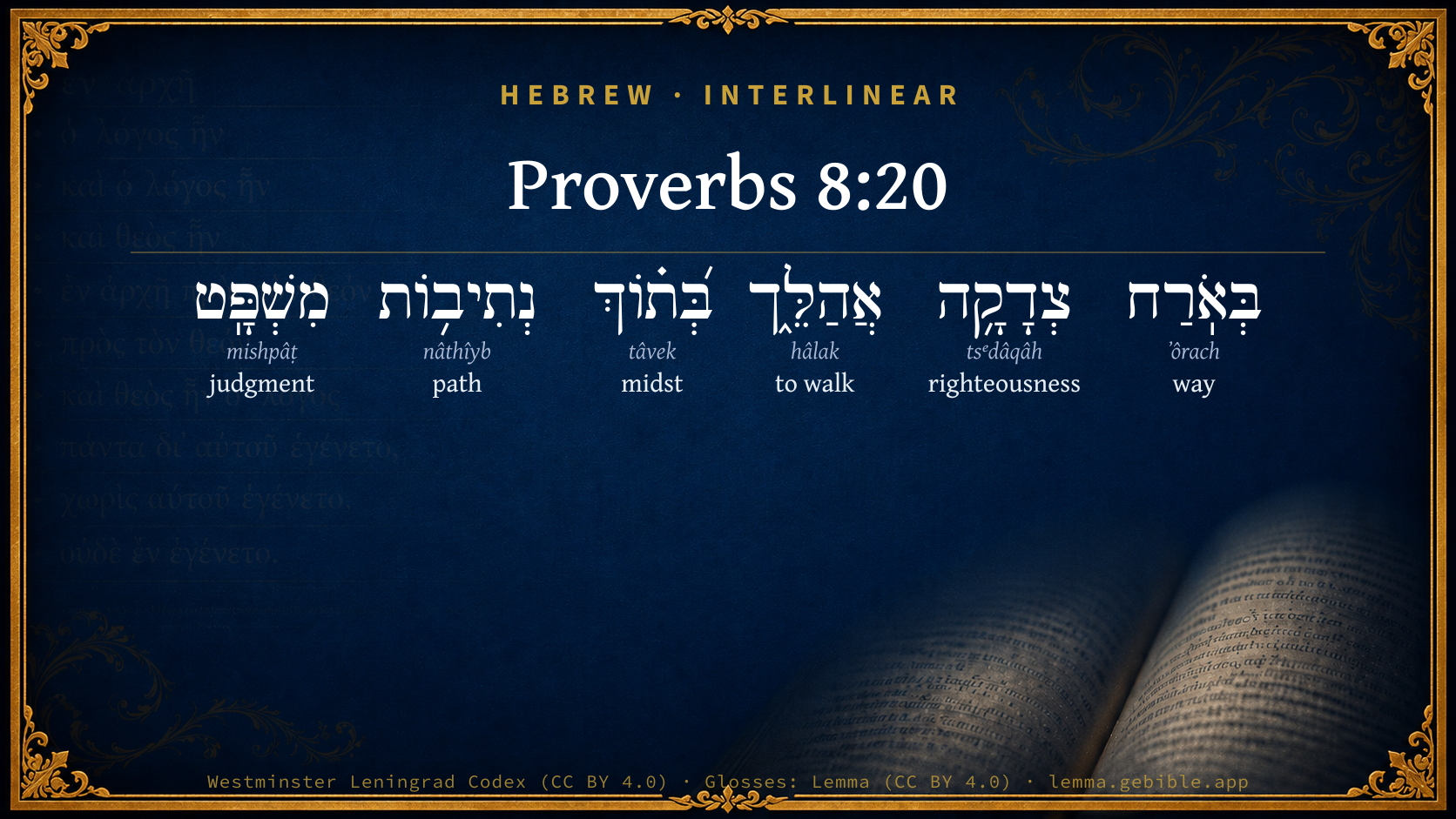
Proverbs 8:20

Hebrew (Westminster Leningrad Codex) Proverbs 8:20 appears in the Hebrew Old Testament. The text above is from the Westminster Leningrad Codex. Each word links to its Strong’s number, a concise gloss, and parsing drawn from the Open Scriptures Hebrew Bible morphology. Click any word for its full Brown-Driver-Briggs (BDB) entry.
Download image
Cite this verse

Proverbs 8:20 (World English Bible). Public Domain. Lemma interlinear Bible study tool, https://lemma.gebible.app/v/proverbs/8/20.

Show BibTeX & RIS
BibTeX
RIS
English Translation
I walk in the way of righteousness, In the midst of the paths of justice;
World English Bible · Public Domain
Download a study sheet

One document with this verse’s original text, its word-by-word gloss line, the meaning frame, cross-references with their text, attributed commentary, and full source and license credits — printable, and it pastes into notes with its structure intact.

This verse Autodidact and up

Study sheet (.html) Plain text (.txt)

A passage Seminary Student

Up to 50 verses in one chapter. A passage sheet keeps up to 6 commentary sources and 12 cross-references per verse, in the order this page ranks them, and says so on the sheet whenever that leaves anything out. Ask for a single verse and you get the Autodidact verse sheet above.

Everything on this page stays free to read, with no account — the sheet is a download of what is already on screen, not access to it.

Want to remove ads? Support Godless Engineer
Compare translations 3

The same verse in 3 English versions, stacked beneath the original-language interlinear above. Click any original word for its lexicon entry.

Each is an independent rendering of the whole verse — the interlinear is not word-aligned to these translations.

Highlighted words mark where these versions differ — a whole-verse word diff, not a word-by-word alignment.

  • World English Bible Public Domain
    I walk in the way of righteousness, In the midst of the paths of justice;
  • King James Version Public Domain
    I lead in the way of righteousness, in the midst of the paths of judgment:
  • unfoldingWord Literal Text CC BY-SA 4.0
    I walk in the path of righteousness, in the midst of the pathways of justice,

unfoldingWord Literal Text — © unfoldingWord, licensed CC BY-SA 4.0. Word-aligned USFM3 via Door43 (git.door43.org/unfoldingWord/en_ult).

Versions to compare (up to 4)

3 of 4 selected

Show all 18 translations

Every available English version of this verse, each an independent rendering of the whole verse.

  • World English Bible Public Domain
    I walk in the way of righteousness, In the midst of the paths of justice;
  • Berean Standard Bible Public Domain
    I walk in the way of righteousness, along the paths of justice,
  • Majority Standard Bible Public Domain
    I walk in the way of righteousness, along the paths of justice,
  • King James Version Public Domain
    I lead in the way of righteousness, in the midst of the paths of judgment:
  • American Standard Version (1901) Public Domain
    I walk in the way of righteousness, In the midst of the paths of justice;
  • Revised Version (1885) Public Domain
    I walk in the way of righteousness, in the midst of the paths of judgment:
  • Geneva Bible (1599) Public Domain
    I cause to walke in the way of righteousnes, and in the middes of the paths of iudgement,
  • Douay-Rheims (1899) Public Domain
    I walk in the way of justice, in the midst of the paths of judgment,
  • Young's Literal Translation Public Domain
    In a path of righteousness I cause to walk, In midst of paths of judgment,
  • Literal Standard Version CC BY-SA 4.0
    I cause to walk in a path of righteousness, || In midst of paths of judgment,
  • Unlocked Literal Bible CC BY-SA 4.0
    I walk in the path of righteousness, in the midst of the paths of justice.
  • unfoldingWord Literal Text CC BY-SA 4.0
    I walk in the path of righteousness, in the midst of the pathways of justice,
  • Darby Bible Public Domain
    I walk in the path of righteousness, in the midst of the paths of judgment:
  • World Messianic Bible Public Domain
    I walk in the way of righteousness, in the middle of the paths of justice,
  • Webster's Bible Public Domain
    I lead in the way of righteousness, in the midst of the paths of judgment.
  • Free Bible Version CC BY-SA 4.0
    I live in a way that's right; I follow the paths of justice.
  • Bible in Basic English Public Domain
    I go in the road of righteousness, in the way of right judging:
  • JPS Tanakh (1917) Public Domain
    I walk in the way of righteousness, in the midst of the paths of justice;

Literal Standard Version (2020), Covenant Press — licensed CC BY-SA 4.0. Text via the HelloAO Bible API (eBible.org). Unlocked Literal Bible (unfoldingWord) — licensed CC BY-SA 4.0. Text via the HelloAO Bible API (eBible.org). unfoldingWord Literal Text — © unfoldingWord, licensed CC BY-SA 4.0. Word-aligned USFM3 via Door43 (git.door43.org/unfoldingWord/en_ult). Free Bible Version, Dr. Jonathan Gallagher — licensed CC BY-SA 4.0. Text via the HelloAO Bible API (eBible.org).

Word by word

More ways to search: Search by grammar → Find every occurrence → Compare this word →

Practice this passage: Drill this verse → Learn its vocabulary →

About this verse

These counts appear in no published source. They are computed here, from the morphology-tagged text and Lemma’s own curated glosses. What Lemma adds →

6
words
6
distinct lemmas
Wisdom
section

Shared distinctive vocabulary

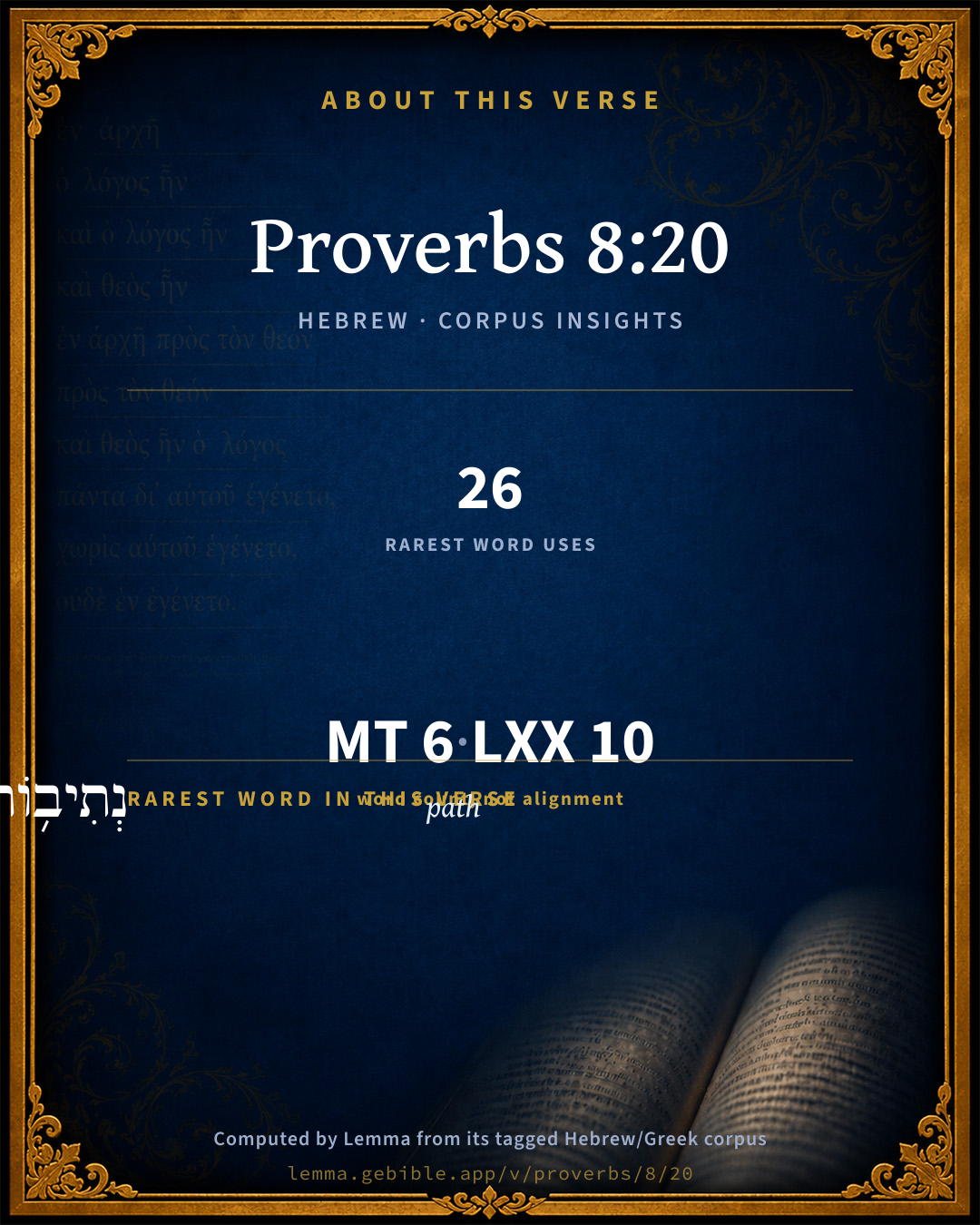
נְתִיב֥וֹת path H5410 occurs in 26 verses of the Hebrew Bible. Also found in:

Grammatical profile

  • 1 verb
  • 5 nouns

Verb forms

  • אֲהַלֵּ֑ך Piel · Imperfect

Hebrew & Septuagint length

In English translation the verse runs 15 words from the Hebrew and 14 from the Septuagint (LXX English) — closely comparable.

A rough comparison of the two English renderings, which tokenize alike — not a word-level alignment.

Word counts can differ between the Hebrew and the Greek without any difference in meaning — e.g. the Hebrew direct-object marker אֵת has no separate Greek word, and Greek often adds the article ὁ.

In the original languages it is 6 Hebrew tokens and 10 Greek tokens — but the two are counted differently (Hebrew bundles its prefixes and suffixes into one token; the Greek is in lemma form), so that isn’t a like-for-like length.

Cross-references

14

Topical passages linked to Proverbs 8:20 in the Treasury of Scripture Knowledge — connected by theme and wording, ordered by reader-vote popularity; previews shown in the World English Bible.

  • John 10:27–28 My sheep hear my voice, and I know them, and they follow me.
  • Deuteronomy 5:32 You shall observe to do therefore as Yahweh your God has commanded you: you shall not turn aside to the right hand or to the left.
  • Psalms 32:8 I will instruct you and teach you in the way which you shall go. I will counsel you with my eye on you.
  • Proverbs 4:11–12 I have taught you in the way of wisdom. I have led you in straight paths.
  • Psalms 25:4–5 Show me your ways, Yahweh. Teach me your paths.
  • Proverbs 3:6 In all your ways acknowledge him, And he will direct your paths.
  • Proverbs 6:22 When you walk, it will lead you. When you sleep, it will watch over you. When you awake, it will talk with you.
  • Isaiah 2:3 Many peoples shall go and say, "Come, let's go up to the mountain of Yahweh, To the house of the God of Jacob; And he will teach us of his ways, And we will walk in his paths. For out of Zion the law shall go forth, And the word of Yahweh from Jerusalem.
  • Psalms 23:3 He restores my soul. He guides me in the paths of righteousness for his name's sake.
  • Isaiah 49:10 They shall not hunger nor thirst; neither shall the heat nor sun strike them: for he who has mercy on them will lead them, even by springs of water will he guide them.
  • John 10:3 The gatekeeper opens the gate for him, and the sheep listen to his voice. He calls his own sheep by name, and leads them out.
  • Revelation 7:17 for the Lamb who is in the midst of the throne shepherds them, and leads them to springs of waters of life. And God will wipe away every tear from their eyes."
  • Proverbs 4:25–27 Let your eyes look straight ahead. Fix your gaze directly before you.
  • Isaiah 55:4 Behold, I have given him for a witness to the peoples, a leader and commander to the peoples.

Cross-references courtesy of OpenBible.info (CC BY 4.0).

Hebrew and Greek witnesses Masoretic Hebrew ↔ Greek Septuagint

The same verse in the two great witnesses to the Old Testament, shown verse-for-verse.

These are two independent witnesses, not word-aligned to each other, and the Septuagint is shown in lemma (dictionary) form.

Hebrew Proverbs 8:20 Masoretic · Westminster Leningrad Codex

בְּאֹֽרַח צְדָקָ֥ה אֲהַלֵּ֑ך בְּ֝ת֗וֹךְ נְתִיב֥וֹת מִשְׁפָּֽט

I walk in the way of righteousness, In the midst of the paths of justice;

World English Bible · Public Domain

Greek LXX Proverbs 8:20 Septuagint · lemma form

ἐν ὁδός δικαιοσύνη περιπατέω καί ἀνά μέσος τρίβος δικαίωμα ἀναστρέφω

I walk in ways of righteousness, and am conversant with the paths of judgment;

LXX2012 (modern English Septuagint) · Public Domain

Hebrew: Westminster Leningrad Codex (CC BY 4.0). Greek: Septuagint (public domain); English from LXX2012 (modern English Septuagint) (Public Domain). How the Septuagint differs from the Hebrew →

Commentary

Notes on Proverbs 8:20 from classic Christian and Jewish commentators (each source and its license shown beneath its notes). The classic Christian expositions comment on the surrounding passage and are grouped to its opening verse, so a note may address several verses; the Jewish commentaries on the Tanakh (Rashi and others) are per-verse, so they appear only where the commentator wrote on this verse.

Lemma curates 59 commentaries, every one of them public domain or Creative Commons licensed, each selected and text-cleaned for this edition rather than reprinted as found. About our sources →

Trapp's Complete Commentary

John Trapp

Pro 8:20 I lead in the way of righteousness, in the midst of the paths of judgment:

Ver. 20. I lead in the way of righteousness.] Which is to say, I got not my wealth per fas atque nefas, by right and wrong, by wrench and wile. My riches are not the riches of unrighteousness, "the mammon of iniquity"; {Luk 16:9} but are honestly come by, and are therefore like to be "durable," {Pro 8:18} or, as others render it, ancient. St Jerome somewhere saith, that most rich men are either themselves bad men, or heirs of those that have been bad. There is a profane proverb among us, Happy is that child whose father goes to the devil! It is reported of Nevessan the lawyer, that he should say, He that will not venture his body, shall never be valiant; he that will not venture his soul, never rich. But wisdom’s walk lies not any such way. God forbid, saith she, that I, or any of mine, should take of Satan, "from a thread even to a shoe latchet, lest he should say, I have made you rich." {Gen 14:23}

John Trapp, A Commentary or Exposition upon All the Books of the Old and New Testament (1647–1656) — public domain. Text from a community e-Sword module.

The Biblical Illustrator

Joseph S. Exell

Pro_8:20

I lead in the way of righteousnses.

Substance the inheritance of the saints

I. Jesus leads in the way of righteousness--

1. By leading them into His holy, strict, and condemning law.

2. By implanting sincerity and uprightness.

II. Jesus leads in the midst of the paths of judgment. These paths of judgment are when He, with His holy eye, scrutinises the heart and brings to light its secret workings. He leads by setting up a court of judicature in the heart, arraigning the soul at its bar; not with vengeance, as punishing a criminal, but as a parent, after the child has been playing truant all day.

III. Jesus causes the soul to inherit substance. Something solid, weighty, powerful, real, and eternal. Power and life and feeling, and the blessed kingdom of God set up with authority in the soul. A substantial religion--something that is dropped into the soul from His own blessed self, something that comes out of Himself, and out of the fulness of His own loving heart, to make them rejoice and be glad. (J. C. Philpot.)

In the midst of the paths of Judgment.

The golden mean

In this country, if you walk in the middle of the street in the town, or in the middle of the road in the country, you are exposed to danger from horses and vehicles, for which that part of the road was reserved, and therefore side-paths and pavements have been provided, where you can take refuge from the traffic. It is different in the East. There the roads are so badly made, and so little frequented, that you are always safest in the middle. There is a rock, perhaps, on this side, and a precipice or a ditch on that, and the edges of the road are always so rugged and uneven that only the well-worn track in the middle is available for easy travelling. And from this condition of Eastern roads has arisen the moral lesson that the middle of the path of conduct is the safest and the best. The sentiment may be exemplified in everything moral and religious. The Greeks of old always spoke of the golden mean between two extremes, and were fond of proving that truth and safety always lay in the middle. The wise man speaks of the paths of judgment. These paths are oft either side of the way of righteousness, which is the middle; and they are called paths of judgment because, if you stray into them off the strait and narrow way of righteousness, you will meet with dangers and evils that will assuredly punish you. The virtues that yield the blessings of life are in the middle, between the vices that wreck and blight your life. A little too much on the one side or the other makes all the difference in the world; and so close to each other do the evils you have to avoid come, that narrow is the way that leadeth unto life, and few there be that find it. The side-path may, therefore, be smooth and pleasant, but it leads to danger. The middle of the road may be rough and difficult, but it is safe--the way of righteousness, between the paths of judgment. (H. Macmillan,D. D.)

The Biblical Illustrator, edited by Joseph S. Exell (c. 1880s–1900s) — public domain. Text from a community e-Sword module.

Joseph Benson's Commentary

Pro 8:20-21. I lead in the way of righteousness — In the way of truth, justice, and mercy, of holiness and happiness; the way in which God would have men to walk, and which will certainly bring them to the desired end. In the midst of the paths of judgment, keeping at an equal distance from both extremes, and from the very borders of them. That I may cause, &c., to inherit substance — Substantial, true, and satisfying happiness; which is here opposed to all worldly enjoyments, which are but mere shadows, and dreams of felicity, Pro 23:5.

Joseph Benson's Commentary on the Old and New Testaments (1811–1818) — public domain. Text from a community e-Sword module.

Geneva Bible (1599)

Geneva Bible translators

For there can be no true justice or judgment, which is not rejected by this wisdom.

Geneva Bible (1599) marginal notes — public domain. Text via Bolls.life.

Jamieson, Fausset & Brown

Robert Jamieson, A. R. Fausset & David Brown

The courses in which wisdom leads conduct to a true present prosperity (Pro 23:5).

Jamieson, Fausset & Brown — Commentary Critical and Explanatory on the Whole Bible (1871) — public domain (CC PDM 1.0). Text via the HelloAO Bible API.

Adam Clarke's Commentary

Verse 20. I lead in the way of righteousness] Nothing but the teaching that comes from God by his word and Spirit can do this.

Adam Clarke's Commentary on the Bible (1810–1826) — public domain. Text from a community e-Sword/MySword module.

Ellicott's Commentary for English Readers

(20) I lead in the way of righteousness.—Comp. Psa_37:23; also a prayer for such guidance, Psa_119:33; Psa_143:8; and a promise of it Isa_30:21

A Bible Commentary for English Readers, edited by Charles John Ellicott (1878–1897) — public domain. Text from a community e-Sword module.

John Gill's Exposition

I lead in the way of righteousness,.... As a king his subjects, a shepherd his flock; as a guide to persons that are ignorant and out of the way; as parents their children, teaching them to go; or as a master his scholars: and the way Wisdom, or Christ, leads his people in, is "the way of righteousness"; the doctrine of righteousness, or the way and manner of a sinner's justification in the sight of God; all men are out of the way of it, and are ignorant of the right way; Christ leads them into it: he leads them off of their own righteousness by showing that it does not deserve the name of one; that it is unacceptable to God, unprofitable to him, and insufficient to justify them before him; and he leads them to his own righteousness, which he has wrought out; and shows them that this is answerable to the demands of law and justice, is acceptable to God, and imputed by him without works; and this he does in his word and by his Spirit: and in this way of righteousness he leads them into his Father's presence with acceptance; to himself, in which he beholds them with pleasure; and to eternal glory, which gives them a title to it: he also leads into the practice of righteousness; he teaches them, and they learn of him works of righteousness; he goes before them by way of example, and he gives them his Spirit and grace to enable them to perform them; and which may more especially be intended in the next clause;

in the midst of the paths of judgment: of truth and holiness; in his commandments and ordinances; in all which they are led not against their wills but with them; and not only walk but run with the greatest cheerfulness in those ways and paths of his.

John Gill's Exposition of the Whole Bible (1746–1763) — public domain (CC PDM 1.0). Text via the HelloAO Bible API.

Matthew Poole's English Annotations

Keeping at an equal distance from both extremes, and from the very borders of them; which is called a

putting away iniquity far from us, Job 22:23.

Matthew Poole's English Annotations on the Holy Bible (1683–1685) — public domain. Text from a community e-Sword/MySword module.

Whedon's Commentary on the Bible

Daniel D. Whedon

20, 21. I lead — אהלךְ, perhaps better, I move habitually; that is, as the leader and exemplar of my votaries: for the purpose stated in the next verse.

Righteousness — Rectitude.

Judgment — Judicial or administrative justice.

Substance — All real substantial good.

Treasures — Treasuries, storehouses. “That I may insure abundance to those who love me.” — Zockler. “So results a heritage to those who love me.” — Miller. Thus ends this head of the discourse of wisdom. How magnificent and substantial the blessings she holds out to her votaries! How great the contrast between her and the syren of voluptuous pleasure! The lovers of a short-lived, carnal indulgence plunge speedily into utter misery and ruin:

the lovers of heavenly wisdom secure to themselves and their posterity permanent good of the highest kind. It may positively be true, that in the mind of the writer these blessings did not go beyond the present life. But we, to whom life and immortality are fully brought to light by the Gospel, may extend and amplify the principles here laid down, to the laying hold of the spiritual and eternal. We may carry forward the promises and propositions of wisdom, so as to include “the life that is to come;” “an inheritance incorruptible, and undefiled, and that fadeth not away, reserved in heaven for you, who are kept by the power of God through faith unto salvation ready to be revealed in the last time.” 1Pe_1:4-5.

The following verses are admired by all critics as a composition of wonderful excellence. The general subject is the same as the preceding; the personification is continued; but wisdom, instead of being regarded as a quality or attribute of man, is presented, in a bold prosopopoeia, as an attribute of God himself. The design is to show the claims of wisdom on the ground of her antiquity, her divine origin, and her sympathy with man.

Daniel D. Whedon (gen. ed.), Commentary on the Old and New Testaments (1874–1909) — public domain. Text from a community e-Sword module.

The Pulpit Commentary

I lead in the way (better, I walk in the way) of righteousness. I act always according to the rules of justice. In the midst of the paths of judgment. I swerve not to one side or the other. (Pro_4:27) So the psalmist prays, "Teach me, O Lord, the way of thy statutes; and I shall keep it unto the end;" "Cause me to know the way wherein I should walk". (Psa_119:33 Psa_143:8) And the promise is given to the faithful in Isa_30:21, "Thine ears shall hear a word behind thee, saying, This is the way, walk ye in it, when ye turn to the right hand, and when ye turn to the left." Virtue, as Aristotle has taught us, is the mean between two extremes.

The Pulpit Commentary (1880–1919), ed. H.D.M. Spence-Jones & Joseph S. Exell — public domain. Text from a community e-Sword module.

Lesson kit

Teaching starters — assembled from the data on this page, not authored interpretation. Every prompt links to the verse data it draws on. Edit before teaching.

Proverbs, in the Wisdom, opens this verse with 6 words (6 distinct Hebrew lemmas). Its most distinctive word is nâthîyb (“path”). A historical commentator’s framing appears above. Read the whole chapter for the surrounding context.

Discussion questions

  1. What does “path” (nâthîyb) contribute to the verse as a whole?
  2. How does Judges 5:6, which shares the word «path», read alongside this verse?
  3. The translations on this page render this verse differently — a whole-verse word diff, not a word-by-word alignment. What might account for the different wordings?
  4. «אֲהַלֵּ֑ך» is a Piel Imperfect verb. How does that grammatical form shape the action described?
  5. Compare how Trapp's Complete Commentary and The Biblical Illustrator read this verse. Where do they agree or differ?

Things to notice

Reading settings

Reading text

Shown beneath each verse's original-language words.

Old Testament
Old Testament edition

Read the OT as the Masoretic Hebrew (MT) or the Greek Septuagint (LXX).

English shown for the Greek Septuagint (in the Hebrew ↔ Greek comparison).

Comparing translations? Open the Compare panel on any verse page to stack up to four side by side.