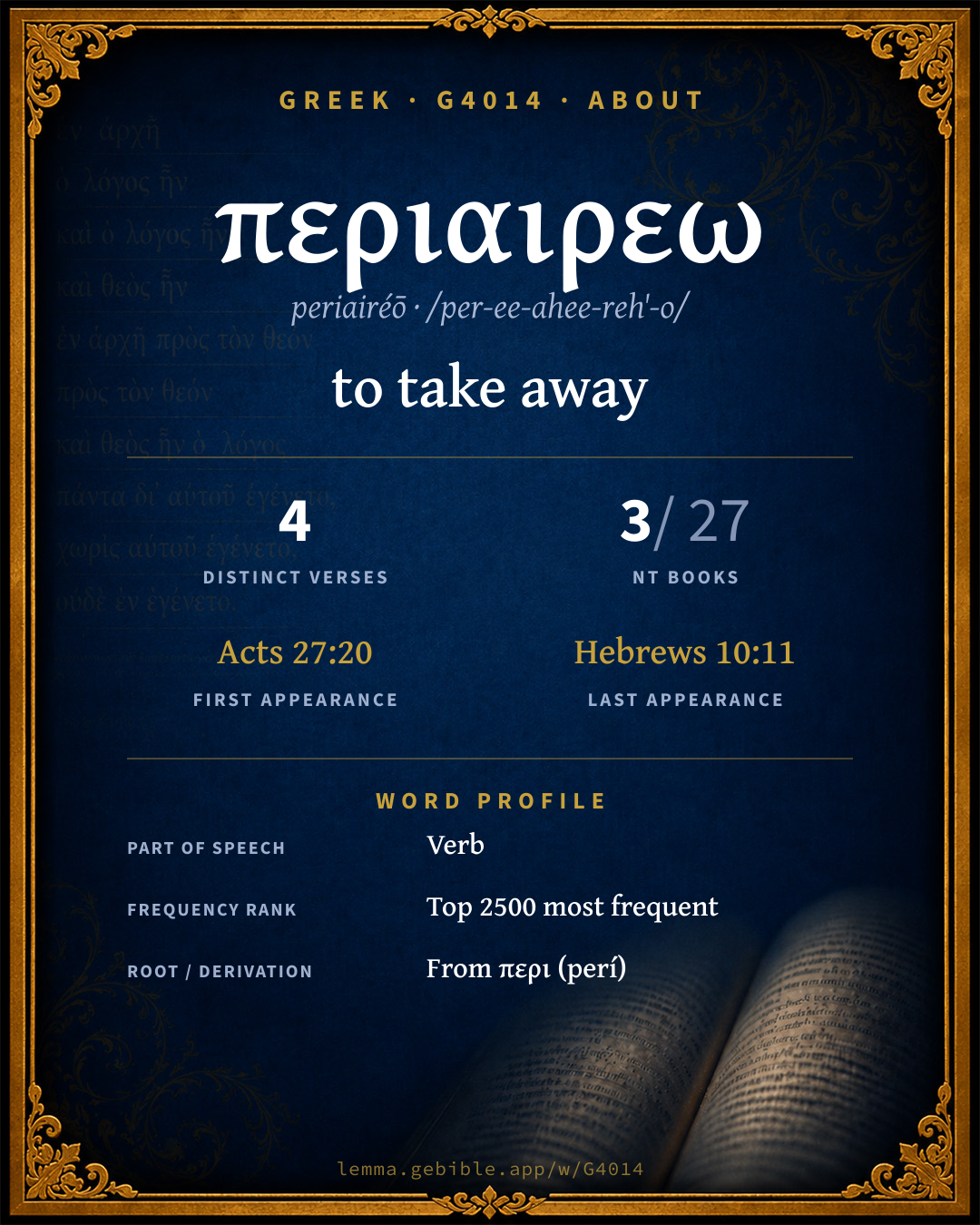
περιαιρέω
to take away
‘to take away’ is one of 2 main senses fuller range ↓
Full lexicon entry — Thayer's Greek Lexicon
From Thayer's Greek Lexicon
Where this word appears
See every Aorist-tense verb in the Greek New Testament →
Grammar key — what these labels mean
Part of speech
- Verb
- An action or state-of-being word.
Tense
- Aorist
- Action viewed as a simple whole, without regard to duration — often past (perfective aspect).
- Imperfect
- Continuous or repeated action in past time (“was writing”).
- Present
- Ongoing or general action in present time (imperfective aspect).
Voice
- Active
- The subject performs the action.
- Passive
- The subject receives the action.
Mood
- Infinitive
- A verbal noun (“to write”), unmarked for person or number.
- Participle
- A verbal adjective (“writing,” “having written”).
- Indicative
- States a fact or asks a factual question (the mood of reality).
Case
- Nominative
- The case of the subject (and the predicate nominative).
Person
- 3rd person
- The one spoken about (“he / she / it / they”).
Gender
- Masculine
- Grammatically masculine.
Number
- Plural
- More than one.
- Singular
- One.
Grammatical forms
- Verb, Aorist, Active, Infinitive 1 time (25%)
- Verb, Aorist, Active, Participle, Nominative, Plural, Masculine 1 time (25%)
- Verb, Imperfect, Passive, Indicative, 3rd person, Singular 1 time (25%)
- Verb, Present, Passive, Indicative, 3rd person, Singular 1 time (25%)
Parsed forms decoded from the imported morphology (Robinson–Tischendorf, public domain), counted across 4 parsed occurrences — not distinct verses.
Every verse where G4014 appears — 4 distinct verses across 3 books. Click any verse to open its interlinear word-by-word view. Verse text shown in the World English Bible for context — . Each verse’s Greek form is shown with its reference; the English is not keyword-highlighted, since the data carries no word-level English alignment. Use “Compare translations” on any verse to read it across multiple English versions. This concordance covers the Greek New Testament; Septuagint (Greek Old Testament) occurrences of this word are not indexed here.
Acts 2 verses
- Acts 27:20 περιῃρεῖτο impf pass ind 3sg When neither sun nor stars shone on us for many days, and no small tempest pressed on us, all hope that we would be saved was now taken away.
- Acts 27:40 περιελόντες aor act ptcp nom pl masc Casting off the anchors, they left them in the sea, at the same time untying the rudder ropes. Hoisting up the foresail to the wind, they made for the beach.
2 Corinthians 1 verse
Hebrews 1 verse
About this entry
At a glance — auto-summarized from this page’s data, not written by a person. Every figure links to its source below. This summary describes the numbers; it doesn’t interpret them.
At its core, περιαιρεω (periairéō) means “to take away.” It is rare — just 4 verses in the entire Greek New Testament. The word gravitates to Acts (50%), then 2 Corinthians and Hebrews. It first appears in Acts 27:20. Ranging over 2 senses, it is not a single-sense word. Dig into 4-verse concordance and the renderings breakdown below.
Gloss history
Strong's 1890 vs modern scholarship
About this word
Strong's G4014 catalogs a Greek word from the Greek New Testament.
These counts are not copied from any lexicon or concordance. They are computed here, from the morphology-tagged Greek New Testament. What Lemma adds →
- 4
- distinct verses
- The word appears in 4 distinct verses.
- 3 / 27
- NT books
- The word appears in 3 of 27 New Testament books.
- #1,877
- by frequency
- Top 2500 most frequent Greek words (rank 1,877 of 5,347 Greek words by occurrence).
View all 4 occurrences in the concordance →
Most concentrated in
- Acts 2 verses 50%
- 2 Corinthians 1 verse 25%
- Hebrews 1 verse 25%
By section of the New Testament
By traditional corpus
Conventional, traditional groupings — biblical authorship is debated, so this is a traditional corpus grouping, not an authorship claim. Some books belong to more than one corpus (Luke is in both the Gospels and the Lukan corpus, and so on), so these shares overlap and need not total 100%. Each figure is a share of the word’s 4 distinct verses.
- Lukan (Luke–Acts) 2 verses · 50%
- Pauline corpus 1 verse · 25%
- Hebrews 1 verse · 25%
How translations render this word
Counts come from each version’s own published word-to-Strong’s tagging or interlinear alignment — an approximate guide to how each version renders this word, not a word-level alignment the data otherwise carries. Because each total is that version’s own tagged count, the per-version totals vary from one another and need not match the appearance or distinct-verse counts above. These counts may also differ from a printed concordance because Lemma counts each distinctly tagged rendering and does not collapse phrase taggings into a single head-word total. This is a fixed set of word-tagged versions (KJV, ASV, BSB, ULT) and does not change with the reading translation you choose elsewhere. Each version’s license is shown beside its name below (and on Sources).
- King James Version: Shall be taken away 1×, Take away 1×, Taken away 1×
- American Standard Version: Casting 1×, Is taken away 1×, Take away 1×
- Berean Standard Bible: Cutting away 1×, Is taken away 1×, Take away 1×
- unfoldingWord Literal Text: Being taken away 1×, Having cut loose 1×, Having sailed 1×
King James Version Public Domain
Renders G4014 across 5 tagged occurrences — most commonly:
American Standard Version Public Domain
Renders G4014 across 5 tagged occurrences — most commonly:
Berean Standard Bible Public Domain
Renders G4014 across 5 tagged occurrences — most commonly:
unfoldingWord Literal Text CC BY-SA 4.0
Renders G4014 across 7 tagged occurrences — most commonly:
Senses in Thayer's
The 2 senses Thayer's distinguishes for this word, in lexicon order (not ranked by frequency or importance). The full entry — with sub-senses — is in the Lexicon Entry tab.
- to take away that which surrounds or envelopes a thing
- metaph. to take away altogether or entirely
Word origin
Derived from περι (perí) (G4012) — about.
Forms in the corpus
The 4 distinct written forms G4014 takes in the Greek New Testament, most frequent first — each parse links to that tense’s occurrences in the concordance.
| Form | Parsing | Example | Uses |
|---|---|---|---|
| περιαιρεῖται periaireîtai | Verb, Present, Passive, Indicative, 3rd person, Singular | 2 Corinthians 3:16 | 1 |
| περιελεῖν perieleîn | Verb, Aorist, Active, Infinitive | Hebrews 10:11 | 1 |
| περιελόντες perielóntes | Verb, Aorist, Active, Participle, Nominative, Plural, Masculine | Acts 27:40 | 1 |
| περιῃρεῖτο periēreîto | Verb, Imperfect, Passive, Indicative, 3rd person, Singular | Acts 27:20 | 1 |
Same root — word family
Other Thayer's entries built from the same root as G4014, grouped by Strong’s listed origin. These share a root / origin per the lexicon — not necessarily a shared meaning. Each links to that word’s own entry.
Derives from
Shares the same root
- περιαγω periágō G4013 to lead around
- περιαστραπτω periastráptō G4015 to shine around
- περιβαλλω peribállō G4016 to throw around
- περιβλεπω periblépō G4017 to look around
- περιδεω peridéō G4019 to bind around
- περιεργαζομαι periergázomai G4020 to bustle about
- περιεργος períergos G4021 busybody
- περιερχομαι periérchomai G4022 to go about
- περιεχω periéchō G4023 to surround
- περιζωννυμι perizṓnnymi G4024 to gird
- περιΐστημι periḯstēmi G4026 to stand around
- περικαθαρμα perikátharma G4027 scum
- περικαλυπτω perikalýptō G4028 to cover up
- περικειμαι períkeimai G4029 to lie around
- περικεφαλαια perikephalaía G4030 helmet
- περικρατης perikratḗs G4031 to have power over
- περικρυπτω perikrýptō G4032 to hide
- περικυκλοω perikyklóō G4033 to encircle
- περιλαμπω perilámpō G4034 to shine around
- περιλειπω perileípō G4035 to remain over
- περιλυπος perílypos G4036 deeply sorrowful
- περιμενω periménō G4037 to wait for
- περιξ périx G4038 round about
- περιοικεω perioikéō G4039 to be neighbor
+17 more words share this root (not shown).
Compare all same-root words → Showing 4 of 43 — not the complete family. They share a root, not necessarily a meaning.
Septuagint usage
The same Greek word περιαιρεω appears 52 times in the Greek Old Testament (Septuagint), across 47 verses in 16 books.
- 52
- LXX occurrences
- Tagged occurrences of this Greek word in the Septuagint.
- 47
- verses
- Distinct Septuagint verses containing this word.
- 16 / 39
- OT books
- The word appears in 16 of the 39 Old Testament books.
Sample Septuagint occurrences
- Genesis 38:14 περιαἱρέω
- Exodus 8:4 περιαἱρέω
- Leviticus 3:4 περιαἱρέω
- Numbers 17:20 περιαἱρέω
- Deuteronomy 7:15 περιαἱρέω
- Joshua 24:14 περιαἱρέω
- 1 Samuel 1:14 περιαἱρέω
- 2 Samuel 3:10 περιαἱρέω
- 1 Chronicles 21:8 περιαἱρέω
- 2 Chronicles 32:12 περιαἱρέω
- Esther 3:10 περιαἱρέω
- Psalms 118:22 περιαἱρέω
Septuagint occurrences (same lexeme)
Every verse where the same Strong’s number (G4014) appears in the Greek Septuagint. Verse text shown in the World English Bible for context; the Greek form is the matched word — the English is not keyword-highlighted.
- Genesis 38:14 περιαἱρέω She took off of her the garments of her widowhood, and covered herself with her veil, and wrapped herself, and sat in the gate of Enaim, which is by the way to Timnah; for she saw that Shelah was grown up, and she wasn't given to him as a wife.
- Genesis 38:19 περιαἱρέω She arose, and went away, and put off her veil from her, and put on the garments of her widowhood.
- Genesis 41:42 περιαἱρέω Pharaoh took off his signet ring from his hand, and put it on Joseph's hand, and arrayed him in robes of fine linen, and put a gold chain about his neck,
- Exodus 8:4 περιαἱρέω and the frogs shall come up both on you, and on your people, and on all your servants.'"
- Exodus 8:7 περιαἱρέω The magicians did in like manner with their enchantments, and brought up frogs on the land of Egypt.
- Exodus 8:27 περιαἱρέω We will go three days' journey into the wilderness, and sacrifice to Yahweh our God, as he shall command us."
- Exodus 10:17 περιαἱρέω Now therefore please forgive my sin again, and pray to Yahweh your God, that he may also take away from me this death."
- Exodus 32:2 περιαἱρέω Aaron said to them, "Take off the golden rings, which are in the ears of your wives, of your sons, and of your daughters, and bring them to me."
- Exodus 32:3 περιαἱρέω All the people took off the golden rings which were in their ears, and brought them to Aaron.
- Exodus 32:24 περιαἱρέω I said to them, 'Whoever has any gold, let them take it off:' so they gave it me; and I threw it into the fire, and out came this calf."
- Exodus 33:6 περιαἱρέω The children of Israel stripped themselves of their jewelry from Mount Horeb onward.
- Exodus 34:34 περιαἱρέω But when Moses went in before Yahweh to speak with him, he took the veil off, until he came out; and he came out, and spoke to the children of Israel that which he was commanded.
- Leviticus 3:4 περιαἱρέω and the two kidneys, and the fat that is on them, which is by the loins, and the cover on the liver, with the kidneys, he shall take away.
- Leviticus 3:9 περιαἱρέω He shall offer from the sacrifice of peace offerings an offering made by fire to Yahweh; its fat, the entire tail fat, he shall take away close to the backbone; and the fat that covers the inwards, and all the fat that is on the inwards,
- Leviticus 3:10 περιαἱρέω and the two kidneys, and the fat that is on them, which is by the loins, and the cover on the liver, with the kidneys, he shall take away.
- Leviticus 3:15 περιαἱρέω and the two kidneys, and the fat that is on them, which is by the loins, and the cover on the liver, with the kidneys, he shall take away.
- Leviticus 4:8 περιαἱρέω He shall take all the fat of the bull of the sin offering off of it; the fat that covers the innards, and all the fat that is on the innards,
- Leviticus 4:9 περιαἱρέω and the two kidneys, and the fat that is on them, which is by the loins, and the cover on the liver, with the kidneys, he shall take away,
- Leviticus 4:19 περιαἱρέω All its fat he shall take from it, and burn it on the altar.
- Leviticus 4:31 περιαἱρέω All its fat he shall take away, like the fat is taken away from off of the sacrifice of peace offerings; and the priest shall burn it on the altar for a sweet savor to Yahweh; and the priest shall make atonement for him, and he will be forgiven.
- Leviticus 4:35 περιαἱρέω All its fat he shall take away, like the fat of the lamb is taken away from the sacrifice of peace offerings; and the priest shall burn them on the altar, on the offerings of Yahweh made by fire; and the priest shall make atonement for him concerning his sin that he has sinned, and he will be forgiven.
- Leviticus 7:4 περιαἱρέω and the two kidneys, and the fat that is on them, which is by the loins, and the cover on the liver, with the kidneys, shall he take away;
- Numbers 17:20 περιαἱρέω
- Numbers 30:13 περιαἱρέω Every vow, and every binding oath to afflict the soul, her husband may establish it, or her husband may make it void.
- Numbers 30:14 περιαἱρέω But if her husband altogether hold his peace at her from day to day, then he establishes all her vows, or all her bonds, which are on her: he has established them, because he held his peace at her in the day that he heard them.
- Numbers 30:16 περιαἱρέω These are the statutes, which Yahweh commanded Moses, between a man and his wife, between a father and his daughter, being in her youth, in her father's house.
- Deuteronomy 7:15 περιαἱρέω Yahweh will take away from you all sickness; and none of the evil diseases of Egypt, which you know, will he put on you, but will lay them on all those who hate you.
- Deuteronomy 21:13 περιαἱρέω and she shall put the clothing of her captivity from off her, and shall remain in your house, and bewail her father and her mother a full month: and after that you shall go in to her, and be her husband, and she shall be your wife.
- Joshua 24:14 περιαἱρέω Now therefore fear Yahweh, and serve him in sincerity and in truth; and put away the gods which your fathers served beyond the River, and in Egypt; and serve you Yahweh.
- Joshua 24:23 περιαἱρέω Now therefore put away, [said he], the foreign gods which are among you, and incline your heart to Yahweh, the God of Israel.
- 1 Samuel 1:14 περιαἱρέω Eli said to her, How long will you be drunken? put away your wine from you.
- 1 Samuel 7:3 περιαἱρέω Samuel spoke to all the house of Israel, saying, If you do return to Yahweh with all your heart, then put away the foreign gods and the Ashtaroth from among you, and direct your hearts to Yahweh, and serve him only; and he will deliver you out of the hand of the Philistines.
- 1 Samuel 7:4 περιαἱρέω Then the children of Israel did put away the Baals and the Ashtaroth, and served Yahweh only.
- 1 Samuel 28:3 περιαἱρέω Now Samuel was dead, and all Israel had lamented him, and buried him in Ramah, even in his own city. Saul had put away those who had familiar spirits, and the wizards, out of the land.
- 2 Samuel 3:10 περιαἱρέω to transfer the kingdom from the house of Saul, and to set up the throne of David over Israel and over Judah, from Dan even to Beersheba.
- 1 Chronicles 21:8 περιαἱρέω David said to God, I have sinned greatly, in that I have done this thing: but now, put away, I beg you, the iniquity of your servant; for I have done very foolishly.
- 2 Chronicles 32:12 περιαἱρέω Has not the same Hezekiah taken away his high places and his altars, and commanded Judah and Jerusalem, saying, You shall worship before one altar, and on it shall you burn incense?
- 2 Chronicles 33:15 περιαἱρέω He took away the foreign gods, and the idol out of the house of Yahweh, and all the altars that he had built in the mountain of the house of Yahweh, and in Jerusalem, and cast them out of the city.
- 2 Chronicles 34:33 περιαἱρέω Josiah took away all the abominations out of all the countries that pertained to the children of Israel, and made all who were found in Israel to serve, even to serve Yahweh their God. All his days they didn't depart from following Yahweh, the God of their fathers.
- Esther 3:10 περιαἱρέω The king took his ring from his hand, and gave it to Haman the son of Hammedatha the Agagite, the Jews' enemy.
- Psalms 118:22 περιαἱρέω The stone which the builders rejected has become the head of the corner.
- Psalms 118:39 περιαἱρέω
- Proverbs 4:24 περιαἱρέω Put away from yourself a perverse mouth. Put corrupt lips far from you.
- Jonah 3:6 περιαἱρέω The news reached the king of Nineveh, and he arose from his throne, and took off his royal robe, covered himself with sackcloth, and sat in ashes.
- Zephaniah 3:11 περιαἱρέω In that day you will not be disappointed for all your doings, in which you have transgressed against me; for then I will take away out of the midst of you your proudly exulting ones, and you will no more be haughty in my holy mountain.
- Zephaniah 3:15 περιαἱρέω Yahweh has taken away your judgments. He has thrown out your enemy. The King of Israel, Yahweh, is in the midst of you. You will not be afraid of evil any more.
- Zechariah 10:11 περιαἱρέω He will pass through the sea of affliction, And will strike the waves in the sea, And all the depths of the Nile will dry up; And the pride of Assyria will be brought down, And the scepter of Egypt will depart.
These are occurrences of the same Greek lexeme (G4014) in the Septuagint — not a translation of any one Hebrew word. The store carries no word-level Hebrew↔Greek alignment, so no Hebrew original is asserted here. Counts come from the recovered LXX Strong's tagging — high-frequency vocabulary is well covered, while rare or late forms may be untagged — so they reflect tagged occurrences and may slightly undercount.