1 John 1:6

Greek (Tischendorf 8th ed.) 1 John 1:6 appears in the Greek New Testament. The text above is from the Tischendorf 8th edition. Each word links to its Strong’s number and a concise gloss. Click any word for its full Thayer’s Greek Lexicon entry.
Download image
Cite this verse

1 John 1:6 (World English Bible). Public Domain. Lemma interlinear Bible study tool, https://lemma.gebible.app/v/1-john/1/6.

Show BibTeX & RIS
BibTeX
RIS
English Translation
If we say that we have fellowship with him and walk in the darkness, we lie, and don't tell the truth.
World English Bible · Public Domain
Download a study sheet

One document with this verse’s original text, its word-by-word gloss line, the meaning frame, cross-references with their text, attributed commentary, and full source and license credits — printable, and it pastes into notes with its structure intact.

This verse Autodidact and up

Study sheet (.html) Plain text (.txt)

A passage Seminary Student

Up to 50 verses in one chapter. A passage sheet keeps up to 6 commentary sources and 12 cross-references per verse, in the order this page ranks them, and says so on the sheet whenever that leaves anything out. Ask for a single verse and you get the Autodidact verse sheet above.

Everything on this page stays free to read, with no account — the sheet is a download of what is already on screen, not access to it.

Want to remove ads? Support Godless Engineer
Compare translations 3

The same verse in 3 English versions, stacked beneath the original-language interlinear above. Click any original word for its lexicon entry.

Each is an independent rendering of the whole verse — the interlinear is not word-aligned to these translations.

Highlighted words mark where these versions differ — a whole-verse word diff, not a word-by-word alignment.

  • World English Bible Public Domain
    If we say that we have fellowship with him and walk in the darkness, we lie, and don't tell the truth.
  • King James Version Public Domain
    If we say that we have fellowship with him, and walk in darkness, we lie, and do not the truth:
  • unfoldingWord Literal Text CC BY-SA 4.0
    If we say that we have fellowship with him and walk in the darkness, we are lying and we are not doing the truth.

unfoldingWord Literal Text — © unfoldingWord, licensed CC BY-SA 4.0. Word-aligned USFM3 via Door43 (git.door43.org/unfoldingWord/en_ult).

Versions to compare (up to 4)

3 of 4 selected

Show all 19 translations

Every available English version of this verse, each an independent rendering of the whole verse.

  • World English Bible Public Domain
    If we say that we have fellowship with him and walk in the darkness, we lie, and don't tell the truth.
  • Berean Standard Bible Public Domain
    If we say we have fellowship with Him yet walk in the darkness, we lie and do not practice the truth.
  • Majority Standard Bible Public Domain
    If we say we have fellowship with Him yet walk in the darkness, we lie and do not practice the truth.
  • King James Version Public Domain
    If we say that we have fellowship with him, and walk in darkness, we lie, and do not the truth:
  • American Standard Version (1901) Public Domain
    If we say that we have fellowship with him and walk in the darkness, we lie, and do not the truth:
  • Revised Version (1885) Public Domain
    If we say that we have fellowship with him, and walk in the darkness, we lie, and do not the truth:
  • Geneva Bible (1599) Public Domain
    If wee say that wee haue fellowship with him, and walke in darkenesse, we lie, and doe not truely:
  • Douay-Rheims (1899) Public Domain
    If we say that we have fellowship with him, and walk in darkness, we lie, and do not the truth.
  • Young's Literal Translation Public Domain
    if we may say -- `we have fellowship with Him,' and in the darkness may walk -- we lie, and do not the truth;
  • Literal Standard Version CC BY-SA 4.0
    if we may say, “We have fellowship with Him,” and may walk in the darkness—we lie, and do not [speak] the truth;
  • Unlocked Literal Bible CC BY-SA 4.0
    If we say that we have fellowship with him and walk in darkness, we are lying and are not practicing the truth.
  • unfoldingWord Literal Text CC BY-SA 4.0
    If we say that we have fellowship with him and walk in the darkness, we are lying and we are not doing the truth.
  • Darby Bible Public Domain
    If we say that we have fellowship with him, and walk in darkness, we lie, and do not practise the truth.
  • World Messianic Bible Public Domain
    If we say that we have fellowship with him and walk in the darkness, we lie and don’t tell the truth.
  • Webster's Bible Public Domain
    If we say that we have fellowship with him, and walk in darkness, we lie, and do not the truth:
  • Free Bible Version CC BY-SA 4.0
    If we claim to share this friendship with him and yet go on living in darkness, we're lying, and not living in the truth.
  • Bible in Basic English Public Domain
    If we say we are joined to him, and are walking still in the dark, our words are false and our acts are untrue:
  • Text-Critical English NT CC BY 4.0
    If we say that we have fellowship with him and yet walk in the darkness, we lie and do not live by the truth.
  • Tyndale New Testament (1534) Public Domain
    yf we saye that we have fellishippe with him and yet walke in darknes we lye and do not the truth:

Literal Standard Version (2020), Covenant Press — licensed CC BY-SA 4.0. Text via the HelloAO Bible API (eBible.org). Unlocked Literal Bible (unfoldingWord) — licensed CC BY-SA 4.0. Text via the HelloAO Bible API (eBible.org). unfoldingWord Literal Text — © unfoldingWord, licensed CC BY-SA 4.0. Word-aligned USFM3 via Door43 (git.door43.org/unfoldingWord/en_ult). Free Bible Version, Dr. Jonathan Gallagher — licensed CC BY-SA 4.0. Text via the HelloAO Bible API (eBible.org).

Word by word

More ways to search: Search by grammar → Find every occurrence → Compare this word →

Practice this passage: Drill this verse → Learn its vocabulary →

ψευδόμεθα
pseúdomai
G5574
“to lie”
Verb, Present, Middle or Passive deponent, Indicative, 1st person, Plural
Part of Speech
Verb
Tense
Present
Voice
Middle or Passive deponent
Mood
Indicative
Person
1st person
Number
Plural
Full Thayer's Definition

Origin: middle voice of an apparently primary verb

TDNT: 18:54,1

1. to lie, to speak deliberate falsehoods 2. to deceive one by a lie, to lie to
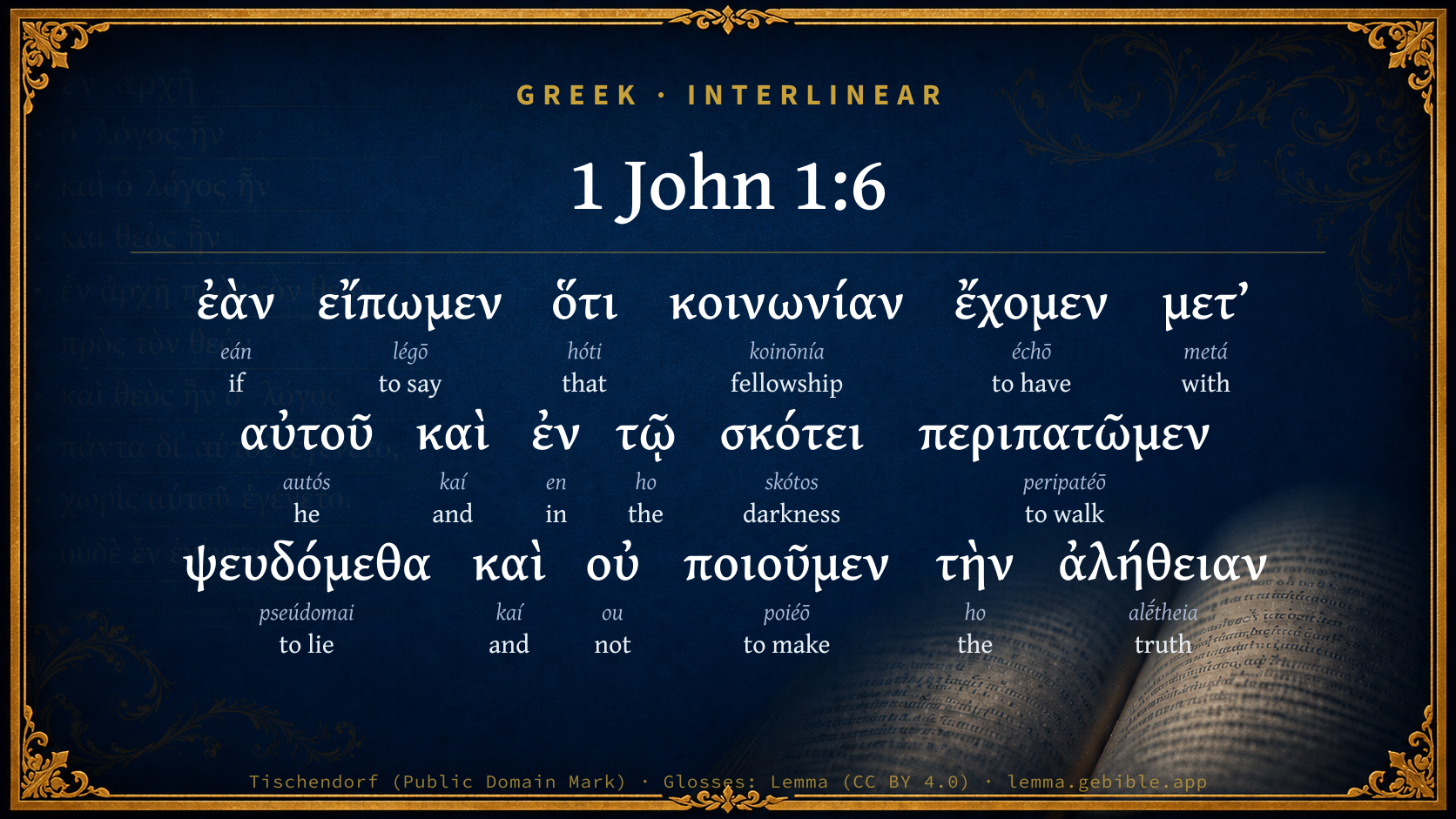
  1. ἐὰν eán G1437 “if” Conditional
  2. εἴπωμεν légō G3004 “to say” Verb, Aorist, Active, Subjunctive, 1st person, Plural
  3. ὅτι hóti G3754 “that” Conjunction
  4. κοινωνίαν koinōnía G2842 “fellowship” Noun, Accusative, Singular, Feminine
  5. ἔχομεν échō G2192 “to have” Verb, Present, Active, Indicative, 1st person, Plural
  6. μετ’ metá G3326 “with” Preposition
  7. αὐτοῦ autós G846 “he” Personal pronoun, Genitive, Singular, Masculine
  8. καὶ kaí G2532 “and” Conjunction
  9. ἐν en G1722 “in” Preposition
  10. τῷ ho G3588 “the” Article, Dative, Singular, Neuter
  11. σκότει skótos G4655 “darkness” Noun, Dative, Singular, Neuter
  12. περιπατῶμεν peripatéō G4043 “to walk” Verb, Present, Active, Subjunctive, 1st person, Plural
  13. καὶ kaí G2532 “and” Conjunction
  14. οὐ ou G3756 “not” Particle, Negative
  15. ποιοῦμεν poiéō G4160 “to make” Verb, Present, Active, Indicative, 1st person, Plural
  16. τὴν ho G3588 “the” Article, Accusative, Singular, Feminine
  17. ἀλήθειαν alḗtheia G225 “truth” Noun, Accusative, Singular, Feminine

About this verse

These counts appear in no published source. They are computed here, from the morphology-tagged text and Lemma’s own curated glosses. What Lemma adds →

18
words
16
distinct lemmas
General Epistles
section

Notable vocabulary

The rarest word here is ψευδόμεθα to lie G5574 — appearing just 12 times in the whole Greek New Testament.

Shared distinctive vocabulary

ψευδόμεθα to lie G5574 occurs in 12 verses of the Greek New Testament. Also found in:

Repetition

Words recur within this verse:

Cross-references

24

Topical passages linked to 1 John 1:6 in the Treasury of Scripture Knowledge — connected by theme and wording, ordered by reader-vote popularity; previews shown in the World English Bible.

  • 1 John 4:20 If a man says, "I love God," and hates his brother, he is a liar; for he who doesn't love his brother whom he has seen, how can he love God whom he has not seen?
  • 1 John 2:4 One who says, "I know him," and doesn't keep his commandments, is a liar, and the truth isn't in him.
  • John 3:19–21 This is the judgment, that the light has come into the world, and men loved the darkness rather than the light; for their works were evil.
  • Proverbs 4:18–19 But the path of the righteous is like the dawning light, That shines more and more until the perfect day.
  • John 8:12 Again, therefore, Jesus spoke to them, saying, "I am the light of the world. He who follows me will not walk in the darkness, but will have the light of life."
  • Proverbs 2:13 Who forsake the paths of uprightness, To walk in the ways of darkness;
  • 1 John 1:10 If we say that we haven't sinned, we make him a liar, and his word is not in us.
  • John 12:35 Jesus therefore said to them, "Yet a little while the light is with you. Walk while you have the light, that darkness doesn't overtake you. He who walks in the darkness doesn't know where he is going.
  • 2 Corinthians 6:14–16 Don't be unequally yoked with unbelievers, for what fellowship have righteousness and iniquity? Or what communion has light with darkness?
  • John 12:46 I have come as a light into the world, that whoever believes in me may not remain in the darkness.
  • Psalms 5:4–6 For you are not a God who has pleasure in wickedness. Evil can't live with you.
  • John 11:10 But if a man walks in the night, he stumbles, because the light isn't in him."
  • James 2:14 What good is it, my brothers, if a man says he has faith, but has no works? Can faith save him?
  • 1 John 1:3 that which we have seen and heard we declare to you, that you also may have fellowship with us. Yes, and our fellowship is with the Father, and with his Son, Jesus Christ.
  • James 2:18 Yes, a man will say, "You have faith, and I have works." Show me your faith from your works, and I by my works will show you my faith.
  • Revelation 3:17–18 Because you say, 'I am rich, and have gotten riches, and have need of nothing;' and don't know that you are the wretched one, miserable, poor, blind, and naked;
  • John 8:44–45 You are of your Father, the devil, and you want to do the desires of your father. He was a murderer from the beginning, and doesn't stand in the truth, because there is no truth in him. When he speaks a lie, he speaks on his own; for he is a liar, and the father of it.
  • 1 John 1:8 If we say that we have no sin, we deceive ourselves, and the truth is not in us.
  • 1 John 2:9–11 He who says he is in the light and hates his brother, is in the darkness even until now.
  • Psalms 82:5 They don't know, neither do they understand. They walk back and forth in darkness. All the foundations of the earth are shaken.
  • Psalms 94:20 Shall the throne of wickedness have fellowship with you, Which brings about mischief by statute?
  • Matthew 7:22 Many will tell me in that day, 'Lord, Lord, didn't we prophesy in your name, in your name cast out demons, and in your name do many mighty works?'
  • 1 Timothy 4:2 through the hypocrisy of men who speak lies, branded in their own conscience as with a hot iron;
  • James 2:16 and one of you tells them, "Go in peace, be warmed and filled;" and yet you didn't give them the things the body needs, what good is it?

Cross-references courtesy of OpenBible.info (CC BY 4.0).

Commentary

Notes on 1 John 1:6 from classic Christian and Jewish commentators (each source and its license shown beneath its notes). The classic Christian expositions comment on the surrounding passage and are grouped to its opening verse, so a note may address several verses; the Jewish commentaries on the Tanakh (Rashi and others) are per-verse, so they appear only where the commentator wrote on this verse.

Lemma curates 59 commentaries, every one of them public domain or Creative Commons licensed, each selected and text-cleaned for this edition rather than reprinted as found. About our sources →

The Cambridge Bible for Schools and Colleges

gen. ed. J. J. S. Perowne

6. An inference from the first principle just laid down. God is light, utterly removed from all darkness: therefore to be in darkness is to be cut off from Him.

If we say] With great gentleness he puts the case hypothetically, and with great delicacy he includes himself in the hypothesis. This ‘if we’ continues in almost every verse until 1Jn_2:3, after which it is changed into the equivalent ‘he that’, which continues down to 1Jn_2:11; after that neither form is used. This is one of several indications that from 1Jn_1:6 to 1Jn_2:11 is a definite division of the Epistle, based upon the introductory verse, 1Jn_1:5. With 1Jn_2:12 there is a new departure.

walk in darkness] This ‘walk’ (περιπατεῖν) is the Latin versari and signifies the ordinary course of life. The word in this sense is frequent in S. Paul and in S. John. Comp. 1Jn_2:6; 1Jn_2:11; 2Jn_1:4; 2Jn_1:6; 3Jn_1:3-4; Rev_21:24; Joh_8:12. It expresses not merely action, but habitual action. A life in moral darkness can no more have communion with God, than a life in a coal-pit can have communion with the sun. For ‘what communion hath light with darkness?’ (2Co_6:4). Light can be shut out, but it cannot be shut in. Some Gnostics taught, not merely that to the illuminated all conduct was alike, but that to reach the highest form of illumination men must experience every kind of action, however abominable, in order to work themselves free from the powers that rule the world (Eus. H. E. IV. vii. 9). ‘In darkness’ should probably be in the darkness: in 1Jn_1:6-7, as in 1Jn_2:8-9; 1Jn_2:11, both light and darkness have the article in the Greek, which is not merely generic but emphatic; that which is light indeed is opposed to that which is darkness indeed. In 2Co_6:14, ‘What communion hath light with darkness?’, neither word has the article.

we lie, and do not the truth] Antithetic parallelism, as in 1Jn_1:5. The negative statement here carries us further than the positive one: it includes conduct as well as speech. See on Joh_3:21, where ‘doing the truth’ is opposed to ‘practising evil’. It is also the opposite of ‘doing a lie’ (Rev_21:27; Rev_22:15). In LXX. ‘to do mercy and truth’ is found several times. So also S. Paul opposes truth to iniquity (1Co_13:6); shewing that neither does he confine truth to truthfulness in words. In this Epistle we find many striking harmonies in thought and language between S. John and S. Paul, quite fatal to the view that there is a fundamental difference in teaching between the two Apostles.

The Cambridge Bible for Schools and Colleges (gen. ed. J. J. S. Perowne; Cambridge University Press, 1878–1918) — public domain. Text from a community e-Sword module.

Lange's Commentary on the Holy Scriptures

2. First Inference: The True Fellowship.

1Jn_1:6-7

6If we say that we have fellowship with him, and walk in darkness,12 we lie, and do not the truth: 7But if we walk in the light, as he13 is in the light, we have fellowship one with another,14 and the blood of Jesus15 Christ his Son cleanseth16 us from all sin.17 18

EXEGETICAL AND CRITICAL

The sequence is clear: the Apostle concludes from the Being of God the nature of their life who are and live in fellowship with God. He postulates that spiritual fellowship necessitates an affinity among persons in fellowship with one another, and that this internal fellowship must manifest itself externally in their life, so that fellowship with God is impossible without a corresponding godlike life as exhibited in the walk and conversation of men.

1Jn_1:6. The negative part of the inference stands first, connecting with the last clause of the preceding verse (“and darkness in Him is none whatsoever”).

If we say.—John is very fond of this phrase, 1Jn_1:7-10; 1Jn_2:1; 1Jn_4:12; it is similar to ἐάν τις, 1Jn_2:1; 1Jn_2:15; 1Jn_4:20, or ὂς ἂν, 1Jn_3:17; 1Jn_4:15. As to the sense, the following phrases present parallels: πᾶς ὁ ἒχων, 1Jn_3:3; πᾶς ὁ ποιῶν, 1Jn_3:4; πᾶς ὁ μένων, 1Jn_3:6; πᾶς ὁ ἀρνούμενος, 1Jn_2:23; without πᾶς, 1Jn_2:4; 1Jn_2:6; 1Jn_2:9-10. The Apostle is thus wont to describe an objective possibility (Winer, p. 308), i.e., he assumes that it may be so, and that the event would show whether it will be so. The Apostle renders this hypothesis general by the use of the communicative Plural, and thus makes his speech more lively; if we,—not excluding myself and the Apostles, beginning with myself down to the most humble reader of this Epistle, or to any individual Church-member,—should say. Thus John combines in the communicative and hypothetical form generality of application and considerate delicacy (Lücke). Saying does not denote here the inaudible language of the heart, that is thinking, but articulate utterance and assertion induced by the force of conviction. But it is not on that account nos gerere (Episcopius), as if the reference were to a testimony of our walk and practical conduct, although this saying and alleging must be taken as equivalent to an act, a fact or an action. [Wordsworth suggests that ἑὰν εἲπωμεν contains a reference to the saying of the Gnostics, who alleged that by reason of the spiritual seed in them, and of their superior spiritual knowledge, and communion with the light, they were free to act as they chose, and were not polluted thereby, and were not guilty of sin (Irenæus, I., 6, 20). Some of them even ventured to extol the workers of the most audacious acts of darkness, such as Cain, Korah and Judas, as persons gifted with superior freedom of thought and intrepidity of action, and to affirm that, since the soul could not attain unto perfection except by knowledge, it was even requisite for men to make themselves familiar with all manner of evil, in order that by a universal empiricism of evil they might arrive the sooner at their ultimate consummation. See Irenæus, I., 25, 4, ed. Stieren; p. 103, ed. Grabe; II., 32, ed. Stieren; p. 187, ed. Grabe, and cf. Blunt on the Heresies of the Apostolic Age, Lectures, 1John 9, p. 179.—M.]

That we have fellowship with Him.—See the notes on 1Jn_1:3. Here the Father only is mentioned, of whom it was said above that He is Light, in order to draw therefrom a conclusion bearing on the nature of the Christian life. [Fellowship with God is the centre and foundation of the Christian life.—M.]

And walk in the darkness.—And combined with say makes one sentence.—Walk, περιπατεῖν, 1Jn_2:6; 2Jn_1:6, occurs also Rom_6:4; Rom_8:4; its synonymes are πολίτευμα, Php_3:20, ἀναστροφὴ and ἀναστρέφειν, Eph_4:17, sq., 1Jn_2:2, sq.—Bengel: “actione interna et externa, quoquo nos vertimus.” It embraces all our actions, not only those perceptible to men (Ebrard), but also that on which these depend, whereby they are caused, the inward actions of our life.

In the darkness indicates the sphere and element in which that walking takes place, cf. Joh_8:12. Darkness, which is not at all in God, does not in any way belong to Him, is the undivine, the unholy, that which is separate from Him—sin, evil. It is therefore not: to have still adhering to one sin or evil, or failure and falling through haste or weakness in temptation, in the struggle; but as the walk does not denote gross and common sin only, so walking in the darkness does not imply the presence of satisfaction with sin, or the entire passing through the whole territory of sin in all directions; the reference must be to one particular phase of life; some want to be Christians and make good their profession in every thing except honour; others are not severe with themselves or unfaithful to God and His Word in matters of worldly possession or in some master-passions, although in other respects they are strict and faithful. Such men walk, nevertheless, in the darkness, and the words “we lie” apply also to them. It is a contradiction and opposition, cf. 2Co_6:14, sqq. Not exactly intentional lying and conscious hypocrisy, but actual contradiction between Christian principle and the Christian sphere of life, and the real exhibition of life, certainly not without personal guilt; it is our guilt and our sin, our own lie, we ourselves are liars. Whenever, under those circumstances, we say that we have fellowship with Him, we lie; we lie to ourselves, if we say it only within ourselves, in our heart, think or imagine it, or we lie to others, if we say it to them in our words or our works. Such lying consists, therefore, in thoughts, words and deeds.

And do not the truth.—This is not the same as ψεύδεσθαι, as if ποιεῖν τὴν ἀλήθειαν were identical with ἀληθεύειν, Eph_4:15. It is neither the same as agere recte (Socinus), nor sincere (Beza, Grotius, Carpzovius), nor veraciter (Calvin). The truth consists not only in words, but also in thoughts and deeds; its sphere embraces the whole life, the whole man. The truth, according to John’s view, must be done; saying with him implies acting; not to do the truth is here parallel with walking in the darkness, while to do the truth corresponds to walking in the Light. “It is one and the same truth, which is apprehended in faith and confessed with the mouth, which, as a holy, Divine power, recreates the life of the new man and manifests itself in internal and external deeds.” (Düsterdieck), cf. Joh_3:19-21 [where ποιεῖν τὴν ἀλήθειαν is opposed to φαῦλα πράσσειν, and where special reference is made to the ἒργα.—M.]—Thus the Apostle raises his powerful protest against every form of show-, word- or lip-Christianity, but his reference is to Christians, and therefore he passes on to 1Jn_1:7, to the positive part of the inference. But if we walk in the Light.—δὲ marks an antithesis. In the Light is explained by the antithesis ἐν σκότει, and by the additional clause, as He is in the Light, with reference to 1Jn_1:5. [But this, it seems, is not the only antithesis, for it is also antithetical to ἐὰν εἲπωμεν, ὂτι κοινωνίανἒχομεν μετ̓ αὐτοῦ, 1Jn_1:6, viz.: if we not only say that we have fellowship with God and not walk in the darkness, but if we really walk in the Light; so Huther, Ebrard.—M.].—Our walk in the light embraces, therefore, the holiness of our inner and outer life, a holiness which in its consequences operates a communion among the brethren, and fully corresponding to the Light-Being of God, which is also Love, exhibits its essential strength in the formation and preservation of fellowship. As He is in the Light is only formally different from God is Light; the latter phrase denotes Light as the Being of God, the former designates the element in which He is and lives.—ὡς indicates the oneness of element [in which Christians walk and God lives and moves—M.] and ground in God and ourselves; His holiness must be traceable in us if we have fellowship with Him. He indeed is in the Light, while we walk in the light, it matters not how poor and defective our efforts may be. The sense is very similar to 1Pe_1:14-16; 2Pe_1:4. [Cf. ἐστι and περιπατῶμεν. God is infinite—man finite.—M.]

We have fellowship one with another.—The reading μετ̓ αὐτοῦ cannot be right; for to walk in the Light and to have fellowship with Him coincide. But we naturally expect an advance in the argument. It is, therefore, not right to take μετ̓ ἀλλήλων as ἡμῶν τε καὶ τοῦ φωτός (Theophrast., Oecumen.), especially because God and men, the Creator and His creatures, are not of sufficient equality to be comprised in μετ̓ αλλήλων. Equally inadmissible is the construction of Beza (cum illo mutuam communionem), and that of de Wette, who renders our fellowship with God. It is the fellowship of Christians one with another, as 1Jn_1:3, μετ̓ ἡμῶν, cf. 1Jn_3:11; 1Jn_4:7; 1Jn_4:11-12. To have (see note on 1Jn_1:3) and to keep this fellowship is not a light matter; it is the fruit of the walking in the Light, of the fellowship with God, of a holy life and of holy aspirations. For sin separates, impedes and constantly destroys that fellowship. [This passage shows that the fellowship of Christians, or the “communion of Saints,” as it is expressed in the Apostles’ Creed, rests on a truly Catholic basis, and that its restriction to the narrow limits of a sect is at once un-evangelical, un-Apostolic and un-Christian.—M.] Hence the Apostle continues:

And the blood of Jesus His Son cleanseth us.—The copula καὶ establishes a parallel with the preceding words, and points consequently not to fellowship with God and the brethren to be established, but to a fellowship already existing, and so well established that the first, viz.: fellowship with God, has already yielded the fruit of the second, viz.: fellowship with the brethren. It is impossible to take and interpret καὶ = γὰρ, as alleged by Oecumen., Bede, Calov, Semler, al. The question is not to supply proof of the fellowship with the brethren, but to state a consequence of walking in the Light. The only question is whether the cleansing through the blood of Christ takes place alongside or inside the fellowship of the brethren with one another. The work of redemption is a whole, and not mechanical, but organic and moral, so that this cleansing takes place inside the fellowship of the Church, of the fellowship essential to and established for redemption. Exegetically important is, moreover, the meaning and the Present form of καθαρίζει. This word cannot be the same as ἀφιέναι τὰς ἀμαρτίας, because it recurs, 1Jn_1:9, by the side of and after that phrase. The reference is, therefore, not to the remission of sins, to exemption from punishment or the pardon of guilt, but to the cancelling of sin and redemption from it. The Apostle does not advert here to justification, regeneration, conversion, the actus judicialis or forensis concerning the sinner, but to sanctification. The Present may suggest the idea of daily repentance and forgiveness of sins, but the meaning of the verb forbids also this reference. But wherein that cleansing consists is defined by the cleansing subject: the blood of Jesus His Son. It is said αἷμα, consequently not: God’s new covenant with us established by the blood of Christ (Socinus), not: our faith in the sufferings of Christ (Grotius), not: Jesus Christ who shed His blood for us, not: the contemplation of the death of Jesus (Paulus), not: the reasonable belief of the moral end of the crucifixion of Jesus (Oertel); τὸ αἶμα Ιησοῦ is the blood shed upon the cross, the bloody death of Jesus on the cross, as in 1Jn_5:6, sqq. [The blood which Jesus, so-called because of His incarnation, shed as a sacrifice at His Crucifixion, or the bloody sacrificial death of Jesus, so Huther, Düsterdieck, Ebrard.—M.]. This indicates the historical fact when the man Jesus died upon the cross at Golgotha, the sufferings of the Lord when He made experience of the sins of men, suffered for them, carried them also, assumed them (ἀμνὸς τοῦ θεοῦ ὁ αἲρων, etc., Joh_1:29), and took them away as Reconciler, but takes them away also as our Saviour, having died for us, but now lives and works in us, cf. 1Jn_3:5. [Wordsworth: “No less a sacrifice than the death of the Son of God was required to propitiate the offended justice of God for sin; and no less a price than His blood, to ransom us from the bondage of Satan, to which we were reduced by sin.”—M.]. The addition of τοῦ υἲου αὐτοῦ points to His relation to God the Father, consequently to His Divinity, where two things are to be considered, first, the exaltation and glory, secondly, the humiliation and servant-form of the Crucified One; the blood of the God-Man is the subject which cleanses. Now the death of Jesus is a sacrificial death, His blood sacrificial blood, shed for the atonement of committed guilt, for reconciling the offended majesty of God and the inimically disinclined sinner, a ransom for mankind doomed to death and condemnation. See 1Jn_2:2; 1Jn_3:5; 1Jn_4:9; 1Jn_5:6, sqq. He creates to believers justification before God, but the power that creates preserves also that which it creates. The redeemed congregate at the cross of Jesus; sin is forgiven, the debt remitted, sin must now be cancelled and fresh guilt avoided; in believers pecatum manet but non regnat. Thus in the Church congregated at the cross and preserved in unity, sanctification continues in operation, after having begun its operativeness in justification. It is not our walking in the Light, not our own efforts in sanctification, but the blood of Jesus which cleanses us. (See Doctrinal and Ethical, No. 3).

[The whole doctrine of this verse is very fully and admirably set forth in Düsterdieck. The sum of what he says we give in the language of Alford: “St. John, in accord with the other Apostles, sets forth the Death and Blood of Christ in two different aspects:

1. As the one sin-offering for the world, in which sense we are justified by the application of the blood of Christ by faith, His satisfaction being imputed to us.

2. As a victory over sin itself, His blood being the purifying medium, whereby we gradually, being already justified, become pure and clean from all sin. And this application of Christ’s blood is made by the Spirit which dwelleth in us.

The former of these asserts the imputed righteousness of Christ put on us in justification: the latter, the inherent righteousness of Christ wrought in us gradually in sanctification. And it is of this latter that he is here treating.”—M.]

From all sin—whether sins of thought, word or deed, sins of rashness or sins of ignorance, sins of malice, sins of omission or sins of commission, sins in affectu or sins in defectu, sins of pleasure or sins of pain, sins committed at our work or during our recreation, sins against the first or the second table of the decalogue. Bengel: originale, actuale.

[Wordsworth notices the completeness of this doctrinal statement, which declares that Jesus is the Christ, against the Cerinthians (but this rests on the doubtful reading χριστοῦ, see App. Crit., 1Jn_5:7; 1Jn_5:4), that He is the Son of God, against the Ebionites, that He shed His blood on the cross, against the Simonians and Docetæ, that it cleanseth from all sin, against those who deny pardon on earth to deadly sin after baptism, and that it cleanseth us if we walk in the Light, against the Antinomian Gnostics, who changed the grace of God into lasciviousness (Judges 4), and alleged that a man might walk in darkness and yet be clean from all guilt of sin.—M.]

DOCTRINAL AND ETHICAL

1. As He is in the Light, 1Jn_1:7—is not a Gnostic dogma simply required to be known and understood, but an ethical principle for the governance of our walk. Light, as it is the Being of God (1Jn_1:5), so it is also the element of God, and because it is the Being of God, therefore it is also His element, wherein He dwells and lives. Light must become our element in order that it may also become our Being; we must live in Him that He may more fully live in us, for we are destined to become θείας κοινωνοὶ φύσεως, 2Pe_1:4. To strive after resemblance of God (Lücke) is saying too little. Nor is Bengel altogether right in saying: “imitatio Dei criterium communionis cum Illo.” For if the Lord says (Mat_5:48): “Be ye therefore perfect, even as your Father which is in heaven is perfect” (cf. Luk_6:36), perfection or compassion is not set down as a foreign and distant goal, or held up as an ideal rule, but the experience and enjoyment of the perfect compassion of God is to become an impulse for receiving and appropriating it, in order that we, in our turn, may exhibit it. 1Pe_1:15-16 is similar. Even Paul says (Eph_5:1): γίνεσθαιοὖν μιμηταὶ τοῦ θεοῦ ὡς τέχνα ἀγαπητά. As children they are in their converse with the Father to inhale and receive what they experience at His hands, in order that they may have within themselves a living fountain, causing in its turn the streaming forth of Divine life, and to do as the Father doeth. The reference is not to an artificial imitation, but to a filial following the Father in ardent attachment to Him. The child is not so much literally to imitate as to cleave to the Father, to receive Him, and as the Lord so often requires it, to follow Him. Such a life in converse with God, in the life-sphere of God, John emphatically demands as the chief requirement of individual Christians, as well as of the whole Church.

2. The Person of Jesus is again taken as uniting the Godhead and Manhood, when His blood is spoken of as αἶμα τοῦ υἱοῦ αὐτοῦ (of God). The word αἶμα testifies against Docetism, because it is operative as a real power, and against Ebionism the words “His Son,” whose the blood is: the Godhead, in brief, is a factor in the work of redemption. This combined expression opposes as much Nestorianism, which separates the two natures, as Eutychianism, which confounds them, and testifies for the Lutheran doctrine with its communicatio idiomatum, and against the Reformed principle: finitum non capax infiniti. Luther, in his Confession of Faith, A. D. 1528–29 (Guerike: Symbolik, p. 666), says: “Again I believe and know that the Scripture teaches, that - - God the Son - - did assume a whole, full humanity, and was the true seed or child promised to Abraham and David, and was born as the natural son of Mary, every way and in every form a true man, as I am myself and all others; but that He came without sin, of the Virgin alone, by the Holy Ghost. And that this man is truly God, and became (other reading: was born) one inseparable Person of God and man, so that Mary the holy Virgin is a very and true mother not only of the man Christ, as the Nestorians do teach, but of the Son of God.” But if Luther in a Trinity Sermon (Erlangen edit., 9, p. 25), on the ground of Act_20:28, calls the blood of Christ straightway the blood of God, it is to be borne in mind that in that passage κυρίου and not θεοῦ is the best authenticated reading, and that such an oxymoron must not be pressed beyond seeing in it the doctrine of the inseparable God-Man. Calov’s following Luther cannot be regarded as a precedent of great moment, since the Scripture, with its wisdom in the choice of terms, does not require us so to do.—Cf. Doctrinal and Ethical, on 1Jn_1:3, No. 3. [Also the last note on 1Jn_1:7, in Exegetical and Critical.—M.]

[Article II. of the 39 Articles of the Church of England and the Prot. Episc. Church in the U. S. states thus briefly the doctrine of the Person of Christ: “The Son, which is the Word of the Father, begotten from everlasting of the Father, the very and eternal God, and of one substance with the Father, took man’s nature in the womb of the blessed Virgin, of her substance: so that two whole and perfect natures, that is to say, the Godhead and Manhood, were joined together in one Person, never to be divided, whereof is one Christ, very God and very Man; who truly suffered, was crucified, dead and buried, to reconcile His Father to us, and to be a sacrifice, not only for original guilt, but also for all actual sins of men.” And the Athanasian Creed, 1:28–35, thus defines:

28. Est ergo Fides recta, ut credamur et confiteamur, quia Dominus noster Jesus Christus, Dei Filius, Deus pariter et Homo est.

29. Deus ex substantia Patris ante sæcula genitus: Homo, ex substantia Matris in sæcula natus.

30. Perfectus Deus, perfectus Homo, ex anima rationali et humana carne subsistens.

31. Æqualis Patri secundum Divinitatem: minor Patre secundum Humanitatem.

32. Qui licet Deus sit et Homo, non duo tamen, sed unus est Christus.

33. Unus autem, non conversione Divinitatis in carnem, sed assumptione Humanitatis in Deum.

34. Unus omnino, non confusione Substantiæ, sed unitate Personæ.

35. Nam sicut anima rationalis et caro unus est Homo; ita Deus et Homo unus est Christus.”—M.]

3. The work of Jesus is strongly characterized in one direction: “His blood cleanseth from all sin.” This statement involves the following particulars:

1. We can nevermore cleanse ourselves, our cleansing remains the work of Christ.

2. It is just the death of Christ that effects and accomplishes our cleansing; dying for sin, He conquers it; the victory of sin is its defeat, and the defeat of Christ is His victory; fighting unto death, He acquires the life of His own, and sin in its triumph over Him on the cross is discomfited. For His sake God turns to the world His reconciled countenance, and through faith in the Crucified One the world abandons sin, which is enmity against God. The cross, the death upon the cross, possesses an overwhelming power of attraction, and the life of the Son of God shut up in the life of the body breaks through in the life of the Spirit, in the working of the Spirit sent by Him and the Father, who now becomes operative in believers (Joh_7:39; Col. 16:7; Act_2:33).

3. Sin still cleaves to the justified; justification does not miraculously or magically cancel sin by a judicial decree, it only absolves us from punishment, guilt and condemnation, but requires the carrying on of the work of redemption (of which it is the beginning), and of its consummation in sanctification; justification does not end, but it does begin redemption.

4. Justification does not even effect the independence of the believer, but merely introduces him into the walk in Light, to the fellowship of the brethren one with another, as into the sphere within which redemption may be carried on and consummated, and also in the individual; redemption, like the knowledge of infinite Love, is a common experience (Eph_3:18, sq., σὺν πᾶσιντοῖς ἁγίοις).

5. Sanctification is the continuation of justification, it must ever return to it and recur to its power and might.

6. Sanctification is a work gradual in its growth.

7. It has respect to all sin, not only to its manifestation, but to its seat and origin.

8. Justification and sanctification, the power of the death upon the cross and the fellowship with the brethren, the walk in the Light and the cleansing from all sin, all these reciprocally operate on and promote each other; this holds more particularly good of brotherly, of Church-fellowship, and of the hallowing power of the Saviour’s death upon the cross, so that we are reminded of the words of Cicero: “Nisi in bonis amicitia esse non potest.” Or, we must distinguish, but not separate Christ for us, before us, and in us.

HOMILETICAL AND PRACTICAL

Every thing depends on the reply you give to the question whether sin rules you or as yet only adheres to you. If sin reigns over you, you belong as yet to the darkness, but if the reign of sin is broken in you, though there be still sin in you, you belong to the children of light.—It is not with pride, but with gratitude to God, that the Christian contemplates his being in the light. —Love of God and of the brethren is the power of sanctification, and this is the life of love.—It is just the sanctified who see even the smallest sins with painfulness and perceive that they stand in need of cleansing through Jesus Christ.—If thy sin troubles thee in its deep motions, know that in the cross thou hast a well, whence thou mayest and must draw consolation. It is not sufficient that thou art a Christian who is shone upon, thou must become an enlightened Christian.

Starke:—The ungodly are children of darkness without admitting it, they walk in the darkness without perceiving it, they commit the works of darkness without believing it. O, terrible blindness! Lord, open thou their eyes that they may see, tremble and return from their evil way.—How busy are people during the natural day! O, that they would not suffer the acceptable time and the day of salvation to pass by idly and without profit! Walk in the Light!—The virtue of the blood of Jesus Christ effects not only our first cleansing from dead works, but also our daily cleansing.

Spener:—We may say it and glory that we have fellowship with God; nor is it spiritual pride to acknowledge the grace of God which we nave received, provided we do not ascribe it to ourselves.—Light is impatient of darkness, and God of sin. By this test thyself, whether thou art God’s. Moses shone beautifully through long converse with this light; why should not the soul wherein He dwelleth do likewise? Let thy light shine, and do not deceive thyself by false conceits.

Neander:—To those who sincerely strive to walk in the Light, yet make daily experience of the still remaining influence of sin, and are disquieted in their conscience on hearing that fellowship with God, who is Light, can only be had by those who walk in the light,—to such is offered the comfortable assurance of entire cleansing from the sin as yet adhering to them. But the self-deception of those is also met, who trust to cleansing through the blood of Christ, without a corresponding course of life. The close connection between Christ in us and Christ for us is here indicated.

Heubner:—Only among the pure is fellowship, i.e., true concord, love, confluence of the hearts. Evil separates, and is the source of discord.—The kingdom of God is the kingdom of love and peace; that of Satan the kingdom of discord.

Ahlfeld:—Which are the seals and evidences of true fellowship with God? 1. That we walk in the light; 2. that we have fellowship one with another; 3. the humble confession that we owe the cleansing from our sins solely to the blood of Jesus Christ.—Providence moves pari passu from the first creative fiat to the last judgment.—Thou knowest that every transgression enshrouds thy heart in night.—True fellowship does not flow from our natural life, not from leagues for the commission of common sin, not from common pleasure or common profit, but only from the walk in Light.—First His passion, then thy passion; first His dying, then thy dying.—As long as Christ is our Righteousness, you also must go with Him into the walk in Light. As long as He is truly your Surety and Sacrifice, you also must with Him present to God your heart and will as a sacrifice of sweet savour. But he that learns to sacrifice himself, remains also in the fellowship with the brethren.

Besser:—But how many, who, perchance, do not know the school-name of the modern Nicolaitanes, the Pantheists, yet do their works, while from the fear of a separateness from sin, grievous to the flesh, they change the frontier-line between good and evil, put light for darkness and darkness for light, and then spread a figment of their own thoughts, which they call God, as a pillow for their worldly-mindedness.—Our fellowship with God, whom we do not see, is evidenced by our fellowship with one another, where one sees the other.—There are also will-o’-the-wisp-fellowships, and the mere saying of any Church-fellowship that it has fellowship with God is not sufficient.—Anna, the electress of Brandenburg, ordained in her will: “Our text shall be 1Jn_1:7 : The blood of Jesus Christ His Son cleanseth us from all sin.”

Steinhofer:—“A soul washed in the blood of Jesus Christ has very delicate perceptions. The light which has risen in her shows her the smallest dust-particle of sin and the most subtle motions of the flesh, and makes her perceive whatever accords with her happy frame in gladsome converse with God and the Saviour, and whatever disturbs it.”

[Rieger:—The Bible-verse of the blood of Jesus Christ and its cleansing virtue is a verse for the children of God, for the children of the Light, and says to them: your love of the light, your hatred of darkness with its unfruitful works were insufficient to warrant your access to God, your joyous appeal to His Love; with these only your approach of the Light would have caused you to melt away as wax exposed to the heat of fire; but it is the blood of Jesus Christ the Son of God, that is, God’s sending His Son into the world to make atonement for your sins, whatever He did and suffered, especially His sacrificial blood-shedding in the voluntary surrender of Himself, and His present priestly appearance before the face of God with His blood and the treasure of all His merits contained therein, it is this which must be of avail to you. The design of this blood-shedding was the cleansing of your sins; and thus we find it declared in the Gospel, for our use in penitence and faith; thus it was sprinkled over us in Holy Baptism; and thus the Holy Ghost applies it in our daily renovation, bestowing upon us the double benefit of the forgiveness of our sins and the cleansing from all unrighteousness. At every motion of sin in our conscience or in our members, we may, under the influence of the Spirit, apply to this blood and its cleansing virtue, and thus prevent the calling into question or the sundering of our fellowship with God, and that in the power of the power of the high-priesthood of Christ we may ever become and remain nearer to God.”—M.]

[Bp. Hall:—As He is Light, so every aberration from Him is darkness; if we then say that we have fellowship with this pure and holy God, and yet walk in the darkness of any sin whatsoever, we belie ourselves, and do not according to that truth which we profess.—M.]

[Sermons:—

Griffith, M.:—The spiritual antidote to cure our sinful souls.

Charnock, Stephen:—The virtues of the blood of Christ.

Earle:—The Popish doctrine of purgatory repugnant to the Scripture account of remission through the blood of Christ.—M.]

Footnotes:

[12][1Jn_1:6. ἐν τῷ σκότει, in the darkness; so German, Lillie, al., Dutch, Ital., French verss.—M.]

[13][1Jn_1:7. ὡς αὐτὸς ἐστιν, as He Himself is, etc.; so Meyer, Lillie, Wordsworth, al. Winer: “Among the Greeks, as is well known, αὐτός in the casus rectus does not stand for the mere unemphatic he, nor could any decisive examples of this be found in the N. T.”—M.]

[14]μετ̓ ἀλλήλων. The best Codd., also Sinait., have this reading; μετ̓ αὐτο͂ν is substituted chiefly by Latin Codd., but the less authentic reading, and clearly a correction designed to conform 1Jn_5:7 to 1Jn_5:6.

[15]After ̓Ιησοῦ A. G. K., al. read χριστοῦ, probably on account of 1Jn_5:3. [It is omitted by B. C. Sin., al., Lachm., Tischend., Buttm.—M.]

[16] καθαρίσει or καθαριεῖ lacks sufficient authority.

[17][Sin. reads ἁμαρτίας ἡμῶν.—M.]

[18][German of the last clause:—“and the blood of Jesus, His Son, cleanseth us from all sin.”—M.]

Lange's Commentary on the Holy Scriptures (Critical, Doctrinal, and Homiletical), ed. John Peter Lange, English translation edited by Philip Schaff (1864–1880) — public domain. Text from a community e-Sword module.

Tyndale Open Study Notes

Tyndale Open Resources

1:6 This is the first of several instances in which John challenges the claims of the Gnostics, who had broken away from the apostolic fellowship and were thus living in spiritual darkness. They claimed to have fellowship with God but did not express his character, which is light. Jesus had warned the Jewish leaders of his day not to let the light they thought they had be darkness (Matt 6:23)—their religious beliefs had blinded them to the spiritual illumination they could have received from Christ. In like manner, these Gnostic teachers thought they were enlightened but were actually darkened by their so-called illuminations. They claimed to have spiritual experiences from God, yet they rejected fellowship with the ones who had actually seen God in the flesh, namely, John and the other apostles.

Tyndale Open Study Notes — © Tyndale Open Resources, licensed CC BY-SA 4.0. Text via the HelloAO Bible API.

Bengel's Gnomon

Johann Albrecht Bengel

1Jn 1:6. Ἐὰν εἴπωμεν, if we say) To say anything at variance with the fact, is fraud: 1Jn 1:8; 1Jn 1:10. So he that saith, ch. 1Jn 2:4; 1Jn 2:9; if a man say, ch. 1Jn 4:20. To say, is to persuade one’s self and others, to think, to bear before one’s self [to profess openly], to pretend.—κοινωνίαν, fellowship) 1Jn 1:3.—ἐν τῷ σκότει, in darkness) Comp. ch. 1Jn 2:8-11.—περιπατῶμεν, we walk) by internal and external action, wherever we turn ourselves.—ψευδόμεθα, we lie) A similar expression occurs, ch. 1Jn 2:4.—οὐ ποιοῦμεν τὴν ἀλήθειαν, we do not the truth) that is, the truth has no place with us in our very action.

Bengel's Gnomon of the New Testament — English translation (T&T Clark, Edinburgh, 1860) — public domain. Text from a community e-Sword module.

Meyer's Critical & Exegetical Commentary

Heinrich August Wilhelm Meyer

1Jn_1:6. Inference from 1Jn_1:5. He alone has fellowship with God, who does not walk in darkness.

ἐὰν εἴπωμεν] The same form of speech (ἐάν) is repeated from verse to verse (only with the exception of 1Jn_2:2) until chap. 1Jn_2:3; then appears the participle with the definite article: ὁ λέγων, 1Jn_2:4, 1Jn_2:9; ὁ ἀγαπῶν, 1Jn_2:10; ὁ μισῶν, 1Jn_2:11.

The use of the hypothetical particles, especially of ἐάν, is also found very often in the Gospel.[53] On the 1st person plural, Lorinus says: suam quoque in hac hypothesi personam conjugit, ut lenius ac facilius agat; better Lücke: By the communicative and hypothetical form the language gains, on the one hand, in refining delicacy, and, on the other, in more general reference and force; unsatisfactorily Ebrard: The 1st person plural serves only to express the general we.

ὅτι κοινωνίαν ἔχομεν μετʼ αὐτοῦ] see 1Jn_1:3. Fellowship with God forms the innermost essence of all true Christian life.

καὶ ἐν τῷ σκότει περιπατῶμεν] comp. Gospel of Joh_8:12. ἐν τῷ σκότει περιπατεῖν is not merely not to know whither we are going (Luther), but to live in darkness, i.e. in sin, as our element. According to Weiss, who denies to the σκότος, as well as to the contrasted φῶς, an ethical reference, it is = to walk in the unenlightened state; but is not this just the very state in which the life is ruled by sin?

Bengel, for more particular definition, rightly adds: actione interna et externa, quoque nos vertimus; such a walking in darkness is all life whose principle is not the love of God.[54]

ψευδόμεθα καὶ οὐ ποιοῦμεν τὴν ἀλήθειαν] for, τίς κοινωνία φωτὶ πρὸς σκότος; (2Co_6:14). ψευδόμεθα expresses the moral objectionableness of such a contradiction between the deed and the word.

The negative clause is not a mere repetition of the same thought, but introduces along with it a new idea: ψευδόμεθα refers to εἴπωμεν; οὐ ποιοῦμεν τ. ἀλ. refers back to ἐν τ. σκ. περιπατῶμεν; for ποιεῖν τὴν ἀλ. is not merely = ἀληθεύειν (Eph_4:15), but signifies the practice of ἀλήθεια in word and deed; comp. Joh_3:21, where it is contrasted with φαῦλα πράσσειν, and is used expressly of ἔργα. In the common interpretation, according to which it is = agere candide, sincere (Cyprian, Theodorus, Socinus, Grotius, etc.), τὴν ἀλήθειαν does not receive its due force; by the article the idea is specified in its complete generality and objectivity: the true, i.e. that which corresponds to the nature and will of God (Brückner, Braune), although it must be admitted that the general idea is here used with special reference to the desirable conformity between word and deed; emphasis is thereby given to the fact that in the case mentioned in ἐὰν κ.τ.λ. the alleged κοινωνία with God is practically denied. In de Wettes explanation: to do that which corresponds to the nature of Christian fellowship, a meaning is given to the expression which is neither indicated in the word nor in the train of thought.

[53] ἐάν is usedas Winer says, p. 260, VII. p. 273with the idea of an objective possibility, i.e. when the particular event is to be represented simply as objectively possible, and the speaker does not want to express his subjective view of it (whether he considers it probable, desirable, etc.). A Tertium non datur (Ebrard) is not contained in it.

[54] That in περιπατεῖν there is a reference to the outward manner of life is self-evident, but that it only signifies this, as visible by the eyes of men, to the exclusion of the inner activity of life, is an unfounded assertion of Ebrard. The commentators rightly point out that this περιπατεῖν ἐν σκότει is different from the failing and falling, through over-haste and weakness, in temptation and in conflict (Gerlach); it does not mean: still to have darkness in us (Spener).

Meyer — Critical and Exegetical Commentary on the New Testament — English translation by Peter Christie, edited by Frederick Crombie (T&T Clark, 1880) — public domain. Text from a community e-Sword module.

Expositor's Greek Testament

ed. W. Robertson Nicoll

1Jn 1:6-7 . The heresy of Antinomianism, represented by the Nicolaitans ( cf. Introd. p. 156). ἐὰν εἴπωμεν , a gentle and charitable hypothesis. He does not charge his readers with actually holding this pernicious doctrine, and he includes himself (“we,” not “ye”). περιπατεῖν , Heb. הָלַךְ , of the whole course of life. The Greek phrase is ἀναστρέφεσθαι ( conversari ). God is light and sin darkness, peccata tenebræ sunt (Aug.), and it is impossible to be living in sin or compromising with it and at the same time be enjoying fellowship with God. ψευδόμεθα : we may believe the lie, being self-deceived (1Jn 1:8 ); for disobedience to the Truth blinds us to it. Knowledge comes by doing ( cf. Joh 7:17 ). τὴν ἀλήθειαν , see note on 1Jn 1:8 . “Walking in the light” has two blessed results: (1) “fellowship with one another,” which may mean either fellowship with God He with us and we with Him (Aug., Calv.), or communion of saints our fellow-believers with us and we with them . In fact the one idea implies the other. They are inseparable. Communion with our brethren is the consequence and evidence of communion with God. Cf. 1Jn 4:20 . (2) “Cleansing in the blood of Jesus.” τὸ αἷμα Ἰησοῦ , God’s Infinite Sacrifice for the sin of the world a N.T. phrase of peculiar poignancy and fragrance. Cf. Ignat. ad Rom. vii.: τὸ αἷμα αὐτοῦ , ὅ ἐστιν ἀγάπη ἄφθαρτος . When we walk in the light, that demonstration of the length to which God has gone in sacrifice for our sakes, is ever before us, and the amazing spectacle subdues our hearts, takes possession of them, and drives out every evil affection. cf. Catherine of Siena: “The blood and tears of the Divine Son are able to cleanse us from head to foot”. πάσης ἁμαρτίας , “every sin,’ i.e. every outbreak of the sinful principle; not “all sin” ( πάσης τῆς ἁμαρτίας ). cf. Rom 3:19 : πᾶν στόμα … πᾶς ὁ κόσμος .

The Expositor's Greek Testament, edited by W. Robertson Nicoll (1897–1910) — public domain. Text from a community e-Sword module.

Cambridge Greek Testament for Schools and Colleges

6. An inference from the first principle just laid down. God is light, utterly removed from all darkness: therefore to be in darkness is to be cut off from Him. If God is light, then those who have communion with Him must (1) walk in light, (2) be conscious of sin, (3) confess their sin (1Jn 1:6-10).

ἐὰν εἴπῳμεν. With great gentleness he states the case hypothetically, and with great delicacy he includes himself in the hypothesis. As in his Gospel, he has in view only professing Christians, and he warns them against three false professions, each introduced in the same way (1Jn 1:6; 1Jn 1:8; 1Jn 1:10). In between these three possible forms of false doctrine is stated by way of antithesis the right course of action and profession (7, 9). The symmetrical arrangement of clauses is very marked throughout. Further on in the Epistle S. John varies the form of expression from ἐὰν εἴπωμεν to ὁ λέγων (1Jn 2:4; 1Jn 2:6; 1Jn 2:9) and ἐάν τις εἴπῃ (1Jn 4:20). The conditional particles ἐὰν and εἰ, especially the former, are very frequent in this Epistle.

ἐν τῷ σκότει περιπατῶμεν. Comp. ὁ λαὸς ὁ πορευόμενος ἐν σκότει (Isa 9:1). Darkness is the sphere of the κόσμος, and the κόσμος is in antagonism to God. Περιπατεῖν is the Latin versari and signifies the ordinary course of life. The word in this sense is frequent only in S. Paul and in S. John. Comp. 1Jn 2:6; 1Jn 2:11; 2Jn 1:4; 2Jn 1:6; 3Jn 1:3-4; Rev 21:24; Joh 8:12; Eph 5:1; Eph 5:9-15, &c. It expresses not merely action, but habitual action. A life in moral darkness can no more have communion with God, than a life in a coal-pit can have communion with the sun. For ‘what communion hath light with darkness?’ (2Co 6:4). Light can be shut out, but it cannot be shut in. Some Gnostics taught, not merely that to the illuminated all conduct was alike, but that to reach the highest form of illumination men must experience every kind of action, however abominable, in order to work themselves free from the powers that rule the world (Eus. H. E. IV. vii. 9). Ἐν τῷ σκότει should probably be rendered in the darkness: in 1Jn 1:6-7, as in 1Jn 2:8-9; 1Jn 2:11, both ‘light’ and ‘darkness’ have the article, which is not merely generic but emphatic; that which is light indeed is opposed to that which is darkness indeed. In ‘What communion hath light with darkness?’, neither word has the article: τίς κοινωνία φωτὶ πρὸς σκότος; (2Co 6:14).

ψευδόμεθα καὶ οὐ ποιοῦμεν τὴν ἀλ. As in 1Jn 1:5, the affirmation is enforced by denying its opposite. But here the negative clause carries us further than the positive one: it includes conduct as well as speech. In Joh 3:21 ποιεῖν τ. ἀλήθειαν is opposed to φαῦλα πράσσειν, to do what has true moral worth as opposed to practising what is morally good-for-nothing. Ethical rather than intellectual truth is here meant by ἀλήθεια. With ποιεῖν τὴν ἀλ. should be contrasted ποιεῖν ψεῦδος (Rev 21:27; Rev 22:15). In LXX. ποιεῖν ἐλεημοσύνην (or ἔλεος) καὶ ἀλήθ. occurs (Gen 47:29; 2Sa 2:6; &c.); but there the ἔλεος renders ποιεῖν less startling. In Neh 9:33 the very phrase occurs; ἀλήθειαν ἐποίησας. S. Paul comes near to it when he opposes ἀλήθεια to ἀδικία (1Co 13:6); shewing that with him also truth is not confined to speech. In this Epistle we find many striking harmonies in thought and language between S. John and S. Paul, quite fatal to the view that there is a fundamental difference in teaching between the two. See on 1Jn 2:16.

Note the exact correspondence between the two halves of the verse: ψευδόμεθα balances εἴπωμεν (speech); ποιοῦμεν balances περιπατῶμεν (action). Profession without conduct is a lie: Nequaquam ergo sola fidei confessio sufficit ad salutem, cui bonorum operum attestatio deest (Bede).

Cambridge Greek Testament for Schools and Colleges (Cambridge University Press, 1896; 21 vols, various authors incl. Carr, Maclear, Plummer, Farrar, Lumby, Moule, M. R. James, Simcox) — public domain. Text from a community e-Sword module.

Jamieson, Fausset & Brown

Robert Jamieson, A. R. Fausset & David Brown

say--profess.

have fellowship with him-- (Jo1 1:3). The essence of the Christian life.

walk--in inward and outward action, whithersoever we turn ourselves [BENGEL].

in darkness--Greek, "in the darkness"; opposed to "the light" (compare Jo1 2:8, Jo1 2:11).

lie-- (Jo1 2:4).

do not--in practice, whatever we say.

the truth-- (Eph 4:21; Joh 3:21).

Jamieson, Fausset & Brown — Commentary Critical and Explanatory on the Whole Bible (1871) — public domain (CC PDM 1.0). Text via the HelloAO Bible API.

Adam Clarke's Commentary

Verse 6. If we say that we have fellowship] Having fellowship, κοινωνια, communion, with God, necessarily implies a partaking of the Divine nature. Now if a man profess to have such communion, and walk in darkness-live an irreligious and sinful life, he lies, in the profession which he makes, and does not the truth-does not walk according to the directions of the Gospel, on the grace of which he holds his relation to God, and his communion with him.

The Gnostics, against whose errors it is supposed this epistle was written, were great pretenders to knowledge, to the highest degrees of the Divine illumination, and the nearest communion with the fountain of holiness, while their manners were excessively corrupt.

Adam Clarke's Commentary on the Bible (1810–1826) — public domain. Text from a community e-Sword/MySword module.

John Calvin's Commentaries

6 If we say It is, indeed, an argument from what is inconsistent, when he concludes that they are alienated from God, who walk in darkness. This doctrine, however, depends on a higher principle, that God sanctifies all who are his. For it is not a naked precept that he gives, which requires that our life should be holy; but he rather shews that the grace of Christ serves for this end to dissipate darkness, and to kindle in us the light of God; as though he had said, “What God communicates to us is not a vain fiction; for it is necessary that the power and effect of this fellowship should shine forth in our life; otherwise the possession of the gospel is fallacious.” What he adds, and do not the truth, is the same as if he had said, “We do not act truthfully. We do not regard what is true and right.” And this mode of speaking, as I have before observed, is frequently used by him.

John Calvin's Commentaries (1540-1563) — public domain. Text from the Calvin Translation Society English edition (1840s-50s) via the Christian Classics Ethereal Library (ccel.org). Calvin's coverage is partial (roughly two-thirds of the Bible); uncommented books and verses are honest gaps, never fabricated. The 19th-century editor's footnotes and remarks are omitted so the notes are faithfully Calvin's own voice.

John Gill's Exposition

If we say that we have fellowship with him,.... The Alexandrian copy reads, "for if we say": that is, if any profess to be partakers of the divine nature, to be like unto God, and to have communion with him, to have the light of his countenance, and the discoveries of his love:

and walk in darkness; in the darkness of sin, ignorance, and unbelief, or are in a state of unregeneracy and blindness; whose understandings are darkened, and they know not God in Christ, nor have any true sight and sense of themselves, their sin and danger; and are ignorant of Christ and his righteousness, and the way of salvation by him; and are strangers to the Spirit of God, and the work of his grace; and are unacquainted with the truths of the Gospel; and not only so, but go on in darkness more and more; prefer it to the light, love it, and the works of it; have fellowship with them, and choose them; take pleasure in the ways of sin and wickedness, and continue, and walk on in them; if such persons pretend to fellowship with God, they are liars:

we lie; it cannot be, it is a contradiction, the thing is impossible and impracticable; what communion hath light with darkness? or what fellowship can the throne of iniquity, or those in whom sin reigns, have with God? for God is light, and were they partakers of him, or like unto him, or had communion with him, they would consequently be in the light, and not in darkness, and much less walk in it; wherefore they are liars,

and do not the truth: they do not say the truth, nor act according to it; they do not act uprightly or sincerely, but are hypocrites, and pretend to that which they have not; and if they did the truth, they would come to the light, and not walk in darkness; see Joh 3:21.

John Gill's Exposition of the Whole Bible (1746–1763) — public domain (CC PDM 1.0). Text via the HelloAO Bible API.

Trapp's Complete Commentary

John Trapp

6 If we say that we have fellowship with him, and walk in darkness, we lie, and do not the truth:

Ver. 6. If we say that, &c.] As they do that profess to know God, but in works do deny him, Tit 1:16. {See Trapp on "Tit 1:16"}

And walk in darkness] There is a child of light that walks in darkness, Isa 50:10, but that is in another sense. The wicked also that are here said to walk in darkness have their sparkles of light that they have kindled, Isa 50:10, but it is as a light smitten out of a flint, which neither warms nor guides them, but dazzleth their eyes, and goes out, so that they lie down in sorrow.

John Trapp, A Commentary or Exposition upon All the Books of the Old and New Testament (1647–1656) — public domain. Text from a community e-Sword module.

Albert Barnes' Notes on the Bible

If we say that we have fellowship uith him - If we reckon ourselves among his friends, or, in other words, if we profess to be like him: for a profession of religion involves the idea of having fellowship with God, (compare the notes at 1Jo 1:3), and he who professes that should be like him.

And walk in darkness - Live in sin and error. To “walk in darkness” now commonly denotes to be in doubt about our religious state, in contradistinction from living in the enjoyment of religion. That is not, however, probably the whole idea here. The leading thought is, that if we live in sin, it is a proof that our profession of religion is false. Desirable as it is to have the comforts of religion, yet it is not always true that they who do not are not true Christians, nor is it true by any means that they intend to deceive the world.

We lie - We are false professors; we are deceived if we think that we can have fellowship with God, and yet live in the practice of sin. As God is pure, so must we be, if we would be his friends. This does not mean necessarily that they meant to deceive, but that there was an irreconcilable contradiction between a life of sin and fellowship with God.

And do not the truth - Do not act truly. The profession is a false one. Compare the notes at Joh 3:22. To do the truth is to act in accordance with truth; and the expression here means that such an one could not be a Christian. And yet how many there are who are living in known sin who profess to be Christians! How many whose minds are dark on the whole subject of religion, who have never known anything of the real peace and joy which it imparts, who nevertheless entertain the belief that they are the friends of God, and are going to heaven! They trust in a name, in forms, in conformity to external rites, and have never known anything of the internal peace and purity which religion imparts, and in fact have never had any true fellowship with that God who is light, and in whom there is no darkness at all. Religion is light; religion is peace, purity, joy; and though there are eases where for a time a true Christian may be left to darkness, and have no spiritual joy, and be in doubt about his salvation, yet still it is a great truth, that unless we know by personal experience what it is to walk habitually in the light, to have the comforts of religion, and to experience in our own souls the influences which make the heart pure, and which bring us into conformity to the God who is light, we can have no true religion. All else is but a name, which will not avail us on the final day.

Albert Barnes' Notes on the Bible (1834–1885) — public domain. Text from a community e-Sword/MySword module.

Matthew Poole's English Annotations

Light and darkness are frequently put for holiness and wickedness, Luk 16:8; Rom 13:12; Eph 5:8; 1Th 5:5. The sum then is: That if any pretend to friendship with God, or to have received holy and gracious influences from him, and do yet lead wicked lives, they are liars, even guilty of a practical lie, doing what makes their profession false and insincere.

Matthew Poole's English Annotations on the Holy Bible (1683–1685) — public domain. Text from a community e-Sword/MySword module.

Whedon's Commentary on the Bible

Daniel D. Whedon

6. If we say—The errorists who say this are never, in this epistle, far out of John’s sight. Thrice in this brief summary does he allude to them with an if we say.

Fellowship with him… walk in darkness—The vital heresy of the errorists; claiming that divine communion is perfectly compatible with wicked conduct; professing that they “know God,” and are thereby relieved from all obligation to do right.

We lie—It is a guilty error, not a mere mistake. We say it in order to claim holiness, and yet indulge in sin.

Do not—Practise not.

The truth—The moral truth of the divine commandments reproduced in the gospel.

Daniel D. Whedon (gen. ed.), Commentary on the Old and New Testaments (1874–1909) — public domain. Text from a community e-Sword module.

The Pulpit Commentary

A corollary from verse 5. If God is Light to the exclusion of all darkness, then fellowship with darkness excludes fellowship with him. If we say ejan ei]pwmen; "if any of us, no matter who he be, at any time say." The construction marks the supposed action as one likely to occur. The apostle includes himself in the possibility, and of course he and his readers did say that they had communion with God. By" walking" peripatein versari is meant our daily life, our movement and activity in the world (Joh_8:12 Joh 11:9, 10 12:35 21:18; Rev_21:24) this activity will inevitably express the koinwnia in which we live. To have communion with him who is Light, and be continually exhibiting a life of darkness, is impossible. The Carpocratians and other Gnostics, who taught that to the enlightened all action is indifferent, because neither purity nor filth can change the nature of pure gold, are perhaps here aimed at (Mansel, "Gnostic Heresies," pages 117-121). We lie, and do not the truth. As in verse 5, St. John enforces a statement by denying the opposite. But the negative is not a mere equivalent of the positive: the two together mean, "we are false both in word and deed." Truth with St. John is not confined to language; it is exhibited in conduct also (cf. poiein yeudov. (Rev_21:27 Rev_22:15)

Vers. 6-10.

If if:" which shall it be?

Connecting link: The purpose of God in revealing himself to us as Light is that we may come into fellowship with him; and that in this fellowship we ourselves may become sons of light, which by nature we are not. Topic

The only way in which the purpose of this Divine message about God himself can be accomplished in us is by our first recognizing truly and fully what we are, and then acknowledging our state before him.

I THE ENDS OF GOD IN THUS DECLARING HIMSELF MAY BE FRUSTRATED IN ONE OR OTHER OF THREE WAYS.

1. If we maintain that our fellowship with God follows as a matter ofcourse, independently of moral considerations; e.g., if we

(1) say that we have fellowship with him (verse 6), and if we

(2) walk in darkness. In that case we are

(a) false in word: "we lie;

(b) false in practice: "we do not the truth.

The truth is not merely to be objectively perceived by the understanding, but is also to be transmuted into life. Men would soon go on to know more of objective truth if they would but put in practice what they already know. A fellowship in the Light, and a living and walking in the darkness, are far asunder as the east is from the west.

2. If we maintain that there is no wrong in not being in fellowship withGod, or if we deny that sin is the great barrier to fellowship, i.e., " if we say that we have no sin" (verse 8), in that case

(1) we are self-deceived;

(2) "the truth is not in us," i.e., as an informing guide, or as a regulating power. Note: To take a true view of sin its evil, its guilt, its subtlety, its destructiveness is an imperative condition of understanding the value of the gospel message and of the Redeemer"s work.

3. If we maintain that sin, albeit it may be located in us, has never brokenforth into act; i.e., " if we say that we have not sinned" (verse 10), in that case

(1) we are putting the lie on what God has said; for certainly God himself and we are in violent moral contrast. But if so, and we say we have not sinned, then we charge the sin on God; and since the revelation of God as Light is meant to throw up our sin in its darkness and enormity, if we deny our darkness, we thereby deny God"s light.

(2) God"s Word is not in us, i.e., as the moving power or the enlightening force. It is outside us; but we close the eye, and will not let it shine within. It may be, it is, true that in God we live, and move, and have our being: that we cannot flee from his presence: that he has beset us behind and before, and laid his hand upon us; and yet we may, like Cain, "go out from the presence of the Lord," and be out of fellowship with him; we may, yea, we shall, remain unillumined by his brightness, and unsaved by his revelation of himself, unless we first learn to own our guilt, to take our right place as sinful men before a holy God. To this the Apostle John urges. Hence observe

II THERE IS ANOTHER AND A BETTER COURSE, IN OUR ADOPTION OF WHICH THE ENDS OF GOD IN REVEALING HIMSELF MAY BE ACCOMPLISHED IN US. A double duty and also a double issue are here pointed out.

1. Confession. "If we confess our sins" (verse 9); "not only acknowledge them, but acknowledge them openly in the face of men" (so Westcott). Unquestionably, open confession forms an essential part of our duty. (cf Rom_10:9) The open confession before men of Jesus as our Saviour from sin, obviously includes as its basis the acknowledgment of the sin from which we are to be saved. Certainly there must be

(1) confession before God, (Psa_32:5) and

(2) confession and restitution before man where the wrong has been to man. (Luk_19:8 Jam_5:16) This first duty will have a twofold issue. Where sin is thus confessed, there will be

(1) forgiveness,

(2) cleansing; and both these are guaranteed to the penitent by

(a) the faithfulness and

(b) the justice of God.

Faithfulness in the fulfillment of the promise; and justice, in that, when the penitent puts away sin by forsaking it, God puts it away by forgiving it, through his method of mercy in Jesus Christ.

2. Walking in the light is the second duty. We walk in the light, and God is in the light. Ours is to be constant advance; God"s is permanent being. When once a penitent has by confession avowedly quitted the realm of darkness, he at once begins to move on in light, and towards fuller light. This second duty will also have a twofold issue.

(1) Fellowship. Sin is the great separator of man from God, and of men from one another. We "turn every one to his own way." Jesus is the great Reconciler, and thus the Restorer of the ruptured fellowship.

(2) The efficacy of the blood of Christ will then be fully realized. Few verses in Scripture have suffered so much as this seventh verse, by being first halved and then isolated. It must be read as a whole, and the full force of" the elongated present" must be given to each verb. "If we are walking in the light, as he is in the light, we are having fellowship one with another, and the blood of Jesus Christ his Son IS CLEANSING US from all sin;" i.e., the redeeming efficacy of the work of the Son of God is disclosing itself as a practical power, by removing the estrangement and the foulness which sin had brought. It can no longer be a question Is Christ a Redeemer? for there will be the living, the manifest proof that he is so, in our being cleansed through him from guilt and sin, and restored to communion with God and to loving fellowship with our brother. Then, then, he who is the Light will not only have transferred us from the kingdom of darkness to the kingdom of light, but will actually have transformed us from being darkness to becoming light in the Lord. Then will the light and purity of heaven be reflected in us on earth, and we, while living on earth, shall be steadily moving toward the brighter light above.

Vers. 6, 7.

The condition and consequences of fellowship with God.

"If we say that we have fellowship with him," etc.

I THE CONDITION OF FELLOWSHIP WITH GOD. St. John states this condition both negatively and positively.

1. Negatively. "If we say that we have fellowship with him, and walk in the darkness, we lie, and do not the truth.

(1) There may be a profession of fellowship with God, while the practice is utterly opposed to his character and will. We have spoken of this fellowship in our treatment of the third verse. To "walk" is an expression frequently used in the sacred Scriptures to indicate the entire life, with special reference to its outward aspects. To "walk in darkness" is to live in the practice of sin. In St. John"s time there were persons who claimed to have communion with the Light, but walked in the darkness. The Gnostics professedly devoted their souls to the pursuit of the highest knowledge, and yet were guilty of the vilest sins with their bodies, alleging "that the flesh was so corrupt that no filthiness of life could affect it.

(2) That such profession, joined with such practice, is a twofold lie. "If we say that we have fellowship with him, and walk in the darkness, we lie." Here is the lie of the lip. The profession is untrue. "And do not the truth." Here is the lie of the life. The practice is opposed to truth. Truth is not only to be spoken, but acted. Life should be brought into harmony with the eternal verities. The truth acknowledged in the creed should be expressed in the conduct. But in this case supposed truth is neither spoken nor acted.

2. Positively. "But if we walk in the light, as he is in the light, we have fellowship one with another." "This walking in the light, as he is in the light," says Alford, "is no mere imitation of God, but is an identity in the essential element of our daily walk with the essential element of God"s eternal Being; not imitation, but coincidence and identity of the very atmosphere of life." "The light" denotes "the sphere of the manifestation of the good and the God-like." The words of St. Paul, in." Eph_5:8, Eph_5:9, considerably elucidate this verse: "Ye were once darkness, but are now light in the Lord: walk as children of light (for the fruit of the light is in all goodness and righteousness and truth) As Meyer says, the "whole of Christian morality is here presented under its three great aspects the good, the right, the true." If we would express the meaning of the apostle"s phrase, "walking in the light," in a single word, "holiness" is the word best suited to that purpose. We discover three ideas in this expression of St. John.

(1) Life in sympathy with holiness. The heart beating in harmony with the light.

(2) Life in the practice of holiness. The inward principle expressed in the outward conduct. The light of the heart shining in the life.

(3) Life progressing in holiness. He who walks is not stationary, but advancing. The godly soul "follows on to know the Lord;" "presses on toward the goal unto the prize of the high calling of God in Christ Jesus." This, then, is the condition of fellowship with God walking in the light; holiness of heart and of life.

II THE CONSEQUENCES OF FELLOWSHIP WITH GOD.

1. Fellowship with the saints. "We have fellowship one with another." The reality of our communion with God is attested by our communion of love with those who are his. Walking in the sphere of truth, righteousness, and love, we have fellowship with all those who walk in the same sphere. All who walk in the light are one in their deepest sympathies, in their most steadfast principles, in their most important aims, and in their highest aspirations; they are one in character, in service, and in destiny. Hence their communion with each other is genuine, vital, and blessed.

2. Sanctification through the Saviour. "And the blood of Jesus his Son cleanseth us from all sin." This implies that even they who walk in the light need cleansing from sin. "The requirement that we walk in the light, is confronted by the fact that in us there still is sin and darkness." Notice:

(1) The power by which we are cleansed. "The blood of Jesus his Son." Not the material blood of Jesus, but his blood in its moral significance and strength. "The life of the flesh is in the blood"; (Lev_17:11) "The blood is the life". (Deu_12:23) The blood of Jesus denotes the sacrifice of the life of Jesus for us. The power of that sacrifice is chiefly the power of holy and purifying love. It is the fullest and mightiest expression of the infinite love of God the Father toward us, who "spared not his own Son, but delivered him up for us all;" and of the infinite love of Jesus his Son toward us in his voluntary self-sacrifice. "Who gave himself for us, that he might redeem us from all iniquity, and purify unto himself a people for his own possession, zealous of good works." Holy love received into the heart, by its own essential nature, is cleansing in its influence. In proportion as the love of God in the death of Jesus Christ is heartily believed, will sin be hated and holiness loved and cultivated.

(2) The progressiveness of this cleansing. "The blood of Jesus his Son cleanseth us." The apostle uses the present tense. He does not write "cleansed," or "hath cleansed," but "is cleansing us." The cleansing is not accomplished at once and for ever. It is a continual process. The precious blood of Christ exerts its purifying and sanctifying influence until the heart and the life are thoroughly cleansed from all sin.

(3) The thoroughness of this cleansing. "Cleanseth us from all sin." No sin-stains are so deep as to defy its power. "Though your sins be as scarlet, they shall be as white as snow," etc. (Isa_1:18; cf. Eze_36:25; Heb_9:13, Heb_9:14)

Let our earnest endeavour be to walk in the light, and to trust in the great and gracious Saviour. W.J.

The Pulpit Commentary (1880–1919), ed. H.D.M. Spence-Jones & Joseph S. Exell — public domain. Text from a community e-Sword module.

John Wesley's Explanatory Notes

If we say - Either with our tongue, or in our heart, if we endeavour to persuade either ourselves or others. We have fellowship with him, while we walk, either inwardly or outwardly, in darkness - In sin of any kind. We do not the truth - Our actions prove, that the truth is not in us.

John Wesley, Explanatory Notes Upon the Whole Bible (1754–1765) — public domain. Text via the GEBible commentary corpus.

Burkitt's Expository Notes on the New Testament

William Burkitt

Observe here, 1. What great plainness of speech St. John uses with and towards such persons as call themselves Christians, and pretend to fellowship with God, but yet hold communion with sin, he says, they lie.

O how well does fervour, vehemency, and impartiality, become the ministers of Christ in reproving sin! Health is found in those smart wounds which ministerial reproof makes.

Observe, 2. St. John speaks in the first, not in the second person plural; if we say, not if you; if we apostles and ministers, as well as if you disciples and members of Christ, be guilty of this hypocrisy, we lie, and do not the truth; he does not say, and speak not the truth, but do it not; there is a twofold lie, the lie of the lip, and the lie of life, and the latter is the louder of the two; they lie, because they do not the truth. The sum is, that a profession of piety and religion, accompanied with sin and unsuitable walking, is odious hypocrisy abhorred by God and man.

Observe, 3. The practice of the sincere and serious Christian, he walks in the light; that is, in the clear knowledge of the gospel, and in the exemplary and exact performance of his duty. Walking implies motion, it is a voluntary motion, an uniform and even motion, a progressive motion, a constant motion. To talk of religion is easy, but to walk wisely before God and man in the practice of our whole duty, requires diligence and circumspection.

Observe, 4. The pattern after which the Christian walks, and that is God; he walks in the light, as he is in the light; God is in the light, that is, all his actions are exactly pure and holy, and our walking must for the quality of it, be holy, though for equality it cannot be so holy as God is holy.

Observe, 5. A double privilege secured to such as walk in communion with God, we have fellowship one with another; justification by Christ, the blood of Jesus Christ, cleanseth from all sin.

Note, 1. Such as walk in the light have a certain fellowship and communion one with another,.

Oh! How great is our dignity! How gracious Christ’s dignation! How high are we exalted! How low is he abased! The second privilege follows:

William Burkitt's Expository Notes on the New Testament (1700–1703) — public domain. Text from a community e-Sword module.

The People's New Testament

B. W. Johnson

6. If we say … and walk in darkness. To claim a fellowship with him who is Light and to walk in the darkness of error, of ignorance, and of sinfulness are utterly inconsistent. Do not the truth. He who obeys not the truth walks in darkness.

B. W. Johnson's The People's New Testament with Notes (1889–1891) — public domain. Electronic text from the Christian Classics Ethereal Library (CCEL) ThML edition.

Alford’s Greek Testament

Henry Alford

6.] None can have communion with Him who walk in darkness. If we say (the hypothesis is not assumed,—“If we say, as we do:”—but is purely hypothetical, “say who will and when he will.” This ἐάν with the subj. is repeated in every verse as far as ch. 2:1. The 1st pers. plur. gives to the sayings a more general form, precluding any from escaping from the inference: at the same time that by including himself in the hypothesis, the Apostle descends to the level of his readers, thus giving to his exhortations the “come,” and not “go,” which ever wins men’s hearts the most) that we have communion with Him (see on ver. 3. “Communion with God is the very innermost essence of all true Christian life.” Huther), and walk in the darkness (περιπατῶμεν, as so often in N. T., of the whole being and moving and turning in the world: as Bengel, “actione interna et externa, quoquo nos vertimus:” see reff. τῷ σκότει, τῷ φωτί, mark off the two more distinctly than could be done without the art., as two existing separate ethical regions, the God and no-God regions of spiritual being), we lie (ψευδόμεθα is used with reference to εἴπωμεν: our assertion is a false one), and do not the truth (this clause is not a mere repetition, in a negative form, of the preceding ψευδόμεθα, as e. g. Episcopius, “hoc dicentes non facimus quod rectum est:” but is an independent proposition, answering to ἐν τῷ σκότει περιπατῶμεν, and asserting that all such walking in darkness is a not-doing of the truth. Christ is “the Truth:” and all doing the Truth is of Him, and of those who are in union with Him. So that ἡ ἀλήθεια is objective, not as ἀλήθεια alone might be, subjective, and imports “God’s truth,” καθώς ἐστιν ἀλήθεια ἐν τῷ Ἰησοῦ, Eph 4:21. We may observe how closely the teaching here as to φῶς and ἀλήθεια resembles that in Eph 4:5. See also Joh 3:21)

Henry Alford, The Greek Testament (1849–1861) — public domain. Text from a community e-Sword module.

International Critical Commentary

6-10. The relation of man to God as determined by the fact that God is light.

6. This revelation of God is not made to satisfy speculative curiosity. It bears directly on practical life. If truly apprehended, it puts aside three false pleas often put forward by men to excuse their “love of darkness.”

The first of these pleas is the “indifference of moral conduct to spiritual communion.” Fellowship with God is impossible where men “walk in darkness.” The light transforms those who receive it. Those who continue to practise the works of darkness cannot be in fellowship with the light. To assert the opposite is to state what is contrary to the facts as we know them (ψευδόμεθα). Now that the revelation of God as light has been made by Jesus Christ, such language is a deliberate lie. And the actual conduct of those who make such a statement belies the claim they put forward to have fellowship with God. Their actions are not an expression in life of the moral ideal revealed by Jesus Christ. They “do not the truth.”

ἐὰν εἴπωμεν] The form of the sentence introduces a not impossible, perhaps a not unlikely, contingency. And the use of the first person plural, where the writer is thinking of his τεκνία, with whom he is in spiritual fellowship, and with whom he identifies himself as “compassed with infirmity” and not free from the dangers to which he knows them to be exposed, is an indication that the influence of his opponents had made itself felt both in thought and practice among those who were in the main still faithful to the “truth” as he conceived it. Throughout the Epistle he writes under a pressing sense of danger. He is not wasting his weapons on purely hypothetical situations, of the realization of which he felt no serious apprehension.

μετʼ αὐτοῦ] the Father. The expression must have the same reference as the ἐν αὐτῷ of the preceding verse.

ἐν τῷ σκότει περιπατῶμεν] Cf. 2:11, (ὁ μισῶν) ἐν τῇ σκοτίᾳ περιπατεῖ: Joh 8:12, περιπατήσῃ ἐν τῇ σκοτίᾳ: cf. Joh 11:9, Joh 11:10. The metaphor used by the Lord in the Gospel has already become part of the natural religious language of Christian.The use of περιπατεῖν of conduct (cf. the Hebrew הלך) is common in S Paul and S. John. In the Synoptic Gospels it is found only in Mar 7:5, περιπατοῦσιν … κατὰ τὴν παράδοσιν. Cf. Act 21:21, τοῖς ἔθεσιν περιπατεῖν. For the LXX usage, cf. Pro 8:20, ἐν ὁδοῖς δικαιοσύνης περιπατῶ: Ecc 11:9, περιπάτει ἐν ὁδοῖς καρδίας σου ἄμωμος: and for the use of “walk” in connection with φῶς, Isa 2:5, δεῦτε πορευθῶμεν τῷ φωτὶ κυρίου.

For the false views combated in this verse we may compare Clem. Al. Str. iii .4. 30, τοιαῦτα καὶ οἱ ἀπὸ Προδίκου ψευδωνύμως Γνωστικοὺς σφᾶς αὐτοὺς ἀναγορεύοντες δογματίζουσιν υἱοὺς μὲν φύσειτοῦ πρώτου θεοῦ λέγοντες αὑτούς, καταχρώμενοι δὲ τῇ εὐγενείᾳ καὶτῇ ἐλευθερίᾳ ζῶσιν ὡς βούλονται· βούλονται δὲ φιληδόνως· and 5:40, ἀδιαφόρως ζῆν διδάσκουσιν: and later, πᾶς βίος ἀκίνδυνος ἐκλεκτῷ. Iren. 1. vi. 2, τὸ πνευματικὸν θέλουσιν οἱ αὐτοὶ εἷναι ἀδύνατον φθορὰν καταδέξασθαι, κἂν ὁποίαις συγκαταγένωνται πράξεσιν.

σκότει] The distinction can hardly be maintained in this Epistle between σκότος, “the concrete thing called darkness,” and σκοτία, “its abstract quality” (cf. 2:11); or, as Dr. Westcott defines it, “darkness absolutely, opposed to light,” and “darkness realized as a state.” The form σκότος occurs only here and in Joh 3:19 in the Johannine writings.

οὐ ποιοῦμεν τὴν ἀλήθειαν] Cf. Joh 3:21, ὁ δὲ ποιῶν τὴν ἀλήθειαν ἔρχεται πρὸς τὸ φῶς, ἵνα φανερωθῇ αὐτοῦ τὰ ἔργα ὅτι ἐν θεῷ ἐστιν εἰργασμένα, where the thoughts of this verse find expression in a positive form. Compare also Neh 9:33, ὅτιἀλήθειαν ἐποίησας: and for the opposite expression, Rev 21:27, ὁ ποιῶν βδέλυγμα καὶ ψεῦδος: 22:15, ὁ φιλῶν καὶ ποιῶν ψεῦδος. To “do the truth,” or to “do a lie,” are natural expressions in the Johannine system of thought in which ἀλήθεια has a far wider signification than that with which its modern connotation familarizes us. The Johannine usage corresponds with the meaning of the Hebrew אמת, which denotes reliability, faithfulness, and therefore, when it refers to what is spoken, truth. We may compare the phrases עשֹׂה תסד ואמת, Gen 24:49, Gen 24:47:29; Jos 2:14; 2S. 15:20; and הלך באמת, 1 K. 2:4, 3:6; 2 K. 20:3; Isa 38:3. The “truth” has no exclusive reference to the sphere of the intellect. It expresses that which is highest, most completely in conformity with the nature and will of God, in any sphere of being. In relation to man it has to do with his whole nature, moral and spiritual as well as intellectual. “Speaking” the truth is only one part of “doing” the truth, and not the most important. To “do the truth” is to give expression to the highest of which he is capable in every sphere of his being. It relates to action, and conduct and feeling, as well as to word and thought.

εαν] + γαρ A.

τω σκοτει] τα σκοτια Hδ6 (Ψ).7. “Walking in the light,” i.e. the conscious and sustained endeavour to live a life in conformity with the revelation of God, who is “light,” especially as that revelation has been made finally and completely in Jesus Christ, is the necessary condition of fellowship. Where this condition is fulfilled, fellowship is real. To claim it is no lie. Comp. “The righteous … will live in goodness and righteousness, and will walk in eternal light” (Book of Enoch xcii. 4).

αὐτός ἐστιν] The contrast is significant. Men “walk” in light, God “is” in it. Findlay, pp. 100-102.

μετʼ ἀλλήλων] The strict antithesis to ver. 6, “if we claim fellowship with God, while our conduct does not correspond to the claim, we lie,” would naturally be, “if we walk in light we can claim fellowship with God.” This has led to the alteration of ἀλλήλων in some texts, αὐτοῦ or cum Deo being substituted for it. These readings are clearly attempts at simplification. The writer follows his usual custom. Instead of contenting himself with an exact antithesis, he carries the thought a step further. Fellowship among Christians “shows the reality of that larger spiritual life which is life in God” (Wstct.). It is based on fellowship with God, and it is the active realization of that fellowship. As Christians enter into fuller fellowship with each other, the more fully they come to live the life “in God” into which they have been born again. μετʼ ἀλλήλων cannot mean “we with God, and God with us” (Aug. Ew. etc.), nor can it mean that we share with each other the Divine indwelling (Karl), though mutual fellowship is the first step in the path which leads to that.

καί] And where the endeavour to “walk in light” is carried out (it depends on the exercise of man’s will whether or not the endeavour is made), the removal of sin, which hinders fellowship with God, is possible in consequence of what the Son of God has gained for men by His human life, the power of which has been set free by death so as to become available for all men.τὸ αἷμα κ.τ.λ.] As Westcott has pointed out, the significance of “blood” in Jewish thought is most clearly expressed in Lev 17:11. The blood “atones” through the life which is said to be “in” the blood. The power of Christ’s life, freely rendered to God, throughout His life and in His death, and set free by death for wider service than was possible under the limitations of a human life in Palestine at a definite date, is effective for the gradual (καθαρίζει) removal of sin in those who attempt to realize their union with God in Him. The use of καθαρίζει determines the sense to be the removal of sin rather than the cancelling of guilt. As ritual cleanness was the condition of approach to God under the Jewish sacrificial system, so the “blood” of Christ cleans men’s consciences for God’s service and fellowship. See Briggs, The Messiah of the Apostles, p. 469.

καθαρίζει] In the Synoptists the word is used especially of cleansing from leprosy (see also its use in Mat 23:26, τὸ ἐντός: Luk 11:39, τὸ ἔξωθεν). In the Fourth Gospel it does not occur, but the adjective καθαρός is found in the Discourses of the Upper Room (13:10, 11, 15:3). In Acts it is used in the sense of “pronouncing clean” (5:15, 11:9), and also (15:9) with τὰς καρδίας: cf. 2Co 7:1; Eph 5:26; Tit 2:14; Heb 9:14, Heb 9:22, Heb 9:23, Heb 9:10:2; Test. Rub. 4:8. In the LXX it is found as the equivalent of טהר and הקה in the senses (1) to cleanse, (2) to pronounce clean. The present tense may point to the νίψασθαι, of which even ὁ λελουμένος has frequent need in his walk through a soiling world (Joh 13:10). “Docet hic locus gratuitam peccatorum veniam non semel tantum nobis dari, sed perpetuo in ecclesia residere” (Calvin).

Ἰησοῦ τοῦ υἱοῦ αὐτοῦ] Cf. 4:15, 5:5; Heb 4:14 (ἀρχιερέαμέγαν … Ἰησοῦν τὸν υἱὸν τοῦ θεοῦ). As man He gained the power to help men. As Son of God His help is effective.

πάσης ἁμαρτίας] Sin in all its forms and manifestations; Mat 12:31. Cf. Jas 1:2, πᾶσα χαρά: Eph 1:8, πᾶσασοφία: and for the singular, 1Jn 3:4, 1Jn 3:8, 1Jn 3:9. The writer is apparently thinking of sin as an active power, showing itself in many forms, rather than of specific acts of sin. Weiss’ interpretation “all sins,” i.e. not only of the pre-Christian period of a man’s life, but also those committed in the course of Christian life, would require the plural. But in general sense it is correct, and rightly throws the emphasis on πάσης, sin in whatsoever form it may manifest itself. Karl’s limitation of the meaning to sins committed before men became Christians (“d. h. von der vor dem Christentum begangenen”), is not justified by the words used by the writer. And the reason suggested, that “post-Christian” sins require also intercession (Johannische Studien, pp. 18, 82), is a curious instance of the perversion of an excellent principle, that of interpreting the Epistle by the help of the Epistle itself.

δε] om. 29. 66** harl. * boh-txt. | εστιν] ambulat, boh-txt.

μετ αλληλων א Acorr B C K L P etc.] μετ αυτου A*uid tol. Clem. Tert. Did.: cum Deo, harl.

του υιου αυτου ιῡ χῡ H 257 (33) Ia 192 (318).

ιησου א B C P 29. 69 ** ascr fu. syrsch et p txt sah. boh-txt. arm. aethro Clem. Fulg.] + Χριστου A K L al. pler. cat. vg. boh-codd. syrp c* aethpp Tert. Aug. Bed.

του υιου αυτου] om. aeth. Aug. (semel) Ic 174.

καθαριζει] καθαρισει 5. 106. 13lect 14lect Rev_2 scr: καθαριει6. 7. 29. 66** Aug. (bis): purgabit, sah. cop.

International Critical Commentary — older volumes (1896–1929), various authors — public domain. Text from a community e-Sword module.

Vincent's Word Studies in the New Testament

Marvin R. Vincent

If we say [εαν ειπωμεν] . The subjunctive mood puts the case as supposed, not as assumed.

Walk in the darkness. The phrase occurs only in John's Gospel and First Epistle. Darkness here is skotov, instead of skotia (ver. 5). See on Joh 1:5. Walk [περιπατωμεν] , is, literally, walk about; indicating the habitual course of the life, outward and inward. The verb, with this moral sense, is common in John and Paul, and is found elsewhere only in Mr 7:5; Act 21:21.

We lie and do not the truth. Again the combination of the positive and negative statements. See on ver. 5. The phrase to do the truth occurs only in John's Gospel and First Epistle. See on Joh 3:21. All walking in darkness is a not doing of the truth. "Right action is true thought realized. Every fragment of right done is so much truth made visible" (Westcott).

Marvin R. Vincent, Word Studies in the New Testament (1887–1900) — public domain. Text from a community e-Sword/MySword module.

Westcott on Hebrews & the Epistles of John

Brooke Foss Westcott

od we say We have no sin, 406 deceive ourselves and the truth is not in us. 10Tf we say We have not sinned, we make Him a liar and His word is not in us.

On the other hand (z=. 7, 9):

But if we walk in the light, as He is in the light, we have fellowship one

with another, and the blood of Jesus His Son cleanseth us from all sin.

If we confess our sins,

He is faithful and rightcous to forgive us our sins, and

to cleanse us from all unrighteousness.

The third contrast passes into a different form (ii. 1 f.).

The whole description refers to the general character and tendency of life, and not to the absolute fulfilment of the character in detail.

The progress in the development of the thought is obvious from the parallelisms, ‘ We lie,’ ‘we deceive ourselves, ‘we make Him a liar’: we are false, that is, to our own knowledge; we persuade ourselves that falsehood is truth; we dare to set ourselves above God. And again: ‘we do not the truth, ‘the truth δ not in us, ‘His word 18 not in us’: we do not carry into act that which we have recognised as our ruling principle ; the Truth, to which conscience bears witness, is not the spring and law of our life; we have broken off our vital connexion with the Truth when it comes to us as ‘the Word of God’ with a present, personal force.

Corresponding to this growth of falsehood we have a view of the general character of the Christian

life, a life of spiritual fellowship and sanctification; and then of its detailed realisation in spite of partial failures.

6. ἐὰν εἴπωμεν)ῦ]͵ St John considers only the case of professing Christians. In doing this he unites himself with those whom he addresses; and recognises the fact that he no less than his fellow-Christians has to guard against the temptations to which the three types of false doctrine correspond.

The exact form of expression (ἐὰν εἴπωμεν) is found only in this passage It contemplates a direct assertion of the several statements, and not simply the mental conception of them.

drt] The particle here and in op. 8, 10 seems to be recitative. Comp. ii. 4; iv. 20; John i. 20, 32; iv. 17, 25; Vi. 14; Vil 12; ix. 9, 23, 41.

κοιν. ἔχομεν per αὐτοῦ] with Him, 2.6. with God (the Father), the subject which immediately precedes.

The statement is the simple assertion of the enjoyment of the privileges of the Christian faith, Ὁ. 3, note: “If we claim to have reached the end of Christian effort...

καὶ ἐν τῷ ox. περ. The compati-

bility of indifference to moral action with the possession of true faith has been maintained by enthusiasts in all times of religious excitement. Comp. c. i. 4; tii. 6; 3 John 11.

For early forms of the false teaching see Iren. i. 6, 2; Clem. Alex. Strom. iii. 4 §§ 31 f.; 5 ὃ 40. Comp. Jude 2. 4.

ἐν τῷ ox. wep.| walk in the darkmess, choose and use the darkness as our sphere of action. The question is not directly of the specific character of special acts, but of the whole region of life outward and inward, The darkness (τὸ σκότος) is the absolute opposite of ‘ the light.’

To choose this as our sphere of movement is necessarily to shun fellowship with God. Part of the thought included in ‘ walking in darkness’ may be expressed by saying that we seek to hide part of our lives from ourselves, from our neighbour, from God. Comp. John iii. 20.

. For the phrase see Is, ix. 2; John 16; Luke i. 79; Rom. ii. 19. Sores occurs in St John only here and J ohn iil, 19 note.

The image of ‘ walking,’ ἀρείων on the Old Testament 90, uxx. περιπαreiv, is not found applied to conduct in classical writers, but is common in St John and St Paul. The word is not found in this sense in St James or St Peter, and in the Synoptic group of writings only in Mark vii. 5; Acts xxi. 21. St John, it may be added, does not use ἀναστροφή, avaστρέφεσθαι, which are common in St Peter and occur in St Paul and St James; nor πορεύεσθαι, which is found in St Luke (Gosp. Acts), St Peter (1, 2), and St Jude. Such ‘walking’ is not to be limited to mere outward

_ conduct, but covers the whole activity

of life.

ψευδόμεθα.. οὐ ποιοῦμεν... The combination of the positive and negative expressions here again (Ὁ. 5) presents the two sides of the thought. Men who profess to combine fellowship with God with the choice of darkness as their sphere of life, actively affirm what they know to be false; and on the other hand, they neglect to carry out in deed what they claim to hold. The two clauses (lie...do) correspond with the two which precede (say... walk). .

ψευδόμεθα)] The assertion is not only false in fact, but known to be false: it is at variance with man’s nature. Comp. James iii. 14.

tinctio verborum... Ambulant.. Justi in luce cum virtutum operibus servieutes ad meliora proficiunt... Deus autem sine aliquo profectu semper bonus, justus, verusque existit.

The realm —

Son. The union of the two natures in the one Person is clearly marked by the contrast ‘Jesus’ (not Jesus Christ), ‘ His Son.’ Compare (iv. 15); v. 5; Heb. iv. 14; (Gal. iv. 4 f£); and for the full title Ὁ. 3 note. “Here the human name (Jesus) brings out the possibility of the communication of Christ’s Blood; and the divine name brings out its all-sufficing efficacy.

Mire,..ait ef sanguis Jesu filii @gjus : Filius quippe Dei in divinitatis natura sanguinem habere non potuit; sed quia idem Filius Dei etiam Filius hominis factus est recte propter unitatem persons ejus Filii Dei sanguinem appellat ut verum eum corpus assumpsisse, verum pro nobis sanguinem fudisse demonstraret (Bede). So Ignatius (ad Eph. 1) ventures to write ἐν αἵματι θεοῦ. Comp. Lightfoot on Clem. Rom. i. 2 παθήματα αὐτοῦ, and the Additional Note in the Appendix, pp. 4oo ff.

For the title see Additional Note on iii, 23.

καθαρίζει) emundat V., purgabit Aug., cleanseth. Comp. John xiii. ro. The thought is not of the forgiveness of sin only, but of the removal of sin. The sin is done away ; and the purifying action is exerted continuously.

The apostle describes the end and consummation of Christ’s work, towards which the believer is ever moving. There is no promise that the end will be reached on earth.

8. The mention of sin at the end of v. 7 leads on to a new tLought and a new plea. ‘How,’ it may be asked, ‘has the Christian anything more to do with sin? How does it still continue?’ The question hasreal difficulty.

trast the general statement οὐκ ἔστιν aX. ἐν αὐτῷ John viii. 44 (‘there is no truth in him’).

9. How then, it may be asked, can consequences be done away? If sin is something which clings to us in this way, how can it be ‘effaced’? -The answer is that the same attributes of God which lead to the punishment of the unrepentant lead to the forgiveness and cleansing of the penitent. He meets frank confession with free blessing. And the divine blessing connected with the confession of sins is twofold. It includes (1) the remission ef sins, the remission of the consequences which they entail, and (2) the cleansing of the sinner from the moral imperfection which separates him from God: 1 Cor. vi. 9; Luke xiii. 27.

ἐὰν ὁμολ.} There is no sharp opposition in form between this verse and o.-8, as there is between 7 and 6 (if 406 say—but tf (ἐὰν δέ) we walk). Open confession and open assertion are acts of the same order.

ὁμολ. ras ap.| confess our sine, not - only acknowledge them, but acknowledge them openly in the face of men. Comp. ii. 23; iv. 2, 3,15; Apoc. iii. 5; John i. 20; ix. 22; xii. 42; Rom. x. 9, &c. The exact phrase is not found else-

xvii. 25; Rom. iii. 26; and so also Christ, c. ii. 1, iii. 7; 1 Pet. iii. 18 (the usage in Matt. xxvii. 19, 24; Luke ‘xxiii. 47 is different). The subject in c ii. 29 is doubtfuh

The essence of righteousness lies in the recognition and fulfilment of what is due from one to another. Truth passing into action is righteousness. He is said to be righteous who decides rightly, and he also who passes successfully through a trial.

Righteousness is completely fulfilled in God both in respect of what He does and of what He is. Here action and character (as we speak) absolutely coincide. And yet further, the ‘righteousness’ of God answers to His revealed purpose of love; so that the idea of righteousness in this case draws near not unfrequently to the idea of ‘mercy. Compare the use of ‘righteousness’ in the second part of Isaiah (6.9. xlii. 6, Cheyne).

It may indeed be said most truly that the righteousness of God is His love seen in relation to the discipline of man; and that love is righteousness seen in relation to the purpose of God.

So far as righteousness is manifested in the life of one whose powers and circumstances change, the principle, which is unchanging, will receive manifold relative embodiments from time to time.

The forgiveness and the cleansing

ee oe ee eg

pends on a distinct relation to God in Christ. This admits of no degree;

but there is a progressive hallowing

of the Christian which follows after to the end of life (Ὁ. 7).

The two parts of the divine action answer to the two aspects of right-

eousness already noticed. As judg-.

ing righteously God forgives those who stand in a just relation to Himself: as being righteous He commu-

nicates His nature to those who are united with Him in His Son.

Hence it is said that ‘God cleanses’ —there can be no doubt as to the subject—as before that ‘the blood of Christ cleanses.’ The Father, the one Fountain .of Godhead, cleanses by applying the blood of the Son to believers. It is significant also that ‘gin’ (as distinguished from ‘sins’) is here regarded under the relative aspect of duty as ‘unrighteousness’ (c. v. 17).

ἀδικίας] iniquitate V., unrighteousness. The word occurs elsewhere in St John only inc. v. 17; John vii. 18.

Generally the kindred words (δικαιοσύνη, &c.) are rare in his writings. Righteousness and unrighteousness are regarded by him characteristically under the aspect of truth and falsehood: that is, under the form of being rather than under the form of manifestation.

The correspondence of righteous and unrighteousness is lost in the Latin (justus...iniguitate), and hence in A.V.

10. So far the Apostle has dealt with the two main aspects of the revelation God is light. He has shewn what is the character which it fixes for the man who is to have fellowship with Him (if we walk in the light); and he has shewn also how that character can be obtained (7f we confess our sins). Man must become like God; and to this end he must recognise his natural unlikeness to Him.

A third plea still remains. He who recognises the true character of sin, and the natural permanence of sin as ἃ power within, may yet deny that he personally has sinned. This plea is suggested by the words ‘our sins’ in Ὁ. 9, just as the plea in v. 8 was suggested by ‘all sin’ in » 7. ConViction in this case is sought not primarily in consciousness (106 lie, 9.6;

_ The ‘word’ here differs from the ‘truth’ in Ὁ. 8 as the process differs from the result. The ‘truth’ is the sum considered gbjectively ‘of that which the ‘word’ expresses. The word as a living power makes the truth real little by little to him who receives it (John vili. 31, 32). And further, the ‘word’ is personal: it calls up the thought of the speaker: it is ‘the word of God.’ The truth on the other hand is abstract, though it is embodied in a Person.

The word, like‘ the truth, can be regarded both as the moving principle which stirs the man and as the sphere in which the man moves. The ‘word abides in him’ (John v. 38, comp. viii. 37), and conversely he ‘abides i in the word’ (John viii. 3r),

Brooke Foss Westcott (1825–1901), The Epistle to the Hebrews (1889) and The Epistles of St John (1883) — public domain (pre-1929). Text recovered from Internet Archive / Google Books OCR scans. Westcott’s Gospel of John commentary is not included (its OCR lost the chapter running-heads required for reliable verse-keying). Some Greek quoted in the Hebrews volume is imperfectly rendered by the OCR.

Lesson kit

Teaching starters — assembled from the data on this page, not authored interpretation. Every prompt links to the verse data it draws on. Edit before teaching.

1 John, in the General Epistles, opens this verse with 18 words (16 distinct Greek lemmas). Its most distinctive word is pseúdomai (“to lie”). A historical commentator’s framing appears above. Read the whole chapter for the surrounding context.

Discussion questions

  1. What does “to lie” (pseúdomai) contribute to the verse as a whole?
  2. How does Matthew 5:11, which shares the word «to lie», read alongside this verse?
  3. What does the repetition of “and” (2× in this one verse) do in this verse?
  4. The translations on this page render this verse differently — a whole-verse word diff, not a word-by-word alignment. What might account for the different wordings?
  5. Compare how The Cambridge Bible for Schools and Colleges and Lange's Commentary on the Holy Scriptures read this verse. Where do they agree or differ?

Things to notice

Reading settings

Reading text

Shown beneath each verse's original-language words.

Old Testament
Old Testament edition

Read the OT as the Masoretic Hebrew (MT) or the Greek Septuagint (LXX).

English shown for the Greek Septuagint (in the Hebrew ↔ Greek comparison).

Comparing translations? Open the Compare panel on any verse page to stack up to four side by side.