
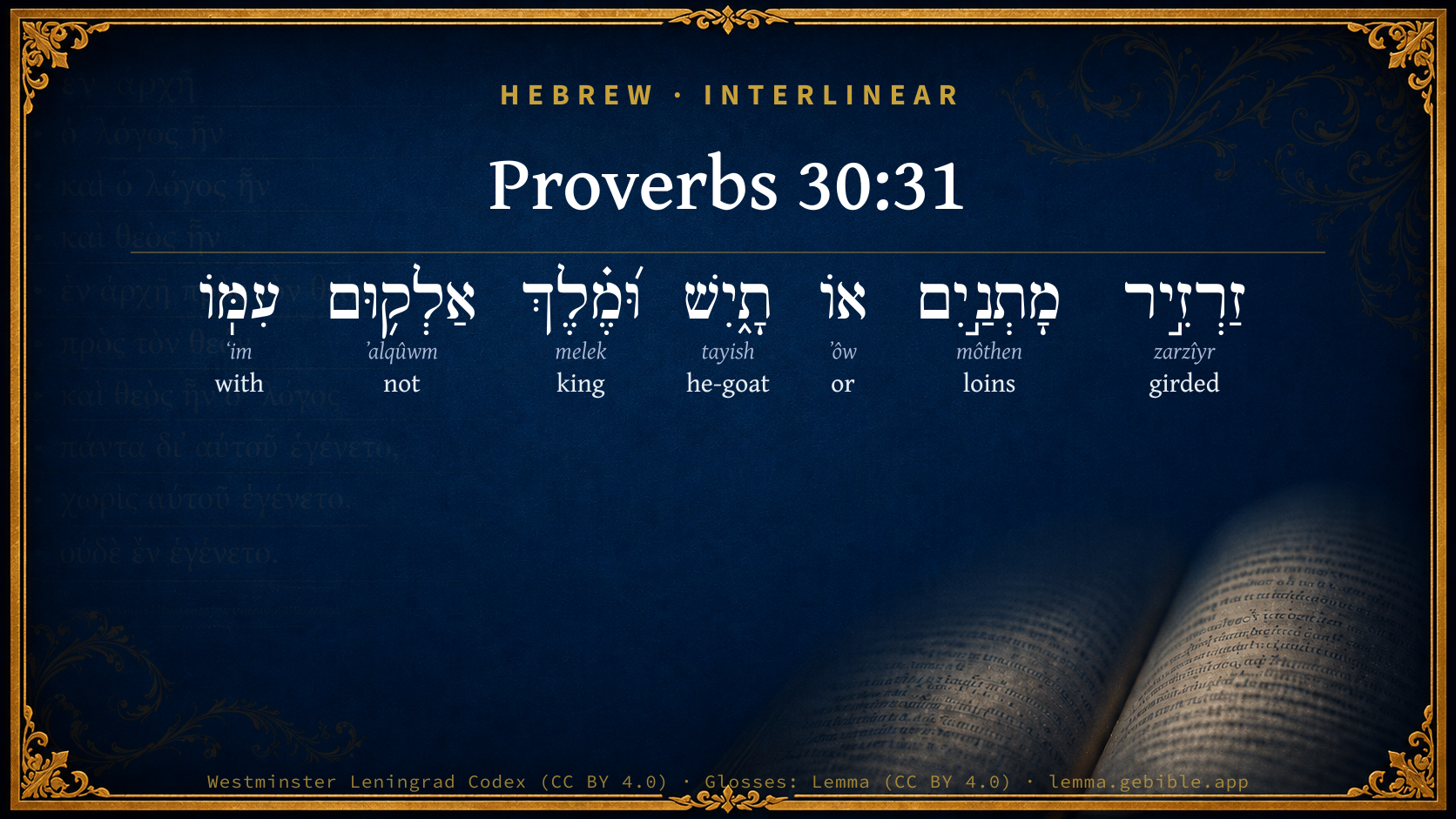
Proverbs 30:31

Hebrew (Westminster Leningrad Codex) Proverbs 30:31 appears in the Hebrew Old Testament. The text above is from the Westminster Leningrad Codex. Each word links to its Strong’s number, a concise gloss, and parsing drawn from the Open Scriptures Hebrew Bible morphology. Click any word for its full Brown-Driver-Briggs (BDB) entry.
Download image
Cite this verse

Proverbs 30:31 (World English Bible). Public Domain. Lemma interlinear Bible study tool, https://lemma.gebible.app/v/proverbs/30/31.

Show BibTeX & RIS
BibTeX
RIS
English Translation
The greyhound, The male goat also; And the king against whom there is no rising up.
World English Bible · Public Domain
Highlights Full analysis ↓
Download a study sheet

One document with this verse’s original text, its word-by-word gloss line, the meaning frame, cross-references with their text, attributed commentary, and full source and license credits — printable, and it pastes into notes with its structure intact.

This verse Autodidact and up

Study sheet (.html) Plain text (.txt)

A passage Seminary Student

Up to 50 verses in one chapter. A passage sheet keeps up to 6 commentary sources and 12 cross-references per verse, in the order this page ranks them, and says so on the sheet whenever that leaves anything out. Ask for a single verse and you get the Autodidact verse sheet above.

Everything on this page stays free to read, with no account — the sheet is a download of what is already on screen, not access to it.

Want to remove ads? Support Godless Engineer
Compare translations 3

The same verse in 3 English versions, stacked beneath the original-language interlinear above. Click any original word for its lexicon entry.

Each is an independent rendering of the whole verse — the interlinear is not word-aligned to these translations.

Highlighted words mark where these versions differ — a whole-verse word diff, not a word-by-word alignment.

  • World English Bible Public Domain
    The greyhound, The male goat also; And the king against whom there is no rising up.
  • King James Version Public Domain
    A greyhound; an he goat also; and a king, against whom there is no rising up.
  • unfoldingWord Literal Text CC BY-SA 4.0
    a rooster of loins, or a male goat, and a king against whom one does not rise up.

unfoldingWord Literal Text — © unfoldingWord, licensed CC BY-SA 4.0. Word-aligned USFM3 via Door43 (git.door43.org/unfoldingWord/en_ult).

Versions to compare (up to 4)

3 of 4 selected

Show all 18 translations

Every available English version of this verse, each an independent rendering of the whole verse.

  • World English Bible Public Domain
    The greyhound, The male goat also; And the king against whom there is no rising up.
  • Berean Standard Bible Public Domain
    a strutting rooster; a he-goat; and a king with his army around him.
  • Majority Standard Bible Public Domain
    a strutting rooster; a he-goat; and a king with his army around him.
  • King James Version Public Domain
    A greyhound; an he goat also; and a king, against whom there is no rising up.
  • American Standard Version (1901) Public Domain
    The greyhound; the he-goat also; And the king against whom there is no rising up.
  • Revised Version (1885) Public Domain
    The greyhound; the he-goat also; and the king, against whom there is no rising up.
  • Geneva Bible (1599) Public Domain
    A lusty grayhound, and a goate, and a King against whom there is no rising vp.
  • Douay-Rheims (1899) Public Domain
    A cock girded about the loins: and a ram: and a king, whom none can resist.
  • Young's Literal Translation Public Domain
    A girt one of the loins, or a he-goat, And a king -- no rising up with him.
  • Literal Standard Version CC BY-SA 4.0
    A girt one of the loins, || Also a male goat, || And a king—troops with him.
  • Unlocked Literal Bible CC BY-SA 4.0
    a strutting rooster; a goat; and a king whose soldiers are beside him.
  • unfoldingWord Literal Text CC BY-SA 4.0
    a rooster of loins, or a male goat, and a king against whom one does not rise up.
  • Darby Bible Public Domain
    a [horse] girt in the loins; or the he-goat; and a king, against whom none can rise up.
  • World Messianic Bible Public Domain
    the greyhound; the male goat; and the king against whom there is no rising up.
  • Webster's Bible Public Domain
    A greyhound; a he-goat also; and a king, against whom there is no rising up.
  • Free Bible Version CC BY-SA 4.0
    The strutting starling, the male goat, and a king with his army.
  • Bible in Basic English Public Domain
    The war-horse, and the he-goat, and the king when his army is with him.
  • JPS Tanakh (1917) Public Domain
    The greyhound; the he-goat also; and the king, against whom there is no rising up.

Literal Standard Version (2020), Covenant Press — licensed CC BY-SA 4.0. Text via the HelloAO Bible API (eBible.org). Unlocked Literal Bible (unfoldingWord) — licensed CC BY-SA 4.0. Text via the HelloAO Bible API (eBible.org). unfoldingWord Literal Text — © unfoldingWord, licensed CC BY-SA 4.0. Word-aligned USFM3 via Door43 (git.door43.org/unfoldingWord/en_ult). Free Bible Version, Dr. Jonathan Gallagher — licensed CC BY-SA 4.0. Text via the HelloAO Bible API (eBible.org).

Word by word

More ways to search: Search by grammar → Find every occurrence → Compare this word →

Practice this passage: Drill this verse → Learn its vocabulary →

About this verse

These counts appear in no published source. They are computed here, from the morphology-tagged text and Lemma’s own curated glosses. What Lemma adds →

7
words
7
distinct lemmas
Wisdom
section

Notable vocabulary

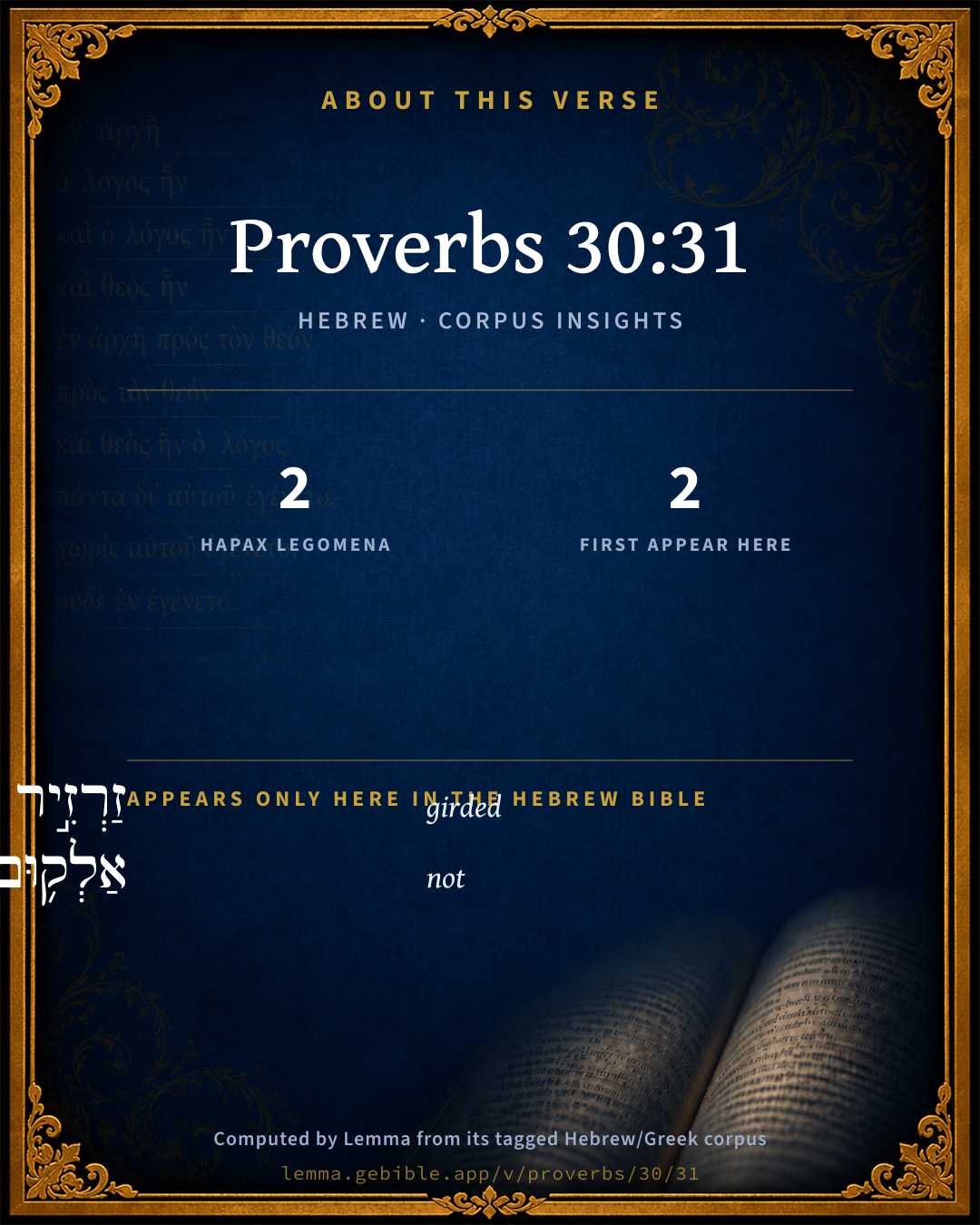
2 hapax legomena — words that appear only here in the entire Hebrew Bible:

  • זַרְזִ֣יר girded H2223
  • אַלְק֥וּם not H510

First appearance in Scripture

These words make their first canonical appearance in the Hebrew Bible here:

  • זַרְזִ֣יר girded H2223
  • אַלְק֥וּם not H510

Shared distinctive vocabulary

תָ֑יִשׁ he-goat H8495 occurs in 4 verses of the Hebrew Bible. Also found in:

Grammatical profile

  • 4 nouns
  • 1 preposition
  • 1 conjunction
  • 1 adverb

Hebrew & Septuagint length

In English translation the verse runs 16 words from the Hebrew and 23 from the Septuagint (LXX English) — the Septuagint runs noticeably longer here. See the side-by-side →

A rough comparison of the two English renderings, which tokenize alike — not a word-level alignment.

Word counts can differ between the Hebrew and the Greek without any difference in meaning — e.g. the Hebrew direct-object marker אֵת has no separate Greek word, and Greek often adds the article ὁ.

Cross-references

3

Topical passages linked to Proverbs 30:31 in the Treasury of Scripture Knowledge — connected by theme and wording, ordered by reader-vote popularity; previews shown in the World English Bible.

  • Proverbs 16:14 The king's wrath is a messenger of death, But a wise man will pacify it.
  • Proverbs 20:2 The terror of a king is like the roaring of a lion: He who provokes him to anger forfeits his own life.
  • Daniel 3:15–18 Now if you are ready whenever you hear the sound of the horn, flute, zither, lyre, harp, pipe, and all kinds of music to you fall down and worship the image which I have made, [well]: but if you don't worship, you shall be cast the same hour into the midst of a burning fiery furnace; and who is that god that shall deliver you out of my hands?

Cross-references courtesy of OpenBible.info (CC BY 4.0).

Hebrew and Greek witnesses Masoretic Hebrew ↔ Greek Septuagint

The same verse in the two great witnesses to the Old Testament, shown verse-for-verse.

Here the Septuagint runs noticeably longer than the Hebrew — LXX2012 (modern English Septuagint) 23 words vs World English Bible 16. A rough length comparison of the two English translations, not a word-level alignment — read both below.

These are two independent witnesses, not word-aligned to each other, and the Septuagint is shown in lemma (dictionary) form.

Hebrew Proverbs 30:31 Masoretic · Westminster Leningrad Codex

זַרְזִ֣יר מָתְנַ֣יִם אוֹ תָ֑יִשׁ וּ֝מֶ֗לֶךְ אַלְק֥וּם עִמּֽוֹ

The greyhound, The male goat also; And the king against whom there is no rising up.

World English Bible · Public Domain

Greek LXX Proverbs 30:31 Septuagint · lemma form

καί ἀλέκτωρ ἐν περιπατέω θῆλυς εὔψυχος καί τράγος ἡγέομαι αἰπόλιον καί βασιλεύς δημηγορέω ἐν ἔθνος

and a cock walking in boldly among the hens, and the goat leading the herd; and a king publicly speaking before a nation.

LXX2012 (modern English Septuagint) · Public Domain

On this verse, The Cambridge Bible for Schools and Colleges discusses the Septuagint’s reading. Read the note in Commentary ↓

Hebrew: Westminster Leningrad Codex (CC BY 4.0). Greek: Septuagint (public domain); English from LXX2012 (modern English Septuagint) (Public Domain). How the Septuagint differs from the Hebrew →

Commentary

Notes on Proverbs 30:31 from classic Christian and Jewish commentators (each source and its license shown beneath its notes). The classic Christian expositions comment on the surrounding passage and are grouped to its opening verse, so a note may address several verses; the Jewish commentaries on the Tanakh (Rashi and others) are per-verse, so they appear only where the commentator wrote on this verse.

Lemma curates 59 commentaries, every one of them public domain or Creative Commons licensed, each selected and text-cleaned for this edition rather than reprinted as found. About our sources →

Ellicott's Commentary for English Readers

(31) A greyhound.—It is very doubtful what animal is meant here as being “girt [i.e., slender] in the loins.” Several have been suggested, e.g., the horse, zebra, cock; but the rendering of the Authorised Version is as probable as any.

A king, against whom there is no rising up.—Who marches with resistless force, trampling on his conquered foes. (Comp. the description of the march of the Assyrians, Isa_37:24 sqq.; comp. also Isa_63:1 sqq. and Joe_2:2 sqq.) It has been proposed to translate these words also as “a king with whom is [i.e., followed by] his people,” in much the same sense.

A Bible Commentary for English Readers, edited by Charles John Ellicott (1878–1897) — public domain. Text from a community e-Sword module.

The Cambridge Bible for Schools and Colleges

gen. ed. J. J. S. Perowne

31. A greyhound] The Heb. word, which occurs nowhere else, and means literally, well-girt (or, well-knit) in the loins (R.V. marg.), has been variously rendered, war-horse, cock (ἀλέκτωρ ἐμπεριπατῶν θηλείαις εὔψυχος, LXX.; gallus succinctus lumbos, Vulg.), wrestler, Maurer. The R.V. retains greyhound in the text, with “or, war-horse,” in the margin.

against whom there is no rising up] The rendering of R.V. marg., when his army is with him, accords better perhaps with the ruling idea of the quatrain, being “stately in march;” though the king on his royal progress, before whom all prostrate themselves, in outward token that “there is no rising up against him,” satisfies well the conditions.

The Cambridge Bible for Schools and Colleges (gen. ed. J. J. S. Perowne; Cambridge University Press, 1878–1918) — public domain. Text from a community e-Sword module.

John Gill's Exposition

A greyhound,.... So Gersom interprets the word; but Jarchi owns he does not know what is meant; and Aben Ezra only says, it is the name of a living creature, but does not say what; but observes, that some interpret it of the "bee", and others of the "eagle". The words of the original text only describe something "girt about the loins" (o): and Kimchi (p) observes, that some say it is a hunting dog so called, because it is thin about the loins, as if it was bound and girt; and Aristotle (q) describes hunting dogs as well girded about their loins: but others, as Kimchi in the same place observes, interpret it of the leopard, which is small, and strong in its loins; and others of a bird called the starling; but he owns he cannot understand the meaning of its loins being girt: David de Pomis (r) interprets it of a cock; others, he says, interpret it a hunting dog; others, a leopard; and some, a species of an unclean bird; perhaps he means the starling, as before; and so the word is used for that bird in the Talmud (s), and in the Arabic language (t). Most likely the "horse" is meant; which is a very stately and majestic creature in its going, and is very comely when it has its harness girt on; and especially a war horse, with all its warlike accoutrements, when it proceeds to battle, and stalks on in it; this creature, one should think, could not be omitted among the four, which is described in so magnificent a manner in Job 39:19; and is called the goodly horse in the battle, Zac 10:3; unless a fine slender bodied race horse should be meant: the horse bids fairer than any other creature named to be what is designed. The third creature follows, which goes well, and is comely in going:

an he goat also; which with its long beard walks very gravely, and in a stately manner, before the flock; and the Septuagint, Syriac, and Arabic versions add, "going before the flock"; see Jer 50:8. This stately walk of the goat is very particularly taken notice of by, Aelian (u); he observes, that the she goat disdains to be last in a flock of sheep, but declares by her walk that she ought to be first; he adds, that the he goat goes before the she goats, glorying in his beard; and, by a kind of wonderful instinct in nature, judges the male is to be preferred to the female (w). Kings, rulers, and governors, are compared to this creature; as Alexander the great is in Dan 8:5; see Zac 10:3; especially such resemble it who rule well, and set good examples to their subjects: and to such, ministers of the Gospel are like; who go before their flocks, guide and direct them, and are examples to them: and likewise all believers; who strive to go before others in good works, and who then are comely in their going. The fourth is,

and a king, against whom there is no rising up; no insurrection, no opposition; who is not to be resisted or withstood; a lawful king, in the lawful administration of government, who rules in the fear of God, and according to his word, and the good and wholesome laws of a nation, ought not to be resisted, Rom 13:1; and a powerful, successful, and victorious king cannot be resisted, withstood, and prevailed over; he drives all before him, and subdues all under him, as David, Cyrus, Alexander, and others. But to none can this better be applied than to Christ, the King of kings; against whom there is no rising, before whom none can stand, against whom the gates of hell can never prevail; who, even in his state of humiliation, conquered and subdued all his and our enemies; destroyed the tyrant, sin; spoiled Satan, and his principalities and powers; overcame the world; abolished death, the last enemy; and delivered his people out of the hands of all, and made them more than conquerors: and who went forth in the ministry of the Gospel, into the Gentile world, conquering and to conquer; bearing down all opposition before him, and subduing the people under him; and who, in the latter day, will engage with his antichristian enemies, the beast, false prophet, and kings of the earth, and shall overcome them, and clear the world of them. And this is King who is comely in his going; as he was in his goings of old from everlasting; when he drew nigh to his divine. Father, and became the surety of his people; and in his coming into this world, by the assumption of our nature, to save lost perishing sinners: and so he is in his spiritual visits to his saints; in his goings in the sanctuary, and walks he takes amidst the golden candlesticks, his churches; as he will be also when he comes a second time in the clouds of heaven: it will be a glorious appearing; he will come with all the saints, and be attended with his mighty angels; he will come in their glory, in his own, and in the glory of his Father; and will be comely in his going indeed it will be with great stateliness and majesty. The learned Dr. Pococke (x), from the use of the word "alkum" in the Arabic language, renders the words thus, "and a king with whom the people is"; who agree together; the one rules well, and the other obey cheerfully; such a king walking with majesty is comely to his people, and terrible to his enemies. The Targum is,

"and a king, who stands and speaks in the house of his people.''

(o) "accinctus lumbis equus", Junius & Tremellius, Piscator, Cartwright, Glassius, Bochart, Buxtorf; "infibulatus lumbos equus", Schultens. (p) Sepher. Shorash. in voce (q) De Physiognom. c. 6. (r) Lexic. fol. 28. 1. (s) T. Bab. Bava Kama, fol. 92. 2. (t) Golius, col. 1092. (u) De Animal. l. 7. c. 26. (w) "Dux pecoris hircus, duxerat hircus oves", Tibullus, l. 2. Eleg. 1. v. 58. (x) Specimen. Arab. Hist. p. 203. So "kuma" is used for people in the Alcoran, Surat. Joseph. v. 9.

John Gill's Exposition of the Whole Bible (1746–1763) — public domain (CC PDM 1.0). Text via the HelloAO Bible API.

Albert Barnes' Notes on the Bible

A greyhound - The Hebrew word occurs nowhere else in the Old Testament. The literal meaning is: “one with loins girded;” and some have referred this to the stripes of the zebra, others to the “war-horse” (compare Job 39:19, Job 39:25), as he is represented in the sculptures of Persepolis, with rich and stately trappings.

A king, against whom there is no rising up - i. e., A king irresistible. Others prefer, “a king in the midst of his people,” and the sense, as giving a more vivid picture, is certainly more satisfactory.

Albert Barnes' Notes on the Bible (1834–1885) — public domain. Text from a community e-Sword/MySword module.

Haydock's Catholic Bible Commentary

Loins. It rules, and is even terrible to lions. (Pliny x. 21.) --- The terms of the original are found nowhere else, and some understand the horse, the bee, and a soldier in arms. (Calmet) --- Whom. Hebrew, "and Alkum with him." (Montanus) --- But we know no animal or king of this name;; and it may imply, "in the midst of his court," or "assembly." (Chaldean) Some Latin copies read, Et Rex, nec est qui resistat ei, (Sixtus V.) which is more conformable to the Hebrew, (Calmet) and is here translated, though the Vulgate read, Nec est rex qui, &c. These four emblems (Haydock) denote fortitude, chastity, order, and justice.

George Leo Haydock (1774–1849), Haydock's Catholic Family Bible and Commentary, 1859 edition — public domain. Excludes Psalms (Douay-Rheims chapter numbering differs from Protestant) and Deuterocanonical books (Catholic canon only).

Matthew Poole's English Annotations

A greyhound, called in Hebrew, girt in the lions; either because its loins are slender, and as it were girt up into a little compass, and tight or well trussed up: or because of its great agility and swiftness; for the girding of the loins was used for expedition in going or working. Or, as it is rendered by others a horse, to wit, a war-horse, having his armour girt about him, and marching to the battle, which he doth with great majesty and courage, as God himself observes at large, Job 39:19, &c.

An he-goat; which marcheth in the head of the flock in grave and stately manner, conducting them with great courage and resolution, and being ready to fight for them, either with beasts or men that oppose him; whence great captains are oft compared to he-goats, as Isa 14:9; Jer 1:8; Da 8:5,21; Zec 10:3.

A king, against whom there is no rising up; a mighty and victorious king, whose power none can withstand, who therefore goeth hither and thither, and proceedeth in his affairs with invincible courage and majesty. But this place, with the variation of one Hebrew point, reading ammo for immo, may be rendered, as a very learned man observes, a king, and his people with him; a king when he hath the hearts and hands of his people going along with him in his undertakings.

Matthew Poole's English Annotations on the Holy Bible (1683–1685) — public domain. Text from a community e-Sword/MySword module.

The Pulpit Commentary

A greyhound; ryzirz (zarzir mothnayim), "girt in the loins" (periesfigmenov thn , Symmachus), an expression very vague, and, as the name of an animal, occurring nowhere else in the Old Testament. In post-biblical Hebrew zarzir is found as the name of some pugnacious bird, and the Septuagint, Vulgate, and Syriac call it here the cock. So also Aquila and Theodotion. But if the word is onomatopoetic, it would seem to apply with more propriety to one of the raven tribe; and then what is to be made of the allusion to the loins? And how comes it that amid the quadrupeds in the gnome a bird should suddenly be introduced, as one stately in going? It seems certain that some quadruped is here meant, but what? What animal has as characteristic tight-girded loins or slender or active loins? There are, indeed, many that might be so designated, but none that, as far as we know, appropriated this unique appellation. Hence various opinions are held by commentators concerning the identification. The zebra, say some, with its stripes, which may be thus denoted; the war horse, say others, comparing Job_39:19, Job_39:25, and considering the trappings with which, as we see in ancient sculptures, he was adorned; others, again, fix upon the leopard as the beast intended. But that of the Authorized Version seems, on the whole, to be the most likely rendering, the slender, agile make of the greyhound having given cause for the appropriation of the term used in the text. Delitzsch compares the German word windspiel, which designates the greyhound without the necessity of using the full term, wiadspielhund. The only points which may be considered adverse to this view are these two, viz. the ill repute in which dogs were held by the Hebrews, Scripture consistently disparaging and despising them; and the fact that, as far as we have information, the Jews did not use dogs for hunting purposes, though nowadays the Arabs keep a kind of Persian greyhound for sporting, and Assyrian monuments have familiarized us with the appearance of hounds employed in the chase of the lion and the wild ox. Agur may be referring to what he has seen elsewhere, but what was well known to these for whom he wrote. Gesenius suggests (253), "a warrior girt in the loins," which is adopted by Wordsworth, and gives a suitable idea. This would correspond with the king in the last line; but the interpretation is quite arbitrary, and supported by no ancient authority, resting on the fact that girding the loins is always spoken of human beings. The cock strutting among his hens is, as we have hinted, the idea which approves itself to many ancient translators. Thus the Septuagint, alektwr emperipatwn yhleiaiv euqucov . We are not disposed to adept this identification, more especially as common poultry were unknown in Palestine till long after Solomon"s time. Certainly what we call cocks and hens, or barn door fowls, are never mentioned in the Old Testament. and seem to have been introduced from Persia after the rise of the Persian empire. The latest editors decide for the war horse; but the conflicting claims cannot be reconciled, and the matter must be left undetermined. A he goat also. This is a very natural comparison, as the stately manner in which the he goat (tay-ish, "the butter") heads the flock has been always observed. The LXX expresses this, paraphrasing, "and the he goat leading the herd." "Flocks of goats are very numerous in Palestine at this day, as they were in former ages. We see them everywhere on the mountains, in smaller or larger numbers; at times also along with sheep, as one flock, in which ease it is usually a he goat that is the special leader of the whole, walking before it as gravely as a sexton before the white flock of a church choir" (Geikie, "Holy Land," 1:232). A king, against whom there is no rising up; Vulgate, nec est rex qui resistat ei, which ought to mean "and a king whom nothing resists," but can scarcely be compelled to produce this meaning without violence. The difficulty in the sentence arises from the word which in the above rendering is regarded as composed of the negative al, and kum, the infinitive, "to rise against, oppose." But this is contrary to grammatical usage, and would be a solecism. To some it has seemed that a proper name was intended, and they have invented a King Alkum or Alkimos, whom they suppose to have been celebrated in or after Solomon"s time. Many modern commentators take the word to be an Arabic expression, consisting of al, the definite article, and kum, "people," and consider the meaning to be "a king with whom is the people," i.e. surrounded by his people or army. This is certainly a stately sight, and may well stand parallel to the hero lion among beasts, and the bold he goat at the head of the flock. Other Arabic expressions may probably be found elsewhere in this chapter; e.g. vers. 15, 16, 17, aluka, etc. Septuagint, "a king haranguing before a nation (dhmhgorwn en eynei )." This passage, again, has been taken in a spiritual sense as referring to Christ, the Lion of the tribe of Judah, the Warrior girt with the sword, the Leader of the flock, the King of kings.

The Pulpit Commentary (1880–1919), ed. H.D.M. Spence-Jones & Joseph S. Exell — public domain. Text from a community e-Sword module.

John Wesley's Explanatory Notes

An he-goat - Which marches in the head of the flock in a grave and stately manner, conducting them with great courage and resolution, and being ready to fight for them, either with beasts or men that oppose him. A king - Hebrew. a king and his people with him, a king when he hath the hearts and hands of his people going along with him in his undertakings.

John Wesley, Explanatory Notes Upon the Whole Bible (1754–1765) — public domain. Text via the GEBible commentary corpus.

Rashi

Rabbi Shlomo Yitzchaki (Rashi)

The greyhound Heb. זרזיר מתנים. I do not know what it is, but from the context appears to be an animal with weak loins.

and the king against whom no one dares to rise up Heb. ומלך אלקום I do not know what it is according to its simple meaning, but the Aggadic midrashim interpret these five sections of four as corresponding to the four kingdoms. Since their rule over Israel was strengthened because of the iniquity of having transgressed the five Books of the Pentateuch, Scripture mentions them five times.

[16] The grave and the barren womb The grave represents the kingdom of Babylon, for it is stated regarding Nebuchadnezzar (Hab. 2:5): “who widened his desire like the nether- world.” And the barren womb, that is Media, in whose time mercy (רחמים) was held back from Israel, as it is said (Esther 3:13): to destroy, kill and cause to perish.”

the earth, which is not sated with water This represents Greece, which was not sated with issuing decrees on Israel.

and fire, which does not say, “Enough!” Corresponding to Esau, who acted with burning wrath against Israel, for he said to destroy children and women in one day. And likewise...

[19] The way of the eagle This is Babylon, the great eagle, with the long wings (Ezek. 17:3).

serpent This is Media.

the way of a ship in the heart of the sea This represents Greece, who was swift with its decrees.

the way of a man with a young woman This represents Edom, who said, “I will be a mistress forever.” [גבר is interpreted as גברת, a mistress, and בעלמה as לעולם, forever.]

[20] So is the way of an adulterous woman The people of Israel brought this evil upon themselves because they played the adulteress with idolatry, and they deserved that the retribution should befall them.

and she says, “I have no committed no sin.” As it says (Jeremiah 2:35), “Behold, I contend with you concerning because you say, I have not sinned.” (Until this point are the words of Rashi [as they appear] in Mikraoth Gedoloth.)

[21] the earth quakes This refers to Eretz Israel.

under a slave This refers to Nebuchadnezzar, who was the slave and secretary of Merodach-baladan, as appears in Hullin. [To my knowledge, this does not appear in Hullin, but in Helek, the eleventh chapter of Sanhedrin, 96a.]

and a wretch who is sated with food This refers to Ahasuerus, who made a banquet for one hundred and eighty days

[23] a hated woman who is married Corresponding to Greece.

and a maidservant who inherits her mistress This refers to Esau, who should have served Jacob, but the matter was reversed.

[25] The ants are a people not strong This refers to Babylon, as it is stated (Isa. 23:13): “Behold the land of the Chaldees, this people has never been.”

yet they prepare their food in the summer [This refers to] Nebuchadnezzar, who performed one [act of] honor to the Holy One, blessed be He, in the days of Merodach-baladan, when he sent letters to Hezekiah, and wrote therein, “Peace to King Hezekiah; peace to city of Jerusalem; peace to the great God.” Nebuchadnezzar was the one who wrote his letters, but he was not there that day, and when he came and they told him what they had done, he responded, “You call Him the great God, yet you address Him last!” He ran after the messenger and brought him back. For that [act of] pursuit, he merited the kingship. This is how he “prepared his bread in the summer,” like the ant.

[26] The hyraxes are a people not strong This refers to Media and Persia.

yet they make their home in the rock For they built the Temple.

[28] The spider grasps with its hands This refers to Esau, as it is stated (Gen. 27:22): “The voice is the voice of Jacob, but the hands are the hands of Esau.”

in a king’s palaces That he [Esau] entered the Temple of the King and destroyed it.

[30] The lion is the mightiest of the beasts This is Nebuchadnezzar, as it is stated (Jer. 4:7): The lion has come up from his thicket.”

the one who girds his loins This refers to Media and Persia, who girded their loins and assassinated Belshazzar and seized the kingdom of Babylon.

[31] and the he-goat This refers to Greece, as it is stated (Dan. 8:21): “And the rough he-goat is the king of Greece.”

and the king against whom no one dares to rise up This is Edom, who says, “I am it, and there is none besides me.” No one opposes him. אלקום, no one stands with him.

Rashi on the Tanakh — English translations: “The Judaica Press complete Tanach with Rashi, translated by A. J. Rosenberg” (CC BY 4.0); “Pentateuch with Rashi's commentary by M. Rosenbaum and A.M. Silbermann, 1929-1934” (public domain); “The Metsudah Tanach series, Lakewood, N.J” (CC BY 4.0); and “The Book of Joshua, Metsudah Publications, 1997” (CC BY 4.0). Text via Sefaria.

Lesson kit

Teaching starters — assembled from the data on this page, not authored interpretation. Every prompt links to the verse data it draws on. Edit before teaching.

Proverbs, in the Wisdom, opens this verse with 7 words (7 distinct Hebrew lemmas). Its most distinctive word is zarzîyr (“girded”). The Greek Septuagint runs longer here. A historical commentator’s framing appears above. Read the whole chapter for the surrounding context.

Discussion questions

  1. The word zarzîyr carries the sense “girded.” How does it shape the verse?
  2. This verse holds 2 words here found nowhere else in the Hebrew Bible. What might the rare words draw attention to?
  3. 2 words here appear for the first time in Scripture. What is being introduced at this debut?
  4. Genesis 30:35 shares the word «he-goat» with this verse. How do the two illuminate each other?
  5. Compared with the Hebrew, the Septuagint runs longer here. What questions does that raise?
  6. The translations on this page render this verse differently — a whole-verse word diff, not a word-by-word alignment. What might account for the different wordings?
  7. Reading how Ellicott's Commentary for English Readers and The Cambridge Bible for Schools and Colleges read this verse, where do the two commentators agree and where do they part?

Things to notice

  • 2 words in this verse appear nowhere else in the Hebrew Bible.
  • 2 words make their first canonical appearance in Scripture here.
  • These translations choose different wording for 10 words in this verse.
  • 7 distinct Hebrew lemmas span 7 words in this verse.

Reading settings

Reading text

Shown beneath each verse's original-language words.

Old Testament
Old Testament edition

Read the OT as the Masoretic Hebrew (MT) or the Greek Septuagint (LXX).

English shown for the Greek Septuagint (in the Hebrew ↔ Greek comparison).

Comparing translations? Open the Compare panel on any verse page to stack up to four side by side.