2 Corinthians 5:7

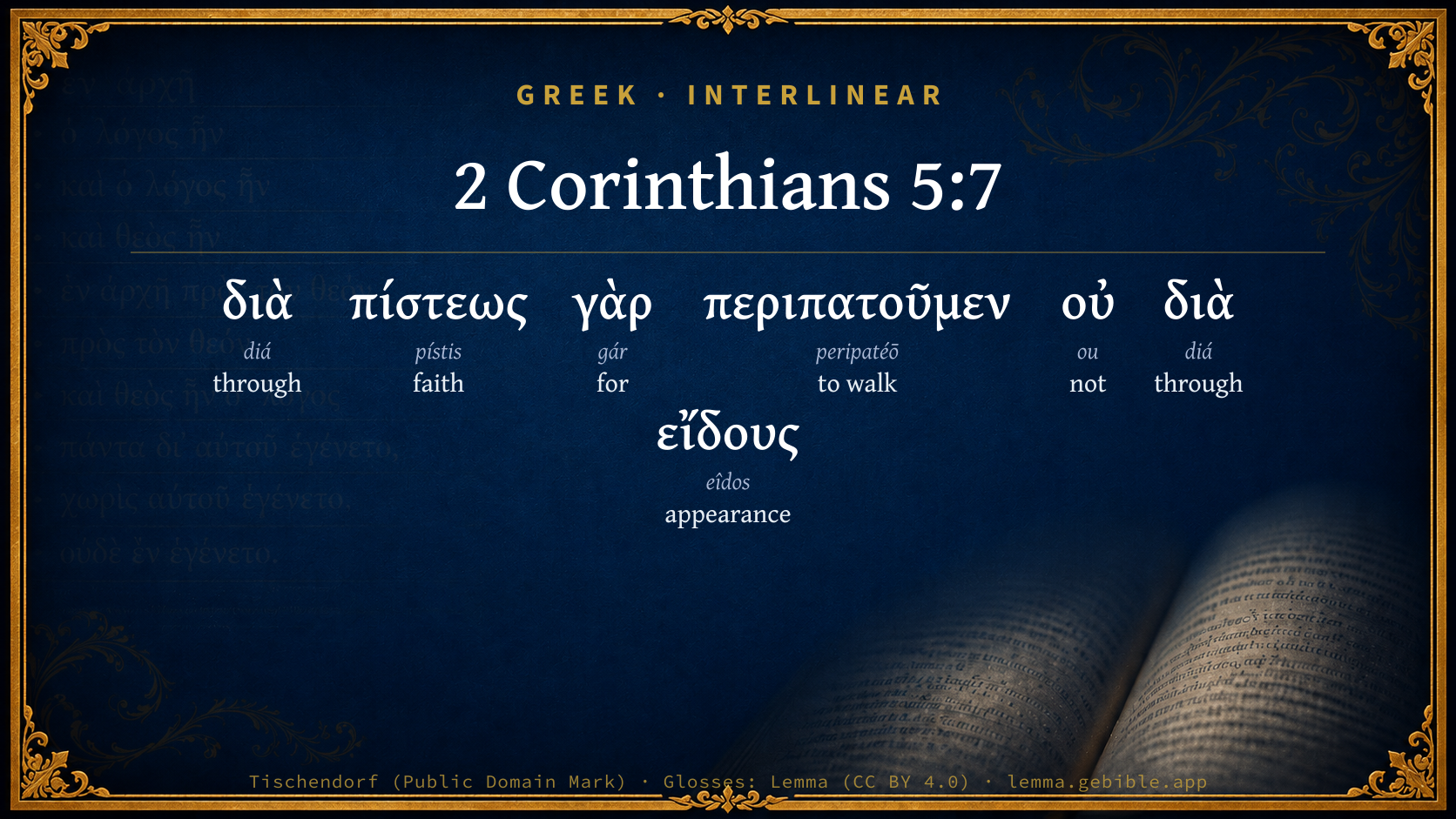
Greek (Tischendorf 8th ed.) 2 Corinthians 5:7 appears in the Greek New Testament. The text above is from the Tischendorf 8th edition. Each word links to its Strong’s number and a concise gloss. Click any word for its full Thayer’s Greek Lexicon entry.
Download image
Cite this verse

2 Corinthians 5:7 (World English Bible). Public Domain. Lemma interlinear Bible study tool, https://lemma.gebible.app/v/2-corinthians/5/7.

Show BibTeX & RIS
BibTeX
RIS
English Translation
for we walk by faith, not by sight.
World English Bible · Public Domain
Download a study sheet

One document with this verse’s original text, its word-by-word gloss line, the meaning frame, cross-references with their text, attributed commentary, and full source and license credits — printable, and it pastes into notes with its structure intact.

This verse Autodidact and up

Study sheet (.html) Plain text (.txt)

A passage Seminary Student

Up to 50 verses in one chapter. A passage sheet keeps up to 6 commentary sources and 12 cross-references per verse, in the order this page ranks them, and says so on the sheet whenever that leaves anything out. Ask for a single verse and you get the Autodidact verse sheet above.

Everything on this page stays free to read, with no account — the sheet is a download of what is already on screen, not access to it.

Want to remove ads? Support Godless Engineer
Compare translations 3

The same verse in 3 English versions, stacked beneath the original-language interlinear above. Click any original word for its lexicon entry.

Each is an independent rendering of the whole verse — the interlinear is not word-aligned to these translations.

Highlighted words mark where these versions differ — a whole-verse word diff, not a word-by-word alignment.

  • World English Bible Public Domain
    for we walk by faith, not by sight.
  • King James Version Public Domain
    (For we walk by faith, not by sight:)
  • unfoldingWord Literal Text CC BY-SA 4.0
    for we walk by faith, not by sight.

unfoldingWord Literal Text — © unfoldingWord, licensed CC BY-SA 4.0. Word-aligned USFM3 via Door43 (git.door43.org/unfoldingWord/en_ult).

Versions to compare (up to 4)

3 of 4 selected

Show all 19 translations

Every available English version of this verse, each an independent rendering of the whole verse.

  • World English Bible Public Domain
    for we walk by faith, not by sight.
  • Berean Standard Bible Public Domain
    For we walk by faith, not by sight.
  • Majority Standard Bible Public Domain
    For we walk by faith, not by sight.
  • King James Version Public Domain
    (For we walk by faith, not by sight:)
  • American Standard Version (1901) Public Domain
    (for we walk by faith, not by sight);
  • Revised Version (1885) Public Domain
    (for we walk by faith, not by sight);
  • Geneva Bible (1599) Public Domain
    (For we walke by faith, and not by sight.)
  • Douay-Rheims (1899) Public Domain
    (For we walk by faith, and not by sight.)
  • Young's Literal Translation Public Domain
    for through faith we walk, not through sight --
  • Literal Standard Version CC BY-SA 4.0
    for we walk through faith, not through sight—
  • Unlocked Literal Bible CC BY-SA 4.0
    For we walk by faith, not by sight.
  • unfoldingWord Literal Text CC BY-SA 4.0
    for we walk by faith, not by sight.
  • Darby Bible Public Domain
    (for we walk by faith, not by sight;)
  • World Messianic Bible Public Domain
    for we walk by faith, not by sight.
  • Webster's Bible Public Domain
    (For we walk by faith, not by sight:)
  • Free Bible Version CC BY-SA 4.0
    (For we live by trusting in God, not by seeing him.)
  • Bible in Basic English Public Domain
    (For we are walking by faith, not by seeing,)
  • Text-Critical English NT CC BY 4.0
    For we walk by faith, not by sight.
  • Tyndale New Testament (1534) Public Domain
    For we walke in fayth and se not.

Literal Standard Version (2020), Covenant Press — licensed CC BY-SA 4.0. Text via the HelloAO Bible API (eBible.org). Unlocked Literal Bible (unfoldingWord) — licensed CC BY-SA 4.0. Text via the HelloAO Bible API (eBible.org). unfoldingWord Literal Text — © unfoldingWord, licensed CC BY-SA 4.0. Word-aligned USFM3 via Door43 (git.door43.org/unfoldingWord/en_ult). Free Bible Version, Dr. Jonathan Gallagher — licensed CC BY-SA 4.0. Text via the HelloAO Bible API (eBible.org).

Word by word

More ways to search: Search by grammar → Find every occurrence → Compare this word →

Practice this passage: Drill this verse → Learn its vocabulary →

About this verse

These counts appear in no published source. They are computed here, from the morphology-tagged text and Lemma’s own curated glosses. What Lemma adds →

7
words
6
distinct lemmas
Pauline Epistles
section

Notable vocabulary

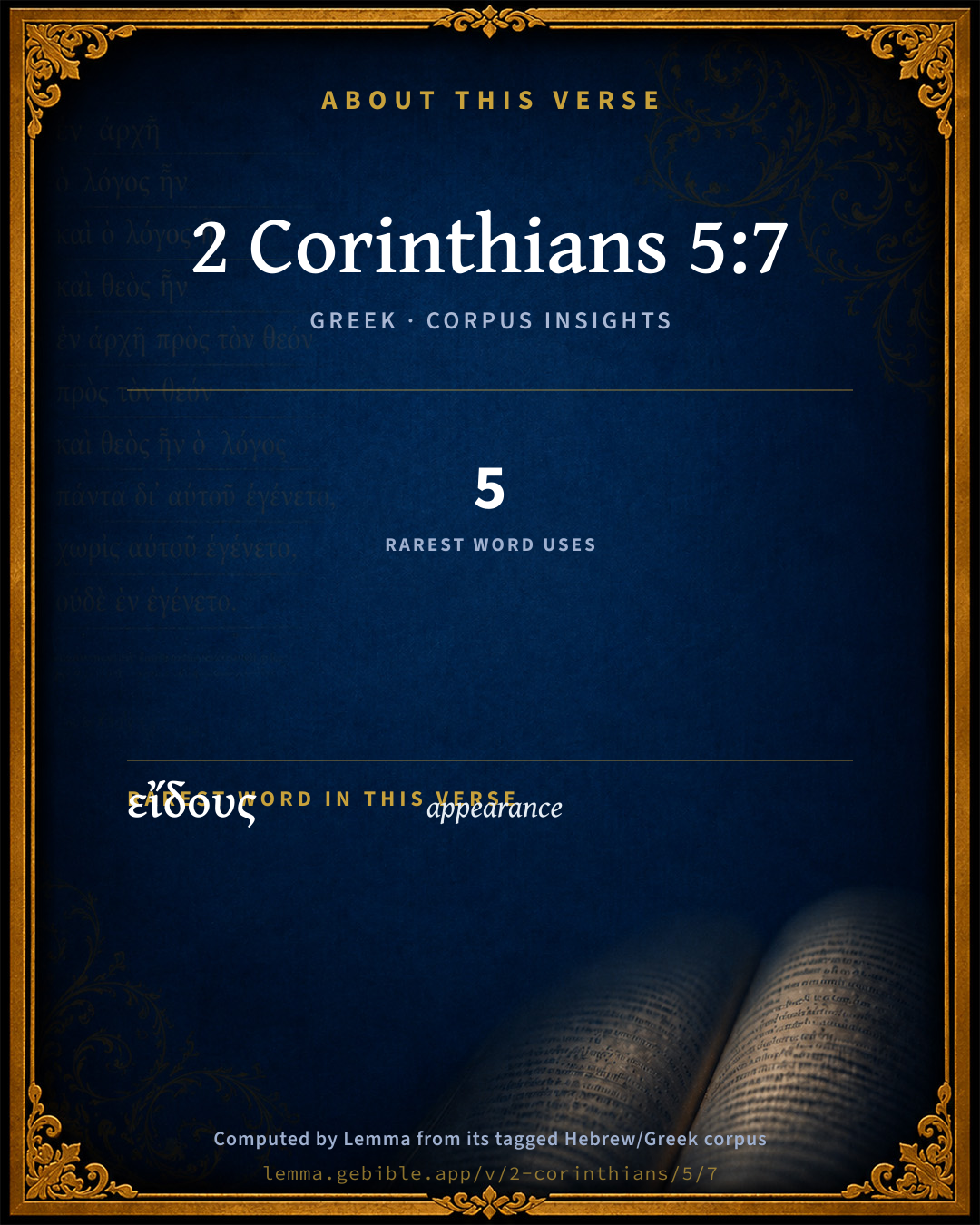
The rarest word here is εἴδους appearance G1491 — appearing just 5 times in the whole Greek New Testament.

Shared distinctive vocabulary

εἴδους appearance G1491 occurs in 5 verses of the Greek New Testament. Also found in:

Repetition

A word recurs within this verse:

  • διὰ through G1223 ×2

Cross-references

10

Topical passages linked to 2 Corinthians 5:7 in the Treasury of Scripture Knowledge — connected by theme and wording, ordered by reader-vote popularity; previews shown in the World English Bible.

  • Hebrews 11:1–27 Now faith is assurance of things hoped for, proof of things not seen.
  • 2 Corinthians 4:18 while we don't look at the things which are seen, but at the things which are not seen. For the things which are seen are temporal, but the things which are not seen are eternal.
  • Romans 8:24–25 For we were saved in hope, but hope that is seen is not hope. For who hopes for that which he sees?
  • 1 Peter 1:8 whom not having known you love; in whom, though now you don't see him, yet believing, you rejoice greatly with joy unspeakable and full of glory--
  • Hebrews 10:38 But the righteous will live by faith. If he shrinks back, my soul has no pleasure in him."
  • Galatians 2:20 I have been crucified with Christ, and it is no longer I that live, but Christ living in me. That life which I now live in the flesh, I live by faith in the Son of God, who loved me, and gave himself up for me.
  • 1 Peter 5:9 Withstand him steadfast in your faith, knowing that your brothers who are in the world are undergoing the same sufferings.
  • 1 Corinthians 13:12 For now we see in a mirror, dimly, but then face to face. Now I know in part, but then I will know fully, even as I was also fully known.
  • 2 Corinthians 1:24 Not that we have lordship over your faith, but are fellow workers with you for your joy. For you stand firm in faith.
  • Deuteronomy 12:9 for you haven't yet come to the rest and to the inheritance, which Yahweh your God gives you.

Cross-references courtesy of OpenBible.info (CC BY 4.0).

Commentary

Notes on 2 Corinthians 5:7 from classic Christian and Jewish commentators (each source and its license shown beneath its notes). The classic Christian expositions comment on the surrounding passage and are grouped to its opening verse, so a note may address several verses; the Jewish commentaries on the Tanakh (Rashi and others) are per-verse, so they appear only where the commentator wrote on this verse.

Lemma curates 59 commentaries, every one of them public domain or Creative Commons licensed, each selected and text-cleaned for this edition rather than reprinted as found. About our sources →

Tyndale Open Study Notes

Tyndale Open Resources

5:7 Our hope for future resurrection can only be known by faith (see Heb 11:1, 3, 27), yet we do have Jesus’ own resurrection and the presence of the Holy Spirit as evidence of what is to come (1 Cor 15:1-9; Eph 1:14).

Tyndale Open Study Notes — © Tyndale Open Resources, licensed CC BY-SA 4.0. Text via the HelloAO Bible API.

Bengel's Gnomon

Johann Albrecht Bengel

2Co 5:7. Διὰ πίστεως, by faith) Not to see, is nearly the same as being separated.—γὰρ, for) This refers to ἀπὸ, from [2Co 5:6, absent from the Lord].—περιπατοῦμεν, we walk) in the world. So πορεύεσθαι, Luk 13:33.—οὐ διὰ εἴδους, not by what appears to the eye [Engl. V. sight]) The LXX. translate מראה, εἶδος, vision, aspect, appearance.[26] See especially Num 12:8: ἐν εἴδει, ΚΑῚ Οὐ ΔΙʼ ΑἸΝΙΓΜΆΤΩΝ, apparently and not in dark speeches; likewise Exo 24:17. Faith and sight are opposed to one another. Faith has its termination at death in this passage, therefore sight then begins.

[26] Not the act or power of seeing (as ‘sight’ often means): but the thing seen, what presents itself to the eye, the appearance seen.—ED.

Bengel's Gnomon of the New Testament — English translation (T&T Clark, Edinburgh, 1860) — public domain. Text from a community e-Sword module.

Meyer's Critical & Exegetical Commentary

Heinrich August Wilhelm Meyer

2Co_5:7. Reason assigned for the ἐνδημοῦντες … κυρίου. For through faith we walk, etc.; faith is the sphere through which we walk, i.e. faith is the element through which our earthly life moves. If we walked διὰ εἴδους, seeing that this presupposes the being together with Christ, we should not be ἐκδημοῦντες ἀπὸ τοῦ κυρίου. The object of faith we must from the whole connection conceive to be the Lord in His glory, whose real form (τὸ εἶδος) we shall only have before us when we are with Him. Comp. Rom_8:17; 1Th_4:17; Joh_17:24; 1Pe_1:8, al.

διὰ πίστεως] quite in accordance with the Greek phrase διὰ δικαιοσύνης ἰέναι. Comp. περιπατεῖν διὰ τοῦ φῶτος, Rev_21:24, and the classical expressions πορεύεσθαι διὰ τῶν ἡδονῶν and the like; see, in general, Valckenaer, ad Phoeniss. 402; Heindorf, ad Protag. p. 323 A; Hermann, ad Oed. Col. 905; Bernhardy, p. 235.

οὐ διὰ εἴδους] i.e. not so, that we are surrounded by the appearance, not so, that we have before us Christ, the Exalted One, in His real appearance and form, i.e. in His visible δόξα, and that this glorious εἶδος shines round us in our walk. Comp. Joh_17:24, and the πρόσωπον πρὸς πρόσωπον, 1Co_13:12. εἶδος never means, as it is mostly explained, vision (not even in Num_12:8), but always species. The Vulgate renders rightly: per speciem. See Luk_3:22; Luk_9:29; Joh_5:37; 1Th_5:22; Duncan, Lex., ed. Rost, p. 333; Ast, Lex. Plat. I. p. 607 f.; Tittmann, Synon. p. 119, who, however, with the assent of Lipsius (Rechtfertigungsl. p. 100), wrongly takes it: externa rerum specie captum vivere, so that the meaning would be: Vita nostra immortali ilia spe, non harum rerum vana specie regitur. According to this view, different objects would quite arbitrarily be assumed for πίστις and εἶδος; and further, where Paul specifies with περιπατεῖν that by which it is defined, he uses as a prepositional expression not διά, but κατά (Rom_8:4; Rom_14:15, al.), or renders palpable the manner of the walking by ἐν (2Co_4:2; Rom_6:4, al.), or characterizes it by the dative, as 2Co_12:18; Gal_5:16. These reasons tell also in opposition to Hofmann, who explains διά of the walk, which has its quality from faith, etc., and εἶδος of an outward form of the walker himself, in which the latter presents himself as visible.

Regarding the relation of the διὰ πίστεως to the διὰ εἴδους, observe that in the temporal life we have the πίστις, and not the εἶδος, while in the future world through the Parousia there is added to the πίστις also the εἶδος, but the former does not thereby cease, it rather remains eternal (1Co_13:13).

Meyer — Critical and Exegetical Commentary on the New Testament — English translation by Peter Christie, edited by Frederick Crombie (T&T Clark, 1880) — public domain. Text from a community e-Sword module.

Expositor's Greek Testament

ed. W. Robertson Nicoll

2Co 5:7 . διὰ πίστεως γὰρ κ . τ . λ .: for we walk by faith ( cf. Joh 20:29 , and chap. 2Co 4:18 ), i.e. , in a state of faith (see note on διά with the gen. of attendant circumstances 2Co 2:4 ), not by appearance ( εἶδος , as the reff. show, must be thus translated = quod aspicitur ; but nevertheless the rendering of A.V. and R.V. “not by sight,” though verbally inexact, conveys the sense. cf. Heb 11:1 , ἔστιν δὲ πίστις … πραγμάτων ἔλεγχος οὐ βλεπομένων , and 1Co 13:12 ). The verse is parenthetical and explanatory of the sense in which we are “absent from the Lord”.

The Expositor's Greek Testament, edited by W. Robertson Nicoll (1897–1910) — public domain. Text from a community e-Sword module.

Geneva Bible (1599)

Geneva Bible translators

Faith of those things which we hope for, and not having God presently in our view.

Geneva Bible (1599) marginal notes — public domain. Text via Bolls.life.

Jamieson, Fausset & Brown

Robert Jamieson, A. R. Fausset & David Brown

we walk--in our Christian course here on earth.

not by sight--Greek, "not by appearance." Our life is governed by faith in our immortal hope; not by the outward specious appearance of present things [TITTMANN, Greek Synonyms of the New Testament]. Compare "apparently," the Septuagint, "by appearance," Num 12:8. WAHL supports English Version. Co2 4:18 also confirms it (compare Rom 8:24; Co1 13:12-13). God has appointed in this life faith for our great duty, and in the next, vision for our reward [SOUTH] (Pe1 1:8).

Jamieson, Fausset & Brown — Commentary Critical and Explanatory on the Whole Bible (1871) — public domain (CC PDM 1.0). Text via the HelloAO Bible API.

Adam Clarke's Commentary

Verse 7. For we walk by faith] While we are in the present state faith supplies the place of direct vision. In the future world we shall have sight-the utmost evidence of spiritual and eternal things; as we shall be present with them, and live in them. Here we have the testimony of God, and believe in their reality, because we cannot doubt his word. And to make this more convincing he gives us the earnest of his Spirit, which is a foretaste of glory.

Adam Clarke's Commentary on the Bible (1810–1826) — public domain. Text from a community e-Sword/MySword module.

John Calvin's Commentaries

7. For we walk by faith (Εἰδος) I have here rendered aspectum, (sight,) because few understood the meaning of the word species, (appearance.) He states the reason, why it is that we are now absent from the Lord — because we do not as yet see him face to face. (1 Corinthians 13:12.) The manner of that absence is this — that God is not openly beheld by us. The reason why he is not seen by us is, that we walk by faith Now it is on good grounds that faith is opposed to sight, because it, perceives those things that are hid from the view of men — because it reaches forth to future things, which do not as yet appear. For such is the condition of believers, that they resemble the dead rather than the living — that they often seem as if they were forsaken by God — that they always have the elements of death shut up within them. Hence they must necessarily hope against hope. (Romans 4:18.) Now the things that are hoped for are hid, as we read in Romans 8:24, and faith is the

manifestation of things which do not appear. (Hebrews 11:1.)

It is not to be wondered, then, if the apostle says, that we have not as yet the privilege of sight, so long as we walk by faith For we see, indeed, but it is through a glass, darkly; (1 Corinthians 13:12,) that is, in place of the reality we rest upon the word.

John Calvin's Commentaries (1540-1563) — public domain. Text from the Calvin Translation Society English edition (1840s-50s) via the Christian Classics Ethereal Library (ccel.org). Calvin's coverage is partial (roughly two-thirds of the Bible); uncommented books and verses are honest gaps, never fabricated. The 19th-century editor's footnotes and remarks are omitted so the notes are faithfully Calvin's own voice.

Ellicott's Commentary for English Readers

(7) For we walk by faith, not by sight—Better, and not by what we see (or, by appearance). It seems almost sad to alter the wording of a familiar and favourite text, but it must be admitted that the word translated “sight” never means the faculty of seeing, but always the form and fashion of the thing seen. (Comp. Luk_3:22; Luk_9:29; Joh_5:37.) The fact is taken for granted; and it comes as the proof that as we are, we are absent from the Lord. Now we believe in Him without seeing Him; hereafter we shall see Him face to face. Our life and conduct and our “walk” in this world rest on our belief in the Unseen.

A Bible Commentary for English Readers, edited by Charles John Ellicott (1878–1897) — public domain. Text from a community e-Sword module.

The Cambridge Bible for Schools and Colleges

gen. ed. J. J. S. Perowne

7. for we walk by faith, not by sight] Cf. ch. 2Co_4:18 and Joh_20:29. The word translated sight signifies not the act of vision, but the thing seen. Cf. Luk_3:22; Luk_9:29; Joh_5:37, in two of which passages the word is translated shape, in the third fashion. This is the reason of the statement made in the last verse. We are absent from God, because we are not yet face to face with the heavenly realities, but dimly realize them afar off (1Co_13:12; Heb_11:1).

The Cambridge Bible for Schools and Colleges (gen. ed. J. J. S. Perowne; Cambridge University Press, 1878–1918) — public domain. Text from a community e-Sword module.

John Gill's Exposition

For we walk by faith, and not by sight. Faith is a grace which answers many useful purposes; it is the eye of the soul, by which it looks to Christ for righteousness, peace, pardon, life, and salvation; the hand by which it receives him, and the foot by which it goes to him, and walks in him as it has received him; which denotes not a single act of faith, but a continued course of believing; and is expressive, not of a weak, but of a strong steady faith of glory and happiness, and of interest in it: and it is opposed to "sight": by which is meant, not sensible communion, but the celestial vision: there is something of sight in faith; that is a seeing of the Son; and it is an evidence of things not seen, of the invisible glories of the other world; faith looks at, and has a glimpse of things not seen, which are eternal; but it is but seeing as through a glass darkly; it is not that full sight, face to face, which will be had hereafter, when faith is turned into vision.

For we walk by faith, and not by sight. Faith is a grace which answers many useful purposes; it is the eye of the soul, by which it looks to Christ for righteousness, peace, pardon, life, and salvation; the hand by which it receives him, and the foot by which it goes to him, and walks in him as it has received him; which denotes not a single act of faith, but a continued course of believing; and is expressive, not of a weak, but of a strong steady faith of glory and happiness, and of interest in it: and it is opposed to "sight": by which is meant, not sensible communion, but the celestial vision: there is something of sight in faith; that is a seeing of the Son; and it is an evidence of things not seen, of the invisible glories of the other world; faith looks at, and has a glimpse of things not seen, which are eternal; but it is but seeing as through a glass darkly; it is not that full sight, face to face, which will be had hereafter, when faith is turned into vision.

2 Corinthians 5:8

co2 5:8

co2 5:8

co2 5:8We are confident, I say, and willing rather,.... We are cheerful in our present state, being assured of future happiness; though we choose rather

to be absent from the body; that is, to die, to depart out of this world. The interval between death, and the resurrection, is a state of absence from the body, during which time the soul is disembodied, and exists in a separate state; not in a state of inactivity and sleep, for that would not be desirable, but of happiness and glory, enjoying the presence of God, and praising of him, believing and waiting for the resurrection of the body, when both will be united together again; and after that there will be no more absence, neither from the body, nor from the Lord:

and to be present with the Lord. This was promised to Christ in the everlasting covenant, that all his spiritual seed and offspring should be with him. This he expected; it was the joy of this which was set before him, that carried him through his sufferings and death with so much cheerfulness; this is the sum of his prayers and intercession, and what all his preparations in heaven are on the account of. It is this which supports and comforts the saints under all their sorrows here, and which makes them meet death with pleasure, which otherwise is formidable and disagreeable to nature; and even desirous of parting with life, to be with Christ, which is far better.

John Gill's Exposition of the Whole Bible (1746–1763) — public domain (CC PDM 1.0). Text via the HelloAO Bible API.

Trapp's Complete Commentary

John Trapp

7 (For we walk by faith, not by sight:)

Ver. 7. For we walk by faith] Which puts our heads into heaven, sets us on the top of Pisgah with Moses, and therehence descries and describes unto us the promised land, gives us to set one foot aforehand in the porch of Paradise, to see as Stephen did Christ holding out a crown, with this inscription, Vincenti dabo I die conquering.

Not by sight] Sense corrects imagination, reason sense, but faith corrects both, thrusting Hagar out of doors, when haughty and haunty grown. But as Nabash, so the devil labours to put out the right eye of faith, and to leave us only the left eye of reason.

John Trapp, A Commentary or Exposition upon All the Books of the Old and New Testament (1647–1656) — public domain. Text from a community e-Sword module.

Albert Barnes' Notes on the Bible

For we walk - To walk, in the Scriptures often denotes to live, to act, to conduct in a certain way; see the notes on Rom 4:12; Rom 6:4. It has reference to the fact that life is a journey, or a pilgrimage, and that the Christian is traveling to another country. The sense here is, that we conduct ourselves in our course of life with reference to the things which are unseen, and not with reference to the things which are seen.

By faith - In the belief of those things which we do not see. We believe in the existence of objects which are invisible, and we are influenced by them. To walk by faith, is to live in the confident expectation of things that are to come; in the belief of the existence of unseen realities; and suffering them to influence us as if they were seen. The people of this world are influenced by the things that are seen. They live for wealth, honor, splendor, praise, for the objects which this world can furnish, and as if there were nothing which is unseen, or as if they ought not to be influenced by the things which are unseen. The Christian, on the contrary, has a firm conviction of the reality of the glories of heaven; of the fact that the Redeemer is there; of the fact that there is a crown of glory; and he lives, and acts as if that were all real, and as if he saw it all. The simple account of faith, and of living by faith is, that we live and act as if these things were true, and suffer them to make an impression on our mind according to their real nature; see the note on Mar 16:16.

It is contradistinguished from living simply under the influence of things that are seen. God is unseen - but the Christian lives, and thinks, and acts as if there were a God, and as if he saw him. Christ is unseen now by the bodily eye; but the Christian lives and acts as if he were seen, that is, as if his eye were known to be upon us, and as if he was now exalted to heaven and was the only Saviour. The Holy Spirit is unseen; but he lives, and acts as if there were such a Spirit, and as if his influences were needful to renew, and purify the soul. Heaven is unseen; but the Christian lives, and thinks, and acts as if there were a heaven, and as if he now saw its glories. He has confidence in these, and in kindred truths, and he acts as if they were real. Could man see all these; were they visible to the naked eye as they are to the eye of faith, no one would doubt the propriety of living and acting with reference to them.

But if they exist, there is no more impropriety in acting with reference to them than if they were seen. Our seeing or not seeing them does not alter their nature or importance, and the fact that they are not seen does not make it improper to act with reference to them. There are many ways of being convinced of the existence and reality of objects besides seeing them; and it may be as rational to be influenced by the reason, the judgment, or by strong confidence, as it is to be influenced by sight. Besides, all people are influenced by things which they have not seen. They hope for objects that are future. They aspire to happiness which they have not yet beheld. They strive for honor and wealth which are unseen, and which is in the distant future. They live, and act - influenced by strong faith and hope - as if these things were attainable; and they deny themselves, and labor, and cross oceans and deserts, and breathe in pestilential air to obtain those things which they have not seen, and which to them are in the distant future.

And why should not the Christian endure like labor, and be willing to suffer in like manner, to gain the unseen crown which is incorruptible, and to acquire the unseen wealth which the moth does not corrupt? And further still, the people of this world strive for those objects which they have not beheld, without any promise or any assurance that they shall obtain them. No being able to grant them has promised them; no one has assured them that their lives shall be lengthened out to obtain them. In a moment they may be cut off and all their plans frustrated; or they may be utterly disappointed and all their plans fail; or if they gain the object, it may be unsatisfactory, and may furnish no pleasure such as they had anticipated. But not so the Christian. He has:

(1) The promise of life.

(2) He has the assurance that sudden death cannot deprive him of it. It at once removes him to the object of pursuit, not from it.

(3) He has the assurance that when obtained, it shall not disgust, or satiate, or decay, but that it shall meet all the expectations of the soul, and shall be eternal.

Not by sight - This may mean either that we are not influenced by a sight of these future glories, or that we are not influenced by the things which we see. The main idea is, that we are not influenced and governed by the sight. We are not governed and controlled by the things which we see, and we do not see those things which actually influence and control us. In both it is faith that controls us, and not sight.

Albert Barnes' Notes on the Bible (1834–1885) — public domain. Text from a community e-Sword/MySword module.

Haydock's Catholic Bible Commentary

It is only by faith we now walk in this foreign land towards God; we do not as yet feast on Him by any clear view. (Bible de Vence)

George Leo Haydock (1774–1849), Haydock's Catholic Family Bible and Commentary, 1859 edition — public domain. Excludes Psalms (Douay-Rheims chapter numbering differs from Protestant) and Deuterocanonical books (Catholic canon only).

Matthew Poole's English Annotations

That is, we live, and order our conversations, not by sight, or any evidence of sense, but by faith, which is described by the apostle, Heb 11:1, to be the substance of things hoped for, the evidence of things not seen. We see nothing here by the eye of sense but mortality, corruption, and misery; but by faith we see another more excellent and glorious state, and we order our life according to our faith, and sight of things that are invisible: or sight here may be taken more strictly for the beatific vision prepared in heaven for the saints.

Matthew Poole's English Annotations on the Holy Bible (1683–1685) — public domain. Text from a community e-Sword/MySword module.

Whedon's Commentary on the Bible

Daniel D. Whedon

7. For—Reason why we realize the superiority of our Christ-home; our eye of faith sees what our eye of body does not.

We walk—The Christian’s progress through the world. By—Rather, through, the preposition of instrumentality, faith; being the candle through whose light we are thus able to walk aright.

By sight—Rather, according to appearance; that is, to the bodily eye. Faith enables us to walk in disregard of material and worldly interests.

Daniel D. Whedon (gen. ed.), Commentary on the Old and New Testaments (1874–1909) — public domain. Text from a community e-Sword module.

The Pulpit Commentary

For we walk by faith (2Co_4:18; Rom_8:25) Not by sight; rather, not by appearance; not by anything actually seen. We do not yet see "face to face", (1Co_13:12) but are guided by things which "eye hath not seen.

The walk of faith.

Life is a pilgrimage which men undertake and accomplish upon very different principles and to very different results and ends. In this parenthesis St. Paul very succinctly and very impressively describes the nature of that pilgrimage which he had adopted and with which he was satisfied.

I THE WALK WITH WHICH THAT OF THE CHRISTIAN IS CONTRASTED. This, which is that of the unenlightened and unrenewed, is the walk by sight; i.e. by repressing the spiritual nature and walking by the light which earth offers, by the mere guidance of the senses, by the influence of society, the approval and esteem of men, by considerations drown from earth and limited to earth. This is a course of life in which there is no satisfaction, no safety, and no blessed prospect.

II THE CHARACTERISTICS OF THE WALK OF FAITH. Faith in itself is neutral; its excellence depends upon its object. The Christian regulates his course through this life of temptation, danger, and discipline by:

1. Faith in the existence of God, the God who possesses all. moralexcellences as his attributes.

2. Faith in Providence; i.e. in the personal interest and care of him who is called Friend and Father.

3. Faith in God as a Saviour, which is faith in Christ, the salvation of theLord revealed to man.

4. Faith in a righteous and authoritative taw.

5. Faith in ever-present spiritual aid guidance, protection, bounty, etc.

6. Faith in Divine promises, by which the pilgrim is assured that he shallreach home at last.

III THE ENCOURAGEMENTS TO UNDERTAKE AND TO PERSEVERE IN THE WALK OF FAITH.

1. It is the one principle enjoined throughout revelation, from the day ofAbraham, the father of the faithful, down to the apostolic age.

2. The possibility of the walk by faith has been proved by the example ofthe great and the good who have gone before us. (vide Heb 11)

3. To those who live by faith life has a meaning and. dignity whichotherwise cannot possibly attach to it.

4. Faith can sustain amidst the trials and sorrows of earth.

5. And faith is the blossom of which the vision of the glorified Saviourshall, be the heavenly and immortal fruit. T.

Walking by faith.

walk by faith, not by sight." "Walking" is a familiar Scripture term for a man"s life on the earth. It seems to have been associated with the figure of life as a "pilgrimage" in the Old Testament, and as a "racecourse" in the New Testament. It is joined to another word sometimes, and our "walk and conversation" are spoken of, our "going forward" and "turning about.

I WALK AS DESCRIPTIVE OF HUMAN LIFE. Its suitability will be seen if we notice:

1. That it is a moving on. The days of our life go by as do the scenes in apanorama.

2. It is a slow moving on, steady and regular as the clock; time moves on, bearing all its sons away.

3. It is a moving on through ever-changing scenes, as is the path of thetraveller, now up the hillside, now along the dusty highway, and now through the shaded valleys, with ever-varying sights and sounds around us.

4. It is a moving on somewhere; for he who walks has some end before himor some home in view. So our human life has its goal. We pass on into the eternal, where we may find our home.

II WALK BY SIGHT AS DESCRIPTIVE OF THE WORLDLY LIFE. "Walk by sight" does not mean "in the power of our vision," but "under the influence and persuasion of things seen and temporal." It is the one essential characteristic of the worldly man that his judgments and decisions are made, his affections are ruled, and his conduct is ordered by what may be gathered under the term "the fashion of this world." Sense condi-tions determine his place. Sense-requirements command his allegiance. Sense principles inspire his doings and decide his relations. He "walks" with a horizon no further off than yonder ridge of hills, and with no thought really bigger in his soul than "What shall we eat? what shall we drink? and what shall we enjoy?" Saying this is the saddest revelation of man"s essential wrongness before the God who "made him for himself.

III WALK BY FAITH AS DESCRIPTIVE OF THE CHRISTIAN LIFE. We are not yet face to face with the eternal realities, but faith as the "substance of things hoped for" gives us a present actual possession of those eternal things, and makes them exert their power on our "walk." Faith in the unseen and eternal can

(1) cheer;

(2) raise the tone;

(3) bring steadfastness into our walk and conversation.

The realities are revealed to faith; human sight can only see passing shadows of things. R.T.

The Pulpit Commentary (1880–1919), ed. H.D.M. Spence-Jones & Joseph S. Exell — public domain. Text from a community e-Sword module.

John Wesley's Explanatory Notes

For we cannot clearly see him in this life, wherein we walk by faith only: an evidence, indeed, that necessarily implies a kind of "seeing him who is invisible;" yet as far beneath what we shall have in eternity, as it is above that of bare, unassisted reason.

John Wesley, Explanatory Notes Upon the Whole Bible (1754–1765) — public domain. Text via the GEBible commentary corpus.

Burkitt's Expository Notes on the New Testament

William Burkitt

That is, our condition here in this world is such, that we cannot see God face to face, but by faith only; whilst we are in the body, we do not see and enjoy, but believe and expect. Faith is the thing in expectation: sight is the thing in fruition; faith is a cloudy discovery of things at a distance; sight is a clear view and apprehension of things that are present.

Learn, 1. That faith is for earth, and sight is for heaven.

2. That till we have sight, it is a great advantage that we have faith.

3. That if we now have faith, we may be well assured that ere long we shall have sight.

William Burkitt's Expository Notes on the New Testament (1700–1703) — public domain. Text from a community e-Sword module.

McGarvey & Pendleton's Commentaries

J. W. McGarvey

(for we walk by faith, not by sight) ;

J. W. McGarvey (with Philip Y. Pendleton), Commentaries on the New Testament (The Fourfold Gospel, 1914; Acts; and the epistles) — public domain. Text from a community e-Sword/MySword module.

The People's New Testament

B. W. Johnson

7. For we walk by faith, not by sight. It is by faith here that we see the Lord, though absent from him.

B. W. Johnson's The People's New Testament with Notes (1889–1891) — public domain. Electronic text from the Christian Classics Ethereal Library (CCEL) ThML edition.

Cambridge Greek Testament for Schools and Colleges

7. διὰ πίστεως … διὰ εἴδους. Perhaps διά has not quite the same shade of meaning in both cases. In each place it may indicate either the means by which, or the element through which, the motion takes place. The latter meaning easily passes into the condition in which a thing takes place. In Rev 21:24 διὰ τοῦ φωτὸς περιπατεῖν may mean ‘walk in the light’ (A.V.), or, ‘amidst the light’ (R.V.), or, ‘by the light’ (R.V. margin). Here διὰ εἴδους cannot mean ‘by sight’ in the sense of ‘by our eyesight’: it means ‘by that which is seen’ (Luk 3:22; Luk 9:29); ‘we have no pillar of cloud or of fire to guide us.’ Comp. στόμα κατὰ στόμα λαλήσω αὑτῷ, ἐν εἴδει καὶ οὐ διʼ αἰνιγμάτων (Num 12:8), which S. Paul has also in mind in 1Co 13:12. We live here under a condition of believing in Christ, not under the condition of His visible presence.

Cambridge Greek Testament for Schools and Colleges (Cambridge University Press, 1896; 21 vols, various authors incl. Carr, Maclear, Plummer, Farrar, Lumby, Moule, M. R. James, Simcox) — public domain. Text from a community e-Sword module.

International Critical Commentary

7. διὰ πίστεως γὰρ κ.τ.λ. The Apostle seems to feel that ἐκδημ. ἀπὸ τοῦ Κυρίου may cause perplexity, and he hastens to explain in what sense such an expression is true. ‘It is through a world of faith that we walk here, not through a world of visible form’; and non videre prope tantundem est atque disjunctum esse (Beng.). In this life we have to walk under conditions of faith, not under conditions of what is seen. Belief, however strong, cannot be the same as sight; and from a Christ whom we cannot see we are to that extent separated, just as a blind man is cut off from the world to which he nevertheless belongs; νῦν αὐτὸν τοῖς τοῦ σώματος ὀφθαλμοῖς οὐχ ὁρῶμεν, τότε δὲ καὶ ὀψόμεθα καὶ συνεσόμεθα (Thdrt.). AV and RV. give the general sense of the verse correctly, but εἶδος cannot mean ‘sight.’ It means ‘that which is seen,’ species. Cf. ἐν εἴδει καὶ οὐ διʼ αἰνιγμάτων (Num 12:8 ); τὸ δὲ εἶδος τῆς δόξης Κυρίου (Exo 24:17), species gloriae Domini. Haec erit species, Augustine says, quando faciet quod dixit, Ostendam me ipsum illi. And again, Neque enim jam fides erit qua credantur quae non videantur, sed species, qua videantur quae credebantur (De Trin. xiv. 2). There is a slight change from διὰ πίστεως to διὰ εἴδους, the former being subjective and the latter objective, but it causes no difficulty. In this world the Christian is under the condition of belief in Christ, not under the condition of His visible form. Here we have faith only; hereafter both faith and sight.* Faith is a virtue which ‘abideth’; see on 1Co 13:13.

International Critical Commentary — older volumes (1896–1929), various authors — public domain. Text from a community e-Sword module.

Vincent's Word Studies in the New Testament

Marvin R. Vincent

By sight [δια ειδους] . The correct rendering is appearance. The word is not used actively in the sense of vision. Faith is contrasted with the actual appearance of heavenly things. Hence the marginal reading of the Rev. should go into the text.

Marvin R. Vincent, Word Studies in the New Testament (1887–1900) — public domain. Text from a community e-Sword/MySword module.

Lesson kit

Teaching starters — assembled from the data on this page, not authored interpretation. Every prompt links to the verse data it draws on. Edit before teaching.

2 Corinthians, in the Pauline Epistles, opens this verse with 7 words (6 distinct Greek lemmas). Its most distinctive word is eîdos (“appearance”). A historical commentator’s framing appears above. Read the whole chapter for the surrounding context.

Discussion questions

  1. What does “appearance” (eîdos) contribute to the verse as a whole?
  2. Luke 3:22 shares the word «appearance» with this verse. How do the two illuminate each other?
  3. “through” occurs 2× in this one verse. What is the effect of the repetition?
  4. Reading how Tyndale Open Study Notes and Bengel's Gnomon read this verse, where do the two commentators agree and where do they part?

Things to notice

Reading settings

Reading text

Shown beneath each verse's original-language words.

Old Testament
Old Testament edition

Read the OT as the Masoretic Hebrew (MT) or the Greek Septuagint (LXX).

English shown for the Greek Septuagint (in the Hebrew ↔ Greek comparison).

Comparing translations? Open the Compare panel on any verse page to stack up to four side by side.