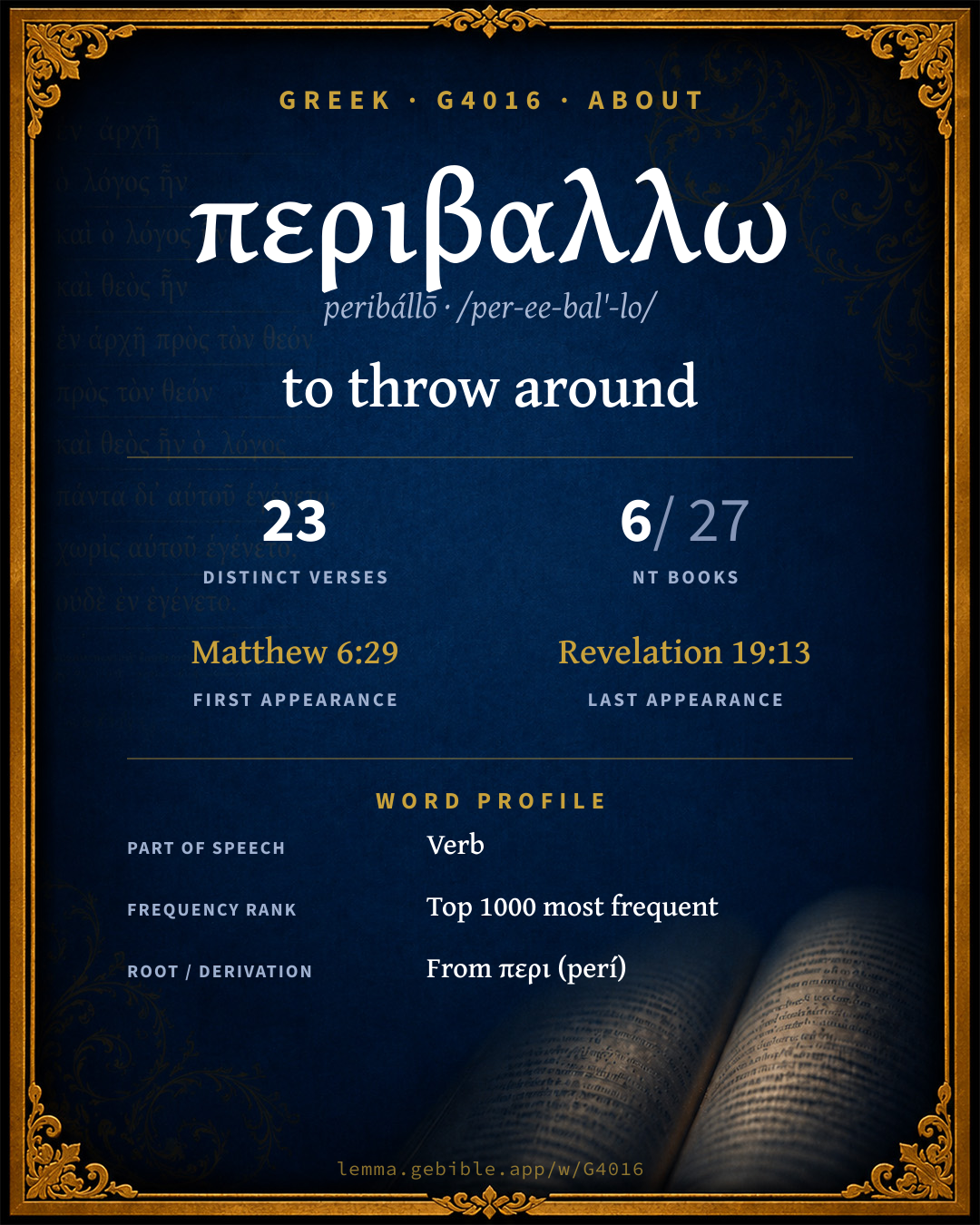
περιβάλλω
to throw around
Full lexicon entry — Thayer's Greek Lexicon
From Thayer's Greek Lexicon
Where this word appears
See every Aorist-tense verb in the Greek New Testament →
Grammar key — what these labels mean
Part of speech
- Verb
- An action or state-of-being word.
Tense
- Perfect
- A completed past action with continuing present results.
- Aorist
- Action viewed as a simple whole, without regard to duration — often past (perfective aspect).
- Future
- Action expected in future time.
Voice
- Passive
- The subject receives the action.
- Active
- The subject performs the action.
- Middle
- The subject acts on or for itself, or with special interest in the action.
Mood
- Participle
- A verbal adjective (“writing,” “having written”).
- Indicative
- States a fact or asks a factual question (the mood of reality).
- Imperative
- Expresses a command or request.
- Subjunctive
- Expresses probability, purpose, or possibility (the mood of contingency).
Case
- Nominative
- The case of the subject (and the predicate nominative).
- Accusative
- The case of the direct object and of extent.
Person
- 2nd person
- The one addressed (“you”).
- 3rd person
- The one spoken about (“he / she / it / they”).
- 1st person
- The speaker (“I / we”).
Gender
- Feminine
- Grammatically feminine.
- Masculine
- Grammatically masculine.
Number
- Singular
- One.
- Plural
- More than one.
Grammatical forms 15 distinct
- Verb, Perfect, Passive, Participle, Nominative, Singular, Feminine 3 times (13%)
- Verb, Aorist, Active, Indicative, 2nd person, Plural 2 times (9%)
- Verb, Aorist, Middle, Indicative, 3rd person, Singular 2 times (9%)
- Verb, Perfect, Passive, Participle, Accusative, Plural, Masculine 2 times (9%)
- Verb, Perfect, Passive, Participle, Accusative, Singular, Masculine 2 times (9%)
- Verb, Perfect, Passive, Participle, Nominative, Plural, Masculine 2 times (9%)
- Verb, Perfect, Passive, Participle, Nominative, Singular, Masculine 2 times (9%)
- Verb, Aorist, Active, Indicative, 1st person, Plural 1 time (4%)
+7 more forms (7 occurrences)
Parsed forms decoded from the imported morphology (Robinson–Tischendorf, public domain), counted across 23 parsed occurrences — not distinct verses.
Every verse where G4016 appears — 23 distinct verses across 6 books. Click any verse to open its interlinear word-by-word view. Verse text shown in the World English Bible for context — . Each verse’s Greek form is shown with its reference; the English is not keyword-highlighted, since the data carries no word-level English alignment. Use “Compare translations” on any verse to read it across multiple English versions. This concordance covers the Greek New Testament; Septuagint (Greek Old Testament) occurrences of this word are not indexed here.
Matthew 5 verses
- Matthew 6:29 περιεβάλετο aor mid ind 3sg yet I tell you that even Solomon in all his glory was not dressed like one of these.
- Matthew 6:31 περιβαλώμεθα aor mid subj 1pl "Therefore don't be anxious, saying, 'What will we eat?', 'What will we drink?' or, 'With what will we be clothed?'
- Matthew 25:36 περιεβάλετέ aor act ind 2pl naked, and you clothed me; I was sick, and you visited me; I was in prison, and you came to me.'
- Matthew 25:38 περιεβάλομεν aor act ind 1pl When did we see you as a stranger, and take you in; or naked, and clothe you?
- Matthew 25:43 περιεβάλετέ aor act ind 2pl I was a stranger, and you didn't take me in; naked, and you didn't clothe me; sick, and in prison, and you didn't visit me.'
Mark 2 verses
- Mark 14:51 περιβεβλημένος perf pass ptcp nom sg masc A certain young man followed him, having a linen cloth thrown around himself, over his naked body. The young men grabbed him,
- Mark 16:5 περιβεβλημένον perf pass ptcp acc sg masc Entering into the tomb, they saw a young man sitting on the right side, dressed in a white robe, and they were amazed.
Luke 2 verses
- Luke 12:27 περιεβάλετο aor mid ind 3sg Consider the lilies, how they grow. They don't toil, neither do they spin; yet I tell you, even Solomon in all his glory was not arrayed like one of these.
- Luke 23:11 περιβαλὼν aor act ptcp nom sg masc Herod with his soldiers humiliated him and mocked him. Dressing him in luxurious clothing, they sent him back to Pilate.
John 1 verse
Acts 1 verse
Revelation 12 verses
- Revelation 3:5 περιβαλεῖται fut mid ind 3sg He who overcomes will be arrayed in white garments, and I will in no way blot his name out of the book of life, and I will confess his name before my Father, and before his angels.
- Revelation 3:18 περιβάλῃ aor mid subj 2sg I counsel you to buy from me gold refined by fire, that you may become rich; and white garments, that you may clothe yourself, and that the shame of your nakedness may not be revealed; and eye salve to anoint your eyes, that you may see.
- Revelation 4:4 περιβεβλημένους perf pass ptcp acc pl masc Around the throne were twenty-four thrones. On the thrones were twenty-four elders sitting, dressed in white garments, with crowns of gold on their heads.
- Revelation 7:9 περιβεβλημένους perf pass ptcp acc pl masc After these things I looked, and behold, a great multitude, which no man could number, out of every nation and of all tribes, peoples, and languages, standing before the throne and before the Lamb, dressed in white robes, with palm branches in their hands.
- Revelation 7:13 περιβεβλημένοι perf pass ptcp nom pl masc One of the elders answered, saying to me, "These who are arrayed in white robes, who are they, and from where did they come?"
- Revelation 10:1 περιβεβλημένον perf pass ptcp acc sg masc I saw a mighty angel coming down out of the sky, clothed with a cloud. A rainbow was on his head. His face was like the sun, and his feet like pillars of fire.
- Revelation 11:3 περιβεβλημένοι perf pass ptcp nom pl masc I will give power to my two witnesses, and they will prophesy one thousand two hundred sixty days, clothed in sackcloth."
- Revelation 12:1 περιβεβλημένη perf pass ptcp nom sg fem A great sign was seen in heaven: a woman clothed with the sun, and the moon under her feet, and on her head a crown of twelve stars.
- Revelation 17:4 περιβεβλημένη perf pass ptcp nom sg fem The woman was dressed in purple and scarlet, and decked with gold and precious stones and pearls, having in her hand a golden cup full of abominations and the impurities of the sexual immorality of the earth.
- Revelation 18:16 περιβεβλημένη perf pass ptcp nom sg fem saying, 'Woe, woe, the great city, she who was dressed in fine linen, purple, and scarlet, and decked with gold and precious stones and pearls!
- Revelation 19:8 περιβάληται aor mid subj 3sg It was given to her that she would array herself in bright, pure, fine linen: for the fine linen is the righteous acts of the saints.
- Revelation 19:13 περιβεβλημένος perf pass ptcp nom sg masc He is clothed in a garment sprinkled with blood. His name is called "The Word of God."
About this entry
At a glance — auto-summarized from this page’s data, not written by a person. Every figure links to its source below. This summary describes the numbers; it doesn’t interpret them.
At its core, περιβαλλω (peribállō) means “to throw around.” Its uses cluster heavily in Revelation (52% of all occurrences). Spanning 23 verses in 6 books, it ranks among the uncommon words of the Greek New Testament. It first appears in Matthew 6:29. Sharing its root, it stands alongside περι, περιαγω and περιαιρεω. Dig into 23-verse concordance and the renderings breakdown below.
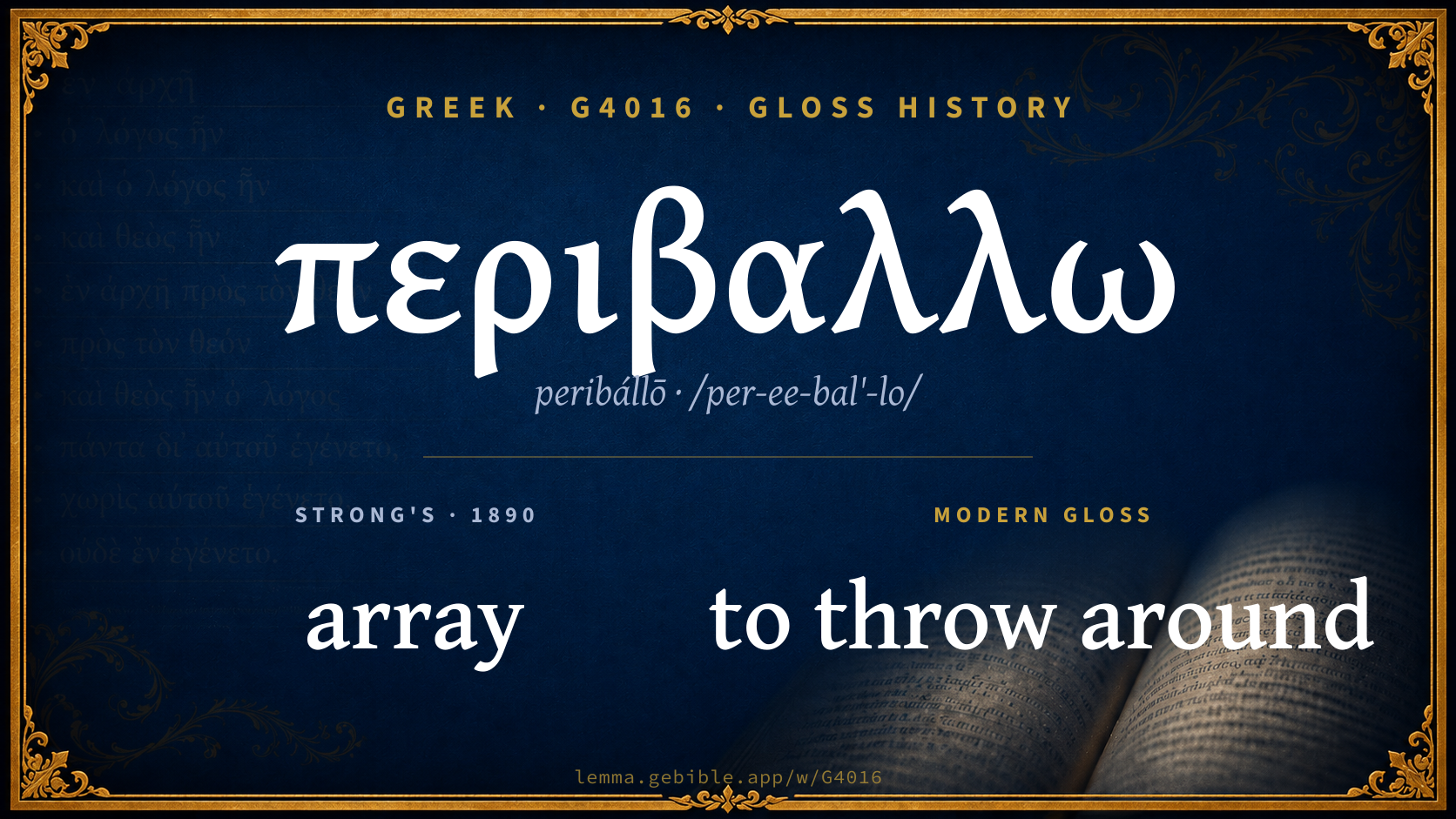
Gloss history
Strong's 1890 vs modern scholarship
About this word
Strong's G4016 catalogs a Greek word from the Greek New Testament.
These counts are not copied from any lexicon or concordance. They are computed here, from the morphology-tagged Greek New Testament. What Lemma adds →
- 23
- distinct verses
- The word appears in 23 distinct verses.
- 6 / 27
- NT books
- The word appears in 6 of 27 New Testament books.
- #563
- by frequency
- Top 1000 most frequent Greek words (rank 563 of 5,347 Greek words by occurrence).
View all 23 occurrences in the concordance →
Most concentrated in
- Revelation 12 verses 52%
- Matthew 5 verses 22%
- Mark 2 verses 9%
By section of the New Testament
By traditional corpus
Conventional, traditional groupings — biblical authorship is debated, so this is a traditional corpus grouping, not an authorship claim. Some books belong to more than one corpus (Luke is in both the Gospels and the Lukan corpus, and so on), so these shares overlap and need not total 100%. Each figure is a share of the word’s 23 distinct verses.
- Johannine 13 verses · 57%
- Revelation 12 verses · 52%
- Gospels 10 verses · 43%
- Lukan (Luke–Acts) 3 verses · 13%
How translations render this word
Counts come from each version’s own published word-to-Strong’s tagging or interlinear alignment — an approximate guide to how each version renders this word, not a word-level alignment the data otherwise carries. Because each total is that version’s own tagged count, the per-version totals vary from one another and need not match the appearance or distinct-verse counts above. These counts may also differ from a printed concordance because Lemma counts each distinctly tagged rendering and does not collapse phrase taggings into a single head-word total. This is a fixed set of word-tagged versions (KJV, ASV, BSB, ULT) and does not change with the reading translation you choose elsewhere. Each version’s license is shown beside its name below (and on Sources).
- King James Version: Clothed 6×, Arrayed 4×, About 2×
- American Standard Version: Arrayed 8×, Cast 2×, Was 2×
- Berean Standard Bible: Clothed in 3×, Dressed 2×, Dressed in 2×
- unfoldingWord Literal Text: Clothe 2×, Clothed 2×, Clothed himself 2×
King James Version Public Domain
Renders G4016 across 28 tagged occurrences — most commonly:
Plus 10 renderings that appear only once — usually multi-word phrases or single function words the recovered tagging swept in, not distinct renderings.
American Standard Version Public Domain
Renders G4016 across 31 tagged occurrences — most commonly:
Plus 17 renderings that appear only once — usually multi-word phrases or single function words the recovered tagging swept in, not distinct renderings.
Berean Standard Bible Public Domain
Renders G4016 across 23 tagged occurrences — most commonly:
Plus 14 renderings that appear only once — usually multi-word phrases or single function words the recovered tagging swept in, not distinct renderings.
unfoldingWord Literal Text CC BY-SA 4.0
Renders G4016 across 29 tagged occurrences — most commonly:
Plus 21 renderings that appear only once — usually multi-word phrases or single function words the recovered tagging swept in, not distinct renderings.
Senses in Thayer's
The 1 sense Thayer's distinguishes for this word, in lexicon order (not ranked by frequency or importance). The full entry — with sub-senses — is in the Lexicon Entry tab.
- to throw around, to put around
Word origin
Derived from περι (perí) (G4012) — about.
Forms in the corpus
The 15 distinct written forms G4016 takes in the Greek New Testament, most frequent first — each parse links to that tense’s occurrences in the concordance.
Same root — word family
Other Thayer's entries built from the same root as G4016, grouped by Strong’s listed origin. These share a root / origin per the lexicon — not necessarily a shared meaning. Each links to that word’s own entry.
Derives from
Shares the same root
- περιαγω periágō G4013 to lead around
- περιαιρεω periairéō G4014 to take away
- περιαστραπτω periastráptō G4015 to shine around
- περιβλεπω periblépō G4017 to look around
- περιδεω peridéō G4019 to bind around
- περιεργαζομαι periergázomai G4020 to bustle about
- περιεργος períergos G4021 busybody
- περιερχομαι periérchomai G4022 to go about
- περιεχω periéchō G4023 to surround
- περιζωννυμι perizṓnnymi G4024 to gird
- περιΐστημι periḯstēmi G4026 to stand around
- περικαθαρμα perikátharma G4027 scum
- περικαλυπτω perikalýptō G4028 to cover up
- περικειμαι períkeimai G4029 to lie around
- περικεφαλαια perikephalaía G4030 helmet
- περικρατης perikratḗs G4031 to have power over
- περικρυπτω perikrýptō G4032 to hide
- περικυκλοω perikyklóō G4033 to encircle
- περιλαμπω perilámpō G4034 to shine around
- περιλειπω perileípō G4035 to remain over
- περιλυπος perílypos G4036 deeply sorrowful
- περιμενω periménō G4037 to wait for
- περιξ périx G4038 round about
- περιοικεω perioikéō G4039 to be neighbor
+17 more words share this root (not shown).
Derived from this word
Compare all same-root words → Showing 4 of 44 — not the complete family. They share a root, not necessarily a meaning.
Septuagint usage
The same Greek word περιβαλλω appears 55 times in the Greek Old Testament (Septuagint), across 55 verses in 24 books.
- 55
- LXX occurrences
- Tagged occurrences of this Greek word in the Septuagint.
- 55
- verses
- Distinct Septuagint verses containing this word.
- 24 / 39
- OT books
- The word appears in 24 of the 39 Old Testament books.
Sample Septuagint occurrences
- Genesis 24:65 περιβάλλω
- Leviticus 13:45 περιβάλλω
- Deuteronomy 22:12 περιβάλλω
- Judges 4:18 περιβάλλω
- Ruth 3:9 περιβάλλω
- 1 Samuel 28:8 περιβάλλω
- 1 Kings 1:1 περιβάλλω
- 2 Kings 8:15 περιβάλλω
- 1 Chronicles 21:16 περιβάλλω
- 2 Chronicles 28:15 περιβάλλω
- Esther 6:8 περιβάλλω
- Job 23:9 περιβάλλω
Septuagint occurrences (same lexeme)
Every verse where the same Strong’s number (G4016) appears in the Greek Septuagint — showing the first 50 of 55. Verse text shown in the World English Bible for context; the Greek form is the matched word — the English is not keyword-highlighted.
- Genesis 24:65 περιβάλλω She said to the servant, "Who is the man who is walking in the field to meet us?" The servant said, "It is my master." She took her veil, and covered herself.
- Genesis 28:20 περιβάλλω Jacob vowed a vow, saying, "If God will be with me, and will keep me in this way that I go, and will give me bread to eat, and clothing to put on,
- Genesis 38:14 περιβάλλω She took off of her the garments of her widowhood, and covered herself with her veil, and wrapped herself, and sat in the gate of Enaim, which is by the way to Timnah; for she saw that Shelah was grown up, and she wasn't given to him as a wife.
- Leviticus 13:45 περιβάλλω "The leper in whom the plague is shall wear torn clothes, and the hair of his head shall hang loose. He shall cover his upper lip, and shall cry, 'Unclean! Unclean!'
- Deuteronomy 22:12 περιβάλλω You shall make you fringes on the four borders of your cloak, with which you cover yourself.
- Judges 4:18 περιβάλλω Jael went out to meet Sisera, and said to him, Turn in, my lord, turn in to me; don't be afraid. He came in to her into the tent, and she covered him with a rug.
- Judges 4:19 περιβάλλω He said to her, Please give me a little water to drink; for I am thirsty. She opened a bottle of milk, and gave him drink, and covered him.
- Ruth 3:9 περιβάλλω He said, Who are you? She answered, I am Ruth your handmaid: spread therefore your skirt over your handmaid; for you are a near kinsman.
- 1 Samuel 28:8 περιβάλλω Saul disguised himself, and put on other clothing, and went, he and two men with him, and they came to the woman by night: and he said, Please divine to me by the familiar spirit, and bring me up whoever I shall name to you.
- 1 Kings 1:1 περιβάλλω Now king David was old and stricken in years; and they covered him with clothes, but he got no heat.
- 1 Kings 11:29 περιβάλλω It happened at that time, when Jeroboam went out of Jerusalem, that the prophet Ahijah the Shilonite found him in the way; now [Ahijah] had clad himself with a new garment; and they two were alone in the field.
- 1 Kings 12:24 περιβάλλω Thus says Yahweh, You shall not go up, nor fight against your brothers the children of Israel: return every man to his house; for this thing is of me. So they listened to the word of Yahweh, and returned and went their way, according to the word of Yahweh.
- 1 Kings 20:16 περιβάλλω They went out at noon. But Ben Hadad was drinking himself drunk in the pavilions, he and the kings, the thirty-two kings who helped him.
- 1 Kings 20:27 περιβάλλω The children of Israel were mustered, and were provisioned, and went against them: and the children of Israel encamped before them like two little flocks of kids; but the Syrians filled the country.
- 2 Kings 8:15 περιβάλλω It happened on the next day, that he took the coverlet, and dipped it in water, and spread it on his face, so that he died: and Hazael reigned in his place.
- 2 Kings 19:1 περιβάλλω It happened, when king Hezekiah heard it, that he tore his clothes, and covered himself with sackcloth, and went into the house of Yahweh.
- 2 Kings 19:2 περιβάλλω He sent Eliakim, who was over the household, and Shebna the scribe, and the elders of the priests, covered with sackcloth, to Isaiah the prophet the son of Amoz.
- 1 Chronicles 21:16 περιβάλλω David lifted up his eyes, and saw the angel of Yahweh standing between earth and the sky, having a drawn sword in his hand stretched out over Jerusalem. Then David and the elders, clothed in sackcloth, fell on their faces.
- 2 Chronicles 28:15 περιβάλλω The men who have been mentioned by name rose up, and took the captives, and with the spoil clothed all who were naked among them, and arrayed them, and shod them, and gave them to eat and to drink, and anointed them, and carried all the feeble of them on donkeys, and brought them to Jericho, the city of palm trees, to their brothers: then they returned to Samaria.
- Esther 6:8 περιβάλλω let royal clothing be brought which the king uses to wear, and the horse that the king rides on, and on the head of which a crown royal is set:
- Job 23:9 περιβάλλω He works to the north, but I can't see him; He turns south, but I can't catch a glimpse of him.
- Job 24:8 περιβάλλω They are wet with the showers of the mountains, And embrace the rock for lack of a shelter.
- Psalms 44:10 περιβάλλω You make us turn back from the adversary. Those who hate us take spoil for themselves.
- Psalms 44:14 περιβάλλω You make us a byword among the nations, A shaking of the head among the peoples.
- Psalms 70:13 περιβάλλω
- Psalms 72:6 περιβάλλω He will come down like rain on the mown grass, As showers that water the earth.
- Psalms 108:19 περιβάλλω
- Psalms 108:29 περιβάλλω
- Psalms 146:8 περιβάλλω Yahweh opens the eyes of the blind. Yahweh raises up those who are bowed down. Yahweh loves the righteous.
- Proverbs 28:4 περιβάλλω Those who forsake the law praise the wicked; But those who keep the law contend with them.
- Proverbs 29:5 περιβάλλω A man who flatters his neighbor, Spreads a net for his feet.
- Song of Solomon 1:7 περιβάλλω Tell me, you whom my soul loves, Where you graze your flock, Where you rest them at noon; For why should I be as one who is veiled Beside the flocks of your companions? Lover
- Isaiah 4:1 περιβάλλω Seven women shall take hold of one man in that day, saying, "We will eat our own bread, and wear our own clothing: only let us be called by your name. Take away our reproach."
- Isaiah 37:1 περιβάλλω It happened, when king Hezekiah heard it, that he tore his clothes, and covered himself with sackcloth, and went into the house of Yahweh.
- Isaiah 37:2 περιβάλλω He sent Eliakim, who was over the household, and Shebna the scribe, and the elders of the priests, covered with sackcloth, to Isaiah the prophet the son of Amoz.
- Isaiah 58:7 περιβάλλω Isn't it to deal your bread to the hungry, and that you bring the poor who are cast out to your house? when you see the naked, that you cover him; and that you not hide yourself from your own flesh?
- Isaiah 59:6 περιβάλλω Their webs shall not become garments, neither shall they cover themselves with their works: their works are works of iniquity, and the act of violence is in their hands.
- Isaiah 59:17 περιβάλλω He put on righteousness as a breastplate, and a helmet of salvation on his head; and he put on garments of vengeance for clothing, and was clad with zeal as a mantle.
- Jeremiah 4:30 περιβάλλω You, when you are made desolate, what will you do? Though you clothe yourself with scarlet, though you deck you with ornaments of gold, though you enlarge your eyes with paint, in vain do you make yourself beautiful; [your] lovers despise you, they seek your life.
- Lamentations 4:5 περιβάλλω Those who did feed delicately are desolate in the streets: Those who were brought up in scarlet embrace dunghills.
- Ezekiel 4:2 περιβάλλω and lay siege against it, and build forts against it, and cast up a mound against it; set camps also against it, and plant battering rams against it round about.
- Ezekiel 16:10 περιβάλλω I clothed you also with embroidered work, and shod you with sealskin, and I girded you about with fine linen, and covered you with silk.
- Ezekiel 16:18 περιβάλλω and you took your embroidered garments, and covered them, and did set my oil and my incense before them.
- Ezekiel 18:7 περιβάλλω and has not wronged any, but has restored to the debtor his pledge, has taken nothing by robbery, has given his bread to the hungry, and has covered the naked with a garment;
- Ezekiel 18:16 περιβάλλω neither has wronged any, has not taken anything to pledge, neither has taken by robbery, but has given his bread to the hungry, and has covered the naked with a garment;
- Ezekiel 27:7 περιβάλλω Of fine linen with embroidered work from Egypt was your sail, that it might be to you for an ensign; blue and purple from the isles of Elishah was your awning.
- Ezekiel 32:3 περιβάλλω Thus says the Lord Yahweh: I will spread out my net on you with a company of many peoples; and they shall bring you up in my net.
- Ezekiel 34:3 περιβάλλω You eat the fat, and you clothe you with the wool, you kill the fatlings; but you don't feed the sheep.
- Daniel 12:6 περιβάλλω One said to the man clothed in linen, who was above the waters of the river, How long shall it be to the end of these wonders?
- Daniel 12:7 περιβάλλω I heard the man clothed in linen, who was above the waters of the river, when he held up his right hand and his left hand to heaven, and swore by him who lives forever that it shall be for a time, times, and a half; and when they have made an end of breaking in pieces the power of the holy people, all these things shall be finished.
These are occurrences of the same Greek lexeme (G4016) in the Septuagint — not a translation of any one Hebrew word. The store carries no word-level Hebrew↔Greek alignment, so no Hebrew original is asserted here. Counts come from the recovered LXX Strong's tagging — high-frequency vocabulary is well covered, while rare or late forms may be untagged — so they reflect tagged occurrences and may slightly undercount.