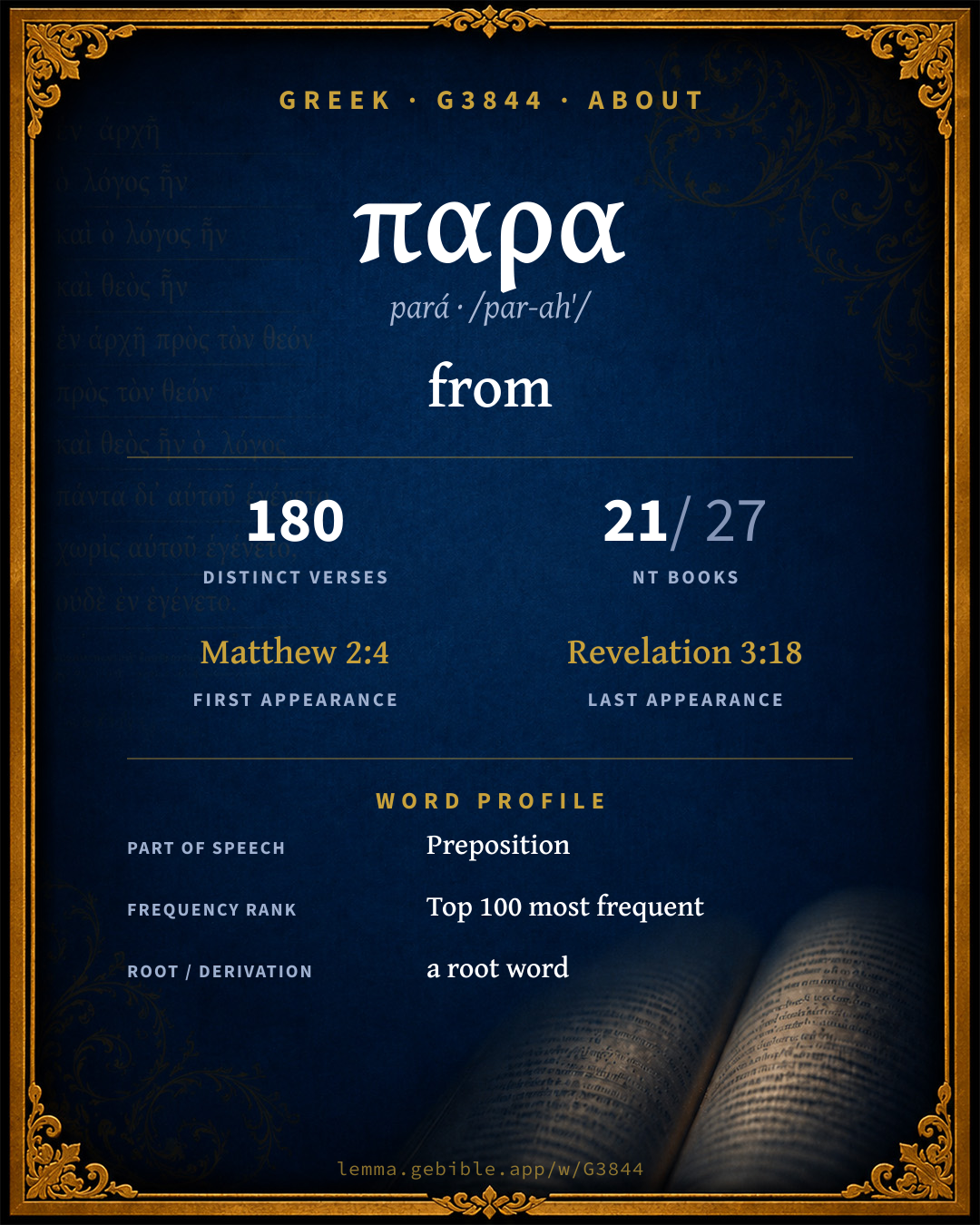
παρά
from
Full lexicon entry — Thayer's Greek Lexicon
From Thayer's Greek Lexicon
Where this word appears
Grammar key — what these labels mean
Part of speech
- Preposition
- A relational word governing a noun in a particular case.
Every verse where G3844 appears in the Book of Ephesians — 2 distinct verses. Click any verse to open its interlinear word-by-word view. Verse text shown in the World English Bible for context — . Each verse’s Greek form is shown with its reference; the English is not keyword-highlighted, since the data carries no word-level English alignment. Use “Compare translations” on any verse to read it across multiple English versions. This concordance covers the Greek New Testament; Septuagint (Greek Old Testament) occurrences of this word are not indexed here.
Ephesians
- Ephesians 6:8 παρὰ prep knowing that whatever good thing each one does, he will receive the same again from the Lord, whether he is bound or free.
- Ephesians 6:9 παρ’ prep You masters, do the same things to them, and give up threatening, knowing that he who is both their Master and yours is in heaven, and there is no partiality with him.
About this entry
At a glance — auto-summarized from this page’s data, not written by a person. Every figure links to its source below. This summary describes the numbers; it doesn’t interpret them.
At its core, παρα (pará) means “from.” Its English rendering has broadened — “of” classically, “from” (Berean Standard Bible) in modern versions; see the renderings breakdown. Spanning 180 verses in 21 books, it ranks among the common words of the Greek New Testament. It first appears in Matthew 2:4. Sharing its root, it stands alongside παραβαινω, παραβαλλω and παραβιαζομαι. Each statement above links to its evidence; the full detail follows below.
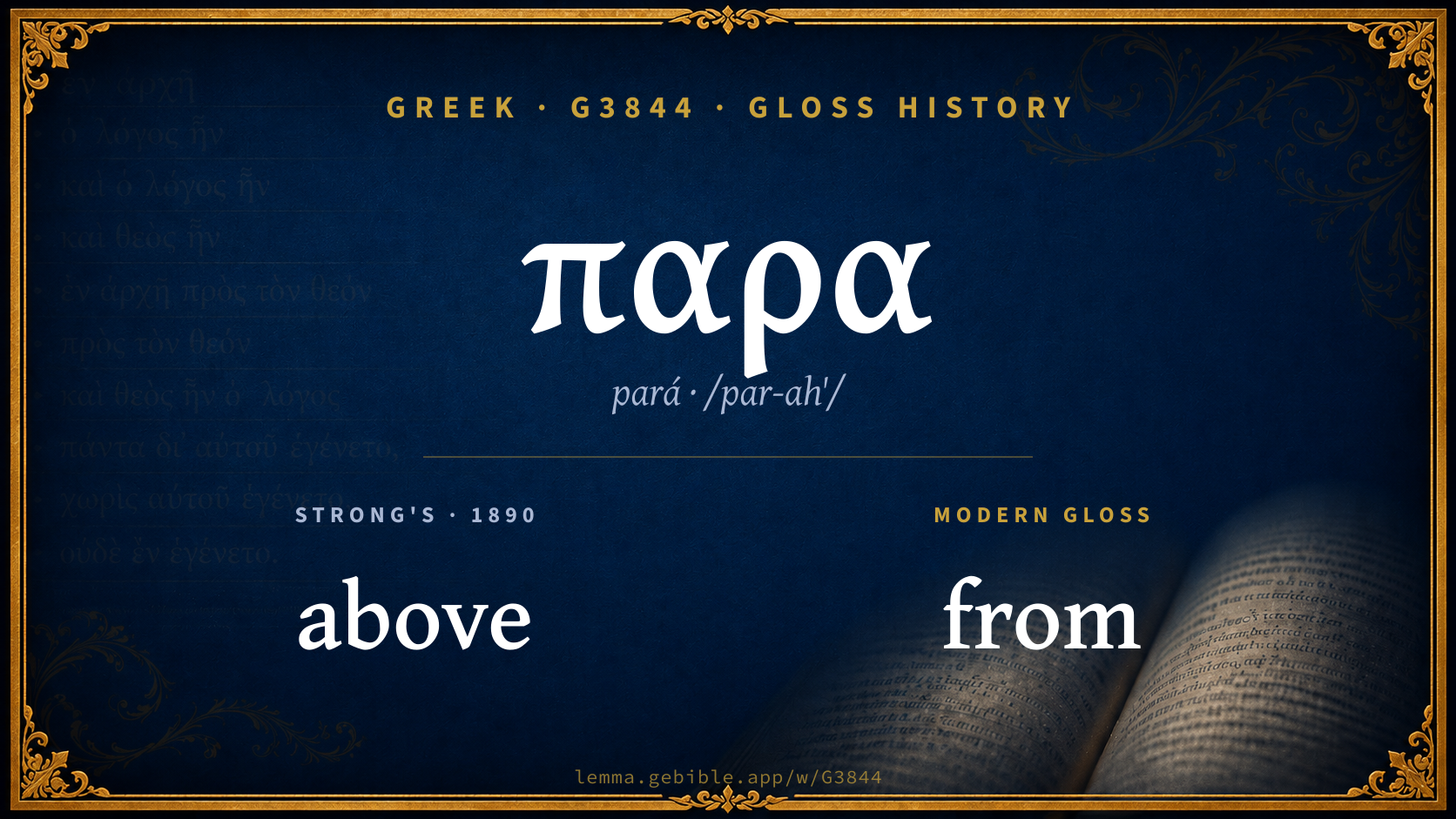
Gloss history
Strong's 1890 vs modern scholarship
About this word
Strong's G3844 catalogs a Greek word from the Greek New Testament.
These counts are not copied from any lexicon or concordance. They are computed here, from the morphology-tagged Greek New Testament. What Lemma adds →
- 180
- distinct verses
- The word appears in 180 distinct verses.
- 21 / 27
- NT books
- The word appears in 21 of 27 New Testament books.
- #84
- by frequency
- Top 100 most frequent Greek words (rank 84 of 5,347 Greek words by occurrence).
View all 180 occurrences in the concordance →
By section of the New Testament
By traditional corpus
Conventional, traditional groupings — biblical authorship is debated, so this is a traditional corpus grouping, not an authorship claim. Some books belong to more than one corpus (Luke is in both the Gospels and the Lukan corpus, and so on), so these shares overlap and need not total 100%. Each figure is a share of the word’s 180 distinct verses.
- Gospels 88 verses · 49%
- Lukan (Luke–Acts) 55 verses · 31%
- Pauline corpus 40 verses · 22%
- Johannine 35 verses · 19%
- General (Catholic) Epistles 11 verses · 6%
- Hebrews 10 verses · 6%
- Revelation 3 verses · 2%
How translations render this word
Counts come from each version’s own published word-to-Strong’s tagging or interlinear alignment — an approximate guide to how each version renders this word, not a word-level alignment the data otherwise carries. Because each total is that version’s own tagged count, the per-version totals vary from one another and need not match the appearance or distinct-verse counts above. These counts may also differ from a printed concordance because Lemma counts each distinctly tagged rendering and does not collapse phrase taggings into a single head-word total. This is a fixed set of word-tagged versions (KJV, ASV, BSB, ULT) and does not change with the reading translation you choose elsewhere. Each version’s license is shown beside its name below (and on Sources).
- King James Version: Of 49×, With 40×, From 22×
- American Standard Version: From 40×, With 40×, Of 29×
- Berean Standard Bible: From 58×, With 25×, At 9×
- unfoldingWord Literal Text: From 80×, With 37×, Beside 15×
King James Version Public Domain
Renders G3844 across 197 tagged occurrences — most commonly:
Plus 26 renderings that appear only once — usually multi-word phrases or single function words the recovered tagging swept in, not distinct renderings. Not rendered by a distinct English word in 5 further occurrences.
American Standard Version Public Domain
Renders G3844 across 199 tagged occurrences — most commonly:
Plus other, less common renderings. Plus 26 renderings that appear only once — usually multi-word phrases or single function words the recovered tagging swept in, not distinct renderings.
Berean Standard Bible Public Domain
Renders G3844 across 160 tagged occurrences — most commonly:
Plus other, less common renderings. Plus 18 renderings that appear only once — usually multi-word phrases or single function words the recovered tagging swept in, not distinct renderings. Not rendered by a distinct English word in 21 further occurrences.
unfoldingWord Literal Text CC BY-SA 4.0
Renders G3844 across 199 tagged occurrences — most commonly:
Plus other, less common renderings. Plus 12 renderings that appear only once — usually multi-word phrases or single function words the recovered tagging swept in, not distinct renderings.
Senses in Thayer's
The 1 sense Thayer's distinguishes for this word, in lexicon order (not ranked by frequency or importance). The full entry — with sub-senses — is in the Lexicon Entry tab.
- from, of at, by, besides, near
Word origin
Origin: a root word
A primary preposition; properly near that is (with genitive case) from beside (literally or figuratively) (with dative case) at (or in ) the vicinity of (objectively or subjectively) (with accusative case) to the proximity with (local [especially beyond or opposed to] or causal [ on account of]). In compounds it retains the same variety of application : - above against among at before by contrary to X friend from + give [such things as they] + that [she] had X his in more than nigh unto (out) of past save side... by in the sight of than [there-] fore with. In compounds it retains the same variety of application.
— Strong’s Exhaustive Concordance (1890), public domain.
Forms in the corpus
The 3 distinct written forms G3844 takes in the Greek New Testament, most frequent first — each parse links to that case’s occurrences in the concordance.
| Form | Parsing | Example | Uses |
|---|---|---|---|
| παρὰ parà | Preposition | Matthew 2:16 | 129 |
| παρ’ par | Preposition | Matthew 2:4 | 59 |
| παρά pará | Preposition | Acts 9:43 | 3 |
Same root — word family
Other Thayer's entries built from the same root as G3844, grouped by Strong’s listed origin. These share a root / origin per the lexicon — not necessarily a shared meaning. Each links to that word’s own entry.
Derived from this word
- παραβαινω parabaínō G3845 to neglect
- παραβαλλω parabállō G3846 to place beside
- παραβιαζομαι parabiázomai G3849 to compel
- παραβουλευομαι parabouleúomai G3851 to consult wrongly
- παραγγελλω parangéllō G3853 to announce
- παραγινομαι paragínomai G3854 to appear
- παραγω parágō G3855 to pass by
- παραδειγματιζω paradeigmatízō G3856 to make example
- παραδεχομαι paradéchomai G3858 to receive
- παραδιατριβη paradiatribḗ G3859 empty business
- παραδιδωμι paradídōmi G3860 to deliver
- παραδοξος parádoxos G3861 strange
- παραζηλοω parazēlóō G3863 to provoke
- παραθαλασσιος parathalássios G3864 by the sea
- παραθεωρεω paratheōréō G3865 to compare
- παραινεω parainéō G3867 to exhort
- παραιτεομαι paraitéomai G3868 to beg pardon
- παρακαθιζω parakathízō G3869 to sit beside
- παρακαλεω parakaléō G3870 to call beside
- παρακαλυπτω parakalýptō G3871 to cover up
- παρακαταθηκη parakatathḗkē G3872 deposit
- παρακειμαι parákeimai G3873 to lie beside
- παρακολουθεω parakolouthéō G3877 to follow after
- παρακουω parakoúō G3878 to disobey
+52 more words derive from G3844 (not shown).
Proper names from this root
People and places named from this root — a name, not an additional meaning of the word.
Compare all same-root words → Showing 4 of 78 — not the complete family. 1 of the same-root words is a proper name (a person or place). They share a root, not necessarily a meaning.
Septuagint usage
The same Greek word παρα appears 800 times in the Greek Old Testament (Septuagint), across 736 verses in 33 books.
- 800
- LXX occurrences
- Tagged occurrences of this Greek word in the Septuagint.
- 736
- verses
- Distinct Septuagint verses containing this word.
- 33 / 39
- OT books
- The word appears in 33 of the 39 Old Testament books.
Sample Septuagint occurrences
- Genesis 13:18 παρά
- Exodus 2:3 παρά
- Leviticus 1:16 παρά
- Numbers 1:50 παρα
- Deuteronomy 2:6 παρά
- Joshua 4:3 παρα
- Judges 1:14 παρά
- Ruth 2:12 παρά
- 1 Samuel 1:17 παρά
- 2 Samuel 2:31 παρά
- 1 Kings 2:15 παρά
- 2 Kings 1:3 παρά
Septuagint occurrences (same lexeme)
Every verse where the same Strong’s number (G3844) appears in the Greek Septuagint — showing the first 50 of 736. Verse text shown in the World English Bible for context; the Greek form is the matched word — the English is not keyword-highlighted.
- Genesis 13:18 παρά Abram moved his tent, and came and lived by the oaks of Mamre, which are in Hebron, and built an altar there to Yahweh.
- Genesis 18:14 παρά Is anything too hard for Yahweh? At the set time I will return to you, when the season comes round, and Sarah will have a son."
- Genesis 19:1 παρά The two angels came to Sodom at evening. Lot sat in the gate of Sodom. Lot saw them, and rose up to meet them. He bowed himself with his face to the earth,
- Genesis 19:24 παρά Then Yahweh rained on Sodom and on Gomorrah sulfur and fire from Yahweh out of the sky.
- Genesis 21:30 παρά He said, "You shall take these seven ewe lambs from my hand, that it may be a witness to me, that I have dug this well."
- Genesis 22:17 παρά that in blessing I will bless you, and in multiplying I will multiply your seed as the stars of the heavens, and as the sand which is on the seashore. Your seed will possess the gate of his enemies.
- Genesis 23:6 παρά "Hear us, my lord. You are a prince of God among us. In the choice of our tombs bury your dead. None of us will withhold from you his tomb, but that you may bury your dead."
- Genesis 23:11 παρά "No, my lord, hear me. I give you the field, and I give you the cave that is in it. In the presence of the children of my people I give it to you. Bury your dead."
- Genesis 23:13 παρά He spoke to Ephron in the audience of the people of the land, saying, "But if you will, please hear me. I will give the price of the field. Take it from me, and I will bury my dead there."
- Genesis 23:20 παρά The field, and the cave that is therein, were made sure to Abraham for a possession of a burying place by the children of Heth.
- Genesis 24:11 παρά He made the camels kneel down outside the city by the well of water at the time of evening, the time that women go out to draw water.
- Genesis 24:23 παρά and said, "Whose daughter are you? Please tell me. Is there room in your father's house for us to lodge in?"
- Genesis 24:25 παρά She said moreover to him, "We have both straw and provender enough, and room to lodge in."
- Genesis 24:50 παρά Then Laban and Bethuel answered, "The thing proceeds from Yahweh. We can't speak to you bad or good.
- Genesis 25:10 παρά the field which Abraham purchased of the children of Heth. There was Abraham buried, with Sarah his wife.
- Genesis 25:11 παρά It happened after the death of Abraham, that God blessed Isaac, his son. Isaac lived by Beer Lahai Roi.
- Genesis 25:22 παρά The children struggled together within her. She said, "If it be so, why do I live?" She went to inquire of Yahweh.
- Genesis 27:15 παρά Rebekah took the good clothes of Esau, her elder son, which were with her in the house, and put them on Jacob, her younger son.
- Genesis 29:20 παρά Jacob served seven years for Rachel. They seemed to him but a few days, for the love he had for her.
- Genesis 29:25 παρά It happened in the morning that, behold, it was Leah. He said to Laban, "What is this you have done to me? Didn't I serve with you for Rachel? Why then have you deceived me?"
- Genesis 29:27 παρά Fulfill the week of this one, and we will give you the other also for the service which you will serve with me yet seven other years."
- Genesis 30:33 παρά So my righteousness will answer for me hereafter, when you come concerning my hire that is before you. Everyone that is not speckled and spotted among the goats, and black among the sheep, that might be with me, will be counted stolen."
- Genesis 31:32 παρά With whoever you find your gods, he shall not live. Before our relatives, discern what is yours with me, and take it." For Jacob didn't know that Rachel had stolen them.
- Genesis 31:39 παρά That which was torn of animals, I didn't bring to you. I bore the loss of it. Of my hand you required it, whether stolen by day or stolen by night.
- Genesis 32:2 παρα When he saw them, Jacob said, "This is God's host." He called the name of that place Mahanaim.
- Genesis 33:18 παρα Jacob came in peace to the city of Shechem, which is in the land of Canaan, when he came from Paddan Aram; and encamped before the city.
- Genesis 33:19 παρά He bought the parcel of ground, where he had spread his tent, at the hand of the children of Hamor, Shechem's father, for one hundred pieces of money.
- Genesis 34:16 παρά then will we give our daughters to you, and we will take your daughters to us, and we will dwell with you, and we will become one people.
- Genesis 36:37 παρά Samlah died, and Shaul of Rehoboth by the river, reigned in his place.
- Genesis 37:3 παρά Now Israel loved Joseph more than all his children, because he was the son of his old age, and he made him a coat of many colors.
- Genesis 38:20 παρά Judah sent the kid of the goats by the hand of his friend, the Adullamite, to receive the pledge from the woman's hand, but he didn't find her.
- Genesis 39:2 παρά Yahweh was with Joseph, and he was a prosperous man. He was in the house of his master the Egyptian.
- Genesis 39:15 παρά It happened, when he heard that I lifted up my voice and cried, that he left his garment by me, and ran outside."
- Genesis 39:16 παρά She laid up his garment by her, until his master came home.
- Genesis 39:18 παρά and it happened, as I lifted up my voice and cried, that he left his garment by me, and ran outside."
- Genesis 40:3 παρά He put them in custody in the house of the captain of the guard, into the prison, the place where Joseph was bound.
- Genesis 40:7 παρά He asked Pharaoh's officers who were with him in custody in his master's house, saying, "Why do you look so sad today?"
- Genesis 41:3 παρά Behold, seven other cattle came up after them out of the river, ill-favored and lean-fleshed, and stood by the other cattle on the brink of the river.
- Genesis 41:17 παρά Pharaoh spoke to Joseph, "In my dream, behold, I stood on the brink of the river:
- Genesis 41:32 παρά The dream was doubled to Pharaoh, because the thing is established by God, and God will shortly bring it to pass.
- Genesis 43:34 παρά He sent portions to them from before him, but Benjamin's portion was five times as much as any of theirs. They drank, and were merry with him.
- Genesis 44:9 παρά With whoever of your servants it be found, let him die, and we also will be my lord's bondservants."
- Genesis 44:10 παρά He said, "Now also let it be according to your words: he with whom it is found will be my bondservant; and you will be blameless."
- Genesis 44:16 παρά Judah said, "What will we tell my lord? What will we speak? Or how will we clear ourselves? God has found out the iniquity of your servants. Behold, we are my lord's bondservants, both we, and he also in whose hand the cup is found."
- Genesis 44:17 παρά He said, "Far be it from me that I should do so. The man in whose hand the cup is found, he will be my bondservant; but as for you, go up in peace to your father."
- Genesis 44:32 παρά For your servant became collateral for the boy to my father, saying, 'If I don't bring him to you, then I will bear the blame to my father forever.'
- Genesis 49:13 παρά "Zebulun will dwell at the haven of the sea. He will be for a haven of ships. His border will be on Sidon.
- Genesis 49:25 παρά Even by the God of your father, who will help you, By the Almighty, who will bless you, With blessings of heaven above, Blessings of the deep that lies below, Blessings of the breasts, and of the womb.
- Genesis 49:30 παρά in the cave that is in the field of Machpelah, which is before Mamre, in the land of Canaan, which Abraham bought with the field from Ephron the Hittite as a burial place.
- Genesis 49:32 παρά the field and the cave that is therein, which was purchased from the children of Heth."
These are occurrences of the same Greek lexeme (G3844) in the Septuagint — not a translation of any one Hebrew word. The store carries no word-level Hebrew↔Greek alignment, so no Hebrew original is asserted here. Counts come from the recovered LXX Strong's tagging — high-frequency vocabulary is well covered, while rare or late forms may be untagged — so they reflect tagged occurrences and may slightly undercount.