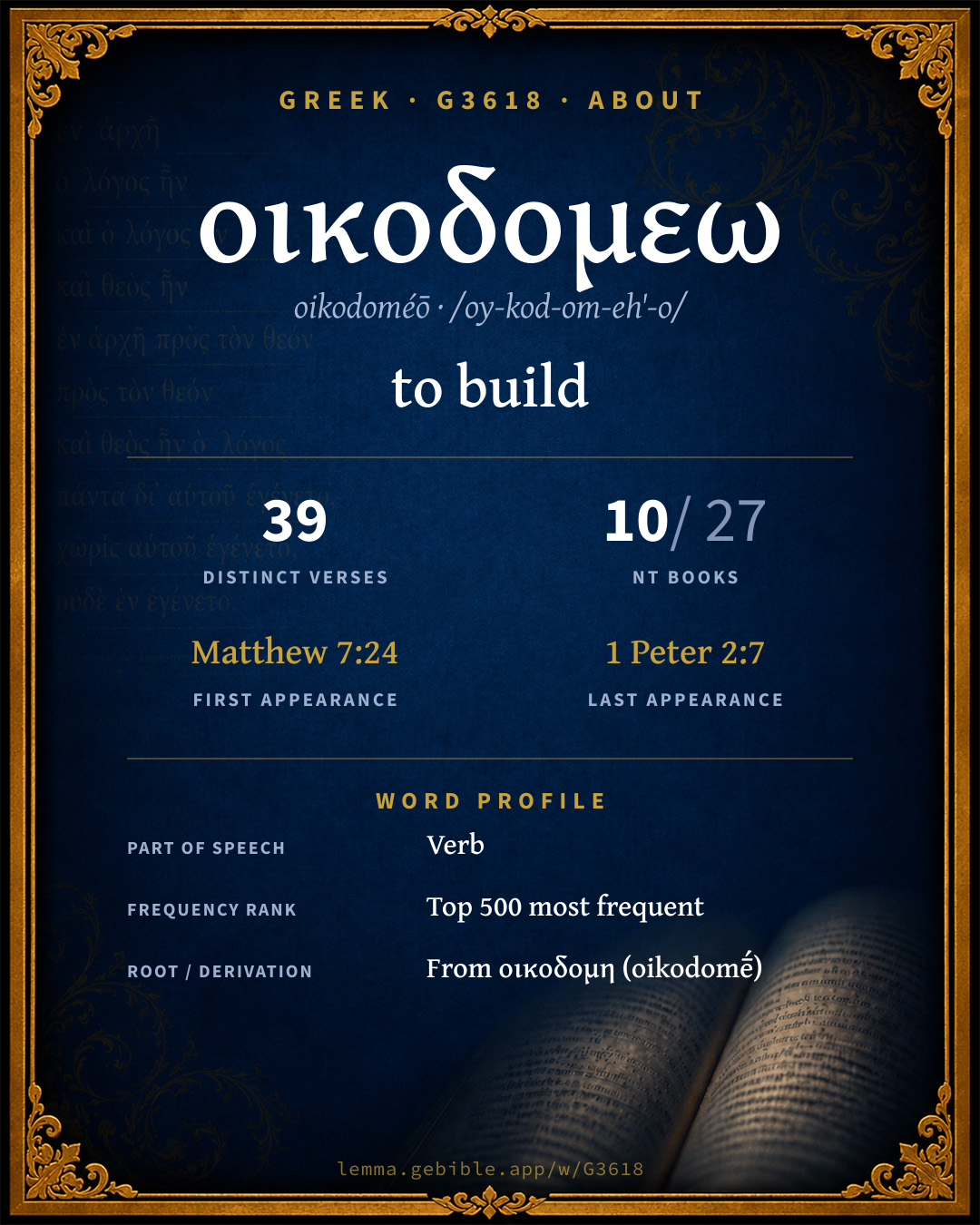
οἰκοδομέω
to build
‘to build’ is one of 2 main senses fuller range ↓
Full lexicon entry — Thayer's Greek Lexicon
From Thayer's Greek Lexicon
Where this word appears
See every Present-tense verb in the Greek New Testament →
Grammar key — what these labels mean
Part of speech
- Verb
- An action or state-of-being word.
- Noun
- A naming word — a person, place, thing, or idea.
Tense
- Aorist
- Action viewed as a simple whole, without regard to duration — often past (perfective aspect).
- Present
- Ongoing or general action in present time (imperfective aspect).
- Future
- Action expected in future time.
- Imperfect
- Continuous or repeated action in past time (“was writing”).
- Pluperfect
- A past action completed before another past point (“had written”).
- Perfect
- A completed past action with continuing present results.
Voice
- Active
- The subject performs the action.
- Passive
- The subject receives the action.
Mood
- Indicative
- States a fact or asks a factual question (the mood of reality).
- Participle
- A verbal adjective (“writing,” “having written”).
- Infinitive
- A verbal noun (“to write”), unmarked for person or number.
- Imperative
- Expresses a command or request.
- Subjunctive
- Expresses probability, purpose, or possibility (the mood of contingency).
Case
- Nominative
- The case of the subject (and the predicate nominative).
- Genitive
- The case of source, possession, or “of” — answers “whose / from what.”
- Dative
- The case of the indirect object, means, or location — “to / for / with / in.”
Person
- 3rd person
- The one spoken about (“he / she / it / they”).
- 1st person
- The speaker (“I / we”).
- 2nd person
- The one addressed (“you”).
Gender
- Masculine
- Grammatically masculine.
- Feminine
- Grammatically feminine.
Number
- Singular
- One.
- Plural
- More than one.
Grammatical forms 23 distinct
- Verb, Aorist, Active, Indicative, 3rd person, Singular 6 times (15%)
- Verb, Present, Active, Indicative, 3rd person, Singular 4 times (10%)
- Verb, Present, Active, Participle, Nominative, Plural, Masculine 4 times (10%)
- Verb, Aorist, Active, Infinitive 3 times (7%)
- Verb, Future, Active, Indicative, 1st person, Singular 3 times (7%)
- Verb, Present, Active, Indicative, 2nd person, Plural 3 times (7%)
- Verb, Present, Active, Participle, Nominative, Singular, Masculine 2 times (5%)
- Noun, Genitive, Plural, Masculine 1 time (2%)
+15 more forms (15 occurrences)
Parsed forms decoded from the imported morphology (Robinson–Tischendorf, public domain), counted across 41 parsed occurrences — not distinct verses.
Every verse where G3618 appears — 39 distinct verses across 10 books. Click any verse to open its interlinear word-by-word view. Verse text shown in the World English Bible for context — . Each verse’s Greek form is shown with its reference; the English is not keyword-highlighted, since the data carries no word-level English alignment. Use “Compare translations” on any verse to read it across multiple English versions. This concordance covers the Greek New Testament; Septuagint (Greek Old Testament) occurrences of this word are not indexed here.
Matthew 8 verses
- Matthew 7:24 ᾠκοδόμησεν aor act ind 3sg "Everyone therefore who hears these words of mine, and does them, I will liken him to a wise man, who built his house on a rock.
- Matthew 7:26 ᾠκοδόμησεν aor act ind 3sg Everyone who hears these words of mine, and doesn't do them will be like a foolish man, who built his house on the sand.
- Matthew 16:18 οἰκοδομήσω fut act ind 1sg I also tell you that you are Peter, and on this rock I will build my assembly, and the gates of Hades will not prevail against it.
- Matthew 21:33 ᾠκοδόμησεν aor act ind 3sg "Hear another parable. There was a man who was a master of a household, who planted a vineyard, set a hedge about it, dug a winepress in it, built a tower, leased it out to farmers, and went into another country.
- Matthew 21:42 οἰκοδομοῦντες pres act ptcp nom pl masc Jesus said to them, "Did you never read in the Scriptures, 'The stone which the builders rejected, The same was made the head of the corner. This was from the Lord. It is marvelous in our eyes?'
- Matthew 23:29 οἰκοδομεῖτε pres act ind 2pl "Woe to you, scribes and Pharisees, hypocrites! For you build the tombs of the prophets, and decorate the tombs of the righteous,
- Matthew 26:61 οἰκοδομῆσαι aor act inf and said, "This man said, 'I am able to destroy the temple of God, and to build it in three days.'"
- Matthew 27:40 οἰκοδομῶν pres act ptcp nom sg masc and saying, "You who destroy the temple, and build it in three days, save yourself! If you are the Son of God, come down from the cross!"
Mark 4 verses
- Mark 12:1 ᾠκοδόμησεν aor act ind 3sg He began to speak to them in parables. "A man planted a vineyard, put a hedge around it, dug a pit for the winepress, built a tower, rented it out to a farmer, and went into another country.
- Mark 12:10 οἰκοδομοῦντες pres act ptcp nom pl masc Haven't you even read this Scripture: 'The stone which the builders rejected, The same was made the head of the corner.
- Mark 14:58 οἰκοδομήσω fut act ind 1sg "We heard him say, 'I will destroy this temple that is made with hands, and in three days I will build another made without hands.'"
- Mark 15:29 οἰκοδομῶν pres act ptcp nom sg masc Those who passed by blasphemed him, wagging their heads, and saying, "Ha! You who destroy the temple, and build it in three days,
Luke 11 verses
- Luke 4:29 ᾠκοδόμητο plup pass ind 3sg They rose up, threw him out of the city, and led him to the brow of the hill that their city was built on, that they might throw him off the cliff.
- Luke 6:48 οἰκοδομοῦντι οἰκοδομῆσθαι pres act ptcp dat sg masc perf pass inf He is like a man building a house, who dug and went deep, and laid a foundation on the rock. When a flood arose, the stream broke against that house, and could not shake it, because it was founded on the rock.
- Luke 6:49 οἰκοδομήσαντι aor act ptcp dat sg masc But he who hears, and doesn't do, is like a man who built a house on the earth without a foundation, against which the stream broke, and immediately it fell, and the ruin of that house was great."
- Luke 7:5 ᾠκοδόμησεν aor act ind 3sg for he loves our nation, and he built our synagogue for us."
- Luke 11:47 οἰκοδομεῖτε pres act ind 2pl Woe to you! For you build the tombs of the prophets, and your fathers killed them.
- Luke 11:48 οἰκοδομεῖτε pres act ind 2pl So you testify and consent to the works of your fathers. For they killed them, and you build their tombs.
- Luke 12:18 οἰκοδομήσω fut act ind 1sg He said, 'This is what I will do. I will pull down my barns, and build bigger ones, and there I will store all my grain and my goods.
- Luke 14:28 οἰκοδομῆσαι aor act inf For which of you, desiring to build a tower, doesn't first sit down and count the cost, to see if he has enough to complete it?
- Luke 14:30 οἰκοδομεῖν pres act inf saying, 'This man began to build, and wasn't able to finish.'
- Luke 17:28 ᾠκοδόμουν impf act ind 3pl Likewise, even as it happened in the days of Lot: they ate, they drank, they bought, they sold, they planted, they built;
- Luke 20:17 οἰκοδομοῦντες pres act ptcp nom pl masc But he looked at them, and said, "Then what is this that is written, 'The stone which the builders rejected, The same was made the chief cornerstone?'
John 1 verse
Acts 5 verses
- Acts 4:11 οἰκοδόμων n gen pl masc He is 'the stone which was regarded as worthless by you, the builders, which has become the head of the corner.'
- Acts 7:47 οἰκοδόμησεν aor act ind 3sg But Solomon built him a house.
- Acts 7:49 οἰκοδομήσετέ fut act ind 2pl 'heaven is my throne, And the earth a footstool for my feet. What kind of house will you build me?' says the Lord; 'Or what is the place of my rest?
- Acts 9:31 οἰκοδομουμένη pres pass ptcp nom sg fem So the assemblies throughout all Judea and Galilee and Samaria had peace, and were built up. They were multiplied, walking in the fear of the Lord and in the comfort of the Holy Spirit.
- Acts 20:32 οἰκοδομῆσαι aor act inf Now, brothers, I entrust you to God, and to the word of his grace, which is able to build up, and to give you the inheritance among all those who are sanctified.
Romans 1 verse
1 Corinthians 5 verses
- 1 Corinthians 8:1 οἰκοδομεῖ pres act ind 3sg Now concerning things sacrificed to idols: We know that we all have knowledge. Knowledge puffs up, but love builds up.
- 1 Corinthians 8:10 οἰκοδομηθήσεται fut pass ind 3sg For if a man sees you who have knowledge sitting in an idol's temple, won't his conscience, if he is weak, be emboldened to eat things sacrificed to idols?
- 1 Corinthians 10:23 οἰκοδομεῖ pres act ind 3sg "All things are lawful for me," but not all things are profitable. "All things are lawful for me," but not all things build up.
- 1 Corinthians 14:4 οἰκοδομεῖ οἰκοδομεῖ pres act ind 3sg pres act ind 3sg He who speaks in another language edifies himself, but he who prophesies edifies the assembly.
- 1 Corinthians 14:17 οἰκοδομεῖται pres pass ind 3sg For you most assuredly give thanks well, but the other person is not built up.
Galatians 1 verse
1 Thessalonians 1 verse
1 Peter 2 verses
- 1 Peter 2:5 οἰκοδομεῖσθε pres pass ind 2pl You also, as living stones, are built up as a spiritual house, to be a holy priesthood, to offer up spiritual sacrifices, acceptable to God through Jesus Christ.
- 1 Peter 2:7 οἰκοδομοῦντες pres act ptcp nom pl masc For you therefore who believe is the honor, but for such as are disobedient, "The stone which the builders rejected, Has become the chief cornerstone,"
About this entry
At a glance — auto-summarized from this page’s data, not written by a person. Every figure links to its source below. This summary describes the numbers; it doesn’t interpret them.
At its core, οικοδομεω (oikodoméō) means “to build.” First canonically at Matthew 7:24, it enters the text early. With 39 verses in 10 books, it is a moderately common word in the Greek New Testament. Its uses concentrate in Luke (28% of all occurrences). Catalogued under 2 senses, its meaning is not single-sense. Each statement above links to its evidence; the full detail follows below.
Gloss history
Strong's 1890 vs modern scholarship
About this word
Strong's G3618 catalogs a Greek word from the Greek New Testament.
These counts are not copied from any lexicon or concordance. They are computed here, from the morphology-tagged Greek New Testament. What Lemma adds →
- 39
- distinct verses
- The word appears in 39 distinct verses.
- 10 / 27
- NT books
- The word appears in 10 of 27 New Testament books.
- #364
- by frequency
- Top 500 most frequent Greek words (rank 364 of 5,347 Greek words by occurrence).
View all 39 occurrences in the concordance →
By section of the New Testament
By traditional corpus
Conventional, traditional groupings — biblical authorship is debated, so this is a traditional corpus grouping, not an authorship claim. Some books belong to more than one corpus (Luke is in both the Gospels and the Lukan corpus, and so on), so these shares overlap and need not total 100%. Each figure is a share of the word’s 39 distinct verses.
- Gospels 24 verses · 62%
- Lukan (Luke–Acts) 16 verses · 41%
- Pauline corpus 8 verses · 21%
- General (Catholic) Epistles 2 verses · 5%
- Johannine 1 verse · 3%
How translations render this word
Counts come from each version’s own published word-to-Strong’s tagging or interlinear alignment — an approximate guide to how each version renders this word, not a word-level alignment the data otherwise carries. Because each total is that version’s own tagged count, the per-version totals vary from one another and need not match the appearance or distinct-verse counts above. These counts may also differ from a printed concordance because Lemma counts each distinctly tagged rendering and does not collapse phrase taggings into a single head-word total. This is a fixed set of word-tagged versions (KJV, ASV, BSB, ULT) and does not change with the reading translation you choose elsewhere. Each version’s license is shown beside its name below (and on Sources).
- King James Version: Built 7×, Build 5×, Builders 5×
- American Standard Version: Build 6×, Built 6×, Builders 5×
- Berean Standard Bible: Built 6×, Build 5×, Builders 5×
- unfoldingWord Literal Text: Built 6×, Build 4×, Builders 3×
King James Version Public Domain
Renders G3618 across 42 tagged occurrences — most commonly:
Plus 14 renderings that appear only once — usually multi-word phrases or single function words the recovered tagging swept in, not distinct renderings.
American Standard Version Public Domain
Renders G3618 across 42 tagged occurrences — most commonly:
Plus 16 renderings that appear only once — usually multi-word phrases or single function words the recovered tagging swept in, not distinct renderings.
Berean Standard Bible Public Domain
Renders G3618 across 41 tagged occurrences — most commonly:
Plus 15 renderings that appear only once — usually multi-word phrases or single function words the recovered tagging swept in, not distinct renderings.
unfoldingWord Literal Text CC BY-SA 4.0
Renders G3618 across 49 tagged occurrences — most commonly:
Plus 16 renderings that appear only once — usually multi-word phrases or single function words the recovered tagging swept in, not distinct renderings.
Senses in Thayer's
The 2 senses Thayer's distinguishes for this word, in lexicon order (not ranked by frequency or importance). The full entry — with sub-senses — is in the Lexicon Entry tab.
- to build a house, erect a building
- metaph.
Word origin
Derived from οικοδομη (oikodomḗ) (G3619) — building.
From the same as G3619 ; to be a house builder that is construct or (figuratively) confirm : - (be in) build (-er -ing up) edify embolden.
— Strong’s Exhaustive Concordance (1890), public domain.
Forms in the corpus
The 22 distinct written forms G3618 takes in the Greek New Testament, most frequent first — each parse links to that tense’s occurrences in the concordance.
Same root — word family
Other Thayer's entries built from the same root as G3618, grouped by Strong’s listed origin. These share a root / origin per the lexicon — not necessarily a shared meaning. Each links to that word’s own entry.
Derives from
Shares the same root
Compare all same-root words → They share a root, not necessarily a meaning.
Septuagint usage
The same Greek word οικοδομεω appears 364 times in the Greek Old Testament (Septuagint), across 333 verses in 31 books.
- 364
- LXX occurrences
- Tagged occurrences of this Greek word in the Septuagint.
- 333
- verses
- Distinct Septuagint verses containing this word.
- 31 / 39
- OT books
- The word appears in 31 of the 39 Old Testament books.
Sample Septuagint occurrences
- Genesis 2:22 οἰκοδομέω
- Exodus 1:11 οἰκοδομέω
- Numbers 13:22 οἰκοδομέω
- Deuteronomy 6:10 οἰκοδομέω
- Joshua 6:26 οἰκοδομέω
- Judges 1:26 οἰκοδομέω
- Ruth 4:11 οἰκοδομέω
- 1 Samuel 2:35 οἰκοδομέω
- 2 Samuel 5:9 οἰκοδομέω
- 1 Kings 2:35 οἰκοδομέω
- 2 Kings 14:22 οἰκοδομέω
- 1 Chronicles 5:36 οἰκοδομέω
Septuagint occurrences (same lexeme)
Every verse where the same Strong’s number (G3618) appears in the Greek Septuagint — showing the first 50 of 333. Verse text shown in the World English Bible for context; the Greek form is the matched word — the English is not keyword-highlighted.
- Genesis 2:22 οἰκοδομέω He made the rib, which Yahweh God had taken from the man, into a woman, and brought her to the man.
- Genesis 4:17 οἰκοδομέω Cain knew his wife. She conceived, and gave birth to Enoch. He built a city, and called the name of the city, after the name of his son, Enoch.
- Genesis 8:20 οἰκοδομέω Noah built an altar to Yahweh, and took of every clean animal, and of every clean bird, and offered burnt offerings on the altar.
- Genesis 10:11 οἰκοδομέω Out of that land he went forth into Assyria, and built Nineveh, Rehoboth Ir, Calah,
- Genesis 11:4 οἰκοδομέω They said, "Come, let's build us a city, and a tower, whose top reaches to the sky, and let's make us a name; lest we be scattered abroad on the surface of the whole earth."
- Genesis 11:5 οἰκοδομέω Yahweh came down to see the city and the tower, which the children of men built.
- Genesis 11:8 οἰκοδομέω So Yahweh scattered them abroad from there on the surface of all the earth. They stopped building the city.
- Genesis 12:7 οἰκοδομέω Yahweh appeared to Abram, and said, "I will give this land to your seed." He built an altar there to Yahweh, who appeared to him.
- Genesis 12:8 οἰκοδομέω He left from there to the mountain on the east of Bethel, and pitched his tent, having Bethel on the west, and Ai on the east. There he built an altar to Yahweh, and called on the name of Yahweh.
- Genesis 13:18 οἰκοδομέω Abram moved his tent, and came and lived by the oaks of Mamre, which are in Hebron, and built an altar there to Yahweh.
- Genesis 22:9 οἰκοδομέω They came to the place which God had told him of. Abraham built the altar there, and laid the wood in order, bound Isaac his son, and laid him on the altar, on the wood.
- Genesis 26:25 οἰκοδομέω He built an altar there, and called on the name of Yahweh, and pitched his tent there. There Isaac's servants dug a well.
- Genesis 35:7 οἰκοδομέω He built an altar there, and called the place El Beth El; because there God was revealed to him, when he fled from the face of his brother.
- Exodus 1:11 οἰκοδομέω Therefore they set taskmasters over them to afflict them with their burdens. They built storage cities for Pharaoh: Pithom and Raamses.
- Exodus 17:15 οἰκοδομέω Moses built an altar, and called the name of it Yahweh our Banner.
- Exodus 20:25 οἰκοδομέω If you make me an altar of stone, you shall not build it of hewn stones; for if you lift up your tool on it, you have polluted it.
- Exodus 24:4 οἰκοδομέω Moses wrote all the words of Yahweh, and rose up early in the morning, and built an altar under the mountain, and twelve pillars for the twelve tribes of Israel.
- Exodus 32:5 οἰκοδομέω When Aaron saw this, he built an altar before it; and Aaron made a proclamation, and said, "Tomorrow shall be a feast to Yahweh."
- Numbers 13:22 οἰκοδομέω They went up by the South, and came to Hebron; and Ahiman, Sheshai, and Talmai, the children of Anak, were there. (Now Hebron was built seven years before Zoan in Egypt.)
- Numbers 21:27 οἰκοδομέω Therefore those who speak in proverbs say, Come you to Heshbon; Let the city of Sihon be built and established:
- Numbers 23:1 οἰκοδομέω Balaam said to Balak, Build me here seven altars, and prepare me here seven bulls and seven rams.
- Numbers 23:14 οἰκοδομέω He took him into the field of Zophim, to the top of Pisgah, and built seven altars, and offered up a bull and a ram on every altar.
- Numbers 23:29 οἰκοδομέω Balaam said to Balak, Build me here seven altars, and prepare me here seven bulls and seven rams.
- Numbers 32:16 οἰκοδομέω They came near to him, and said, We will build sheepfolds here for our cattle, and cities for our little ones:
- Numbers 32:24 οἰκοδομέω Build you cities for your little ones, and folds for your sheep; and do that which has proceeded out of your mouth.
- Numbers 32:34 οἰκοδομέω The children of Gad built Dibon, and Ataroth, and Aroer,
- Numbers 32:37 οἰκοδομέω The children of Reuben built Heshbon, and Elealeh, and Kiriathaim,
- Numbers 32:38 οἰκοδομέω and Nebo, and Baal Meon, (their names being changed), and Sibmah: and they gave other names to the cities which they built.
- Deuteronomy 6:10 οἰκοδομέω It shall be, when Yahweh your God shall bring you into the land which he swore to your fathers, to Abraham, to Isaac, and to Jacob, to give you, great and goodly cities, which you didn't build,
- Deuteronomy 8:12 οἰκοδομέω lest, when you have eaten and are full, and have built goodly houses, and lived therein;
- Deuteronomy 20:5 οἰκοδομέω The officers shall speak to the people, saying, What man is there who has built a new house, and has not dedicated it? let him go and return to his house, lest he die in the battle, and another man dedicate it.
- Deuteronomy 20:20 οἰκοδομέω Only the trees of which you know that they are not trees for food, you shall destroy and cut them down; and you shall build bulwarks against the city that makes war with you, until it fall.
- Deuteronomy 22:8 οἰκοδομέω When you build a new house, then you shall make a battlement for your roof, that you don't bring blood on your house, if any man fall from there.
- Deuteronomy 25:9 οἰκοδομέω then his brother's wife shall come to him in the presence of the elders, and loose his shoe from off his foot, and spit in his face; and she shall answer and say, So shall it be done to the man who does not build up his brother's house.
- Deuteronomy 27:5 οἰκοδομέω There shall you build an altar to Yahweh your God, an altar of stones: you shall lift up no iron [tool] on them.
- Deuteronomy 27:6 οἰκοδομέω You shall build the altar of Yahweh your God of uncut stones; and you shall offer burnt offerings thereon to Yahweh your God:
- Deuteronomy 28:30 οἰκοδομέω You shall betroth a wife, and another man shall lie with her: you shall build a house, and you shall not dwell therein: you shall plant a vineyard, and shall not use the fruit of it.
- Joshua 6:26 οἰκοδομέω Joshua charged them with an oath at that time, saying, Cursed be the man before Yahweh, that rises up and builds this city Jericho: with the loss of his firstborn shall he lay the foundation of it, and with the loss of his youngest son shall he set up the gates of it.
- Joshua 9:2 οἰκοδομέω that they gathered themselves together, to fight with Joshua and with Israel, with one accord.
- Joshua 19:50 οἰκοδομέω according to the commandment of Yahweh they gave him the city which he asked, even Timnathserah in the hill-country of Ephraim; and he built the city, and lived therein.
- Joshua 21:42 οἰκοδομέω These cities were every one with their suburbs round about them: thus it was with all these cities.
- Joshua 22:10 οἰκοδομέω When they came to the region about the Jordan, that is in the land of Canaan, the children of Reuben and the children of Gad and the half-tribe of Manasseh built there an altar by the Jordan, a great altar to look on.
- Joshua 22:11 οἰκοδομέω The children of Israel heard say, Behold, the children of Reuben and the children of Gad and the half-tribe of Manasseh have built an altar in the forefront of the land of Canaan, in the region about the Jordan, on the side that pertains to the children of Israel.
- Joshua 22:16 οἰκοδομέω Thus says the whole congregation of Yahweh, What trespass is this that you have committed against the God of Israel, to turn away this day from following Yahweh, in that you have built you an altar, to rebel this day against Yahweh?
- Joshua 22:19 οἰκοδομέω However, if the land of your possession be unclean, then pass over to the land of the possession of Yahweh, in which Yahweh's tent dwells, and take possession among us: but don't rebel against Yahweh, nor rebel against us, in building you an altar besides the altar of Yahweh our God.
- Joshua 22:23 οἰκοδομέω that we have built us an altar to turn away from following Yahweh; or if to offer thereon burnt offering or meal-offering, or if to offer sacrifices of peace-offerings thereon, let Yahweh himself require it;
- Joshua 22:26 οἰκοδομέω Therefore we said, Let us now prepare to build us an altar, not for burnt offering, nor for sacrifice:
- Joshua 22:29 οἰκοδομέω Far be it from us that we should rebel against Yahweh, and turn away this day from following Yahweh, to build an altar for burnt-offering, for meal-offering, or for sacrifice, besides the altar of Yahweh our God that is before his tent.
- Joshua 24:13 οἰκοδομέω I gave you a land whereon you had not labored, and cities which you didn't build, and you dwell therein; of vineyards and olive groves which you didn't plant do you eat.
- Judges 1:26 οἰκοδομέω The man went into the land of the Hittites, and built a city, and called the name of it Luz, which is the name of it to this day.
These are occurrences of the same Greek lexeme (G3618) in the Septuagint — not a translation of any one Hebrew word. The store carries no word-level Hebrew↔Greek alignment, so no Hebrew original is asserted here. Counts come from the recovered LXX Strong's tagging — high-frequency vocabulary is well covered, while rare or late forms may be untagged — so they reflect tagged occurrences and may slightly undercount.