

Mark 12:1
Greek (Tischendorf 8th ed.) Mark 12:1 appears in the Greek New Testament. The text above is from the Tischendorf 8th edition. Each word links to its Strong’s number and a concise gloss. Click any word for its full Thayer’s Greek Lexicon entry.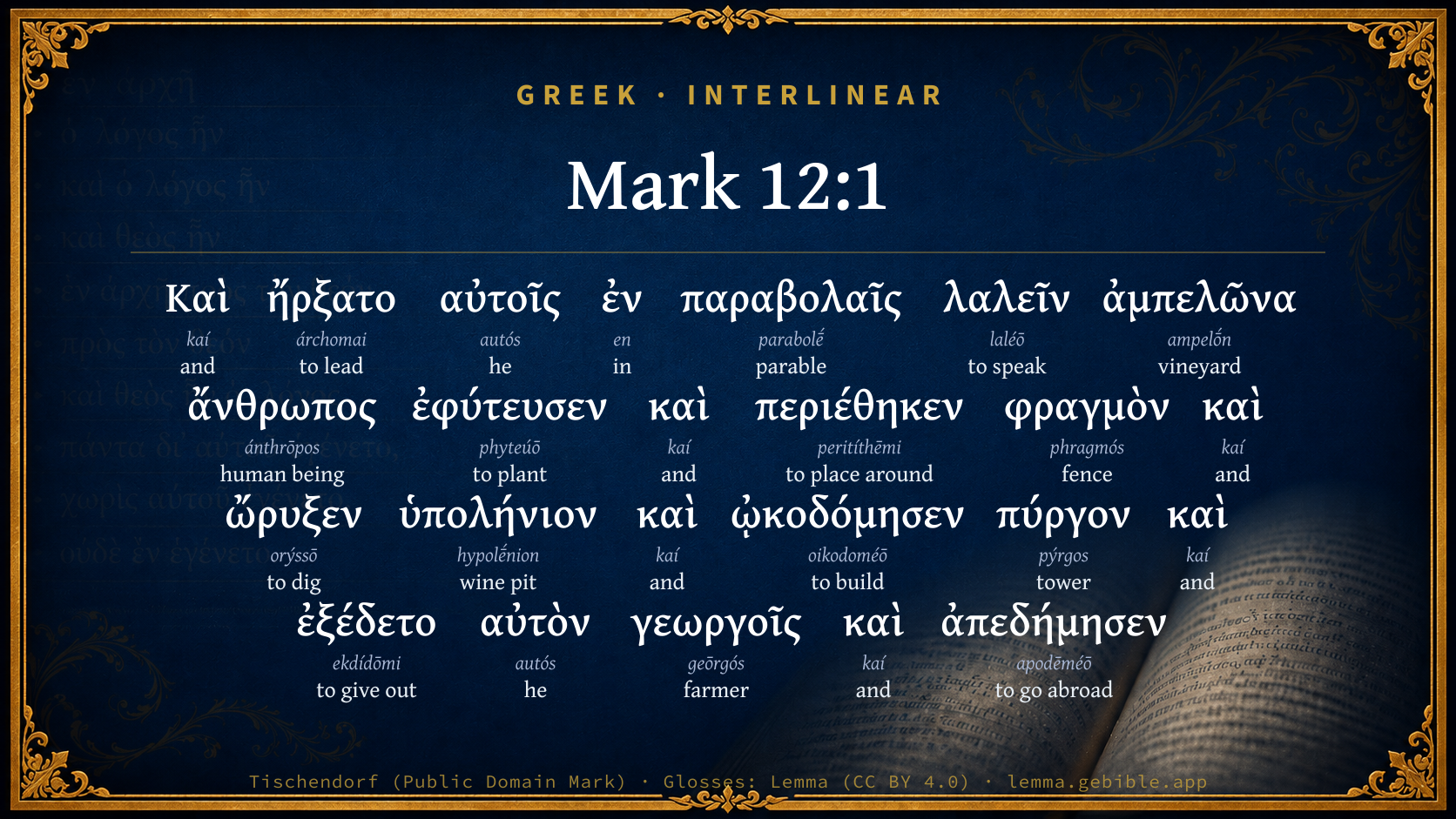
He began to speak to them in parables. "A man planted a vineyard, put a hedge around it, dug a pit for the winepress, built a tower, rented it out to a farmer, and went into another country.
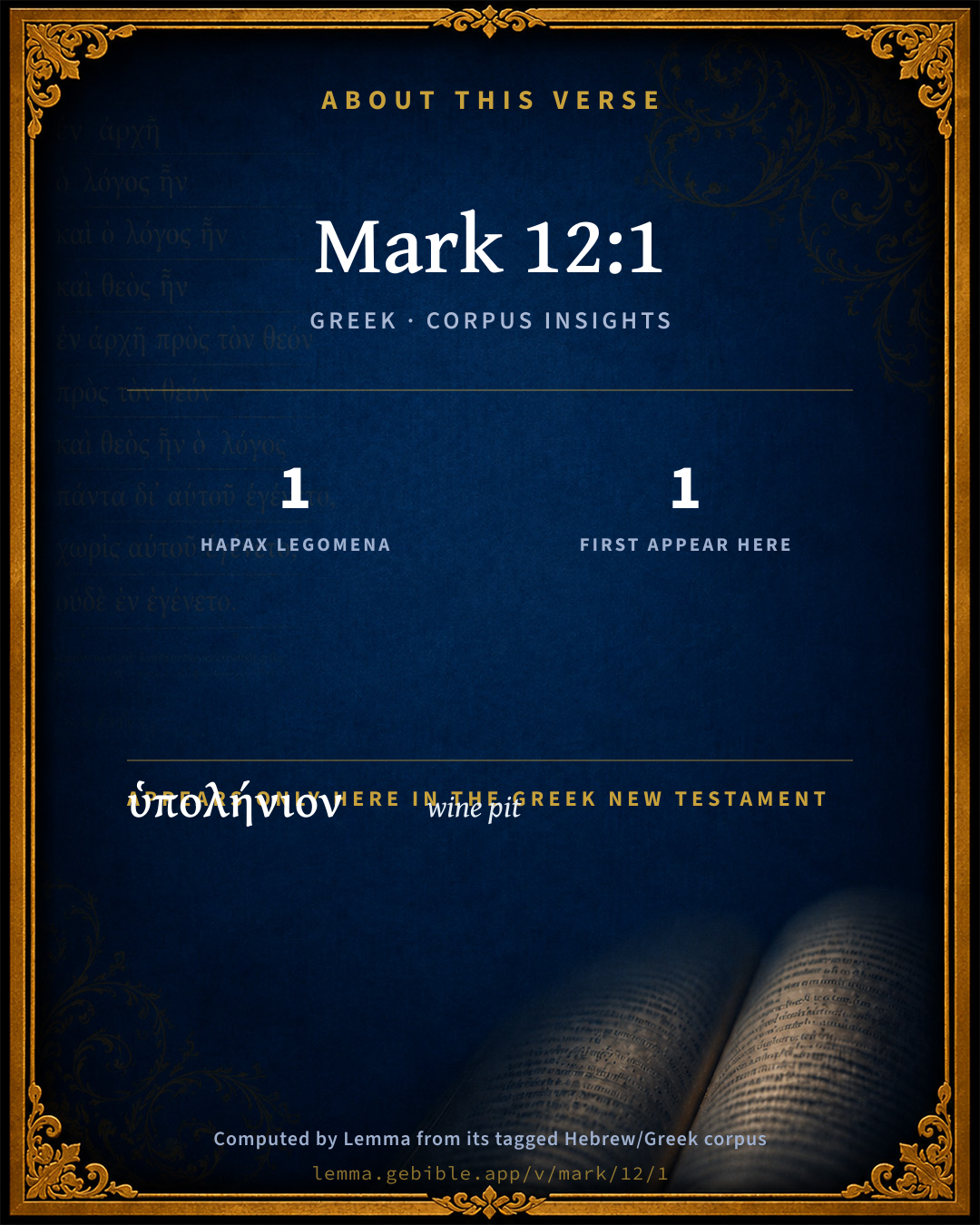
- 1 hapax legomenon — only here in the Greek New Testament
- 1 first appearance in the Greek New Testament
Download a study sheet
One document with this verse’s original text, its word-by-word gloss line, the meaning frame, cross-references with their text, attributed commentary, and full source and license credits — printable, and it pastes into notes with its structure intact.
This verse Autodidact and up
A passage Seminary Student
Up to 50 verses in one chapter. A passage sheet keeps up to 6 commentary sources and 12 cross-references per verse, in the order this page ranks them, and says so on the sheet whenever that leaves anything out. Ask for a single verse and you get the Autodidact verse sheet above.
Everything on this page stays free to read, with no account — the sheet is a download of what is already on screen, not access to it.
Compare translations 3
The same verse in 3 English versions, stacked beneath the original-language interlinear above. Click any original word for its lexicon entry.
Each is an independent rendering of the whole verse — the interlinear is not word-aligned to these translations.
Highlighted words mark where these versions differ — a whole-verse word diff, not a word-by-word alignment.
-
World English Bible Public Domain
He began to speak to them in parables. "A man planted a vineyard, put a hedge around it, dug a pit for the winepress, built a tower, rented it out to a farmer, and went into another country.
-
King James Version Public Domain
And he began to speak unto them by parables. A certain man planted a vineyard, and set an hedge about it, and digged a place for the winefat, and built a tower, and let it out to husbandmen, and went into a far country.
-
unfoldingWord Literal Text CC BY-SA 4.0
And he began to speak to them in parables: “A man planted a vineyard and put a hedge around it and dug a pit for a winepress and built a watchtower and rented it out to farmers and went abroad.
unfoldingWord Literal Text — © unfoldingWord, licensed CC BY-SA 4.0. Word-aligned USFM3 via Door43 (git.door43.org/unfoldingWord/en_ult).
Show all 19 translations
Every available English version of this verse, each an independent rendering of the whole verse.
-
World English Bible Public Domain
He began to speak to them in parables. "A man planted a vineyard, put a hedge around it, dug a pit for the winepress, built a tower, rented it out to a farmer, and went into another country.
-
Berean Standard Bible Public Domain
Then Jesus began to speak to them in parables: “A man planted a vineyard. He put a wall around it, dug a wine vat, and built a watchtower. Then he rented it out to some tenants and went away on a journey.
-
Majority Standard Bible Public Domain
Then Jesus began to speak to them in parables: “A man planted a vineyard. He put a wall around it, dug a wine vat, and built a watchtower. Then he rented it out to some tenants and went away on a journey.
-
King James Version Public Domain
And he began to speak unto them by parables. A certain man planted a vineyard, and set an hedge about it, and digged a place for the winefat, and built a tower, and let it out to husbandmen, and went into a far country.
-
American Standard Version (1901) Public Domain
And he began to speak unto them in parables. A man planted a vineyard, and set a hedge about it, and digged a pit for the winepress, and built a tower, and let it out to husbandmen, and went into another country.
-
Revised Version (1885) Public Domain
And he began to speak unto them in parables. A man planted a vineyard, and set a hedge about it, and digged a pit for the winepress, and built a tower, and let it out to husbandmen, and went into another country.
-
Geneva Bible (1599) Public Domain
And he began to speake vnto them in parables, A certaine man planted a vineyard, and copassed it with an hedge, and digged a pit for the winepresse, and built a tower in it, and let it out to husbandmen, and went into a strange countrey.
-
Douay-Rheims (1899) Public Domain
And he began to speak to them in parables: A certain man planted a vineyard and made a hedge about it, and dug a place for the winefat, and built a tower, and let it to husbandmen; and went into a far country.
-
Young's Literal Translation Public Domain
And he began to speak to them in similes: `A man planted a vineyard, and put a hedge around, and digged an under-winevat, and built a tower, and gave it out to husbandmen, and went abroad;
-
Literal Standard Version CC BY-SA 4.0
And He began to speak to them in allegories: “A man planted a vineyard, and put a hedge around, and dug a wine vat, and built a tower, and gave it out to farmers, and went abroad;
-
Unlocked Literal Bible CC BY-SA 4.0
Then Jesus began to teach them in parables. He said, “A man planted a vineyard, put a hedge around it, and dug a pit for a winepress. He built a watchtower and then leased the vineyard to vine growers. Then he went away on a journey.
-
unfoldingWord Literal Text CC BY-SA 4.0
And he began to speak to them in parables: “A man planted a vineyard and put a hedge around it and dug a pit for a winepress and built a watchtower and rented it out to farmers and went abroad.
-
Darby Bible Public Domain
And he began to say to them in parables, A man planted a vineyard, and made a fence round [it] and dug a wine-vat, and built a tower, and let it out to husbandmen, and left the country.
-
World Messianic Bible Public Domain
He began to speak to them in parables. “A man planted a vineyard, put a hedge around it, dug a pit for the wine press, built a tower, rented it out to a farmer, and went into another country.
-
Webster's Bible Public Domain
And he began to speak to them by parables. A certain man planted a vineyard, and set a hedge about it, and digged a place for the wine-vat, and built a tower, and let it out to husbandmen, and went into a far country.
-
Free Bible Version CC BY-SA 4.0
Then Jesus began to speak to them using illustrated stories. “Once there was a man who planted a vineyard. He put a fence around it, dug a pit for a winepress, and built a watchtower. Then he leased it to some farmers, and left on a journey.
-
Bible in Basic English Public Domain
And he gave them teaching in the form of stories. A man had a vine-garden planted, and put a wall about it, and made a place for crushing out the wine, and put up a tower, and let it out to field-workers, and went into another country.
-
Text-Critical English NT CC BY 4.0
Then Jesus began to speak to them in parables: “A man planted a vineyard, put a fence around it, dug a pit for the winepress, built a tower, leased it to farmers, and left the country.
-
Tyndale New Testament (1534) Public Domain
And he beganne to speake vnto them in similitudes. A certayne man planted a vineyarde and compased it with an hedge and ordeyned a wyne presse and bylt a toure in that. And let that out to hyre vnto husbandme and went into a straunge countre.
Literal Standard Version (2020), Covenant Press — licensed CC BY-SA 4.0. Text via the HelloAO Bible API (eBible.org). Unlocked Literal Bible (unfoldingWord) — licensed CC BY-SA 4.0. Text via the HelloAO Bible API (eBible.org). unfoldingWord Literal Text — © unfoldingWord, licensed CC BY-SA 4.0. Word-aligned USFM3 via Door43 (git.door43.org/unfoldingWord/en_ult). Free Bible Version, Dr. Jonathan Gallagher — licensed CC BY-SA 4.0. Text via the HelloAO Bible API (eBible.org).
Word by word
More ways to search: Search by grammar → Find every occurrence → Compare this word →
Practice this passage: Drill this verse → Learn its vocabulary →
- Appears 1× in the Greek New Testament
- First appears here
- Part of Speech
- Noun
- Case
- Accusative
- Number
- Singular
- Gender
- Neuter
Full Thayer's Definition
- Καὶ kaí G2532 “and” Conjunction
- ἤρξατο árchomai G756 “to lead” Verb, Aorist, Middle deponent, Indicative, 3rd person, Singular
- αὐτοῖς autós G846 “he” Personal pronoun, Dative, Plural, Masculine
- ἐν en G1722 “in” Preposition
- παραβολαῖς parabolḗ G3850 “parable” Noun, Dative, Plural, Feminine
- λαλεῖν laléō G2980 “to speak” Verb, Present, Active, Infinitive
- ἀμπελῶνα ampelṓn G290 “vineyard” Noun, Accusative, Singular, Masculine
- ἄνθρωπος ánthrōpos G444 “human being” Noun, Nominative, Singular, Masculine
- ἐφύτευσεν phyteúō G5452 “to plant” Verb, Aorist, Active, Indicative, 3rd person, Singular
- καὶ kaí G2532 “and” Conjunction
- περιέθηκεν peritíthēmi G4060 “to place around” Verb, Aorist, Active, Indicative, 3rd person, Singular
- φραγμὸν phragmós G5418 “fence” Noun, Accusative, Singular, Masculine
- καὶ kaí G2532 “and” Conjunction
- ὤρυξεν orýssō G3736 “to dig” Verb, Aorist, Active, Indicative, 3rd person, Singular
- ὑπολήνιον hypolḗnion G5276 “wine pit” Noun, Accusative, Singular, Neuter
- καὶ kaí G2532 “and” Conjunction
- ᾠκοδόμησεν oikodoméō G3618 “to build” Verb, Aorist, Active, Indicative, 3rd person, Singular
- πύργον pýrgos G4444 “tower” Noun, Accusative, Singular, Masculine
- καὶ kaí G2532 “and” Conjunction
- ἐξέδετο ekdídōmi G1554 “to give out” Verb, Aorist, Middle, Indicative, 3rd person, Singular
- αὐτὸν autós G846 “he” Personal pronoun, Accusative, Singular, Masculine
- γεωργοῖς geōrgós G1092 “farmer” Noun, Dative, Plural, Masculine
- καὶ kaí G2532 “and” Conjunction
- ἀπεδήμησεν apodēméō G589 “to go abroad” Verb, Aorist, Active, Indicative, 3rd person, Singular
About this verse
These counts appear in no published source. They are computed here, from the morphology-tagged text and Lemma’s own curated glosses. What Lemma adds →
- 24
- words
- 18
- distinct lemmas
- Gospels
- section
Notable vocabulary
1 hapax legomenon — a word that appears only here in the entire Greek New Testament:
- ὑπολήνιον wine pit G5276
First appearance in Scripture
This word makes its first canonical appearance in the Greek New Testament here:
- ὑπολήνιον wine pit G5276
Shared distinctive vocabulary
ὤρυξεν to dig G3736 occurs in 3 verses of the Greek New Testament. Also found in:
Cross-references
30Topical passages linked to Mark 12:1 in the Treasury of Scripture Knowledge — connected by theme and wording, ordered by reader-vote popularity; previews shown in the World English Bible.
- Isaiah 5:1–4 Let me sing for my well beloved a song of my beloved about his vineyard. My beloved had a vineyard on a very fruitful hill.
- Mark 13:34 "It is like a man, traveling to another country, having left his house, and given authority to his servants, and to each one his work, and also commanded the doorkeeper to keep watch.
- Song of Solomon 8:11–12 Solomon had a vineyard at Baal Hamon. He leased out the vineyard to keepers. Each was to bring a thousand shekels of silver for its fruit.
- Matthew 25:14 "For it is like a man, going into another country, who called his own servants, and entrusted his goods to them.
- Mark 4:2 He taught them many things in parables, and told them in his teaching,
- Romans 11:17–24 But if some of the branches were broken off, and you, being a wild olive, were grafted in among them, and became partaker with them of the root and of the richness of the olive tree;
- Psalms 80:8–16 You brought a vine out of Egypt. You drove out the nations, and planted it.
- Mark 4:33–34 With many such parables he spoke the word to them, as they were able to hear it.
- Acts 7:38 This is he who was in the assembly in the wilderness with the angel that spoke to him on Mount Sinai, and with our fathers, who received living oracles to give to us,
- Acts 7:46–47 who found favor in the sight of God, and asked to find a habitation for the God of Jacob.
- Romans 3:1–2 Then what advantage does the Jew have? Or what is the profit of circumcision?
- Romans 9:4–5 who are Israelites; whose is the adoption, the glory, the covenants, the giving of the law, the service, and the promises;
- Luke 19:12 He said therefore, "A certain nobleman went into a far country to receive for himself a kingdom, and to return.
- Luke 20:9–19 He began to tell the people this parable. "A man planted a vineyard, and rented it out to some farmers, and went into another country for a long time.
- Nehemiah 9:13–14 You came down also on Mount Sinai, and spoke with them from heaven, and gave them right ordinances and true laws, good statutes and commandments,
- Psalms 147:19–20 He shows his word to Jacob; His statutes and his ordinances to Israel.
- Isaiah 7:23 It will happen in that day that every place where there were a thousand vines at a thousand silver shekels, shall be for briers and thorns.
- Jeremiah 2:21 Yet I had planted you a noble vine, wholly a right seed: how then are you turned into the degenerate branches of a foreign vine to me?
- Ezekiel 20:11–12 I gave them my statutes, and shown them my ordinances, which if a man do, he shall live in them.
- Ezekiel 20:18–20 I said to their children in the wilderness, Don't you walk in the statutes of your fathers, neither observe their ordinances, nor defile yourselves with their idols.
- Ezekiel 20:49 Then said I, Ah Lord Yahweh! they say of me, Isn't he a speaker of parables?
- Matthew 13:10–15 The disciples came, and said to him, "Why do you speak to them in parables?"
- Matthew 13:34–35 Jesus spoke all these things in parables to the multitudes; and without a parable, he didn't speak to them,
- Matthew 21:28–22:14 But what do you think? A man had two sons, and he came to the first, and said, 'Son, go work today in my vineyard.'
- Mark 4:11–13 He said to them, "To you is given the mystery of the Kingdom of God, but to those who are outside, all things are done in parables,
- Mark 12:1–12 He began to speak to them in parables. "A man planted a vineyard, put a hedge around it, dug a pit for the winepress, built a tower, rented it out to a farmer, and went into another country.
- Luke 8:10 He said, "To you it is given to know the mysteries of the Kingdom of God, but to the rest in parables; that 'seeing they may not see, and hearing they may not understand.'
- Luke 13:6–9 He spoke this parable. "A certain man had a fig tree planted in his vineyard, and he came seeking fruit on it, and found none.
- Luke 15:13 Not many days after, the younger son gathered all of this together and traveled into a far country. There he wasted his property with riotous living.
- John 15:1–8 "I am the true vine, and my Father is the farmer.
Cross-references courtesy of OpenBible.info (CC BY 4.0).
Lesson kit
Teaching starters — assembled from the data on this page, not authored interpretation. Every prompt links to the verse data it draws on. Edit before teaching.
Mark, in the Gospels, opens this verse with 24 words (18 distinct Greek lemmas). Its most distinctive word is hypolḗnion (“wine pit”). A historical commentator’s framing appears above. Read the whole chapter for the surrounding context.
Discussion questions
- How does “wine pit” (hypolḗnion) shape what this verse is saying?
- 1 word here appears nowhere else in the Greek New Testament. Why might the author reach for such rare wording?
- This is the first place “wine pit” appears in Scripture (first appears here). What does its debut here establish?
- How does Matthew 21:33, which shares the word «to dig», read alongside this verse?
- What does the repetition of “and” (6× in this one verse) do in this verse?
- These translations render this verse differently; the difference is in the English rendering, not the original. What questions does that raise?
- Compare how Matthew Henry's Commentary and The Cambridge Bible for Schools and Colleges read this verse. Where do they agree or differ?
Things to notice
- 1 word in this verse appears nowhere else in the Greek New Testament.
- 1 word makes its first canonical appearance in Scripture here.
- These translations choose different wording for 23 words in this verse.
- “and” occurs 6× in this single verse.
- 18 distinct Greek lemmas span 24 words in this verse.
Commentary
Notes on Mark 12:1 from classic Christian and Jewish commentators (each source and its license shown beneath its notes). The classic Christian expositions comment on the surrounding passage and are grouped to its opening verse, so a note may address several verses; the Jewish commentaries on the Tanakh (Rashi and others) are per-verse, so they appear only where the commentator wrote on this verse.
Lemma curates 59 commentaries, every one of them public domain or Creative Commons licensed, each selected and text-cleaned for this edition rather than reprinted as found. About our sources →
Matthew Henry's Commentary
Matthew Henry's Commentary on the Whole Bible (1708–1710) — public domain (CC PDM 1.0). Text via the HelloAO Bible API.
The Cambridge Bible for Schools and Colleges
gen. ed. J. J. S. Perowne
The Cambridge Bible for Schools and Colleges (gen. ed. J. J. S. Perowne; Cambridge University Press, 1878–1918) — public domain. Text from a community e-Sword module.
The Biblical Illustrator
Joseph S. Exell
The Biblical Illustrator, edited by Joseph S. Exell (c. 1880s–1900s) — public domain. Text from a community e-Sword module.
Joseph Benson's Commentary
Joseph Benson's Commentary on the Old and New Testaments (1811–1818) — public domain. Text from a community e-Sword module.
The Preacher's Complete Homiletical Commentary
Joseph S. Exell (gen. ed.)
The Preacher's Complete Homiletical Commentary (gen. ed. Joseph S. Exell; Funk & Wagnalls, c. 1892) — public domain (pre-1929). A full-Bible homiletical/sermon-outline anthology covering 65 of 66 books (2 John is absent from the source module). Text from a community e-Sword module.
Lange's Commentary on the Holy Scriptures
Lange's Commentary on the Holy Scriptures (Critical, Doctrinal, and Homiletical), ed. John Peter Lange, English translation edited by Philip Schaff (1864–1880) — public domain. Text from a community e-Sword module.
MacLaren's Expositions of Holy Scripture
Alexander MacLaren
Alexander MacLaren, Expositions of Holy Scripture (1904–1910) — public domain. Text from a community e-Sword module.
The Annotated Bible
Arno C. Gaebelein
Arno C. Gaebelein, The Annotated Bible (1913–1922) — public domain. Text from a community e-Sword module.
Godbey's Commentary on the New Testament
William B. Godbey
William B. Godbey, Commentary on the New Testament (1896–1900) — public domain. Text from a community e-Sword module.
The Expositor's Bible
William Robertson Nicoll, ed., The Expositor's Bible (London: Hodder & Stoughton, 1887–1910) — public domain. 65 of 66 books (1 Corinthians is not separately keyed, as that volume carries no machine-parseable verse references); section-level commentary keyed to the opening verse. Introductory and overview sections not keyed to a specific passage are excluded.
Tyndale Open Study Notes
Tyndale Open Resources
Tyndale Open Study Notes — © Tyndale Open Resources, licensed CC BY-SA 4.0. Text via the HelloAO Bible API.
Meyer's Critical & Exegetical Commentary
Heinrich August Wilhelm Meyer
Meyer — Critical and Exegetical Commentary on the New Testament — English translation by Peter Christie, edited by Frederick Crombie (T&T Clark, 1880) — public domain. Text from a community e-Sword module.
Expositor's Greek Testament
ed. W. Robertson Nicoll
The Expositor's Greek Testament, edited by W. Robertson Nicoll (1897–1910) — public domain. Text from a community e-Sword module.
Alford’s Greek Testament
Henry Alford
Henry Alford, The Greek Testament (1849–1861) — public domain. Text from a community e-Sword module.
International Critical Commentary
International Critical Commentary — older volumes (1896–1929), various authors — public domain. Text from a community e-Sword module.
Geneva Bible (1599)
Geneva Bible translators
Geneva Bible (1599) marginal notes — public domain. Text via Bolls.life.
Adam Clarke's Commentary
Adam Clarke's Commentary on the Bible (1810–1826) — public domain. Text from a community e-Sword/MySword module.
Ellicott's Commentary for English Readers
A Bible Commentary for English Readers, edited by Charles John Ellicott (1878–1897) — public domain. Text from a community e-Sword module.
Trapp's Complete Commentary
John Trapp
John Trapp, A Commentary or Exposition upon All the Books of the Old and New Testament (1647–1656) — public domain. Text from a community e-Sword module.
Albert Barnes' Notes on the Bible
Albert Barnes' Notes on the Bible (1834–1885) — public domain. Text from a community e-Sword/MySword module.
Haydock's Catholic Bible Commentary
George Leo Haydock (1774–1849), Haydock's Catholic Family Bible and Commentary, 1859 edition — public domain. Excludes Psalms (Douay-Rheims chapter numbering differs from Protestant) and Deuterocanonical books (Catholic canon only).
Matthew Poole's English Annotations
Matthew Poole's English Annotations on the Holy Bible (1683–1685) — public domain. Text from a community e-Sword/MySword module.
Dummelow's Commentary on the Holy Bible
J. R. Dummelow
J. R. Dummelow, A Commentary on the Holy Bible (Macmillan, 1909) — public domain. Text from a community e-Sword module.
The Pulpit Commentary
The Pulpit Commentary (1880–1919), ed. H.D.M. Spence-Jones & Joseph S. Exell — public domain. Text from a community e-Sword module.
John Wesley's Explanatory Notes
John Wesley, Explanatory Notes Upon the Whole Bible (1754–1765) — public domain. Text via the GEBible commentary corpus.
Scofield Reference Notes
C. I. Scofield
The Scofield Reference Bible (1917 edition), notes by C. I. Scofield — public domain. Text from a community e-Sword module.
Kretzmann's Popular Commentary
Paul E. Kretzmann
Paul E. Kretzmann, Popular Commentary of the Bible (1921–1924) — public domain. Text from a community e-Sword module.
The Sermon Bible
William Robertson Nicoll (ed.)
The Sermon Bible, ed. William Robertson Nicoll (1888–1900) — public domain. Text from a community e-Sword module.
Burkitt's Expository Notes on the New Testament
William Burkitt
William Burkitt's Expository Notes on the New Testament (1700–1703) — public domain. Text from a community e-Sword module.
McGarvey & Pendleton's Commentaries
J. W. McGarvey
J. W. McGarvey (with Philip Y. Pendleton), Commentaries on the New Testament (The Fourfold Gospel, 1914; Acts; and the epistles) — public domain. Text from a community e-Sword/MySword module.
Darby's Synopsis of the New Testament
John Nelson Darby
John Nelson Darby — Synopsis of the Books of the Bible: the New Testament (c. 1857–1862) — public domain. Text from a community e-Sword module.
The People's New Testament
B. W. Johnson
B. W. Johnson's The People's New Testament with Notes (1889–1891) — public domain. Electronic text from the Christian Classics Ethereal Library (CCEL) ThML edition.
unfoldingWord translationNotes
Door43 World Missions Community
unfoldingWord translationNotes — © Distant Shores Media and the Door43 World Missions Community, licensed CC BY-SA 4.0. Source: git.door43.org/Door43/en_tn.
Cambridge Greek Testament for Schools and Colleges
Cambridge Greek Testament for Schools and Colleges (Cambridge University Press, 1896; 21 vols, various authors incl. Carr, Maclear, Plummer, Farrar, Lumby, Moule, M. R. James, Simcox) — public domain. Text from a community e-Sword module.
Vincent's Word Studies in the New Testament
Marvin R. Vincent
Marvin R. Vincent, Word Studies in the New Testament (1887–1900) — public domain. Text from a community e-Sword/MySword module.