
Numbers 32:34

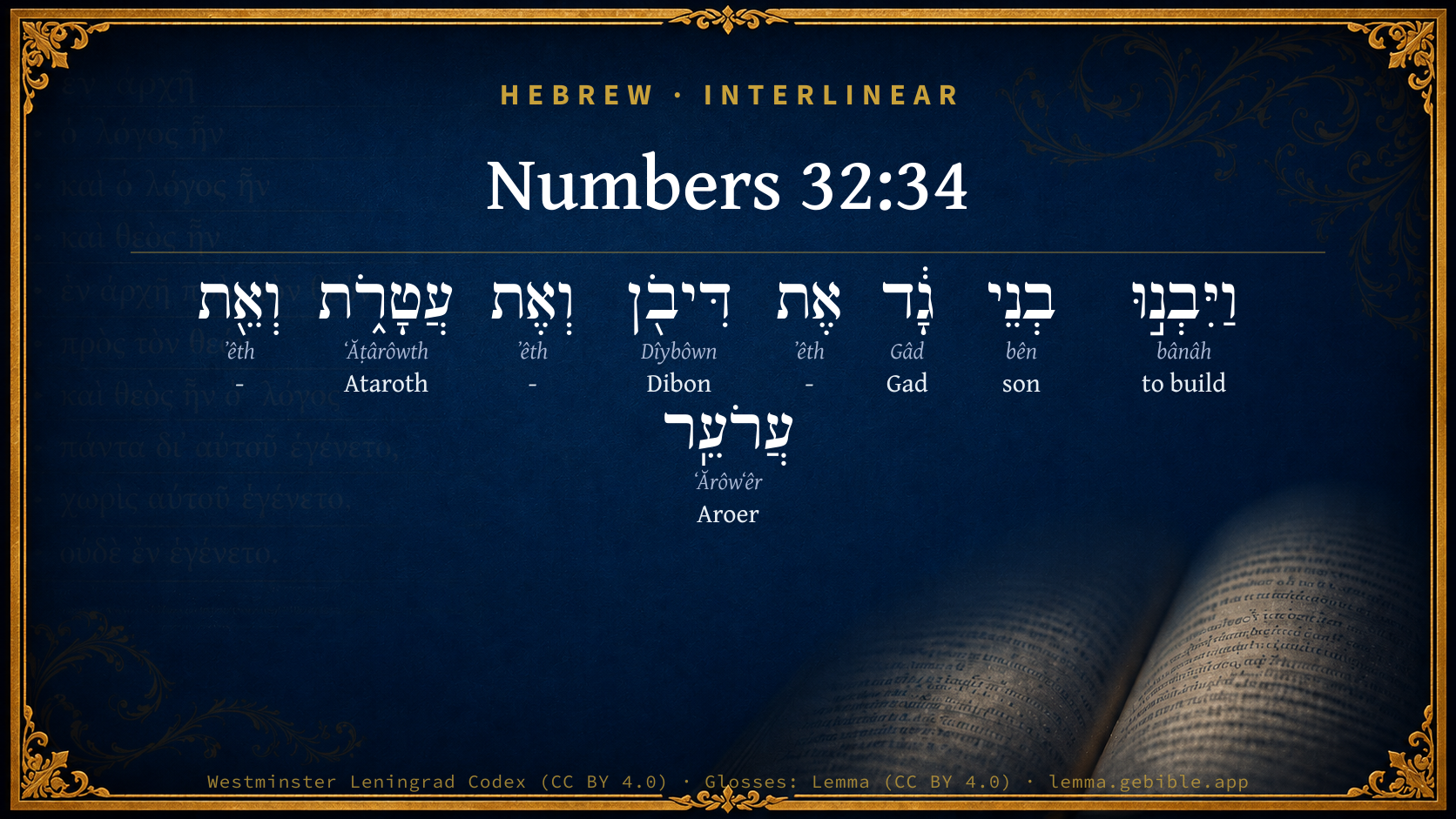
Hebrew (Westminster Leningrad Codex) Numbers 32:34 appears in the Hebrew Old Testament. The text above is from the Westminster Leningrad Codex. Each word links to its Strong’s number, a concise gloss, and parsing drawn from the Open Scriptures Hebrew Bible morphology. Click any word for its full Brown-Driver-Briggs (BDB) entry.
Download image
Cite this verse

Numbers 32:34 (World English Bible). Public Domain. Lemma interlinear Bible study tool, https://lemma.gebible.app/v/numbers/32/34.

Show BibTeX & RIS
BibTeX
RIS
English Translation
The children of Gad built Dibon, and Ataroth, and Aroer,
World English Bible · Public Domain
Highlights
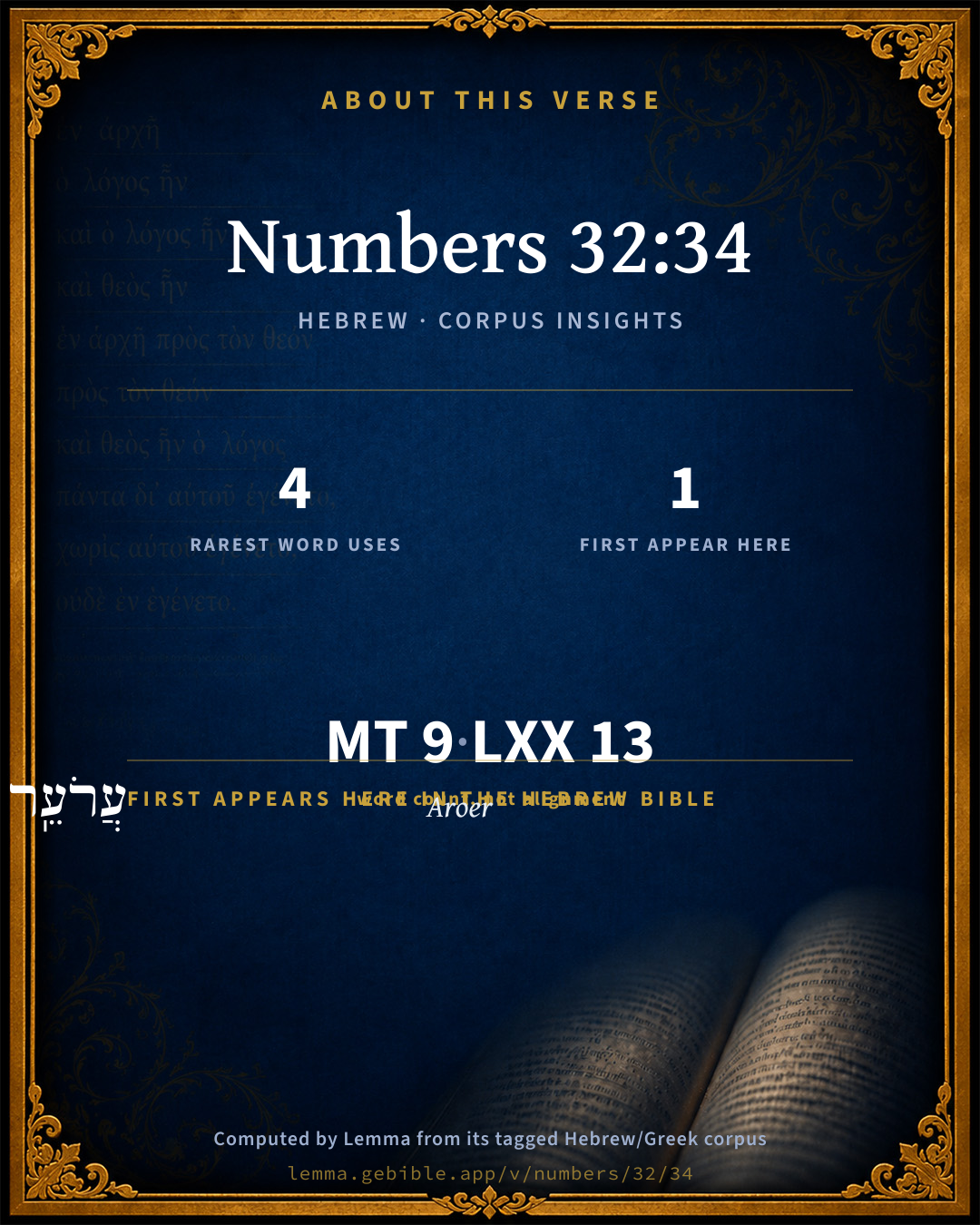
  • 1 first appearance in the Hebrew Bible
Full analysis ↓
Download a study sheet

One document with this verse’s original text, its word-by-word gloss line, the meaning frame, cross-references with their text, attributed commentary, and full source and license credits — printable, and it pastes into notes with its structure intact.

This verse Autodidact and up

Study sheet (.html) Plain text (.txt)

A passage Seminary Student

Up to 50 verses in one chapter. A passage sheet keeps up to 6 commentary sources and 12 cross-references per verse, in the order this page ranks them, and says so on the sheet whenever that leaves anything out. Ask for a single verse and you get the Autodidact verse sheet above.

Everything on this page stays free to read, with no account — the sheet is a download of what is already on screen, not access to it.

Want to remove ads? Support Godless Engineer
Compare translations 3

The same verse in 3 English versions, stacked beneath the original-language interlinear above. Click any original word for its lexicon entry.

Each is an independent rendering of the whole verse — the interlinear is not word-aligned to these translations.

Highlighted words mark where these versions differ — a whole-verse word diff, not a word-by-word alignment.

  • World English Bible Public Domain
    The children of Gad built Dibon, and Ataroth, and Aroer,
  • King James Version Public Domain
    And the children of Gad built Dibon, and Ataroth, and Aroer,
  • unfoldingWord Literal Text CC BY-SA 4.0
    And the sons of Gad built Dibon and Ataroth and Aroer

unfoldingWord Literal Text — © unfoldingWord, licensed CC BY-SA 4.0. Word-aligned USFM3 via Door43 (git.door43.org/unfoldingWord/en_ult).

Versions to compare (up to 4)

3 of 4 selected

Show all 18 translations

Every available English version of this verse, each an independent rendering of the whole verse.

  • World English Bible Public Domain
    The children of Gad built Dibon, and Ataroth, and Aroer,
  • Berean Standard Bible Public Domain
    And the Gadites built up Dibon, Ataroth, Aroer,
  • Majority Standard Bible Public Domain
    And the Gadites built up Dibon, Ataroth, Aroer,
  • King James Version Public Domain
    And the children of Gad built Dibon, and Ataroth, and Aroer,
  • American Standard Version (1901) Public Domain
    And the children of Gad built Dibon, and Ataroth, and Aroer,
  • Revised Version (1885) Public Domain
    And the children of Gad built Dibon, and Ataroth, and Aroer;
  • Geneva Bible (1599) Public Domain
    Then the children of Gad built Dibon, and Ataroth, and Aroer,
  • Douay-Rheims (1899) Public Domain
    And the sons of Cad built Dibon, and Ataroth, and Aroer,
  • Young's Literal Translation Public Domain
    And the sons of Gad build Dihon, and Ataroth, and Aroer,
  • Literal Standard Version CC BY-SA 4.0
    And the sons of Gad build Dihon, and Ataroth, and Aroer,
  • Unlocked Literal Bible CC BY-SA 4.0
    The descendants of Gad rebuilt Dibon, Ataroth, Aroer,
  • unfoldingWord Literal Text CC BY-SA 4.0
    And the sons of Gad built Dibon and Ataroth and Aroer
  • Darby Bible Public Domain
    And the children of Gad built Dibon, and Ataroth, and Aroer,
  • World Messianic Bible Public Domain
    The children of Gad built Dibon, Ataroth, Aroer,
  • Webster's Bible Public Domain
    And the children of Gad built Dibon, and Ataroth, and Aroer,
  • Free Bible Version CC BY-SA 4.0
    The people of Gad rebuilt Dibon, Ataroth, Aroer,
  • Bible in Basic English Public Domain
    And the children of Gad were the builders of Dibon and Ataroth and Aroer;
  • JPS Tanakh (1917) Public Domain
    And the children of Gad built Dibon, and Ataroth, and Aroer;

Literal Standard Version (2020), Covenant Press — licensed CC BY-SA 4.0. Text via the HelloAO Bible API (eBible.org). Unlocked Literal Bible (unfoldingWord) — licensed CC BY-SA 4.0. Text via the HelloAO Bible API (eBible.org). unfoldingWord Literal Text — © unfoldingWord, licensed CC BY-SA 4.0. Word-aligned USFM3 via Door43 (git.door43.org/unfoldingWord/en_ult). Free Bible Version, Dr. Jonathan Gallagher — licensed CC BY-SA 4.0. Text via the HelloAO Bible API (eBible.org).

Word by word

More ways to search: Search by grammar → Find every occurrence → Compare this word →

Practice this passage: Drill this verse → Learn its vocabulary →

About this verse

These counts appear in no published source. They are computed here, from the morphology-tagged text and Lemma’s own curated glosses. What Lemma adds →

9
words
7
distinct lemmas
Pentateuch
section

Notable vocabulary

The rarest word here is עֲטָרֹ֑ת Ataroth H5852 — appearing just 4 times in the whole Hebrew Bible.

First appearance in Scripture

This word makes its first canonical appearance in the Hebrew Bible here:

  • עֲרֹעֵֽר Aroer H6177

Shared distinctive vocabulary

עֲטָרֹ֑ת Ataroth H5852 occurs in 4 verses of the Hebrew Bible. Also found in:

Grammatical profile

  • 1 verb
  • 5 nouns
  • 3 particles

Verb forms

  • וַיִּבְנ֣וּ Qal · Sequential Imperfect

Hebrew & Septuagint length

In English translation the verse runs 10 words from the Hebrew and 11 from the Septuagint (LXX English) — closely comparable.

A rough comparison of the two English renderings, which tokenize alike — not a word-level alignment.

Word counts can differ between the Hebrew and the Greek without any difference in meaning — e.g. the Hebrew direct-object marker אֵת has no separate Greek word, and Greek often adds the article ὁ.

In the original languages it is 9 Hebrew tokens and 13 Greek tokens — but the two are counted differently (Hebrew bundles its prefixes and suffixes into one token; the Greek is in lemma form), so that isn’t a like-for-like length.

Cross-references

5

Topical passages linked to Numbers 32:34 in the Treasury of Scripture Knowledge — connected by theme and wording, ordered by reader-vote popularity; previews shown in the World English Bible.

  • Deuteronomy 2:36 From Aroer, which is on the edge of the valley of the Arnon, and [from] the city that is in the valley, even to Gilead, there was not a city too high for us; Yahweh our God delivered up all before us:
  • Numbers 32:3 Ataroth, and Dibon, and Jazer, and Nimrah, and Heshbon, and Elealeh, and Sebam, and Nebo, and Beon,
  • Isaiah 17:2 The cities of Aroer are forsaken; they shall be for flocks, which shall lie down, and none shall make them afraid.
  • Numbers 21:20 and from Bamoth to the valley that is in the field of Moab, to the top of Pisgah, which looks down on the desert.
  • Numbers 33:45–46 They traveled from Iyim, and encamped in Dibon-gad.

Cross-references courtesy of OpenBible.info (CC BY 4.0).

Hebrew and Greek witnesses Masoretic Hebrew ↔ Greek Septuagint

The same verse in the two great witnesses to the Old Testament, shown verse-for-verse.

These are two independent witnesses, not word-aligned to each other, and the Septuagint is shown in lemma (dictionary) form.

Hebrew Numbers 32:34 Masoretic · Westminster Leningrad Codex

וַיִּבְנ֣וּ בְנֵי גָ֔ד אֶת דִּיבֹ֖ן וְאֶת עֲטָרֹ֑ת וְאֵ֖ת עֲרֹעֵֽר

The children of Gad built Dibon, and Ataroth, and Aroer,

World English Bible · Public Domain

Greek LXX Numbers 32:34 Septuagint · lemma form

καί οἰκοδομέω ὁ υἱός γαδ ὁ δαιβων καί ὁ αταρωθ καί ὁ αροηρ

And the sons of Gad built Daebon, and Ataroth, and Aroer,

LXX2012 (modern English Septuagint) · Public Domain

Hebrew: Westminster Leningrad Codex (CC BY 4.0). Greek: Septuagint (public domain); English from LXX2012 (modern English Septuagint) (Public Domain). How the Septuagint differs from the Hebrew →

Targum (Aramaic paraphrase)

2

The Targum is the ancient Jewish Aramaic paraphrase of the Hebrew Scriptures — an interpretive translation, not the Hebrew text itself. Onkelos (literal) and Pseudo-Jonathan (expansive) render the Torah, and Jonathan the Prophets. Coverage is partial: where no permissively-licensed English translation exists for a verse, only the Aramaic is shown. This is verse-level text, not a word-by-word alignment to the Hebrew.

  1. Targum Onkelos Torah (Genesis–Deuteronomy)
    וּבְנוֹ בְנֵי גָד יָת דִיבוֹן וְיָת עֲטָּרוֹת וְיָת עֲרֹעֵר

    (no public-domain English translation for this verse)

    Targum Onkelos — Aramaic: “Onkelos Genesis” (public domain); “Onkelos Exodus” (public domain); “Onkelos Leviticus” (public domain); “Onkelos Numbers” (public domain); “Onkelos Deuteronomy” (public domain). English: “Sefaria Community Translation” (CC0 1.0 (public-domain dedication)); “J.W. Etheridge. The Targums of Onkelos and Jonathan Ben Uzziel on the Pentateuch. London: Longmans, Green, 1862” (public domain). Text via Sefaria.

  2. Targum Pseudo-Jonathan Torah (Genesis–Deuteronomy)
    וּבְנוֹ בְנֵי גָד יַת מַדְבֶּשְׁתָּא וְיַת מַכְלֶלְתָּא וְיַת לְחָיַית

    And the sons of Gad built (rebuilt) Madbashta and Maklalta and Lechaiath,

    Targum Pseudo-Jonathan — Aramaic: “Targum Jonathan on Genesis” (public domain); “Targum Jonathan on Exodus” (public domain); “Targum Jonathan on Leviticus” (public domain); “Targum Jonathan on Numbers” (public domain); “Targum Jonathan on Deuteronomy” (public domain). English: “The Targum of Jonathan ben Uzziel, trans. J. W. Etheridge, London, 1862” (public domain). Text via Sefaria.

Commentary

Notes on Numbers 32:34 from classic Christian and Jewish commentators (each source and its license shown beneath its notes). The classic Christian expositions comment on the surrounding passage and are grouped to its opening verse, so a note may address several verses; the Jewish commentaries on the Tanakh (Rashi and others) are per-verse, so they appear only where the commentator wrote on this verse.

Lemma curates 59 commentaries, every one of them public domain or Creative Commons licensed, each selected and text-cleaned for this edition rather than reprinted as found. About our sources →

Joseph Benson's Commentary

Num 32:34. Built — Repaired and fortified. For they neither had need nor leisure as yet to do more, the old cities not being burned and ruined, as divers in Canaan were.

Joseph Benson's Commentary on the Old and New Testaments (1811–1818) — public domain. Text from a community e-Sword module.

Keil & Delitzsch

C. F. Keil & F. Delitzsch

The Gadites built, i.e., restored and fortified, the following places. Dibon, also called Dibon Gad, an hour's journey to the north of the central Arnon. Ataroth, probably preserved in the extensive ruins of Attarus, on Jebel Attarus, between el Krriath (Kureyat) and Makur, i.e., Machaerus (see Seetzen, ii. p. 342). Aroer, not the Aroer before Rabbah, which was allotted to the Gadites (Jos 13:25), as v. Raumer supposes; but the Aroer of Reuben in the centre of the valley of the Arnon (Jos 12:2; Jos 13:9, Jos 13:16), which is still to be seen in the ruins of Araayr, on the edge of the lofty rocky wall which bounds the Modjeb (Burckhardt, p. 633). Atroth Shophan: only mentioned here; situation unknown. Jaezer: probably to be sought for in the ruins of es Szir, to the west of Ammn (see at Num 21:32). Jogbehah: only mentioned again in Jdg 8:11, and preserved in the ruins of Jebeiha, about two hours to the north-west of Ammn (Burckhardt, p. 618; Robinson, App. p. 168). Beth-nimrah, contracted into Nimrah (Num 32:3), according to Jos 13:27, in the valley of the Jordan, and according to the Onomast. (s. v. Βηθναβράν) Beth-amnaram, five Roman miles to the north of Libias (Bethharam), now to be seen in the ruins of Nimrein or Nemrin, where the Wady Shaib enters the Jordan (Burckhardt, pp. 609, 661; Robinson, ii. p. 279), in a site abounding in water and pasturage (Seetzen, ii. pp. 318, 716). Beth-Haran, or Beth-Haram (Jos 13:27): Beth-ramphtha, according to Josephus, Ant. 18:2, 1, which was called Julias, in honour of the wife of Augustus. According to the Onomast. it was called Beth-Ramtha by the Syrians (רמתא בּית, the form of the Aramaean stat. emphat.), and was named Livias by Herod Antipas, in honour of Livia, the wife of Augustus. It has been preserved in the ruins of Rameh, not far from the mouth of the Wady Hesbn (Burckhardt, p. 661, and Robinson, ii. 305). The words וגו מבצר ערי in Num 32:36 are governed by ויּבנוּ in Num 32:34 : "they built them as fortified cities and folds for flocks," i.e., they fortified them, and built folds in them.

Keil & Delitzsch — Biblical Commentary on the Old Testament (1861–1891) — public domain (CC PDM 1.0). Text via the HelloAO Bible API. (Old Testament only.)

Tyndale Open Study Notes

Tyndale Open Resources

32:34-36 The precise locations of Atroth-shophan, Jogbehah, and Beth-haran are unknown. Aroer was located on the northern rim of the Arnon canyon.

Tyndale Open Study Notes — © Tyndale Open Resources, licensed CC BY-SA 4.0. Text via the HelloAO Bible API.

Jamieson, Fausset & Brown

Robert Jamieson, A. R. Fausset & David Brown

And the children of Gad built--(See on Num 32:16).

Dibon--identified with Dheban, now in ruins, an hour's distance from the Arnon (Mojeb).

Ataroth (Hebrew, "crowns")--There are several towns so called in Scripture, but this one in the tribe of Gad has not been identified.

Aroer--now Arair, standing on a precipice on the north bank of the Arnon.

Jamieson, Fausset & Brown — Commentary Critical and Explanatory on the Whole Bible (1871) — public domain (CC PDM 1.0). Text via the HelloAO Bible API.

Adam Clarke's Commentary

Verse 34. The children of Gad built - Aroer] This was situated on the river Arnon, De 2:36; 2Kg 10:33. It was formerly inhabited by the Emim, a warlike and perhaps gigantic people. They were expelled by the Moabites; the Moabites by the Amorites; and the Amorites by the Israelites. The Gadites then possessed it till the captivity of their tribe, with that of Reuben and the half of the tribe of Manasseh, by the Assyrians, 2Kg 15:29, after which the Moabites appear to have repossessed it, as they seem to have occupied it in the days of Jeremiah, Jer 48:15-20.

Adam Clarke's Commentary on the Bible (1810–1826) — public domain. Text from a community e-Sword/MySword module.

Ellicott's Commentary for English Readers

(34) And the children of Gad built Dibon . . . Better, repaired or fortified. Some of the cities mentioned in this and the following verses—as, e.g., Dibon and Heshbon—are mentioned also in Numbers 21 in connection with the conquest of the Amoritish territory. It is not probable that new cities would have been built at this time, nor did the circumstances of the Israelites admit of the delay which would have been involved in such an undertaking. It was at Dibon that the Moabite stone was discovered by Mr. Klein in 1868. For the geographical position and modern names of the towns mentioned in these verses, see Keil (in loc). In the distribution of the towns by Joshua, some of the southernmost towns repaired or fortified by the Gadites appear to have fallen to the tribe of Reuben. (See Jos_13:16-17.) Heshbon, on the other hand, appears to have fallen to the lot of the tribe of Gad, and to have been assigned to the Levites (1Ch_6:80-81).

A Bible Commentary for English Readers, edited by Charles John Ellicott (1878–1897) — public domain. Text from a community e-Sword module.

The Cambridge Bible for Schools and Colleges

gen. ed. J. J. S. Perowne

34–38. Many of these towns have been identified with some probability. But the list represents a tradition very different from that in Jos_13:15-28 (P ), and must be ultimately derived from an earlier source, though in its present form it was probably written by a priestly writer. In Jos_13:15-28 Reuben occupies the position which is ordinarily represented on modern maps, on the south of Gad, the dividing line between them running east from about the northern point of the Dead Sea. But in the present passage Reuben’s position is not so independent. Five of the six towns assigned to them in Num_32:37-38 are situated in a district about midway between the Jabbok and the Arnon, and lie between Gadite towns to the north and south of them. They are thus represented as occupying an enclave within the Gadite area. Sibmah is unknown, as also are Atroth-shophan and Beth-nimrah. See G. A. Smith, Hist. Geogr. p. 567.

The Cambridge Bible for Schools and Colleges (gen. ed. J. J. S. Perowne; Cambridge University Press, 1878–1918) — public domain. Text from a community e-Sword module.

John Gill's Exposition

And the children of Gad built,.... Or rather repaired the walls and fortifications, and rebuilt houses which had been demolished in the wars with Sihon and Og; when the following places were taken by the Israelites:

Dibon, and Ataroth, and Aroer; the two first are mentioned in Num 32:3. Aroer was a city situated on the river Arnon, and was after this in the hands of the Moabites: Jerom says (q), it was showed in his day on the top of the mountain, upon the bank of the river Arnon, which flows into the Dead sea, Jer 48:19.

(q) De loc. Heb. fol. 87. I.

John Gill's Exposition of the Whole Bible (1746–1763) — public domain (CC PDM 1.0). Text via the HelloAO Bible API.

Albert Barnes' Notes on the Bible

The cities here named fall into three groups. On Dibon, compare Num 21:19. The Moabite stone was discovered here in 1868. This city, occupied on the first acquisition of the territory by the Gadites, and assigned by Joshua to the Reubenites, was eventually recaptured by the Moabites, in whose hands it remained. Ataroth, i. e., “crowns” (Attarus?) was seven miles northwest of Dibon. Aroer (Arair) lay between Dibon and the Arnon.

Atroth, Shophan - , was Atroth-Shophan, i. e., Atroth, or Ataroth of Shophan, or “of the burrow;” thus distinguished from the Ataroth named in the verse preceding from which it was probably not far distant. These four cities may be styled the Dibon settlement.

Num 32:35

Jaazer - (compare Num 32:1) with the neighboring “Jogbehah” (Jebeiha), seven miles to the northeast, formed the second group.

Num 32:36

The third Gadite settlement lay in the valley of the Jordan, to the west of the preceding. It comprised the cities of Bethnimrah (Nimrun) and “Beth-haran” (Beit-ha-ran).

Albert Barnes' Notes on the Bible (1834–1885) — public domain. Text from a community e-Sword/MySword module.

Haydock's Catholic Bible Commentary

Built, or repaired; for they had been cities of the Amorrhites before. --- Aroer was occupied by the Moabites after the Israelites were led into captivity, Jeremias xlviii. 1, 19.

George Leo Haydock (1774–1849), Haydock's Catholic Family Bible and Commentary, 1859 edition — public domain. Excludes Psalms (Douay-Rheims chapter numbering differs from Protestant) and Deuterocanonical books (Catholic canon only).

Matthew Poole's English Annotations

i.e. Repaired and fortified, as that word is oft used, as 1Ki 12:25; 2Ki 14:22; 2Ch 8:1; 11:5; 26:2; Dan 4:30; for they neither had need nor leisure as yet to do more, the old cities not being burnt and ruined, as divers in Canaan were.

Matthew Poole's English Annotations on the Holy Bible (1683–1685) — public domain. Text from a community e-Sword/MySword module.

Whedon's Commentary on the Bible

Daniel D. Whedon

34. Built — Restored and fortified.

Dibon,… Ataroth,… Aroer — Jos_13:16-17, notes.

Daniel D. Whedon (gen. ed.), Commentary on the Old and New Testaments (1874–1909) — public domain. Text from a community e-Sword module.

The Pulpit Commentary

The children of Gad built, i.e., no doubt, they put these places in some habitable and defensible state of repair until they should return. Dibon. Now Dhiban, four miles north of Arnon. It is called Dibongad in Num_33:45, Num_33:46, but it is doubtful whether there is any allusion to its present occupation, since "Gad" was a common affix in the languages of Canaan. (cf. Jos_11:17) Dibon was subsequently assigned to Reuben, (Jos_13:9) but was recovered by Moab, and became one of his strongholds (cf. Isa_15:2 Jer_48:18, Jer_48:22) The Moabite stone was found here. Ataroth. Now Attarus, seven miles from Dibon. Aroer. Not the Aroer before Rabbath, (Jos_13:25) but the Aroer by the brink of Arnon. (Deu_2:36 Jos_13:16)

The Pulpit Commentary (1880–1919), ed. H.D.M. Spence-Jones & Joseph S. Exell — public domain. Text from a community e-Sword module.

John Wesley's Explanatory Notes

Built - Repaired and fortified. For they neither had need nor leisure as yet to do more, the old cities not being burnt and ruined, as divers in Canaan were.

John Wesley, Explanatory Notes Upon the Whole Bible (1754–1765) — public domain. Text via the GEBible commentary corpus.

unfoldingWord translationNotes

Door43 World Missions Community

Dibon, Ataroth, Aroer, Atroth Shophan, Jazer, Jogbehah, Beth Nimrah, and Beth Haran

These are names of cities. (See: How to Translate Names)

translationWords

stronghold

ewe

unfoldingWord translationNotes — © Distant Shores Media and the Door43 World Missions Community, licensed CC BY-SA 4.0. Source: git.door43.org/Door43/en_tn.

Lesson kit

Teaching starters — assembled from the data on this page, not authored interpretation. Every prompt links to the verse data it draws on. Edit before teaching.

Numbers, in the Pentateuch, opens this verse with 9 words (7 distinct Hebrew lemmas). Its most distinctive word is ʻĂṭârôwth (“Ataroth”). A historical commentator’s framing appears above. Read the whole chapter for the surrounding context.

Discussion questions

  1. How does “Ataroth” (ʻĂṭârôwth) shape what this verse is saying?
  2. The word “Aroer” first appears here in Scripture. What is being introduced at this debut?
  3. Numbers 32:3 shares the word «Ataroth» with this verse. How do the two illuminate each other?
  4. These translations render this verse differently; the difference is in the English rendering, not the original. What questions does that raise?
  5. The verb «וַיִּבְנ֣וּ» is Qal Sequential Imperfect. How does its form color the action?
  6. Reading how Joseph Benson's Commentary and Keil & Delitzsch read this verse, where do the two commentators agree and where do they part?

Things to notice

Reading settings

Reading text

Shown beneath each verse's original-language words.

Old Testament
Old Testament edition

Read the OT as the Masoretic Hebrew (MT) or the Greek Septuagint (LXX).

English shown for the Greek Septuagint (in the Hebrew ↔ Greek comparison).

Comparing translations? Open the Compare panel on any verse page to stack up to four side by side.