
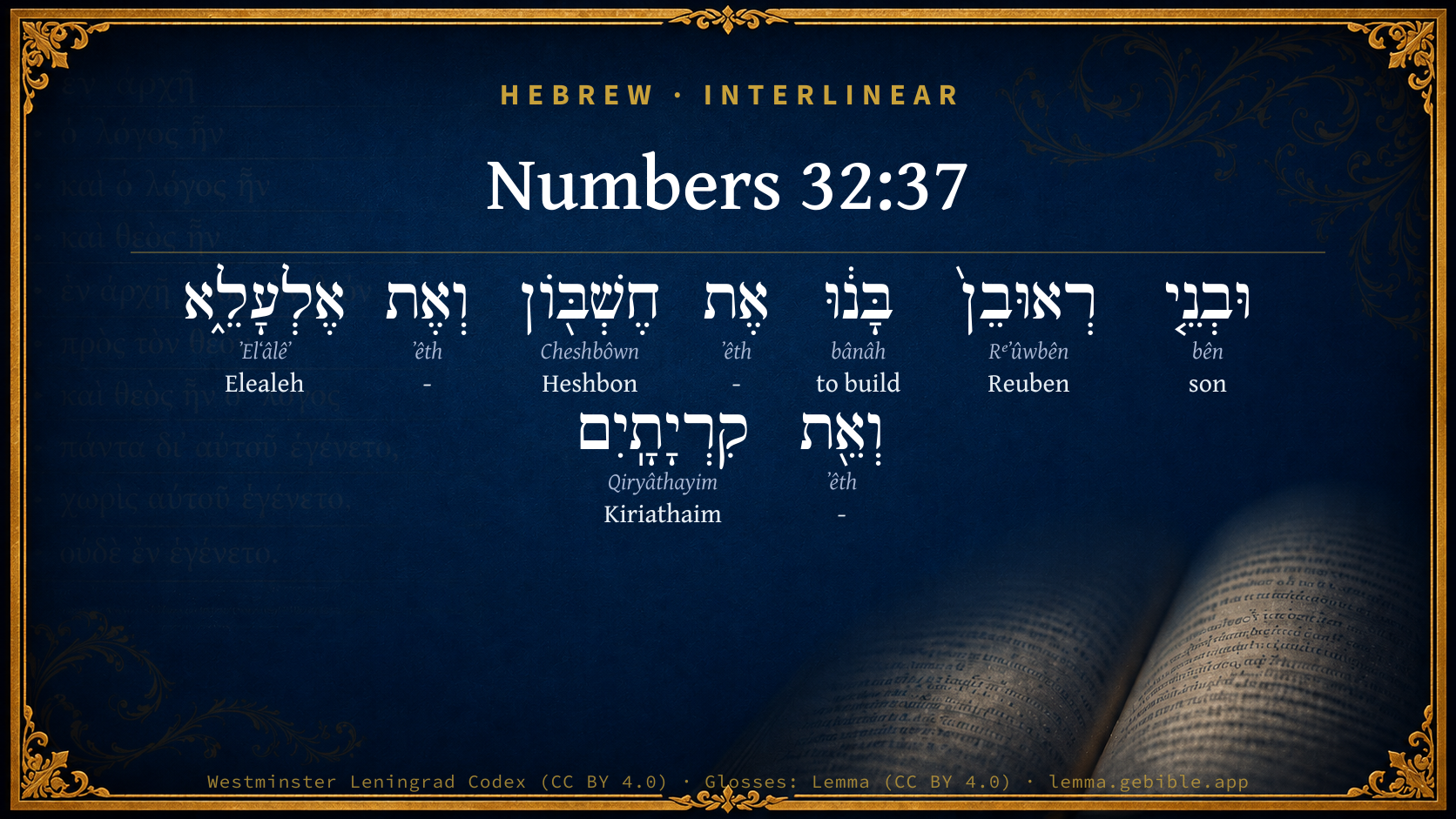
Numbers 32:37

Hebrew (Westminster Leningrad Codex) Numbers 32:37 appears in the Hebrew Old Testament. The text above is from the Westminster Leningrad Codex. Each word links to its Strong’s number, a concise gloss, and parsing drawn from the Open Scriptures Hebrew Bible morphology. Click any word for its full Brown-Driver-Briggs (BDB) entry.
Download image
Cite this verse

Numbers 32:37 (World English Bible). Public Domain. Lemma interlinear Bible study tool, https://lemma.gebible.app/v/numbers/32/37.

Show BibTeX & RIS
BibTeX
RIS
English Translation
The children of Reuben built Heshbon, and Elealeh, and Kiriathaim,
World English Bible · Public Domain
Download a study sheet

One document with this verse’s original text, its word-by-word gloss line, the meaning frame, cross-references with their text, attributed commentary, and full source and license credits — printable, and it pastes into notes with its structure intact.

This verse Autodidact and up

Study sheet (.html) Plain text (.txt)

A passage Seminary Student

Up to 50 verses in one chapter. A passage sheet keeps up to 6 commentary sources and 12 cross-references per verse, in the order this page ranks them, and says so on the sheet whenever that leaves anything out. Ask for a single verse and you get the Autodidact verse sheet above.

Everything on this page stays free to read, with no account — the sheet is a download of what is already on screen, not access to it.

Want to remove ads? Support Godless Engineer
Compare translations 3

The same verse in 3 English versions, stacked beneath the original-language interlinear above. Click any original word for its lexicon entry.

Each is an independent rendering of the whole verse — the interlinear is not word-aligned to these translations.

Highlighted words mark where these versions differ — a whole-verse word diff, not a word-by-word alignment.

  • World English Bible Public Domain
    The children of Reuben built Heshbon, and Elealeh, and Kiriathaim,
  • King James Version Public Domain
    And the children of Reuben built Heshbon, and Elealeh, and Kirjathaim,
  • unfoldingWord Literal Text CC BY-SA 4.0
    And the sons of Reuben built Heshbon and Elealeh and Kiriathaim

unfoldingWord Literal Text — © unfoldingWord, licensed CC BY-SA 4.0. Word-aligned USFM3 via Door43 (git.door43.org/unfoldingWord/en_ult).

Versions to compare (up to 4)

3 of 4 selected

Show all 18 translations

Every available English version of this verse, each an independent rendering of the whole verse.

  • World English Bible Public Domain
    The children of Reuben built Heshbon, and Elealeh, and Kiriathaim,
  • Berean Standard Bible Public Domain
    The Reubenites built up Heshbon, Elealeh, Kiriathaim,
  • Majority Standard Bible Public Domain
    The Reubenites built up Heshbon, Elealeh, Kiriathaim,
  • King James Version Public Domain
    And the children of Reuben built Heshbon, and Elealeh, and Kirjathaim,
  • American Standard Version (1901) Public Domain
    And the children of Reuben built Heshbon, and Elealeh, and Kiriathaim,
  • Revised Version (1885) Public Domain
    And the children of Reuben built Heshbon, and Elealeh, and Kiriathaim;
  • Geneva Bible (1599) Public Domain
    And the children of Reuben built Heshbon, and Elealeh, and Kiriathaim,
  • Douay-Rheims (1899) Public Domain
    But the children of Ruben built Hesebon, and Eleale, and Cariathaim,
  • Young's Literal Translation Public Domain
    And the sons of Reuben have build Heshbon, and Elealeh, and Kirjathaim,
  • Literal Standard Version CC BY-SA 4.0
    And the sons of Reuben have built Heshbon, and Elealeh, and Kirjathaim,
  • Unlocked Literal Bible CC BY-SA 4.0
    The descendants of Reuben rebuilt Heshbon, Elealeh, Kiriathaim,
  • unfoldingWord Literal Text CC BY-SA 4.0
    And the sons of Reuben built Heshbon and Elealeh and Kiriathaim
  • Darby Bible Public Domain
    -- And the children of Reuben built Heshbon, and Elaleh, and Kirjathaim,
  • World Messianic Bible Public Domain
    The children of Reuben built Heshbon, Elealeh, Kiriathaim,
  • Webster's Bible Public Domain
    And the children of Reuben built Heshbon, and Elealeh, and Kirjathaim,
  • Free Bible Version CC BY-SA 4.0
    The people of Reuben rebuilt Heshbon, Elealeh, Kiriathaim,
  • Bible in Basic English Public Domain
    And the children of Reuben were the builders of Heshbon and Elealeh and Kiriathaim;
  • JPS Tanakh (1917) Public Domain
    And the children of Reuben built Heshbon, and Elealeh, and Kiriathaim;

Literal Standard Version (2020), Covenant Press — licensed CC BY-SA 4.0. Text via the HelloAO Bible API (eBible.org). Unlocked Literal Bible (unfoldingWord) — licensed CC BY-SA 4.0. Text via the HelloAO Bible API (eBible.org). unfoldingWord Literal Text — © unfoldingWord, licensed CC BY-SA 4.0. Word-aligned USFM3 via Door43 (git.door43.org/unfoldingWord/en_ult). Free Bible Version, Dr. Jonathan Gallagher — licensed CC BY-SA 4.0. Text via the HelloAO Bible API (eBible.org).

Word by word

More ways to search: Search by grammar → Find every occurrence → Compare this word →

Practice this passage: Drill this verse → Learn its vocabulary →

About this verse

These counts appear in no published source. They are computed here, from the morphology-tagged text and Lemma’s own curated glosses. What Lemma adds →

9
words
7
distinct lemmas
Pentateuch
section

Notable vocabulary

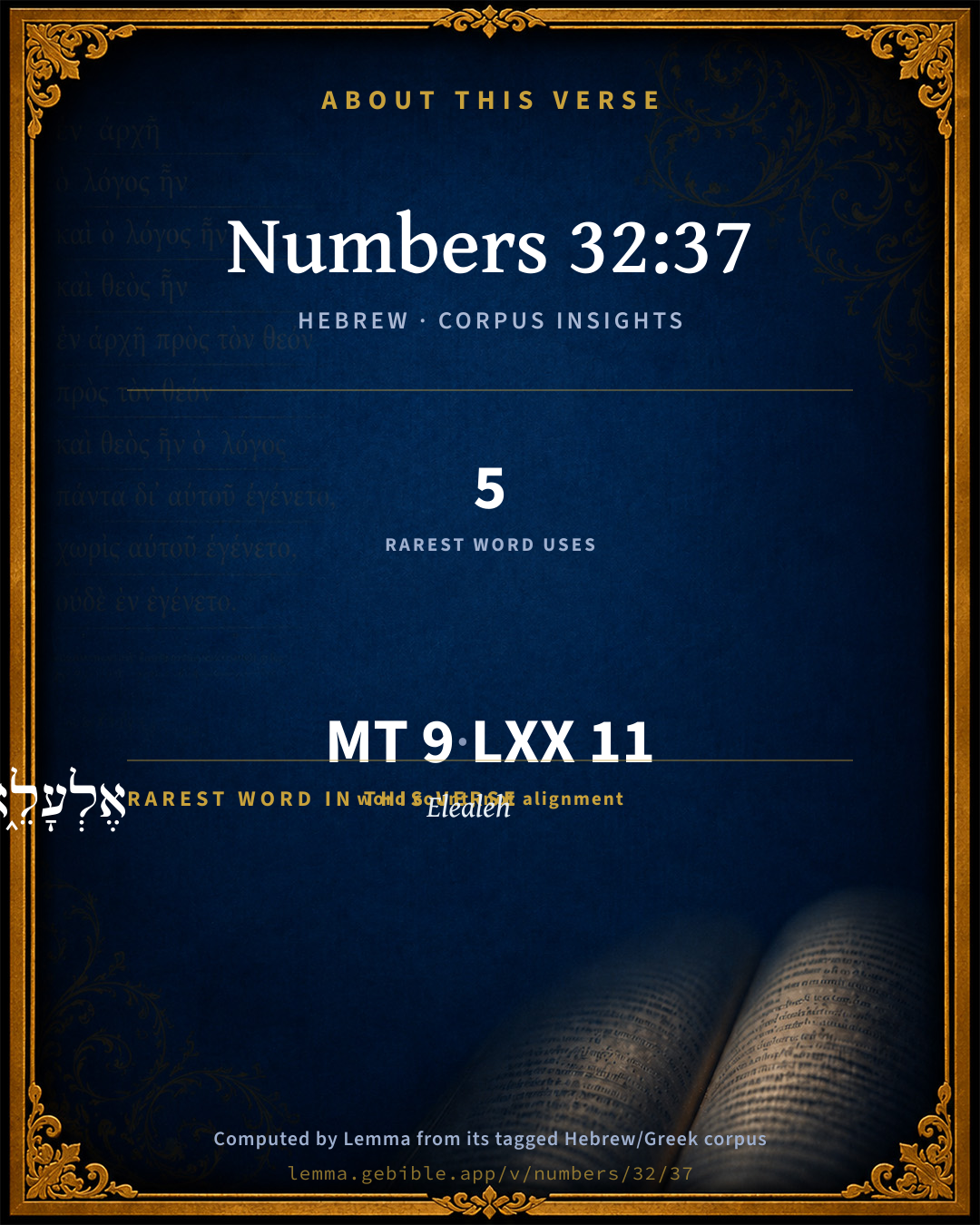
The rarest word here is אֶלְעָלֵ֑א Elealeh H500 — appearing just 5 times in the whole Hebrew Bible.

Shared distinctive vocabulary

אֶלְעָלֵ֑א Elealeh H500 occurs in 5 verses of the Hebrew Bible. Also found in:

Grammatical profile

  • 1 verb
  • 5 nouns
  • 3 particles

Verb forms

  • בָּנ֔וּ Qal · Perfect

Hebrew & Septuagint length

In English translation the verse runs 10 words from the Hebrew and 11 from the Septuagint (LXX English) — closely comparable.

A rough comparison of the two English renderings, which tokenize alike — not a word-level alignment.

Word counts can differ between the Hebrew and the Greek without any difference in meaning — e.g. the Hebrew direct-object marker אֵת has no separate Greek word, and Greek often adds the article ὁ.

In the original languages it is 9 Hebrew tokens and 11 Greek tokens — but the two are counted differently (Hebrew bundles its prefixes and suffixes into one token; the Greek is in lemma form), so that isn’t a like-for-like length.

Cross-references

3

Topical passages linked to Numbers 32:37 in the Treasury of Scripture Knowledge — connected by theme and wording, ordered by reader-vote popularity; previews shown in the World English Bible.

  • Numbers 21:27 Therefore those who speak in proverbs say, Come you to Heshbon; Let the city of Sihon be built and established:
  • Numbers 32:3 Ataroth, and Dibon, and Jazer, and Nimrah, and Heshbon, and Elealeh, and Sebam, and Nebo, and Beon,
  • Isaiah 15:4 Heshbon cries out, and Elealeh; their voice is heard even to Jahaz: therefore the armed men of Moab cry aloud; his soul trembles within him.

Cross-references courtesy of OpenBible.info (CC BY 4.0).

Hebrew and Greek witnesses Masoretic Hebrew ↔ Greek Septuagint

The same verse in the two great witnesses to the Old Testament, shown verse-for-verse.

These are two independent witnesses, not word-aligned to each other, and the Septuagint is shown in lemma (dictionary) form.

Hebrew Numbers 32:37 Masoretic · Westminster Leningrad Codex

וּבְנֵ֤י רְאוּבֵן֙ בָּנ֔וּ אֶת חֶשְׁבּ֖וֹן וְאֶת אֶלְעָלֵ֑א וְאֵ֖ת קִרְיָתָֽיִם

The children of Reuben built Heshbon, and Elealeh, and Kiriathaim,

World English Bible · Public Domain

Greek LXX Numbers 32:37 Septuagint · lemma form

καί ὁ υἱός ρουβην οἰκοδομέω ὁ εσεβων καί ελεαλη καί καριαθαιμ

And the sons of Ruben built Esebon, and Eleale, and Kariatham,

LXX2012 (modern English Septuagint) · Public Domain

On this verse, Keil & Delitzsch discusses the Septuagint’s reading. Read the note in Commentary ↓

Hebrew: Westminster Leningrad Codex (CC BY 4.0). Greek: Septuagint (public domain); English from LXX2012 (modern English Septuagint) (Public Domain). How the Septuagint differs from the Hebrew →

Targum (Aramaic paraphrase)

2

The Targum is the ancient Jewish Aramaic paraphrase of the Hebrew Scriptures — an interpretive translation, not the Hebrew text itself. Onkelos (literal) and Pseudo-Jonathan (expansive) render the Torah, and Jonathan the Prophets. Coverage is partial: where no permissively-licensed English translation exists for a verse, only the Aramaic is shown. This is verse-level text, not a word-by-word alignment to the Hebrew.

  1. Targum Onkelos Torah (Genesis–Deuteronomy)
    וּבְנֵי רְאוּבֵן בְּנוֹ יָת חֶשְׁבּוֹן וְיָת אֶלְעָלֵא וְיָת קִרְיָתָיִם

    (no public-domain English translation for this verse)

    Targum Onkelos — Aramaic: “Onkelos Genesis” (public domain); “Onkelos Exodus” (public domain); “Onkelos Leviticus” (public domain); “Onkelos Numbers” (public domain); “Onkelos Deuteronomy” (public domain). English: “Sefaria Community Translation” (CC0 1.0 (public-domain dedication)); “J.W. Etheridge. The Targums of Onkelos and Jonathan Ben Uzziel on the Pentateuch. London: Longmans, Green, 1862” (public domain). Text via Sefaria.

  2. Targum Pseudo-Jonathan Torah (Genesis–Deuteronomy)
    וּבְנֵי רְאוּבֵן בָּנוּ יַת בֵּית חוּשְׁבְּנֵי וְיַת מַעֲלַת מָרָא וְיַת קַרְתָּא דִתְרֵין שׁוֹקְהָא מְכַבְּשָׁן בְּמַרְמֵירָא הִיא בַיְרֵישָׁא

    And the sons of Reuben built (rebuilt) Beth Heshbon and Mahalath Mera, and the city of the two streets paved with marble which is Beresha,

    Targum Pseudo-Jonathan — Aramaic: “Targum Jonathan on Genesis” (public domain); “Targum Jonathan on Exodus” (public domain); “Targum Jonathan on Leviticus” (public domain); “Targum Jonathan on Numbers” (public domain); “Targum Jonathan on Deuteronomy” (public domain). English: “The Targum of Jonathan ben Uzziel, trans. J. W. Etheridge, London, 1862” (public domain). Text via Sefaria.

Commentary

Notes on Numbers 32:37 from classic Christian and Jewish commentators (each source and its license shown beneath its notes). The classic Christian expositions comment on the surrounding passage and are grouped to its opening verse, so a note may address several verses; the Jewish commentaries on the Tanakh (Rashi and others) are per-verse, so they appear only where the commentator wrote on this verse.

Lemma curates 59 commentaries, every one of them public domain or Creative Commons licensed, each selected and text-cleaned for this edition rather than reprinted as found. About our sources →

Tyndale Open Study Notes

Tyndale Open Resources

32:37-38 If names of some of the towns were changed to avoid pagan associations (e.g., “Baal,” the well-known Canaanite god, or “Nebo,” a Babylonian deity; see Isa 46:1), the alternate designations are not provided here.

Tyndale Open Study Notes — © Tyndale Open Resources, licensed CC BY-SA 4.0. Text via the HelloAO Bible API.

John Gill's Exposition

And Nebo, and Baalmeon, (their names being changed,).... For Nebo was the name of an idol, after which perhaps the city was called: Baalmeon signifies "Baal's habitation", and where it is highly probable was a temple of his; and the children of Reuben, not liking to retain such idolatrous names, gave them others, but what they were it is not said; and certain it is, that when these places came into the hands of the Moabites, their ancient names were restored to them, as appears from Isa 15:2.

and Shibmah; the same with Shebam, Num 32:3, and gave other names unto the cities which they built; but they are neither known, nor did they always continue, as has been observed.

John Gill's Exposition of the Whole Bible (1746–1763) — public domain (CC PDM 1.0). Text via the HelloAO Bible API.

Albert Barnes' Notes on the Bible

The Reubenites established themselves more compactly than the Gadites. Elcalch (el-’Al) a mile to the northeast; Nebo (Nebbeh) probably three miles to the southwest; Baal-meon (Main) nearly two miles to the south; Kirjathaim (Kureiyat?): and Shibmah, more properly Sibmah, famous at a later period for its vines (compare Isa 16:8), four miles east of Heshbon; all clustered round the old Amorite Capital. The Reubenites probably retained at the partition all these cities with the exception of Heshbon, which, passing to the Levites, were thenceforth reckoned as within the tribe of Gad.

Neither the Reubenites nor the Gadites were “builders” in the sense of founders of the cities of which they thus took possession. They probably fortified them, for the first time or afresh, so as to render them places of safety for their families during the campaigns on the other side of the Jordan; and provided them with all conveniences for their flocks and herds.

Albert Barnes' Notes on the Bible (1834–1885) — public domain. Text from a community e-Sword/MySword module.

Whedon's Commentary on the Bible

Daniel D. Whedon

37. Kirjathaim is known only by conjecture.

Daniel D. Whedon (gen. ed.), Commentary on the Old and New Testaments (1874–1909) — public domain. Text from a community e-Sword module.

The Pulpit Commentary

The children of Reuben. Reuben had, at the time of the last census, been greater in number than Gad, and had been his leader on the march. He now begins to take that secondary position which was always to be his. Of the towns which he now occupied, the Moabites recovered many, while the most important of all (Heshbon) had to be surrendered to the Levites. He was indeed compensated with the southern settlements of the Gadites as far as the Wady Hesban, but even so his limits were very straitened as compared with those of Gad and of half Manasseh. Heshbon. Cf. Num_21:25. In Jos_21:39 1Ch_6:81, Heshbon is spoken of as belonging to Gad. This can only be explained on the supposition that the temporary settlements of the two tribes were really intermixed, and that Heshbon, as the old capital of that region, was jointly occupied. In after times it, too, together with Elealeh and Kirjathaim, Nebo, Baal-meon, and Sibmah, all fell into the hands of Moab. (Isa_15:2, 4 16:8 Jer_48:22, Jer_48:23)

The Pulpit Commentary (1880–1919), ed. H.D.M. Spence-Jones & Joseph S. Exell — public domain. Text from a community e-Sword module.

Keil & Delitzsch

C. F. Keil & F. Delitzsch

The Reubenites built Heshbon, the capital of king Sihon (see Num 21:16), which was allotted to the tribe of Reuben (Jos 13:17), but relinquished to the Gadites, because it was situated upon the border of their territory, and given up by them to the Levites (Jos 21:39; Ch1 6:66). It stood almost in the centre between the Arnon and Jabbok, opposite to Jericho, and, according to the Onomast., twenty Roman miles from the Jordan, where the ruins of a large town of about a mile in circumference are still to be seen, with deep bricked wells, and a large reservoir, bearing the ancient name of Hesban or H׬sban (Seetzen; Burckhardt, p. 623; Robinson, Pal. ii. 278; cf. v. Raumer, Pal. p. 262; and Ritter's Erdkunde, xv. p. 1176). - Elealeh: half-an-hour's journey to the north-east of Heshbon, now called el Aal, i.e., the height, upon the top of a hill, from which you can see the whole of southern Belka; it is now in ruins with many cisterns, pieces of wall, and foundations of houses (Burckhardt, p. 523). - Kirjathaim, probably to the south-west of Medeba, where the ruins of el Teym are not to be found (see at Gen 14:5). Nebo, on Mount Nebo (see at Num 27:12). The Onomast. places the town eight Roman miles to the south of Heshbon, whilst the mountain is six Roman miles to the west of that town. Baal-Meon, called Beon in Num 32:3, Beth-Meon in Jer 48:23, and more fully Beth-Baal-Meon in Jos 13:17, is probably to be found, not in the ruins of Maein discovered by Seetzen and Legh, an hour's journey to the south-west of Tueme (Teim), and the same distance to the north of Habbis, on the north-east of Jebel Attarus, and nine Roman miles to the south of Heshbon, as most of the modern commentators from Rosenm׬ller to Knobel suppose; but in the ruins of Myun, mentioned by Burckhardt (p. 624), three-quarters of an hour to the south-east of Heshbon, where we find it marked upon Kiepert's and Van de Velde's maps.

(Note: Although Baal-Meon is unquestionably identified with Maein in the Onom. (see v. Raumer, Pal. p. 259), Ch1 5:8 is decidedly at variance with this. It is stated there that "Bela dwelt in Aroer, and even unto Nebo and Baal-Meon," a statement which places Baal-Meon in the neighbourhood of Nebo, like the passage before us, and is irreconcilable with the supposition that it was identical with Maein in the neighbourhood of Attarus. In the case of Seetzen, however, the identification of Maein with Baal-Meon is connected with the supposition, which is now generally regarded as erroneous, namely, that Nebo is the same as the Jebel Attarus. (See, on the other hand, Hengstenberg, Balaam; and Ritter's Erdkunde, xv. pp. 1187ff.))

Shibmah (Num 32:3, Shebam), which was only 500 paces from Heshbon, according to Jerome (on Isa 14:8), has apparently disappeared, without leaving a trace behind.

(Note: The difference in the forms Shibmah, Baal-Meon (Num 32:38), and Beth-Nimrah (Num 32:36), instead of Shebam, Beon, and Nimrah (Num 32:3), is rendered useless as a proof that Num 32:3 is Jehovistic, and Num 32:36-38 Elohistic, from the simple fact that Baal-Meon itself is a contraction of Beth-Baal-Meon (Jos 13:17). If the Elohist could write this name fully in one place and abbreviated in another, he could just as well contract it still further, and by exchanging the labials call it Beon; and so also he could no doubt omit the Beth in the case of Nimrah, and use the masculine form Shebam in the place of Shibmah. The contraction of the names in Num 32:3 is especially connected with the fact, that diplomatic exactness was not required for an historical account, but that the abbreviated forms in common use were quite sufficient.)

Thus all the places built by the Reubenites were but a short distance from Heshbon, and surrounded this capita; whereas those built by the Gadites were some of them to the south of it, on the Arnon, and others to the north, towards Rabbath-Ammon. It is perfectly obvious from this, that the restoration of these towns took place before the distribution of the land among these tribes, without any regard to their possession afterwards. In the distribution, therefore, the southernmost of the towns built by the Gadites, viz., Aroer, Dibon, and Ataroth, fell to the tribe of Reuben; and Heshbon, which was built by the Reubenites, fell to the tribe of Gad. The words שׁם מוּסבּת, "changed of name," are governed by בּנוּ: "they built the towns with an alteration of their names," mutatis nominibus (for סבב, in the sense of changing, see Zac 14:10). There is not sufficient ground for altering the text, שׁם into שׁוּר (Knobel), according to the περικυκλωμένας of the lxx, or the περιτετευχισμένας of Symmachus. The Masoretic text is to be found not only in the Chaldee, the Syriac, the Vulgate, and the Saadic versions, but also in the Samaritan. The expression itself, too, cannot be justly described as "awkward," nor is it a valid objection that the naming is mentioned afterwards; for altering the name of a town and giving it a new name are not tautological. The insertion of the words, "their names being changed," before Shibmah, is an indication that the latter place did not receive any other name. Moreover, the new names which the builders gave to these towns did not continue in use long, but were soon pressed out by the old ones again. "And they called by names the names of the towns:" this is a roundabout way of saying, they called the towns by (other, or new) names: cf. Ch1 6:50.

Keil & Delitzsch — Biblical Commentary on the Old Testament (1861–1891) — public domain (CC PDM 1.0). Text via the HelloAO Bible API. (Old Testament only.)

unfoldingWord translationNotes

Door43 World Missions Community

Heshbon, Elealeh, Kiriathaim, Nebo, Baal Meon ... Sibmah

These are names of cities. (See: How to Translate Names)

their names were later changed

This can be translated in active form. AT: "people later changed the names of these cities" (See: Active or Passive)

Machir

This is the name of a man. See how you translated this name in Numbers 26:29.

translationWords

Gilead

Amorite

unfoldingWord translationNotes — © Distant Shores Media and the Door43 World Missions Community, licensed CC BY-SA 4.0. Source: git.door43.org/Door43/en_tn.

Lesson kit

Teaching starters — assembled from the data on this page, not authored interpretation. Every prompt links to the verse data it draws on. Edit before teaching.

Numbers, in the Pentateuch, opens this verse with 9 words (7 distinct Hebrew lemmas). Its most distinctive word is ʼElʻâlêʼ (“Elealeh”). A historical commentator’s framing appears above. Read the whole chapter for the surrounding context.

Discussion questions

  1. How does “Elealeh” (ʼElʻâlêʼ) shape what this verse is saying?
  2. How does Numbers 32:3, which shares the word «Elealeh», read alongside this verse?
  3. The translations on this page render this verse differently — a whole-verse word diff, not a word-by-word alignment. What might account for the different wordings?
  4. «בָּנ֔וּ» is a Qal Perfect verb. How does that grammatical form shape the action described?
  5. Compare how Tyndale Open Study Notes and John Gill's Exposition read this verse. Where do they agree or differ?

Things to notice

Reading settings

Reading text

Shown beneath each verse's original-language words.

Old Testament
Old Testament edition

Read the OT as the Masoretic Hebrew (MT) or the Greek Septuagint (LXX).

English shown for the Greek Septuagint (in the Hebrew ↔ Greek comparison).

Comparing translations? Open the Compare panel on any verse page to stack up to four side by side.