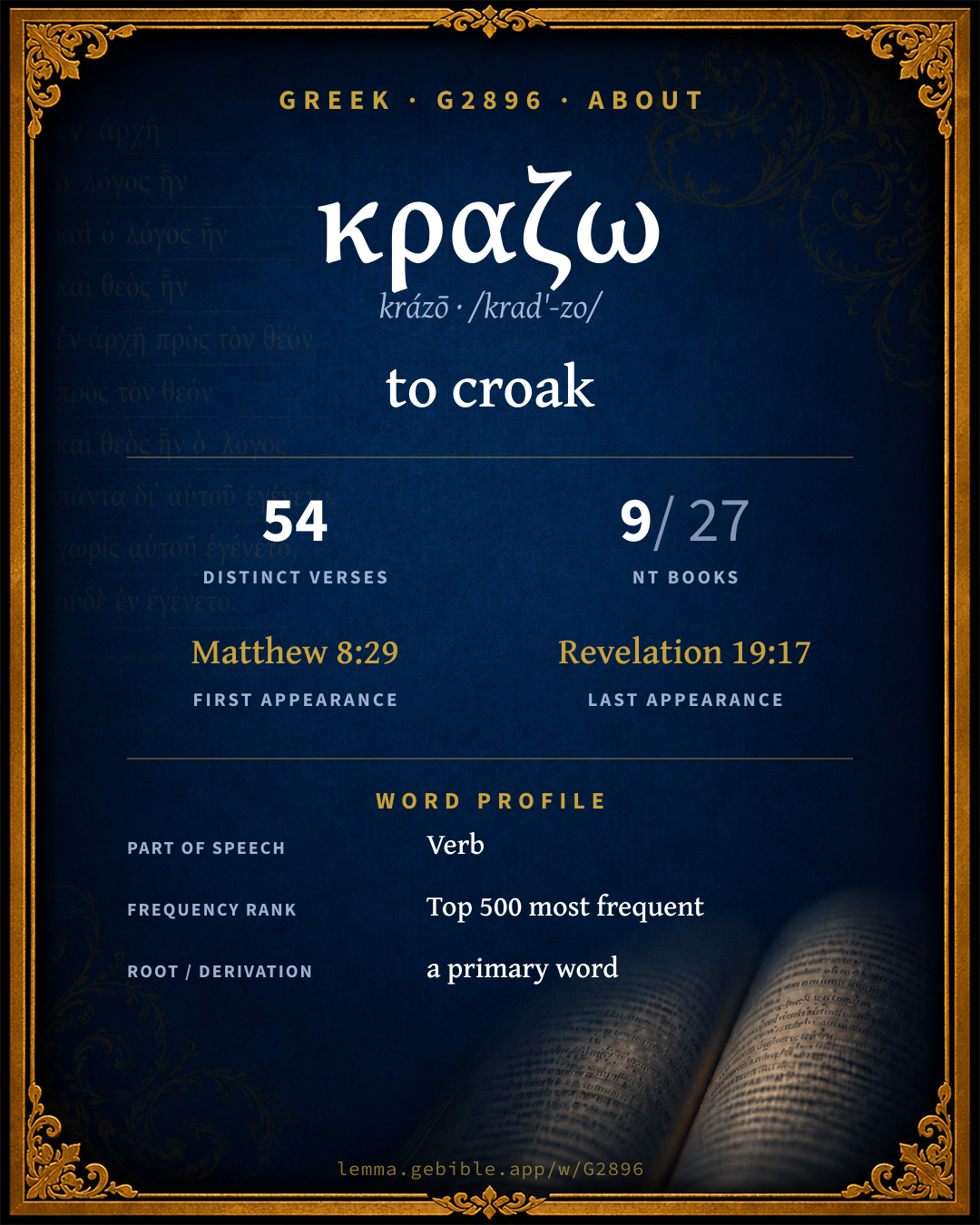
κράζω
to croak
‘to croak’ is one of 4 main senses fuller range ↓
Full lexicon entry — Thayer's Greek Lexicon
From Thayer's Greek Lexicon
Where this word appears
See every Aorist-tense verb in the Greek New Testament →
Grammar key — what these labels mean
Part of speech
- Verb
- An action or state-of-being word.
Tense
- Aorist
- Action viewed as a simple whole, without regard to duration — often past (perfective aspect).
- Imperfect
- Continuous or repeated action in past time (“was writing”).
- Present
- Ongoing or general action in present time (imperfective aspect).
- Perfect
- A completed past action with continuing present results.
- Future
- Action expected in future time.
Voice
- Active
- The subject performs the action.
Mood
- Indicative
- States a fact or asks a factual question (the mood of reality).
- Participle
- A verbal adjective (“writing,” “having written”).
- Infinitive
- A verbal noun (“to write”), unmarked for person or number.
Case
- Nominative
- The case of the subject (and the predicate nominative).
- Accusative
- The case of the direct object and of extent.
Person
- 3rd person
- The one spoken about (“he / she / it / they”).
- 1st person
- The speaker (“I / we”).
Gender
- Masculine
- Grammatically masculine.
- Neuter
- Grammatically neuter.
Number
- Singular
- One.
- Plural
- More than one.
Grammatical forms 17 distinct
- Verb, Aorist, Active, Indicative, 3rd person, Singular 10 times (18%)
- Verb, Imperfect, Active, Indicative, 3rd person, Plural 8 times (15%)
- Verb, Aorist, Active, Indicative, 3rd person, Plural 7 times (13%)
- Verb, Imperfect, Active, Indicative, 3rd person, Singular 5 times (9%)
- Verb, Present, Active, Indicative, 3rd person, Singular 5 times (9%)
- Verb, Present, Active, Participle, Nominative, Plural, Masculine 5 times (9%)
- Verb, Aorist, Active, Participle, Nominative, Singular, Masculine 4 times (7%)
- Verb, Present, Active, Participle, Nominative, Singular, Masculine 2 times (4%)
+9 more forms (9 occurrences)
Parsed forms decoded from the imported morphology (Robinson–Tischendorf, public domain), counted across 55 parsed occurrences — not distinct verses.
Every verse where G2896 appears — 54 distinct verses across 9 books. Click any verse to open its interlinear word-by-word view. Verse text shown in the World English Bible for context — . Each verse’s Greek form is shown with its reference; the English is not keyword-highlighted, since the data carries no word-level English alignment. Use “Compare translations” on any verse to read it across multiple English versions. This concordance covers the Greek New Testament; Septuagint (Greek Old Testament) occurrences of this word are not indexed here.
Matthew 12 verses
- Matthew 8:29 ἔκραξαν aor act ind 3pl Behold, they cried out, saying, "What do we have to do with you, Jesus, Son of God? Have you come here to torment us before the time?"
- Matthew 9:27 κράζοντες pres act ptcp nom pl masc As Jesus passed by from there, two blind men followed him, calling out and saying, "Have mercy on us, son of David!"
- Matthew 14:26 ἔκραξαν aor act ind 3pl When the disciples saw him walking on the sea, they were troubled, saying, "It's a ghost!" and they cried out for fear.
- Matthew 14:30 ἔκραξεν aor act ind 3sg But when he saw that the wind was strong, he was afraid, and beginning to sink, he cried out, saying, "Lord, save me!"
- Matthew 15:22 ἔκραζεν impf act ind 3sg Behold, a Canaanite woman came out from those borders, and cried, saying, "Have mercy on me, Lord, you son of David! My daughter is severely demonized!"
- Matthew 15:23 κράζει pres act ind 3sg But he answered her not a word. His disciples came and begged him, saying, "Send her away; for she cries after us."
- Matthew 20:30 ἔκραξαν aor act ind 3pl Behold, two blind men sitting by the road, when they heard that Jesus was passing by, cried out, "Lord, have mercy on us, you son of David!"
- Matthew 20:31 ἔκραξαν aor act ind 3pl The multitude rebuked them, telling them that they should be quiet, but they cried out even more, "Lord, have mercy on us, you son of David!"
- Matthew 21:9 ἔκραζον impf act ind 3pl The multitudes who went before him, and who followed kept shouting, "Hosanna to the son of David! Blessed is he who comes in the name of the Lord! Hosanna in the highest!"
- Matthew 21:15 κράζοντας pres act ptcp acc pl masc But when the chief priests and the scribes saw the wonderful things that he did, and the children who were crying in the temple and saying, "Hosanna to the son of David!" they were indignant,
- Matthew 27:23 ἔκραζον impf act ind 3pl But the governor said, "Why? What evil has he done?" But they cried out exceedingly, saying, "Let him be crucified!"
- Matthew 27:50 κράξας aor act ptcp nom sg masc Jesus cried again with a loud voice, and yielded up his spirit.
Mark 10 verses
- Mark 3:11 ἔκραζον impf act ind 3pl The unclean spirits, whenever they saw him, fell down before him, and cried, "You are the Son of God!"
- Mark 5:5 κράζων pres act ptcp nom sg masc Always, night and day, in the tombs and in the mountains, he was crying out, and cutting himself with stones.
- Mark 5:7 κράξας aor act ptcp nom sg masc and crying out with a loud voice, he said, "What have I to do with you, Jesus, you Son of the Most High God? I adjure you by God, don't torment me."
- Mark 9:24 κράξας aor act ptcp nom sg masc Immediately the father of the child cried out with tears, "I believe. Help my unbelief!"
- Mark 9:26 κράξας aor act ptcp nom sg masc Having cried out, and convulsed greatly, it came out of him. The boy became like one dead; so much that most of them said, "He is dead."
- Mark 10:47 κράζειν pres act inf When he heard that it was Jesus the Nazarene, he began to cry out, and say, "Jesus, you son of David, have mercy on me!"
- Mark 10:48 ἔκραζεν impf act ind 3sg Many rebuked him, that he should be quiet, but he cried out much more, "You son of David, have mercy on me!"
- Mark 11:9 ἔκραζον impf act ind 3pl Those who went in front, and those who followed, cried out, "Hosanna! Blessed is he who comes in the name of the Lord!
- Mark 15:13 ἔκραξαν aor act ind 3pl They cried out again, "Crucify him!"
- Mark 15:14 ἔκραξαν aor act ind 3pl Pilate said to them, "Why, what evil has he done?" But they cried out exceedingly, "Crucify him!"
Luke 3 verses
- Luke 9:39 κράζει pres act ind 3sg Behold, a spirit takes him, he suddenly cries out, and it convulses him so that he foams, and it hardly departs from him, bruising him severely.
- Luke 18:39 ἔκραζεν impf act ind 3sg Those who led the way rebuked him, that he should be quiet; but he cried out all the more, "You son of David, have mercy on me!"
- Luke 19:40 κράξουσιν fut act ind 3pl He answered them, "I tell you that if these were silent, the stones would cry out."
John 4 verses
- John 1:15 κέκραγεν perf act ind 3sg John testified about him. He cried out, saying, "This was he of whom I said, 'He who comes after me has surpassed me, for he was before me.'"
- John 7:28 ἔκραξεν aor act ind 3sg Jesus therefore cried out in the temple, teaching and saying, "You both know me, and know where I am from. I have not come of myself, but he who sent me is true, whom you don't know.
- John 7:37 ἔκραξεν aor act ind 3sg Now on the last and greatest day of the feast, Jesus stood and cried out, "If anyone is thirsty, let him come to me and drink!
- John 12:44 ἔκραξεν aor act ind 3sg Jesus cried out and said, "Whoever believes in me, believes not in me, but in him who sent me.
Acts 11 verses
- Acts 7:57 κράξαντες aor act ptcp nom pl masc But they cried out with a loud voice, and stopped their ears, and rushed at him with one accord.
- Acts 7:60 ἔκραξεν aor act ind 3sg He kneeled down, and cried with a loud voice, "Lord, don't hold this sin against them!" When he had said this, he fell asleep.
- Acts 14:14 κράζοντες pres act ptcp nom pl masc But when the apostles, Barnabas and Paul, heard of it, they tore their clothes, and sprang into the multitude, crying out,
- Acts 16:17 ἔκραζεν impf act ind 3sg Following Paul and us, she cried out, "These men are servants of the Most High God, who proclaim to us the way of salvation!"
- Acts 19:28 ἔκραζον impf act ind 3pl When they heard this they were filled with anger, and cried out, saying, "Great is Artemis of the Ephesians!"
- Acts 19:32 ἔκραζον impf act ind 3pl Some therefore cried one thing, and some another, for the assembly was in confusion. Most of them didn't know why they had come together.
- Acts 19:34 κράζοντες pres act ptcp nom pl masc But when they perceived that he was a Jew, all with one voice for a time of about two hours cried out, "Great is Artemis of the Ephesians!"
- Acts 21:28 κράζοντες pres act ptcp nom pl masc crying out, "Men of Israel, help! This is the man who teaches all men everywhere against the people, and the law, and this place. Moreover, he also brought Greeks into the temple, and has defiled this holy place!"
- Acts 21:36 κράζοντες pres act ptcp nom pl masc for the multitude of the people followed after, crying out, "Away with him!"
- Acts 23:6 ἔκραζεν impf act ind 3sg But when Paul perceived that the one part were Sadducees and the other Pharisees, he cried out in the council, "Men and brothers, I am a Pharisee, a son of Pharisees. Concerning the hope and resurrection of the dead I am being judged!"
- Acts 24:21 ἐκέκραξα aor act ind 1sg unless it is for this one thing that I cried standing among them, 'Concerning the resurrection of the dead I am being judged before you today!'"
Romans 2 verses
- Romans 8:15 κράζομεν pres act ind 1pl For you didn't receive the spirit of bondage again to fear, but you received the Spirit of adoption, by whom we cry, "Abba! Father!"
- Romans 9:27 κράζει pres act ind 3sg Isaiah cries concerning Israel, "If the number of the children of Israel are as the sand of the sea, It is the remnant who will be saved;
Galatians 1 verse
James 1 verse
Revelation 10 verses
- Revelation 6:10 ἔκραξαν aor act ind 3pl They cried with a loud voice, saying, "How long, Master, the holy and true, until you judge and avenge our blood on those who dwell on the earth?"
- Revelation 7:2 ἔκραξεν aor act ind 3sg I saw another angel ascend from the sunrise, having the seal of the living God. He cried with a loud voice to the four angels to whom it was given to harm the earth and the sea,
- Revelation 7:10 κράζουσιν pres act ind 3pl They cried with a loud voice, saying, "Salvation be to our God, who sits on the throne, and to the Lamb!"
- Revelation 10:3 ἔκραξεν ἔκραξεν aor act ind 3sg aor act ind 3sg He cried with a loud voice, as a lion roars. When he cried, the seven thunders uttered their voices.
- Revelation 12:2 κράζει pres act ind 3sg She was with child. She cried out in pain, laboring to give birth.
- Revelation 14:15 κράζων pres act ptcp nom sg masc Another angel came out from the temple, crying with a loud voice to him who sat on the cloud, "Send forth your sickle, and reap; for the hour to reap has come; for the harvest of the earth is ripe!"
- Revelation 18:2 ἔκραξεν aor act ind 3sg He cried with a mighty voice, saying, "Fallen, fallen is Babylon the great, and she has become a habitation of demons, a prison of every unclean spirit, and a prison of every unclean and hateful bird!
- Revelation 18:18 ἔκραζον impf act ind 3pl and cried out as they looked at the smoke of her burning, saying, 'What is like the great city?'
- Revelation 18:19 ἔκραζον impf act ind 3pl They cast dust on their heads, and cried, weeping and mourning, saying, 'Woe, woe, the great city, in which all who had their ships in the sea were made rich by reason of her great wealth!' For in one hour is she made desolate.
- Revelation 19:17 ἔκραξεν aor act ind 3sg I saw an angel standing in the sun. He cried with a loud voice, saying to all the birds that fly in the sky, "Come! Be gathered together to the great supper of God,
About this entry
At a glance — auto-summarized from this page’s data, not written by a person. Every figure links to its source below. This summary describes the numbers; it doesn’t interpret them.
The Greek verb κραζω centers on the idea of “to croak.” Its English rendering has broadened — “cried” classically, “he cried out” (Berean Standard Bible) in modern versions; see the renderings breakdown. The Greek New Testament uses it across 54 verses — moderately common. Its earliest occurrence is Matthew 8:29. Thayer's distinguishes 4 senses for it. For the data behind this summary, explore the sense tree and the renderings breakdown below.
Gloss history
Strong's 1890 vs modern scholarship

About this word
Strong's G2896 catalogs a Greek word from the Greek New Testament.
These counts are not copied from any lexicon or concordance. They are computed here, from the morphology-tagged Greek New Testament. What Lemma adds →
- 54
- distinct verses
- The word appears in 54 distinct verses.
- 9 / 27
- NT books
- The word appears in 9 of 27 New Testament books.
- #292
- by frequency
- Top 500 most frequent Greek words (rank 292 of 5,347 Greek words by occurrence).
View all 54 occurrences in the concordance →
By section of the New Testament
By traditional corpus
Conventional, traditional groupings — biblical authorship is debated, so this is a traditional corpus grouping, not an authorship claim. Some books belong to more than one corpus (Luke is in both the Gospels and the Lukan corpus, and so on), so these shares overlap and need not total 100%. Each figure is a share of the word’s 54 distinct verses.
- Gospels 29 verses · 54%
- Lukan (Luke–Acts) 14 verses · 26%
- Johannine 14 verses · 26%
- Revelation 10 verses · 19%
- Pauline corpus 3 verses · 6%
- General (Catholic) Epistles 1 verse · 2%
How translations render this word
Counts come from each version’s own published word-to-Strong’s tagging or interlinear alignment — an approximate guide to how each version renders this word, not a word-level alignment the data otherwise carries. Because each total is that version’s own tagged count, the per-version totals vary from one another and need not match the appearance or distinct-verse counts above. These counts may also differ from a printed concordance because Lemma counts each distinctly tagged rendering and does not collapse phrase taggings into a single head-word total. This is a fixed set of word-tagged versions (KJV, ASV, BSB, ULT) and does not change with the reading translation you choose elsewhere. Each version’s license is shown beside its name below (and on Sources).
- King James Version: Cried 19×, Cried out 6×, Crying 6×
- American Standard Version: Cried 12×, Crying 7×, He cried 7×
- Berean Standard Bible: He cried out 8×, Cried out 7×, Crying out 7×
- unfoldingWord Literal Text: Cried out 8×, Crying out 8×, He cried out 4×
King James Version Public Domain
Renders G2896 across 59 tagged occurrences — most commonly:
Plus 8 renderings that appear only once — usually multi-word phrases or single function words the recovered tagging swept in, not distinct renderings.
American Standard Version Public Domain
Renders G2896 across 59 tagged occurrences — most commonly:
Plus 13 renderings that appear only once — usually multi-word phrases or single function words the recovered tagging swept in, not distinct renderings.
Berean Standard Bible Public Domain
Renders G2896 across 54 tagged occurrences — most commonly:
Plus 15 renderings that appear only once — usually multi-word phrases or single function words the recovered tagging swept in, not distinct renderings. Not rendered by a distinct English word in 1 further occurrence.
unfoldingWord Literal Text CC BY-SA 4.0
Renders G2896 across 56 tagged occurrences — most commonly:
Plus 15 renderings that appear only once — usually multi-word phrases or single function words the recovered tagging swept in, not distinct renderings.
Senses in Thayer's
The 4 senses Thayer's distinguishes for this word, in lexicon order (not ranked by frequency or importance). The full entry — with sub-senses — is in the Lexicon Entry tab.
- of the cry of a raven
- hence, to cry out, cry aloud, vociferate
- to cry or pray for vengeance
- cry out aloud, speak with a loud voice
Word origin
Origin: a primary word
A primary verb; properly to croak (as a raven) or scream that is (generally) to call aloud ( shriek exclaim intreat ): - cry (out).
— Strong’s Exhaustive Concordance (1890), public domain.
Forms in the corpus
The 17 distinct written forms G2896 takes in the Greek New Testament, most frequent first — each parse links to that tense’s occurrences in the concordance.
Same root — word family
Other Thayer's entries built from the same root as G2896, grouped by Strong’s listed origin. These share a root / origin per the lexicon — not necessarily a shared meaning. Each links to that word’s own entry.
Derived from this word
Compare all same-root words → They share a root, not necessarily a meaning.
Septuagint usage
The same Greek word κραζω appears 88 times in the Greek Old Testament (Septuagint), across 87 verses in 17 books.
- 88
- LXX occurrences
- Tagged occurrences of this Greek word in the Septuagint.
- 87
- verses
- Distinct Septuagint verses containing this word.
- 17 / 39
- OT books
- The word appears in 17 of the 39 Old Testament books.
Sample Septuagint occurrences
- Genesis 41:55 κράζω
- Exodus 5:8 κράζω
- Numbers 11:2 κράζω
- Joshua 6:16 κράζω
- Judges 1:14 κράζω
- 2 Samuel 13:19 κράζω
- Job 6:5 κράζω
- Psalms 3:5 κράζω
- Isaiah 6:3 κράζω
- Jeremiah 4:5 κράζω
- Lamentations 3:8 κράζω
- Ezekiel 27:30 κράζω
Septuagint occurrences (same lexeme)
Every verse where the same Strong’s number (G2896) appears in the Greek Septuagint — showing the first 50 of 87. Verse text shown in the World English Bible for context; the Greek form is the matched word — the English is not keyword-highlighted.
- Genesis 41:55 κράζω When all the land of Egypt was famished, the people cried to Pharaoh for bread, and Pharaoh said to all the Egyptians, "Go to Joseph. What he says to you, do."
- Exodus 5:8 κράζω The number of the bricks, which they made before, you require from them. You shall not diminish anything of it, for they are idle; therefore they cry, saying, 'Let us go and sacrifice to our God.'
- Exodus 22:22 κράζω "You shall not take advantage of any widow or fatherless child.
- Exodus 32:17 κράζω When Joshua heard the noise of the people as they shouted, he said to Moses, "There is the noise of war in the camp."
- Numbers 11:2 κράζω The people cried to Moses; and Moses prayed to Yahweh, and the fire abated.
- Joshua 6:16 κράζω It happened at the seventh time, when the priests blew the trumpets, Joshua said to the people, Shout; for Yahweh has given you the city.
- Judges 1:14 κράζω It happened, when she came [to him], that she moved him to ask of her father a field: and she alighted from off her donkey; and Caleb said to her, What would you?
- Judges 3:9 κράζω When the children of Israel cried to Yahweh, Yahweh raised up a savior to the children of Israel, who saved them, even Othniel the son of Kenaz, Caleb's younger brother.
- Judges 3:15 κράζω But when the children of Israel cried to Yahweh, Yahweh raised them up a savior, Ehud the son of Gera, the Benjamite, a man left-handed. The children of Israel sent tribute by him to Eglon the king of Moab.
- Judges 4:3 κράζω The children of Israel cried to Yahweh: for he had nine hundred chariots of iron; and twenty years he mightily oppressed the children of Israel.
- Judges 18:24 κράζω He said, you have taken away my gods which I made, and the priest, and are gone away, and what have I more? and how then say you to me, What ails you?
- 2 Samuel 13:19 κράζω Tamar put ashes on her head, and tore her garment of various colors that was on her; and she laid her hand on her head, and went her way, crying aloud as she went.
- 2 Samuel 19:5 κράζω Joab came into the house to the king, and said, You have shamed this day the faces of all your servants, who this day have saved your life, and the lives of your sons and of your daughters, and the lives of your wives, and the lives of your concubines;
- 2 Samuel 19:29 κράζω The king said to him, Why speak you any more of your matters? I say, You and Ziba divide the land.
- Job 6:5 κράζω Does the wild donkey bray when he has grass? Or does the ox low over his fodder?
- Job 19:7 κράζω "Behold, I cry out of wrong, but I am not heard: I cry for help, but there is no justice.
- Job 30:20 κράζω I cry to you, and you do not answer me. I stand up, and you gaze at me.
- Job 30:28 κράζω I go mourning without the sun. I stand up in the assembly, and cry for help.
- Job 34:20 κράζω In a moment they die, even at midnight; The people are shaken and pass away, The mighty are taken away without hand.
- Job 35:9 κράζω "By reason of the multitude of oppressions they cry out; They cry for help by reason of the arm of the mighty.
- Job 35:12 κράζω There they cry, but none gives answer, Because of the pride of evil men.
- Job 38:41 κράζω Who provides for the raven his prey, When his young ones cry to God, And wander for lack of food?
- Psalms 3:5 κράζω I laid myself down and slept. I awakened; for Yahweh sustains me.
- Psalms 4:4 κράζω Stand in awe, and don't sin. Search your own heart on your bed, and be still. Selah.
- Psalms 16:6 κράζω The lines have fallen to me in pleasant places. Yes, I have a good inheritance.
- Psalms 17:7 κράζω Show your marvelous loving kindness, You who save those who take refuge by your right hand from their enemies.
- Psalms 17:42 κράζω
- Psalms 21:3 κράζω For you meet him with the blessings of goodness; You set a crown of fine gold on his head.
- Psalms 21:6 κράζω For you make him most blessed forever. You make him glad with joy in your presence.
- Psalms 21:25 κράζω
- Psalms 27:1 κράζω Yahweh is my light and my salvation. Whom shall I fear? Yahweh is the strength of my life. Of whom shall I be afraid?
- Psalms 29:3 κράζω Yahweh's voice is on the waters. The God of glory thunders, even Yahweh on many waters.
- Psalms 29:9 κράζω Yahweh's voice makes the deer calve, And strips the forests bare. In his temple everything says, "Glory!"
- Psalms 30:23 κράζω
- Psalms 31:3 κράζω For you are my rock and my fortress, Therefore for your name's sake lead me and guide me.
- Psalms 33:7 κράζω He gathers the waters of the sea together as a heap. He lays up the deeps in storehouses.
- Psalms 33:18 κράζω Behold, Yahweh's eye is on those who fear him, On those who hope in his loving kindness;
- Psalms 54:17 κράζω
- Psalms 56:3 κράζω When I am afraid, I will put my trust in you.
- Psalms 60:3 κράζω You have shown your people hard things. You have made us drink the wine that makes us stagger.
- Psalms 64:14 κράζω
- Psalms 65:17 κράζω
- Psalms 68:4 κράζω Sing to God! Sing praises to his name! Extol him who rides on the clouds: To Yah, his name! Rejoice before him!
- Psalms 76:2 κράζω His tent is also in Salem; His dwelling place in Zion.
- Psalms 85:3 κράζω You have taken away all your wrath. You have turned from the fierceness of your anger.
- Psalms 85:7 κράζω Show us your loving kindness, Yahweh. Grant us your salvation.
- Psalms 87:2 κράζω Yahweh loves the gates of Zion more than all the dwellings of Jacob.
- Psalms 87:10 κράζω
- Psalms 87:14 κράζω
- Psalms 106:6 κράζω We have sinned with our fathers. We have committed iniquity. We have done wickedly.
These are occurrences of the same Greek lexeme (G2896) in the Septuagint — not a translation of any one Hebrew word. The store carries no word-level Hebrew↔Greek alignment, so no Hebrew original is asserted here. Counts come from the recovered LXX Strong's tagging — high-frequency vocabulary is well covered, while rare or late forms may be untagged — so they reflect tagged occurrences and may slightly undercount.