
Psalms 60:3

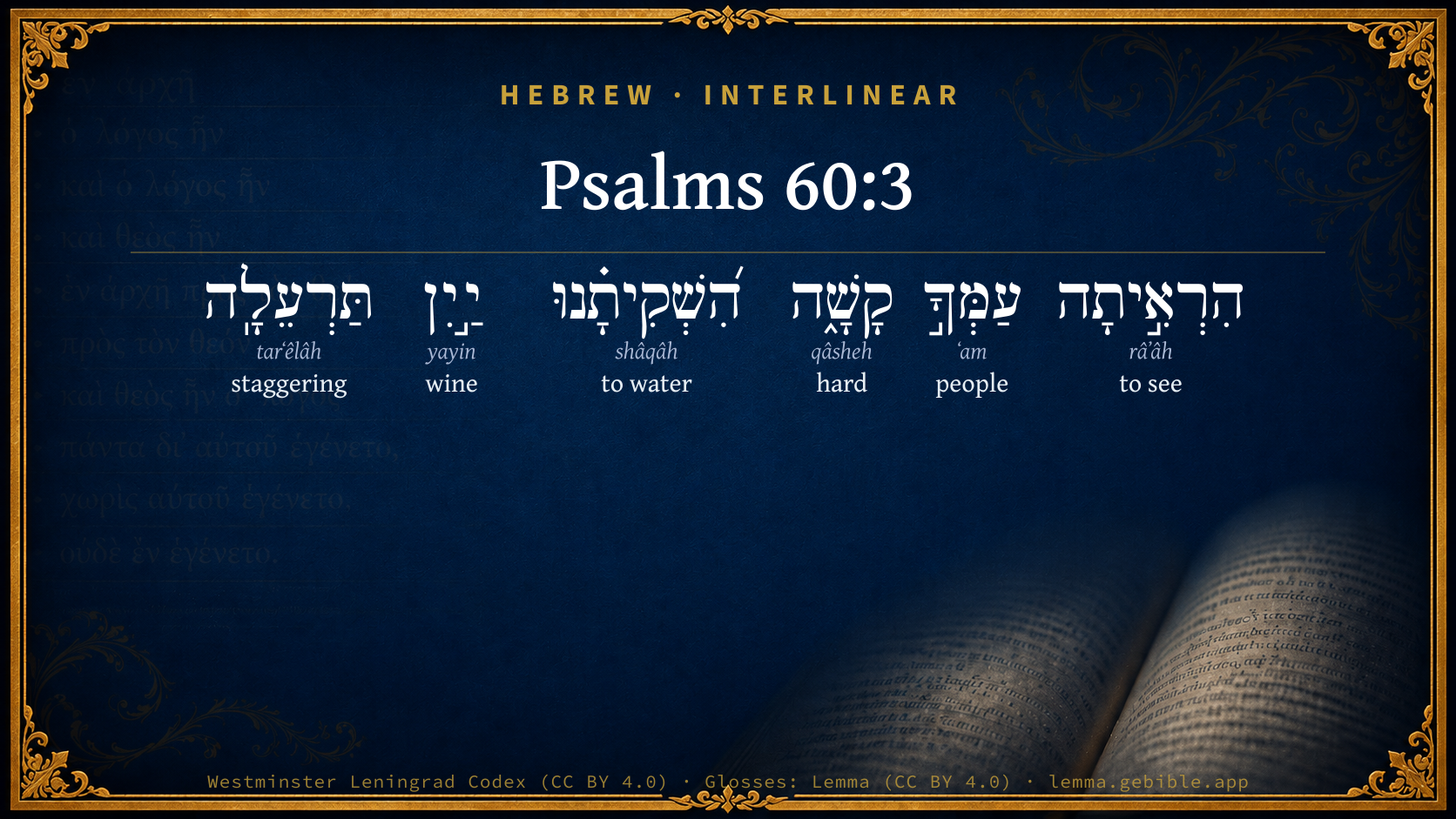
Hebrew (Westminster Leningrad Codex) Psalms 60:3 appears in the Hebrew Old Testament. The text above is from the Westminster Leningrad Codex. Each word links to its Strong’s number, a concise gloss, and parsing drawn from the Open Scriptures Hebrew Bible morphology. Click any word for its full Brown-Driver-Briggs (BDB) entry.
Download image
Cite this verse

Psalms 60:3 (World English Bible). Public Domain. Lemma interlinear Bible study tool, https://lemma.gebible.app/v/psalms/60/3.

Show BibTeX & RIS
BibTeX
RIS
English Translation
You have shown your people hard things. You have made us drink the wine that makes us stagger.
World English Bible · Public Domain
Highlights
  • 1 first appearance in the Hebrew Bible
Full analysis ↓
Download a study sheet

One document with this verse’s original text, its word-by-word gloss line, the meaning frame, cross-references with their text, attributed commentary, and full source and license credits — printable, and it pastes into notes with its structure intact.

This verse Autodidact and up

Study sheet (.html) Plain text (.txt)

A passage Seminary Student

Up to 50 verses in one chapter. A passage sheet keeps up to 6 commentary sources and 12 cross-references per verse, in the order this page ranks them, and says so on the sheet whenever that leaves anything out. Ask for a single verse and you get the Autodidact verse sheet above.

Everything on this page stays free to read, with no account — the sheet is a download of what is already on screen, not access to it.

Want to remove ads? Support Godless Engineer
Compare translations 3

The same verse in 3 English versions, stacked beneath the original-language interlinear above. Click any original word for its lexicon entry.

Each is an independent rendering of the whole verse — the interlinear is not word-aligned to these translations.

Highlighted words mark where these versions differ — a whole-verse word diff, not a word-by-word alignment.

  • World English Bible Public Domain
    You have shown your people hard things. You have made us drink the wine that makes us stagger.
  • King James Version Public Domain
    Thou hast shewed thy people hard things: thou hast made us to drink the wine of astonishment.
  • unfoldingWord Literal Text CC BY-SA 4.0
    You have made your people see the difficult. You have made us drink the wine of staggering.

unfoldingWord Literal Text — © unfoldingWord, licensed CC BY-SA 4.0. Word-aligned USFM3 via Door43 (git.door43.org/unfoldingWord/en_ult).

Versions to compare (up to 4)

3 of 4 selected

Show all 18 translations

Every available English version of this verse, each an independent rendering of the whole verse.

  • World English Bible Public Domain
    You have shown your people hard things. You have made us drink the wine that makes us stagger.
  • Berean Standard Bible Public Domain
    You have shown Your people hardship; we are staggered from the wine You made us drink.
  • Majority Standard Bible Public Domain
    You have shown Your people hardship; we are staggered from the wine You made us drink.
  • King James Version Public Domain
    Thou hast shewed thy people hard things: thou hast made us to drink the wine of astonishment.
  • American Standard Version (1901) Public Domain
    Thou hast showed thy people hard things: Thou hast made us to drink the wine of staggering.
  • Revised Version (1885) Public Domain
    Thou hast shewed thy people hard things: thou hast made us to drink the wine of staggering.
  • Geneva Bible (1599) Public Domain
    Thou hast shewed thy people heauy things: thou hast made vs to drinke the wine of giddines.
  • Douay-Rheims (1899) Public Domain
    O God, thou hast cast us off, and hast destroyed us; thou hast been angry, and hast had mercy on us.
  • Young's Literal Translation Public Domain
    Thou hast shewn Thy people a hard thing, Thou hast caused us to drink wine of trembling.
  • Literal Standard Version CC BY-SA 4.0
    You have shown Your people a hard thing, || You have caused us to drink wine of trembling.
  • Unlocked Literal Bible CC BY-SA 4.0
    You have made your people see difficult things; you have made us drink the wine of staggering.
  • unfoldingWord Literal Text CC BY-SA 4.0
    You have made your people see the difficult. You have made us drink the wine of staggering.
  • Darby Bible Public Domain
    Thou hast shewn thy people hard things; thou hast made us to drink the wine of bewilderment.
  • World Messianic Bible Public Domain
    You have shown your people hard things. You have made us drink the wine that makes us stagger.
  • Webster's Bible Public Domain
    \\60:1\\To the chief Musician upon Shushan-eduth, Michtam of David, to teach; when he strove with Aram-naharaim and with Aram-zobah, when Joab returned, and smote of Edom in the valley of salt twelve thousand. O God, thou hast cast us off, thou hast scattered us, thou hast been displeased; O turn thyself to us again.
  • Free Bible Version CC BY-SA 4.0
    You have been very hard on your people; you gave us wine that made us stagger around.
  • Bible in Basic English Public Domain
    You have made the people see hard times; you have given us the wine of shaking for our drink.
  • JPS Tanakh (1917) Public Domain
    (60-5) Thou hast made Thy people to see hard things; Thou hast made us to drink the wine of staggering.

Literal Standard Version (2020), Covenant Press — licensed CC BY-SA 4.0. Text via the HelloAO Bible API (eBible.org). Unlocked Literal Bible (unfoldingWord) — licensed CC BY-SA 4.0. Text via the HelloAO Bible API (eBible.org). unfoldingWord Literal Text — © unfoldingWord, licensed CC BY-SA 4.0. Word-aligned USFM3 via Door43 (git.door43.org/unfoldingWord/en_ult). Free Bible Version, Dr. Jonathan Gallagher — licensed CC BY-SA 4.0. Text via the HelloAO Bible API (eBible.org).

Word by word

More ways to search: Search by grammar → Find every occurrence → Compare this word →

Practice this passage: Drill this verse → Learn its vocabulary →

About this verse

These counts appear in no published source. They are computed here, from the morphology-tagged text and Lemma’s own curated glosses. What Lemma adds →

6
words
6
distinct lemmas
Wisdom
section

Notable vocabulary

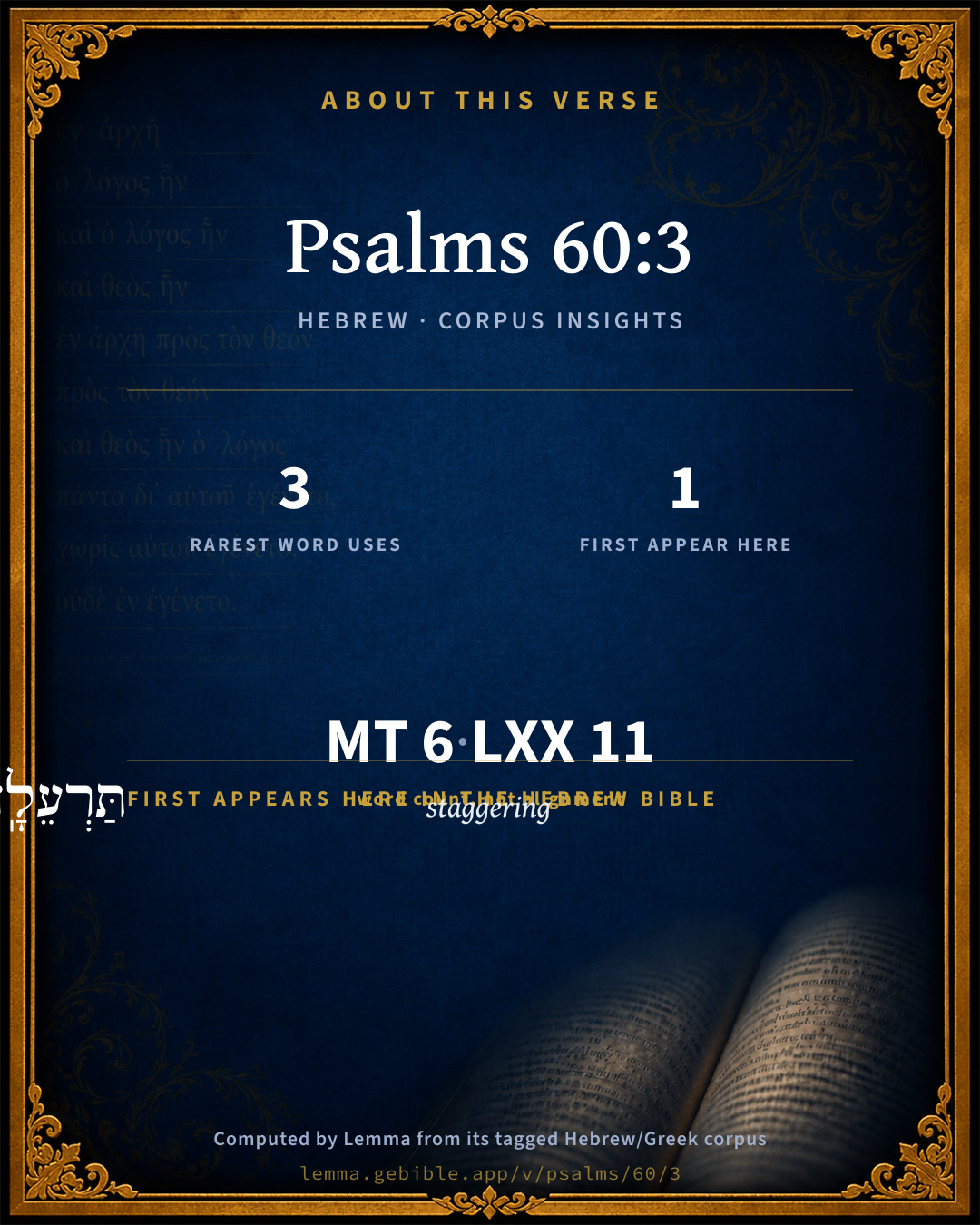
The rarest word here is תַּרְעֵלָֽה staggering H8653 — appearing just 3 times in the whole Hebrew Bible.

First appearance in Scripture

This word makes its first canonical appearance in the Hebrew Bible here:

  • תַּרְעֵלָֽה staggering H8653

Shared distinctive vocabulary

תַּרְעֵלָֽה staggering H8653 occurs in 3 verses of the Hebrew Bible. Also found in:

Grammatical profile

  • 2 verbs
  • 3 nouns
  • 1 adjective

Verb forms

  • הִרְאִ֣יתָה Hiphil · Perfect
  • הִ֝שְׁקִיתָ֗נוּ Hiphil · Perfect

Hebrew & Septuagint length

In English translation the verse runs 18 words from the Hebrew and 16 from the Septuagint (LXX English) — closely comparable.

A rough comparison of the two English renderings, which tokenize alike — not a word-level alignment.

Word counts can differ between the Hebrew and the Greek without any difference in meaning — e.g. the Hebrew direct-object marker אֵת has no separate Greek word, and Greek often adds the article ὁ.

In the original languages it is 6 Hebrew tokens and 11 Greek tokens — but the two are counted differently (Hebrew bundles its prefixes and suffixes into one token; the Greek is in lemma form), so that isn’t a like-for-like length.

Cross-references

12

Topical passages linked to Psalms 60:3 in the Treasury of Scripture Knowledge — connected by theme and wording, ordered by reader-vote popularity; previews shown in the World English Bible.

  • Psalms 71:20 You, who have shown us many and bitter troubles, You will let me live. You will bring us up again from the depths of the earth.
  • Isaiah 51:17 Awake, awake, stand up, Jerusalem, that have drunk at the hand of Yahweh the cup of his wrath; you have drunken the bowl of the cup of staggering, and drained it.
  • Isaiah 51:22 Thus says your Lord Yahweh, and your God who pleads the cause of his people, Behold, I have taken out of your hand the cup of staggering, even the bowl of the cup of my wrath; you shall no more drink it again:
  • Jeremiah 25:15 For thus says Yahweh, the God of Israel, to me: take this cup of the wine of wrath at my hand, and cause all the nations, to whom I send you, to drink it.
  • Psalms 75:8 For in the hand of Yahweh there is a cup, Full of foaming wine mixed with spices. He pours it out. Indeed the wicked of the earth drink and drink it to its very dregs.
  • Ezekiel 23:31–32 You have walked in the way of your sister; therefore will I give her cup into your hand.
  • Nehemiah 9:32 Now therefore, our God, the great, the mighty, and the awesome God, who keep covenant and loving kindness, don't let all the travail seem little before you, that has come on us, on our kings, on our princes, and on our priests, and on our prophets, and on our fathers, and on all your people, since the time of the kings of Assyria to this day.
  • Lamentations 4:21 Rejoice and be glad, daughter of Edom, that dwell in the land of Uz: The cup shall pass through to you also; you shall be drunken, and shall make yourself naked.
  • Daniel 9:12 He has confirmed his words, which he spoke against us, and against our judges who judged us, by bringing on us a great evil; for under the whole sky has not been done as has been done on Jerusalem.
  • Habakkuk 2:16 You are filled with shame, and not glory. You will also drink, and be exposed! The cup of Yahweh's right hand will come around to you, and disgrace will cover your glory.
  • Revelation 16:19 The great city was divided into three parts, and the cities of the nations fell. Babylon the great was remembered in the sight of God, to give to her the cup of the wine of the fierceness of his wrath.
  • Revelation 18:16 saying, 'Woe, woe, the great city, she who was dressed in fine linen, purple, and scarlet, and decked with gold and precious stones and pearls!

Cross-references courtesy of OpenBible.info (CC BY 4.0).

Hebrew and Greek witnesses Masoretic Hebrew ↔ Greek Septuagint

The same verse in the two great witnesses to the Old Testament, shown verse-for-verse.

You’re reading Greek Psalm 59 (Hebrew Psalm 60). The Septuagint counts the superscription, so verse numbers can differ from the Hebrew — chapter-level alignment, not verse-by-verse. Numbering follows Rahlfs.

These are two independent witnesses, not word-aligned to each other, and the Septuagint is shown in lemma (dictionary) form.

Hebrew Psalms 60:3 Masoretic · Westminster Leningrad Codex

הִרְאִ֣יתָה עַמְּךָ֣ קָשָׁ֑ה הִ֝שְׁקִיתָ֗נוּ יַ֣יִן תַּרְעֵלָֽה

You have shown your people hard things. You have made us drink the wine that makes us stagger.

World English Bible · Public Domain

Greek LXX Greek Psalm 59:3 Septuagint · lemma form

ὁ θεός ἀποὠθέω ἐγώ καί κατααἱρέω ἐγώ ὀργίζω καί οἰκτείρω ἐγώ

You have shown your people hard things: you have made us drink the wine of astonishment.

LXX2012 (modern English Septuagint) · Public Domain

Hebrew: Westminster Leningrad Codex (CC BY 4.0). Greek: Septuagint (public domain); English from LXX2012 (modern English Septuagint) (Public Domain). How the Septuagint differs from the Hebrew →

Commentary

Notes on Psalms 60:3 from classic Christian and Jewish commentators (each source and its license shown beneath its notes). The classic Christian expositions comment on the surrounding passage and are grouped to its opening verse, so a note may address several verses; the Jewish commentaries on the Tanakh (Rashi and others) are per-verse, so they appear only where the commentator wrote on this verse.

Lemma curates 59 commentaries, every one of them public domain or Creative Commons licensed, each selected and text-cleaned for this edition rather than reprinted as found. About our sources →

Trapp's Complete Commentary

John Trapp

Psa 60:3 Thou hast shewed thy people hard things: thou hast made us to drink the wine of astonishment.

Ver. 3. Thou hast showed thy people hard things] God will be sure to plough his own ground, whatsoever becometh of the waste; and to weed his own garden, though the rest of the world should be let alone to grow wild.

Thou hast made us to drink the wine of astonishment] Vinum vacillationis, we are intoxicated with our afflictions, according to that, Deu 28:28; Deu 28:34, we are drunk with them, or rather mad, and put quite besides all faith and hope in a manner, Fuimus obstupefacti tanquam venefica potione.

John Trapp, A Commentary or Exposition upon All the Books of the Old and New Testament (1647–1656) — public domain. Text from a community e-Sword module.

J. A. Alexander on Psalms

Joseph Addison Alexander

5. (Psa 60:3). Thou hast made thy people see (what is) hard; thou hast made us drink wine of staggering (or reeling). The meaning of the first clause is, that God had made them experience hardship. See a similar expression in Psa 71:20. Wine of staggering, wine that causes men to reel or stagger, here used as a figure for confusion, weakness, and distress. The same image reappears in Psa 75:8, Isa 51:17; Isa 51:22, Jer 25:15; Jer 49:12. See above, on Psa 11:6.

Joseph Addison Alexander, The Psalms Translated and Explained (1850) — public domain. Text from a community e-Sword module.

Tyndale Open Study Notes

Tyndale Open Resources

60:3 wine (Hebrew yayin) that sent us reeling: Yayin, the generic Hebrew term meaning “wine,” is often associated with drunkenness (2 Sam 13:28; Isa 5:11; 28:7-8; cp. Ps 104:15; Deut 14:26; Isa 55:1); it symbolized God’s judgment of the wicked (Ps 75:8; Jer 51:7).

Tyndale Open Study Notes — © Tyndale Open Resources, licensed CC BY-SA 4.0. Text via the HelloAO Bible API.

Geneva Bible (1599)

Geneva Bible translators

Thou hast handled thy people sharply, in taking from them sense and judgment, in that they aided Saul the wicked King, and pursued him to whom God had given the just title of the realm.

Geneva Bible (1599) marginal notes — public domain. Text via Bolls.life.

Jamieson, Fausset & Brown

Robert Jamieson, A. R. Fausset & David Brown

drink . . . wine of astonishment--literally, "of staggering"--that is, made us weak (compare Psa 75:8; Isa 51:17, Isa 51:22).

Jamieson, Fausset & Brown — Commentary Critical and Explanatory on the Whole Bible (1871) — public domain (CC PDM 1.0). Text via the HelloAO Bible API.

Adam Clarke's Commentary

Verse 3. Thou hast made us to drink the wine of astonishment] We reel as drunken men; we are giddy, like those who have drank too much wine; but our giddiness has been occasioned by the astonishment and dismay that have taken place in consequence of the prevalence of our enemies, and the unsettled state of the land. It has been remarked that the three first verses of this Psalm do not agree with the rest, and it also appears that the three first verses of Ps 85:1-3 do not agree with the rest of that Psalm. But let them change places, and the three first verses of this be set instead of the three first verses of Ps 85:1-3, and let those be placed here instead of these, and then the whole of each Psalm will be consistent. This was first suggested by Bishop Hare, and the supposition seems to be well founded. Some imagine that the whole of the Psalm refers to the distracted state of the land after the death of Saul till the time that David was anointed king over all Israel, at Hebron; others, to the disastrous war with the Syrians. See before.

Adam Clarke's Commentary on the Bible (1810–1826) — public domain. Text from a community e-Sword/MySword module.

John Calvin's Commentaries

3. Thou hast showed thy people hard things He says, first, that the nation had been dealt with severely, and then adds a figure which may additionally represent the grievousness of its calamities, speaking of it as drunk with the wine of stupor or astonishment. Even the Hebraist interpreters are not agreed among themselves as to the meaning of תרעלה, tarelah, which I have rendered astonishment. Several of them translate it poison. But it is evident that the Psalmist alludes to some kind of poisoned drink, which deprives a person of his senses, insinuating that the Jews were stupified by their calamities. He would place, in short, before their eyes the curse of God, which had pressed upon the government of Saul, and induce them to abandon their obstinate attempts to maintain the interests of a throne which lay under the divine reprobation.

John Calvin's Commentaries (1540-1563) — public domain. Text from the Calvin Translation Society English edition (1840s-50s) via the Christian Classics Ethereal Library (ccel.org). Calvin's coverage is partial (roughly two-thirds of the Bible); uncommented books and verses are honest gaps, never fabricated. The 19th-century editor's footnotes and remarks are omitted so the notes are faithfully Calvin's own voice.

Ellicott's Commentary for English Readers

(3) Hard things—i.e., a hard fate.

Wine of astonishment.—Literally, either wine of reeling—i.e., an intoxicating draught—or wine as reeling—i.e., bewilderment like wine, or wine, which is not wine, but bewilderment, according as we take the construction.

In any case the figure is the same which meets us often in Hebrew poetry (comp. Psa_75:8-9; Isa_51:17; Isa_51:22; Jer_25:15, &c) expressing that infatuation which the heathen proverb so well describes:—

“Quem Deus vult perdere prius dementat.”

A Bible Commentary for English Readers, edited by Charles John Ellicott (1878–1897) — public domain. Text from a community e-Sword module.

The Cambridge Bible for Schools and Colleges

gen. ed. J. J. S. Perowne

3. hard] i.e. calamitous.

the wine of astonishment] Better as R.V., the wine of staggering. The cup of God’s wrath is a common metaphor for His judgements. It is like some drugged potion, which robs the drinker of reason, and makes him reel helplessly along, the mockery of all beholders. Commonly it is administered to the enemies of Israel (Psa_75:8; Jer_25:15 ff); but also to Israel itself (Isa_51:17; Isa_51:21 f).

The Cambridge Bible for Schools and Colleges (gen. ed. J. J. S. Perowne; Cambridge University Press, 1878–1918) — public domain. Text from a community e-Sword module.

John Gill's Exposition

Thou hast showed thy people hard things,.... As to have their city and temple burial, multitudes of them slain, and the rest carried captive, and put into the hands of cruel lords and hard masters, and made a proverb, a taunt, and a curse, in all places; and all this done to a people that were the Lord's by profession, who called themselves so, though now a "loammi", Hos 1:9; and these were hard things to flesh and blood, yet no other than what they deserved;

thou hast made us to drink the wine of astonishment; or "of trembling" (n), Isa 51:17; that is, to endure such troubles as made them tremble, and astonished and stupefied them; took away their senses, and made them unfit for anything, being smitten with madness, blindness, and astonishment of heart, as is threatened them, Deu 28:28; see Rom 11:7.

(n) "tremoris", Musculus, Vatablus, Amama; "trepidationis", Michaelis; "horroris", Gejerus.

John Gill's Exposition of the Whole Bible (1746–1763) — public domain (CC PDM 1.0). Text via the HelloAO Bible API.

Albert Barnes' Notes on the Bible

Thou hast showed thy people hard things - Thou hast caused them to see reverses, disappointments, and trials. This refers, according to the supposition in the Introduction to the psalm, to some calamitous events which had occurred. The probability seems to be that the Edomites may have spread desolation over the land.

Thou hast made us to drink the wine of astonishment - The word rendered “astonishment” - תרעלה tar‛êlâh - occurs only here and in Isa 51:17, Isa 51:22 - in both of which verses in Isaiah it is rendered trembling. It means properly reeling, drunkenness; and the idea here is, that it was as if he had given them a cup - that is, an intoxicating drink - which had caused them to reel as a drunken man; or, in other words, their efforts had been unsuccessful. Compare Psa 11:6, note; Isa 51:17, note.

Albert Barnes' Notes on the Bible (1834–1885) — public domain. Text from a community e-Sword/MySword module.

Matthew Poole's English Annotations

Thou hast showed, Heb. made them to see, i.e. to experience or feel, as seeing is oft put, as Psa 49:10, and oft elsewhere. Thou hast filled us with no less horror and trembling, than men intoxicated with strong and stupefying drink, which they are forced to drink. Compare Isa 51:17,21.

Matthew Poole's English Annotations on the Holy Bible (1683–1685) — public domain. Text from a community e-Sword/MySword module.

The Treasury of David

Charles H. Spurgeon

Ver. 3. Thou hast showed thy people hard things. Hardships had been heaped upon them, and the psalmist traces these rigorous providences to their fountainhead. Nothing had happened by chance, but all had come by divine design and with a purpose, yet for all that things had gone hard with Israel. The psalmist claims that they were still the Lord's own people, though in the first verse he had said, "thou hast cast us off." The language of complaint is usually confused, and faith in time of trouble ere long contradicts the desponding statements of the flesh.

Thou hast made us to drink the wine of astonishment. Our afflictions have made us like men drunken with some potent and bitter wine; we are in amazement, confusion, delirium; our steps reel, and we stagger as those about to fall. The great physician gives his patients potent potions to purge out their abounding and deep seated diseases. Astonishing evils bring with them astonishing results. The grapes of the vineyard of sin produce a wine which fills the most hardened with anguish when justice compels them to quaff the cup. There is a fire water of anguish of soul which even to the righteous makes a cup of trembling, which causes them to be exceeding sorrowful almost unto death. When grief becomes so habitual as to be our drink, and to take the place of our joys, becoming our only wine, then are we in an evil case indeed.

Ver. 3. Thou hast showed thy people hard things. God will be sure to plough his own ground, whatsoever becometh of the waste; and to weed his own garden, though the rest of the world should be let alone to grow wild. John Trapp.

Ver. 3. Thou hast given us to drink infatuation, or bewilderment, as men drink wine. So Hupfeld explains the constructions, referring to Ps 80:5, "Thou hast made them feed upon weeping like bread; "1Ki 22:27, "Feed him with affliction as bread, and with affliction as water" uxl mymw; Isa 30:20. But the apposition is capable of being explained in another way, for the second noun may in fact be a predicate further defining the first: "Thou hast given us wine to drink which is (not wine, but) bewilderment." J. J. Stewart Perowne.

Ver. 3. The wine of astonishment. "Intoxicating wine." Hebrew, "Wine of staggering, "that is, which causeth staggering, or, in other words, intoxicating. Some render, "wine of stupor, "or stupefying. Symmachus, "wine of agitation, "and this sense I have adopted which is also that of the Syriac. Benjamin Boothroyd.

Ver. 3. That God does afflict his people severely, and that he has good reason for the same.

Ver. 3. The wine of astonishment. A purgative, a tonic. Astonishing sin followed by astonishing chastisements, discoveries of corruption, of the spirituality of the law, of the terrors of divine wrath, and by astonishing depressions, temptations, and conflicts.

Psalms 60:4*

Charles H. Spurgeon's The Treasury of David (1869–1885) — public domain. Psalms only. Text from a community e-Sword/MySword module.

Whedon's Commentary on the Bible

Daniel D. Whedon

3. Wine of astonishment—Literally, wine of reeling, or drunkenness, called the “cup of trembling,” Isa_51:17; Isa_51:22. This unexpected judgment had deprived them of strength, as one who reeled and staggered from intoxication.

Daniel D. Whedon (gen. ed.), Commentary on the Old and New Testaments (1874–1909) — public domain. Text from a community e-Sword module.

The Pulpit Commentary

Thou hast showed thy people hard things; literally, a hard thing, or harshness; i.e. severity. Thou hast made us to drink the wine of astonishment; or, of trembling; (as in Isa_51:17, Isa_51:22) comp. Psa_75:8 Jer_25:15-17 Jer_49:12 Eze_23:32-34 Zec_12:2. The outpouring of Divine vengeance is represented under the figure of presenting a cup, which the doomed man is forced to drink.

The Pulpit Commentary (1880–1919), ed. H.D.M. Spence-Jones & Joseph S. Exell — public domain. Text from a community e-Sword module.

John Wesley's Explanatory Notes

To drink - Thou hast filled us with no less honour, than men intoxicated with strong drink.

John Wesley, Explanatory Notes Upon the Whole Bible (1754–1765) — public domain. Text via the GEBible commentary corpus.

Rashi

Rabbi Shlomo Yitzchaki (Rashi)

You have forsaken us; You have breached us When Edom fell into his hand, he foresaw with the holy spirit that they are destined to rule over Israel and to levy evil decrees upon Israel. He stood up and begged for mercy on account of the subjugation of the exile. “We suffered many troubles in the time of the Judges from the enemies around us.”

You were angry You were angry with us. From now on, restore Your goodwill upon us.

Rashi on the Tanakh — English translations: “The Judaica Press complete Tanach with Rashi, translated by A. J. Rosenberg” (CC BY 4.0); “Pentateuch with Rashi's commentary by M. Rosenbaum and A.M. Silbermann, 1929-1934” (public domain); “The Metsudah Tanach series, Lakewood, N.J” (CC BY 4.0); and “The Book of Joshua, Metsudah Publications, 1997” (CC BY 4.0). Text via Sefaria.

Lesson kit

Teaching starters — assembled from the data on this page, not authored interpretation. Every prompt links to the verse data it draws on. Edit before teaching.

Psalms, in the Wisdom, opens this verse with 6 words (6 distinct Hebrew lemmas). Its most distinctive word is tarʻêlâh (“staggering”). A historical commentator’s framing appears above. Read the whole chapter for the surrounding context.

Discussion questions

  1. How does “staggering” (tarʻêlâh) shape what this verse is saying?
  2. This is the first place “staggering” appears in Scripture (first appears here). What does its debut here establish?
  3. How does Isaiah 51:17, which shares the word «staggering», read alongside this verse?
  4. The translations on this page render this verse differently — a whole-verse word diff, not a word-by-word alignment. What might account for the different wordings?
  5. «הִרְאִ֣יתָה» is a Hiphil Perfect verb. How does that grammatical form shape the action described?
  6. Compare how Trapp's Complete Commentary and J. A. Alexander on Psalms read this verse. Where do they agree or differ?

Things to notice

Reading settings

Reading text

Shown beneath each verse's original-language words.

Old Testament
Old Testament edition

Read the OT as the Masoretic Hebrew (MT) or the Greek Septuagint (LXX).

English shown for the Greek Septuagint (in the Hebrew ↔ Greek comparison).

Comparing translations? Open the Compare panel on any verse page to stack up to four side by side.