
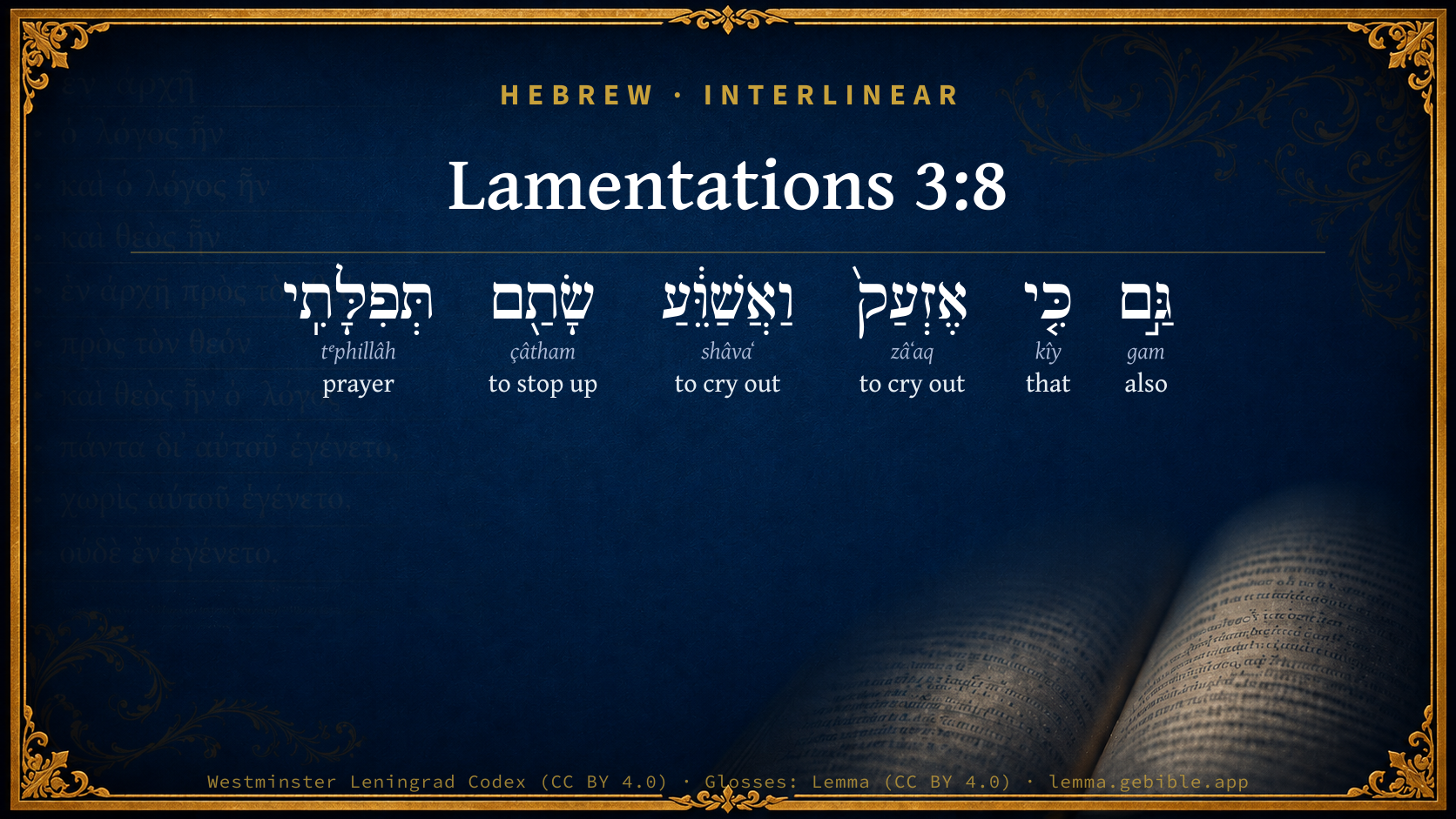
Lamentations 3:8

Hebrew (Westminster Leningrad Codex) Lamentations 3:8 appears in the Hebrew Old Testament. The text above is from the Westminster Leningrad Codex. Each word links to its Strong’s number, a concise gloss, and parsing drawn from the Open Scriptures Hebrew Bible morphology. Click any word for its full Brown-Driver-Briggs (BDB) entry.
Download image
Cite this verse

Lamentations 3:8 (World English Bible). Public Domain. Lemma interlinear Bible study tool, https://lemma.gebible.app/v/lamentations/3/8.

Show BibTeX & RIS
BibTeX
RIS
English Translation
Yes, when I cry, and call for help, he shuts out my prayer.
World English Bible · Public Domain
Download a study sheet

One document with this verse’s original text, its word-by-word gloss line, the meaning frame, cross-references with their text, attributed commentary, and full source and license credits — printable, and it pastes into notes with its structure intact.

This verse Autodidact and up

Study sheet (.html) Plain text (.txt)

A passage Seminary Student

Up to 50 verses in one chapter. A passage sheet keeps up to 6 commentary sources and 12 cross-references per verse, in the order this page ranks them, and says so on the sheet whenever that leaves anything out. Ask for a single verse and you get the Autodidact verse sheet above.

Everything on this page stays free to read, with no account — the sheet is a download of what is already on screen, not access to it.

Want to remove ads? Support Godless Engineer
Compare translations 3

The same verse in 3 English versions, stacked beneath the original-language interlinear above. Click any original word for its lexicon entry.

Each is an independent rendering of the whole verse — the interlinear is not word-aligned to these translations.

Highlighted words mark where these versions differ — a whole-verse word diff, not a word-by-word alignment.

  • World English Bible Public Domain
    Yes, when I cry, and call for help, he shuts out my prayer.
  • King James Version Public Domain
    Also when I cry and shout, he shutteth out my prayer.
  • unfoldingWord Literal Text CC BY-SA 4.0
    Even when I cry out and call for help, he shuts out my prayer.

unfoldingWord Literal Text — © unfoldingWord, licensed CC BY-SA 4.0. Word-aligned USFM3 via Door43 (git.door43.org/unfoldingWord/en_ult).

Versions to compare (up to 4)

3 of 4 selected

Show all 18 translations

Every available English version of this verse, each an independent rendering of the whole verse.

  • World English Bible Public Domain
    Yes, when I cry, and call for help, he shuts out my prayer.
  • Berean Standard Bible Public Domain
    Even when I cry out and plead for help, He shuts out my prayer.
  • Majority Standard Bible Public Domain
    Even when I cry out and plead for help, He shuts out my prayer.
  • King James Version Public Domain
    Also when I cry and shout, he shutteth out my prayer.
  • American Standard Version (1901) Public Domain
    Yea, when I cry, and call for help, he shutteth out my prayer.
  • Revised Version (1885) Public Domain
    Yea, when I cry and call for help, he shutteth out my prayer.
  • Geneva Bible (1599) Public Domain
    Also when I cry and showte, hee shutteth out my prayer.
  • Douay-Rheims (1899) Public Domain
    Ghimel. Yea, and when I cry, and entreat, he hath shut out my prayer.
  • Young's Literal Translation Public Domain
    Also when I call and cry out, He hath shut out my prayer.
  • Literal Standard Version CC BY-SA 4.0
    Also when I call and cry out, || He has shut out my prayer.
  • Unlocked Literal Bible CC BY-SA 4.0
    and though I call out and cry for help, he shut out my prayer.
  • unfoldingWord Literal Text CC BY-SA 4.0
    Even when I cry out and call for help, he shuts out my prayer.
  • Darby Bible Public Domain
    Even when I cry and shout, he shutteth out my prayer.
  • World Messianic Bible Public Domain
    Yes, when I cry, and call for help, he shuts out my prayer.
  • Webster's Bible Public Domain
    Also when I cry and shout, he shutteth out my prayer.
  • Free Bible Version CC BY-SA 4.0
    Even when I keep on crying out for help, he refuses to listen to my prayer.
  • Bible in Basic English Public Domain
    Even when I send up a cry for help, he keeps my prayer shut out.
  • JPS Tanakh (1917) Public Domain
    Yea, when I cry and call for help, He shutteth out my prayer.

Literal Standard Version (2020), Covenant Press — licensed CC BY-SA 4.0. Text via the HelloAO Bible API (eBible.org). Unlocked Literal Bible (unfoldingWord) — licensed CC BY-SA 4.0. Text via the HelloAO Bible API (eBible.org). unfoldingWord Literal Text — © unfoldingWord, licensed CC BY-SA 4.0. Word-aligned USFM3 via Door43 (git.door43.org/unfoldingWord/en_ult). Free Bible Version, Dr. Jonathan Gallagher — licensed CC BY-SA 4.0. Text via the HelloAO Bible API (eBible.org).

Word by word

More ways to search: Search by grammar → Find every occurrence → Compare this word →

Practice this passage: Drill this verse → Learn its vocabulary →

About this verse

These counts appear in no published source. They are computed here, from the morphology-tagged text and Lemma’s own curated glosses. What Lemma adds →

6
words
6
distinct lemmas
Prophets
section

Notable vocabulary

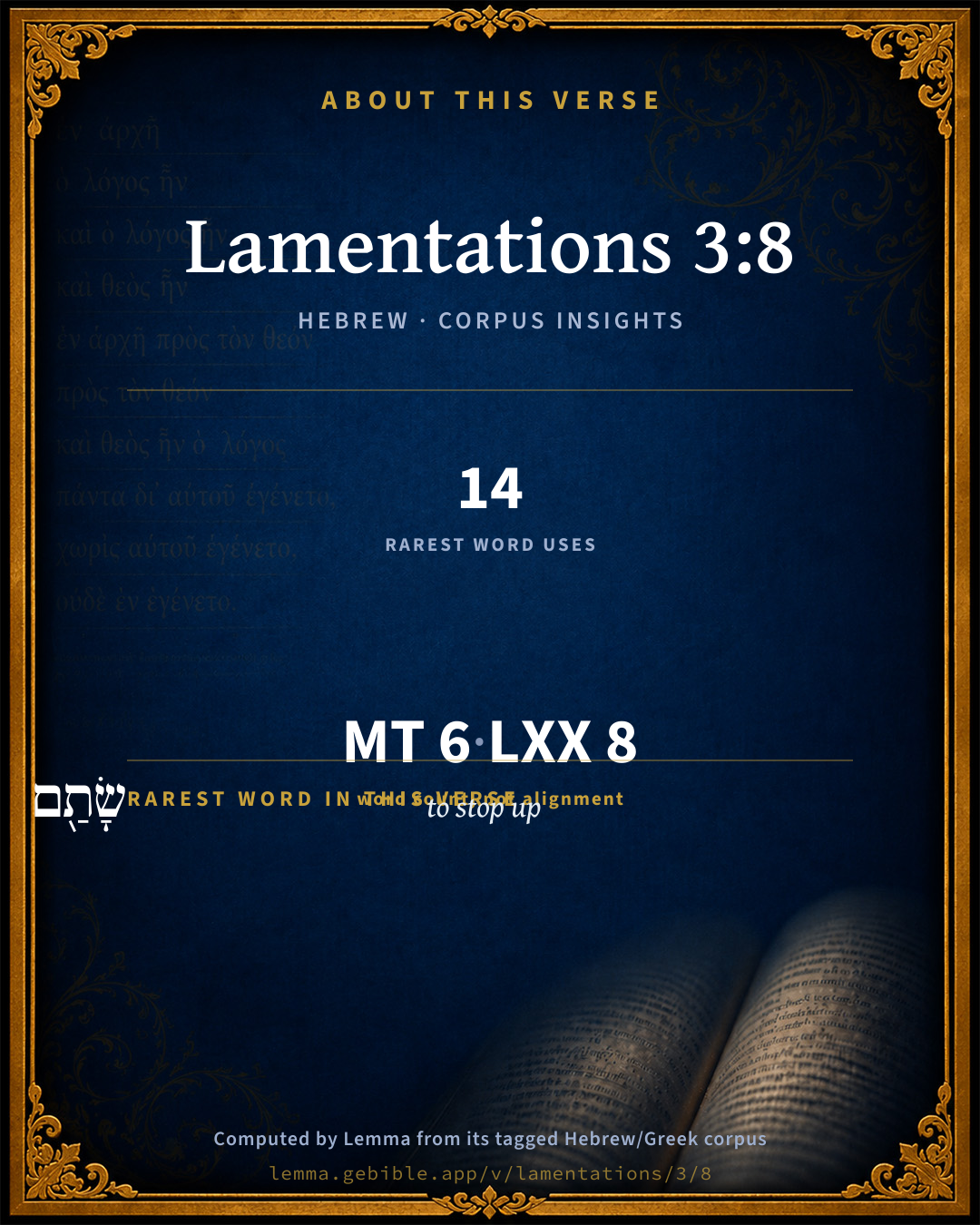
The rarest word here is שָׂתַ֖ם to stop up H5640 — appearing just 14 times in the whole Hebrew Bible.

Shared distinctive vocabulary

שָׂתַ֖ם to stop up H5640 occurs in 14 verses of the Hebrew Bible. Also found in:

Grammatical profile

  • 3 verbs
  • 1 noun
  • 1 conjunction
  • 1 particle

Verb forms

  • אֶזְעַק֙ Qal · Imperfect
  • וַאֲשַׁוֵּ֔עַ Piel · Imperfect
  • שָׂתַ֖ם Qal · Perfect

Hebrew & Septuagint length

In English translation the verse runs 13 words from the Hebrew and 12 from the Septuagint (LXX English) — closely comparable.

A rough comparison of the two English renderings, which tokenize alike — not a word-level alignment.

Word counts can differ between the Hebrew and the Greek without any difference in meaning — e.g. the Hebrew direct-object marker אֵת has no separate Greek word, and Greek often adds the article ὁ.

In the original languages it is 6 Hebrew tokens and 8 Greek tokens — but the two are counted differently (Hebrew bundles its prefixes and suffixes into one token; the Greek is in lemma form), so that isn’t a like-for-like length.

Cross-references

7

Topical passages linked to Lamentations 3:8 in the Treasury of Scripture Knowledge — connected by theme and wording, ordered by reader-vote popularity; previews shown in the World English Bible.

  • Job 30:20 I cry to you, and you do not answer me. I stand up, and you gaze at me.
  • Psalms 22:2 My God, I cry in the daytime, but you don't answer; In the night season, and am not silent.
  • Job 19:7 "Behold, I cry out of wrong, but I am not heard: I cry for help, but there is no justice.
  • Lamentations 3:44 You have covered yourself with a cloud, so that no prayer can pass through.
  • Matthew 27:46 About the ninth hour Jesus cried with a loud voice, saying, "Eli, Eli, lima sabachthani?" That is, "My God, my God, why have you forsaken me?"
  • Habakkuk 1:2 Yahweh, how long will I cry, and you will not hear? I cry out to you "Violence!" and will you not save?
  • Psalms 80:4 Yahweh God of hosts, How long will you be angry against the prayer of your people?

Cross-references courtesy of OpenBible.info (CC BY 4.0).

Hebrew and Greek witnesses Masoretic Hebrew ↔ Greek Septuagint

The same verse in the two great witnesses to the Old Testament, shown verse-for-verse.

These are two independent witnesses, not word-aligned to each other, and the Septuagint is shown in lemma (dictionary) form.

Hebrew Lamentations 3:8 Masoretic · Westminster Leningrad Codex

גַּ֣ם כִּ֤י אֶזְעַק֙ וַאֲשַׁוֵּ֔עַ שָׂתַ֖ם תְּפִלָּתִֽי

Yes, when I cry, and call for help, he shuts out my prayer.

World English Bible · Public Domain

Greek LXX Lamentations 3:8 Septuagint · lemma form

καί γέ κράζω καί βοάω ἀποφράσσω προσευχή ἐγώ

GIMEL. Yes, though I cry and shout, he shuts out my prayer.

LXX2012 (modern English Septuagint) · Public Domain

Hebrew: Westminster Leningrad Codex (CC BY 4.0). Greek: Septuagint (public domain); English from LXX2012 (modern English Septuagint) (Public Domain). How the Septuagint differs from the Hebrew →

Commentary

Notes on Lamentations 3:8 from classic Christian and Jewish commentators (each source and its license shown beneath its notes). The classic Christian expositions comment on the surrounding passage and are grouped to its opening verse, so a note may address several verses; the Jewish commentaries on the Tanakh (Rashi and others) are per-verse, so they appear only where the commentator wrote on this verse.

Lemma curates 59 commentaries, every one of them public domain or Creative Commons licensed, each selected and text-cleaned for this edition rather than reprinted as found. About our sources →

Trapp's Complete Commentary

John Trapp

Lam 3:8 Also when I cry and shout, he shutteth out my prayer.

Ver. 8. Also when I cry and shout.] As poor prisoners use to do for relief and release.

He shutteth out my prayer.] Or, Shutteth his ear to my prayer. This was very grievous to any good heart; more than it could be to Cicero, a stranger to the true God, who yet bewaileth the matter to his brother in these words, I would pray to the gods for those things; but that, alas! they have given over to hear my prayers.

John Trapp, A Commentary or Exposition upon All the Books of the Old and New Testament (1647–1656) — public domain. Text from a community e-Sword module.

Joseph Benson's Commentary

Lam 3:8. Also when I cry and shout — When, under a conviction that, in my present distressed condition, I cannot deliver myself, and that no creature can deliver me, I make application to God in prayer for deliverance, and am serious, fervent, and importunate in my addresses to him; he shutteth out my prayer — Refuses to hearken to it, or give me any ease or relief; Hebrew, שׂתם, the same as סתם, he hath obstructed my prayer; “hath barred my prayer from approaching him.” — Blaney. Thus sometimes God seems to be angry even against the prayers of his people, Psa 80:5. And their case is deplorable indeed when they are denied, not only the benefit of an answer, but the comfort of acceptance.

Joseph Benson's Commentary on the Old and New Testaments (1811–1818) — public domain. Text from a community e-Sword module.

Geneva Bible (1599)

Geneva Bible translators

This is a great tentation to the godly when they see not the fruit of their prayers, and causeth them to think that they are not heard, which thing God useth to do, that they might pray more earnestly and the oftener.

Geneva Bible (1599) marginal notes — public domain. Text via Bolls.life.

Jamieson, Fausset & Brown

Robert Jamieson, A. R. Fausset & David Brown

shutteth out--image from a door shutting out any entrance (Job 30:20). So the antitype. Christ (Psa 22:2).

Jamieson, Fausset & Brown — Commentary Critical and Explanatory on the Whole Bible (1871) — public domain (CC PDM 1.0). Text via the HelloAO Bible API.

John Calvin's Commentaries

The Prophet describes here the extremity of all evils, that it availed him nothing to cry and to pray. And yet we know that we are called to do this in all our miseries.

“The strongest tower is the name of the Lord, to it will the righteous flee and shall be safe.” (Proverbs 18:10.)

Again,

“Whosoever shall call on the name of the Lord shall be saved.” (Joel 2:32.)

And Scripture is full of testimonies of this kind; that is, that God graciously invites all the faithful to himself:

“He shall call upon me, and I will hear him.” (Psalm 91:15.)

“In the day when I call, answer me speedily.” (Psalm 102:2.)

“Before they call, I will answer.” (Isaiah 65:24.)

In short, there is no need to collect all the passages; but we may be content with this one thing, that when God claims to himself this prerogative, that he answers prayers, he intimates that it is what cannot be separated from his eternal essence and godhead; that is, that he is ready to hear prayer. And hence the Psalmist concludes,

“To thee shall all flesh come.” (Psalm 65:3.)

When, therefore, Jeremiah complains that his prayers were in vain, and without any fruit or effect., it seems strange and inconsistent. But we know that God holds the faithful in suspense, and so hears as to prove and try their patience, sometimes for a long time. This is the reason why he defers and delays his aid.

It is no wonder, then, that God did not hear the prayers of his servant, that is, according to the judgment of the flesh. For God never rejects his own, nor is he deaf to their prayers and their sighs; but the faithful often speak according to what the flesh judges. As, then, the Prophet found that he obtained nothing by prayer, he says that his prayer was shut out, or that the door was closed against him, so that his prayer did not come to God.

Now, this passage is worthy of special notice; for except God immediately meets us, we become languid, and not only our ardor in prayer is cooled but almost extinguished. Let us, then, bear in mind, theft though God may not help us soon, yet our prayers are never repudiated by him; and since we see that the holy fathers experienced the same thing, let us not wonder, if the Lord at this day were to try our faith in the same manner. Let us, therefore, persevere hi calling on Him; and should there be a longer delay, and our complaint be that we are not heard, yet let us proceed in the same course, as we shall see the Prophet did. It follows, —

John Calvin's Commentaries (1540-1563) — public domain. Text from the Calvin Translation Society English edition (1840s-50s) via the Christian Classics Ethereal Library (ccel.org). Calvin's coverage is partial (roughly two-thirds of the Bible); uncommented books and verses are honest gaps, never fabricated. The 19th-century editor's footnotes and remarks are omitted so the notes are faithfully Calvin's own voice.

Ellicott's Commentary for English Readers

(8) He shutteth out my prayer—i.e., stops it so that it does not reach the ear of Jehovah; and it is Jehovah himself who does this.

A Bible Commentary for English Readers, edited by Charles John Ellicott (1878–1897) — public domain. Text from a community e-Sword module.

John Gill's Exposition

Also when I cry and shout,.... Cry, because of the distress of the enemy within; "shout", or cry aloud for help from others without; as persons in a prison do, to make them hear and pity their case: thus the prophet in his affliction cried aloud to God; was fervent, earnest, and importunate in prayer; and yet not heard:

he shutteth out my prayer; shuts the door, that it may not enter; as the door is sometimes shut upon beggars, that their cry may not be heard. The Targum is,

"the house of my prayer is shut.''

Jarchi interprets it of the windows of the firmament being shut, so that his prayer could not pass through, or be heard; see Lam 3:44. The phrase designs God's disregard, or seeming disregard, of the prayer of the prophet, or of the people; and his shutting his ears against it. Of this, as the Messiah's case, see Psa 22:2.

John Gill's Exposition of the Whole Bible (1746–1763) — public domain (CC PDM 1.0). Text via the HelloAO Bible API.

Albert Barnes' Notes on the Bible

Shout - i. e. call for help.

Shutteth out - Or, “shutteth in.” God has so closed up the avenues to the place in which he is immured, that his voice can find no egress.

Albert Barnes' Notes on the Bible (1834–1885) — public domain. Text from a community e-Sword/MySword module.

Haydock's Catholic Bible Commentary

Prayer. God would not allow him to pray for the people, chap. vii. 16.

George Leo Haydock (1774–1849), Haydock's Catholic Family Bible and Commentary, 1859 edition — public domain. Excludes Psalms (Douay-Rheims chapter numbering differs from Protestant) and Deuterocanonical books (Catholic canon only).

Matthew Poole's English Annotations

In the condition I am in, I cannot help myself, no creatures can help me, I have no hope but in God. I take the ordinary course in that case, which is prayer, I pray fervently and aloud, as those that are serious and importunate for what they desire (for shouting here signifies no more than making a loud noise, not a loud noise of joy and rejoicing, as it mostly signifies); but he deals with me as great persons that have no mind to listen to suitors, and shut their gates against them, he shutteth out my supplications: which made their case wholly desperate and remediless.

Matthew Poole's English Annotations on the Holy Bible (1683–1685) — public domain. Text from a community e-Sword/MySword module.

The Pulpit Commentary

He shutteth out my prayer. There is a kind of barrier through which these futile prayers cannot penetrate (comp. on ver. 44).

Unheard prayer.

There were seasons when it seemed to the prophet that God not only refused to interpose in his behalf, but refused even to listen to his prayer. In such faithless and yet not unnatural imaginations and fears many truly pious natures have participated. Complaints are made by the afflicted that they have prayed, but have prayed in vain; that God has "shut out" their prayer.

I THERE IS PRAYER WHICH GOD DOES SHUT OUT, i.e. THE PRAYER OF SELFISHNESS AND SIN. Men ask and receive not, because they ask amiss. They ask for gifts which God has never promised to bestow and which he has never encouraged them unreservedly to desire. There are bad things which men ask God for and which it would harm the suppliants to receive. There are things not bad in themselves, the bestowal of which, however, upon certain persons and in certain circumstances would be spiritually harmful. Such gifts are withheld, not in malevolence, but in mercy.

II THERE IS PRAYER WHICH IS NOT UNHEARD, BUT THE ANSWER TO WHICH IS NOT IMMEDIATE AND IS NOT JUST WHAT IS EXPECTED. Denial is one thing, delay is another. Perhaps it may be said that every true prayer is both heard and answered. For every acceptable petition takes the tone of our Saviour"s ever memorable and incomparable prayer, "Not my will, O my Father, but thine, be done." Misinterpretation is to be avoided. The reason of delay, of seeming denial, is to be sought in ourselves. God often withholds for a season, in order to awaken our faith and submission, what he intends eventually to confer. T.

The Pulpit Commentary (1880–1919), ed. H.D.M. Spence-Jones & Joseph S. Exell — public domain. Text from a community e-Sword module.

Rashi

Rabbi Shlomo Yitzchaki (Rashi)

He shuts out my prayer He shut the windows of the sky before it.

Rashi on the Tanakh — English translations: “The Judaica Press complete Tanach with Rashi, translated by A. J. Rosenberg” (CC BY 4.0); “Pentateuch with Rashi's commentary by M. Rosenbaum and A.M. Silbermann, 1929-1934” (public domain); “The Metsudah Tanach series, Lakewood, N.J” (CC BY 4.0); and “The Book of Joshua, Metsudah Publications, 1997” (CC BY 4.0). Text via Sefaria.

Lesson kit

Teaching starters — assembled from the data on this page, not authored interpretation. Every prompt links to the verse data it draws on. Edit before teaching.

Lamentations, in the Prophets, opens this verse with 6 words (6 distinct Hebrew lemmas). Its most distinctive word is çâtham (“to stop up”). A historical commentator’s framing appears above. Read the whole chapter for the surrounding context.

Discussion questions

  1. The word çâtham carries the sense “to stop up.” How does it shape the verse?
  2. Genesis 26:15 shares the word «to stop up» with this verse. How do the two illuminate each other?
  3. These translations render this verse differently; the difference is in the English rendering, not the original. What questions does that raise?
  4. The verb «אֶזְעַק֙» is Qal Imperfect. How does its form color the action?
  5. Reading how Trapp's Complete Commentary and Joseph Benson's Commentary read this verse, where do the two commentators agree and where do they part?

Things to notice

Reading settings

Reading text

Shown beneath each verse's original-language words.

Old Testament
Old Testament edition

Read the OT as the Masoretic Hebrew (MT) or the Greek Septuagint (LXX).

English shown for the Greek Septuagint (in the Hebrew ↔ Greek comparison).

Comparing translations? Open the Compare panel on any verse page to stack up to four side by side.