
Judges 18:24

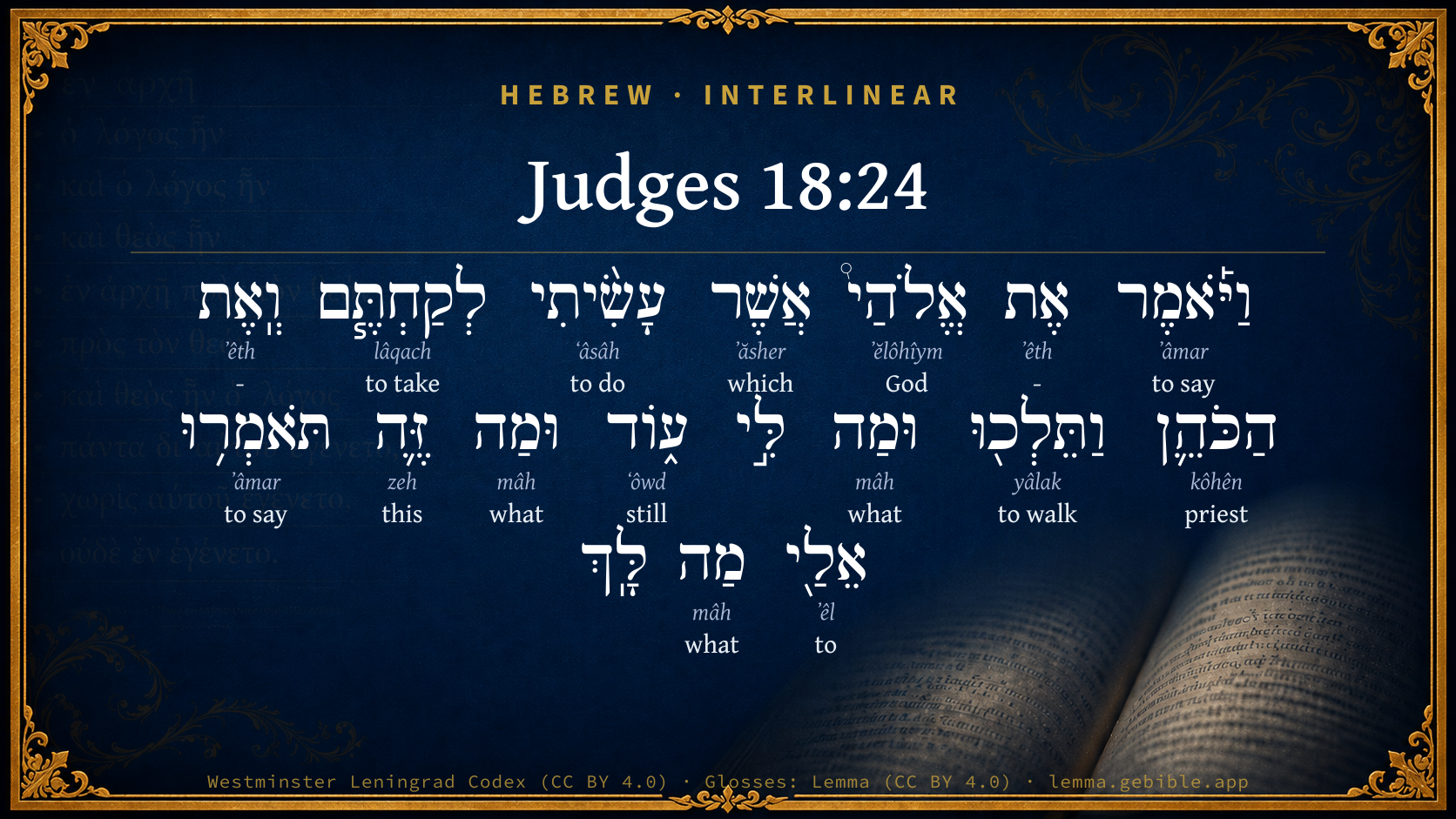
Hebrew (Westminster Leningrad Codex) Judges 18:24 appears in the Hebrew Old Testament. The text above is from the Westminster Leningrad Codex. Each word links to its Strong’s number, a concise gloss, and parsing drawn from the Open Scriptures Hebrew Bible morphology. Click any word for its full Brown-Driver-Briggs (BDB) entry.
Download image
Cite this verse

Judges 18:24 (World English Bible). Public Domain. Lemma interlinear Bible study tool, https://lemma.gebible.app/v/judges/18/24.

Show BibTeX & RIS
BibTeX
RIS
English Translation
He said, you have taken away my gods which I made, and the priest, and are gone away, and what have I more? and how then say you to me, What ails you?
World English Bible · Public Domain
Download a study sheet

One document with this verse’s original text, its word-by-word gloss line, the meaning frame, cross-references with their text, attributed commentary, and full source and license credits — printable, and it pastes into notes with its structure intact.

This verse Autodidact and up

Study sheet (.html) Plain text (.txt)

A passage Seminary Student

Up to 50 verses in one chapter. A passage sheet keeps up to 6 commentary sources and 12 cross-references per verse, in the order this page ranks them, and says so on the sheet whenever that leaves anything out. Ask for a single verse and you get the Autodidact verse sheet above.

Everything on this page stays free to read, with no account — the sheet is a download of what is already on screen, not access to it.

Want to remove ads? Support Godless Engineer
Compare translations 3

The same verse in 3 English versions, stacked beneath the original-language interlinear above. Click any original word for its lexicon entry.

Each is an independent rendering of the whole verse — the interlinear is not word-aligned to these translations.

Highlighted words mark where these versions differ — a whole-verse word diff, not a word-by-word alignment.

  • World English Bible Public Domain
    He said, you have taken away my gods which I made, and the priest, and are gone away, and what have I more? and how then say you to me, What ails you?
  • King James Version Public Domain
    And he said, Ye have taken away my gods which I made, and the priest, and ye are gone away: and what have I more? and what is this that ye say unto me, What aileth thee?
  • unfoldingWord Literal Text CC BY-SA 4.0
    And he said, “My gods, which I made, you took, and the priest, and you went. And what still to me? So what is this, you say to me, ‘What to you’?”

unfoldingWord Literal Text — © unfoldingWord, licensed CC BY-SA 4.0. Word-aligned USFM3 via Door43 (git.door43.org/unfoldingWord/en_ult).

Versions to compare (up to 4)

3 of 4 selected

Show all 18 translations

Every available English version of this verse, each an independent rendering of the whole verse.

  • World English Bible Public Domain
    He said, you have taken away my gods which I made, and the priest, and are gone away, and what have I more? and how then say you to me, What ails you?
  • Berean Standard Bible Public Domain
    He replied, “You took the gods I had made, and my priest, and went away. What else do I have? How can you say to me, ‘What is the matter with you?’”
  • Majority Standard Bible Public Domain
    He replied, “You took the gods I had made, and my priest, and went away. What else do I have? How can you say to me, ‘What is the matter with you?’”
  • King James Version Public Domain
    And he said, Ye have taken away my gods which I made, and the priest, and ye are gone away: and what have I more? and what is this that ye say unto me, What aileth thee?
  • American Standard Version (1901) Public Domain
    And he said, ye have taken away my gods which I made, and the priest, and are gone away, and what have I more? and how then say ye unto me, What aileth thee?
  • Revised Version (1885) Public Domain
    And he said, Ye have taken away my gods which I made, and the priest, and are gone away, and what have I more? and how then say ye unto me, What aileth thee?
  • Geneva Bible (1599) Public Domain
    And hee saide, Yee haue taken away my gods, which I made, and the Priest, and go your wayes: and what haue I more? howe then say ye vnto me, what ayleth thee?
  • Douay-Rheims (1899) Public Domain
    And he answered: You have taken away my gods which I have made me and the priest, and all that I have, and do you say: What aileth thee?
  • Young's Literal Translation Public Domain
    And he saith, `My gods which I made ye have taken, and the priest, and ye go; and what to me more? and what `is' this ye say unto me, What -- to thee!'
  • Literal Standard Version CC BY-SA 4.0
    And he says, “You have taken my gods which I made, and the priest, and you go; and what more do I [have]? And what [is] this you say to me, What [is this] to you?”
  • Unlocked Literal Bible CC BY-SA 4.0
    He said, “You stole the gods that I made, you have taken my priest, and you are leaving. What else do I have left? How can you ask me, 'What is bothering you?'”
  • unfoldingWord Literal Text CC BY-SA 4.0
    And he said, “My gods, which I made, you took, and the priest, and you went. And what still to me? So what is this, you say to me, ‘What to you’?”
  • Darby Bible Public Domain
    And he said, "You take my gods which I made, and the priest, and go away, and what have I left? How then do you ask me, 'What ails you?'"
  • World Messianic Bible Public Domain
    He said, “You have taken away my gods which I made, and the priest, and have gone away! What more do I have? How can you ask me, ‘What ails you?’”
  • Webster's Bible Public Domain
    And he said, Ye have taken away my gods which I made, and the priest, and ye have gone away: and what have I more? and what is this that ye say to me, What aileth thee?
  • Free Bible Version CC BY-SA 4.0
    “You stole the gods I made, and my priest too, and then left. What have you left me with? How can you ask me, ‘What's the matter with you?’”
  • Bible in Basic English Public Domain
    And he said, You have taken my gods which I made, and my priest, and have gone away; what is there for me now? Why then do you say to me, What is your trouble?
  • JPS Tanakh (1917) Public Domain
    And he said: 'Ye have taken away my god which I made, and the priest, and are gone away, and what have I more? and how then say ye unto me: What aileth thee?'

Literal Standard Version (2020), Covenant Press — licensed CC BY-SA 4.0. Text via the HelloAO Bible API (eBible.org). Unlocked Literal Bible (unfoldingWord) — licensed CC BY-SA 4.0. Text via the HelloAO Bible API (eBible.org). unfoldingWord Literal Text — © unfoldingWord, licensed CC BY-SA 4.0. Word-aligned USFM3 via Door43 (git.door43.org/unfoldingWord/en_ult). Free Bible Version, Dr. Jonathan Gallagher — licensed CC BY-SA 4.0. Text via the HelloAO Bible API (eBible.org).

Word by word

More ways to search: Search by grammar → Find every occurrence → Compare this word →

Practice this passage: Drill this verse → Learn its vocabulary →

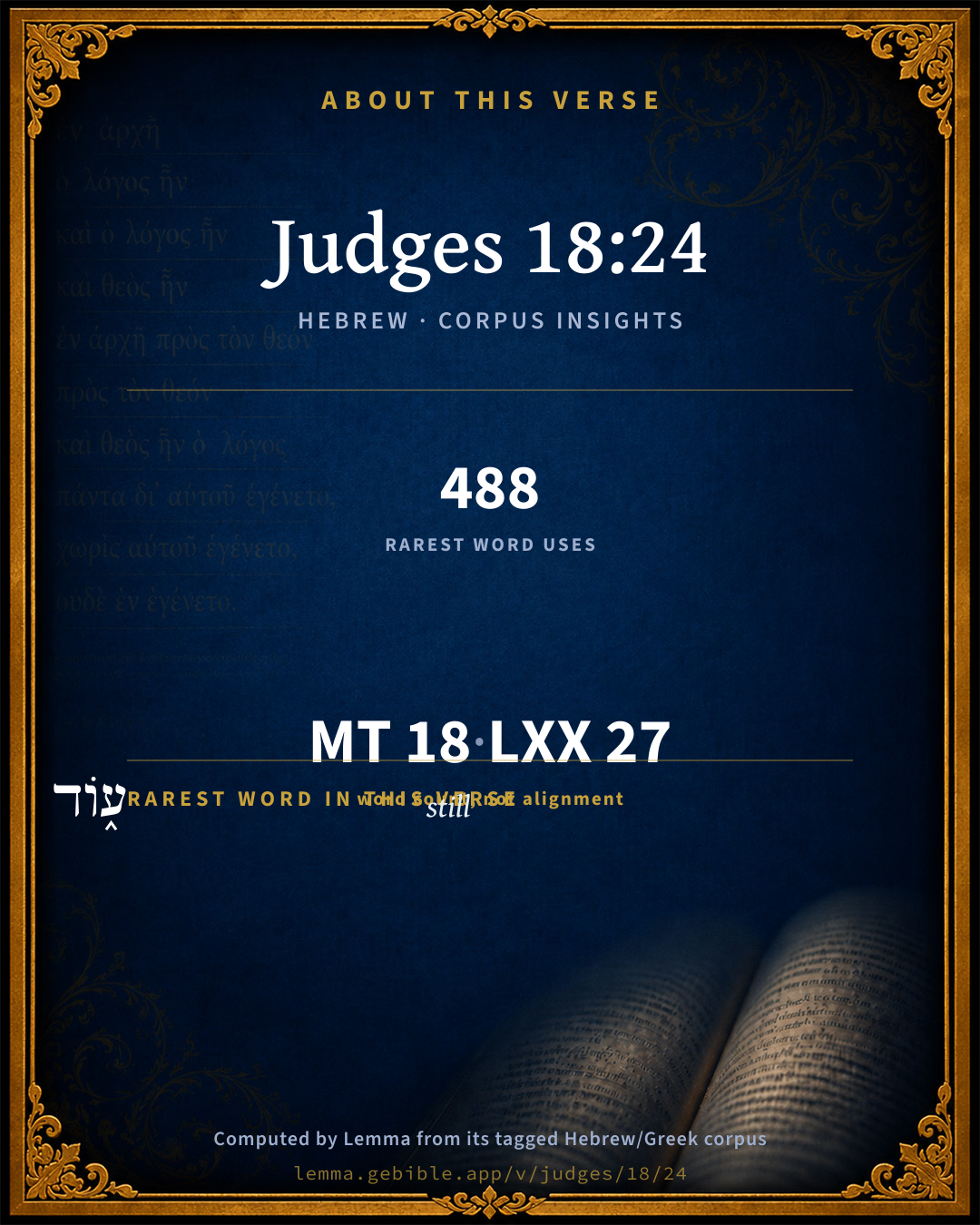
ע֑וֹד
ʻôwd
H5750
“still”
Adverb
Part of Speech
Adverb
Full BDB Definition

Origin: from H5749

TWOT: 1576a

a going round, continuance (substantive) - still, yet, again, besides (adverb) - still, yet (of continuance or persistence) - still, yet, more (of addition or repetition) - again - still, moreover, besides
  1. וַיֹּ֡אמֶר ʼâmar H559 “and · to say” Conjunction + Verb, Qal, Sequential Imperfect, 3rd Person, Masculine, Singular
  2. אֶת ʼêth H853 “-” Particle, Direct Object
  3. אֱלֹהַי֩ ʼĕlôhîym H430 “God(s) · my” Noun, Common, Masculine, Plural, Construct + Suffix, Personal, 1st Person, Common, Singular
  4. אֲשֶׁר ʼăsher H834 “which” Particle, Relative
  5. עָשִׂ֨יתִי ʻâsâh H6213 “to do” Verb, Qal, Perfect, 1st Person, Common, Singular
  6. לְקַחְתֶּ֧ם lâqach H3947 “to take” Verb, Qal, Perfect, 2nd Person, Masculine, Plural
  7. וְֽאֶת ʼêth H853 “and · -” Conjunction + Particle, Direct Object
  8. הַכֹּהֵ֛ן kôhên H3548 “the · priest” Particle, Definite Article + Noun, Common, Masculine, Singular, Absolute
  9. וַתֵּלְכ֖וּ yâlak H3212 “and · to walk” Conjunction + Verb, Qal, Sequential Imperfect, 2nd Person, Masculine, Plural
  10. וּמַה mâh H4100 “and · what” Conjunction + Particle, Interrogative
  11. וּמַה mâh H4100 “and · what” Conjunction + Particle, Interrogative
  12. זֶּ֛ה zeh H2088 “this” Pronoun, Demonstrative, Masculine, Singular
  13. תֹּאמְר֥וּ ʼâmar H559 “to say” Verb, Qal, Imperfect, 2nd Person, Masculine, Plural
  14. אֵלַ֖י ʼêl H413 “to · me” Preposition + Suffix, Personal, 1st Person, Common, Singular
  15. מַה mâh H4100 “what” Particle, Interrogative

About this verse

These counts appear in no published source. They are computed here, from the morphology-tagged text and Lemma’s own curated glosses. What Lemma adds →

18
words
12
distinct lemmas
Historical
section

Grammatical profile

  • 5 verbs
  • 2 nouns
  • 1 pronoun
  • 3 prepositions
  • 1 adverb
  • 6 particles

Verb forms

  • וַיֹּ֡אמֶר Qal · Sequential Imperfect
  • עָשִׂ֨יתִי Qal · Perfect
  • לְקַחְתֶּ֧ם Qal · Perfect
  • וַתֵּלְכ֖וּ Qal · Sequential Imperfect
  • תֹּאמְר֥וּ Qal · Imperfect

Repetition

Words recur within this verse — often emphatic in Hebrew:

  • וַיֹּ֡אמֶר to say H559 ×2
  • וּמַה what H4100 ×3

Hebrew & Septuagint length

In English translation the verse runs 33 words from the Hebrew and 36 from the Septuagint (LXX English) — closely comparable.

A rough comparison of the two English renderings, which tokenize alike — not a word-level alignment.

Word counts can differ between the Hebrew and the Greek without any difference in meaning — e.g. the Hebrew direct-object marker אֵת has no separate Greek word, and Greek often adds the article ὁ.

In the original languages it is 18 Hebrew tokens and 27 Greek tokens — but the two are counted differently (Hebrew bundles its prefixes and suffixes into one token; the Greek is in lemma form), so that isn’t a like-for-like length.

Cross-references

9

Topical passages linked to Judges 18:24 in the Treasury of Scripture Knowledge — connected by theme and wording, ordered by reader-vote popularity; previews shown in the World English Bible.

  • Habakkuk 2:18–19 "What value does the engraved image have, that its maker has engraved it; the molten image, even the teacher of lies, that he who fashions its form trusts in it, to make mute idols?
  • Psalms 115:8 Those who make them will be like them; Yes, everyone who trusts in them.
  • Isaiah 44:18–20 They don't know, neither do they consider: for he has shut their eyes, that they can't see; and their hearts, that they can't understand.
  • Judges 17:13 Then said Micah, Now know I that Yahweh will do me good, seeing I have a Levite to my priest.
  • Jeremiah 50:38 A drought is on her waters, and they shall be dried up; for it is a land of engraved images, and they are mad over idols.
  • Jeremiah 51:17 Every man is become brutish [and is] without knowledge; every goldsmith is disappointed by his image; for his molten image is falsehood, and there is no breath in them.
  • Ezekiel 23:5 Oholah played the prostitute when she was mine; and she doted on her lovers, on the Assyrians [her] neighbors,
  • Acts 19:26 You see and hear, that not at Ephesus alone, but almost throughout all Asia, this Paul has persuaded and turned away many people, saying that they are no gods, that are made with hands.
  • Revelation 17:2 with whom the kings of the earth committed sexual immorality, and those who dwell in the earth were made drunken with the wine of her sexual immorality."

Cross-references courtesy of OpenBible.info (CC BY 4.0).

Hebrew and Greek witnesses Masoretic Hebrew ↔ Greek Septuagint

The same verse in the two great witnesses to the Old Testament, shown verse-for-verse.

These are two independent witnesses, not word-aligned to each other, and the Septuagint is shown in lemma (dictionary) form.

Hebrew Judges 18:24 Masoretic · Westminster Leningrad Codex

וַיֹּ֡אמֶר אֶת אֱלֹהַי֩ אֲשֶׁר עָשִׂ֨יתִי לְקַחְתֶּ֧ם וְֽאֶת הַכֹּהֵ֛ן וַתֵּלְכ֖וּ וּמַה לִּ֣י ע֑וֹד וּמַה זֶּ֛ה תֹּאמְר֥וּ אֵלַ֖י מַה לָּֽךְ

He said, you have taken away my gods which I made, and the priest, and are gone away, and what have I more? and how then say you to me, What ails you?

World English Bible · Public Domain

Greek LXX Judges 18:24 Septuagint · lemma form

καί εἶπον μιχαιας ὅτι ὁ γλυπτός ἐγώ ὅς ποιέω λαμβάνω καί ὁ ἱερεύς καί πορεύομαι καί τίς ἐγώ ἔτι καί τίς οὗτος λέγω πρός ἐγώ τίς κράζω

And Michaias said, Because you⌃ have taken my graven image which I made, and my priest, and are gone; and what have I remaining? and what is this that you⌃ say to me, Why cry you?

LXX2012 (modern English Septuagint) · Public Domain

On this verse, Ellicott's Commentary for English Readers discusses the Septuagint’s reading. Read the note in Commentary ↓

Hebrew: Westminster Leningrad Codex (CC BY 4.0). Greek: Septuagint (public domain); English from LXX2012 (modern English Septuagint) (Public Domain). How the Septuagint differs from the Hebrew →

Targum (Aramaic paraphrase)

1

The Targum is the ancient Jewish Aramaic paraphrase of the Hebrew Scriptures — an interpretive translation, not the Hebrew text itself. Onkelos (literal) and Pseudo-Jonathan (expansive) render the Torah, and Jonathan the Prophets. Coverage is partial: where no permissively-licensed English translation exists for a verse, only the Aramaic is shown. This is verse-level text, not a word-by-word alignment to the Hebrew.

  1. Targum Jonathan Prophets (Joshua–Malachi)
    וַאֲמַר יַת דַחַלְתִּי דִי עֲבָדִית נְסֵיבְתּוּן וְיַת כַּהֲנָא וַאֲזַלְתּוּן וּמַה לִי עוֹד וּמַה דֵין תֵּימְרוּן לִי מַה לָךְ:

    (no public-domain English translation for this verse)

    Targum Jonathan — Aramaic: “Mikraot Gedolot” (public domain). English: “Sefaria Community Translation” (CC0 1.0 (public-domain dedication)); “London "Chaldee Paraphrase," 1871” (public domain). Text via Sefaria.

Commentary

Notes on Judges 18:24 from classic Christian and Jewish commentators (each source and its license shown beneath its notes). The classic Christian expositions comment on the surrounding passage and are grouped to its opening verse, so a note may address several verses; the Jewish commentaries on the Tanakh (Rashi and others) are per-verse, so they appear only where the commentator wrote on this verse.

Lemma curates 59 commentaries, every one of them public domain or Creative Commons licensed, each selected and text-cleaned for this edition rather than reprinted as found. About our sources →

Trapp's Complete Commentary

John Trapp

Jdg 18:24 And he said, Ye have taken away my gods which I made, and the priest, and ye are gone away: and what have I more? and what [is] this [that] ye say unto me, What aileth thee?

Ver. 24. My gods which I made.] Goodly gods that were made by man, and could not save themselves from being stolen! See Isa 44:9. So the breaden god among the Papists: together with their images, those carpenters’ chips, as Mrs. Cotismore called them. {a}

And what have I more?] The Vulgate hath it, All that I have: that is, all that I make any account of. He reckoned all the rest of his goods as nothing, having lost his gods; and came forth to fight for them, velut pro aris et focis. This superstitious zealot shall rise up in judgment against our lukewarm Laodiceans, our neuter passive professors, that care not what becomes of true religion, - modo ferveat olla, so the pot boil. God hath many such cold friends now-a-days. {1Ki 18:21}

{a} Act. and Mon., 763.

John Trapp, A Commentary or Exposition upon All the Books of the Old and New Testament (1647–1656) — public domain. Text from a community e-Sword module.

Joseph Benson's Commentary

Jdg 18:24. My gods which I made — Or, rather, my god, as the Hebrew word generally signifies, meaning the image, which he considered as a symbol of God’s presence with him; for he could not be so stupid as to think it to be the great Jehovah, who made heaven and earth, and whom he professed to worship, but merely as a medium through which he offered up his worship to him, as many of the heathen did. What have I more? — I value nothing I have in comparison of what you have taken away. Which zeal for idolatrous trash may shame multitudes that call themselves Christians, and yet value their worldly conveniences more than all the concerns of their own salvation. Is Micah thus fond of his false gods? And how ought we to be affected toward the true God? Let us reckon our communion with God our greatest gain; and the loss of God the sorest loss. Wo unto us, if He depart. For what have we more?

Joseph Benson's Commentary on the Old and New Testaments (1811–1818) — public domain. Text from a community e-Sword module.

Geneva Bible (1599)

Geneva Bible translators

This declareth what opinion the idolaters have of their idols.

Geneva Bible (1599) marginal notes — public domain. Text via Bolls.life.

Adam Clarke's Commentary

Verse 24. Ye have taken away my gods] As Micah was a worshipper of the true God, as we have seen, he cannot mean any kind of idols by the word אלהי elohai here used. He undoubtedly means those representations of Divine things, and symbols of the Divine presence such as the teraphim, ephod, c. for they are all evidently included under the word elohai, which we translate my gods.

Adam Clarke's Commentary on the Bible (1810–1826) — public domain. Text from a community e-Sword/MySword module.

Ellicott's Commentary for English Readers

(24) My gods which I made.—He does not scruple to call the pesel and teraphim “gods” (his Elohim), any more than the idolater Laban had done (Gen_30:31). The expression seems to be intended to show scorn for Micah; and perhaps it is from missing this element that the LXX. soften it down into “my graven image,” and the Chaldee to “my fear.” “My gods which I made” would be a very ordinary expression for the Greeks, who called a sculptor a “god-maker” (theopoios), but was startling on the lips of an Israelite. Micah pathetically asks “What have I more?” but we may well hope that his present loss was his ultimate gain, and that he found the true God in place of the lost gods which he had made.

A Bible Commentary for English Readers, edited by Charles John Ellicott (1878–1897) — public domain. Text from a community e-Sword module.

The Cambridge Bible for Schools and Colleges

gen. ed. J. J. S. Perowne

24. my gods which I made] Cf. Gen_31:30 ff. E, a passage which shews several points of resemblance to the present. For my gods, Vulgate deos meos, we might render my God, offensive though the idea is to us; Micah was a worshipper of Jehovah, see on Jdg_17:5. The LXX paraphrases ‘my graven image.’

The Cambridge Bible for Schools and Colleges (gen. ed. J. J. S. Perowne; Cambridge University Press, 1878–1918) — public domain. Text from a community e-Sword module.

John Gill's Exposition

And he said, ye have taken away my gods that I made,.... Meaning his graven and molten images, which he had made, or caused to be made, out of the silver his mother gave him, or however had paid for the making of; and though this might be an argument proving his right unto them, it was a very poor one in favour of their deity; and it is astonishing he should call them gods he knew the making of, and who could not save themselves from being stolen and carried off:

and the priest and ye are gone away; they had not only took away his gods, but the priest that sacrificed for him unto them, and assisted him in acts of devotion to them, or to God by them, and were gone off with both:

and what have I more? signifying, that all he had in the world, wife, children, and substance, were all nothing in comparison of these; there was nothing he so much valued as he did these, nor could he take any pleasure or comfort in anything, being deprived of them, so much was his heart set on them:

and what is this that ye say unto me, what aileth thee? what a question is this you ask, as if the injury done me was none at all, and that I had no reason to complain; that it was a trifling insignificant thing, worthy of no regard, when it was a matter of the greater moment and importance to him in life.

John Gill's Exposition of the Whole Bible (1746–1763) — public domain (CC PDM 1.0). Text via the HelloAO Bible API.

Matthew Poole's English Annotations

So far was he besotted with superstition and idolatry, that he esteemed those gods which were man’s work. But he could not be so stupid as to think these were indeed the great Jehovah that made heaven and earth; but only a lower sort of gods, by whom, as mediators, he offered up his worship unto the true God, as it is manifest divers of the heathens did.

What have I more? I value nothing I have in comparison of what you have taken away. Which zeal for idolatrous trash may shame multitudes that call themselves Christians, and yet apparently value their worldly conveniences more than all the concerns even of the true religion, and of their own salvation.

Matthew Poole's English Annotations on the Holy Bible (1683–1685) — public domain. Text from a community e-Sword/MySword module.

Whedon's Commentary on the Bible

Daniel D. Whedon

24. My gods — This language of Micah shows that, however earnest and deep was his desire to serve and please Jehovah, his sanctuary and images had already carried him far towards idolatry.

Daniel D. Whedon (gen. ed.), Commentary on the Old and New Testaments (1874–1909) — public domain. Text from a community e-Sword module.

The Pulpit Commentary

My gods, or, as some render it, my god. But the plural is probably right, as Micah was thinking of the molten and graven images, and the teraphim, and called them gods, without perhaps meaning to imply that there was any God but Jehovah.

The lost gods.

Micah"s distress at the loss of his gods and priest may be regarded on two sides on the side of superstition and on that of genuine devotion.

I THE SUPERSTITIOUS SIDE OF MICAH"S DISTRESS.

1. The god that can be stolen must be no true God. Micah should have seen the folly of his idolatry in the catastrophe which had befallen him. If the idols could not protect their own shrine, what could they do for their owner"s home?

2. The man whose character is corrupt is worthless as a priest. Yet after the Levite had behaved in the vilest way Micah still felt the loss of him bitterly. This distress came from his superstitious belief in the efficacy of the residence of an official priest in his house, no matter what was the baseness of the man"s character or the emptiness of his services.

3. A religion which depends on any material things or human offices for its efficacy is foreign to the character of the spiritual worship of the true God. It was a mistake for Micah to suppose that he would lose the presence of God by losing the images which he had made, or the blessing of God by losing his priest. Nothing that is done to a man"s outside life can affect his religious blessings. God dwells in the shrine of the heart. No persecution can rob us of his presence. The Waldenses in their mountain cave had lost every earthly comfort, but they had not lost God. God"s blessings are not dependent on external ordinances, though these are the usual channels through which they flow. If we have no visible temple, altar, priest, or service, God can still bless us fully.

II THE NATURAL SIDE OF MICAH"S DISTRESS. There is much in it which speaks well for Micah. Micah is a religious man. To him the loss of what he believes to be the source of religious blessings is a great trouble. Are not they who can lose the real presence of God in their hearts without any feeling of compunction far more astray than this man with all his idolatry and superstition? God is the light and life of the soul. How strange then that any should live without him and yet not know that anything "aileth" them! But whatever a man makes into a god for himself will interest him deeply. If he makes a god of his money, his art, his child, the loss of his god will plunge him into the darkness of despair.

1. Since we are thus deeply affected by the object of our supreme devotion, let us see that this is no earthly thing which can be stolen or destroyed, but the true, eternal God who will never leave us.

2. God sometimes takes from us the earthly treasures of which we have made gods that we may see the mistake of our idolatry, and so learn to lift up our hearts to the ever-abiding presence. A.

The Pulpit Commentary (1880–1919), ed. H.D.M. Spence-Jones & Joseph S. Exell — public domain. Text from a community e-Sword module.

John Wesley's Explanatory Notes

I made - So far was he besotted with superstition and idolatry, that he esteemed those gods, which were man's work. But he could not be so stupid, as to think these were indeed the great Jehovah that made heaven and earth; but only a lower sort of gods, by whom, as mediators, he offered up his worship to the true God, as divers of the Heathen did. What have I - I value nothing I have in comparison of what you have taken away. Which zeal for idolatrous trash may shame multitudes that call themselves Christians, and yet value their worldly conveniences more than all the concerns of their own salvation. Is Micah thus fond of his false gods? And how ought we to be affected toward the true God? Let us reckon our communion with God our greatest gain; and the loss of God the sorest loss. Wo unto us, if He depart! For what have we more.

John Wesley, Explanatory Notes Upon the Whole Bible (1754–1765) — public domain. Text via the GEBible commentary corpus.

Keil & Delitzsch

C. F. Keil & F. Delitzsch

And when he replied, "Ye have taken away my gods which I made, and the priest, and have departed; what is there still to me (what have I left)? and how can ye say to me, What is to thee?" they ordered him to be silent, lest he should forfeit his life: "Let not thy voice be heard among us, lest men of savage disposition (נפשׁ מרי as in Sa2 17:8) should fall upon thee (vid., Jdg 15:12; Jdg 8:21, etc.), and thou shouldst not save thy life and that of thy household," i.e., shouldst bring death upon thyself and thy family. ואספתּה is also dependent upon פּן.

Keil & Delitzsch — Biblical Commentary on the Old Testament (1861–1891) — public domain (CC PDM 1.0). Text via the HelloAO Bible API. (Old Testament only.)

unfoldingWord translationNotes

Door43 World Missions Community

the gods that I made

Micah did not make his gods, rather the craftsman made them. AT: "the gods which I had made for me" or "the gods which a craftsman made for me" (See: Metonymy)

What else do I have left?

Micah asks this question to emphasize that he no longer has the things that are important to him. AT: "I have nothing left." or "You have taken everything that is important to me." (See: Rhetorical Question)

How can you ask me, 'What is bothering you?'

Micah asks this question to emphasize that the Danites definitely know what is bothering him. AT: "You know that I am greatly distressed!'" or "You know how much I am bothered by what you have done to me!'" (See: Rhetorical Question)

let us hear you say anything

The phrase "us hear you say" refers to the Danites hearing Micah speaking about what had happened, but it also includes if they are told by others that Micah had spoken about what had happened. AT: "let us find out that you have said anything" or "say anything about this" (See: Metonymy)

hear you say anything

The word "anything" refers to any information about the Danites coming to Micah's house and stealing his idols. This can be stated clearly. AT: "hear you say anything about this matter" or "hear you say anything about what has happened" (See: Assumed Knowledge and Implicit Information)

you and your family will be killed

This can be stated in active form. AT: "kill you and your family" (See: Active or Passive)

went their way

This means that they continued on their journey. AT: "continued on their journey" or "continued travelling" (See: Idiom)

they were too strong for him

This refers to the Danites being too strong for Micah and his men to fight against. AT: "they were too strong for him and his men to fight" (See: Assumed Knowledge and Implicit Information)

translationWords

false god

priest

people group

Dan

anger

unfoldingWord translationNotes — © Distant Shores Media and the Door43 World Missions Community, licensed CC BY-SA 4.0. Source: git.door43.org/Door43/en_tn.

Rashi

Rabbi Shlomo Yitzchaki (Rashi)

What else do I have. What else remains for me?

Rashi on the Tanakh — English translations: “The Judaica Press complete Tanach with Rashi, translated by A. J. Rosenberg” (CC BY 4.0); “Pentateuch with Rashi's commentary by M. Rosenbaum and A.M. Silbermann, 1929-1934” (public domain); “The Metsudah Tanach series, Lakewood, N.J” (CC BY 4.0); and “The Book of Joshua, Metsudah Publications, 1997” (CC BY 4.0). Text via Sefaria.

Lesson kit

Teaching starters — assembled from the data on this page, not authored interpretation. Every prompt links to the verse data it draws on. Edit before teaching.

Judges, in the Historical, opens this verse with 18 words (12 distinct Hebrew lemmas). Its most distinctive word is ʻôwd (“still”). A historical commentator’s framing appears above. Read the whole chapter for the surrounding context.

Discussion questions

  1. What does “still” (ʻôwd) contribute to the verse as a whole?
  2. How does Habakkuk 2:18–19, which shares this passage’s theme, read alongside this verse?
  3. What does the repetition of “to say” (2× in this one verse) do in this verse?
  4. These translations render this verse differently; the difference is in the English rendering, not the original. What questions does that raise?
  5. «וַיֹּ֡אמֶר» is a Qal Sequential Imperfect verb. How does that grammatical form shape the action described?
  6. Compare how Trapp's Complete Commentary and Joseph Benson's Commentary read this verse. Where do they agree or differ?

Things to notice

Reading settings

Reading text

Shown beneath each verse's original-language words.

Old Testament
Old Testament edition

Read the OT as the Masoretic Hebrew (MT) or the Greek Septuagint (LXX).

English shown for the Greek Septuagint (in the Hebrew ↔ Greek comparison).

Comparing translations? Open the Compare panel on any verse page to stack up to four side by side.