Psalms 68:4

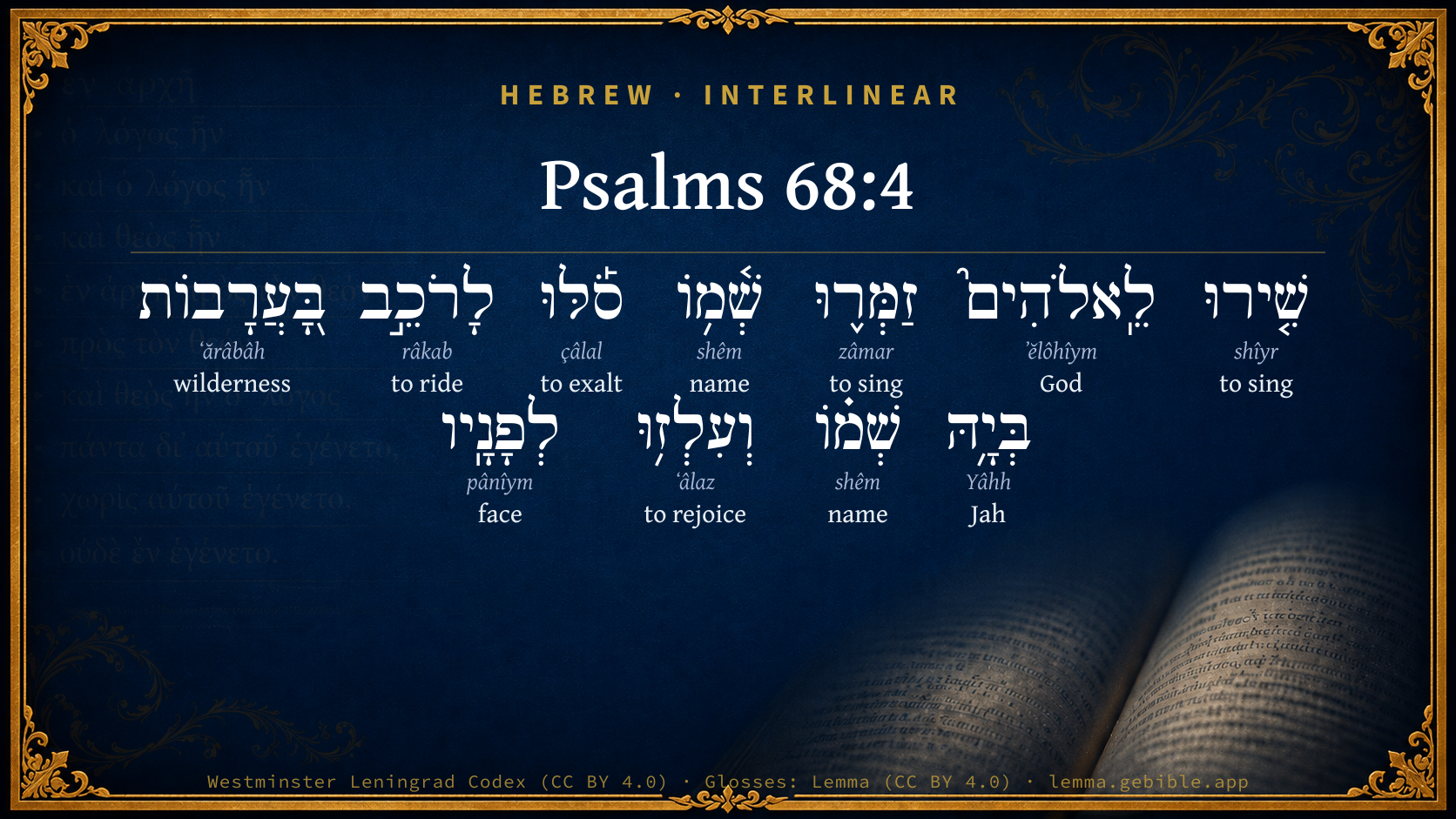
Hebrew (Westminster Leningrad Codex) Psalms 68:4 appears in the Hebrew Old Testament. The text above is from the Westminster Leningrad Codex. Each word links to its Strong’s number, a concise gloss, and parsing drawn from the Open Scriptures Hebrew Bible morphology. Click any word for its full Brown-Driver-Briggs (BDB) entry.
Download image
Cite this verse

Psalms 68:4 (World English Bible). Public Domain. Lemma interlinear Bible study tool, https://lemma.gebible.app/v/psalms/68/4.

Show BibTeX & RIS
BibTeX
RIS
English Translation
Sing to God! Sing praises to his name! Extol him who rides on the clouds: To Yah, his name! Rejoice before him!
World English Bible · Public Domain
Download a study sheet

One document with this verse’s original text, its word-by-word gloss line, the meaning frame, cross-references with their text, attributed commentary, and full source and license credits — printable, and it pastes into notes with its structure intact.

This verse Autodidact and up

Study sheet (.html) Plain text (.txt)

A passage Seminary Student

Up to 50 verses in one chapter. A passage sheet keeps up to 6 commentary sources and 12 cross-references per verse, in the order this page ranks them, and says so on the sheet whenever that leaves anything out. Ask for a single verse and you get the Autodidact verse sheet above.

Everything on this page stays free to read, with no account — the sheet is a download of what is already on screen, not access to it.

Want to remove ads? Support Godless Engineer
Compare translations 3

The same verse in 3 English versions, stacked beneath the original-language interlinear above. Click any original word for its lexicon entry.

Each is an independent rendering of the whole verse — the interlinear is not word-aligned to these translations.

Highlighted words mark where these versions differ — a whole-verse word diff, not a word-by-word alignment.

  • World English Bible Public Domain
    Sing to God! Sing praises to his name! Extol him who rides on the clouds: To Yah, his name! Rejoice before him!
  • King James Version Public Domain
    Sing unto God, sing praises to his name: extol him that rideth upon the heavens by his name JAH, and rejoice before him.
  • unfoldingWord Literal Text CC BY-SA 4.0
    Sing to God, make music his name, lift up to the one riding over the plains. In Yah his name; yes, exult to his face.

unfoldingWord Literal Text — © unfoldingWord, licensed CC BY-SA 4.0. Word-aligned USFM3 via Door43 (git.door43.org/unfoldingWord/en_ult).

Versions to compare (up to 4)

3 of 4 selected

Show all 18 translations

Every available English version of this verse, each an independent rendering of the whole verse.

  • World English Bible Public Domain
    Sing to God! Sing praises to his name! Extol him who rides on the clouds: To Yah, his name! Rejoice before him!
  • Berean Standard Bible Public Domain
    Sing to God! Sing praises to His name. Exalt Him who rides on the clouds—His name is the LORD—and rejoice before Him.
  • Majority Standard Bible Public Domain
    Sing to God! Sing praises to His name. Exalt Him who rides on the clouds—His name is the LORD—and rejoice before Him.
  • King James Version Public Domain
    Sing unto God, sing praises to his name: extol him that rideth upon the heavens by his name JAH, and rejoice before him.
  • American Standard Version (1901) Public Domain
    Sing unto God, sing praises to his name: Cast up a highway for him that rideth through the deserts; His name is Jehovah; and exult ye before him.
  • Revised Version (1885) Public Domain
    Sing unto God, sing praises to his name: cast up a highway for him that rideth through the deserts; his name is JAH; and exult ye before him.
  • Geneva Bible (1599) Public Domain
    Sing vnto God, and sing prayses vnto his name: exalt him that rideth vpon the heauens, in his Name Iah, and reioyce before him.
  • Douay-Rheims (1899) Public Domain
    And let the just feast, and rejoice before God: and be delighted with gladness.
  • Young's Literal Translation Public Domain
    Sing ye to God -- praise His name, Raise up a highway for Him who is riding in deserts, In Jah `is' His name, and exult before Him.
  • Literal Standard Version CC BY-SA 4.0
    Sing to God—praise His Name, || Raise up a highway for Him who is riding in deserts, || In YAH [is] His Name, and exult before Him.
  • Unlocked Literal Bible CC BY-SA 4.0
    Sing to God! Sing praises to his name! Praise the one who rides through the plains of the Jordan River valley! Yahweh is his name! Rejoice before him!
  • unfoldingWord Literal Text CC BY-SA 4.0
    Sing to God, make music his name, lift up to the one riding over the plains. In Yah his name; yes, exult to his face.
  • Darby Bible Public Domain
    Sing unto God, sing forth his name; cast up a way for him that rideth in the deserts: his name is Jah; and rejoice before him.
  • World Messianic Bible Public Domain
    Sing to God! Sing praises to his name! Extol him who rides on the clouds: to the LORD, his name! Rejoice before him!
  • Webster's Bible Public Domain
    \\68:3\\But let the righteous be glad; let them rejoice before God: yes, let them exceedingly rejoice.
  • Free Bible Version CC BY-SA 4.0
    Sing praises to God! Sing praises to his wonderful reputation! Praise the rider of the clouds—his name is the Lord! Be happy in his presence!
  • Bible in Basic English Public Domain
    Make songs to God, make songs of praise to his name; make a way for him who comes through the waste lands; his name is Jah; be glad before him.
  • JPS Tanakh (1917) Public Domain
    (68-5) Sing unto God, sing praises to His name; extol Him that rideth upon the skies, whose name is the LORD; and exult ye before Him.

Literal Standard Version (2020), Covenant Press — licensed CC BY-SA 4.0. Text via the HelloAO Bible API (eBible.org). Unlocked Literal Bible (unfoldingWord) — licensed CC BY-SA 4.0. Text via the HelloAO Bible API (eBible.org). unfoldingWord Literal Text — © unfoldingWord, licensed CC BY-SA 4.0. Word-aligned USFM3 via Door43 (git.door43.org/unfoldingWord/en_ult). Free Bible Version, Dr. Jonathan Gallagher — licensed CC BY-SA 4.0. Text via the HelloAO Bible API (eBible.org).

Word by word

More ways to search: Search by grammar → Find every occurrence → Compare this word →

Practice this passage: Drill this verse → Learn its vocabulary →

סֹ֡לּוּ
çâlal
H5549
“exalt”
Verb, Qal, Imperative, 2nd Person, Masculine, Plural
Part of Speech
Verb
Stem
Qal
Form
Imperative
Person
2nd Person
Gender
Masculine
Number
Plural
Full BDB Definition

Origin: a primitive root

TWOT: 1506

to lift up, cast up, exalt - (Qal) - to cast up a highway - to cast up a way - to lift up (of song) - (Pilpel) to exalt, esteem highly, prize - (Hithpoel) to exalt oneself
  1. שִׁ֤ירוּ shîyr H7891 “sing” Verb, Qal, Imperative, 2nd Person, Masculine, Plural
  2. לֵֽאלֹהִים֮ ʼĕlôhîym H430 “to/for · God(s)” Preposition + Noun, Common, Masculine, Plural, Absolute
  3. זַמְּר֪וּ zâmar H2167 “sing” Verb, Piel, Imperative, 2nd Person, Masculine, Plural
  4. שְׁ֫מ֥וֹ shêm H8034 “name · his” Noun, Common, Masculine, Singular, Construct + Suffix, Personal, 3rd Person, Masculine, Singular
  5. לָרֹכֵ֣ב râkab H7392 “to/for the · riding” Preposition, Determined + Verb, Qal, Participle Active, Masculine, Singular, Absolute
  6. בָּ֭עֲרָבוֹת ʻărâbâh H6160 “in/at the · wildernesses” Preposition, Determined + Noun, Common, Feminine, Plural, Absolute
  7. בְּיָ֥הּ Yâhh H3050 “in/at · Jah” Preposition + Noun, Proper
  8. שְׁמ֗וֹ shêm H8034 “name · his” Noun, Common, Masculine, Singular, Construct + Suffix, Personal, 3rd Person, Masculine, Singular
  9. וְעִלְז֥וּ ʻâlaz H5937 “and · rejoice” Conjunction + Verb, Qal, Imperative, 2nd Person, Masculine, Plural
  10. לְפָנָֽיו pânîym H6440 “to/for · face(s) · his” Preposition + Noun, Common, Both, Plural, Construct + Suffix, Personal, 3rd Person, Masculine, Singular

About this verse

These counts appear in no published source. They are computed here, from the morphology-tagged text and Lemma’s own curated glosses. What Lemma adds →

11
words
10
distinct lemmas
Wisdom
section

Notable vocabulary

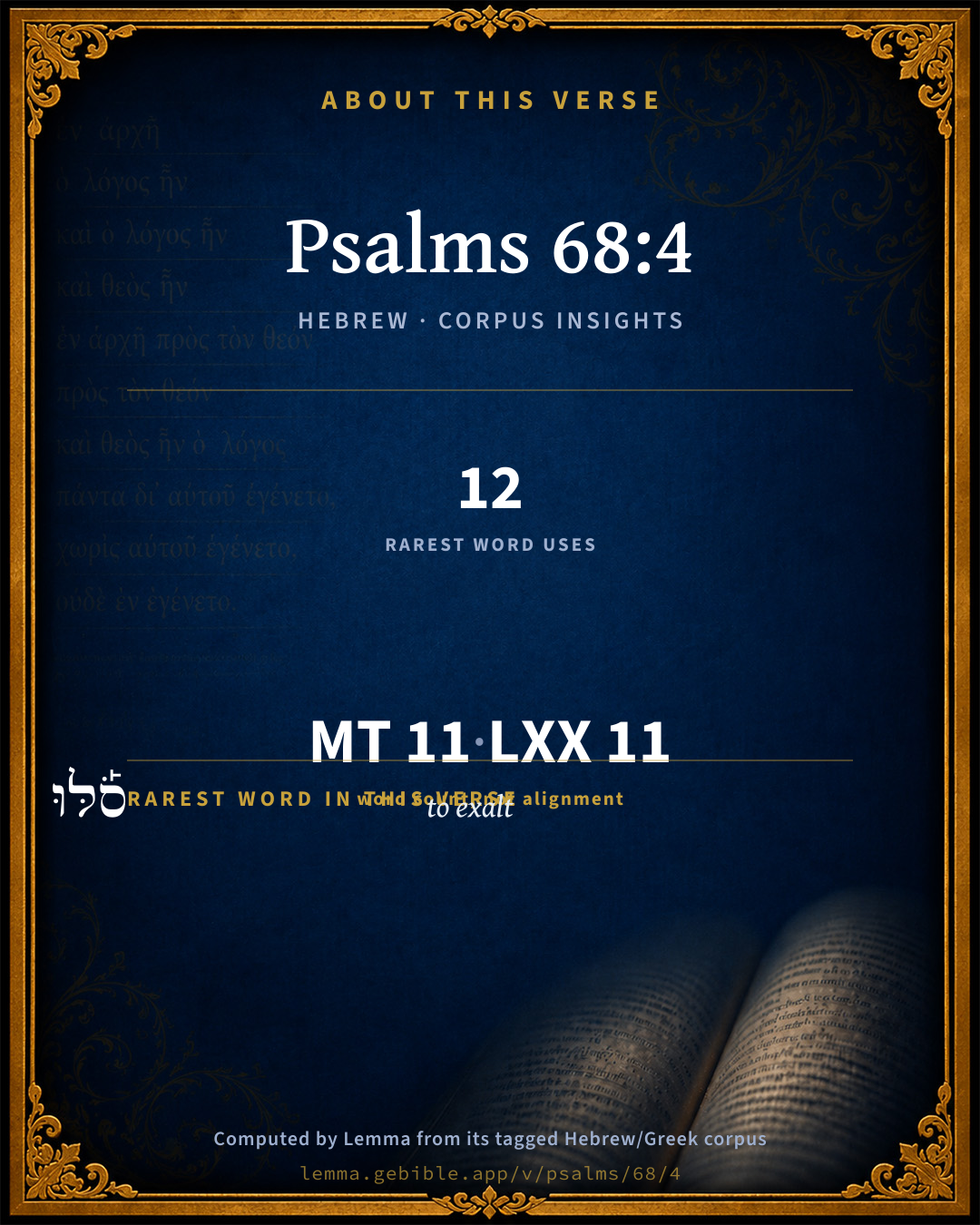
The rarest word here is סֹ֡לּוּ to exalt H5549 — appearing just 12 times in the whole Hebrew Bible.

Shared distinctive vocabulary

סֹ֡לּוּ to exalt H5549 occurs in 10 verses of the Hebrew Bible. Also found in:

Grammatical profile

  • 5 verbs
  • 6 nouns

Verb forms

  • שִׁ֤ירוּ Qal · Imperative
  • זַמְּר֪וּ Piel · Imperative
  • סֹ֡לּוּ Qal · Imperative
  • לָרֹכֵ֣ב Qal · Participle Active
  • וְעִלְז֥וּ Qal · Imperative

Repetition

A word recurs within this verse — often emphatic in Hebrew:

  • שְׁ֫מ֥וֹ name H8034 ×2

Hebrew & Septuagint length

In English translation the verse runs 22 words from the Hebrew and 36 from the Septuagint (LXX English) — closely comparable.

A rough comparison of the two English renderings, which tokenize alike — not a word-level alignment.

Word counts can differ between the Hebrew and the Greek without any difference in meaning — e.g. the Hebrew direct-object marker אֵת has no separate Greek word, and Greek often adds the article ὁ.

In the original languages it is 11 Hebrew tokens and 11 Greek tokens — but the two are counted differently (Hebrew bundles its prefixes and suffixes into one token; the Greek is in lemma form), so that isn’t a like-for-like length.

Cross-references

15

Topical passages linked to Psalms 68:4 in the Treasury of Scripture Knowledge — connected by theme and wording, ordered by reader-vote popularity; previews shown in the World English Bible.

  • Deuteronomy 33:26 There is none like God, Jeshurun, Who rides on the heavens for your help, In his excellency on the skies.
  • Isaiah 12:4–6 In that day you will say, "Give thanks to Yahweh! Call on his name. Declare his doings among the peoples. Proclaim that his name is exalted!
  • Psalms 66:4 All the earth will worship you, And will sing to you; They will sing to your name." Selah.
  • Psalms 104:3 He lays the beams of his chambers in the waters. He makes the clouds his chariot. He walks on the wings of the wind.
  • Psalms 66:2 Sing to the glory of his name! Offer glory and praise!
  • Psalms 68:33 To him who rides on the heaven of heavens, which are of old; Behold, he utters his voice, a mighty voice.
  • Exodus 6:3 and I appeared to Abraham, to Isaac, and to Jacob, as God Almighty; but by my name Yahweh I was not known to them.
  • Psalms 18:10 He rode on a cherub, and flew. Yes, he soared on the wings of the wind.
  • Psalms 67:4 Oh let the nations be glad and sing for joy, For you will judge the peoples with equity, And govern the nations on earth. Selah.
  • Isaiah 40:3 The voice of one who cries, Prepare you in the wilderness the way of Yahweh; make level in the desert a highway for our God.
  • Exodus 3:14 God said to Moses, "I AM WHO I AM," and he said, "You shall tell the children of Israel this: "I AM has sent me to you."
  • Exodus 6:8 I will bring you into the land which I swore to give to Abraham, to Isaac, and to Jacob; and I will give it to you for a heritage: I am Yahweh.'"
  • Psalms 83:18 That they may know that you alone, whose name is Yahweh, Are the Most High over all the earth.
  • Isaiah 19:1 The burden of Egypt. Behold, Yahweh rides on a swift cloud, and comes to Egypt: and the idols of Egypt shall tremble at his presence; and the heart of Egypt shall melt in the midst of it.
  • Isaiah 62:10 Go through, go through the gates; prepare you the way of the people; cast up, cast up the highway; gather out the stones; lift up an ensign for the peoples.

Cross-references courtesy of OpenBible.info (CC BY 4.0).

Hebrew and Greek witnesses Masoretic Hebrew ↔ Greek Septuagint

The same verse in the two great witnesses to the Old Testament, shown verse-for-verse.

You’re reading Greek Psalm 67 (Hebrew Psalm 68). The Septuagint counts the superscription, so verse numbers can differ from the Hebrew — chapter-level alignment, not verse-by-verse. Numbering follows Rahlfs.

These are two independent witnesses, not word-aligned to each other, and the Septuagint is shown in lemma (dictionary) form.

Hebrew Psalms 68:4 Masoretic · Westminster Leningrad Codex

שִׁ֤ירוּ לֵֽאלֹהִים֮ זַמְּר֪וּ שְׁ֫מ֥וֹ סֹ֡לּוּ לָרֹכֵ֣ב בָּ֭עֲרָבוֹת בְּיָ֥הּ שְׁמ֗וֹ וְעִלְז֥וּ לְפָנָֽיו

Sing to God! Sing praises to his name! Extol him who rides on the clouds: To Yah, his name! Rejoice before him!

World English Bible · Public Domain

Greek LXX Greek Psalm 67:4 Septuagint · lemma form

καί ὁ δίκαιος εὐφραίνω ἀγαλλιάομαι ἐνώπιον ὁ θεός τέρπω ἐν εὐφροσύνη

Sing to God, sing praises to his name: make a way for him that rides upon the west (the Lord is his name) and exult before him. They shall be troubled before the face of him,

LXX2012 (modern English Septuagint) · Public Domain

On this verse, Trapp's Complete Commentary discusses the Septuagint’s reading. Read the note in Commentary ↓

Hebrew: Westminster Leningrad Codex (CC BY 4.0). Greek: Septuagint (public domain); English from LXX2012 (modern English Septuagint) (Public Domain). How the Septuagint differs from the Hebrew →

Commentary

Notes on Psalms 68:4 from classic Christian and Jewish commentators (each source and its license shown beneath its notes). The classic Christian expositions comment on the surrounding passage and are grouped to its opening verse, so a note may address several verses; the Jewish commentaries on the Tanakh (Rashi and others) are per-verse, so they appear only where the commentator wrote on this verse.

Lemma curates 59 commentaries, every one of them public domain or Creative Commons licensed, each selected and text-cleaned for this edition rather than reprinted as found. About our sources →

Trapp's Complete Commentary

John Trapp

Psa 68:4 Sing unto God, sing praises to his name: extol him that rideth upon the heavens by his name JAH, and rejoice before him.

Ver. 4. Sing unto God, sing praises] Cantate, Psallite, do it daily and duly, not in a customary, formal, bedulling way. For a help hereunto was this psalm penned, quo nihil ornatius, magnificentius, divinius denique scribi a quoquam possit, saith learned Beza, in a lofty and lively style.

Extol him that rideth upon the heavens] Exalt him so, as when a heap is made up unto a great height. Beza rendereth it, Sternite viam equiti deserti, Cast up or pave the way for him that rideth in the desert. Confer Isa 40:3-4 Mal 3:1 Mat 3:3. The Septuagint render it, οδοποιησατε, Raise up the way, and make it ready (as they use to do before kings that ride in triumph), that the King of glory may come into your hearts, those deserts indeed.

By his name Jah] The same with Jehovah, that proper and incommunicable name of God. Some of the heathens called it Jao, as Diodorus Siculus, Macrobius, &c. Holy and reverend is this name, Aυταυτος, Essentiator, and it is here and elsewhere given to Christ. See it interpreted Rev 1:4.

John Trapp, A Commentary or Exposition upon All the Books of the Old and New Testament (1647–1656) — public domain. Text from a community e-Sword module.

The Biblical Illustrator

Joseph S. Exell

Psa_68:4

Sing unto God.

The service of song

The spirit of holy song is not confined to any denomination. It is given as a precious boon to kings and shepherds, rich and poor, bond and free, men and women, Catholic and Protestant, Moravian, Quaker and Baptist. We are growing in the charity of Christ. There was a time when our hymnology was intensely sectarian. We put our creeds into song, and we would sing only our own poets. We actually argued on disputed doctrines in our sacred songs. Controversy made discord in the songs of Zion. But we see happier days. So then if we have the gift of song consecrate it to the service of God. And let all sing, and sing heartily, in the public assembly. Every heart for God, every life for God, every song for God! This is the sublime sight we long to see, and for which the watching angels wait. (G. W. McCree.)

Joyfulness a Christian duty

It is necessary for some people to remember that cheerfulness, good spirits, lightheartedness, merriment, are not unchristian or unsaintly. We do not please God more by eating bitter aloes than by eating honey. A cloudy, foggy, rainy day is not more heavenly than a day of sunshine. A funeral march is not so much like the music of angels as the songs of birds on a May morning. There is no more religion in the gaunt, naked forest in winter than in the laughing blossoms of the spring and the rich, ripe fruits of autumn. It was not the pleasant things in the world that came from the devil and the dreary things from God; it was sin brought death into the world and all its woe; as the sin vanishes the woe will vanish too. God Himself is the ever blessed God. He dwells in the light of joy as well as of purity, and instead of becoming more like Him as we become more miserable, and as all the brightness and glory of life are extinguished, we become more like God as our blessedness becomes more complete. (R. W. Dale, D. D.)

The Biblical Illustrator, edited by Joseph S. Exell (c. 1880s–1900s) — public domain. Text from a community e-Sword module.

Joseph Benson's Commentary

Psa 68:4. Sing unto God, &c. — “The prophet here exhorts the people of God to magnify with Psalms, and hymns, and spiritual songs, the eternal and incommunicable name of Him who was, and is, and is to come; who, deriving being from none, gives it to all, and who, as Redeemer of his people, is exalted above the heavens, and all the powers therein, above the gods of the nations; is acknowledged and glorified by saints and angels; feared and trembled at by ungodly men and evil spirits.” — Horne. Extol him, &c. — Hebrew, cast up, or prepare the way, for him that rideth through the deserts, or, that did ride in the desert, namely, manifested his presence between the cherubim upon the mercy-seat of the ark, when it was carried through the wilderness; or marched along with it in the cloudy pillar. Or, that now rideth, as in the desert, that is, whose ark, with which he is present, is now carried from place to place, as it was in the desert. This construction is most agreeable to the common usage of the original words here employed, סלו, sollu, rendered extol, properly meaning, to cast up, or prepare a way; and ערבות, gnaraboth, translated heavens, generally signifying the deserts, or plain fields. By his name Jah — Whereby he is known and distinguished from all false gods, Jah being, no doubt, an abbreviation of the name Jehovah, which the heathen pronounced Jao. And rejoice before him — Before the ark, with which he is present. Thus David is said to have danced before the Lord on this occasion.

Joseph Benson's Commentary on the Old and New Testaments (1811–1818) — public domain. Text from a community e-Sword module.

J. A. Alexander on Psalms

Joseph Addison Alexander

5. (Psa 68:4). Sing unto God, celebrate his name, cast up (a highway) for the (one) riding through the deserts, by his name Jah, and exult before him. The second clause alludes to the opening of roads for kings and armies. Compare Isa 40:3, Mal 3:1. The common version of the verb conveys an idea wholly foreign from the usage of the Hebrew word. Riding, i.e. journeying, or giving it a military application, marching. The common version of the next noun (heavens) is entirely unauthorised by usage. The Hebrew word is one still applied by the Arabs to the region over which the Israelites wandered forty years. The idea here suggested is more fully carried out in Psa 68:7-9. By his name Jah, i.e. in the character denoted by this name, which is an abbreviation of Jehovah, peculiar to the song of Moses (Exo 15:2) and the later imitations of it. See my notes on Isa 12:2; Isa 38:11. The people are summoned to prepare for the reception of this glorious visitor.

Joseph Addison Alexander, The Psalms Translated and Explained (1850) — public domain. Text from a community e-Sword module.

Tyndale Open Study Notes

Tyndale Open Resources

68:4-6 The psalmist praises God’s powerful and compassionate reign.

68:4 him who rides the clouds: This is an ancient description of Baal, a Canaanite deity. The psalmist applies it to the Lord as the true “Rider of the Clouds” (see 68:33; 104:3). God wields power over the clouds and the rain.

Tyndale Open Study Notes — © Tyndale Open Resources, licensed CC BY-SA 4.0. Text via the HelloAO Bible API.

Geneva Bible (1599)

Geneva Bible translators

Yah and Jehovah are the names of God, which do signify his essence and majesty incomprehensible, so that hereby is declared that all idols are but vanity, and that the God of Israel is the only true God.

Geneva Bible (1599) marginal notes — public domain. Text via Bolls.life.

Jamieson, Fausset & Brown

Robert Jamieson, A. R. Fausset & David Brown

extol him . . . heavens--literally, "cast up for Him who rideth in the deserts," or "wilderness" (compare Psa 68:7), alluding to the poetical representation of His leading His people in the wilderness as a conqueror, before whom a way is to be prepared, or "cast up" (compare Isa 40:3; Isa 62:10).

by his name JAH--or, "Jehovah," of which it is a contraction (Exo 15:3; Isa 12:2) (Hebrew).

name--or, "perfections" (Psa 9:10; Psa 20:1), which--

Jamieson, Fausset & Brown — Commentary Critical and Explanatory on the Whole Bible (1871) — public domain (CC PDM 1.0). Text via the HelloAO Bible API.

Adam Clarke's Commentary

Verse 4. Extol him that rideth upon the heavens by his name JAH] "Extol him who sitteth on the throne of glory, in the ninth heaven; YAH is his name; and rejoice before him." - Targum.

בערבות baaraboth, which we render in the high heavens, is here of doubtful signification. As it comes from the root ערב arab, to mingle, (hence ereb the evening or twilight, because it appears to be formed of an equal mixture of light and darkness; the Septuagint translate it δυσμων, the west, or setting of the sun; so does the Vulgate and others;) probably it may mean the gloomy desert, through which God, in the chariot of his glory, led the Israelites. If this interpretation do not please, then let it be referred to the darkness in which God is said to dwell, through which the rays of his power and love, in the various dispensations of his power and mercy, shine forth for the comfort and instruction of mankind.

By his name Jah] יה Yah, probably a contraction of the word יהוה Yehovah; at least so the ancient Versions understood it. It is used but in a few places in the sacred writings. It might be translated The Self existent.

Adam Clarke's Commentary on the Bible (1810–1826) — public domain. Text from a community e-Sword/MySword module.

John Calvin's Commentaries

4 Sing unto God, sing praises to his name: exalt him that rideth, etc. He now proceeds to call upon the Lord’s people to praise God. And he begins by pointing out the grounds in general, as I have already hinted, which they have for this exercise, because he comprehends the whole world under his power and government, adding, that he condescends to take the poorest and the most wretched of our family under his protection. His infinite power is commended, when it is said that he rides upon the clouds, or the heavens, for this proves that he sits superior over all things. The Holy Spirit may signify by the expression, that we should exclude from our minds every thing gross and earthly in the conceptions we form of him; but he would, doubtless, impress us chiefly with an idea of his great power, to produce in us a due reverence, and make us feel how far short all our praises must come of his glory. We would attempt in vain to comprehend heaven and earth; but his glory is greater than both. As to the expression which follows, in Jah, his name, there has been some difference of opinion. The Hebrew preposition ב, beth, may here, as sometimes it is, be a mere expletive, and we may read, Jah is his name Others read, in Jah is his name; and I have no objection to this, though I prefer the translation which I have adopted. It is of less consequence how we construe the words, as the meaning of the Psalmist is obvious. The whole world was at that time filled with the vain idols of superstition, and he would assert the claim of God, and set them aside when he brought forward the God of Israel. But it is not enough that the Lord’s people should bow before him with suppliant spirits. Even the wicked, while they fear and tremble before him, are forced to yield him reverence. David would have them draw near to him with cheerfulness and alacrity; and, accordingly, proceeds to insist upon his transcendent goodness shown in condescending to the orphans and widows. The incomprehensible glory of God does not induce him to remove himself to a distance from us, or prevent him from stooping to us in our lowest depths of wretchedness. There can be no doubt that orphans and widows are named to indicate in general all such as the world are disposed to overlook as unworthy of their regard. Generally we distribute our attentions where we expect some return. We give the preference to rank and splendor, and despise or neglect the poor. When it is said, God is in the habitation of his holiness, this may refer either to heaven or to the temple, for either sense will suit the connection. God does not dwell in heaven to indulge his own ease, but heaven is, as it were, his throne, from which he judges the world. On the other hand, the fact of his having chosen to take up his residence with men, and inviting them familiarly to himself there, is one well fitted to encourage the poor, who are cheered to think that he is not far off from them. In the next verse, other instances of the Divine goodness are mentioned — that he gives the bereaved and solitary a numerous offspring, and releases the bonds of the captive. In the last clause of the verse, he denounces the judgment of God against those who impiously despise him, and this that he might show the Lord’s people the folly of envying their lot as well as strike terror into their minds. The sense of the words is, That we ought to comfort ourselves under the worst afflictions, by reflecting that we are in God’s hand, who can mitigate all our griefs and remove all our burdens. The wicked, on the other hand, may congratulate themselves for a time upon their prosperity, but eventually it will fare ill with them. By dwelling in a dry land, is meant being banished, as it were, to a wilderness, and deprived of the benefits of that fatherly kindness which they had so criminally abused.

John Calvin's Commentaries (1540-1563) — public domain. Text from the Calvin Translation Society English edition (1840s-50s) via the Christian Classics Ethereal Library (ccel.org). Calvin's coverage is partial (roughly two-thirds of the Bible); uncommented books and verses are honest gaps, never fabricated. The 19th-century editor's footnotes and remarks are omitted so the notes are faithfully Calvin's own voice.

Ellicott's Commentary for English Readers

(4) Sing praises . . .—Better, play on the harp.

Extol him that rideth upon the heavens.—Rather, cast up a highway for him that rideth on the steppes. (Comp. Isa_40:3, of which this is apparently an echo.) The poet’s voice is the herald’s who precedes the army of God to order the removal of all obstructions, and the formation of cairns to mark the road. Isa_57:14; Isa_62:10, are passages alluding to the same custom.

The translation, “upon the heavens,” rests on a rabbinical interpretation of ‘arabôth.

By derivation it means “a dry sandy region,” a “steppe.” The singular of the noun forms with the article a proper name designating the Jordan valley. (In the poetical books, however, any wild tract of country is called ‘Arabah—Isa_35:1; Isa_35:6.) The plural often designates particular parts of this region, as the plains of Moab or Jericho (2Ki_25:4-5). Such a restricted sense is quite in keeping with the allusions to the early history which make up so much of the psalm.

By his name JAH.—Better, his name is Jah. This abbreviated form of Jehovah is first found in Exo_15:2. No doubt the verse is a fragment of a song as old as the Exodus.

It may be noticed here that the dependence of this psalm on older songs is nowhere more conspicuous than in the very various use of the Divine names, Elohim, Adonai, El, Shaddai, Jehovah, Jah.

A Bible Commentary for English Readers, edited by Charles John Ellicott (1878–1897) — public domain. Text from a community e-Sword module.

The Cambridge Bible for Schools and Colleges

gen. ed. J. J. S. Perowne

4. to his name] Praising Him for all that He has revealed Himself to be. Cp. Psa_44:8; Exo_3:15.

extol &c.] Render,

Cast up a high way for him that rideth through the deserts;

His name is JAH; and exult ye at his presence.

God’s advent is described under the figure of the progress of an Oriental monarch, for whose chariot pioneers prepare the road. In almost identical words the prophet calls to the exiles in Babylon (Isa_40:3),

“Prepare ye in the wilderness the way of the Lord,

Make straight in the desert a high way for our God:”

and in Isa_57:14; Isa_62:10 the same word cast up a high way is used of preparing for the return of Israel from Babylon. God’s people must prepare a way for Him by the removal of the obstacles of unbelief and faintheartedness and ungodliness which hinder Him from coming to deliver them.

The renderings of A.V. Extol … upon the heavens are derived from Jewish sources. The Targ. renders “Extol him that sitteth upon the throne of his glory in Arâbôth,” which is explained by comparison of Psa_68:33 to mean the seventh or uppermost heaven. See Talm. Chagigah 12 b (Streane’s transl. p. 65). The curious addition as it were upon an horse in P.B.V. (Great Bible, but not Coverdale) appears to come from Münster’s Latin Version (1534–5) veluti equo insidet.

JAH is a shortened form of Jehovah (Jahveh), chosen here perhaps with allusion to its use in Exo_15:2 (upon which are based Isa_12:2, Psa_118:4), to recall the memories of the Exodus. It is peculiar to poetry, and outside the book of Psalms, where it occurs most frequently in the familiar Hallelujah = ‘Praise ye Jah,’ it is found only in Exo_15:2; Exo_17:16; Isa_12:2; Isa_26:4; Isa_38:11.

A curious mistake is to be found in the older editions of the Prayer Book, until about 1750:—“Praise him in his name: yea, and rejoice before him.” The Great Bible of 1539 has, “Prayse ye him in his name la and reioyse before hym”; but the edition of Nov. 1540 and others have: “Prayse hym in hys name: yea, and reioyce before hym.” It appears to be simply a typographical error.

4–6. God’s people are summoned to welcome Him and prepare the way for His coming: He is the champion of the weak and defenceless, the liberator of the captive.

The Cambridge Bible for Schools and Colleges (gen. ed. J. J. S. Perowne; Cambridge University Press, 1878–1918) — public domain. Text from a community e-Sword module.

John Gill's Exposition

Sing unto God,.... Manifest in the flesh, risen from the dead, ascended on high, set down at the right hand of his divine Father; having exerted his great strength in their redemption; and therefore should sing the song of redeeming love, with grace and melody in their hearts, unto him;

sing praises to his name: to the honour of his name Jesus, a Saviour, because of the great work of salvation wrought out by him; give him all the praise and glory of it, which due unto his name;

extol him that rideth upon heavens: having ascended above them, and being higher than they, and so is exalted above all blessing and praise; and uses his power and greatness for the help of his people: see Deu 33:26. Some choose to render the words, "prepare the way" (q), as John the Baptist is said to do before him, Isa 11:3; "for him that rideth through the deserts", or "fields" (r); as he did through the fields of Judea on an ass; and through the nations of the world, in the ministry of the word, carried thither by his apostles; whereby places, comparable to deserts for their barrenness and unfruitfulness, became like the garden of the Lord: or rather, "that rideth in the west"; it being at the west end of the tabernacle and temple, where the cherubim were, on which Jehovah rode, they being his chariot;

by his name JAH; or Jehovah; which being a name incommunicable to creatures, and given to Christ, shows him to be the most High; a self-existent Being, the immutable and everlasting "I AM"; which is, and was, and is to come; from whom all creatures receive their being, and are continued in it; and who is also Jehovah our righteousness; and by, in, and because of this name, is he to be extolled and magnified;

and rejoice before him; See Gill on Psa 68:3.

(q) "elevate viam lapidibus", Vatablus; "parata viam", Gejerus; "make an highway", Ainsworth. (r) "per deserta", Hieron. Theodoret. Bugenhagius, aliique in Michaelis; "in campestribus", Piscator, Cocceius; "in campis, vel per campos", Gussetius, p. 641. "in the deserts", Ainsworth.

John Gill's Exposition of the Whole Bible (1746–1763) — public domain (CC PDM 1.0). Text via the HelloAO Bible API.

Albert Barnes' Notes on the Bible

Sing unto God, sing praises to his name - That is, to him; the name being often put for the person himself. The repetition denotes intensity of desire; a wish that God might be praised with the highest praises.

Extol him - The word here rendered “extol” - סלל sâlal - means to lift up, to raise, to raise up, as into a heap or mound; and especially to cast up and prepare a way, or to make a way level before an army by casting up earth; that is, to prepare a way for an army. See the notes at Isa 40:3. Compare also Isa 57:14; Isa 62:10; Job 19:12; Job 30:12, Pro 15:19 (margin); Jer 18:15. This is evidently the idea here. It is not to “extol” God in the sense of praising him; it is to prepare the way before him, as of one marching at the head of his armies, or as a leader of his hosts. The allusion is to God as passing before his people in the march to the promised land; and the call is to make ready the way before him - that is, to remove all obstructions out of his path and to make the road smooth and level.

That rideth - Rather,” that marcheth.” There is, indeed, the idea of riding, yet it is not that of “riding upon the heavens,” which is the meaning, but of riding at the head of his hosts on their march.

Upon the heavens - The word used here - ערבה ‛ărābâh - never means either heaven, or the clouds. It properly denotes an arid tract, a sterile region, a desert; and then, a plain. It is rendered desert in Isa 35:1, Isa 35:6; Isa 40:3; Isa 41:19; Isa 51:3; Jer 2:6; Jer 17:6; Jer 50:12; Eze 47:8; and should have been so rendered here. So it is translated by DeWette, Prof. Alexander, and others. The Septuagint renders it, “Make way for him who is riding westward.” So the Latin Vulgate. The Chaldee renders it, “Extol him who is seated upon the throne of his glory in the north heaven.” The reference, doubtless, is to the passage through the desert over which the Hebrews wandered for forty years. The Hebrew word which is employed here is still applied by the Arabs to that region. The idea is that of Yahweh marching over those deserts at the head of his armies, and the call is to prepare a way for him on his march, compare Psa 68:7-8.

By his name JAH - This refers to his riding or marching at the head of his forces through the desert, in the character described by that name - or, as יה Yâhh; that is, יהוה Yahweh. Yah (Jah) is an abbreviation of the word Yahweh (Jehovah), which was assumed by God as His special name, Exo 6:3. The word Yahweh is usually rendered, in our version, Lord, printed in small capitals to denote that the original is יהוה Yahweh; the word itself is retained, however, in Exo 6:3; Psa 83:18; Isa 12:2 (see the notes); and Isa 26:4. The word “Jah” occurs in this place only, in our English translation. It is found in combination, or in certain formulas - as in the phrase Hallelujah, Psa 104:35; Psa 105:45; Psa 106:1. The meaning here is, that God went thus before His people in the character of the true God, or as Yahweh.

And rejoice before him - Or, in His presence. Let there be joy when He thus manifests Himself as the true God. The presence of God is suited to give joy to all the worlds that He has made, or wherever He manifests Himself to His creatures.

Albert Barnes' Notes on the Bible (1834–1885) — public domain. Text from a community e-Sword/MySword module.

Matthew Poole's English Annotations

Extol him, by praising him; of which this verb is used, Pro 4:8. Or rather, raise up or prepare the way for him; for so this word is commonly used, as Isa 57:14; 57:10, and elsewhere. And this doubtless they did for this solemnity of bringing the ark to Zion. Compare Isa 40:3. That rideth upon the heavens; which phrase is used below, Psa 68:33, though in differing words. Or, that did ride in the desert, where the ark was carried, and God marched along with it in the cloudy pillar. Or, that now rideth as (which particle is frequently understood) in the desert, i.e. that is now carried from place to place as it was in the desert. The word here rendered heavens doth generally signify the desert or plain fields, as Num 33:48,50; 36:13; Jos 5:10; 2Sa 4:7; Isa 40:3, compared with Luk 3:4.

By his name Jah; whereby he is known and distinguished from all false gods; for Jah is generally conceived to be an abbreviature of the name Jehovah, which the heathens pronounced Jao.

Before him; before the ark, where he is present, as David himself is said, to dance before the Lord upon this occasion, 2Sa 6:14.

Matthew Poole's English Annotations on the Holy Bible (1683–1685) — public domain. Text from a community e-Sword/MySword module.

The Treasury of David

Charles H. Spurgeon

Ver. 4. Sing unto God, sing praises to his name. To time and tune, with order and care, celebrate the character and deeds of God, the God of his people. Do it again and again; and let the praise, with resolution of heart, be all directed to him. Sing not for ostentation, but devotion; not to be heard of men, but of the Lord himself. Sing not to the congregation, but "unto God, "

Extol him that rideth upon the heavens by his name JAH. Remember his most great, incomprehensible, and awful name; reflect upon his self existence and absolute dominion, rise to the highest pitch of joyful reverence in adoring him. Heaven beholds him riding on the clouds in storm, and earth has seen him marching over its plains with majesty. The Hebrew seems to be: "Cast up a highway for him who marches through the wilderness, "in allusion to the wanderings of the tribes in the desert. The marches of God were in the waste howling wilderness. His eternal power and Godhead were there displayed in his feeding, ruling, and protecting the vast hosts which he had brought out of Egypt. The ark brought all this to remembrance, and suggested it as a theme for song. The name JAH is an abbreviation of the name Jehovah; it is not a diminution of that name, but an intensified word, containing in it the essence of the longer, august title. It only occurs here in our version of Scripture, except in connection with other words such as Hallelujah.

And rejoice before him. In the presence of him who marched so gloriously at the head of the elect nation, it is most fitting that all his people should display a holy delight. We ought to avoid dulness in our worship. Our songs should be weighty with solemnity, but not heavy with sadness. Angels are nearer the throne than we, but their deepest awe is consonant with the purest bliss; our sense of divine greatness must not minister terror but gladness to our souls; we should rejoice before him. It should be our wish and prayer, that in this wilderness world, a highway may be prepared for the God of grace. "Prepare ye the way of the Lord, make straight in the desert a highway for our God, "is the cry of gospel heralds, and we must all zealously aim at obedience thereto; for where the God of the mercyseat comes, blessings innumerable are given to the sons of men.

Ver. 4. Extol him that rideth upon the heavens. Or, as Symmachus, Jerome, Bishop Lowth, Merrick, and others render, "Prepare the way for him who rideth through the deserts": twbre aravoth; i.e., who rode through the wilderness on the cherubim; alluding to the passage of the ark. "Comprehensive Bible."

Ver. 4. Rideth. Said, perhaps, with allusion to the cherubim on which Jehovah was borne (Ps 18:10), God himself being the Leader and Captain of his people, riding as it were at their head as an earthly captain might lead his army, riding on a war horse. J. J. Stewart Perowne.

Ver. 4. Upon the heavens. The ancient versions in general render the word twkrek super occasus, or occasum. The desert or solitude is the proper and general meaning of it, and there is no authority to render it by the heavens, but that of the Rabbins, which, indeed, is little or none; and of the Chaldee paraphrase which gives it twbrek hyrqy hyorwk super thronam gloriae ejus in nono caelo who sits upon the throne of his glory in the ninth heaven. The psalmist here alludes, as I apprehend, to the passage of the Israelites through the deserts in their way to the promised land, and describes it in many of the principal circumstances of it in the following verses; and God is said to ride, or be carried through the deserts, as the ark of his presence was carried through them, and accompanied the Israelites in all their various stages during their continuance and pilgrimage in them. Samuel Chandler.

Ver. 4. God always goes at the head of his people through the deserts of suffering and need; in the deserts of trouble they find in him a true leader. E. W. Hengstenberg.

Ver. 4. His name JAH. JAH, as the concentration of Jehovah, is the more emphatic term (Stier). It occurs for the first time in Ex 15:2. Frederic Fysh, in "A Lyrical Literary Version of the Psalms, " 1850.

Ver. 4.

I. The name that inspires the song: Jah.

1. Self existent.

2. Immutable.

3. Eternal. II. The song inspired by that name.

1. Of exultation.

2. Of confidence.

3. Of joy. G. R.

Psalms 68:5*

Charles H. Spurgeon's The Treasury of David (1869–1885) — public domain. Psalms only. Text from a community e-Sword/MySword module.

Whedon's Commentary on the Bible

Daniel D. Whedon

4. Extol him—Hebrew, Cast up to him. The same word is used Isa_57:14; Isa_62:10, and elsewhere, for the levelling and smoothing (grading, as we would say) of public royal and military highways. The sense of “extol”—exalt by praises—is admissible, but the figure requires the sense of prepare, cast up, as of a highway for Jehovah.

Rideth upon the heavens—Hebrew, Rideth (בערבות, ba-Araboth) along the desert plains. The word is in the plural; the singular, Arabah, is the name anciently given to the great valley extending from the sources of the Jordan to the Gulf of Akaba, in Arabia, called modernly el-Ghor in its northern and Arabah in its southern half, (BURCKHARDT, Travels in Syria, pp. 441-443,) but may apply to any desert plain or steppe. It often occurs in Scripture, and is almost always translated plain, never “heaven,” except in this place. Desert plain is the idea, which here literally applies not only to the Arabah just mentioned, through the entire length of which the Israelites marched, (Deu_2:1-3,) but to the valleys and plains of Arabia as well. The imagery is military. Jehovah, the sovereign, marches through the lands where of old he led his people, and a suitable way should be prepared. A herald goes before and calls upon the tribes and nations to cast up a highway along the desert steppes. The figure is resumed in Psa_68:7. The spiritual sense, without which the language is simply turgid, is found in Isa_40:3; Luk_3:4-5.

Jah—A poetical form for Jehovah. Read—Cast up [the way to] him who rides in the desert plains by his name Jah. This is his essential name.

Daniel D. Whedon (gen. ed.), Commentary on the Old and New Testaments (1874–1909) — public domain. Text from a community e-Sword module.

The Pulpit Commentary

Sing unto God, sing praises to his Name: (comp. Psa_64:4) extol him that rideth upon the heavens. This passage is now generally translated, Cast up a highway for him that rideth through the deserts (Hengstenberg, Kay, Dean Johnson, Professor Cheyne, Revised Version). The image is that of a king travelling through a waste, for whom a way was made beforehand. (comp. Isa_40:3 Isa_49:11) By his name Jah; rather, Jah is his Name. "Jah the shortened form of "Jehovah occurs first in the Song of Moses. (Exo_15:2) It is repeated here in ver. 18, and recurs in Isa_26:4. Dr. Kay suggests that "it represents the concentration of God"s redeeming power and love." And rejoice before him (comp. ver. 3).

The Pulpit Commentary (1880–1919), ed. H.D.M. Spence-Jones & Joseph S. Exell — public domain. Text from a community e-Sword module.

John Wesley's Explanatory Notes

Jah - Is an abbreviation of the name Jehovah, which the Heathens pronounced Jao. Before him - Before the ark where he is present, as David is said to dance before the Lord, upon this occasion, 2 Sam. vi, 14.

John Wesley, Explanatory Notes Upon the Whole Bible (1754–1765) — public domain. Text via the GEBible commentary corpus.

unfoldingWord translationNotes

Door43 World Missions Community

to his name

This refers to God. AT: "to him" (See: Metonymy)

the one who rides through the plains

God's presence among people is spoken of as if he rides on the earth in a horse or chariot. (See: Metaphor)

A father of the fatherless

God is spoken of as a compassionate God who acts like a father to orphans. AT: "One who acts like a father to children who have no parents" (See: Metaphor)

a judge of the widows

God is spoken of as a merciful God who protects widows. AT: "a protector of widows" (See: Metaphor)

God puts the lonely into families

God is spoken of as if he places lonely people into families. "God provides families for those who have no one to live with" (See: Metaphor)

he brings out the prisoners with singing

God is spoken of as the one who leads prisoners out of their confinement. AT: "God frees prisoners and makes them sing with happiness" (See: Metaphor)

the rebellious

This nominal adjective refers to rebellious people and can be translated with either an adjective or a noun. AT: "rebellious people" or "people who rebel against him" (See: Nominal Adjectives)

a parched land

God's punishment of the rebellious is spoken of as if he forces them to live in a hot desert land. AT: "a very hot and dry land" (See: Metaphor)

translationWords

praise

name

Jordan River

Yahweh

joy

judge, judges

holy

life

prison

rebel

unfoldingWord translationNotes — © Distant Shores Media and the Door43 World Missions Community, licensed CC BY-SA 4.0. Source: git.door43.org/Door43/en_tn.

Rashi

Rabbi Shlomo Yitzchaki (Rashi)

and they will delight with joy And this is the joy, and so will they say, “Sing to God, etc.”

Rashi on the Tanakh — English translations: “The Judaica Press complete Tanach with Rashi, translated by A. J. Rosenberg” (CC BY 4.0); “Pentateuch with Rashi's commentary by M. Rosenbaum and A.M. Silbermann, 1929-1934” (public domain); “The Metsudah Tanach series, Lakewood, N.J” (CC BY 4.0); and “The Book of Joshua, Metsudah Publications, 1997” (CC BY 4.0). Text via Sefaria.

Lesson kit

Teaching starters — assembled from the data on this page, not authored interpretation. Every prompt links to the verse data it draws on. Edit before teaching.

Psalms, in the Wisdom, opens this verse with 11 words (10 distinct Hebrew lemmas). Its most distinctive word is çâlal (“to exalt”). A historical commentator’s framing appears above. Read the whole chapter for the surrounding context.

Discussion questions

  1. How does “to exalt” (çâlal) shape what this verse is saying?
  2. Exodus 9:17 shares the word «to exalt» with this verse. How do the two illuminate each other?
  3. “name” occurs 2× in this one verse. What is the effect of the repetition?
  4. The translations on this page render this verse differently — a whole-verse word diff, not a word-by-word alignment. What might account for the different wordings?
  5. The verb «שִׁ֤ירוּ» is Qal Imperative. How does its form color the action?
  6. Reading how Trapp's Complete Commentary and The Biblical Illustrator read this verse, where do the two commentators agree and where do they part?

Things to notice

Reading settings

Reading text

Shown beneath each verse's original-language words.

Old Testament
Old Testament edition

Read the OT as the Masoretic Hebrew (MT) or the Greek Septuagint (LXX).

English shown for the Greek Septuagint (in the Hebrew ↔ Greek comparison).

Comparing translations? Open the Compare panel on any verse page to stack up to four side by side.