
Psalms 29:3

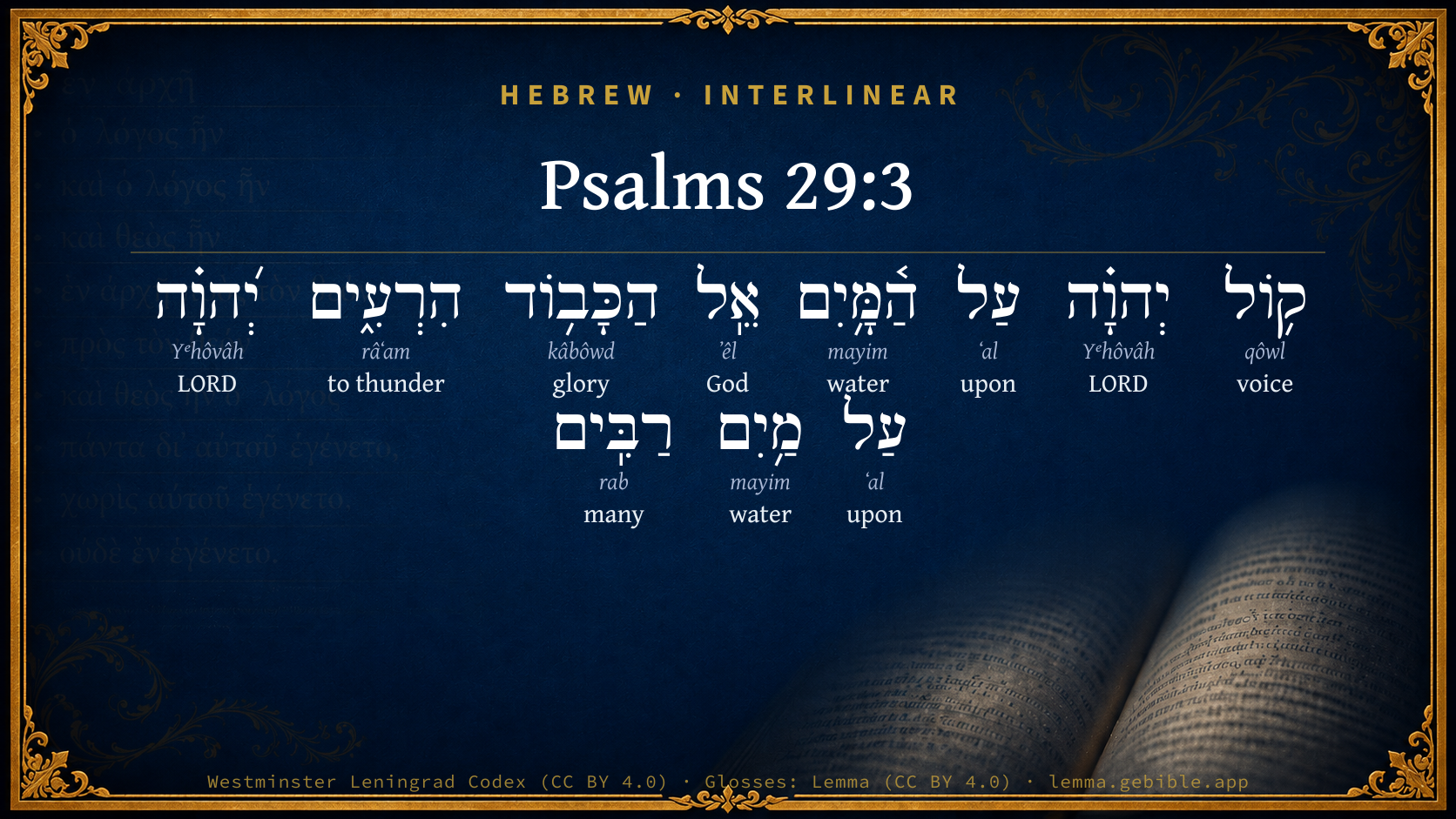
Hebrew (Westminster Leningrad Codex) Psalms 29:3 appears in the Hebrew Old Testament. The text above is from the Westminster Leningrad Codex. Each word links to its Strong’s number, a concise gloss, and parsing drawn from the Open Scriptures Hebrew Bible morphology. Click any word for its full Brown-Driver-Briggs (BDB) entry.
Download image
Cite this verse

Psalms 29:3 (World English Bible). Public Domain. Lemma interlinear Bible study tool, https://lemma.gebible.app/v/psalms/29/3.

Show BibTeX & RIS
BibTeX
RIS
English Translation
Yahweh's voice is on the waters. The God of glory thunders, even Yahweh on many waters.
World English Bible · Public Domain
Download a study sheet

One document with this verse’s original text, its word-by-word gloss line, the meaning frame, cross-references with their text, attributed commentary, and full source and license credits — printable, and it pastes into notes with its structure intact.

This verse Autodidact and up

Study sheet (.html) Plain text (.txt)

A passage Seminary Student

Up to 50 verses in one chapter. A passage sheet keeps up to 6 commentary sources and 12 cross-references per verse, in the order this page ranks them, and says so on the sheet whenever that leaves anything out. Ask for a single verse and you get the Autodidact verse sheet above.

Everything on this page stays free to read, with no account — the sheet is a download of what is already on screen, not access to it.

Want to remove ads? Support Godless Engineer
Compare translations 3

The same verse in 3 English versions, stacked beneath the original-language interlinear above. Click any original word for its lexicon entry.

Each is an independent rendering of the whole verse — the interlinear is not word-aligned to these translations.

Highlighted words mark where these versions differ — a whole-verse word diff, not a word-by-word alignment.

  • World English Bible Public Domain
    Yahweh's voice is on the waters. The God of glory thunders, even Yahweh on many waters.
  • King James Version Public Domain
    The voice of the LORD is upon the waters: the God of glory thundereth: the LORD is upon many waters.
  • unfoldingWord Literal Text CC BY-SA 4.0
    The voice of Yahweh over the waters, the God of glory thunders, Yahweh over many waters.

unfoldingWord Literal Text — © unfoldingWord, licensed CC BY-SA 4.0. Word-aligned USFM3 via Door43 (git.door43.org/unfoldingWord/en_ult).

Versions to compare (up to 4)

3 of 4 selected

Show all 18 translations

Every available English version of this verse, each an independent rendering of the whole verse.

  • World English Bible Public Domain
    Yahweh's voice is on the waters. The God of glory thunders, even Yahweh on many waters.
  • Berean Standard Bible Public Domain
    The voice of the LORD is over the waters; the God of glory thunders; the LORD is heard over many waters.
  • Majority Standard Bible Public Domain
    The voice of the LORD is over the waters; the God of glory thunders; the LORD is heard over many waters.
  • King James Version Public Domain
    The voice of the LORD is upon the waters: the God of glory thundereth: the LORD is upon many waters.
  • American Standard Version (1901) Public Domain
    The voice of Jehovah is upon the waters: The God of glory thundereth, Even Jehovah upon many waters.
  • Revised Version (1885) Public Domain
    The voice of the LORD is upon the waters: the God of glory thundereth, even the LORD upon many waters.
  • Geneva Bible (1599) Public Domain
    The voyce of the Lord is vpon the waters: the God of glorie maketh it to thunder: the Lord is vpon the great waters.
  • Douay-Rheims (1899) Public Domain
    The voice of the Lord is upon the waters; the God of majesty hath thundered, The Lord is upon many waters.
  • Young's Literal Translation Public Domain
    The voice of Jehovah `is' on the waters, The God of glory hath thundered, Jehovah `is' on many waters.
  • Literal Standard Version CC BY-SA 4.0
    The voice of YHWH [is] on the waters, || The God of glory has thundered, || YHWH [is] on many waters.
  • Unlocked Literal Bible CC BY-SA 4.0
    The voice of Yahweh is heard over the waters; the God of glory thunders, Yahweh thunders over many waters.
  • unfoldingWord Literal Text CC BY-SA 4.0
    The voice of Yahweh over the waters, the God of glory thunders, Yahweh over many waters.
  • Darby Bible Public Domain
    The voice of Jehovah is upon the waters: the ùGod of glory thundereth, -- Jehovah upon great waters.
  • World Messianic Bible Public Domain
    The LORD’s voice is on the waters. The God of glory thunders, even the LORD on many waters.
  • Webster's Bible Public Domain
    The voice of the LORD is upon the waters: the God of glory thundereth: the LORD is upon many waters.
  • Free Bible Version CC BY-SA 4.0
    The Lord's voice sounds over the sea. The God of glory thunders. The Lord thunders over the vast ocean.
  • Bible in Basic English Public Domain
    The voice of the Lord is on the waters: the God of glory is thundering, the Lord is on the great waters.
  • JPS Tanakh (1917) Public Domain
    The voice of the LORD is upon the waters; the God of glory thundereth, even the LORD upon many waters.

Literal Standard Version (2020), Covenant Press — licensed CC BY-SA 4.0. Text via the HelloAO Bible API (eBible.org). Unlocked Literal Bible (unfoldingWord) — licensed CC BY-SA 4.0. Text via the HelloAO Bible API (eBible.org). unfoldingWord Literal Text — © unfoldingWord, licensed CC BY-SA 4.0. Word-aligned USFM3 via Door43 (git.door43.org/unfoldingWord/en_ult). Free Bible Version, Dr. Jonathan Gallagher — licensed CC BY-SA 4.0. Text via the HelloAO Bible API (eBible.org).

Word by word

More ways to search: Search by grammar → Find every occurrence → Compare this word →

Practice this passage: Drill this verse → Learn its vocabulary →

הִרְעִ֑ים
râʻam
H7481
“to thunder”
Verb, Hiphil, Perfect, 3rd Person, Masculine, Singular
Part of Speech
Verb
Stem
Hiphil
Form
Perfect
Person
3rd Person
Gender
Masculine
Number
Singular
Full BDB Definition

Origin: a primitive root

TWOT: 2189

to thunder - (Qal) - to make the sound of thunder, thunder - to rage - (Hiphil) - to thunder, cause thunder - to tremble, cause to tremble (by extension)
  1. ק֥וֹל qôwl H6963 “voice of” Noun, Common, Masculine, Singular, Construct
  2. יְהוָ֗ה Yᵉhôvâh H3068 “LORD” Noun, Proper
  3. עַל ʻal H5921 “upon” Preposition
  4. הַ֫מָּ֥יִם mayim H4325 “the · water(s)” Particle, Definite Article + Noun, Common, Masculine, Plural, Absolute
  5. אֵֽל ʼêl H410 “God of” Noun, Common, Masculine, Singular, Construct
  6. הַכָּב֥וֹד kâbôwd H3519 “the · glory” Particle, Definite Article + Noun, Common, Both, Singular, Absolute
  7. יְ֝הוָ֗ה Yᵉhôvâh H3068 “LORD” Noun, Proper
  8. עַל ʻal H5921 “upon” Preposition
  9. מַ֥יִם mayim H4325 “water(s)” Noun, Common, Masculine, Plural, Absolute
  10. רַבִּֽים rab H7227 “many” Adjective, Adjective, Masculine, Plural, Absolute

About this verse

These counts appear in no published source. They are computed here, from the morphology-tagged text and Lemma’s own curated glosses. What Lemma adds →

11
words
8
distinct lemmas
Wisdom
section

Notable vocabulary

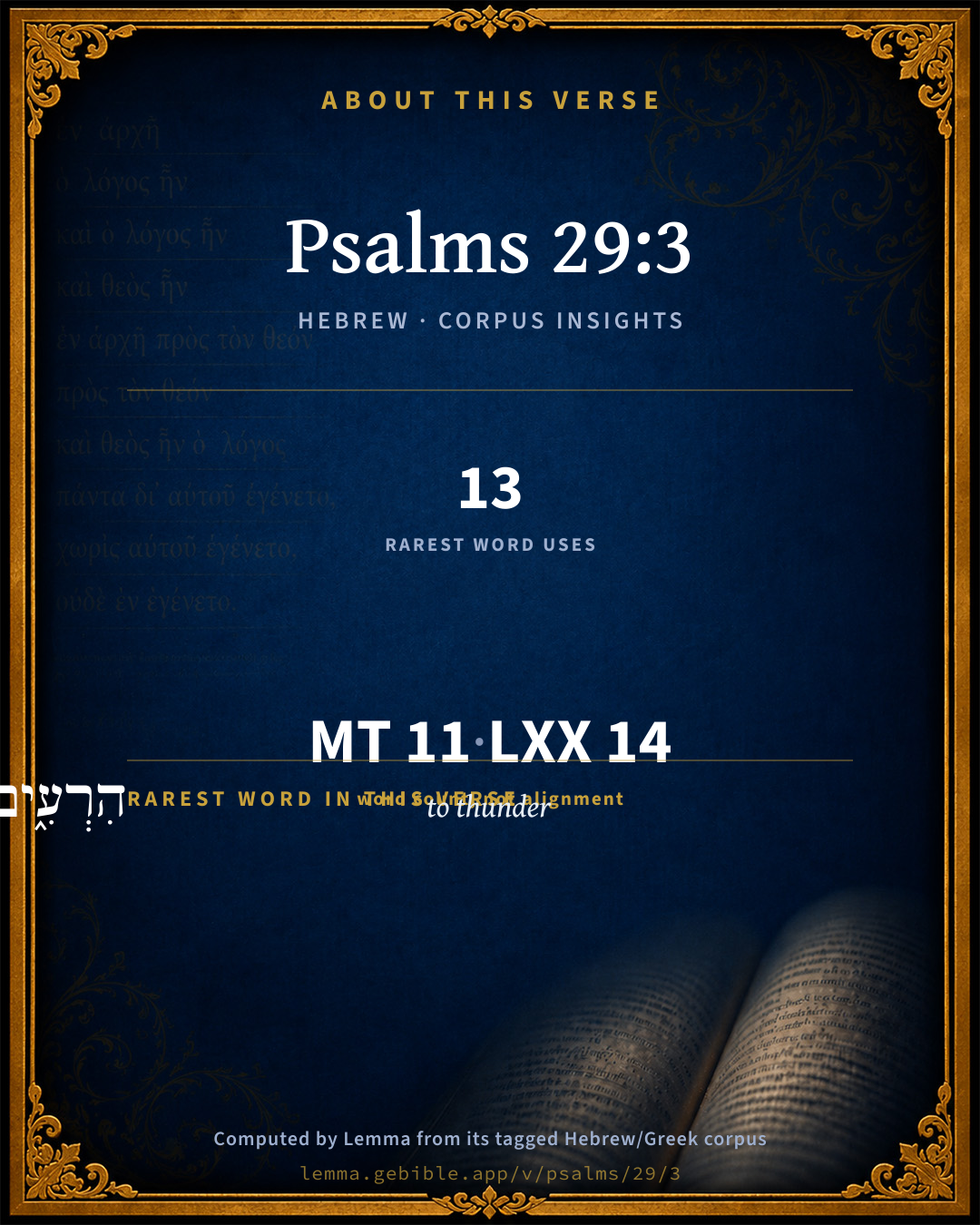
The rarest word here is הִרְעִ֑ים to thunder H7481 — appearing just 13 times in the whole Hebrew Bible.

Shared distinctive vocabulary

הִרְעִ֑ים to thunder H7481 occurs in 13 verses of the Hebrew Bible. Also found in:

Grammatical profile

  • 1 verb
  • 7 nouns
  • 1 adjective
  • 2 prepositions

Verb forms

  • הִרְעִ֑ים Hiphil · Perfect

Repetition

Words recur within this verse — often emphatic in Hebrew:

  • יְהוָ֗ה LORD H3068 ×2
  • עַל upon H5921 ×2
  • הַ֫מָּ֥יִם water H4325 ×2

Hebrew & Septuagint length

In English translation the verse runs 16 words from the Hebrew and 21 from the Septuagint (LXX English) — closely comparable.

A rough comparison of the two English renderings, which tokenize alike — not a word-level alignment.

Word counts can differ between the Hebrew and the Greek without any difference in meaning — e.g. the Hebrew direct-object marker אֵת has no separate Greek word, and Greek often adds the article ὁ.

In the original languages it is 11 Hebrew tokens and 14 Greek tokens — but the two are counted differently (Hebrew bundles its prefixes and suffixes into one token; the Greek is in lemma form), so that isn’t a like-for-like length.

Cross-references

19

Topical passages linked to Psalms 29:3 in the Treasury of Scripture Knowledge — connected by theme and wording, ordered by reader-vote popularity; previews shown in the World English Bible.

  • Job 37:2–5 Hear, oh, hear the noise of his voice, The sound that goes out of his mouth.
  • Psalms 93:3–4 The floods have lifted up, Yahweh, The floods have lifted up their voice. The floods lift up their waves.
  • Exodus 9:33 Moses went out of the city from Pharaoh, and spread abroad his hands to Yahweh; and the thunders and hail ceased, and the rain was not poured on the earth.
  • Exodus 9:28 Pray to Yahweh; for there has been enough of mighty thunderings and hail. I will let you go, and you shall stay no longer."
  • Exodus 19:16 It happened on the third day, when it was morning, that there were thunders and lightnings, and a thick cloud on the mountain, and the sound of an exceedingly loud trumpet; and all the people who were in the camp trembled.
  • Psalms 18:13–15 Yahweh also thundered in the sky, The Most High uttered his voice: Hailstones and coals of fire.
  • Psalms 77:16–19 The waters saw you, God. The waters saw you, and they writhed. The depths also convulsed.
  • Matthew 8:26–27 He said to them, "Why are you fearful, oh you of little faith?" Then he got up, rebuked the wind and the sea, and there was a great calm.
  • 1 Samuel 7:10 As Samuel was offering up the burnt offering, the Philistines drew near to battle against Israel; but Yahweh thundered with a great thunder on that day on the Philistines, and confused them; and they were struck down before Israel.
  • Psalms 104:3 He lays the beams of his chambers in the waters. He makes the clouds his chariot. He walks on the wings of the wind.
  • John 12:29 The multitude therefore, who stood by and heard it, said that it had thundered. Others said, "An angel has spoken to him."
  • Revelation 4:5 Out of the throne proceed lightnings, sounds, and thunders. There were seven lamps of fire burning before his throne, which are the seven Spirits of God.
  • Revelation 8:5 The angel took the censer, and he filled it with the fire of the altar, and threw it on the earth. There followed thunders, sounds, lightnings, and an earthquake.
  • Revelation 11:19 God's temple that is in heaven was opened, and the ark of the Lord's covenant was seen in his temple. Lightnings, sounds, thunders, an earthquake, and great hail followed.
  • Revelation 16:18 There were lightnings, sounds, and thunders; and there was a great earthquake, such as was not since there were men on the earth, so great an earthquake, so mighty.
  • Revelation 19:6 I heard something like the voice of a great multitude, and like the voice of many waters, and like the voice of mighty thunders, saying, "Hallelujah! For the Lord our God, the Almighty, reigns!
  • Psalms 24:7–10 Lift up your heads, you gates; Be lifted up, you everlasting doors: The King of glory will come in.
  • Acts 7:2 He said, "Brothers and fathers, listen. The God of glory appeared to our father Abraham, when he was in Mesopotamia, before he lived in Haran,
  • Revelation 17:14–15 These will war against the Lamb, and the Lamb will overcome them, for he is Lord of lords, and King of kings. They also will overcome who are with him, called and chosen and faithful."

Cross-references courtesy of OpenBible.info (CC BY 4.0).

Hebrew and Greek witnesses Masoretic Hebrew ↔ Greek Septuagint

The same verse in the two great witnesses to the Old Testament, shown verse-for-verse.

You’re reading Greek Psalm 28 (Hebrew Psalm 29). The Septuagint counts the superscription, so verse numbers can differ from the Hebrew — chapter-level alignment, not verse-by-verse. Numbering follows Rahlfs.

These are two independent witnesses, not word-aligned to each other, and the Septuagint is shown in lemma (dictionary) form.

Hebrew Psalms 29:3 Masoretic · Westminster Leningrad Codex

ק֥וֹל יְהוָ֗ה עַל הַ֫מָּ֥יִם אֵֽל הַכָּב֥וֹד הִרְעִ֑ים יְ֝הוָ֗ה עַל מַ֥יִם רַבִּֽים

Yahweh's voice is on the waters. The God of glory thunders, even Yahweh on many waters.

World English Bible · Public Domain

Greek LXX Greek Psalm 28:3 Septuagint · lemma form

φωνή κύριος ἐπί ὁ ὕδωρ ὁ θεός ὁ δόξα βροντάω κύριος ἐπί ὕδωρ πολύς

The voice of the Lord is upon the waters: the God of glory has thundered: the Lord is upon many waters.

LXX2012 (modern English Septuagint) · Public Domain

On this verse, Keil & Delitzsch discusses the Septuagint’s reading. Read the note in Commentary ↓

Hebrew: Westminster Leningrad Codex (CC BY 4.0). Greek: Septuagint (public domain); English from LXX2012 (modern English Septuagint) (Public Domain). How the Septuagint differs from the Hebrew →

Commentary

Notes on Psalms 29:3 from classic Christian and Jewish commentators (each source and its license shown beneath its notes). The classic Christian expositions comment on the surrounding passage and are grouped to its opening verse, so a note may address several verses; the Jewish commentaries on the Tanakh (Rashi and others) are per-verse, so they appear only where the commentator wrote on this verse.

Lemma curates 59 commentaries, every one of them public domain or Creative Commons licensed, each selected and text-cleaned for this edition rather than reprinted as found. About our sources →

The Cambridge Bible for Schools and Colleges

gen. ed. J. J. S. Perowne

3. The voice of the Lord] So thunder is called in Exo_9:23 ff.; Psa_18:13; &c. Cp. Rev_10:3 f.

upon the waters] Hardly the sea, as though the storm were represented as coming in from the Mediterranean; but rather the waters collected in the dense masses of storm-cloud upon which Jehovah rides (Psa_18:9 ff.; Psa_104:3; Jer_10:13).

the God of glory] Cp. “the King of glory” (Psa_24:7 ff.).

the Lord is upon many waters] The idea of the first line is repeated and emphasised. Not Jehovah’s voice alone, but Jehovah Himself is there, and the waters are many (or, great). The R.V. Even the Lord upon many waters is hardly an improvement. The P.B.V. of Psa_29:3-4 is a free paraphrase of the supposed sense.

3–9. The exhibition of Jehovah’s power which is the ground of the opening call to praise. His voice is heard in the pealing of the thunder above the storm-clouds (Psa_29:3-4); the storm bursts, it shatters the cedars and shakes the mountains in the far north (Psa_29:5-6); the lightnings flash (Psa_29:7); the deserts to the far south with their affrighted denizens tremble (Psa_29:8-9); and over all resounds the chorus, Glory (Psa_29:9 b). The seven times repeated voice of the Lord is like successive peals of thunder.

The Cambridge Bible for Schools and Colleges (gen. ed. J. J. S. Perowne; Cambridge University Press, 1878–1918) — public domain. Text from a community e-Sword module.

Trapp's Complete Commentary

John Trapp

Psa 29:3 The voice of the LORD [is] upon the waters: the God of glory thundereth: the LORD [is] upon many waters.

Ver. 3. The voice of the Lord is upon the waters] Thunder is here called, and fitly, the voice of the Lord (being brought, as one instance of those many other glorious works of his in nature), because it comes from him alone. Natural causes there are assigned of it; but we must not stick in them, as Epicurus and his hogs would have us. (The ancient Romans said Deus tonat, Deus fulgurat, for which now tonat, fulgurat.) The best philosophy in this behalf is to hear God Almighty by his thunder speaking unto us from heaven, as if he were present; and to see him in his lightnings, as if he cast his eyes upon us, to behold what we had been doing. This voice of the Lord is fitly instanced as an evidence of the Divine power and majesty; because it is so dreadful, even to the greatest atheists; as it was to Caius Caligula, that potent emperor, ready to run into a mouse hole in a time of thunder (Sueton.).

The God of glory thundereth] And men quake before him; as worms at such a time wriggle into the corners of the earth. And yet your dive clappers duck net at this rattle in the air, though they do at a far smaller matter. So, many tremble not at God’s terrible threats, that yet are afraid of a penal statute.

The Lord is upon many waters] viz. When he thundereth. De aquis pendulis loquitur, saith Vatablus; He speaketh of the waters in the clouds, which are many, and of great force, as appeared in the general deluge; and doth still appear by that infinite inundation of rain that followeth upon the thunder claps. Some render it, The Lord, or, The voice of the Lord, is above many waters, i.e. above the loud roaring of many waters, which is even drowned by the thunder.

John Trapp, A Commentary or Exposition upon All the Books of the Old and New Testament (1647–1656) — public domain. Text from a community e-Sword module.

The Biblical Illustrator

Joseph S. Exell

Psa_29:3-4

The voice of the Lord is upon the waters.

The voice of Jehovah upon the waters

The very pathway of the Lords people is said to be through the waters; and they are a people that do business in deep waters. How Israel, how Peter, found the truth of our text. But when passing through deep waters we are more inclined--and it is a crying evil--to listen to the roar of the waves than to the voice of my precious Christ.

I. afflictions are compared to waters, billows, . . . deep waters. And these may come upon the Church at large through hatred of the truth by Papists, Arminians and Socinians and others. And upon private persons, through temporal trials and persecutions. But these are other waters, blessed ones, such as told of in Eze_47:1-23.

II. the Lords voice on these waters. It is an overruling and comforting voice, in waters of affliction: of conviction, comfort and direction, in the waters of the sanctuary.

III. the attention demanded to such a voice. Listen for it more than to any other whether persecutor or preacher. Supernatural joy comes from listening to the Lords voice. Have you all heard it? If not, may it awaken you now. (Joseph Irons.)

The voice of the Lord is full of majesty.--

The majestic voice

All Gods works praise Him, but there are some which praise Him more than others. There are some of His doings upon which there seems to be graven in larger letters than usual the name of God. Such as the lofty mountains, the thunders and lightnings. The old and universal belief was, that the thunder was the voice of God. But there are spiritual voices of God, and of these we would speak. Samuel on his bed heard it. Saul at his conversion. And God often speaks to man by the Holy Spirit. And the voice of God is ever full of majesty. It is so--

I. essentially; it must be so. Think whose voice it is. How Gods voice is full of majesty because--

1. It is true.

2. Commanding.

3. Very powerful. Let there be light, and there was light.

4. And because Gods voice is His Word, and His Word was His Son the Lord Jesus Christ.

II. always. Gods voice, like mans, has various tones, but it is always full of majesty.

1. Let the tone be what it may, whether harsh as in threatening, or sweet as when consoling, or august as when commanding. Speak to the children of Israel, that they go forward. And at the Resurrection of the dead, and at the Judgment Day.

2. And in all the different degrees of its loudness. Some calls of God are loud, others gentle but all majestic.

3. And in all its mediums. The meanness of a speaker for God does not hinder this.

III. in its effects.

1. It is a breaking voice. The voice of the Lord breaketh the cedars. The proudest and most stubborn sinner is broken before Him.

2. Moving. He maketh them (the mountains) also to skip like a calf. No mountain of error, falsity, or sin can stand unmoved when He speaks.

3. Dividing. Divideth the flames of fire. Where Gods Word is faithfully preached it is ever a dividing power.

4. Shaking shaketh the wilderness. Gods Word does this in mens hearts.

5. Bringing forth--maketh the hinds to calve. So Gods Word makes the soul bring forth holy desire and joy, and whatever a man has in him it has to come forth.

6. Discovering--discovereth the forests. Hypocrites hide, but God discovers them. Oh, listen to His voice bidding you believe and be saved. (C. H. Spurgeon.)

The Voice of the Lord

This sacred poem from which our text is taken, is one of the most elevated and sublime to which the poetry of inspiration itself has given birth. But the words are capable of other than their primary application.

I. consider the modes in which God speaks to man.

1. Through Nature--see this psalm,

2. Through the dispensations and in the government of Providence.

3. Through His revealed truth, and--

4. Chief of all, through His Son.

II. the attributes by which these communications are prominently distinguished--Power and Majesty. Consider--

1. The glory of His nature from whom they proceed.

2. The contents of the communications themselves. They speak of the Divine perfections and chiefly of Gods method of redeeming sinful man.

3. The issues in which attention to, or neglect of, these communications is to terminate. They are identified with the destinies of mans deathless soul.

III. THE tribute which these communications made by God to man imperatively require.

1. Faith.

2. Gratitude.

3. Prayer for ourselves and for our fellow-men. How, then, shall you who are despising these communications of God answer it in the great day of Judgment? Oh, come to Jesus now. (James Parsons.)

The Biblical Illustrator, edited by Joseph S. Exell (c. 1880s–1900s) — public domain. Text from a community e-Sword module.

The Treasury of David

Charles H. Spurgeon

Ver. 3. The voice of the Lord is upon the waters. The thunder is not only poetically but instructively called "the voice of God, "since it peals from on high; it surpasses all other sounds, it inspires awe, it is entirely independent of man, and has been used on some occasions as the grand accompaniment of God's speech to Adam's sons. There is a peculiar terror in a tempest at sea, when deep calleth unto deep, and the raging sea echoes to the angry sky. No sight more alarming than the flash of lightning around the mast of the ship; and no sound more calculated to inspire reverent awe than the roar of the storm. The children of heaven have often enjoyed the tumult with humble joy peculiar to the saints, and even those who know not God have been forced into unwilling reverence while the storm has lasted. The glory of God thundereth. Thunder is in truth no mere electric phenomenon, but is caused by the interposition of God himself. Even the old heathen spake of Jupiter Tonans; but our modern wise men will have us believe in laws and forces, and anything or nothing so they may be rid of God. Electricity of itself can do nothing, it must be called and sent upon its errand; and until the almighty Lord commissions it, its bolt of fire is inert and powerless. As well might a rock of granite, or a bar of iron fly in the midst of heaven, as the lightning go without being sent by the great First Cause. The Lord is upon many waters. Still the Psalmist's ear hears no voice but that of Jehovah, resounding from the multitudinous and dark waters of the upper ocean of clouds, and echoing from the innumerable billows of the storm tossed sea below. The waters above and beneath the firmament are astonished at the eternal voice. When the Holy Spirit makes the divine promise to be heard above the many waters of our soul's trouble, then is God as glorious in the spiritual world as in the universe of matter. Above us and beneath us all is the peace of God when he gives us quiet.

Ver. 3. The voice of the Lord is upon the waters: the God of glory thundereth: the Lord is upon many waters. Yes, great God, these torrents of tears which flow down from my eyes announce thy divine presence in my soul. This heart hitherto so dry, so arid, so hard; this rock which thou hast struck a second time, will not resist thee any longer, for out of it there now gushes healthful waters in abundance. The selfsame voice of God which overturns the mountains, thunders, lightens, and divides the heaven above the sinner, now commands the clouds to pour forth showers of blessings, changing the desert of his soul into a field producing a hundredfold; that voice I hear. J. B. Massillon.

Ver. 3-10. The Lord, etc. All things which we commonly say are the effects of the natural powers of matter and laws of motion, are, indeed (if we will speak strictly and properly), the effects of God's acting upon matter continually and at every moment, either immediately by himself, or mediately by some created intelligent being. Consequently there is no such thing as the cause of nature, or the power of nature. Samuel Clarke, 1675-1729. "The friend and disciple of Newton."

Ver. 3-10.

The voice of the Lord on the ocean is known,

The God of eternity thundereth abroad;

The voice of the Lord from the depth of his throne

Is terror and power; all nature is awed.

The voice of the Lord through the calm of the wood

Awakens its echoes, strikes light through its caves;

The Lord sitteth King on the turbulent flood,

The winds are his servants, his servants the waves. James Montgomery, 1771-1854.

Ver. 3-11

Messiah's voice is in the cloud,

The God of glory thunders loud.

Messiah rides along the floods,

He treads upon the flying clouds.

Messiah's voice is full of power,

His lightnings play when tempests lower.

Messiah's voice the cedars breaks,

While Lebanon's foundation quakes.

Messiah's voice removes the hills,

And all the plains with rivers fills.

The voice of their expiring God,

Shall make the rocks to start abroad;

Mount Zion and Mount Sirion,

Shall bound along with Lebanon:

The flames of fire shall round him wreathe,

When he shall on the ether breathe.

Messiah's voice shall shake the earth,

And, lo! the graves shall groan in birth,

Ten thousand thousand living sons

Shall be the issue of their groans.

The peace of God the gospel sounds;

The peace of God, the earth rebounds,

The gospel everlasting shines

A light from God that never declines.

This is the light Jehovah sends,

To bless the world's remotest ends.

Barclay's Paraphrase.

Ver. 3. God's voice heard in trouble and above trouble, or in great personal and national calamities.

Psalms 29:4*

Ver. 3-10. The Lord, etc. See Psalms on "Ps 29:3" for further information.

Ver. 3-10. See Psalms on "Ps 29:3" for further information.

Ver. 3-11: See Psalms on "Ps 29:3" for further information.

Ver. 3-10. See Psalms on "Ps 29:3" for further information.

Ver. 3-11: See Psalms on "Ps 29:3" for further information.

Ver. 3-10. The Lord, etc. See Psalms on "Ps 29:3" for further information.

Ver. 3-10. See Psalms on "Ps 29:3" for further information.

Ver 3-11: See Psalms on "Ps 29:3" for further information.

Ver. 3-10. The Lord, etc. See Psalms on "Ps 29:3" for further information.

Ver. 3-10. See Psalms on "Ps 29:3" for further information.

Ver 3-11: See Psalms on "Ps 29:3" for further information.

Ver. 3-10. The Lord, etc. See Psalms on "Ps 29:3" for further information.

Ver. 3-10. See Psalms on "Ps 29:3" for further information.

Ver. 3-11.: See Psalms on "Ps 29:3" for further information.

Ver. 3-11.: See Psalms on "Ps 29:3" for further information.

Charles H. Spurgeon's The Treasury of David (1869–1885) — public domain. Psalms only. Text from a community e-Sword/MySword module.

Joseph Benson's Commentary

Psa 29:3. The voice of the Lord — That is, thunder, frequently so called; is upon the waters — Upon the seas, where its noise spreads far and wide, and is very terrible; or rather above the clouds, which are sometimes called waters, as Gen 1:7; Psa 18:11, because they are of a watery substance, and frequently much water is contained in them. And this circumstance is noticed here as being of considerable importance to magnify the divine power, which displays itself in these superior regions, which are far above the reach of all earthly potentates, and from whence he can easily and unavoidably smite all that dwell upon the earth, and will not submit to him. The Lord is upon many waters — Upon the clouds, in which there are sometimes vast treasures of water, and upon which God is said to sit and ride, Psa 18:10-11; Psa 104:3.

Joseph Benson's Commentary on the Old and New Testaments (1811–1818) — public domain. Text from a community e-Sword module.

Keil & Delitzsch

C. F. Keil & F. Delitzsch

Now follows the description of the revelation of God's power, which is the ground of the summons, and is to be the subject-matter of their praise. The All-glorious One makes Himself heard in the language (Rev 10:3.) of the thunder, and reveals Himself in the storm. There are fifteen lines, which naturally arrange themselves into three five-line strophes. The chief matter with the poet, however, is the sevenfold קול ה. Although קול is sometimes used almost as an ejaculatory "Hark!" (Gen 4:10; Isa 52:8), this must not, with Ewald (286, f), be applied to the קול ה of the Psalm before us, the theme of which is the voice of God, who announced Himself from heaven - a voice which moves the world. The dull sounding קול serves not merely to denote the thunder of the storm, but even the thunder of the earthquake, the roar of the tempest, and in general, every low, dull, rumbling sound, by which God makes Himself audible to the world, and more especially from the wrathful side of His doxa. The waters in Psa 29:3 are not the lower waters. Then the question arises what are they? Were the waters of the Mediterranean intended, they would be more definitely denoted in such a vivid description. It is, however, far more appropriate to the commencement of this description to understand them to mean the mass of water gathered together in the thick, black storm-clouds (vid., Psa 18:12; Jer 10:13). The rumbling

(Note: The simple rendering of קול by "voice" has been retained in the text of the Psalm, as in the Authorised Version. The word, however, which Dr. Delitzsch uses is Gedrhn, the best English equivalent of which is a "rumbling." - Tr.)

of Jahve is, as the poet himself explains in Psa 29:3, the thunder produced on high by the אל הכּבוד (cf. מלך הכבוד, Psa 24:7.), which rolls over the sea of waters floating above the earth in the sky. Psa 29:4 and Psa 29:4, just like Psa 29:3 and Psa 29:3, are independent substantival clauses. The rumbling of Jahve is, issues forth, or passes by; ב with the abstract article as in Psa 77:14; Pro 24:5 (cf. Pro 8:8; Luk 4:32, ἐν ἰσχύΐ Rev 18:2), is the ב of the distinctive attribute. In Psa 29:3 the first peals of thunder are heard; in Psa 29:4 the storm is coming nearer, and the peals become stronger, and now it bursts forth with its full violence: Psa 29:5 describes this in a general form, and Psa 29:5 expresses by the fut. consec., as it were inferentially, that which is at present taking place: amidst the rolling of the thunder the descending lightning flashes rive the cedars of Lebanon (as is well-known, the lightning takes the outermost points). The suffix in Psa 29:6 does not refer proleptically to the mountains mentioned afterwards, but naturally to the cedars (Hengst., Hupf., Hitz.), which bend down before the storm and quickly rise up again. The skipping of Lebanon and Sirion, however, is not to be referred to the fact, that their wooded summits bend down and rise again, but, according to Psa 114:4, to their being shaken by the crash of the thunder-a feature in the picture which certainly does not rest upon what is actually true in nature, but figuratively describes the apparent quaking of the earth during a heavy thunderstorm. שריון, according to Deu 3:9, is the Sidonian name of Hermon, and therefore side by side with Lebanon it represents Anti-Lebanon. The word, according to the Masora, has ש sinistrum, and consequently is isriyown, wherefore Hitzig correctly derives it from Arab. srâ, fut. i., to gleam, sparkle, cf. the passage from an Arab poet at Psa 133:3. The lightning makes these mountains bound (Luther, lecken, i.e., according to his explanation: to spring, skip) like young antelopes. ראם,

(Note: On Arab. r'm vid., Seetzen's Reisen iii. 339 and also iv. 496.)

like βούβαλος, βούβαλις, is a generic name of the antelope, and of the buffalo that roams in herds through the forests beyond the Jordan even at the present day; for there are antelopes that resemble the buffalo and also (except in the formation of the head and the cloven hoofs) those that resemble the horse, the lxx renders: ὡς υἱὸς μονοκερώτων. Does this mean the unicorn Germ. one-horn depicted on Persian and African monuments? Is this unicorn distinct from the one horned antelope? Neither an unicorn nor an one horned antelope have been seen to the present day by any traveller. Both animals, and consequently also their relation to one another, are up to the present time still undefinable from a scientific point of view.

(Note: By ראם Ludolf in opposition to Bochart understands the rhinoceros; but this animal, belonging to the swine tribe, is certainly not meant, or even merely associated with it. Moreover, the rhinoceros Germ. nose-horn is called in Egypt charnin (from Arab. chrn = qrn), but the unicorn, charnit. "In the year 1862 the French archaeologist, M. Waddington, was with me in Damascus when an antiquary brought me an ancient vessel on which a number of animals were engraved, their names being written on their bellies. Among the well known animals there was also an unicorn, exactly like a zebra or a horse, but with a long horn standing out upon its forehead; on its body was the word Arab. chrnı̂t. M. Waddington wished to have the vessel and I gave it up to him; and he took it with him to Paris. We talked a good deal about this unicorn, and felt obliged to come to the conclusion that the form of the fabulous animal might have become known to the Arabs at the time of the crusades, when the English coat of arms came to Syria." - Wetzstein.)

Each peal of thunder is immediately followed by a flash of lightning; Jahve's thunder cleaveth flames of fire, i.e., forms (as it were λατομεῖ) the fire-matter of the storm-clouds into cloven flames of fire, into lightnings that pass swiftly along; in connection with which it must be remembered that קול ה denotes not merely the thunder as a phenomenon, but at the same time it denotes the omnipotence of God expressing itself therein. The brevity and threefold division of Psa 29:7 depicts the incessant, zigzag, quivering movement of the lightning (tela trisulca, ignes trisulci, in Ovid). From the northern mountains the storm sweeps on towards the south of Palestine into the Arabian desert, viz., as we are told in Psa 29:8 (cf. Psa 29:5, according to the schema of "parallelism by reservation"), the wilderness region of Kadesh (Kadesh Barnea), which, however we may define its position, must certainly have lain near the steep western slope of the mountains of Edom toward the Arabah. Jahve's thunder, viz., the thunderstorm, puts this desert in a state of whirl, inasmuch as it drives the sand (חול) before it in whirlwinds; and among the mountains it, viz., the strong lightning and thundering, makes the hinds to writhe, inasmuch as from fright they bring forth prematurely. both the Hiph. יהיל and the Pil. יחולל are used with a causative meaning (root חו, חי, to move in a circle, to encircle). The poet continues with ויּחשׂף, since he makes one effect of the storm to develope from another, merging as it were out of its chrysalis state. יערות is a poetical plural form; and חשׂף describes the effect of the storm which "shells" the woods, inasmuch as it beats down the branches of the trees, both the tops and the foliage. While Jahve thus reveals Himself from heaven upon the earth in all His irresistible power, בּהיכלו, in His heavenly palace (Psa 11:4; Psa 18:7), כּלּו (note how בהיכלו resolves this כלו out of itself), i.e., each of the beings therein, says: כבוד. That which the poet, in Psa 29:1, has called upon them to do, now takes place. Jahve receives back His glory, which is immanent in the universe, in the thousand-voiced echo of adoration.

Keil & Delitzsch — Biblical Commentary on the Old Testament (1861–1891) — public domain (CC PDM 1.0). Text via the HelloAO Bible API. (Old Testament only.)

J. A. Alexander on Psalms

Joseph Addison Alexander

3. (Psa 29:3) The voice of Jehovah on the waters! The God of glory thundered. The voice of Jehovah (was) on many waters. The invocation to the heavenly host in the two preceding verses is now justified by an appeal to one particular manifestation of God's majesty, to wit, that afforded by the tempestuous strife of elements.—The first clause may be construed as an exclamation, or the substantive verb may be supplied, either in the past or, present tense. The preterite form of the original does not relate to any specific point of past time, but merely shews that the phenomena described have been heretofore witnessed, and though grand are nothing new. Our present tense gives the sense correctly, but with a departure from the idiomatic form of the original.—The God of glory contains an allusion to Psa 29:1-2. Compare Psa 24:7-10. —On (or above) the waters, i.e. the clouds charged with rain. See above, on Psa 18:12 (11), and compare Jer 10:13.

Joseph Addison Alexander, The Psalms Translated and Explained (1850) — public domain. Text from a community e-Sword module.

Tyndale Open Study Notes

Tyndale Open Resources

29:3-9 The word translated voice (Hebrew qol) can also mean “noise” (1 Kgs 1:45) or “thunder” (Joel 3:16). The Lord’s voice is awe-inspiring, and it dominates whatever rumblings people might attribute to other deities.

Tyndale Open Study Notes — © Tyndale Open Resources, licensed CC BY-SA 4.0. Text via the HelloAO Bible API.

Geneva Bible (1599)

Geneva Bible translators

The thunder claps that are heard out of the clouds, ought to make the wicked to tremble for fear of God’s anger.

Geneva Bible (1599) marginal notes — public domain. Text via Bolls.life.

Jamieson, Fausset & Brown

Robert Jamieson, A. R. Fausset & David Brown

The voice of the Lord--audible exhibition of His power in the tempest, of which thunder is a specimen, but not the uniform or sole example.

the waters--the clouds or vapors (Psa 18:11; Jer 10:13).

Jamieson, Fausset & Brown — Commentary Critical and Explanatory on the Whole Bible (1871) — public domain (CC PDM 1.0). Text via the HelloAO Bible API.

Adam Clarke's Commentary

Verse 3. The voice of the Lord] THUNDER, so called, Ex 9:23, Ex 9:28-29; Job 37:4; Ps 18:13; Isa 30:30. On this subject see the note on Job 37:4, where there is a particular description of the nature and generation of thunder; and of the lightning, clap, rain, and other phenomena which accompany it.

Upon many waters.] The clouds, which Moses calls the waters which are above the firmament.

Adam Clarke's Commentary on the Bible (1810–1826) — public domain. Text from a community e-Sword/MySword module.

John Calvin's Commentaries

3. The voice of Jehovah is upon the waters. David now rehearses the wonders of nature which I have previously referred to; and well indeed does he celebrate the power of God as well as his goodness, in his works. As there is nothing in the ordinary course of nature, throughout the whole frame of heaven and earth, which does not invite us to the contemplation of God, he might have brought forward, as in Psalm 19:1, the sun and the stars, and the whole host of heaven, and the earth with its riches; but he selects only those works of God which prove not only that the world was at first created by him, and is governed by his power, but which also awaken the torpid, and drag them, as it were, in spite of themselves, humbly to adore him; as even Horace was compelled, though he was not only a heathen poet, but an Epicurean, and a vile contemner of Deity, to say of himself in one of his Odes, — (Lib. I. Ode 34.)

“A fugitive from heaven and prayer, I mocked at all religious fear, Deep scienced in the mazy lore Of mad philosophy; but now Hoist sail, and back my voyage plough To that blest harbour which I left before.

“For, lo! that awful heavenly Sire, Who frequent cleaves the clouds with fire, Parent of day, immortal Jove; Late through the floating fields of air, The face of heaven serene and fair, His thund’ring steeds, and winged chariot drove,” etc. Dr Francis’ Translation of Horace.

Experience, too, tells us that those who are most daring in their contempt of God are most afraid of thunderings, storms, and such like violent commotions. With great propriety, therefore, does the prophet invite our attention to these instances which strike the rude and insensible with some sense of the existence of a God, “Qui contraignent les barbares et gens esbestez sentir qu’il y a un Dieu.” — Fr. “Which constrain the rude and insensible to feel that there is a God.”

John Calvin's Commentaries (1540-1563) — public domain. Text from the Calvin Translation Society English edition (1840s-50s) via the Christian Classics Ethereal Library (ccel.org). Calvin's coverage is partial (roughly two-thirds of the Bible); uncommented books and verses are honest gaps, never fabricated. The 19th-century editor's footnotes and remarks are omitted so the notes are faithfully Calvin's own voice.

Ellicott's Commentary for English Readers

(3) The voice.—The invocation to the angels over, the storm bursts, and seven successive peals of thunder mark its course of fury and destruction. It is first heard rolling over the waters from the west (comp. 1Ki_18:44), unless the “waters” and “many waters,” as in Psa_18:11-12, refer to the gathered masses of rain-cloud, when we might compare

“Then broke the thunder

Like a whole sea overhead.”

BROWNING: Pippa Passes.

The Hebrew kôl (“voice”), used also of any loud sound (2Sa_15:10, of the trumpet; Eze_1:24, of water), is sometimes used (Gen_4:10; Isa_52:8) to call attention, like our “Hark !” So Ewald here. Others refer it to the thunder, as in Psa_77:18; but it seems better to take it for the combined noise of the storm, thunder, wind, and rain, as in Shakespeare—

“The gods who keep this pudder o’er our heads.”

A Bible Commentary for English Readers, edited by Charles John Ellicott (1878–1897) — public domain. Text from a community e-Sword module.

John Gill's Exposition

The voice of the Lord is upon the waters,.... What follows concerning thunder, the voice of the Lord, gives so many reasons why he should have glory given him and be worshipped; the Heathens (y) paid their devotion to thunder and lightning: but this should be done to the author of them; which may be literally understood of thunder, and is the voice of the Lord; see Psa 18:13; and which is commonly attended with large showers of rain, Jer 10:13; and is very terrible upon the waters, and has its effect there, Psa 104:7; and this is the rather mentioned, because that there is a God above, who is higher than the mighty, who are called upon to give glory to him, and because that thunder has been terrible to kings and great men of the earth; or this may be figuratively interpreted of the voice of Christ in the Gospel, which reaches to many nations and people, compared to waters, Rev 17:15. The disciples had a commission to preach it to all nations, and the sound of their words went into all the world, Rom 10:18;

the God of glory thundereth; this shows that thunder may be meant by the voice of the Lord, who is glorious in himself, and in all his works; and may be applied to the Gospel of Christ, who is the Lord of glory, and whose ministers, at least some of them, are sons of thunder; see Co1 2:8;

the Lord is upon many waters; that is, his voice is, as before, which is thunder; and that this belongs to God, the Heathens were so sensible of, that they called their chief deity Jupiter Tonans (z).

(y) Pausan. Arcad. sive l. 8. p. 503. (z) Horat. Epod. l. 5. Ode 2. v. 29. Martial. l. 2. Ep. 95.

John Gill's Exposition of the Whole Bible (1746–1763) — public domain (CC PDM 1.0). Text via the HelloAO Bible API.

Albert Barnes' Notes on the Bible

The voice of the Lord - The voice of Yahweh. There can be no doubt that the expression here, which is seven times repeated in the psalm, “the voice of Jehovah,” refers to thunder; and no one can fail to see the appropriateness of the expression. In heavy thunder it seems as if God spake. It comes from above. It fills us with awe. We know, indeed, that thunder as well as the other phenomena in the world, is produced by what are called “natural causes;” that there is no miracle in thunder; and that really God does not “speak” anymore in the thunder than he does in the sighing of the breeze or in the gurgling of the rivulet; but:

(a) He seems more impressively to speak to people in the thunder; and

(b) He may not improperly be regarded as speaking alike in the thunder, in the sighing of the breeze, and in the gurgling stream.

In each and all of these ways God is addressing men; in each and all there are lessons of great value conveyed, as if by His own voice, respecting His own existence and character. Those which are addressed to us particularly in thunder, pertain to His power, His majesty, His greatness; to our own weakness, feebleness, dependence; to the ease with which He could take us away, and to the importance of being prepared to stand before such a God. “Is upon the waters.” The word “is” is supplied here by our translators in italics. The whole passage might be read as an exclamation: “The voice of Jehovah upon the waters!” It is the utterance of one who is overpowered by a sudden clap of thunder. The mind is awed. God seems to speak; His voice is heard rolling over the waters. The psalm was most likely composed in view of the sea or a lake - not improbably in view of the Mediterranean, when a storm was passing over it. A thunderstorm is sublime anywhere, in mountain scenery or upon the plains, upon the land or upon the ocean; but there are circumstances which give it special grandeur at sea, when the thunder seems to “roll” along with nothing to check or break it, and when the sublimity is increased by the solitude which reigns everywhere on the ocean.

The God of glory - The glorious God. See the notes at Psa 24:7-10.

The Lord is upon many waters - Yahweh Himself seems to be on the ocean. His voice is heard there, and He Himself appears to be there. The margin here is, “great waters.” This would seem to imply that the psalm was composed in view of waters more extended than a lake or a river, and sustains the idea above expressed, that it was in view of the great waters which must have been so familiar to the mind of the sacred writer - the waters of the Mediterranean.

Albert Barnes' Notes on the Bible (1834–1885) — public domain. Text from a community e-Sword/MySword module.

Matthew Poole's English Annotations

The voice of the Lord, i.e. thunder, as is manifest from the next clause, and the following effects; which is oft called the Lord’s voice, as Exo 9:23,28,29; Job 37:4,5; Psa 18:14; 46:6. Upon the waters; either,

1. Upon the seas; where its noise spreads far and wide, and is very terrible. But the following verses speak of the effects of it upon the earth only. Or rather,

2. Above in the clouds, which are called waters, Gen 1:7; Psa 18:11, because they are of a watery substance. And this circumstance is considerable here, to magnify the Divine power, which displayeth itself in those high places, which are far above the reach of all earthly potentates, and from whence he can easily and unavoidably smite all that dwell upon the earth, and will not submit to him. Upon many waters, i.e. upon the clouds, in which there are vast treasures of water, and upon which God is said to sit or ride, Psa 18:10,11; 104:3.

Matthew Poole's English Annotations on the Holy Bible (1683–1685) — public domain. Text from a community e-Sword/MySword module.

Whedon's Commentary on the Bible

Daniel D. Whedon

3. The voice of the Lord—This poetic name for thunder (Job_37:4; Job_40:9) has a sevenfold repetition, and is probably the type and basis of the apocalyptic “seven thunders,” (Rev_10:3-4,) as the allegoric imagery of that book is almost wholly borrowed from the Old Testament.

Upon the waters—Either the “great waters”—that is, the sea, as in third line of the verse—or dark water clouds, as Psa_18:11. Thunder upon the ocean has a peculiarly deep and solemn sound, which is probably referred to here.

Daniel D. Whedon (gen. ed.), Commentary on the Old and New Testaments (1874–1909) — public domain. Text from a community e-Sword module.

The Pulpit Commentary

The voice of the Lord is upon the waters. The description of God"s might in the thunderstorm now begins with one of the sudden transitions which David loves. "The voice of the Lord already identified with the thunder in Psa_18:13 is suddenly heard muttering in the height of heaven, "upon the waters;" i.e. the waters stored in the clouds that float on high in the air. The God of glory the God set forth in vers. 1, 2thundereth. It is he himself, according to the psalmist, no minor agent. The Lord (Jehovah) is upon the many (or, great) waters. (comp. Job_37:2-5 and Psa_18:7-14)

The Pulpit Commentary (1880–1919), ed. H.D.M. Spence-Jones & Joseph S. Exell — public domain. Text from a community e-Sword module.

John Wesley's Explanatory Notes

The waters - Above in the clouds, which are called waters, Gen. i, 7 chap. xviii, 11. The Divine power displays itself in those high places, which are far above the reach of all earthly potentates. Many - Upon the clouds, in which there are vast treasures of water, and upon which God is said to sit or ride, chap. xviii, 10, 11; civ, 3.

John Wesley, Explanatory Notes Upon the Whole Bible (1754–1765) — public domain. Text via the GEBible commentary corpus.

unfoldingWord translationNotes

Door43 World Missions Community

General Information:

The psalm shows Yahweh's power and glory.

The voice of Yahweh is heard over the waters

God's voice is louder and clearer than all other sounds and noises. It can be heard over other loud sounds such as the sound of the waters. This can be stated in active form. AT: "When Yahweh speaks his voice is louder than the sound of the sea" or "Yahweh shouts louder than the sound of the waters" (See: Active or Passive)

over the waters

This refers to the seas or the oceans. These waters make a very loud noise as the waves rise and fall.

The voice of Yahweh

All occurrences of "voice" here represent Yahweh speaking. The writer is emphasizing that when Yahweh speaks, the sound is so loud it is heard over the waters, and it is so powerful it can destroy the largest trees. AT: "When Yahweh speaks, his voice" (See: Metonymy)

the God of glory thunders

This speaks about God speaking as if it were the sound of thunder. Just like the sound of thunder, Yahweh's voice can be heard over large distances. AT: "The voice of the glorious God is loud like thunder" or "When the glorious God speaks it rumbles like thunder" (See: Metaphor)

over many waters

"over the large bodies of water"

translationWords

voice

water

God

power

majesty

cedar

Lebanon

unfoldingWord translationNotes — © Distant Shores Media and the Door43 World Missions Community, licensed CC BY-SA 4.0. Source: git.door43.org/Door43/en_tn.

Rashi

Rabbi Shlomo Yitzchaki (Rashi)

The voice of the Lord is upon the waters Upon the Sea of Reeds, “The Lord thundered from heaven” (above 18:14).

thunders Heb. הרעים, tormanta in Old French.

Rashi on the Tanakh — English translations: “The Judaica Press complete Tanach with Rashi, translated by A. J. Rosenberg” (CC BY 4.0); “Pentateuch with Rashi's commentary by M. Rosenbaum and A.M. Silbermann, 1929-1934” (public domain); “The Metsudah Tanach series, Lakewood, N.J” (CC BY 4.0); and “The Book of Joshua, Metsudah Publications, 1997” (CC BY 4.0). Text via Sefaria.

Lesson kit

Teaching starters — assembled from the data on this page, not authored interpretation. Every prompt links to the verse data it draws on. Edit before teaching.

Psalms, in the Wisdom, opens this verse with 11 words (8 distinct Hebrew lemmas). Its most distinctive word is râʻam (“to thunder”). A historical commentator’s framing appears above. Read the whole chapter for the surrounding context.

Discussion questions

  1. How does “to thunder” (râʻam) shape what this verse is saying?
  2. 1 Samuel 1:6 shares the word «to thunder» with this verse. How do the two illuminate each other?
  3. “LORD” occurs 2× in this one verse. What is the effect of the repetition?
  4. These translations render this verse differently; the difference is in the English rendering, not the original. What questions does that raise?
  5. The verb «הִרְעִ֑ים» is Hiphil Perfect. How does its form color the action?
  6. Reading how The Cambridge Bible for Schools and Colleges and Trapp's Complete Commentary read this verse, where do the two commentators agree and where do they part?

Things to notice

Reading settings

Reading text

Shown beneath each verse's original-language words.

Old Testament
Old Testament edition

Read the OT as the Masoretic Hebrew (MT) or the Greek Septuagint (LXX).

English shown for the Greek Septuagint (in the Hebrew ↔ Greek comparison).

Comparing translations? Open the Compare panel on any verse page to stack up to four side by side.