
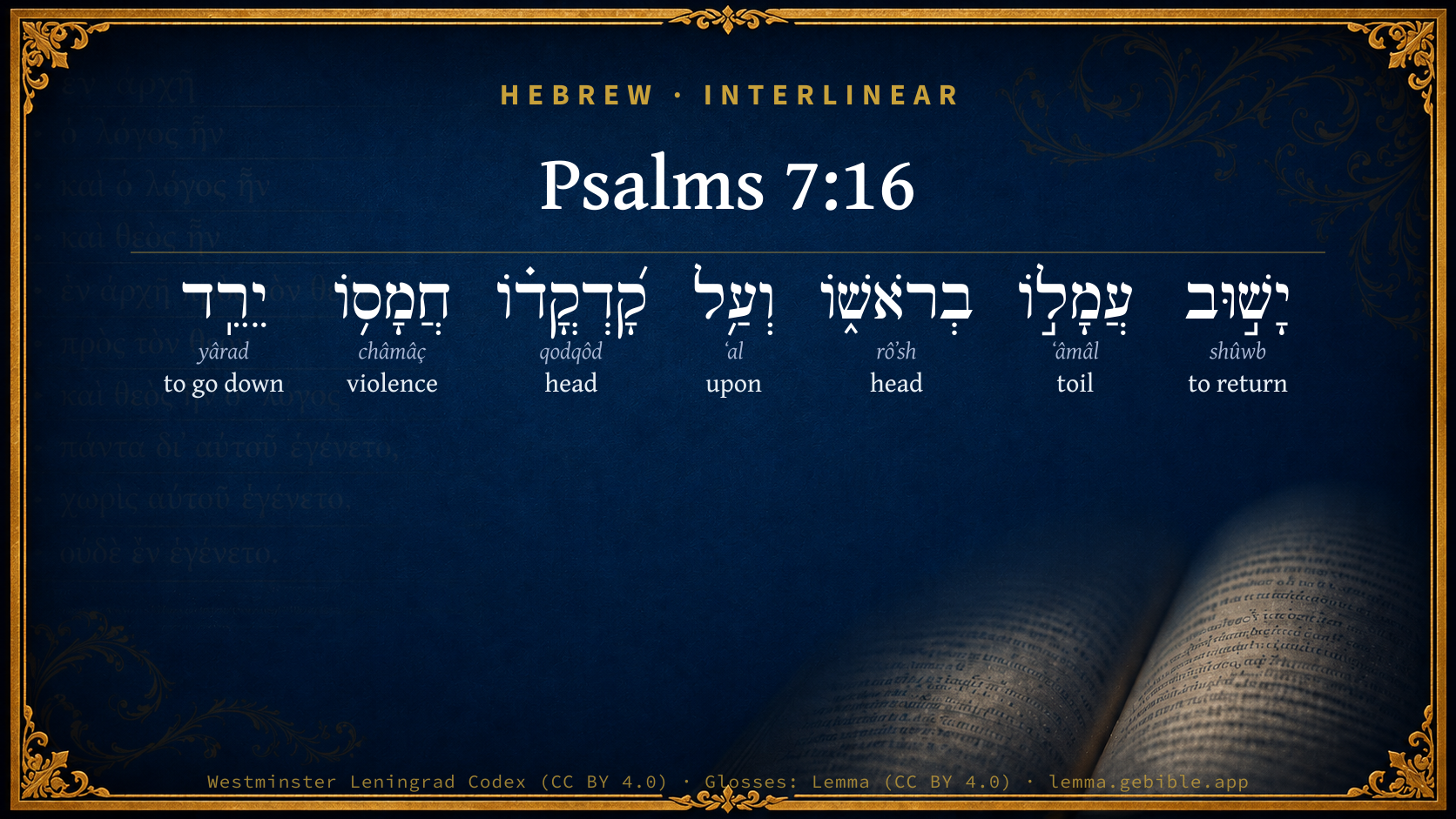
Psalms 7:16

Hebrew (Westminster Leningrad Codex) Psalms 7:16 appears in the Hebrew Old Testament. The text above is from the Westminster Leningrad Codex. Each word links to its Strong’s number, a concise gloss, and parsing drawn from the Open Scriptures Hebrew Bible morphology. Click any word for its full Brown-Driver-Briggs (BDB) entry.
Download image
Cite this verse

Psalms 7:16 (World English Bible). Public Domain. Lemma interlinear Bible study tool, https://lemma.gebible.app/v/psalms/7/16.

Show BibTeX & RIS
BibTeX
RIS
English Translation
The trouble he causes shall return to his own head. His violence shall come down on the crown of his own head.
World English Bible · Public Domain
Download a study sheet

One document with this verse’s original text, its word-by-word gloss line, the meaning frame, cross-references with their text, attributed commentary, and full source and license credits — printable, and it pastes into notes with its structure intact.

This verse Autodidact and up

Study sheet (.html) Plain text (.txt)

A passage Seminary Student

Up to 50 verses in one chapter. A passage sheet keeps up to 6 commentary sources and 12 cross-references per verse, in the order this page ranks them, and says so on the sheet whenever that leaves anything out. Ask for a single verse and you get the Autodidact verse sheet above.

Everything on this page stays free to read, with no account — the sheet is a download of what is already on screen, not access to it.

Want to remove ads? Support Godless Engineer
Compare translations 3

The same verse in 3 English versions, stacked beneath the original-language interlinear above. Click any original word for its lexicon entry.

Each is an independent rendering of the whole verse — the interlinear is not word-aligned to these translations.

Highlighted words mark where these versions differ — a whole-verse word diff, not a word-by-word alignment.

  • World English Bible Public Domain
    The trouble he causes shall return to his own head. His violence shall come down on the crown of his own head.
  • King James Version Public Domain
    His mischief shall return upon his own head, and his violent dealing shall come down upon his own pate.
  • unfoldingWord Literal Text CC BY-SA 4.0
    His trouble returns on his head, and his violence comes down on the top of his head.

unfoldingWord Literal Text — © unfoldingWord, licensed CC BY-SA 4.0. Word-aligned USFM3 via Door43 (git.door43.org/unfoldingWord/en_ult).

Versions to compare (up to 4)

3 of 4 selected

Show all 18 translations

Every available English version of this verse, each an independent rendering of the whole verse.

  • World English Bible Public Domain
    The trouble he causes shall return to his own head. His violence shall come down on the crown of his own head.
  • Berean Standard Bible Public Domain
    His trouble recoils on himself, and his violence falls on his own head.
  • Majority Standard Bible Public Domain
    His trouble recoils on himself, and his violence falls on his own head.
  • King James Version Public Domain
    His mischief shall return upon his own head, and his violent dealing shall come down upon his own pate.
  • American Standard Version (1901) Public Domain
    His mischief shall return upon his own head, And his violence shall come down upon his own pate.
  • Revised Version (1885) Public Domain
    His mischief shall return upon his own head, and his violence shall come down upon his own pate.
  • Geneva Bible (1599) Public Domain
    His mischiefe shall returne vpon his owne head, and his crueltie shall fall vpon his owne pate.
  • Douay-Rheims (1899) Public Domain
    He hath opened a pit and dug it; and he is fallen into the hole he made.
  • Young's Literal Translation Public Domain
    Return doth his perverseness on his head, And on his crown his violence cometh down.
  • Literal Standard Version CC BY-SA 4.0
    His perverseness returns on his head, || And his violence comes down on his crown.
  • Unlocked Literal Bible CC BY-SA 4.0
    His own destructive plans return to his own head, for his violence comes down on his own head.
  • unfoldingWord Literal Text CC BY-SA 4.0
    His trouble returns on his head, and his violence comes down on the top of his head.
  • Darby Bible Public Domain
    His mischief shall return upon his own head, and his violence shall come down upon his own pate.
  • World Messianic Bible Public Domain
    The trouble he causes shall return to his own head. His violence shall come down on the crown of his own head.
  • Webster's Bible Public Domain
    \\7:15\\He made a pit, and digged it, and hath fallen into the ditch which he made.
  • Free Bible Version CC BY-SA 4.0
    The trouble they cause rebounds to hit them on the head; their violence against others comes down on their own skulls.
  • Bible in Basic English Public Domain
    His wrongdoing will come back to him, and his violent behaviour will come down on his head.
  • JPS Tanakh (1917) Public Domain
    (7-17) His mischief shall return upon his own head, and his violence shall come down upon his own pate.

Literal Standard Version (2020), Covenant Press — licensed CC BY-SA 4.0. Text via the HelloAO Bible API (eBible.org). Unlocked Literal Bible (unfoldingWord) — licensed CC BY-SA 4.0. Text via the HelloAO Bible API (eBible.org). unfoldingWord Literal Text — © unfoldingWord, licensed CC BY-SA 4.0. Word-aligned USFM3 via Door43 (git.door43.org/unfoldingWord/en_ult). Free Bible Version, Dr. Jonathan Gallagher — licensed CC BY-SA 4.0. Text via the HelloAO Bible API (eBible.org).

Word by word

More ways to search: Search by grammar → Find every occurrence → Compare this word →

Practice this passage: Drill this verse → Learn its vocabulary →

About this verse

These counts appear in no published source. They are computed here, from the morphology-tagged text and Lemma’s own curated glosses. What Lemma adds →

7
words
7
distinct lemmas
Wisdom
section

Notable vocabulary

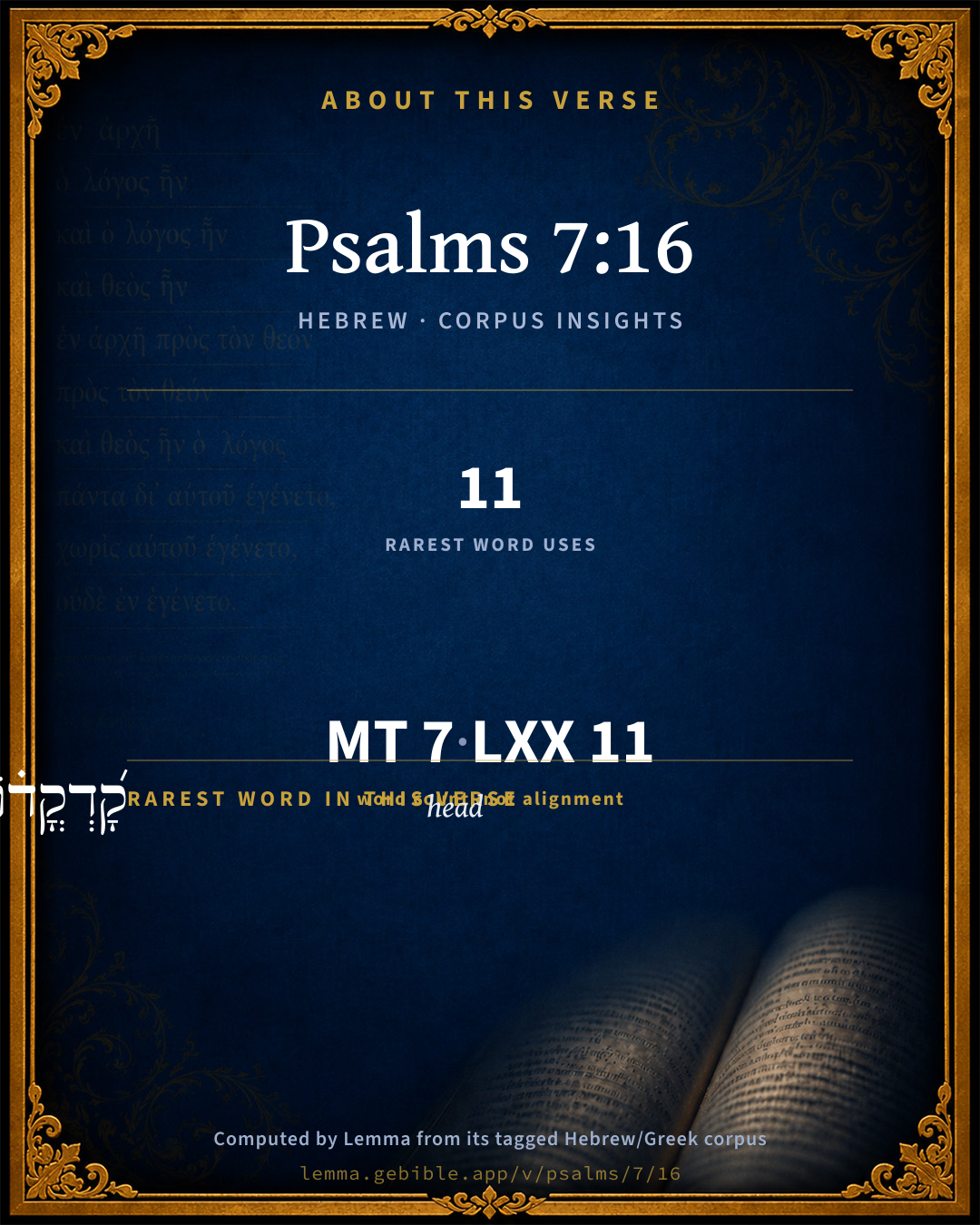
The rarest word here is קָ֝דְקֳד֗וֹ head H6936 — appearing just 11 times in the whole Hebrew Bible.

Shared distinctive vocabulary

קָ֝דְקֳד֗וֹ head H6936 occurs in 11 verses of the Hebrew Bible. Also found in:

Grammatical profile

  • 2 verbs
  • 4 nouns
  • 1 preposition

Verb forms

  • יָשׁ֣וּב Qal · Imperfect
  • יֵרֵֽד Qal · Imperfect

Hebrew & Septuagint length

In English translation the verse runs 22 words from the Hebrew and 18 from the Septuagint (LXX English) — closely comparable.

A rough comparison of the two English renderings, which tokenize alike — not a word-level alignment.

Word counts can differ between the Hebrew and the Greek without any difference in meaning — e.g. the Hebrew direct-object marker אֵת has no separate Greek word, and Greek often adds the article ὁ.

In the original languages it is 7 Hebrew tokens and 11 Greek tokens — but the two are counted differently (Hebrew bundles its prefixes and suffixes into one token; the Greek is in lemma form), so that isn’t a like-for-like length.

Cross-references

11

Topical passages linked to Psalms 7:16 in the Treasury of Scripture Knowledge — connected by theme and wording, ordered by reader-vote popularity; previews shown in the World English Bible.

  • Esther 9:25 but when [the matter] came before the king, he commanded by letters that his wicked device, which he had devised against the Jews, should return on his own head, and that he and his sons should be hanged on the gallows.
  • Psalms 37:12–13 The wicked plots against the just, And gnashes at him with his teeth.
  • 1 Kings 2:32 Yahweh will return his blood on his own head, because he fell on two men more righteous and better than he, and killed them with the sword, and my father David didn't know it, [to wit], Abner the son of Ner, captain of the host of Israel, and Amasa the son of Jether, captain of the host of Judah.
  • 1 Samuel 24:12–13 Yahweh judge between me and you, and Yahweh avenge me of you; but my hand shall not be on you.
  • 1 Samuel 26:10 David said, As Yahweh lives, Yahweh will strike him; or his day shall come to die; or he shall go down into battle and perish.
  • 1 Samuel 28:19 Moreover Yahweh will deliver Israel also with you into the hand of the Philistines; and tomorrow shall you and your sons be with me: Yahweh will deliver the host of Israel also into the hand of the Philistines.
  • 1 Samuel 31:3–4 The battle went sore against Saul, and the archers overtook him; and he was greatly distressed by reason of the archers.
  • Psalms 36:12 There the workers of iniquity are fallen. They are thrust down, and shall not be able to rise.
  • 1 Samuel 23:9 David knew that Saul was devising mischief against him; and he said to Abiathar the priest, Bring here the ephod.
  • Psalms 36:4 He plots iniquity on his bed. He sets himself in a way that is not good; He doesn't abhor evil.
  • Malachi 2:3–5 Behold, I will rebuke your seed, and will spread dung on your faces, even the dung of your feasts; and you will be taken away with it.

Cross-references courtesy of OpenBible.info (CC BY 4.0).

Hebrew and Greek witnesses Masoretic Hebrew ↔ Greek Septuagint

The same verse in the two great witnesses to the Old Testament, shown verse-for-verse.

You’re reading Greek Psalm 7 (Hebrew Psalm 7). The Septuagint counts the superscription, so verse numbers can differ from the Hebrew — chapter-level alignment, not verse-by-verse. Numbering follows Rahlfs.

These are two independent witnesses, not word-aligned to each other, and the Septuagint is shown in lemma (dictionary) form.

Hebrew Psalms 7:16 Masoretic · Westminster Leningrad Codex

יָשׁ֣וּב עֲמָל֣וֹ בְרֹאשׁ֑וֹ וְעַ֥ל קָ֝דְקֳד֗וֹ חֲמָס֥וֹ יֵרֵֽד

The trouble he causes shall return to his own head. His violence shall come down on the crown of his own head.

World English Bible · Public Domain

Greek LXX Greek Psalm 7:16 Septuagint · lemma form

λάκκος ὀρύσσω καί ἀνασκάπτω αὐτός καί ἐνπίπτω εἰς βόθρος ὅς ἐργάζομαι

His trouble shall return on his own head, and his unrighteousness shall come down on his own crown.

LXX2012 (modern English Septuagint) · Public Domain

Hebrew: Westminster Leningrad Codex (CC BY 4.0). Greek: Septuagint (public domain); English from LXX2012 (modern English Septuagint) (Public Domain). How the Septuagint differs from the Hebrew →

Commentary

Notes on Psalms 7:16 from classic Christian and Jewish commentators (each source and its license shown beneath its notes). The classic Christian expositions comment on the surrounding passage and are grouped to its opening verse, so a note may address several verses; the Jewish commentaries on the Tanakh (Rashi and others) are per-verse, so they appear only where the commentator wrote on this verse.

Lemma curates 59 commentaries, every one of them public domain or Creative Commons licensed, each selected and text-cleaned for this edition rather than reprinted as found. About our sources →

Trapp's Complete Commentary

John Trapp

Psa 7:16 His mischief shall return upon his own head, and his violent dealing shall come down upon his own pate.

Ver. 16. His mischief shall return upon his own head] As the Thracians’ arrows did, which they in a rage (because it rained upon them unseasonably) shot up against heaven (Herodot.).

And his violent dealing upon his own pate] i.e. Abundantly, and apparently. Various instances might be given hereof. Henry III of France was stabbed in the same chamber where he had helped to contrive the French massacre. His brother, Charles IX, had blood given him to drink, for he was worthy:

Quem sitiit vivens seelerata mente cruorem,

Perfidus hunc moriens Carolus ore vomit.

John Martin of Briqueras, in France, vaunted everywhere, that he would slit the minister’s nose of Angrogne. But he was shortly after assaulted by a wolf, which bit off his nose, so that he died thereof mad. Dispatch the knave, have done, said Sir Ralph Ellerken, governor of Calais, to the executioner of Adam Davilip, martyr, for I will not away till I see the traitor’s heart out (Acts and Mon.). But shortly after, the said Sir Ralph in a skirmish between the French and us at Bulloin, was among others slain, and had his heart ripped out by the enemy. That was a very remarkable one of Dr. Story, who escaping out of prison in Queen Elizabeth’s days, got to Antwerp, and there thinking himself out of the reach of God’s rod, he got commission under Duke D’Alva, to search all ships coming there for English books. But one Parker, an English merchant, trading to Antwerp, laid his snare fair, saith our chronicler (Speed. 1174), to catch this foul bird, causing secret notice to be given to Story, that in his ship were store of heretical books, with other intelligences that might stand him in stead. The canonist, conceiving that all was cock sure, hasted to the ship, where with looks very big upon the poor mariners, each cabin, chest, and corner above board were searched, and some things found to draw him further on; so that the hatches must be opened, which seemed to be unwillingly done, and great signs of fear were showed by their faces. This drew on the doctor to descend into the hold, where now in the trap the mouse might well gnaw, but could not get out; for the hatches were down, and the sails hoisted up, which with a merry gale were blown into England, where ere long he was arraigned, and condemned of high treason, and accordingly executed at Tyburn, as he had well deserved.

John Trapp, A Commentary or Exposition upon All the Books of the Old and New Testament (1647–1656) — public domain. Text from a community e-Sword module.

J. A. Alexander on Psalms

Joseph Addison Alexander

17. (Psa 7:16). Still a third variation of the same theme. His mischief shall return upon his own head, literally into it, like a falling body which not only rests upon an object, but sinks and is imbedded in it. And on his own crown his violence, including the ideas of injustice and cruelty, shall come down.

Joseph Addison Alexander, The Psalms Translated and Explained (1850) — public domain. Text from a community e-Sword module.

Adam Clarke's Commentary

Verse 16. Shall come down upon his own pate.] Upon his scalp, קדקד kodkod, the top of the head. It may refer to knocking the criminal on the head, in order to deprive him of life. Had scalping been known in those days, I should have thought the reference might be to that barbarous custom.

Adam Clarke's Commentary on the Bible (1810–1826) — public domain. Text from a community e-Sword/MySword module.

The Cambridge Bible for Schools and Colleges

gen. ed. J. J. S. Perowne

16. The certain recoil of evil upon the evil-doer. Cp. 1Sa_25:39 : and the figures in Pro_26:27, and Sir_27:25, “Whoso casteth a stone on high casteth it on his own head.”

The Cambridge Bible for Schools and Colleges (gen. ed. J. J. S. Perowne; Cambridge University Press, 1878–1918) — public domain. Text from a community e-Sword module.

John Gill's Exposition

His mischief shall return upon his own head,.... That which he conceived and devised in his mind, and attempted to bring upon others, shall fall upon himself, as a just judgment from heaven upon him;

and his violent dealing shall come down upon his own pate; referring to the violence with which Saul pursued David, which would be requited to him, and of which he prophesied, Sa1 26:10.

John Gill's Exposition of the Whole Bible (1746–1763) — public domain (CC PDM 1.0). Text via the HelloAO Bible API.

Albert Barnes' Notes on the Bible

His mischief - The mischief which he had designed for others.

Shall return upon his own head - Shall come upon himself. The blow which he aimed at others shall recoil on himself. This is but stating in another form the sentiment which had been expressed in the two previous verses. The language used here has something of a proverbial cast, and perhaps was common in the time of the writer to express this idea.

And his violent dealing - Which he shows to others. The word rendered violent dealing means violence, injustice, oppression, wrong.

Shall all come down upon his own pate - The word here rendered “pate” means properly vertex, top, or crown - as of the head. The idea is that it would come upon himself. He would be treated as he had designed to treat others. The sentiment here expressed is found also in Psa 9:15; Psa 35:8; Psa 37:15. Compare Eurip. Med. 409, and Lucretius v. 1151.

Albert Barnes' Notes on the Bible (1834–1885) — public domain. Text from a community e-Sword/MySword module.

Matthew Poole's English Annotations

Which phrase may note whence this retribution should come, even from heaven, or from the righteous and remarkable judgment of God.

Matthew Poole's English Annotations on the Holy Bible (1683–1685) — public domain. Text from a community e-Sword/MySword module.

The Treasury of David

Charles H. Spurgeon

Ver. 16. The rod which he lifted on high, has smitten his own back. He shot an arrow upward, and it has returned upon his own head. He hurled a stone at another and it has come down upon his own pate. Curses are like young chickens, they always come home to roost. Ashes always fly back in the face of him that throws them. "As he loved cursing, so let it come unto him." (Ps 109:17.) How often has this been the case in the histories of both ancient and modern times. Men have burned their own fingers when they were hoping to brand their neighbour. And if this does not happen now, it will hereafter. The Lord has caused dogs to lick the blood of Ahab in the midst of the vineyard of Naboth. Sooner or later the evil deeds of persecutors have always leaped back into their arms. So it will be in the last great day, when Satan's fiery darts shall all be quivered in his own heart, and all his followers shall reap the harvest which they themselves have sown.

Ver. 16. That most witty of commentators, Old Master Trapp, tells the following notable anecdote, in illustration of this verse:That was a very remarkable instance of Dr. Story, who, escaping out of prison in Queen Elizabeth's days, got to Antwerp, and there thinking himself out of the reach of God's rod, he got commission under the Duke of Alva to search all ships coming thither for English books. But one Parker, an English merchant, trading for Antwerp, laid his snare fair (saith our chronicler), to catch this foul bird, causing secret notice to be given to Story, that in his ship were stores of heretical books, with other intelligence that might stand him in stead. The Canonist conceiving that all was quite sure, hasted to the ship, where, with looks very big upon the poor mariners, each cabin, chest, and corner above-board were searched, and some things found to draw him further on: so that the hatches must be opened, which seemed to be unwillingly done, and great signs of fear were showed by their faces. This drew on the Doctor to descend into the hold, where now in the trap the mouse might well gnaw, but could not get out, for the hatches were down, and the sails hoisted up, which, with a merry gale, were blown into England, where ere long he was arraigned, and condemned of high treason, and accordingly executed at Tyburn, as he had well deserven.

Ver. 16. The story of Phalaris's bull, invented for the torment of others, and serving afterwards for himself, is notorious in heathen story ... It was a voluntary judgment which Archbishop Cranmer inflicted on himself when he thrust that very hand into the fire, and burnt it, with which he had signed to the popish articles, crying out, "Oh, my unworthy right hand!" but who will deny that the hand of the Almighty was also concerned in it? William Turner in "Divine Judgments by way of Retaliation", 1697.

Ver. 14-16. Illustrate by three figures the devices and defeat of persecutors.

Charles H. Spurgeon's The Treasury of David (1869–1885) — public domain. Psalms only. Text from a community e-Sword/MySword module.

The Pulpit Commentary

His mischief shall return upon his own head, and his violent dealing upon his own pate. Some critics see in this a continuation of the metaphor, and suppose that, while the sinner is in the pit, the heap which his own hands have thrown out falls in upon him and crushes him. But it is perhaps better to understand the words in a more general way.

The Pulpit Commentary (1880–1919), ed. H.D.M. Spence-Jones & Joseph S. Exell — public domain. Text from a community e-Sword module.

Radak

Rabbi David Kimhi (Radak)

He hath digged a pit, and graven it out: – repeating the idea in different words. And he says that he hath digged a pit to cause me to fall into it, but he shall fall into it himself. He prophesies that Saul shall die by the sword. And he says:

And hath fallen into the ditch which he maketh: – a past tense in place of a future, as we have explained.

Radak on the Tanakh — English translations: “Sefaria Community Translation” (CC0 1.0 (public-domain dedication)); “Eliyahu Munk, HaChut Hameshulash” (CC BY 4.0); “Rabbi Mike Feuer, Jerusalem Anthology” (CC BY 4.0); and “R. David Kimhi on the first book of Psalms, Translated by R.G. Finch, London, 1919” (public domain). Text via Sefaria.

Lesson kit

Teaching starters — assembled from the data on this page, not authored interpretation. Every prompt links to the verse data it draws on. Edit before teaching.

Psalms, in the Wisdom, opens this verse with 7 words (7 distinct Hebrew lemmas). Its most distinctive word is qodqôd (“head”). A historical commentator’s framing appears above. Read the whole chapter for the surrounding context.

Discussion questions

  1. The word qodqôd carries the sense “head.” How does it shape the verse?
  2. Genesis 49:26 shares the word «head» with this verse. How do the two illuminate each other?
  3. These translations render this verse differently. What is at stake in choosing one wording over another?
  4. The verb «יָשׁ֣וּב» is Qal Imperfect. How does its form color the action?
  5. Reading how Trapp's Complete Commentary and J. A. Alexander on Psalms read this verse, where do the two commentators agree and where do they part?

Things to notice

Reading settings

Reading text

Shown beneath each verse's original-language words.

Old Testament
Old Testament edition

Read the OT as the Masoretic Hebrew (MT) or the Greek Septuagint (LXX).

English shown for the Greek Septuagint (in the Hebrew ↔ Greek comparison).

Comparing translations? Open the Compare panel on any verse page to stack up to four side by side.