
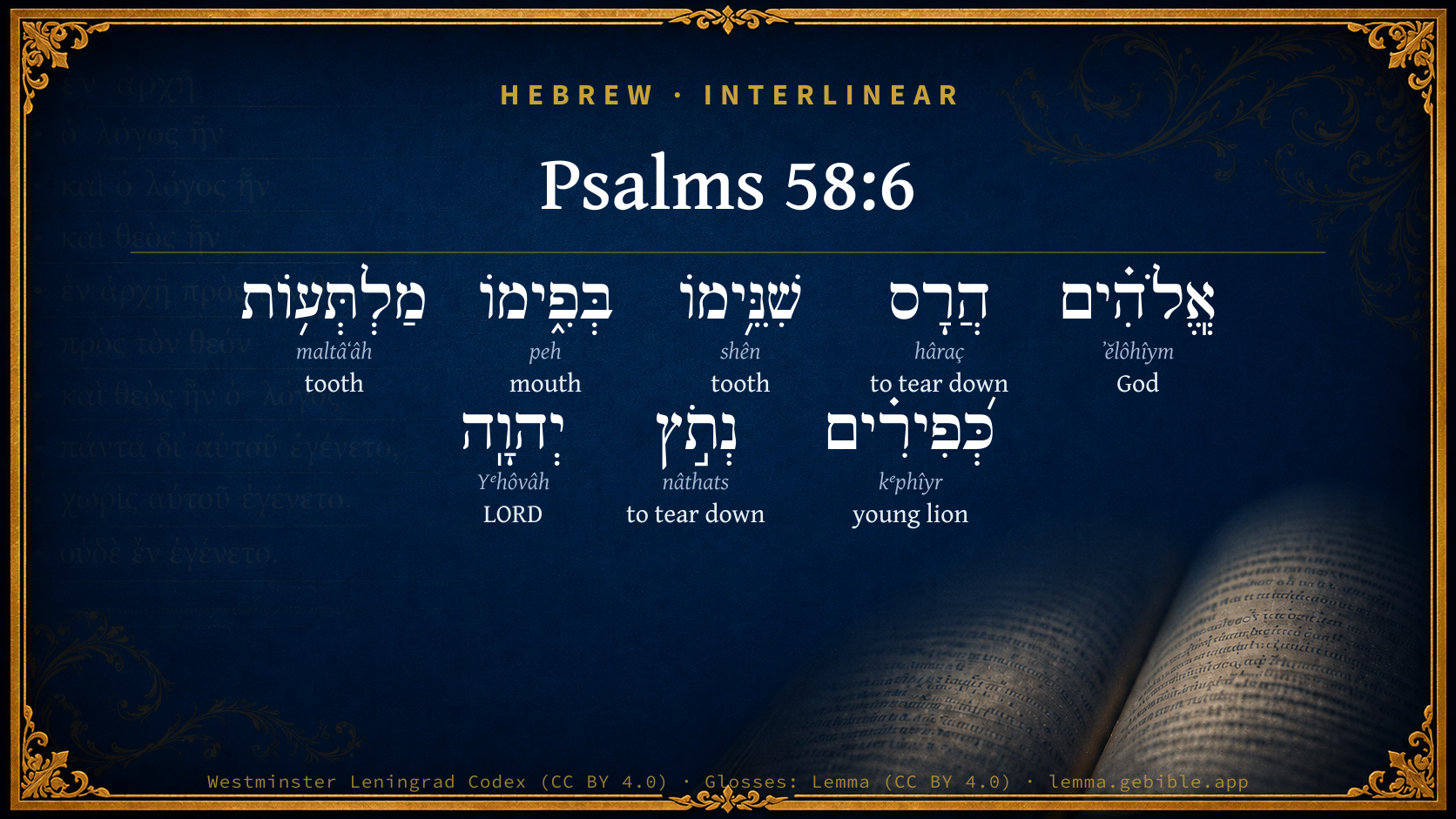
Psalms 58:6

Hebrew (Westminster Leningrad Codex) Psalms 58:6 appears in the Hebrew Old Testament. The text above is from the Westminster Leningrad Codex. Each word links to its Strong’s number, a concise gloss, and parsing drawn from the Open Scriptures Hebrew Bible morphology. Click any word for its full Brown-Driver-Briggs (BDB) entry.
Download image
Cite this verse

Psalms 58:6 (World English Bible). Public Domain. Lemma interlinear Bible study tool, https://lemma.gebible.app/v/psalms/58/6.

Show BibTeX & RIS
BibTeX
RIS
English Translation
Break their teeth, God, in their mouth. Break out the great teeth of the young lions, Yahweh.
World English Bible · Public Domain
Highlights
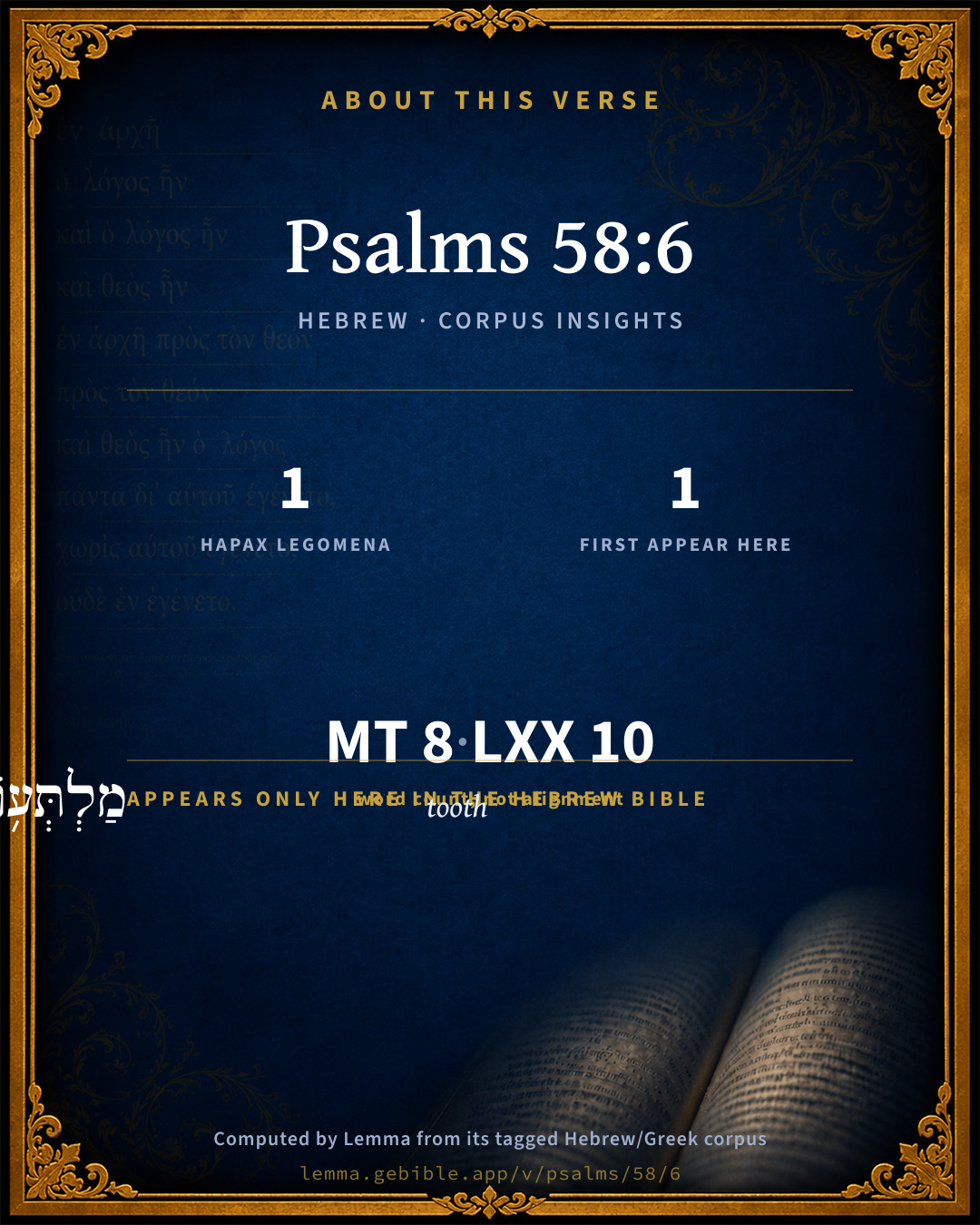
  • 1 hapax legomenon — only here in the Hebrew Bible
  • 1 first appearance in the Hebrew Bible
Full analysis ↓
Download a study sheet

One document with this verse’s original text, its word-by-word gloss line, the meaning frame, cross-references with their text, attributed commentary, and full source and license credits — printable, and it pastes into notes with its structure intact.

This verse Autodidact and up

Study sheet (.html) Plain text (.txt)

A passage Seminary Student

Up to 50 verses in one chapter. A passage sheet keeps up to 6 commentary sources and 12 cross-references per verse, in the order this page ranks them, and says so on the sheet whenever that leaves anything out. Ask for a single verse and you get the Autodidact verse sheet above.

Everything on this page stays free to read, with no account — the sheet is a download of what is already on screen, not access to it.

Want to remove ads? Support Godless Engineer
Compare translations 3

The same verse in 3 English versions, stacked beneath the original-language interlinear above. Click any original word for its lexicon entry.

Each is an independent rendering of the whole verse — the interlinear is not word-aligned to these translations.

Highlighted words mark where these versions differ — a whole-verse word diff, not a word-by-word alignment.

  • World English Bible Public Domain
    Break their teeth, God, in their mouth. Break out the great teeth of the young lions, Yahweh.
  • King James Version Public Domain
    Break their teeth, O God, in their mouth: break out the great teeth of the young lions, O LORD.
  • unfoldingWord Literal Text CC BY-SA 4.0
    God, break their teeth in their mouth! Break out the fangs of the young lions, Yahweh!

unfoldingWord Literal Text — © unfoldingWord, licensed CC BY-SA 4.0. Word-aligned USFM3 via Door43 (git.door43.org/unfoldingWord/en_ult).

Versions to compare (up to 4)

3 of 4 selected

Show all 18 translations

Every available English version of this verse, each an independent rendering of the whole verse.

  • World English Bible Public Domain
    Break their teeth, God, in their mouth. Break out the great teeth of the young lions, Yahweh.
  • Berean Standard Bible Public Domain
    O God, shatter their teeth in their mouths; O LORD, tear out the fangs of the lions.
  • Majority Standard Bible Public Domain
    O God, shatter their teeth in their mouths; O LORD, tear out the fangs of the lions.
  • King James Version Public Domain
    Break their teeth, O God, in their mouth: break out the great teeth of the young lions, O LORD.
  • American Standard Version (1901) Public Domain
    Break their teeth, O God, in their mouth: Break out the great teeth of the young lions, O Jehovah.
  • Revised Version (1885) Public Domain
    Break their teeth, O God, in their mouth: break out the great teeth of the young lions, O LORD.
  • Geneva Bible (1599) Public Domain
    Breake their teeth, O God, in their mouthes: breake the iawes of the yong lions, O Lord.
  • Douay-Rheims (1899) Public Domain
    Which will not hear the voice of the charmers; nor of the wizard that charmeth wisely.
  • Young's Literal Translation Public Domain
    O God, break their teeth in their mouth, The jaw-teeth of young lions break down, O Jehovah.
  • Literal Standard Version CC BY-SA 4.0
    O God, break their teeth in their mouth, || Break down the jaw-teeth of young lions, O YHWH.
  • Unlocked Literal Bible CC BY-SA 4.0
    Break their teeth in their mouths, God; break out the great teeth of the young lions, Yahweh.
  • unfoldingWord Literal Text CC BY-SA 4.0
    God, break their teeth in their mouth! Break out the fangs of the young lions, Yahweh!
  • Darby Bible Public Domain
    O God, break their teeth in their mouth; break out the great teeth of the young lions, O Jehovah.
  • World Messianic Bible Public Domain
    Break their teeth, God, in their mouth. Break out the great teeth of the young lions, LORD.
  • Webster's Bible Public Domain
    \\58:5\\Which will not hearken to the voice of charmers, charming never so wisely.
  • Free Bible Version CC BY-SA 4.0
    God, break their teeth, and smash the jaws of these lions, Lord.
  • Bible in Basic English Public Domain
    O God, let their teeth be broken in their mouths; let the great teeth of the young lions be pulled out, O Lord.
  • JPS Tanakh (1917) Public Domain
    (58-7) Break their teeth, O God, in their mouth; break out the cheek-teeth of the young lions, O LORD.

Literal Standard Version (2020), Covenant Press — licensed CC BY-SA 4.0. Text via the HelloAO Bible API (eBible.org). Unlocked Literal Bible (unfoldingWord) — licensed CC BY-SA 4.0. Text via the HelloAO Bible API (eBible.org). unfoldingWord Literal Text — © unfoldingWord, licensed CC BY-SA 4.0. Word-aligned USFM3 via Door43 (git.door43.org/unfoldingWord/en_ult). Free Bible Version, Dr. Jonathan Gallagher — licensed CC BY-SA 4.0. Text via the HelloAO Bible API (eBible.org).

Word by word

More ways to search: Search by grammar → Find every occurrence → Compare this word →

Practice this passage: Drill this verse → Learn its vocabulary →

About this verse

These counts appear in no published source. They are computed here, from the morphology-tagged text and Lemma’s own curated glosses. What Lemma adds →

8
words
8
distinct lemmas
Wisdom
section

Notable vocabulary

1 hapax legomenon — a word that appears only here in the entire Hebrew Bible:

  • מַלְתְּע֥וֹת tooth H4459

First appearance in Scripture

This word makes its first canonical appearance in the Hebrew Bible here:

  • מַלְתְּע֥וֹת tooth H4459

Shared distinctive vocabulary

כְּ֝פִירִ֗ים young lion H3715 occurs in 32 verses of the Hebrew Bible. Also found in:

Grammatical profile

  • 2 verbs
  • 6 nouns

Verb forms

  • הֲרָס Qal · Imperative
  • נְתֹ֣ץ Qal · Imperative

Hebrew & Septuagint length

In English translation the verse runs 17 words from the Hebrew and 16 from the Septuagint (LXX English) — closely comparable.

A rough comparison of the two English renderings, which tokenize alike — not a word-level alignment.

Word counts can differ between the Hebrew and the Greek without any difference in meaning — e.g. the Hebrew direct-object marker אֵת has no separate Greek word, and Greek often adds the article ὁ.

In the original languages it is 8 Hebrew tokens and 10 Greek tokens — but the two are counted differently (Hebrew bundles its prefixes and suffixes into one token; the Greek is in lemma form), so that isn’t a like-for-like length.

Cross-references

11

Topical passages linked to Psalms 58:6 in the Treasury of Scripture Knowledge — connected by theme and wording, ordered by reader-vote popularity; previews shown in the World English Bible.

  • Psalms 3:7 Arise, Yahweh! Save me, my God! For you have struck all of my enemies on the cheek bone. You have broken the teeth of the wicked.
  • Hosea 5:14 For I will be to Ephraim like a lion, And like a young lion to the house of Judah. I myself will tear in pieces and go away. I will carry off, and there will be no one to deliver.
  • Job 4:10–11 The roaring of the lion, and the voice of the fierce lion, The teeth of the young lions, are broken.
  • Job 29:17 I broke the jaws of the unrighteous, And plucked the prey out of his teeth.
  • Psalms 10:15 Break the arm of the wicked. As for the evil man, seek out his wickedness until you find none.
  • Psalms 17:12 He is like a lion that is greedy of his prey, As it were a young lion lurking in secret places.
  • Micah 5:8 The remnant of Jacob will be among the nations, In the midst of many peoples, Like a lion among the animals of the forest, Like a young lion among the flocks of sheep; Who, if he goes through, treads down and tears in pieces, And there is no one to deliver.
  • Numbers 23:24 Behold, the people rises up as a lioness, As a lion does he lift himself up: He shall not lie down until he eat of the prey, Drink the blood of the slain.
  • Psalms 91:13 You will tread on the lion and cobra. You will trample the young lion and the serpent underfoot.
  • Isaiah 31:4 For thus says Yahweh to me, As the lion and the young lion growling over his prey, if a multitude of shepherds are called forth against him, will not be dismayed at their voice, nor abase himself for the noise of them: so will Yahweh of Hosts come down to fight on Mount Zion, and on the hill of it.
  • Ezekiel 30:21–26 Son of man, I have broken the arm of Pharaoh king of Egypt; and, behold, it has not been bound up, to apply [healing] medicines, to put a bandage to bind it, that it be strong to hold the sword.

Cross-references courtesy of OpenBible.info (CC BY 4.0).

Hebrew and Greek witnesses Masoretic Hebrew ↔ Greek Septuagint

The same verse in the two great witnesses to the Old Testament, shown verse-for-verse.

You’re reading Greek Psalm 57 (Hebrew Psalm 58). The Septuagint counts the superscription, so verse numbers can differ from the Hebrew — chapter-level alignment, not verse-by-verse. Numbering follows Rahlfs.

These are two independent witnesses, not word-aligned to each other, and the Septuagint is shown in lemma (dictionary) form.

Hebrew Psalms 58:6 Masoretic · Westminster Leningrad Codex

אֱֽלֹהִ֗ים הֲרָס שִׁנֵּ֥ימוֹ בְּפִ֑ימוֹ מַלְתְּע֥וֹת כְּ֝פִירִ֗ים נְתֹ֣ץ יְהוָֽה

Break their teeth, God, in their mouth. Break out the great teeth of the young lions, Yahweh.

World English Bible · Public Domain

Greek LXX Greek Psalm 57:6 Septuagint · lemma form

ὅστις οὐ εἰςἀκούω φωνή ἐπιᾄδω φαρμακός τε φαρμακεύω παρά σοφός

God has crushed their teeth in their mouth: God has broken the cheek-teeth of the lions.

LXX2012 (modern English Septuagint) · Public Domain

On this verse, The Cambridge Bible for Schools and Colleges discusses the Septuagint’s reading. Read the note in Commentary ↓

Hebrew: Westminster Leningrad Codex (CC BY 4.0). Greek: Septuagint (public domain); English from LXX2012 (modern English Septuagint) (Public Domain). How the Septuagint differs from the Hebrew →

Commentary

Notes on Psalms 58:6 from classic Christian and Jewish commentators (each source and its license shown beneath its notes). The classic Christian expositions comment on the surrounding passage and are grouped to its opening verse, so a note may address several verses; the Jewish commentaries on the Tanakh (Rashi and others) are per-verse, so they appear only where the commentator wrote on this verse.

Lemma curates 59 commentaries, every one of them public domain or Creative Commons licensed, each selected and text-cleaned for this edition rather than reprinted as found. About our sources →

Matthew Henry's Commentary

In these verses we have,

I. David's prayers against his enemies, and all the enemies of God's church and people; for it is as such that he looks upon them, so that he was actuated by a public spirit in praying against them, and not by any private revenge. 1. He prays that they might be disabled to do any further mischief (Psa 58:6): Break their teeth, O God! Not so much that they might not feed themselves as that they might not be able to make prey of others, Psa 3:7. He does not say, "Break their necks" (no; let them live to repent, slay them not, lest my people forget), but, "Break their teeth, for they are lions, they are young lions, that live by rapine." 2. That they might be disappointed in the plots they had already laid, and might not gain their point: "When he bends his bow, and takes aim to shoot his arrows at the upright in heart, let them be as cut in pieces, Psa 58:7. Let them fall at his feet, and never come near the mark." 3. That they and their interest might waste and come to nothing, that they might melt away as waters that run continually; that is, as the waters of a land-flood, which, though they seem formidable for a while, soon soak into the ground or return to their channels, or, in general, as water spilt upon the ground, which cannot be gathered up again, but gradually dries away and disappears. Such shall the floods of ungodly men be, which sometimes make us afraid (Psa 18:4); so shall the proud waters be reduced, which threaten to go over our soul, Psa 124:4, Psa 124:5. Let us by faith then see what they shall be and then we shall not fear what they are. He prays (Psa 58:8) that they might melt as a snail, which wastes by its own motion, in every stretch it makes leaving some of its moisture behind, which, by degrees, must needs consume it, though it makes a path to shine after it. He that like a snail in her house is plenus sui - full of himself, that pleases himself and trusts to himself, does but consume himself, and will quickly bring himself to nothing. And he prays that they might be like the untimely birth of a woman, which dies as soon as it begins to live and never sees the sun. Job, in his passion, wished he himself had been such a one (Job 3:16), but he knew not what he said. We may, in faith, pray against the designs of the church's enemies, as the prophet does (Hos 9:14, Give them, O Lord! what wilt thou give them? Give them a miscarrying womb and dry breasts), which explains this prayer of the psalmist.

II. His prediction of their ruin (Psa 58:9): "Before your pots can feel the heat of a fire of thorns made under them (which they will presently do, for it is a quick fire and violent while it lasts), so speedily, with such a hasty and violent flame, God shall hurry them away, as terribly and as irresistibly as with a whirlwind, as it were alive, as it were in fury."

1. The proverbial expressions are somewhat difficult, but the sense is plain, (1.) That the judgments of God often surprise wicked people in the midst of their jollity, and hurry them away of a sudden. When they are beginning to walk in the light of their own fire, and the sparks of their own kindling, they are made to lie down in sorrow (Isa 50:11), and their laughter proves like the crackling of thorns under a pot, the comfort of which is soon gone, ere they can say, Alas! I am warm, Ecc 7:6. (2.) That there is no standing before the destruction that comes from the Almighty; for who knows the power of God's anger? When God will take sinners away, dead or alive, they cannot contest with him. The wicked are driven away in their wickedness. Now,

2. There are two things which the psalmist promises himself as the good effects of sinners' destruction: - (1.) That saints would be encouraged and comforted by it (Psa 58:10): The righteous shall rejoice when he sees the vengeance. The pomp and power, the prosperity and success, of the wicked, are a discouragement to the righteous; they sadden their hearts, and weaken their hands, and are sometimes a strong temptation to them to question their foundations, Psa 73:2, Psa 73:13. But when they see the judgments of God hurrying them away, and just vengeance taken on them for all the mischief they have done to the people of God, they rejoice in the satisfaction thereby given to their doubts and the confirmation thereby given to their faith in the providence of God and his justice and righteousness in governing the world; they shall rejoice in the victory thus gained over that temptation by seeing their end, Psa 73:17. He shall wash his feet in the blood of the wicked; that is, there shall be abundance of bloodshed (Psa 68:23), and it shall be as great a refreshment to the saints to see God glorified in the ruin of sinners as it is to a weary traveller to have his feet washed. It shall likewise contribute to their sanctification; the sight of the vengeance shall make them tremble before God (Psa 119:120) and shall convince them of the evil of sin, and the obligations they lie under to that God who pleads their cause and will suffer no man to do them wrong and go unpunished for it. The joy of the saints in the destruction of the wicked is then a holy joy, and justifiable, when it helps to make them holy and to purify them from sin. (2.) That sinners would be convinced and converted by it, Psa 58:11. The vengeance God sometimes takes on the wicked in this world will bring men to say, Verily, there is a reward for the righteous. Any man may draw this inference from such providences, and many a man shall, who before denied even these plain truths or doubted of them. Some shall have this confession extorted from them, others shall have their minds so changed that they shall willingly own it, and thank God who has given them to see it and see it with satisfaction, That God is, and, [1.] That he is the bountiful rewarder of his saints and servants: Verily (however it be, so it may be read) there is a fruit to the righteous; whatever damage he may run, and whatever hardship he may undergo for his religion, he shall not only be no loser by it, but an unspeakable gainer in the issue. Even in this world there is a reward for the righteous; they shall be recompensed in the earth. Those shall be taken notice of, honoured, and protected, that seemed slighted, despised, and abandoned. [2.] That he is the righteous governor of the world, and will surely reckon with the enemies of his kingdom: Verily, however it be, though wicked people prosper, and bid defiance to divine justice, yet it shall be made to appear, to their confusion, that the world is not governed by chance, but by a Being of infinite wisdom and justice; there is a God that judges in the earth, though he has prepared his throne in the heavens. He presides in all the affairs of the children of men, and directs and disposes them according to the counsel of his will, to his own glory; and he will punish the wicked, not only in the world to come, but in the earth, where they have laid up their treasure and promised themselves a happiness - in the earth, that the Lord may be known by the judgments which he executes, and that they may be taken as earnests of a judgment to come. He is a God (so we read it), not a weak man, not an angel, not a mere name, not (as the atheists suggest) a creature of men's fear and fancy, not a deified hero, not the sun and moon, as idolaters imagined, but a God, a self-existent perfect Being; he it is that judges the earth; his favour therefore let us seek, from whom every man's judgment proceeds, and to him let all judgment be referred.

Matthew Henry's Commentary on the Whole Bible (1708–1710) — public domain (CC PDM 1.0). Text via the HelloAO Bible API.

Trapp's Complete Commentary

John Trapp

Psa 58:6 Break their teeth, O God, in their mouth: break out the great teeth of the young lions, O LORD.

Ver. 6. Break their teeth, O God] Disarm and disable them from doing me mischief. See Psa 3:7; Psa 10:13; Psa 57:4, to which last he seemeth here to refer.

John Trapp, A Commentary or Exposition upon All the Books of the Old and New Testament (1647–1656) — public domain. Text from a community e-Sword module.

The Treasury of David

Charles H. Spurgeon

Ver. 6. Break their teeth, O God, in their mouth. If they have no capacity for good, at least deprive them of their ability for evil. Treat them as the snake charmers do their serpents, extract their fangs, break their teeth. The Lord can do this, and he will. He will not suffer the malice of the wicked to triumph, he will deal them such a blow as shall disable them from mischief.

Break out the great teeth of the young lions, O Lord. As if one brute creature had not enough of evil in it to complete the emblem of ungodly nature, another specimen of ferae naturae is fetched in. For fierce cruelty the wicked are likened to young lions, monsters in the prime of their vigour, and the fury of their lustiness; and it is asked that their grinders may be smashed in, broken off, or dashed out, that the creatures may henceforth be harmless. One can well understand how the banished son of Jesse, while poisoned by the venomous slander of his foes, and worried by their cruel power, should appeal to heaven for a speedy and complete riddance from his enemies.

Ver. 6. Break their teeth, destroy the fangs of these serpents, in which their poison is contained. This will amount to the same meaning as above. Save me from the adders, the sly and poisonous slanderers: save me also from the lions --the tyrannical and bloodthirsty men. Adam Clarke.

Ver. 6. Great teeth. mwetlm, according to Michaelis and Gesenius, are the eye teeth, which in lions are sharp and terrible. George Phillips, B.D., in "The Psalms in Hebrew: With a Commentary, "1846.

Ver. 6-9. David's enemies were strong and fierce as young lions: he therefore prayed that their teeth might be broken, even their strongest teeth, their grinders, with which they were ready to devour him; that so they might be disabled from doing mischief. They overwhelmed him like an inundation: but he desired it might prove a land flood, which is soon wasted. They were about to shoot at him: but he would have their bows, or their arrows, to be shivered to pieces, and become like straw, and do no execution, and he prayed that they might waste insensibly as the snail, which leaves its substance all along its track; and that they might come to nothing, like an abortion. He also predicted, that their prosperous rage (which resembled the crackling of thorns under a pot), would soon be extinct, and produce no effect; while the Lord in his wrath would hurry them into speedy destruction; as a furious whirlwind drives a living man down a precipice, or into a dreadful pit. Thomas Scott, 1747-1821.

None.

Psalms 58:7*

Ver. 6-9. See Psalms on "Ps 58:6" for further information.

Ver. 6-9. See Psalms on "Ps 58:6" for further information.

Charles H. Spurgeon's The Treasury of David (1869–1885) — public domain. Psalms only. Text from a community e-Sword/MySword module.

Joseph Benson's Commentary

Psa 58:6. Break their teeth, O God — Their power and instruments of doing mischief. “The mention of teeth here, with the relative their, most probably first refers to those of the adder or serpent, immediately foregoing, whose poison and noxious power are in their teeth; and the way to disarm serpents is to deprive them of their teeth. They who keep serpents tame usually do this by putting to them a piece of red cloth, in which they love to fix their teeth, and so draw them out. This mention of teeth fairly introduces that which follows concerning the lions, whose power of doing mischief with them is more violent; and so signifies the open and riotous offender; as the serpent’s teeth may imply the more secret and indiscernible wounds of the whisperer or backbiter: which yet are as dangerous and destructive as the former; by the smallest prick killing him on whom they fasten.” — Dodd.

Joseph Benson's Commentary on the Old and New Testaments (1811–1818) — public domain. Text from a community e-Sword module.

J. A. Alexander on Psalms

Joseph Addison Alexander

7. (Psa 58:6). O God, crush their teeth in their mouth; the grinders of the young lions shatter, O Jehovah! The complaint is now followed by a prayer, that these ferocious enemies may be disarmed and disabled. This idea is expressed by the use of the same figure as in Psa 3:7, that of wild beasts rendered harmless by the breaking of their teeth. Compare Job 29:17, Hence in the last clause they are expressly called lions. See above, Psa 57:4. Young lions, not mere whelps, from which they are distinguished in Eze 19:2-3, but full-grown lions, in the first maturity of their strength, and therefore more to be dreaded than when older or younger. See above, Psa 17:12; Psa 34:10; Psa 35:17. The Hebrew verbs in this verse are peculiarly expressive, and, though wholly unconnected with each other, are both used elsewhere to express the ideas of violently breaking, breaking down, breaking out, breaking off, and breaking through. See Exo 15:7; Exo 19:21, Lev 14:45, Jdg 6:30, 1Ki 18:30.

Joseph Addison Alexander, The Psalms Translated and Explained (1850) — public domain. Text from a community e-Sword module.

Tyndale Open Study Notes

Tyndale Open Resources

58:6 The psalmist calls on God to break the destructive power of the wicked.

Tyndale Open Study Notes — © Tyndale Open Resources, licensed CC BY-SA 4.0. Text via the HelloAO Bible API.

Geneva Bible (1599)

Geneva Bible translators

Take away all occasions and means whereby they hurt.

Geneva Bible (1599) marginal notes — public domain. Text via Bolls.life.

Jamieson, Fausset & Brown

Robert Jamieson, A. R. Fausset & David Brown

He prays for their destruction, under the figure of ravenous beasts (Psa 3:7; Psa 7:2).

Jamieson, Fausset & Brown — Commentary Critical and Explanatory on the Whole Bible (1871) — public domain (CC PDM 1.0). Text via the HelloAO Bible API.

Adam Clarke's Commentary

Verse 6. Break their teeth] He still compares Saul, his captains, and his courtiers, to lions; and as a lion's power of doing mischief is greatly lessened if all his teeth be broken, so he prays that God may take away their power and means of pursuing their bloody purpose. But he may probably have the serpents in view, of which he speaks in the preceding verse; break their teeth-destroy the fangs of these serpents, in which their poison is contained. This will amount to the same meaning as above. Save me from the adders-the sly and poisonous slanderers: save me also from the lions-the tyrannical and blood-thirsty men.

Adam Clarke's Commentary on the Bible (1810–1826) — public domain. Text from a community e-Sword/MySword module.

John Calvin's Commentaries

6. Break their teeth, O God! in their mouth From this part of the psalm he assumes the language of imprecation, and solicits the vengeance of God, whose peculiar prerogative it is to repel oppression and vindicate injured innocence. It is necessary, however, that we attend to the manner in which this is done. He does not claim the judgment or patronage of God to his cause, until he had, in the first place, asserted his integrity, and stated his complaint against the malicious conduct of his enemies; for God can never be expected to undertake a cause which is unworthy of defense. In the verse before us, he prays that God would crush the wicked, and restrain the violence of their rage. By their teeth, he would intimate that they resembled wild beasts in their desire to rend and destroy the victims of their oppression; and this is brought out more clearly in the latter part of the verse, where he likens them to lions The comparison denotes the fury with which they were bent upon his destruction.

In the next verse, and in the several succeeding verses, he prosecutes the same purpose, employing a variety of apt similitudes. He prays that God would make them flow away like waters, that is, swiftly. The expression indicates the greatness of his faith. His enemies were before his eyes in all the array of their numbers and resources; he saw that their power was deeply rooted and firmly established; the whole nation was against him, and seemed to rise up before him like a hopeless and formidable barrier of rocky mountains. To pray that this solid and prodigious opposition should melt down and disappear, evidenced no small degree of courage, and the event could only appear credible to one who had learnt to exalt the power of God above all intervening obstacles. In the comparison which immediately follows, he prays that the attempts of his adversaries might be frustrated, the meaning of the words being, that their arrows might fall powerless, as if broken, when they bent their bow. Actuated as they were by implacable cruelty, he requests that God would confound their enterprises, and in this we are again called to admire his unshaken courage, which could contemplate the formidable preparations of his enemies as completely at the disposal of God, and their whole power as lying at his feet. Let his example in this particular point be considered. Let us not cease to pray, even after the arrows of our enemies have been fitted to the string, and destruction might seem inevitable.

John Calvin's Commentaries (1540-1563) — public domain. Text from the Calvin Translation Society English edition (1840s-50s) via the Christian Classics Ethereal Library (ccel.org). Calvin's coverage is partial (roughly two-thirds of the Bible); uncommented books and verses are honest gaps, never fabricated. The 19th-century editor's footnotes and remarks are omitted so the notes are faithfully Calvin's own voice.

Ellicott's Commentary for English Readers

(6) Break their teeth.—The change is abrupt from the image of obstinacy deaf to all charms, to that of violence that must be tamed by force.

Great teeth.—Literally, biters, grinders.

A Bible Commentary for English Readers, edited by Charles John Ellicott (1878–1897) — public domain. Text from a community e-Sword module.

The Cambridge Bible for Schools and Colleges

gen. ed. J. J. S. Perowne

6. The figure of the serpent, typical of insidious deadliness, is changed to that of the lion, typical of open ferocity.

Break … break out] Render them powerless for harm. Two strong words, properly used of breaking down and overthrowing walls. Cp. Psa_3:7; Job_4:10 : Pro_30:14.

The LXX rendering of these verbs as perfects of certainty deserves consideration. It only requires a different vocalisation of the consonants, and gives an excellent sense: God shall surely break &c. The tenses in Psa_58:7-8 must then be rendered as futures: They shall melt away &c. Such an authoritative declaration of the punishment in store for the wicked seems more in keeping with the prophetic tone of the Psalm than the prayer for their destruction.

6–9. Since they are thus obstinately and incurably evil, nothing remains but that they should be deprived of their power to hurt or altogether destroyed.

The Cambridge Bible for Schools and Colleges (gen. ed. J. J. S. Perowne; Cambridge University Press, 1878–1918) — public domain. Text from a community e-Sword module.

John Gill's Exposition

Break their teeth, O God, in their mouth,.... From the description of the wicked, the psalmist passes to imprecations on his enemies; whom he represents as cruel and bloodthirsty, and as being stronger than he; and therefore he applies to God, who could, as he sometimes did, smite his enemies on the cheekbone, and break the teeth of the ungodly; which is done by taking the power and instruments of hurting from them: and it may be by "their teeth in their mouth" may be meant their malicious words, calumnies, and detractions; teeth being the instrument of speech; and by "breaking" them, preventing the mischief designed by them;

break out the great teeth of the young lions, O Lord: Saul was the old lion; his princes, nobles, and courtiers, the young ones; whose jaw teeth were as knives to devour David and his men, unless plucked out; or God in his providence should interpose, and hinder the performance of their mischievous and cruel designs; and who could easily destroy them by his blast, and by the breath of his nostrils, Job 4:9.

John Gill's Exposition of the Whole Bible (1746–1763) — public domain (CC PDM 1.0). Text via the HelloAO Bible API.

Albert Barnes' Notes on the Bible

Break their teeth, O God, in their mouth - The word here rendered “break” means properly “to tear out.” The allusion is to his enemies, represented as wild beasts; and the prayer is, that God would deprive them of the means of doing harm - as wild animals are rendered harmless when their teeth are broken out.

Break out the great teeth of the young lions, O Lord - The word used here means properly “biters” or “grinders:” Job 29:17; Pro 30:14; Joe 1:6. Compare the notes at Psa 3:7. The word rendered “young lions” here does not refer to mere whelps, but to full-grown though young lions in their vigor and strength, as contrasted with old lions, or those which are enfeebled by age. The meaning is, that his enemies were of the most fierce and violent kind.

Albert Barnes' Notes on the Bible (1834–1885) — public domain. Text from a community e-Sword/MySword module.

Matthew Poole's English Annotations

Their teeth; their power and instruments of doing mischief. He mentions teeth, partly because the adder’s poison lies in its teeth; and partly to make way for the following metaphor.

The great teeth, called the grinders; which are more sharp and strong than the rest, and more used in breaking and tearing what they are about to eat.

Matthew Poole's English Annotations on the Holy Bible (1683–1685) — public domain. Text from a community e-Sword/MySword module.

Whedon's Commentary on the Bible

Daniel D. Whedon

6. Break their teeth—The allusion is to the custom of extracting the poisonous fangs of the serpent in order to render it harmless and abate the malignity of its nature. This is still practised, though not in every case, according to the writers quoted by Hengstenberg, (Egypt and the Books of Moses.)

Great teeth of the young lions—The allusion changes from the fangs of serpents to the great teeth of lions, by which they tear their prey. The imagery is startling. “Young lions” (כפירים, kephereem) are those in full vigour of youth, and hence more active to destroy; distinguished from גור, (goor,) a sucking lion, Eze_19:2-3; and from לביא, (lahbee,) the great or stout lion, stronger but less active, Gen_49:9; Num_23:24; and from לישׁ, (layeesh,) an old lion enfeebled by age and perishing for lack of prey, Job_4:11; Isa_30:6. The sense of the apparently harsh language of this verse is, according to the known import of the metaphors, that as his enemies could not be diverted or appeased, God would disarm them,—break their power to envenom or destroy. See the allusions explained Job_29:17; Pro_30:14; Joe_1:6. It was not against them personally that the plea was entered, but against their power as officers of government and organized conspirators and persecutors.

Daniel D. Whedon (gen. ed.), Commentary on the Old and New Testaments (1874–1909) — public domain. Text from a community e-Sword module.

The Pulpit Commentary

Vers. 6-9. passes into imprecation, with an "Elohim" emphatically placed first" (Cheyne). Metaphors are accumulated. Menace follow menace. The wrath of God is first invoked upon the evil doers (vers. 6-8); then (ver. 9) coming judgment is announced.

Break their teeth, O God, in their mouth. Serpent charmers sometimes, when they have caught their snake, proceed to beat out the poison fangs with a stone or stick (Geike, "The Holy Land and the Bible," vol. 1, p. 245). The psalmist, in the first clause, seems to allude to this practice; in the second, he changes the metaphor, reverting to his favourite image of the young lion (kephir). Break out the great teeth of the young lions, O Lord. The "cheek teeth", (Joe_1:6) or principal fangs on either side, are intended.

The Pulpit Commentary (1880–1919), ed. H.D.M. Spence-Jones & Joseph S. Exell — public domain. Text from a community e-Sword module.

John Wesley's Explanatory Notes

Their teeth - Their powerful instruments of doing mischief.

John Wesley, Explanatory Notes Upon the Whole Bible (1754–1765) — public domain. Text via the GEBible commentary corpus.

Keil & Delitzsch

C. F. Keil & F. Delitzsch

The verb הרס is used much in the same way in Psa 58:7 as ἀράσσειν (e.g., Iliad, xiii. 577, ἀπὸ δὲ τρυφάλειαν ἄραξεν), which presents a similar onomatope. The form ימּאסוּ is, as in Job 7:5, = ימּסּוּ. The Jewish expositors, less appropriately, compare צנאכם, Num 32:24, and בּזאוּ = בּזזוּ, Isa 18:2, Isa 18:7; שׁאסיך, Chethb, Jer 30:16, and ראמה, Zac 14:10, more nearly resemble it. The treading (bending) of the bow is here, as in Psa 64:4, transferred to the arrows (= כּונן, Psa 11:2): he bends and shoots off his arrows, they shall be as though cut off in the front, i.e., as inoperative as if they had no heads or points (כּמו as in Isa 26:18). In Psa 58:9 follow two figures to which the apprecatory "let them become" is to be supplied. Or is it perhaps to be rendered: As a snail, which Thou causest to melt away, i.e., squashest with the foot (תּמס, as in Psa 39:12, fut. Hiph. of מסה = מסס), let him perish? The change of the number does not favour this; and according to the usage of the language, which is fond of construing הלך with gerunds and participles, and also with abstract nouns, e.g., הלך תּם, הלך קרי, the words תּמס יהלך belong together, and they are also accented accordingly: as a snail or slug which goes along in dissolution, goes on and dissolves as it goes (תּמס after the form תּבל form בּלל

(Note: In the Phoenician, the Cyprian copper mine Ταμασσός appears to have taken its name from תמס, liquefactio (Levy, Phnizische Studien, iii. 7).)).

The snail has received its name from this apparent dissolving into slime. For שׁבּלוּל (with Dag. dirimens for שׁבלוּל) is the naked slimy snail or slug (Targum, according to ancient conception, זחיל תּבללא "the slimeworm"), from שׁבלל, to make wet, moist.

(Note: "God has created nothing without its use," says the Talmud, B. Shabbath 77b; "He has created the snail (שׁבלול לכתית) to heal bruises by laying it upon them:" cf. Genesis Rabba, ch. 51 init., where שׁבלול is explained by לימצא, סיליי, כיליי, κογχύλη, σέσιλος, limax. Abraham b. David of Fez, the contemporary of Saadia, has explained it in his Arabico-Hebrew Lexicon by אלחלזון, the slug. Nevertheless this is properly the name of the snail with a house (נרתיק), Talmudic חלּזון, and even at the present day in Syria and Palestine Arab. ḥlzûn (which is pronounced ḥalezôn); whereas שׁבלול, in conformity with the etymon and with the figure, is the naked snail or slug. The ancient versions perhaps failed to recognise this, because the slug is not very often to be seen in hot eastern countries; but שׁבלול in this signification can be looked upon as traditional. The rendering "a rain-brook or mountain-torrent (Arabic seil sâbil) which running runs away," would, to say nothing more, give us, as Rosenmller has already observed, a figure that has been made use of already in Psa 58:8.)

In the second figure, the only sense in which נפל אשׁת belong together is "the untimely birth of a woman;" and rather than explain with the Talmud (B. Med katan 6b) and Targum (contrary to the accents): as an abortion, a mole,

(Note: The mole, which was thought to have no eyes, is actually called in post-biblical Hebrew אשׁת, plur. אישׁות (vid., Keelim xxi. 3).)

one would alter אשׁת into אשׁה. But this is not necessary, since the construct form אשׁת is found also in other instances (Deu 21:11; Sa1 28:7) out of the genitival relation, in connection with a close coordinate construction. So here, where בּל־הזוּ שׁמשׁ, according to Job 3:16; Ecc 6:3-5, is an attributive clause to נפל אשׁת (the falling away of a woman = abortions), which is used collectively (Ew. 176, b). The accentuation also harmonizes here with the syntactic relation of the words. In Psa 58:10, אטד (plural in African, i.e., Punic, in Dioscorides atadi'n) is the rhamnus or buckthorn, which, like רתם, the broom, not only makes a cheerful crackling fire, but also produces an ash that retains the heat a long time, and is therefore very useful in cooking. The alternative כּמו - כּמו signifies sive, sive, whether the one or the other. חי is that which is living, fresh, viz., the fresh, raw meat still having the blood in it, the opposite of מבשּׁל (Sa1 2:15); חרון, a fierce heat or fire, here a boiling heat. There is no need to understand חרון metonymically, or perhaps as an adjective = charrôn, of boiled meat: it is a statement of the condition. The suffix of ישׁערנּוּ, however, refers, as being neuter, to the whole cooking apparatus, and more especially to the contents of the pots. The rendering therefore is: whether raw or in a state of heat, i.e., of being cooked through, He (Jahve) carries it away as with a whirlwind. Hengstenberg rightly remarks, "To the raw meat correspond the immature plots, and to the cooked the mature ones." To us, who regard the Psalm as belonging to the time of Absalom, and not, like Hengstenberg, to the time of Saul, the meat in the pots is the new kingship of Absalom. The greater the self-renunciation with which David at that time looked on at the ripening revolt, disclaiming all action of his own, the stronger the confidence with which he expected the righteous interposition of God that did actually follow, but (as he here supposes possible) not until the meat in the pot was almost done through; yet, on the other side, so quickly, that the pots had scarcely felt the crackling heat which should fully cook the meat.

Keil & Delitzsch — Biblical Commentary on the Old Testament (1861–1891) — public domain (CC PDM 1.0). Text via the HelloAO Bible API. (Old Testament only.)

unfoldingWord translationNotes

Door43 World Missions Community

General Information:

The author lists things that he would like God to do to wicked people.

Break their teeth ... break out the great teeth of the young lions

In both of these phrases, the wicked people are spoken of as if they were lions, and making them powerless to kill people is spoken of as breaking their teeth. AT: "Take away their power to kill. Make them powerless like young lions whose teeth have been broken and fallen out" (See: Parallelism and Metaphor)

Let them melt away as water that runs off

The wicked people are spoken of as if they were ice or water. No longer existing is spoken of as melting or draining away into the dry ground. AT: "Make them disappear like water that runs off" or "Make them vanish like ice that melts and drains into the ground" (See: Metaphor and Simile)

let them be as though they had no points

"let their arrows be as though they had no points"

Let them be like a snail that melts and passes away

No longer existing is spoken of as melting and disappearing. AT: "Let the wicked vanish like a snail that melts and no longer exists" (See: Simile)

snail

small animal that the Israelites considered unclean and that looks like it is melting as it moves by sliding over slime it has produced

like the untimely-born child of a woman that never sees the sunlight

Not existing is spoken of as being like a baby that is born dead. AT: "like a baby who is born too early too live and see the sunlight" or "like a baby that was born dead" (See: Simile)

translationWords

God

lions

Yahweh

bow and arrow

unfoldingWord translationNotes — © Distant Shores Media and the Door43 World Missions Community, licensed CC BY-SA 4.0. Source: git.door43.org/Door43/en_tn.

Rashi

Rabbi Shlomo Yitzchaki (Rashi)

Which will not hear, etc. This is connected to the preceding verse: “and it closes its ear in order not to hear the voice of charmers.”

caster of spells who knows how to charm snakes.

Rashi on the Tanakh — English translations: “The Judaica Press complete Tanach with Rashi, translated by A. J. Rosenberg” (CC BY 4.0); “Pentateuch with Rashi's commentary by M. Rosenbaum and A.M. Silbermann, 1929-1934” (public domain); “The Metsudah Tanach series, Lakewood, N.J” (CC BY 4.0); and “The Book of Joshua, Metsudah Publications, 1997” (CC BY 4.0). Text via Sefaria.

Lesson kit

Teaching starters — assembled from the data on this page, not authored interpretation. Every prompt links to the verse data it draws on. Edit before teaching.

Psalms, in the Wisdom, opens this verse with 8 words (8 distinct Hebrew lemmas). Its most distinctive word is maltâʻâh (“tooth”). A historical commentator’s framing appears above. Read the whole chapter for the surrounding context.

Discussion questions

  1. How does “tooth” (maltâʻâh) shape what this verse is saying?
  2. 1 word here appears nowhere else in the Hebrew Bible. Why might the author reach for such rare wording?
  3. This is the first place “tooth” appears in Scripture (first appears here). What does its debut here establish?
  4. How does Judges 14:5, which shares the word «young lion», read alongside this verse?
  5. The translations on this page render this verse differently — a whole-verse word diff, not a word-by-word alignment. What might account for the different wordings?
  6. «הֲרָס» is a Qal Imperative verb. How does that grammatical form shape the action described?
  7. Compare how Matthew Henry's Commentary and Trapp's Complete Commentary read this verse. Where do they agree or differ?

Things to notice

Reading settings

Reading text

Shown beneath each verse's original-language words.

Old Testament
Old Testament edition

Read the OT as the Masoretic Hebrew (MT) or the Greek Septuagint (LXX).

English shown for the Greek Septuagint (in the Hebrew ↔ Greek comparison).

Comparing translations? Open the Compare panel on any verse page to stack up to four side by side.