

1 Thessalonians 2:9
Greek (Tischendorf 8th ed.) 1 Thessalonians 2:9 appears in the Greek New Testament. The text above is from the Tischendorf 8th edition. Each word links to its Strong’s number and a concise gloss. Click any word for its full Thayer’s Greek Lexicon entry.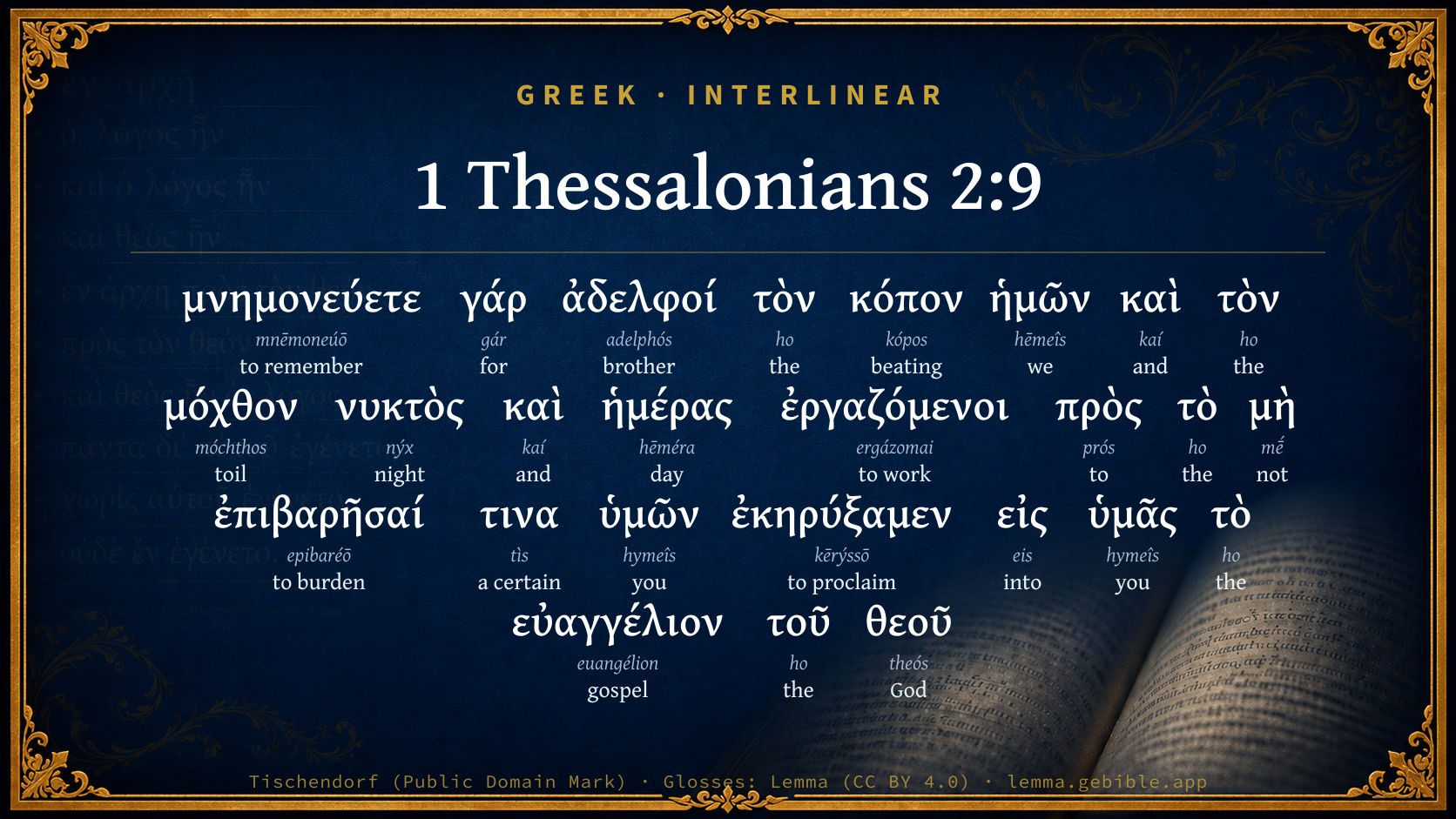
For you remember, brothers, our labor and travail; for working night and day, that we might not burden any of you, we preached to you the Gospel of God.
Download a study sheet
One document with this verse’s original text, its word-by-word gloss line, the meaning frame, cross-references with their text, attributed commentary, and full source and license credits — printable, and it pastes into notes with its structure intact.
This verse Autodidact and up
A passage Seminary Student
Up to 50 verses in one chapter. A passage sheet keeps up to 6 commentary sources and 12 cross-references per verse, in the order this page ranks them, and says so on the sheet whenever that leaves anything out. Ask for a single verse and you get the Autodidact verse sheet above.
Everything on this page stays free to read, with no account — the sheet is a download of what is already on screen, not access to it.
Compare translations 3
The same verse in 3 English versions, stacked beneath the original-language interlinear above. Click any original word for its lexicon entry.
Each is an independent rendering of the whole verse — the interlinear is not word-aligned to these translations.
Highlighted words mark where these versions differ — a whole-verse word diff, not a word-by-word alignment.
-
World English Bible Public Domain
For you remember, brothers, our labor and travail; for working night and day, that we might not burden any of you, we preached to you the Gospel of God.
-
King James Version Public Domain
For ye remember, brethren, our labour and travail: for labouring night and day, because we would not be chargeable unto any of you, we preached unto you the gospel of God.
-
unfoldingWord Literal Text CC BY-SA 4.0
For you remember, brothers, our labor and toil, night and day working in order not to burden any of you, we preached to you the gospel of God.
unfoldingWord Literal Text — © unfoldingWord, licensed CC BY-SA 4.0. Word-aligned USFM3 via Door43 (git.door43.org/unfoldingWord/en_ult).
Show all 19 translations
Every available English version of this verse, each an independent rendering of the whole verse.
-
World English Bible Public Domain
For you remember, brothers, our labor and travail; for working night and day, that we might not burden any of you, we preached to you the Gospel of God.
-
Berean Standard Bible Public Domain
Surely you recall, brothers, our labor and toil. We worked night and day so that we would not be a burden to anyone while we proclaimed to you the gospel of God.
-
Majority Standard Bible Public Domain
Surely you recall, brothers, our labor and toil. We worked night and day so that we would not be a burden to anyone while we proclaimed to you the gospel of God.
-
King James Version Public Domain
For ye remember, brethren, our labour and travail: for labouring night and day, because we would not be chargeable unto any of you, we preached unto you the gospel of God.
-
American Standard Version (1901) Public Domain
For ye remember, brethren, our labor and travail: working night and day, that we might not burden any of you, we preached unto you the gospel of God.
-
Revised Version (1885) Public Domain
For ye remember, brethren, our labour and travail: working night and day, that we might not burden any of you, we preached unto you the gospel of God.
-
Geneva Bible (1599) Public Domain
For ye remember, brethren, our labour and trauaile: for we laboured day and night, because we would not be chargeable vnto any of you, and preached vnto you the Gospel of God.
-
Douay-Rheims (1899) Public Domain
For you remember, brethren, our labour and toil: working night and day, lest we should be chargeable to any of you, we preached among you the gospel of God.
-
Young's Literal Translation Public Domain
for ye remember, brethren, our labour and travail, for, night and day working not to be a burden upon any of you, we did preach to you the good news of God;
-
Literal Standard Version CC BY-SA 4.0
for you remember, brothers, our labor and travail, for working night and day not to be a burden on any of you, we preached the good news of God to you;
-
Unlocked Literal Bible CC BY-SA 4.0
For you remember, brothers, our labor and toil. Night and day we were working so that we might not weigh down any of you. During that time, we preached to you the gospel of God.
-
unfoldingWord Literal Text CC BY-SA 4.0
For you remember, brothers, our labor and toil, night and day working in order not to burden any of you, we preached to you the gospel of God.
-
Darby Bible Public Domain
For ye remember, brethren, our labour and toil: working night and day, not to be chargeable to any one of you, we have preached to you the glad tidings of God.
-
World Messianic Bible Public Domain
For you remember, brothers, our labor and travail; for working night and day, that we might not burden any of you, we preached to you the Good News of God.
-
Webster's Bible Public Domain
For ye remember, brethren, our labor and toil: for laboring night and day, because we would not be chargeable to any of you, we preached to you the gospel of God.
-
Free Bible Version CC BY-SA 4.0
Don't you remember, brothers and sisters, all our hard work—working day and night so we wouldn't be a burden to any of you as we shared God's good news with you?
-
Bible in Basic English Public Domain
For you have the memory, my brothers, of our trouble and care; how, working night and day, so that we might not be a trouble to any of you, we gave you the good news of God.
-
Text-Critical English NT CC BY 4.0
For you remember, brothers, our labor and hardship. Working night and day so as not to be a burden on any of you, we preached to you the gospel of God.
-
Tyndale New Testament (1534) Public Domain
Ye remember brethren oure laboure and travayle. For we laboured daye and nyght because we wolde not be greveous vnto eny of you and preached vnto you the gospell of God.
Literal Standard Version (2020), Covenant Press — licensed CC BY-SA 4.0. Text via the HelloAO Bible API (eBible.org). Unlocked Literal Bible (unfoldingWord) — licensed CC BY-SA 4.0. Text via the HelloAO Bible API (eBible.org). unfoldingWord Literal Text — © unfoldingWord, licensed CC BY-SA 4.0. Word-aligned USFM3 via Door43 (git.door43.org/unfoldingWord/en_ult). Free Bible Version, Dr. Jonathan Gallagher — licensed CC BY-SA 4.0. Text via the HelloAO Bible API (eBible.org).
Word by word
More ways to search: Search by grammar → Find every occurrence → Compare this word →
Practice this passage: Drill this verse → Learn its vocabulary →
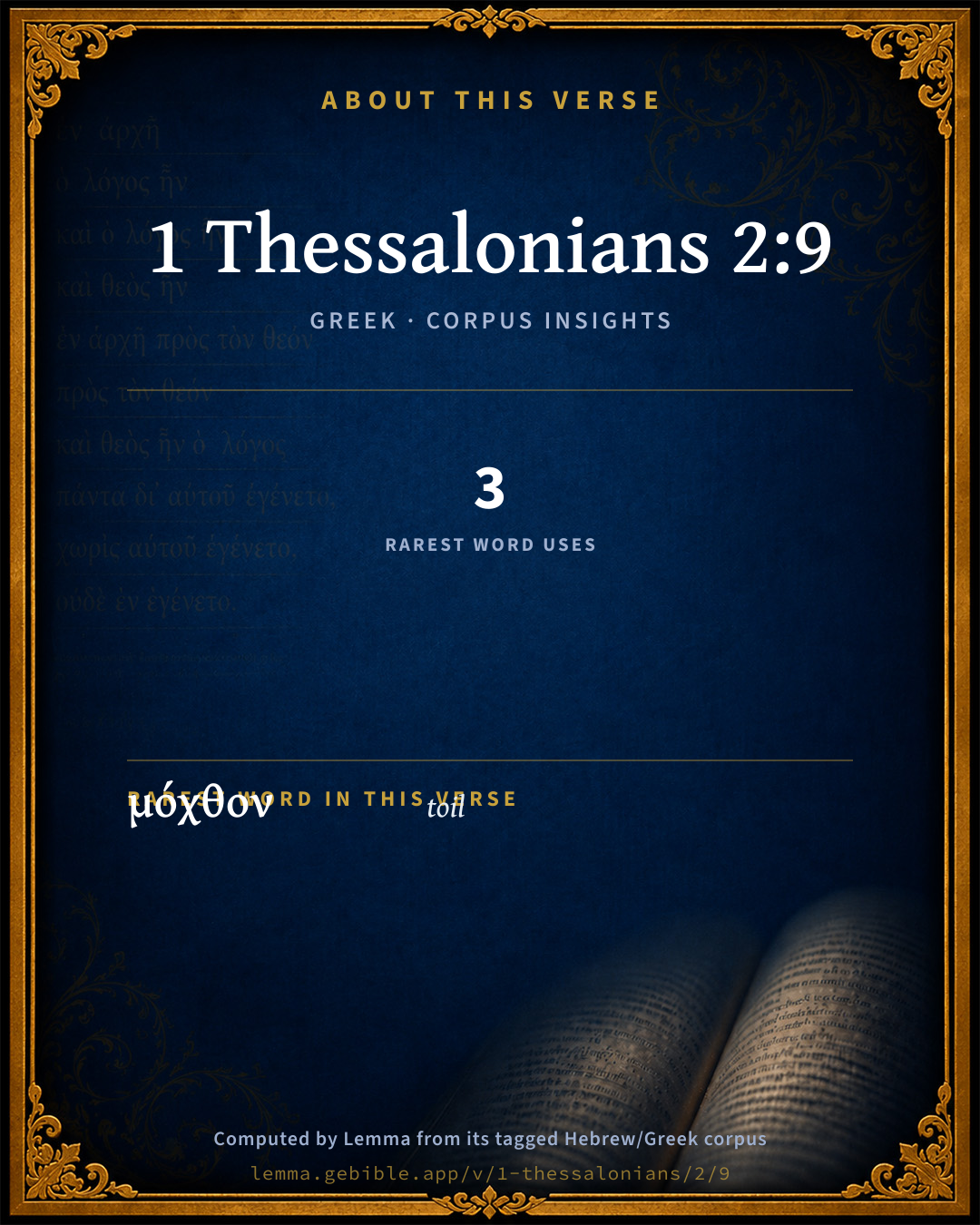
- Appears 3× in the Greek New Testament
- First appears at 2 Corinthians 11:27
- Part of Speech
- Noun
- Case
- Accusative
- Number
- Singular
- Gender
- Masculine
Full Thayer's Definition
- μνημονεύετε mnēmoneúō G3421 “to remember” Verb, Present, Active, Indicative, 2nd person, Plural
- γάρ gár G1063 “for” Conjunction
- ἀδελφοί adelphós G80 “brother” Noun, Vocative, Plural, Masculine
- τὸν ho G3588 “the” Article, Accusative, Singular, Masculine
- κόπον kópos G2873 “beating” Noun, Accusative, Singular, Masculine
- ἡμῶν hēmeîs G2249 “we” Personal pronoun, 1st person, Genitive, Plural
- καὶ kaí G2532 “and” Conjunction
- τὸν ho G3588 “the” Article, Accusative, Singular, Masculine
- μόχθον móchthos G3449 “toil” Noun, Accusative, Singular, Masculine
- νυκτὸς nýx G3571 “night” Noun, Genitive, Singular, Feminine
- καὶ kaí G2532 “and” Conjunction
- ἡμέρας hēméra G2250 “day” Noun, Genitive, Singular, Feminine
- ἐργαζόμενοι ergázomai G2038 “to work” Verb, Present, Middle or Passive deponent, Participle, Nominative, Plural, Masculine
- πρὸς prós G4314 “to” Preposition
- τὸ ho G3588 “the” Article, Accusative, Singular, Neuter
- μὴ mḗ G3361 “not” Particle, Negative
- ἐπιβαρῆσαί epibaréō G1912 “to burden” Verb, Aorist, Active, Infinitive
- τινα tìs G5100 “a certain” Indefinite pronoun, Accusative, Singular, Masculine
- ὑμῶν hymeîs G5210 “you” Personal pronoun, 2nd person, Genitive, Plural
- ἐκηρύξαμεν kērýssō G2784 “to proclaim” Verb, Aorist, Active, Indicative, 1st person, Plural
- εἰς eis G1519 “into” Preposition
- ὑμᾶς hymeîs G5210 “you” Personal pronoun, 2nd person, Accusative, Plural
- τὸ ho G3588 “the” Article, Accusative, Singular, Neuter
- εὐαγγέλιον euangélion G2098 “gospel” Noun, Accusative, Singular, Neuter
- τοῦ ho G3588 “the” Article, Genitive, Singular, Masculine
- θεοῦ theós G2316 “God” Noun, Genitive, Singular, Masculine
About this verse
These counts appear in no published source. They are computed here, from the morphology-tagged text and Lemma’s own curated glosses. What Lemma adds →
- 26
- words
- 20
- distinct lemmas
- Pauline Epistles
- section
Cross-references
31Topical passages linked to 1 Thessalonians 2:9 in the Treasury of Scripture Knowledge — connected by theme and wording, ordered by reader-vote popularity; previews shown in the World English Bible.
- 2 Thessalonians 3:7–9 For you know how you ought to imitate us. For we didn't behave ourselves rebelliously among you,
- 2 Corinthians 11:9 When I was present with you and was in need, I wasn't a burden on anyone, for the brothers, when they came from Macedonia, supplied the measure of my need. In everything I kept myself from being burdensome to you, and I will continue to do so.
- Acts 18:3 and because he practiced the same trade, he lived with them and worked, for by trade they were tent makers.
- 2 Corinthians 12:13–14 For what is there in which you were made inferior to the rest of the assemblies, unless it is that I myself was not a burden to you? Forgive me this wrong.
- Nehemiah 5:15 But the former governors who were before me were chargeable to the people, and took of them bread and wine, besides forty shekels of silver; yes, even their servants bore rule over the people: but I didn't do so, because of the fear of God.
- Nehemiah 5:18 Now that which was prepared for one day was one ox and six choice sheep; also fowls were prepared for me, and once in ten days store of all sorts of wine: yet for all this I didn't demand the bread of the governor, because the bondage was heavy on this people.
- Acts 20:31 Therefore watch, remembering that for a period of three years I didn't cease to admonish everyone night and day with tears.
- 1 Corinthians 9:6–7 Or have only Barnabas and I no right to not work?
- 1 Corinthians 9:15 But I have used none of these things, and I don't write these things that it may be done so in my case; for I would rather die, than that anyone should make my boasting void.
- 1 Corinthians 9:18 What then is my reward? That, when I preach the Gospel, I may present the Gospel of Christ without charge, so as not to abuse my authority in the Gospel.
- 1 Thessalonians 2:6 nor seeking glory from men (neither from you nor from others), when we might have claimed authority as apostles of Christ.
- 1 Timothy 4:10 For to this end we both labor and suffer reproach, because we have set our trust in the living God, who is the Savior of all men, especially of those who believe.
- 1 Timothy 5:5 Now she who is a widow indeed, and desolate, has her hope set on God, and continues in petitions and prayers night and day.
- 2 Timothy 1:3 I thank God, whom I serve as my forefathers did, with a pure conscience. How unceasing is my memory of you in my petitions, night and day
- Psalms 32:4 For day and night your hand was heavy on me. My strength was sapped in the heat of summer. Selah.
- Psalms 88:1 Yahweh, the God of my salvation, I have cried day and night before you.
- Jeremiah 9:1 Oh that my head were waters, and my eyes a spring of tears, that I might weep day and night for the slain of the daughter of my people!
- Luke 2:37 and she had been a widow for about eighty-four years), who didn't depart from the temple, worshipping with fastings and petitions night and day.
- Luke 18:7 Won't God avenge his chosen ones, who are crying out to him day and night, and yet he exercises patience with them?
- Acts 20:34–35 You yourselves know that these hands ministered to my necessities, and to those who were with me.
- Romans 1:1 Paul, a servant of Jesus Christ, called to be an apostle, set apart for the Gospel of God,
- Romans 15:16 that I should be a servant of Christ Jesus to the Gentiles, ministering as a priest the Gospel of God, that the offering up of the Gentiles might be made acceptable, sanctified by the Holy Spirit.
- Romans 15:19 in the power of signs and wonders, in the power of God's Spirit; so that from Jerusalem, and around as far as to Illyricum, I have fully preached the Gospel of Christ;
- 1 Corinthians 4:12 We toil, working with our own hands. When people curse us, we bless. Being persecuted, we endure.
- 2 Corinthians 6:5 in beatings, in imprisonments, in riots, in labors, in watchings, in fastings;
- Philippians 4:16 For even in Thessalonica you sent once and again to my need.
- 1 Thessalonians 1:3 remembering without ceasing your work of faith and labor of love and patience of hope in our Lord Jesus Christ, before our God and Father.
- 1 Thessalonians 2:2 but having suffered before and been shamefully treated, as you know, at Philippi, we grew bold in our God to tell you the Gospel of God in much conflict.
- 1 Thessalonians 3:10 night and day praying exceedingly that we may see your face, and may perfect that which is lacking in your faith?
- 1 Timothy 1:11 according to the Gospel of the glory of the blessed God, which was committed to my trust.
- Acts 20:24 But these things don't count; nor do I hold my life dear to myself, so that I may finish my race with joy, and the ministry which I received from the Lord Jesus, to fully testify to the Gospel of the grace of God.
Cross-references courtesy of OpenBible.info (CC BY 4.0).
Lesson kit
Teaching starters — assembled from the data on this page, not authored interpretation. Every prompt links to the verse data it draws on. Edit before teaching.
1 Thessalonians, in the Pauline Epistles, opens this verse with 26 words (20 distinct Greek lemmas). Its most distinctive word is móchthos (“toil”). A historical commentator’s framing appears above. Read the whole chapter for the surrounding context.
Discussion questions
- The word móchthos carries the sense “toil.” How does it shape the verse?
- 2 Corinthians 11:27 shares the word «toil» with this verse. How do the two illuminate each other?
- “the” occurs 5× in this one verse. What is the effect of the repetition?
- The translations on this page render this verse differently — a whole-verse word diff, not a word-by-word alignment. What might account for the different wordings?
- Reading how The Biblical Illustrator and Joseph Benson's Commentary read this verse, where do the two commentators agree and where do they part?
Things to notice
- These translations choose different wording for 14 words in this verse.
- “the” occurs 5× in this single verse.
- 20 distinct Greek lemmas span 26 words in this verse.
Commentary
Notes on 1 Thessalonians 2:9 from classic Christian and Jewish commentators (each source and its license shown beneath its notes). The classic Christian expositions comment on the surrounding passage and are grouped to its opening verse, so a note may address several verses; the Jewish commentaries on the Tanakh (Rashi and others) are per-verse, so they appear only where the commentator wrote on this verse.
Lemma curates 59 commentaries, every one of them public domain or Creative Commons licensed, each selected and text-cleaned for this edition rather than reprinted as found. About our sources →
The Biblical Illustrator
Joseph S. Exell
The Biblical Illustrator, edited by Joseph S. Exell (c. 1880s–1900s) — public domain. Text from a community e-Sword module.
Joseph Benson's Commentary
Joseph Benson's Commentary on the Old and New Testaments (1811–1818) — public domain. Text from a community e-Sword module.
The Preacher's Complete Homiletical Commentary
Joseph S. Exell (gen. ed.)
The Preacher's Complete Homiletical Commentary (gen. ed. Joseph S. Exell; Funk & Wagnalls, c. 1892) — public domain (pre-1929). A full-Bible homiletical/sermon-outline anthology covering 65 of 66 books (2 John is absent from the source module). Text from a community e-Sword module.
Tyndale Open Study Notes
Tyndale Open Resources
Tyndale Open Study Notes — © Tyndale Open Resources, licensed CC BY-SA 4.0. Text via the HelloAO Bible API.
Meyer's Critical & Exegetical Commentary
Heinrich August Wilhelm Meyer
Meyer — Critical and Exegetical Commentary on the New Testament — English translation by Peter Christie, edited by Frederick Crombie (T&T Clark, 1880) — public domain. Text from a community e-Sword module.
Expositor's Greek Testament
ed. W. Robertson Nicoll
The Expositor's Greek Testament, edited by W. Robertson Nicoll (1897–1910) — public domain. Text from a community e-Sword module.
Cambridge Greek Testament for Schools and Colleges
Cambridge Greek Testament for Schools and Colleges (Cambridge University Press, 1896; 21 vols, various authors incl. Carr, Maclear, Plummer, Farrar, Lumby, Moule, M. R. James, Simcox) — public domain. Text from a community e-Sword module.
Geneva Bible (1599)
Geneva Bible translators
Geneva Bible (1599) marginal notes — public domain. Text via Bolls.life.
Jamieson, Fausset & Brown
Robert Jamieson, A. R. Fausset & David Brown
Jamieson, Fausset & Brown — Commentary Critical and Explanatory on the Whole Bible (1871) — public domain (CC PDM 1.0). Text via the HelloAO Bible API.
Adam Clarke's Commentary
Adam Clarke's Commentary on the Bible (1810–1826) — public domain. Text from a community e-Sword/MySword module.
John Calvin's Commentaries
John Calvin's Commentaries (1540-1563) — public domain. Text from the Calvin Translation Society English edition (1840s-50s) via the Christian Classics Ethereal Library (ccel.org). Calvin's coverage is partial (roughly two-thirds of the Bible); uncommented books and verses are honest gaps, never fabricated. The 19th-century editor's footnotes and remarks are omitted so the notes are faithfully Calvin's own voice.
Ellicott's Commentary for English Readers
A Bible Commentary for English Readers, edited by Charles John Ellicott (1878–1897) — public domain. Text from a community e-Sword module.
The Cambridge Bible for Schools and Colleges
gen. ed. J. J. S. Perowne
The Cambridge Bible for Schools and Colleges (gen. ed. J. J. S. Perowne; Cambridge University Press, 1878–1918) — public domain. Text from a community e-Sword module.
John Gill's Exposition
John Gill's Exposition of the Whole Bible (1746–1763) — public domain (CC PDM 1.0). Text via the HelloAO Bible API.
Trapp's Complete Commentary
John Trapp
John Trapp, A Commentary or Exposition upon All the Books of the Old and New Testament (1647–1656) — public domain. Text from a community e-Sword module.
Albert Barnes' Notes on the Bible
Albert Barnes' Notes on the Bible (1834–1885) — public domain. Text from a community e-Sword/MySword module.
Matthew Poole's English Annotations
Matthew Poole's English Annotations on the Holy Bible (1683–1685) — public domain. Text from a community e-Sword/MySword module.
Whedon's Commentary on the Bible
Daniel D. Whedon
Daniel D. Whedon (gen. ed.), Commentary on the Old and New Testaments (1874–1909) — public domain. Text from a community e-Sword module.
The Pulpit Commentary
The Pulpit Commentary (1880–1919), ed. H.D.M. Spence-Jones & Joseph S. Exell — public domain. Text from a community e-Sword module.
Burkitt's Expository Notes on the New Testament
William Burkitt
William Burkitt's Expository Notes on the New Testament (1700–1703) — public domain. Text from a community e-Sword module.
McGarvey & Pendleton's Commentaries
J. W. McGarvey
J. W. McGarvey (with Philip Y. Pendleton), Commentaries on the New Testament (The Fourfold Gospel, 1914; Acts; and the epistles) — public domain. Text from a community e-Sword/MySword module.
The People's New Testament
B. W. Johnson
B. W. Johnson's The People's New Testament with Notes (1889–1891) — public domain. Electronic text from the Christian Classics Ethereal Library (CCEL) ThML edition.
Alford’s Greek Testament
Henry Alford
Henry Alford, The Greek Testament (1849–1861) — public domain. Text from a community e-Sword module.
International Critical Commentary
International Critical Commentary — older volumes (1896–1929), various authors — public domain. Text from a community e-Sword module.
Vincent's Word Studies in the New Testament
Marvin R. Vincent
Marvin R. Vincent, Word Studies in the New Testament (1887–1900) — public domain. Text from a community e-Sword/MySword module.