
James 1:20

Greek (Tischendorf 8th ed.) James 1:20 appears in the Greek New Testament. The text above is from the Tischendorf 8th edition. Each word links to its Strong’s number and a concise gloss. Click any word for its full Thayer’s Greek Lexicon entry.
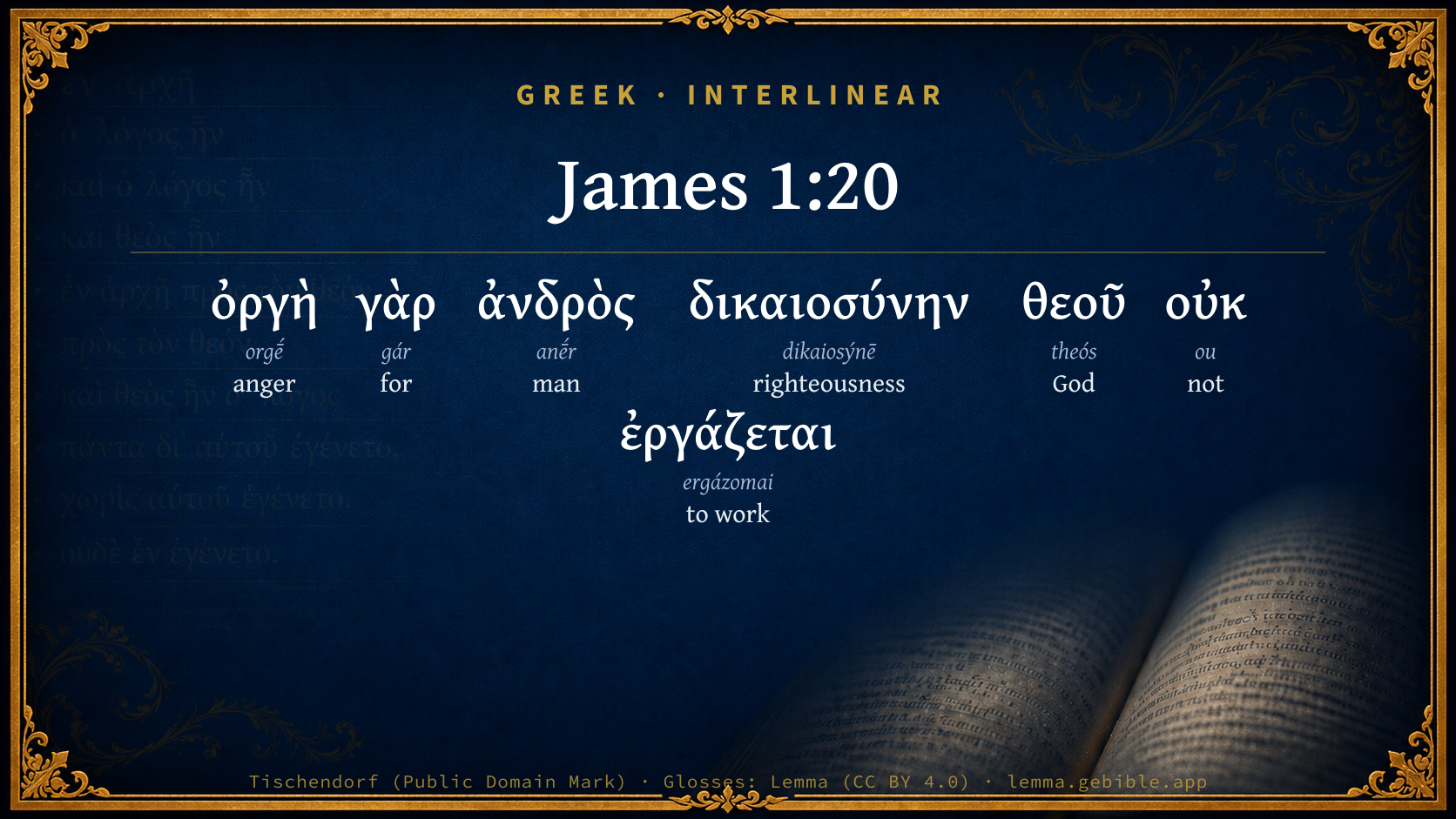
Download image
Cite this verse

James 1:20 (World English Bible). Public Domain. Lemma interlinear Bible study tool, https://lemma.gebible.app/v/james/1/20.

Show BibTeX & RIS
BibTeX
RIS
English Translation
for the anger of man doesn't produce the righteousness of God.
World English Bible · Public Domain
Download a study sheet

One document with this verse’s original text, its word-by-word gloss line, the meaning frame, cross-references with their text, attributed commentary, and full source and license credits — printable, and it pastes into notes with its structure intact.

This verse Autodidact and up

Study sheet (.html) Plain text (.txt)

A passage Seminary Student

Up to 50 verses in one chapter. A passage sheet keeps up to 6 commentary sources and 12 cross-references per verse, in the order this page ranks them, and says so on the sheet whenever that leaves anything out. Ask for a single verse and you get the Autodidact verse sheet above.

Everything on this page stays free to read, with no account — the sheet is a download of what is already on screen, not access to it.

Want to remove ads? Support Godless Engineer
Compare translations 3

The same verse in 3 English versions, stacked beneath the original-language interlinear above. Click any original word for its lexicon entry.

Each is an independent rendering of the whole verse — the interlinear is not word-aligned to these translations.

Highlighted words mark where these versions differ — a whole-verse word diff, not a word-by-word alignment.

  • World English Bible Public Domain
    for the anger of man doesn't produce the righteousness of God.
  • King James Version Public Domain
    For the wrath of man worketh not the righteousness of God.
  • unfoldingWord Literal Text CC BY-SA 4.0
    For anger of man does not work the righteousness of God.

unfoldingWord Literal Text — © unfoldingWord, licensed CC BY-SA 4.0. Word-aligned USFM3 via Door43 (git.door43.org/unfoldingWord/en_ult).

Versions to compare (up to 4)

3 of 4 selected

Show all 19 translations

Every available English version of this verse, each an independent rendering of the whole verse.

  • World English Bible Public Domain
    for the anger of man doesn't produce the righteousness of God.
  • Berean Standard Bible Public Domain
    for man’s anger does not bring about the righteousness that God desires.
  • Majority Standard Bible Public Domain
    for man’s anger does not bring about the righteousness that God desires.
  • King James Version Public Domain
    For the wrath of man worketh not the righteousness of God.
  • American Standard Version (1901) Public Domain
    for the wrath of man worketh not the righteousness of God.
  • Revised Version (1885) Public Domain
    for the wrath of man worketh not the righteousness of God.
  • Geneva Bible (1599) Public Domain
    For the wrath of man doeth not accomplish the righteousnesse of God.
  • Douay-Rheims (1899) Public Domain
    For the anger of man worketh not the justice of God.
  • Young's Literal Translation Public Domain
    for the wrath of a man the righteousness of God doth not work;
  • Literal Standard Version CC BY-SA 4.0
    for the wrath of a man does not work the righteousness of God;
  • Unlocked Literal Bible CC BY-SA 4.0
    For the anger of man does not work the righteousness of God.
  • unfoldingWord Literal Text CC BY-SA 4.0
    For anger of man does not work the righteousness of God.
  • Darby Bible Public Domain
    for man's wrath does not work God's righteousness.
  • World Messianic Bible Public Domain
    for the anger of man doesn’t produce the righteousness of God.
  • Webster's Bible Public Domain
    For the wrath of man worketh not the righteousness of God.
  • Free Bible Version CC BY-SA 4.0
    because human anger doesn't reflect the good character of God.
  • Bible in Basic English Public Domain
    For the righteousness of God does not come about by the wrath of man.
  • Text-Critical English NT CC BY 4.0
    For the anger of man does not produce the righteousness of God.
  • Tyndale New Testament (1534) Public Domain
    For the wrath of man worketh not that which is ryghteous before God.

Literal Standard Version (2020), Covenant Press — licensed CC BY-SA 4.0. Text via the HelloAO Bible API (eBible.org). Unlocked Literal Bible (unfoldingWord) — licensed CC BY-SA 4.0. Text via the HelloAO Bible API (eBible.org). unfoldingWord Literal Text — © unfoldingWord, licensed CC BY-SA 4.0. Word-aligned USFM3 via Door43 (git.door43.org/unfoldingWord/en_ult). Free Bible Version, Dr. Jonathan Gallagher — licensed CC BY-SA 4.0. Text via the HelloAO Bible API (eBible.org).

Word by word

More ways to search: Search by grammar → Find every occurrence → Compare this word →

Practice this passage: Drill this verse → Learn its vocabulary →

About this verse

These counts appear in no published source. They are computed here, from the morphology-tagged text and Lemma’s own curated glosses. What Lemma adds →

7
words
7
distinct lemmas
General Epistles
section

Shared distinctive vocabulary

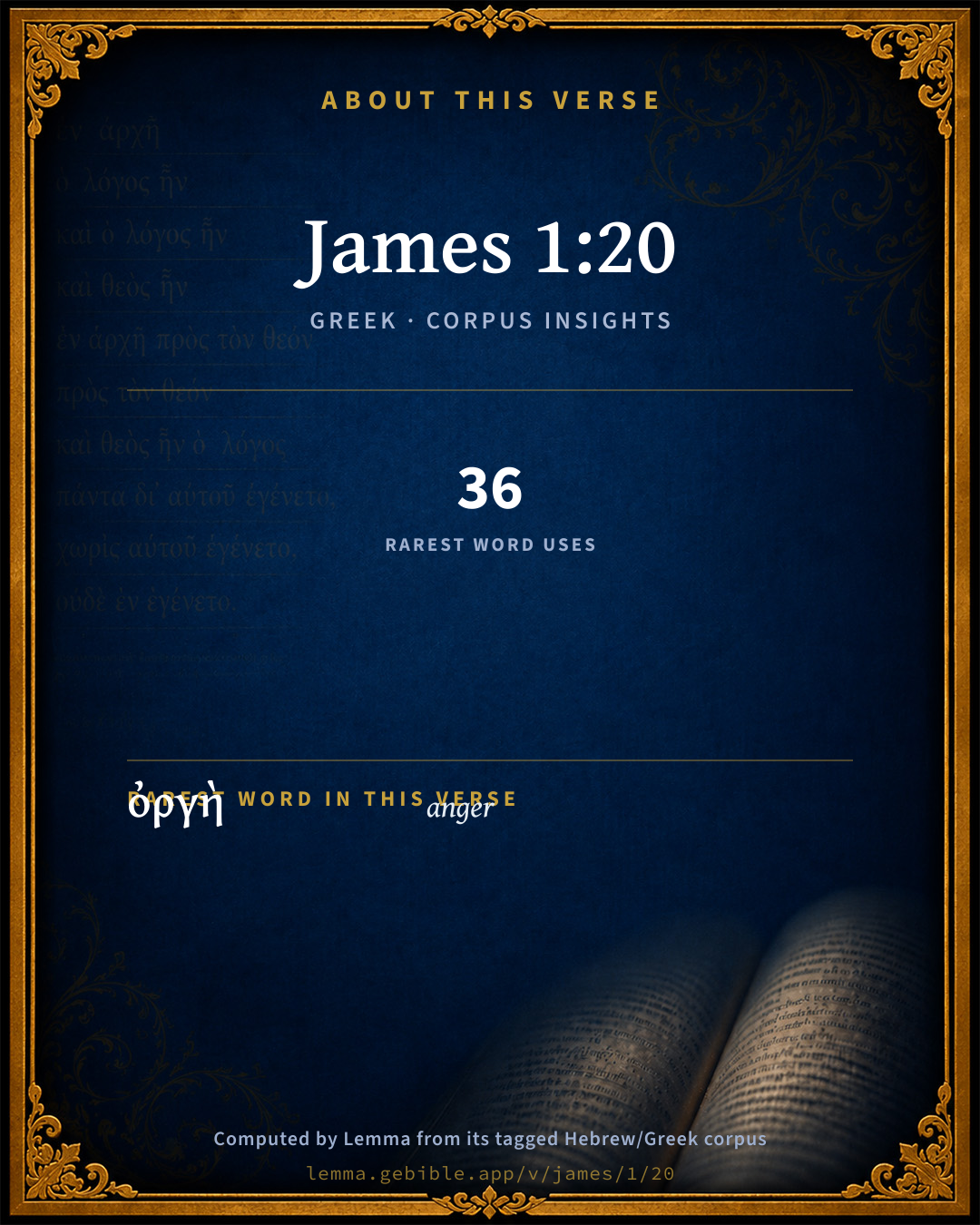
ὀργὴ anger G3709 occurs in 34 verses of the Greek New Testament. Also found in:
Cross-references

4

Topical passages linked to James 1:20 in the Treasury of Scripture Knowledge — connected by theme and wording, ordered by reader-vote popularity; previews shown in the World English Bible.

  • 2 Timothy 2:24–25 The Lord's servant must not quarrel, but be gentle towards all, able to teach, patient,
  • Ephesians 4:26 "Be angry, and don't sin." Don't let the sun go down on your wrath,
  • James 3:17–18 But the wisdom that is from above is first pure, then peaceful, gentle, reasonable, full of mercy and good fruits, without partiality, and without hypocrisy.
  • Numbers 20:11–12 Moses lifted up his hand, and struck the rock with his rod twice: and water came forth abundantly, and the congregation drank, and their cattle.

Cross-references courtesy of OpenBible.info (CC BY 4.0).

Commentary

Notes on James 1:20 from classic Christian and Jewish commentators (each source and its license shown beneath its notes). The classic Christian expositions comment on the surrounding passage and are grouped to its opening verse, so a note may address several verses; the Jewish commentaries on the Tanakh (Rashi and others) are per-verse, so they appear only where the commentator wrote on this verse.

Lemma curates 59 commentaries, every one of them public domain or Creative Commons licensed, each selected and text-cleaned for this edition rather than reprinted as found. About our sources →

Godbey's Commentary on the New Testament

William B. Godbey

ARGUMENT 4

THE RESIDUE OF SIN

20. The “righteousness of God” here mentioned contrasts vividly with our own righteousness, arising from our good works, which is filthy in the sight of God, and utterly inadequate to the severity of the Divine judgments. Unless we are covered with the righteousness of God in Christ, received, and appropriated by faith only, we are certain to go down under condemnation when we stand before the great white throne.

21. “Therefore laying aside pollution and residue of evil, receive with meekness the engrafted word which is able to save your souls.” When the sinner receives the “righteousness of God,” mentioned in Jas 1:20, he is then freely and fully justified by faith for Christ’s sake; however the pollution of original sin, “the residue of evil,” still survives in the heart. Apothemenoi, laying aside, is the Greek aorist, always revealing an instantaneous action. Hence we see clearly and unequivocally in this verse the second work of grace, in sanctification instantaneously wrought in the heart, in the removal of the pollution and remainder of sin. The residue theory of depravity surviving in the heart after regeneration, is hotly contested by Zinzendorfians, but a clear translation of this verse forever sweeps all controversy from the field. “Superfluity of naughtiness” is perfectly, correctly, and more lucidly translated “residue of sin” or “remainder of evil,” which clearly and forever settles the question that there is a residue of evil in the heart of the regenerate, to be eliminated by a subsequent work of grace. Sanctification actually engrafts the word in the heart, so it is no longer a dead letter like a branch severed from the trunk, but a living graft full of spiritual vitality, always flourishing and bearing fruit, perpetuating and consummating the Salvation of the soul.

22. Full salvation completely purifying the heart, always makes the outward life truly exemplary and obedient.

23, 24. The Bible is God’s looking-glass in which we all, when duly illuminated by the Holy Ghost, see ourselves as we are. That is the reason why candid spiritual truth has always been intolerably odious to impenitent sinners, and explains why Paul raised a row and received a thrashing everywhere he went. History repeats itself. In the days of Christ and the apostles, the Jewish churches were largely filled with impenitent sinners. It is equally true of the worldly churches of the present day.

Hence the pulpit in the main has laid aside the straight, hard, spiritual truth of conviction, conversion and sanctification, and gone off into intellectualism, which has no power to disturb the conscience nor save the soul. The sanctified preachers are set out of the churches for no reason save that they incessantly hold up God’s looking glass, i.e., the Bible, before the eyes of the wicked, carnal people, till they see themselves as they are in God’s sight, horrifically ugly with depravity, and black all over with transgression. Then they become mad and want to break the glass and kill the man who holds it up.

William B. Godbey, Commentary on the New Testament (1896–1900) — public domain. Text from a community e-Sword module.

Bengel's Gnomon

Johann Albrecht Bengel

Jas 1:20. Ὀργὴ wrath). A most powerful passion.—ἀνδρὸς, of man) The male sex especially cherishes wrath, 1Ti 2:8; and its actions, whether just or unjust, are more widely exposed to view. The wrath here intimated is that of nature, without grace.—δικαιοσύνην Θεοῦ, the righteousness of God) All duties which are divinely enjoined and pleasing to God.—οὐ κατεργάζεται, worketh not) That is, altogether hinders the righteousness of God; although it seems to itself, while inflamed, especially to work that (righteousness); [and therefore it constitutes the principal part of these three-membered sentences.—V. g.] Purer effects are produced without anger.

Bengel's Gnomon of the New Testament — English translation (T&T Clark, Edinburgh, 1860) — public domain. Text from a community e-Sword module.

Meyer's Critical & Exegetical Commentary

Heinrich August Wilhelm Meyer

Jam_1:20 gives the reason of the exhortation βραδὺς εἰς ὀργήν: for the wrath of man works not the righteousness of God. The preponderance of authorities decides against the reading κατεργάζεται, and in favour of ἐργάζεται. From the fact that δικαιοσύνην is twice in the N. T., namely Act_10:35 and Heb_11:33, joined with the simple verb, it does not follow that ἐργάζεται is a later correction (against de Wette, Wiesinger), especially as κατεργάζεσθαι is also found united with abstract substantives, as in Rom_1:27 with τὴν ἀσχημοσύνην, in Rom_2:9 with τὸ κακόν, and in Rom_7:18 with τὸ καλόν. With the reading ἐργάζεται,and also with κατεργάζεται, when this latter, as is frequently the case (see especially Rom_2:9-10), is synonymous with the former,

δικαιοσύνη is equivalent to τὸ δίκαιον, as is frequently the case in the O. and N. T.; see Act_10:35 above referred to, and the frequently occurring phrase: ποιεῖν τὴν δικαιοσύνην, Gen_18:19; Isa_56:1; Mat_6:1; 1Jn_2:29; 1Jn_3:7; 1Jn_3:10; Rev_22:11. Θεοῦ is added in contrast to ἀνδρός for the sake of a more exact statement, so that δικαιοσύνη Θεοῦ is the righteousness willed by God[91] (similar to τὸ δίκαιον ἐνώπιον τοῦ Θεοῦ, Act_4:19; Luther: the wrath of man works not that which is right before God); so Beza, Hornejus, Wolf, Bengel, de Wette, Bouman, and others correctly explain it. The opposite of δικαιοσύνην Θεοῦ ἐργάζεσθαι is ἁμαρτίαν ἐργάζεσθαι, chap. Jam_2:9 (comp. Mat_7:1 : ἐργαζ. τὴν ἀνομίαν; 1Ma_9:23 : ἐργαζ. τὴν ἀδικίαν; also comp. Rom_2:10 : ἐργαζ. τὸ ἀγαθόν; Gal_6:10). James was the more constrained to give prominence to this idea, as ὀργή itself and the words flowing from it were considered by the pharisaical disposition of Christians, against whom this warning is directed, and of whom it was said: ζῆλον Θεοῦ ἔχουσιν, ἀλλʼ οὐ κατʼ ἐπίγνωσιν, Rom_10:2, as something that was pleasing to God. With the reading κατεργάζεται this verb may also be equivalent to effect, to bring about (as Jam_1:3). Gebser, Grashof, and others understand, in accordance with this view, by δικαιοσύνη Θεοῦ: the condition of justification before God; but, on the one hand, an unsuitable thought is expressed by this, and, on the other hand, a mode of expressing the idea δικαιοσύνη τοῦ Θεοῦ, peculiar to Paul, is without ceremony ascribed to James. But as little is it to be justified when Wiesinger, following Hofmann (Schriftbew. I. ed. 1, p. 548 f.), finds expressed in the words of James, that one by wrathful zeal effects not on others the δικ. Θεοῦ, i.e. that state of righteousness in which God begets men by His word of truth.[92] Though δικαιοσύνη Θεοῦ can denote the righteousness wrought by God, yet this idea is here unsuitable, since no man could entertain the opinion that his wrath could do what can only be effected by God. Also in this case James would only emphasize an impossibility of ὀργή, whereas he was required to bring prominently forward its rejection; moreover, on others is inserted into the text.[93] The same reasons are also decisive against the explanation of Brückner (the wrath of man works not the righteousness which God accomplishesthis generally stated both in respect to the ἈΝΉΡ and in respect to others on whom one strives to work), in which a twofold reference is arbitrarily assumed. Brückner correctly rejects the explanation of Lange, that James speaks against the delusion of wrath, which imagines to administer and accomplish in the world the righteousness of God especially against unbelievers, because there is no reference to this in the context; it is, moreover, linguistically unmaintainable, as ἘΡΓΆΖΕΣΘΑΙ does not mean to administer and accomplish.

ἈΝΔΡΌς stands here as in Jam_1:8; Jam_1:12; it forms a contrast neither to the child (Thomas: ira fortis et deliberate non dicit pueri, qui cito transit), nor to the woman (Bengel: sexns virilis maxime iram alit), nor to ἄνθρωπος, Jam_1:19 (Lange).

[91] It is true the expression δικαιοσύνη θεοῦ occurs not elsewhere in this sense; but this can be the less an objection to it, as the relation in which the genitive Θεοῦ is placed to δικαιοσύνη is not entirely opposed to the genitive of relation, as is evident if we designate the δικ. Θ. as that δικαιοσύνη which is actually so according to the determination of God.

[92] In the second edition (p. 628), Hofmann has indeed altered the words, but not the thought, in the explanation given in the first edition. When he defines the distinction in the use of the idea δικαιοσύνη Θεοῦ, in Rom_1:17 and here, to consist in this, that Paul speaks of justification, in James of regeneration, the untenableness of his explanation is the more evident, for that ὀργή produces regeneration could occur to no one.

[93] Contrary to the Biblical use of language, Oecumenius explains the expression δικαιοσύνη as equivalent to ἕξις ἑν ψυχῇ κατʼ ἀξίαν ἐκάστῳ ἀκονεμητική. Pott wholly arbitrarily refers the verse to the teachers of the Christian religion, paraphrasing it: iratus nequit docere religionem christianum prout fas est Deoque probatur.Several commentators (also Kern) to this verse cite Sir_1:21 : οὐ δυνήσεται θυμὸς ἄδικος δικαιωθῆναι; but incorrectly, since δικαιωθῆναι has an entirely different meaning from κατεργάζεσθαι δικαιοσύνην Θεοῦ.

Meyer — Critical and Exegetical Commentary on the New Testament — English translation by Peter Christie, edited by Frederick Crombie (T&T Clark, 1880) — public domain. Text from a community e-Sword module.

Expositor's Greek Testament

ed. W. Robertson Nicoll

Jas 1:20 . ὀργὴ γὰρ , etc.: Man’s wrath is rarely, if ever, justifiable; even “just indignation” is too often intermixed with other elements; and frequently the premisses on which it is founded are at fault. Man, unlike God, never knows all the circumstances of the case. On the subject of anger, see Mat 5:21-22 , and cf. the Expositor , July, 1905, pp. 28 ff.

The Expositor's Greek Testament, edited by W. Robertson Nicoll (1897–1910) — public domain. Text from a community e-Sword module.

Geneva Bible (1599)

Geneva Bible translators

That which God appointeth.

Geneva Bible (1599) marginal notes — public domain. Text via Bolls.life.

Jamieson, Fausset & Brown

Robert Jamieson, A. R. Fausset & David Brown

Man's angry zeal in debating, as if jealous for the honor of God's righteousness, is far from working that which is really righteousness in God's sight. True "righteousness is sown in peace," not in wrath (Jam 3:18). The oldest and best reading means "worketh," that is, practiceth not: the received reading is "worketh," produceth not.

Jamieson, Fausset & Brown — Commentary Critical and Explanatory on the Whole Bible (1871) — public domain (CC PDM 1.0). Text via the HelloAO Bible API.

Adam Clarke's Commentary

Verse 20. The wrath of man] A furious zeal in matters of religion is detestable in the sight of God; he will have no sacrifice that is not consumed by fire from his own altar. The zeal that made the Papists persecute and burn the Protestants, was kindled in hell. This was the wrath of man, and did not work any righteous act for God; nor was it the means of working righteousness in others; the bad fruit of a bad tree. And do they still vindicate these cruelties? Yes: for still they maintain that no faith is to be kept with heretics, and they acknowledge the inquisition.

Adam Clarke's Commentary on the Bible (1810–1826) — public domain. Text from a community e-Sword/MySword module.

Ellicott's Commentary for English Readers

(20) For the wrath of man worketh not the righteousness of God.—Sarcastically rings the context. Perhaps there is still a sharper point to the satire: the wrath of man does not work God’s righteousness “to the full.” The warning may well be sounded in the ears of Christians still, who are not less apt than Jonah of old to say quickly and in self-excuse, “I do well to be angry” (Jon_4:9). How many a holy work of household and parish has been and is thus hindered and destroyed; and if the golden words of the first bishop of the Church had been heeded better, there never had appeared one page of her long history blotted with the blood of a religious war.

A Bible Commentary for English Readers, edited by Charles John Ellicott (1878–1897) — public domain. Text from a community e-Sword module.

The Cambridge Bible for Schools and Colleges

gen. ed. J. J. S. Perowne

20. the wrath of man …] Better, A man’s wrath, so as to represent the absence of the article in the original. By “the righteousness of God”—the phrase is common to St James and St Paul (Rom_10:3; 2Co_5:21; Php_3:9)—is meant the righteousness which God requires and which He also gives. The besetting sin of the Jews was to identify their own anger against what seemed sin and heresy with the Will of God, to think that they did God service by deeds of violence (Joh_16:2), that they were thus working out His righteousness. The teaching is again after the pattern of the purely ethical books of the Old Testament (Ecc_7:9). The MSS. give two forms of the verb rendered “work;” the commonly received one, which conveys the thought, “does not work out or bring to completeness,” and that of the better MSS. which means simply, “does not work, or practise.”

The Cambridge Bible for Schools and Colleges (gen. ed. J. J. S. Perowne; Cambridge University Press, 1878–1918) — public domain. Text from a community e-Sword module.

John Gill's Exposition

For the wrath of man worketh not the righteousness of God. This is so far from engaging persons to do that which is right and acceptable in the sight of God, that it puts them upon doing that which is evil. The Alexandrian copy reads, "with the wrath of men do not work the righteousness of God"; do not attend upon the word and ordinances of God with a wrathful spirit. Compare, with this, Ti1 2:8.

.

James 1:21

jam 1:21

jam 1:21

jam 1:21Wherefore lay apart all filthiness,.... All manner of filthiness, both of flesh and spirit; all pride, vanity, wrath, malice, and evil speaking, under hearing the word: the allusion seems to be to a boiling pot, which casts up scum and filth, which must be taken off: and such is the spirit of wrathful men; it throws up the filth of haughtiness and pride, of anger, wrath, and wickedness, which must be taken off, and laid aside; or the word will not be heard to any profit, or advantage:

and superfluity of naughtiness, or "malice"; the abundance and overflow of it, which arises from such an evil heart, where wrath prevails, and governs: see Pe1 2:1. There seems to be an allusion to the removing of the superfluous foreskin of the flesh, in circumcision, typical

of the foreskin of the heart, spoken of in Jer 4:4 which the Targum, in that place, calls , "the wickedness", or "naughtiness of your hearts" to be removed:

and receive with meekness the ingrafted word; which becomes so when it is received; when it is put into the heart by the Spirit of God, and is mixed with faith by them that hear it; so that it is, as it were, incorporated into them, and becomes natural to them, which before was not; and taking deep root in them, brings forth much fruit: and where it comes with power, it reduces every high thought into the obedience of Christ, and makes men meek and humble; and only such receive the truth in the love of it; and to such is the Gospel preached, Isa 61:1, and none but such hear it with profit and edification:

which is able to save your souls; even your whole persons, both soul and body: but the soul is only mentioned, as being the more excellent part of man: this must not be understood of the word, as if it was the author or cause of salvation, but as an instrument; it being a declaration of salvation by Christ, or what shows unto men the way of salvation by him; and is the power of God unto salvation to them, when it is attended with the energy of the Spirit, and the efficacy of divine grace. See Ti2 3:15.

John Gill's Exposition of the Whole Bible (1746–1763) — public domain (CC PDM 1.0). Text via the HelloAO Bible API.

Trapp's Complete Commentary

John Trapp

20 For the wrath of man worketh not the righteousness of God.

Ver. 20. For the wrath of man] Unless it be as Moses’ and Christ’s anger was, pure and free from guile and gall, prompting us to pity and pray for the party, Exo 32:32; Mar 3:5.

John Trapp, A Commentary or Exposition upon All the Books of the Old and New Testament (1647–1656) — public domain. Text from a community e-Sword module.

Albert Barnes' Notes on the Bible

For the wrath of man worketh not the righteousness of God - Does not produce in the life that righteousness which God requires. Its tendency is not to incline us to keep the law, but to break it; not to induce us to embrace the truth, but the opposite. The meaning of this passage is not that our wrath will make God either more or less righteous; but that its tendency is not to produce that upright course of life, and love of truth, which God requires. A man is never sure of doing right under the influence of excited feelings; he may do that which is in the highest sense wrong, and which he will regret all his life. The particular meaning of this passage is, that wrath in the mind of man will not have any tendency to make him righteous. It is only that candid state of mind which will lead him to embrace the truth which can be hoped to have such an effect.

Albert Barnes' Notes on the Bible (1834–1885) — public domain. Text from a community e-Sword/MySword module.

Haydock's Catholic Bible Commentary

The anger of man, &c. Let us not then be angry with each other on the way to eternal life, but rather march on with the troop of our companions and brethren meekly, peaceably, and lovingly; nay, I say to you absolutely and without exception, be not angry at all, if it be possible, and admit no pretext whatsoever to open the gate of your heart to so destructive a passion: for St. James here tells us positively, and without reservation, "the anger of man works not the justice of God." (St. Francis de Sales, Introduction to a devout life, p. 3. chap. viii.) --- The patient man is better than the valiant; and he that ruleth his spirit, than he that taketh cities. (Proverbs chap. xvi. 32.) The anger of man is the daughter of pride, the mother of enmities, he enemy of peace and harmony, and the source of stubbornness and blindness of mind and heart. The justice of God is humility, meekness, charity, peace, docility, and forbearance. How great the contrast!

George Leo Haydock (1774–1849), Haydock's Catholic Family Bible and Commentary, 1859 edition — public domain. Excludes Psalms (Douay-Rheims chapter numbering differs from Protestant) and Deuterocanonical books (Catholic canon only).

Whedon's Commentary on the Bible

Daniel D. Whedon

20. Righteousness of God—God’s righteousness, prescribed by him to man. Note on Rom_1:17. Man’s wrath works not in man the righteousness designed and enjoined by God.

Daniel D. Whedon (gen. ed.), Commentary on the Old and New Testaments (1874–1909) — public domain. Text from a community e-Sword module.

The Pulpit Commentary

It gives the reason why men should be slow to wrath. Because man"s wrath does not work God"s righteousness dikaiosunhn Qeou), the righteousness which God demands and requires.

The Pulpit Commentary (1880–1919), ed. H.D.M. Spence-Jones & Joseph S. Exell — public domain. Text from a community e-Sword module.

John Wesley's Explanatory Notes

The righteousness of God here includes all duties prescribed by him, and pleasing to him.

John Wesley, Explanatory Notes Upon the Whole Bible (1754–1765) — public domain. Text via the GEBible commentary corpus.

Scofield Reference Notes

C. I. Scofield

righteousness

(See Scofield "Rom 3:21").

The Scofield Reference Bible (1917 edition), notes by C. I. Scofield — public domain. Text from a community e-Sword module.

The People's New Testament

B. W. Johnson

20. For the wrath of man. An angry man will show forth something very different from God's righteousness.

B. W. Johnson's The People's New Testament with Notes (1889–1891) — public domain. Electronic text from the Christian Classics Ethereal Library (CCEL) ThML edition.

Cambridge Greek Testament for Schools and Colleges

20. οὐκ ἐργάζεται with אABCz and many cursives, against C*KLP and others, which have οὐ κατεργάζεται. There is a tendency in language towards the use of strengthened forms.

20. ὀργὴ γὰρ ἀνδρὸς κ.τ.λ. There is a suggestion of irony in this expression. ὀργή, primarily ‘passionate impulse,’ is as far as possible removed from justice in any case. How much greater the contrast between human ὀργή and divine δικαιοσύνη! On the other hand ὀργὴ θεοῦ is used of divine justice in its manifestation towards sinners, Rom 1:18.

Cambridge Greek Testament for Schools and Colleges (Cambridge University Press, 1896; 21 vols, various authors incl. Carr, Maclear, Plummer, Farrar, Lumby, Moule, M. R. James, Simcox) — public domain. Text from a community e-Sword module.

Alford’s Greek Testament

Henry Alford

20.] for the wrath (any wrath, all wrath) of man (ἀνήρ is used by our Apostle without any such definite precision as has been supposed here by Bengel, “Sexus virilis maxime iram alit:” or Thomus, “Non dicit pueri, quæ cito transit.” Cf. ἀνὴρ δίψυχος, ver. 8, and reff.) worketh not (ἐργάζεται and κατεργάζεται would differ here slightly in sense: the latter would signify more ‘worketh out,’ ‘bringeth to issue or existence,’ the former, ‘practiseth,’ ‘worketh habitually,’ and each of these would throw its own shade of meaning on δικαιοσύνη—see below) the righteousness of God (if ἐργάζεται, = that which is righteousness in God’s sight = τὸ δίκαιον ἐνώπιον τοῦ θεοῦ: if κατεργάζεται, = that righteousness, to produce which is God’s end in begetting us to a new life. In other words, the more general ethical sense is given by ἐργάζεται: the more particular theological one by κατεργάζεται. At all events, we must not interpret δικ. θεοῦ the state of righteousness before God, as some, or that righteousness in another, into which God begets men by his word of truth, as Hofmann (Schriftb. 1. 548 f.) and Wiesinger. When this latter asks, What relevance here has the remark that anger doeth not that which is right in the sight of God?—an easy answer can be given. Be not intemperately zealous, hastily rash to speak and to be angered, even in God’s behalf (for this is implied): be humble, ready to listen, for your angry zeal, your quick speaking, work not God’s righteous purposes—serve not Him, are not carriers forward of that righteousness which is the characteristic of His kingdom, ch. 3:18. How many an endeavour, which might have ended in ἐργάζεσθαι δικαιοσύνην θεοῦ, has been diverted and blighted by hasty speaking and anger, and ended only in disgracing ourselves, and Him whom we would have served, before men! So Bengel, “Ira plane impedit justitiam Dei; tametsi sibi dum fervet, quam maxime operari eam videatur. Purius sine ira fit”).

Henry Alford, The Greek Testament (1849–1861) — public domain. Text from a community e-Sword module.

International Critical Commentary

20. ἐργάζεται, more naturally taken to mean “do,” “practise,” than in the rarer sense, “effect,” “produce,” “bring about,” which properly belongs to κατεργάζομαι (cf. v. 3). Hence δικαιοσύνην is to be taken as equivalent to τὸ δίκαιον, “righteous action” (cf. 2:9 ἁμαρτίαν ἐργάζεσθε). Cf. Act 10:35, Heb 11:33, Psa 15:2 ἐργαζόμενος δικαιοσύνην, and the common O. T. phrase ποιεῖν τὴν δικαιοσύνην, e. g. Gen 18:19. The opposite of ἐργάζεσθαι δικαιοσύνην is ἐργάζεσθαι ἁμαρτίαν, 2:9. δικαιοσύνην θεοῦ then means “righteousness which God approves” (cf. Mat 6:33, Mat 6:4 Macc. 10:10), and the phrase is here due to the contrast with ὀργὴ ἀνδρός.

The whole sentence means: “Wrath doeth not righteousness,” i. e. “Out of wrath righteous action does not spring.” It is doubtless intended as a warning against wrong use of the doctrine that anger is sometimes valuable as an engine of righteousness.

Another interpretation, however, gives to ἐργάζεται the rarer sense “effect,” “produce” (cf. 2Co 7:10), and refers the phrase “produce righteousness” to the effect of the teacher’s anger on a pupil, cf. Zahn, Einleitung, i, § 4, note 2.

οὐκ ἐργάζεται] B־Act_3 minn.

οὐ κατεργάζεται] CKLP minnpler.

External attestation, possibility of conformation to 1:3, and transcriptional tendency to strengthen the verb decide for ἐργάζεται. κατεργάζεται may have been intended to have the sense “produce.”

International Critical Commentary — older volumes (1896–1929), various authors — public domain. Text from a community e-Sword module.

Lesson kit

Teaching starters — assembled from the data on this page, not authored interpretation. Every prompt links to the verse data it draws on. Edit before teaching.

James, in the General Epistles, opens this verse with 7 words (7 distinct Greek lemmas). Its most distinctive word is orgḗ (“anger”). A historical commentator’s framing appears above. Read the whole chapter for the surrounding context.

Discussion questions

  1. The word orgḗ carries the sense “anger.” How does it shape the verse?
  2. How does Matthew 3:7, which shares the word «anger», read alongside this verse?
  3. These translations render this verse differently. What is at stake in choosing one wording over another?
  4. Compare how Godbey's Commentary on the New Testament and Bengel's Gnomon read this verse. Where do they agree or differ?

Things to notice

Reading settings

Reading text

Shown beneath each verse's original-language words.

Old Testament
Old Testament edition

Read the OT as the Masoretic Hebrew (MT) or the Greek Septuagint (LXX).

English shown for the Greek Septuagint (in the Hebrew ↔ Greek comparison).

Comparing translations? Open the Compare panel on any verse page to stack up to four side by side.