
Colossians 3:23

Greek (Tischendorf 8th ed.) Colossians 3:23 appears in the Greek New Testament. The text above is from the Tischendorf 8th edition. Each word links to its Strong’s number and a concise gloss. Click any word for its full Thayer’s Greek Lexicon entry.
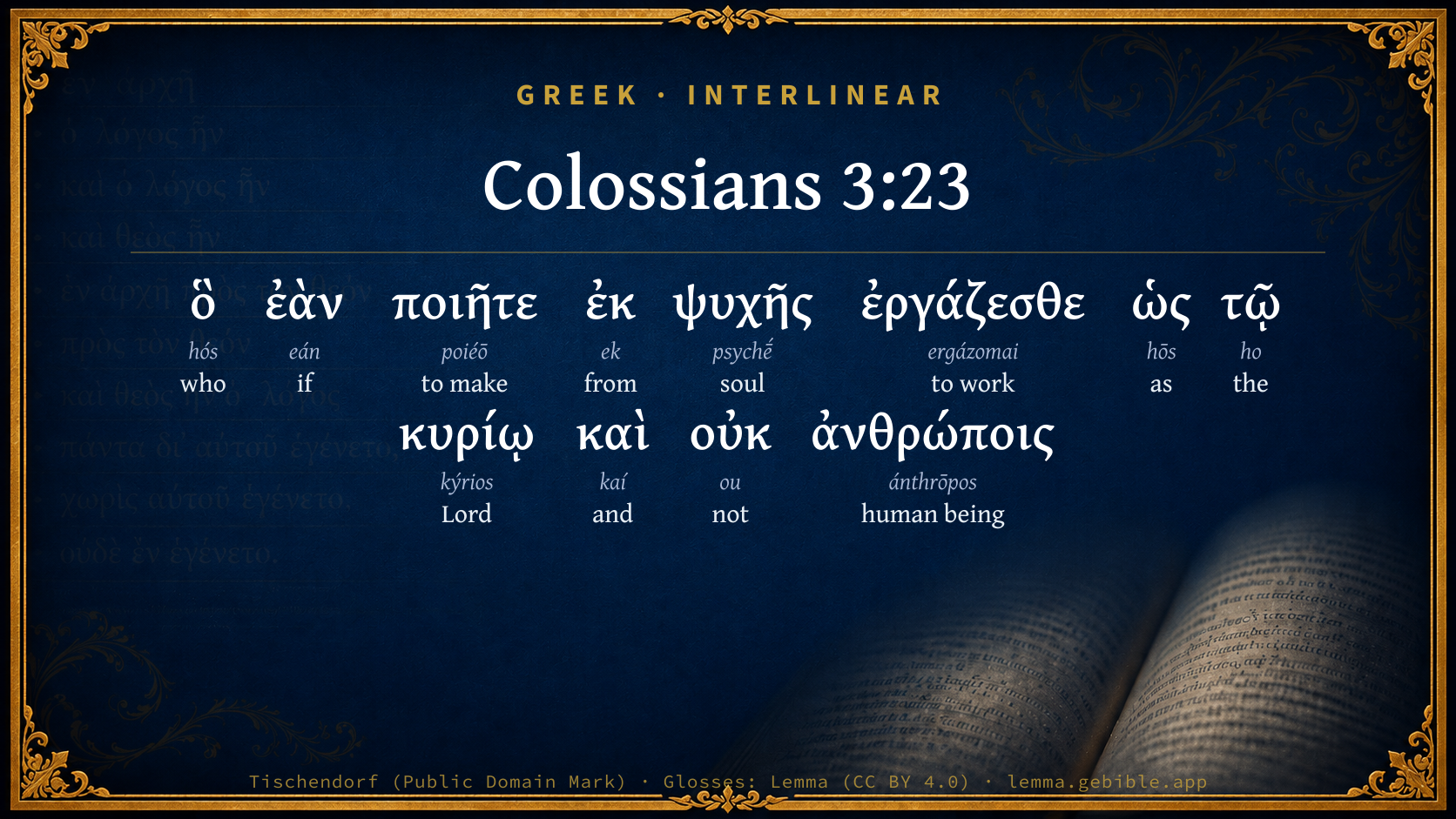
Download image
Cite this verse

Colossians 3:23 (World English Bible). Public Domain. Lemma interlinear Bible study tool, https://lemma.gebible.app/v/colossians/3/23.

Show BibTeX & RIS
BibTeX
RIS
English Translation
And whatever you do, work heartily, as for the Lord, and not for men,
World English Bible · Public Domain
Download a study sheet

One document with this verse’s original text, its word-by-word gloss line, the meaning frame, cross-references with their text, attributed commentary, and full source and license credits — printable, and it pastes into notes with its structure intact.

This verse Autodidact and up

Study sheet (.html) Plain text (.txt)

A passage Seminary Student

Up to 50 verses in one chapter. A passage sheet keeps up to 6 commentary sources and 12 cross-references per verse, in the order this page ranks them, and says so on the sheet whenever that leaves anything out. Ask for a single verse and you get the Autodidact verse sheet above.

Everything on this page stays free to read, with no account — the sheet is a download of what is already on screen, not access to it.

Want to remove ads? Support Godless Engineer
Compare translations 3

The same verse in 3 English versions, stacked beneath the original-language interlinear above. Click any original word for its lexicon entry.

Each is an independent rendering of the whole verse — the interlinear is not word-aligned to these translations.

Highlighted words mark where these versions differ — a whole-verse word diff, not a word-by-word alignment.

  • World English Bible Public Domain
    And whatever you do, work heartily, as for the Lord, and not for men,
  • King James Version Public Domain
    And whatsoever ye do, do it heartily, as to the Lord, and not unto men;
  • unfoldingWord Literal Text CC BY-SA 4.0
    Whatever you might do, work from the soul as to the Lord and not to men,

unfoldingWord Literal Text — © unfoldingWord, licensed CC BY-SA 4.0. Word-aligned USFM3 via Door43 (git.door43.org/unfoldingWord/en_ult).

Versions to compare (up to 4)

3 of 4 selected

Show all 19 translations

Every available English version of this verse, each an independent rendering of the whole verse.

  • World English Bible Public Domain
    And whatever you do, work heartily, as for the Lord, and not for men,
  • Berean Standard Bible Public Domain
    Whatever you do, work at it with your whole being, for the Lord and not for men,
  • Majority Standard Bible Public Domain
    And whatever you do, work at it with your whole being, as for the Lord and not for men,
  • King James Version Public Domain
    And whatsoever ye do, do it heartily, as to the Lord, and not unto men;
  • American Standard Version (1901) Public Domain
    whatsoever ye do, work heartily, as unto the Lord, and not unto men;
  • Revised Version (1885) Public Domain
    whatsoever ye do, work heartily, as unto the Lord, and not unto men;
  • Geneva Bible (1599) Public Domain
    And whatsoeuer ye doe, doe it heartily, as to the Lord, and not to men,
  • Douay-Rheims (1899) Public Domain
    Whatsoever you do, do it from the heart, as to the Lord, and not to men:
  • Young's Literal Translation Public Domain
    and all, whatever ye may do -- out of soul work -- as to the Lord, and not to men,
  • Literal Standard Version CC BY-SA 4.0
    and all, whatever you may do—out of soul work—as to the LORD, and not to men,
  • Unlocked Literal Bible CC BY-SA 4.0
    Whatever you do, work from the soul as to the Lord and not as to people.
  • unfoldingWord Literal Text CC BY-SA 4.0
    Whatever you might do, work from the soul as to the Lord and not to men,
  • Darby Bible Public Domain
    Whatsoever ye do, labour at it heartily, as [doing it] to the Lord, and not to men;
  • World Messianic Bible Public Domain
    And whatever you do, work heartily, as for the Lord and not for men,
  • Webster's Bible Public Domain
    And whatever ye do, do it heartily, as to the Lord, and not to men;
  • Free Bible Version CC BY-SA 4.0
    Do whatever you do really well, as if you're doing it for God, and not for people,
  • Bible in Basic English Public Domain
    Whatever you do, do it readily, as to the Lord and not to men;
  • Text-Critical English NT CC BY 4.0
    Whatever you do, work at it with all your heart, as working for the Lord and not for men,
  • Tyndale New Testament (1534) Public Domain
    And whatsoever ye do do it hertely as though ye did it to the lorde and not vnto men

Literal Standard Version (2020), Covenant Press — licensed CC BY-SA 4.0. Text via the HelloAO Bible API (eBible.org). Unlocked Literal Bible (unfoldingWord) — licensed CC BY-SA 4.0. Text via the HelloAO Bible API (eBible.org). unfoldingWord Literal Text — © unfoldingWord, licensed CC BY-SA 4.0. Word-aligned USFM3 via Door43 (git.door43.org/unfoldingWord/en_ult). Free Bible Version, Dr. Jonathan Gallagher — licensed CC BY-SA 4.0. Text via the HelloAO Bible API (eBible.org).

Word by word

More ways to search: Search by grammar → Find every occurrence → Compare this word →

Practice this passage: Drill this verse → Learn its vocabulary →

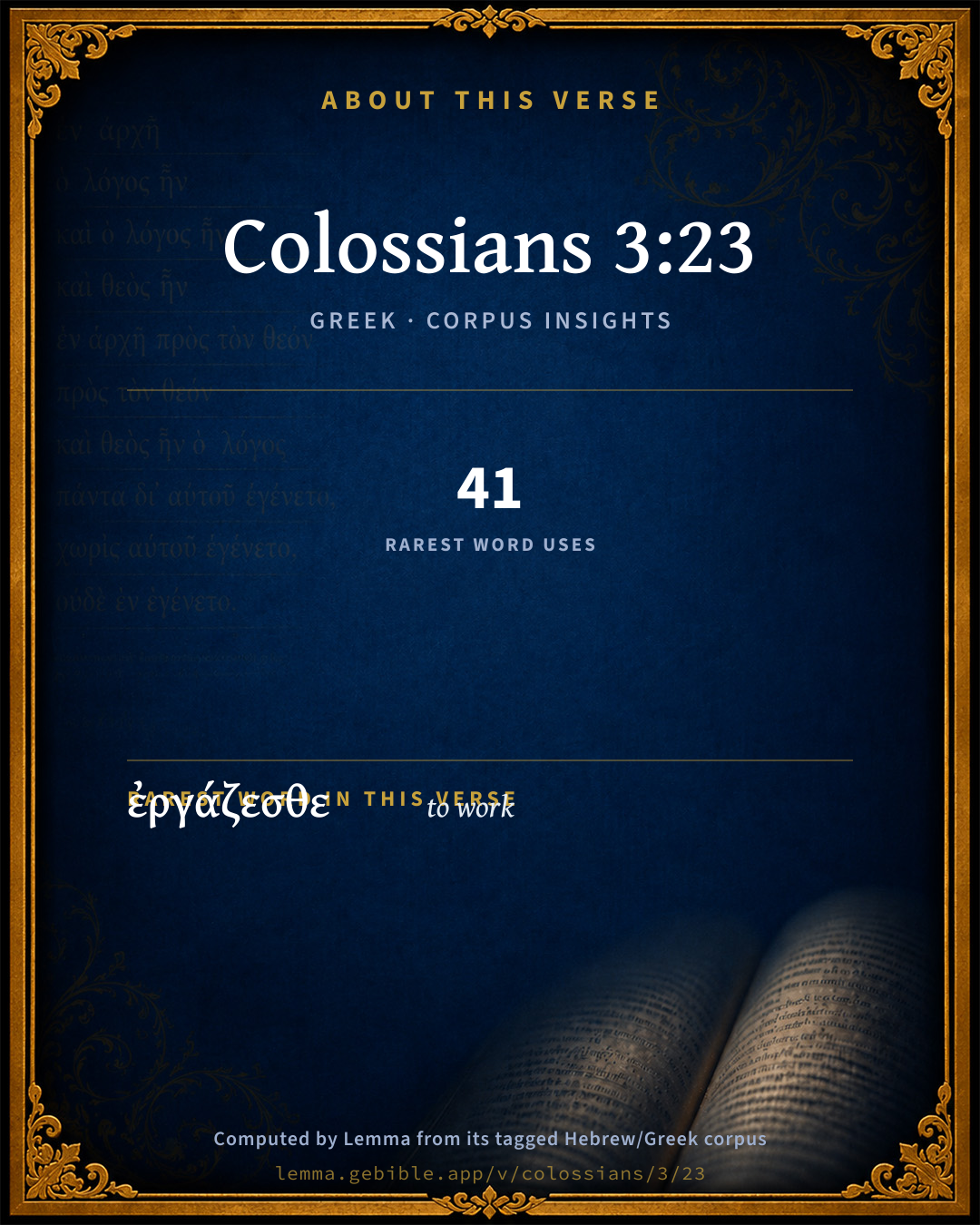
ἐργάζεσθε
ergázomai
G2038
“to work”
Verb, Present, Middle or Passive deponent, Imperative, 2nd person, Plural
Part of Speech
Verb
Tense
Present
Voice
Middle or Passive deponent
Mood
Imperative
Person
2nd person
Number
Plural
Full Thayer's Definition

Origin: middle voice from G2041

TDNT: 12:35,3

1. to work, labour, do work 2. to trade, to make gains by trading, "do business" 3. to do, work out a. exercise, perform, commit b. to cause to exist, produce 4. to work for, earn by working, to acquire
  1. ὃ hós G3739 “who” Relative pronoun, Accusative, Singular, Neuter
  2. ἐὰν eán G1437 “if” Conditional
  3. ποιῆτε poiéō G4160 “to make” Verb, Present, Active, Subjunctive, 2nd person, Plural
  4. ἐκ ek G1537 “from” Preposition
  5. ψυχῆς psychḗ G5590 “soul” Noun, Genitive, Singular, Feminine
  6. ὡς hōs G5613 “as” Adverb
  7. τῷ ho G3588 “the” Article, Dative, Singular, Masculine
  8. κυρίῳ kýrios G2962 “Lord” Noun, Dative, Singular, Masculine
  9. καὶ kaí G2532 “and” Conjunction
  10. οὐκ ou G3756 “not” Particle, Negative
  11. ἀνθρώποις ánthrōpos G444 “human being” Noun, Dative, Plural, Masculine

About this verse

These counts appear in no published source. They are computed here, from the morphology-tagged text and Lemma’s own curated glosses. What Lemma adds →

12
words
12
distinct lemmas
Pauline Epistles
section

Shared distinctive vocabulary

ἐργάζεσθε to work G2038 occurs in 39 verses of the Greek New Testament. Also found in:
Cross-references

17

Topical passages linked to Colossians 3:23 in the Treasury of Scripture Knowledge — connected by theme and wording, ordered by reader-vote popularity; previews shown in the World English Bible.

  • Colossians 3:17 Whatever you do, in word or in deed, do all in the name of the Lord Jesus, giving thanks to God the Father, through him.
  • Ephesians 6:6–7 not in the way of service only when eyes are on you, as men-pleasers; but as servants of Christ, doing the will of God from the heart;
  • Romans 14:8 For if we live, we live to the Lord. Or if we die, we die to the Lord. If therefore we live or die, we are the Lord's.
  • 2 Chronicles 31:21 In every work that he began in the service of the house of God, and in the law, and in the commandments, to seek his God, he did it with all his heart, and prospered.
  • Ecclesiastes 9:10 Whatever your hand finds to do, do it with your might; for there is no work, nor device, nor knowledge, nor wisdom, in Sheol, where you are going.
  • 1 Peter 2:15 For this is the will of God, that by well-doing you should put to silence the ignorance of foolish men:
  • 1 Peter 2:13 Therefore subject yourselves to every ordinance of man for the Lord's sake: whether to the king, as supreme;
  • Psalms 119:10 With my whole heart, I have sought you. Don't let me wander from your commandments.
  • Romans 14:6 He who observes the day, observes it to the Lord; and he who does not observe the day, to the Lord he does not observe it. He who eats, eats to the Lord, for he gives God thanks. He who doesn't eat, to the Lord he doesn't eat, and gives God thanks.
  • 1 Peter 1:22 Seeing you have purified your souls in your obedience to the truth through the Spirit in sincere brotherly affection, love one another from the heart fervently:
  • Psalms 119:34 Give me understanding, and I will keep your law. Yes, I will obey it with my whole heart.
  • Jeremiah 3:10 Yet for all this her treacherous sister Judah has not returned to me with her whole heart, but only in pretense, says Yahweh.
  • Psalms 119:145 I have called with my whole heart. Answer me, Yahweh! I will keep your statutes.
  • Zechariah 7:5–7 "Speak to all the people of the land, and to the priests, saying, 'When you fasted and mourned in the fifth and in the seventh month for these seventy years, did you at all fast to me, really to me?
  • Psalms 103:1 Praise Yahweh, my soul! All that is within me, praise his holy name!
  • Matthew 6:16 "Moreover when you fast, don't be like the hypocrites, with sad faces. For they disfigure their faces, that they may be seen by men to be fasting. Most assuredly I tell you, they have received their reward.
  • Psalms 47:6–7 Sing praise to God, sing praises. Sing praises to our King, sing praises.

Cross-references courtesy of OpenBible.info (CC BY 4.0).

Where the printed editions differ

2 variants

Places in this verse where the major printed Greek editions disagree on the wording in a way that affects the translation — a comparison of editions, not a manuscript-by-manuscript collation. The editions are the modern critical texts (Nestlé-Aland 28/27, SBL, Westcott-Hort, Tregelles, Tyndale House) and the traditional texts behind the KJV (the Textus Receptus and the Byzantine/Majority text). It is not a claim about which reading is original.

  1. Extra text
    πᾶν

    “everything”

    In TRByz Not in NA28NA27TynSBLWHTreg

    πᾶν (pan) 'everything' is only in traditional manuscripts (TR+Byz)

  2. Extra text
    τι

    “any [of]”

    In TRByz Not in NA28NA27TynSBLWHTreg

    τι (ti) 'any [of]' is only in traditional manuscripts (TR+Byz)

Textual data: Translators Amalgamated Greek New Testament (STEPBible TAGNT) · CC BY 4.0.

Commentary

Notes on Colossians 3:23 from classic Christian and Jewish commentators (each source and its license shown beneath its notes). The classic Christian expositions comment on the surrounding passage and are grouped to its opening verse, so a note may address several verses; the Jewish commentaries on the Tanakh (Rashi and others) are per-verse, so they appear only where the commentator wrote on this verse.

Lemma curates 59 commentaries, every one of them public domain or Creative Commons licensed, each selected and text-cleaned for this edition rather than reprinted as found. About our sources →

The Biblical Illustrator

Joseph S. Exell

Col_3:23

Whatsoever ye do, do it heartily, as unto the Lord.

Servants of Christ

The apostle was speaking to slaves, who must have felt their condition to be irksome and degrading, but he applies a principle which altogether transforms it. They are to feel and act as servants of Christ. This principle is of far-reaching application. We are to serve Christ by discharging all the duties of life so as to please Him. This suggests a train of thought which has a special suitableness to young men. Note then the things which are essential to the realization of this lofty ideal of Christian service.

I. There must be a full surrender of the whole being to Christ. No man can serve two masters. He that is not with Me is against Me. Alas! how many act as though they bad made a bargain with Christ; that part of their nature should be given to Him, and part retained for the world and self. In certain circumstances they seem devout and earnest believers, in others frivolous and worldly Such a course is dishonouring to Christ, and injurious to their own souls. There are families in which the children having been asked to do something, refuse or delay; then a struggle ensues, involving discomfort to both parents and children. In others the first intimation is followed by prompt obedience. In the one case is love, order, and happiness; in the other the reverse. Why? In the one case the children had learned to obey, in the other they had not. So some of Gods children have not learned to surrender their wills utterly to Him; hence every act of obedience involves a struggle; but some have learnt to make the struggle once for all, and are now happy in that service which is perfect freedom.

II. Strive to be efficient in your worldly calling. Whatsoever, whether the work of master or servant, prince or peasant, do it as to the Lord. When we can recognize Christ as our Master, and our work as rendered to Him, it should make us faithful servants, whoever may be our immediate employer. Unfortunately this has not been always acted on, and religion has been regarded as a disqualification for efficient service. A lad once said, when urged to decision, I would like to learn my business before being converted, for I notice that the pious men in my fathers employ are not generally good workmen. I want you to wipe out this reproach, and try to excel in everything for the sake of Christ--whether in school, workshop, or counting-house, etc. The influence of Christian character and effort is greatly enhanced when connected with superiority in business. A working man who had recently come to reside in a northern village, was asked, as he was strolling in the fields one Sunday, to attend a cottage service where the speaker was going to preach. The invitation was rudely declined, and OH mentioning the matter to an acquaintance who came up immediately, he was asked if he knew who the preacher was. No. Why that is Thompson, the best forgeman in the district. Oh, indeed, I have often heard of Thompsons work; I will go and hear him preach. He did so and became a new man.

III. Strive to acquire mental culture and general intelligence for the sake of Christ.

1. It will open to you many avenues of enjoyment.

2. It will enable you to discover riches and beauty in the Divine word which would otherwise be concealed.

3. It will help to keep you free from the religious crotchets by which the Christian life is now weakened and disfigured.

4. It will give you greater power to serve Christ. Edward Irving had in his Glasgow congregation the wife of a shoemaker, who was a determined infidel. Irving visited him day after day without producing any impression. But one day he sat down beside him and began talking about his work and the material he was then handling. The man became interested, for he found that the minister knew as much about his trade as he did himself. Next Sunday he went to church, and when taunted by his former companions, replied, Mr. Irving is no fool, he kens leather.

IV. Have some special work to do for Christ. The field of Christian usefulness is wide, and there can be no difficulty in finding suitable work. To help you in this--

1. Be regular and faithful in your devotions.

2. Try to do every day something simply for Christs sake--repress your temper, speak to some friend about salvation, practise some self-denial, for Christs sake, and with the help of the Spirit. Conclusion: Are you serving Christ or Satan? You must be one or the other. (G. D. Macgregor.)

Do all for God

1. When we remember that our destiny is to live with Christ and glorified beings, and that any work that does not fit us for that is a great impertinence, it is alarming at first sight to note that the great bulk of our occupations are of the earth, earthy. All professions and trades are for the purpose of supplying defects in the existing order, and, therefore, when that order is no more, and is superseded by one in which there are no defects, the occupations of this life must necessarily die a natural death. Is there not, then, something which seems inappropriate in the circumstance that all this short life should be taken up in doing what has no reference to eternity, and will be swept away like so much litter?

2. It was just this feeling that gave rise to Monasticism. Men assumed that eternity would be given up to prayer and praise; these, therefore, must be the earthly occupations of religious men. Let us not rail at their mistake, for it is a common assumption that a secular pursuit is an obstacle to a religious mind. Hence a seriously disposed young man is pointed out as destined for the Church.

3. As the pushing of a false theory to its extreme point is one method of showing its fallacy, imagine it to be Gods will that all Christians should have a directly spiritual pursuit. What then? The system of society is brought to a dead-lock. Take away the variety of callings, reduce all to that of the monk, and civilization is undermined and we revert to barbarism. This assuredly cannot be the will of Him who has implanted in us the instincts which develope into civilization.

4. But if this cannot be the will of God, then it must be His will that this man should ply some humble craft; that this other should have the duties of a large estate; that a third should go to the desk; a fourth minister to the sick; a fifth fight the battles of his country. Now if this be the case the greatest harm is done when a man thrusts himself out from his proper vocation. Each mans wisdom and happiness must lie in doing the work God has given him. So thought St. Paul. He did not urge his converts to join him in his missionary journeys, but to abide in his calling with God.

5. With God. This wraps up the secret of which we are in search, how we may serve God in our daily business. How can this be done? By throwing into the work a pure and holy intention. Intention is to our actions what the soul is to the body. As the soul, not the body, makes us moral agents, so motive gives action a moral character. To kill a man, of malice prepense, is murder; but to kill him by accident is no sin at all. A good work, such as prayer, becomes hypocrisy if done for the praise of men.

6. Now the great bulk of lifes work is done with no intention whatever of serving God.

(1) The intention of some in their work is simply to gain a livelihood: a perfectly innocent and even good motive, but not spiritual and such as redeems the work from earthiness.

(2) Others labour with a view of gaining eminence. The effects of work done in this spirit, if it does not meet with success, are sad to witness.

(3) Others mainly work from energy of mind. They would be miserable if idle; but that work has of course no spiritual character.

(4) Another class work from the high and elevating motive of duty; but if the intention have no reference to Gods appointment it has no more spirituality than might have been found in the mind of Cicero or Seneca.

(5) A great mass of human activity has no intention at all, and so runs to waste from a spiritual point of view. Multitudes work mechanically, and by the same instinct of routine as a horse in a mill. But man is surely made for something nobler than to work by mere force of habit.

7. Now what is the true motive which lifts up the humblest duties into a higher atmosphere? This--Whatsoever ye do, etc. The primary reference is to the duties of slaves, the lowest imaginable. The a fortiori inference is this, that if the drudgery of a slave admits of such a consecration, much more does any nobler form of business. No man after this can say, My duties are so very commonplace that they cannot have a religious dignity and value.

8. Practical counsels.

(1) Before you go to your task fix it in your mind that all lawful pursuits are departments of Gods harvest-field in which He has called Christians to labour.

(2) Pursue your own calling with the conscious intention of furthering His work and will.

(3) Then put your hand to it bravely, keeping before you the main aim of pleasing Him with diligence and zeal

(4) Imagine Jesus surveying your work as He will do it at the last day, and strive that there may be no flaw in it. (Dean Goulburn.)

Working

Were I to ask, What was the purpose for which you were sent into the world, I should get a variety of replies. But the right answer would be, To work. So the Bible tells us, and Providence and the worm around. Work is not an evil, but a good. There is work in heaven. Adam unfallen was a working man. If there had been no sin the world would not have been a world of idleness. And what is true of us is true of all Gods creatures. Take water; it never stands still. Take horses, or even the birds, how soon they have to work for a living. Our text tells us how to work and for whom to work. Take then its instruction as a guide for--

I. School work. Many wish there were no such thing. This is foolish, for schools make all the difference between us and heathens. How hard it is for a man to get on in life who has had a poor education. School work is hard, but it will be made all the lighter ii done heartily and to the Lord; and then there would be no need for the coaxing and bribing and threatening that are so common.

II. Home work. Young people should make themselves useful at home, and not expect that everybody should be attending upon them. Home work is an important part of the training for after life; and there is nothing in it beneath the dignity of any girl. And what a comfort it would make you, and what a saving you might be to mothers cares. And the reason it is repulsive is because you do not take to it in a right spirit. Throw heart in it, and it will soon be enjoyable.

III. Business work. Whatever is worth doing at all is worth doing well--the work even of a message-boy, crossing sweeper, or shoeblack. It is often when people are busy at their work that God comes with a blessing. Moses, Gideon, Elisha, the shepherds, the apostles were all called when at their work. Is yours humble? You can exalt it by taking it as Christs, and by doing it with all your heart.

IV. Soul work. This is done more for us than by us. And yet we have to work out what God works in. This will have to be done heartily and unto the Lord, or literally not at all. We have to escape--which surely involves earnestness--to Jesus.

V. Christian work. Every work is Christian if done for Christ, but there is work more especially done for Him. When a little girls mother comes to visit her at school, she wants to introduce all her friends to her. Your work is to introduce them to Jesus. You need not be missionary to do this. (J. H. Wilson, M. A.)

Not unto men

It is related that when Phidias, the great sculptor who carved statues for one of the temples of antiquity, was labouring with minute fidelity upon the hair on the back of the head of one of the historic figures which was to be elevated from the pavement to the very apex of the building, or placed along the frieze, some one expostulated with him, saying, Why do you take such great pains with the hair? It is never to be seen. His simple reply was, The gods will see it. So he laboured thoroughly in the minutest things, not for the eyes of men but for the eyes of the gods. (H. Melvill, B. D.)

Knowing that of the Lord ye shall receive the inheritance; for ye serve the Lord Christ.

Christian Socialism

Christianity, though altogether opposed to those levelling theories which disaffected men industriously broach, places the highest and the lowest on a par in the competition for eternity. Christianity is the best upholder of the distinctions in society; and he can have-read his Bible to little purpose who does not see the appointment of God that there should be rich and poor in the world, master and servant; who does not perceive that want of loyalty is want of religion, and that there is no more direct rebellion against the Creator than resistance to any constituted authority, or the endeavour to bring round that boasted equality in which all shall have the same rights, or to speak more truly, in which none shall have any. But if Christianity makes it sinful to repine against servitude, it gives a dignity to the servant who would still remain in servitude. It tells the servant, that ii faithful here, he may rank with his master hereafter, even though the employment of the master has been the advancement of Christs cause on earth. And oh! it should be a surprisingly cheerful thing to those who have to wear away life in the meanest occupations, that, as immortal beings, they are not one jot disadvantaged by their temporal position, but they make as much progress in the Christian race as those placed at the very highest summit in the Christian office. (H. Melvill, B. D.)

Living for Christ

I. Unity of purpose is necessary.

1. For the development of character.

2. For success in life.

Glory, self-interest, benevolence, each gives unity and force, whereas a man without any such governing principle becomes weak; and it is only by making one object predominant and seeking that object that great results are achieved.

II. That which gives unity to the Christian life is Christ.

1. He is the unifying principle of Christian theology.

2. Of the inward life of the Christian.

3. Of his outward and active life.

We have an illustration of this in Paul, in his theology, experience, and work. Negatively he did not seek wealth or honour, either as his main or subordinate object. He simply sought the glory of Christ.

III. The glory of Christ should be our aim.

1. Because it is our duty. This is the highest thing we can do. Whatever else we do will, in the end, be regarded as nothing.

2. Our inward holiness and happiness will thereby be best advanced.

3. Only thus can we be really useful. Thus only do we associate ourselves with the saints and angels. The extension of Christs kingdom is the only thing worth living for.

4. Christ has died for you, redeemed you. You are not your own but His. Serve Him, then, under the constraint of His love. (C. Hodge, D. D.)

The perfect service

It would be truthful to say that all serve the Lord Christ. Some against their will--Pharisees, Pilate, Judas, etc. Some unconsciously--all who spread the true refinement of art, the researches of science, the charities of philanthropy. But Paul is not now speaking to such, but to the saints and faithful brethren in Christ at Colossae. And these words indicate about the life service of all true Christians.

I. Its motive. The constraint is for Christs sake. Such motive is--

1. Deep enough. It has its hands on all the hidden springs of purpose and love.

2. Abiding enough. To please others who may change or die, or please self, which is fickle and disappointing, cannot ensure the prolonged service men can render to the eternal and unchanging Christ.

II. Its pattern. In some warfare the commander says, Go; in this He says, Follow Me. He was in all points tempted, etc. He has left us an example.

III. Its help. The fishers after their night of bootless toil, Peter walking on the waves, Paul receiving grace to endure a hidden sorrow, are specimens of men needing and receiving help from Christ.

IV. Its comprehensiveness. It includes all circumstances, whether of partizan or statesman; all ages, whether of child or patriarch; of all spheres, whether of the inward or outward life. Whatsoever ye do.

V. Its consummation. It has now the approval of conscience and the Master; it will ultimately receive the reward of the inheritance. (U. R. Thomas.)

The service of Christ is

I. honourable service. We serve the Lord Christ--King of kings, and Lord of lords. The servants of royalty are nobles; so we are kings and priests unto God.

II. Reasonable service. The master had a claim upon the slave as his property won in war or purchased by money. We have been bought with a price. Christ has a right based upon His service of love; we should respond with gratitude.

III. Entire service. The slave was his masters altogether--self, family, belongings, etc. So Christ claims all we are and all we have--time, money, secularities, and not merely Sabbaths, worship, etc.

IV. Happy service. Sometimes the road is rough, but the motive for treading it makes it smooth, and the companionship of Him we love relieves its tedium and lightens its darkness.

V. Easy service. Take My yoke upon you … and ye shall find rest. Love is the magic power which makes what is irksome pleasurable.

VI. The service of Friendship (Joh_15:15). It is the badge of true Christian discipleship--not creeds, professions, sentiments, etc.

VII. Lucrative service.

1. It is its own reward here.

2. It has an exceeding great reward by and by. (A. C. Price, B. A.)

How difficulties in Christs service are overcome

Sometimes when a mans limb has been broken, and long weeks of rest are necessary in order that the fractured bones may reunite, there is danger lest the limb should become permanently contracted; so as soon as it is safe to do so, the patient is ordered to exercise the limb. At first the exercise gives acute pain, but after awhile, as vigour and strength return to the limb, in the thrill of health that he feels, the man forgets the pain and is glad. Now sin has dislocated mans moral nature, and though by grace it may have been reset, still Gods wise exercise of it is exceedingly painful; but then this exercise begets spiritual health, and that health sends such a thrill of pleasure through the soul that the very act of obedience to, and service of, Christ, gains strength to obey and serve; and with increasing strength difficulty after difficulty disappears, pain goes, pleasure comes, and the Christian is master of his work, and delights in it. (A. C. Price, B. A.)

What makes Christs service easy and pleasant

That huge piece of timber which lies there in that quiet creek, from which the tide has receded, leaving it dry and immovable in the sand; try to shift it, and it is only with the utmost difficulty that you can do so. But wait till the tide comes in, and the waters flow around it. Make the attempt now, and with what comparative ease you accomplish it! Even so there are ten thousand things in the way of duty laid upon us by God which, so long as the heart is unrenewed, seem hard and burden some, but all of which yield when once the love of Christ has once entered and filled the heart, are cheerfully taken up and done with ease and joy to the Loved One. A little child had given to her by a friend a bunch of ripe, beautiful grapes. Just as she was about to eat them her mother said, My child, will you give me those grapes? The little one looked at the grapes and then at the mother whom she loved; and then after a pause, as the mothers love came rushing with full tide into her heart, and overmastering every other feeling, she flung the grapes into her mothers lap, and with a kiss surrendered them all (Mat_18:3). The love of Christ makes sacrifice easy and delightful. (A. C. Price, B. A.)

The ruling motive of Christs servants

You cannot serve two masters--you must serve one or other. If your work is first with you, and your fee second, work is your master, and the Lord of work, who is God. But if your fee is first with you, and your work second, fee is your master, and the lord of fee, who is the devil; and not only the devil, but the lowest of devils--the least erected fiend that fell. So there you have it in brief terms--work first, you are Gods servants; fee first, you are the fiends. And it makes a difference, now and ever, believe me, whether you serve Him who has on His vesture and thigh written, King of kings, and whose service is perfect freedom; and him on whose vesture and thigh is written, Slave of slaves, and whose service is perfect slavery. (John Ruskin.)

The sure reward of Christs servants

When Calvin was banished from ungrateful Geneva, he said, Most assuredly if I had merely served man, this would have been a poor recompense; but it is my happiness that I have served Him who never fails to reward His servants to the full extent of His promise. (C. H. Spurgeon.)

All for Jesus

The gospel does not barely supply us with directions, but furnishes us with reasons and power for obedience. The apostle knew that the conditions of believers are various, and therefore laid down distinct precepts for masters and servants, etc., but proposed a common motive for all. Our translation is in the indicative and states the fact--Ye serve the Lord Christ. Is that so? If not, the original will bear rendering in the imperative--Serve ye the Lord Christ. What an exaltation for a slave of Satan to become a servant of Christ. Thy gentleness hath made me great. It is a greater honour to serve Christ in the most menial capacity than to occupy the throne of the Caesars. To serve us He laid aside His glorious array and girt Him with the garments of a servant. In our turn let us serve Him alone and for ever. Ye serve the Lord Christ--

I. In the common acts of life. The fact that the text was addressed to the lowest is instructive. He does not address this choice saying to masters, preachers, deacons, magistrates, or persons of influence, but to slaves. He goes to the kitchen, the field, etc., to his toiling brethren. If the poor slave should serve Jesus how much more ought I?

1. Those who are in a low estate serve the Lord Christ.

(1) By a quiet acquiescence in the arrangement of Providence which has placed them where they are. While the race is as it is some must serve. When a man can say, I have learned in whatsoever state I am to be content, that is obedience and the service of Christ.

(2) By exercising the graces of the Spirit in the discharge of our calling. An honest, trustworthy servant is a standing evidence of the power of religion, and preaches in the nursery, workshop, and many places where a preacher would not be admitted, a silent but effective sermon. This was how the gospel spread in Rome.

(3) By displaying the joy of the Lord in our service. Many have been won to Christ by the cheerfulness of poor Christians. It was so in Pauls day. The Christian slave would not join in the jollity of the heathen festivals, but whenever any one was in trouble he was the cheerful comforter.

(4) By performing the common acts of life as unto Christs self. To the man of God nothing is secular, everything is sacred. What God hath cleansed, that call thou not common.

2. This view of things--

(1) Ennobles life. The bondsman is henceforth free; he serves not man but God.

(2) Cheers the darkest shades.

(3) Ensures a reward.

(4) Should stimulate zeal.

If you serve the Lord Christ, serve Him well. If you had work to do for Her Majesty you would try to do your best.

II. In religious actions. Every professor should have something to do for Christ. It would be well if our Church discipline permitted us to turn out every drone. They are of little use in honey making and are at the bottom of all quarrels. But all who work are not necessarily serving Christ.

1. Some serve in a legal spirit. This spirit has a measure of power in it, as the lash drives the slave. But Christians are free and should serve Christ from gratitude and not from fear.

2. Some in a spirit of formality, as a part of the general routine of their existence. It is the proper thing to go to a place of worship, to give their guinea, etc. Christ is not served by such mechanical working.

3. Some in a party spirit, who serve not Christ but their own denomination, and who would almost be vexed at Christ being honoured by any other sect.

4. Some out of the ambition to be thought useful. Our parents or friends wish us to be active in the Church, and therefore we do it.

5. We must rise above all this. What we do we must do for the Master alone.

III. In special acts done to himself. We desire not only to aid our friend in his projects, but to do something for him himself. So we want to do something, personally, for our Divine Benefactor.

1. We can adore Him. We may be doing nothing for our fellows while thus occupied, but Jesus is dearer to us than the whole race. And as we adore Him in secret so we should extol Him in public.

2. We should pray for: Him. Prayer shall be made for Him continually. It is delightful to pray for sinners and for saints, but there should be special prayer for the extension of Christs kingdom, that He may see the travail of His soul.

3. There should be much communion with Him. If any man serve Me let him follow Me, and where I am there shall also My servant be. To be near Him is one of the essentials of service. Let no day pass without a word with Jesus. You are His spouse--can you live without a loving word from your husband?

4. You should sit at His feet and learn of Him, studying His Word. Martha prepared a feast for Christ and did well, but Jesus gave Mary the preference.

5. You must obey Him. If ye love Me keep My commandments, not simply build chapels, etc.

6. You must be willing to bear reproach for His sake.

7. Care for His Church. Lovest thou Me?--feed My sheep. If you cannot serve with your tongue you can feed the hungry, clothe the naked, etc. Inasmuch as ye have done it unto one of the least of these, etc.

8. Bestow upon Him little wastefulnesses of love--breaking alabaster boxes of very precious ointment on: Him. Think of something now and then that you could not justify in prudence. (C. H. Spurgeon.)

The Biblical Illustrator, edited by Joseph S. Exell (c. 1880s–1900s) — public domain. Text from a community e-Sword module.

Bengel's Gnomon

Johann Albrecht Bengel

Col 3:23. Ὄτι ἐὰν ποιῆτε, whatsoever ye do) in your service.—ὁ ἐάν τι, Eph 6:8.

Bengel's Gnomon of the New Testament — English translation (T&T Clark, Edinburgh, 1860) — public domain. Text from a community e-Sword module.

Meyer's Critical & Exegetical Commentary

Heinrich August Wilhelm Meyer

Col_3:23 f. More precise explanation of the ἐν ἁπλότ. καρδ., φοβούμ. τ. κύρ. just required.

ποιῆτε] in your service.

ἐκ ψυχῆς] μετὰ εὐνοίας, μὴ μετὰ δουλικῆς ἀνάγκης, ἀλλὰ μετὰ ἐλευθερίας καὶ προαιρέσεως, Chrysostom. Comp. on Eph_6:6.

ἐργάζεσθε] execute, carry out, not equivalent to ποιεῖτε, but correlative with it, hence also not in the narrower sense: labour (as e.g. in Xen. Oec. iii. 4 with reference to slaves).

ὡς τῷ κυρ.] Point of view of the ἐργάζ.; this is to be regarded as taking place for Christ, rendered as a service to Him. Comp. Eph_6:6 f. And the relation to the human masters, to whom the slaves belong, is in this higher aspect of the service thrown so much into the background as not to be taken into account at all, in accordance with the principle that no man can serve two masters; hence οὐκ is not relatively, but absolutely negative. Respecting the contrast of ἀνθρ. and Χριστός, see on Gal_1:1.

εἰδότες κ.τ.λ.] Ground of the obligation in ones own consciousness for the ὡς τῷ κυρίῳ κ. οὐκ ἀνθρ.: since ye know that ye shall receive from the Lord, etc. On εἰδότες, comp. Col_4:1.

ἀπὸ κυρίου, excluding the human recompense, stands first with emphasis, and ἀπό (on the part of) denotes, not expressly the direct giving (παρά), through which the recompense is received, but generally the issuing, proceeding from the Lord, who is the possessor and bestower, although the receiving of the recompense at the judgment will be in reality direct (Eph_6:8; 2Ti_1:18). Comp. on 1Co_11:23; Winer, p. 347 [E.T. 463].

τῆς κληρον.] In the Messianic κληρονομία, i.e. in the future possession of eternal bliss (see on Gal_3:18; Eph_1:11; Col_1:12; Rom_4:13), the reward consists. The motive for its purposely-chosen designation by this particular term lies in the fact, that in human relations slaves are not usually heirs, comp. Gen_21:10. Hence also this closing word, next to the ἀπὸ κυρ., has special emphasis: from the Lord ye shall receive the recompense of the inheritance. Comp. as to substance, Ignat. ad Polyc. Colossians 4 : ἵνα κρείττονος ἐλευθερίας ἀπὸ Θεοῦ τὺχωσιν.

On ἀνταπόδοσις (only found here in the N. T.), comp. Thuc. iv. 81.1 (where, however, the sense is different); Plut. Mor. p. 72 F; Polyb. vi. 5. 3, xx. 7. 2, xxxii. 13. 6; passages from Diod. Sic. in Munthes Obss. p. 390; and from the LXX. in Schleusner, I. p. 296; also ἀνταπόδομα in Rom_11:9.

τῷ κυρίῳ Χ. δουλεύετε] without γάρ (see the critical remarks) embraces succinctly the whole summary of the Christian duty of slaves in accordance with the principle already laid down in the ὡς τῷ κυρίῳ κ. οὐκ ἀνθρώποις; Χριστῷ is not to be taken as appositionally equivalent to ὅς ἐστι Χριστός (Hofmann), but in accordance with the quite common usage; hence: to the Lord Christ be serviceable! It is properly rendered thus imperatively in the Vulgate; also by Ewald, Dalmer, Schenkel, and Bleek. The whole significant emphasis lies upon τῷ κυρ. Χριστῷ; His slaves they are to be in the relation of human service. Where the γάρ is regarded as not genuine,[165] the indicative interpretation (the usual one) makes the utterancewhich, moreover, would be superfluous after Col_3:23vapid, especially without the addition of an οὕτως.

[165] The decisive preponderance of the witnesses omitting this γάρ renders it quite impossible to uphold it by subjective criticism (in opposition to Hofmann), proceeding on the supposition that its omission may be traced to an artificial combination of ideas, which is imputed to the copyists. Just as little is the Recepta δέ (instead of γάρ) in ver. 25 to be defended.

Meyer — Critical and Exegetical Commentary on the New Testament — English translation by Peter Christie, edited by Frederick Crombie (T&T Clark, 1880) — public domain. Text from a community e-Sword module.

Expositor's Greek Testament

ed. W. Robertson Nicoll

Col 3:23 . Not only must the slave’s work be done in the fear of the Lord, but done as if it were actually for the Lord that he was doing it, and not for a mere human master. And this principle is to govern every detail of his varied service. ἐκ ψυχῆς : heartily and with good will. οὐκ ἀνθρώποις : their service, Paul would say, is not to be rendered at all ( οὐκ not μὴ ) to their earthly master, but exclusively to Christ.

The Expositor's Greek Testament, edited by W. Robertson Nicoll (1897–1910) — public domain. Text from a community e-Sword module.

Jamieson, Fausset & Brown

Robert Jamieson, A. R. Fausset & David Brown

And--omitted in the oldest manuscripts (compare Eph 6:7-8). Compare the same principle in the case of all men, Hezekiah (Ch2 31:21; Rom 12:11).

do, do it--two distinct Greek verbs, "Whatsoever ye do, work at it" (or "labor at" it).

heartily--not from servile constraint, but with hearty good will.

Jamieson, Fausset & Brown — Commentary Critical and Explanatory on the Whole Bible (1871) — public domain (CC PDM 1.0). Text via the HelloAO Bible API.

The Cambridge Bible for Schools and Colleges

gen. ed. J. J. S. Perowne

23. whatsoever ye do] even in the daily round of servile tasks. For the phrase and its significance, see above, Col_3:17 and note.

do it heartily] Lit., work from the soul. Cp. Eph_6:6.

as to the Lord] Whose will expressed itself for them in each act of common duty. What a transfiguration of the life for the man, or woman, whom law and custom regarded as merely a purchasable “living chattel”! See Introd. to the Ep. to Philemon, p. 155.

not unto men] as the ultimate reasons and constraints.

The Cambridge Bible for Schools and Colleges (gen. ed. J. J. S. Perowne; Cambridge University Press, 1878–1918) — public domain. Text from a community e-Sword module.

John Gill's Exposition

And whatsoever ye do,.... Some have thought that these words, and the two following verses, regard the Colossians in general, and the performance of any, and all good works by them; but by their connection with the preceding verse, and with the beginning of the next chapter, they appear to concern servants only, and what they do under that character, and under the discharge of their duty:

do it heartily, not by mere force and necessity, grudgingly, and with murmurings, but from the heart, and with good will, having a true, real, and hearty affection for their masters, having their good and interest at heart, and a delight in their service; like the Hebrew servant, that loved his master, as also his wife and children, and therefore would not depart from him, see Exo 21:5,

as to the Lord, and not unto men; See Gill on Eph 6:7.

John Gill's Exposition of the Whole Bible (1746–1763) — public domain (CC PDM 1.0). Text via the HelloAO Bible API.

Trapp's Complete Commentary

John Trapp

23 And whatsoever ye do, do it heartily, as to the Lord, and not unto men;

Ver. 23. Do it heartily, as to the Lord] This is to make a virtue of necessity, while in serving men we serve the Lord Christ, going about our earthly businesses with heavenly minds, with not only a habitual, but an actual intention, as much as may be, of glorifying God in all.

John Trapp, A Commentary or Exposition upon All the Books of the Old and New Testament (1647–1656) — public domain. Text from a community e-Sword module.

Matthew Poole's English Annotations

Yea, courageously and cheerfully, from the very soul, not constrainedly and murmuringly, though they be froward and their commands harsh; making account it is Jesus Christ, (who hath power over soul and body, Mat 10:28), not mortal men only, or in and for themselves, whom you serve, {see Eph 6:7} have an eye unto this Sovereign Lord, in the servile office your masters on earth do employ you.

Matthew Poole's English Annotations on the Holy Bible (1683–1685) — public domain. Text from a community e-Sword/MySword module.

The Pulpit Commentary

Whatever ye be doing, work (therein) from (the) soul, as to the Lord, and not to men. (ver. 17; Eph_6:6, Eph_6:7; 1Co_7:21-23) (On the first clause, see ver. 17.) In the Revised Text, however, the turn of expression differs from that of ver. 17, pan being cancelled. The writer is thinking, not so much of the variety of service possible, as of the spirit which should pervade it. "Do" is replaced in the second clause by the more energetic "work," opposed to indolent or useless doing. (comp. Eph_4:28; 2Th_3:10; Joh_5:17 Joh_9:4) "From ejk, out of the soul "indicates the spring of their exertionsinward principle, not outward compulsion; the servant must put his soul into his work. "Soul" implies, even more than "heart," the engagement of the man"s best individual powers. (comp. Php_1:27, as well as. (Eph_6:6) The slaves" daily taskwork is to be done, not only in sight and in fear of the Lord (ver. 22 b; Eph_5:21) but as actually "to the Lord." Him they are serving (ver. 24 b), who alone is "the Lord"; (Col_2:6) every mean and hard task is dignified and sweetened by the thought of being done for him, and the commonest work must be done with the zeal and thoroughness that his service demands. (comp. Eph_6:7, "with good will doing bond service The word "not" (ouj instead of mh) implies that their service is actually rendered to One other and higher than "men" (1Co_7:22; Gal_1:10)

The Pulpit Commentary (1880–1919), ed. H.D.M. Spence-Jones & Joseph S. Exell — public domain. Text from a community e-Sword module.

John Wesley's Explanatory Notes

Heartily - Cheerfully, diligently. Menpleasers are soon dejected and made angry: the single-hearted are never displeased or disappointed; because they have another aim, which the good or evil treatment of those they serve cannot disappoint.

John Wesley, Explanatory Notes Upon the Whole Bible (1754–1765) — public domain. Text via the GEBible commentary corpus.

The People's New Testament

B. W. Johnson

23. And whatsoever ye do. See notes on Eph. 6:7.

B. W. Johnson's The People's New Testament with Notes (1889–1891) — public domain. Electronic text from the Christian Classics Ethereal Library (CCEL) ThML edition.

Cambridge Greek Testament for Schools and Colleges

23. ὅ ἐὰν ποιῆτε. This and the two following verses are an explanation and expansion of φοβούμενοι τὸν κύριον.

ἐκ ψυχῆς. || Eph 6:6. Referring not to singleness of purpose (Col 3:22), but to ready impulse in contrast to external constraint (cf. Delitzsch Psychol. p. 241 Eng. Trans.), “Worke ye of will” (Wyclif).

ἐργάζεσθε. In connexion with ποιεῖν, also in Joh 6:28; 3Jn 1:5. Of the two ποιεῖν appears to be the more general word, ἐργάζεσθαι to indicate result (“do your work”), not merely toil and fatigue as such (κοπιάω, Col 1:29).

ὡς τῷ κυρίῳ καὶ οὐκ ἀνθρώποις. || Eph 6:7. The οὐκ sharply contrasts men with the Lord. They are of course to be serving their earthly masters, but these as such are as nothing compared with Him whom they serve when serving them.

Cambridge Greek Testament for Schools and Colleges (Cambridge University Press, 1896; 21 vols, various authors incl. Carr, Maclear, Plummer, Farrar, Lumby, Moule, M. R. James, Simcox) — public domain. Text from a community e-Sword module.

Alford’s Greek Testament

Henry Alford

23.] ἐκ ψυχῆς, as Chrys., μετʼ εὐνοίας, μὴ μετὰ δουλικῆς ἀνάγκης, ἀλλὰ μετʼ ἐλευθερίας κ. προαιρέσεως. The datives may be taken as of reference, or commodi. In Eph 6:7 the construction is filled up by δουλεύοντες. Mey. observes against De W., that οὐκ is an absolute not a mere relative negative: ‘doing things unto men’ is to be laid aside altogether, not merely less practised than the other: “as workers to the Lord and non-workers to men,” Ellic.

Henry Alford, The Greek Testament (1849–1861) — public domain. Text from a community e-Sword module.

International Critical Commentary

23. ὃ ἐὰν ποιῆτε. This is the correct reading, with א* A B C(D* G) 17 al., Old Lat., Vul., Goth., Boh., Arm., etc. (D* G have ἄν for ἐάν).

The Rec. Text has καὶ πᾶν ὅ τι ἐάν, with Db K L most MSS., Syr. (both), Theodoret, Chrys. (without καί). This reading obviously comes from ver. 17.

ἐκ ψυχῆς. Eph 6:6. μετὰ εὐνοίας. Μὴ μετὰ δουλικῆς ἀνάγκης, ἄλλὰ μετὰ ἐλευθερίας καὶ προαιρέσεως, Chrys.

ἐργάζεσθε. “Do the work.” Not used as particularly appropriate to slaves, but because the things done are ἔργα.

ὡς τῷ Κυρίῳ, κ.τ.λ. Eph 6:7, Eph 6:24, ἀπὸ Κυρίου. Lightfoot notes the absence of the article here, while it is studiously inserted in the context, vv. 22-24. In the parallel in Eph. the preposition is παρά Some commentators and grammarians distinguish the two prepositions as expressing respectively the immediate (παρά) and the ultimate source; but this distinction is untenable. See Lightfoot on Gal 1:12.

International Critical Commentary — older volumes (1896–1929), various authors — public domain. Text from a community e-Sword module.

Vincent's Word Studies in the New Testament

Marvin R. Vincent

Ye do - do it [ποιητε - εργαζεσθε] . Rev., correctly, ye do - work; the latter being the stronger term as opposed to idleness. See on Jas 2:9. An idle man may do. Compare ejrgasia diligence, Luk 12:58. Heartily [εκ ψυχης] . Lit., from the soul. With a personal interest. Note that the apostle uses both heart (kardiav, ver. 22) and soul [ψυχης] ; and in Eph 6:7, adds met' eujnoiav with good disposition (A. V., good will). See on Rom 11:3; Rom 7:23; Rom 1:21. Compare sumyucoi of one accord, Phi 2:2; ijsoyucon like - minded, Phi 2:20; mia yuch with one mind, Phi 1:27.

Marvin R. Vincent, Word Studies in the New Testament (1887–1900) — public domain. Text from a community e-Sword/MySword module.

Lightfoot's Colossians and Philemon

J. B. Lightfoot

22.–iv. 1. ‘Ye slaves, be obedient in all things to the masters set over you in the flesh, not rendering them service only when their eyes are upon you, as aiming merely to please men, but serving in all sincerity of heart, as living in the sight of God and standing in awe of Him. And in every thing that ye do, work faithfully and with all your soul, as labouring not for men, but for the great Lord and Master Himself; knowing that ye have a Master, from whom ye will receive the glorious inheritance as your recompense, whether or not ye may be defrauded of your due by men. Yes, Christ is your Master and ye are his slaves. He that does a wrong shall be requited for his wrong-doing. I say not this of slaves only, but of masters also. There is no partiality, no respect of persons, in God’s distribution of rewards and punishments. Therefore, ye masters, do ye also on your part deal justly and equitably by your slaves, knowing that ye too have a Master in heaven’.

22. Οἱ δοῦλοι] The relations of masters and slaves, both here and in the companion epistle (Ephes. vi. 5–9), are treated at greater length than is usual with St Paul. Here especially the expansion of this topic, compared with the brief space assigned to the duties of wives and husbands (vv. 18, 19), or of children and parents (vv. 20, 21), deserves to be noticed. The fact is explained by a contemporary incident in the Apostle’s private life. His intercourse with Onesimus had turned his thoughts in this direction. See above, p. 33, and the introduction to the Epistle to Philemon: comp. also the note on ver. 11.

ὀφθαλμοδουλείᾳ] ‘eye-service’, as Ephes. vi. 6: comp. Apost. Const. iv. 12 μὴ ὡς ὀφθαλμόδουλος ἀλλ’ ὡς φιλοδέσποτος. This happy expression would seem to be the Apostle’s own coinage. At least there are no traces of it earlier. Compare ἐθελοθρησκεία ii. 23. The reading ὀφθαλμοδουλείᾳ is better supported than ὀφθαλμοδουλείαις, though the plural is rendered slightly more probable in itself by its greater difficulty.

ἀνθρωπάρεσκοι] again in Ephes. vi. 6. It is a LXX word, Ps. lii. 6, where the Greek entirely departs from the Hebrew: comp. also ἀνθρωπαρεσκεῖν Ign. Rom. 2, ἀνθρωπαρέσκεια Justin Apol. i. 2 (p. 53 E). So ὀχλοαρέσκης or ὀχλόαρεσκος, Timo Phlias. in Diog. Laert. iv. 42 (vv. 11.).

ἁπλότητι καρδίας] as in Ephes. vi. 5, i.e. ‘with undivided service’; a LXX expression, 1 Chron. xxix. 17, Wisd. i. 1.

τὸν Κύριον] ‘the one Lord and Master’, as contrasted with τοῖς κατὰ σάρκα κυρίοις: the idea being carried out in the following verses. The received text, by substituting τὸν Θεόν, blunts the edge of the contrast.

23. ἐργάζεσθε] i.e. ‘do it diligently’, an advance upon ποιητε.

οὐκ ἀνθρώποις] For the use of οὐ rather than μὴ in antitheses, see Winer § lv. p. 601 sq. The negative here is wholly unconnected with the imperative, and refers solely to τῷ Κυρίῳ.

J. B. Lightfoot, St Paul's Epistles to the Colossians and Philemon: a revised text with introductions, notes and dissertations (London: Macmillan, 1875) — public domain. Electronic text from Project Gutenberg (ebook #50857). Covers Colossians and Philemon only (the verse-by-verse notes; introductions and dissertations are omitted); Lightfoot's companion Galatians and Philippians volumes are not included, as the available public-domain scans carry garbled Greek that cannot be faithfully reproduced.

Lesson kit

Teaching starters — assembled from the data on this page, not authored interpretation. Every prompt links to the verse data it draws on. Edit before teaching.

Colossians, in the Pauline Epistles, opens this verse with 12 words (12 distinct Greek lemmas). Its most distinctive word is ergázomai (“to work”). A historical commentator’s framing appears above. Read the whole chapter for the surrounding context.

Discussion questions

  1. What does “to work” (ergázomai) contribute to the verse as a whole?
  2. Matthew 7:23 shares the word «to work» with this verse. How do the two illuminate each other?
  3. These translations render this verse differently; the difference is in the English rendering, not the original. What questions does that raise?
  4. Reading how The Biblical Illustrator and Bengel's Gnomon read this verse, where do the two commentators agree and where do they part?

Things to notice

Reading settings

Reading text

Shown beneath each verse's original-language words.

Old Testament
Old Testament edition

Read the OT as the Masoretic Hebrew (MT) or the Greek Septuagint (LXX).

English shown for the Greek Septuagint (in the Hebrew ↔ Greek comparison).

Comparing translations? Open the Compare panel on any verse page to stack up to four side by side.