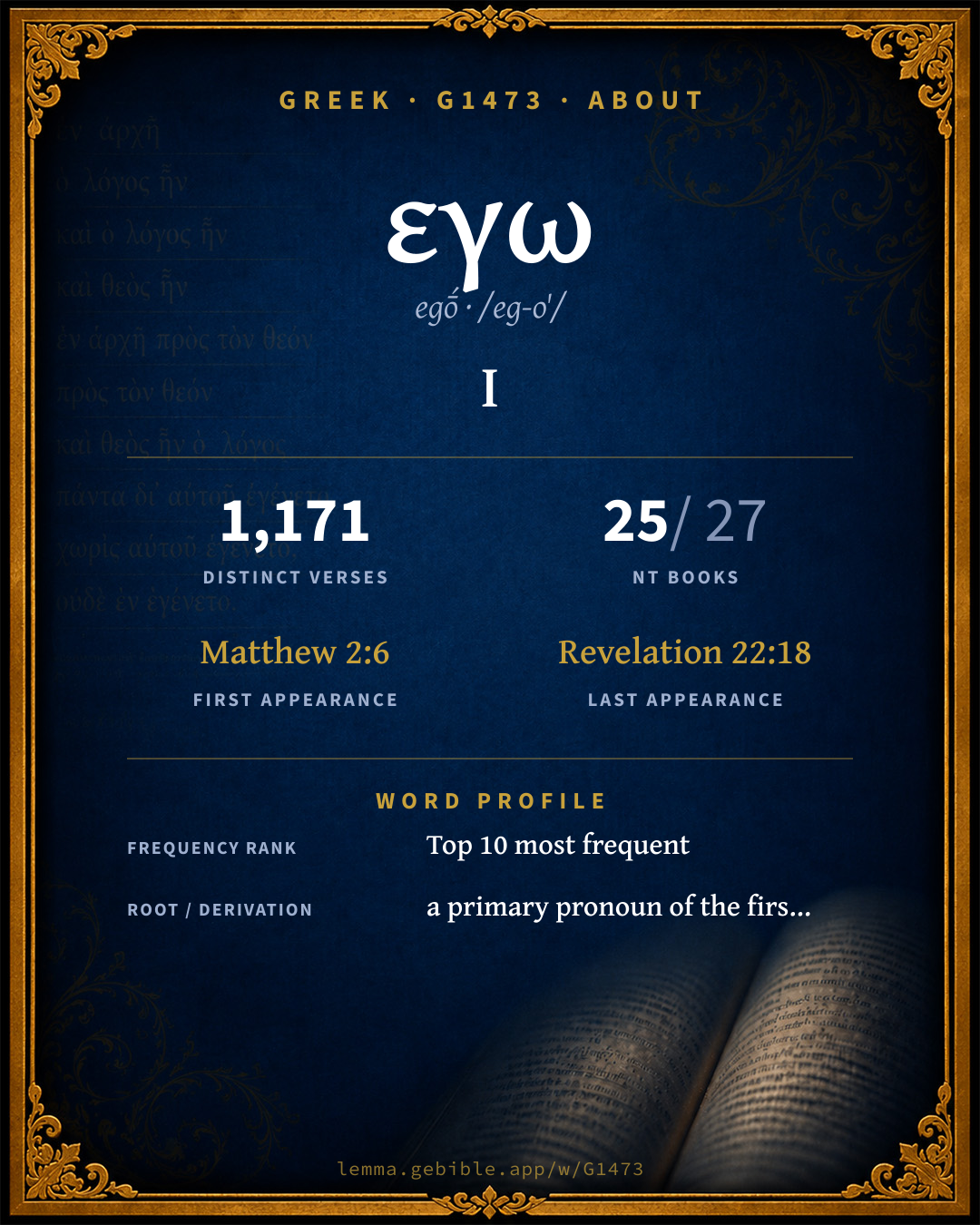
ἐγώ
I
Full lexicon entry — Thayer's Greek Lexicon
From Thayer's Greek Lexicon
Where this word appears
See every Genitive-case word in the Greek New Testament →
Grammar key — what these labels mean
Part of speech
- Personal pronoun
- Stands in for a person already named (“I,” “you,” “he”).
Case
- Genitive
- The case of source, possession, or “of” — answers “whose / from what.”
- Accusative
- The case of the direct object and of extent.
- Nominative
- The case of the subject (and the predicate nominative).
- Dative
- The case of the indirect object, means, or location — “to / for / with / in.”
Person
- 1st person
- The speaker (“I / we”).
Number
- Singular
- One.
- Plural
- More than one.
19 verses where G1473 appears in the Nominative case in the Book of Luke. Filtered view — show all forms. Click any verse to open its interlinear word-by-word view. Verse text shown in the World English Bible for context — . Each verse’s Greek form is shown with its reference; the English is not keyword-highlighted, since the data carries no word-level English alignment. Use “Compare translations” on any verse to read it across multiple English versions. This concordance covers the Greek New Testament; Septuagint (Greek Old Testament) occurrences of this word are not indexed here.
Luke
- Luke 1:18 ἐγὼ μου pron 1 nom sg pron 1 gen sg Zacharias said to the angel, "How can I be sure of this? For I am an old man, and my wife is well advanced in years."
- Luke 1:19 ἐγώ pron 1 nom sg The angel answered him, "I am Gabriel, who stands in the presence of God. I was sent to speak to you, and to bring you this good news.
- Luke 3:16 ἐγὼ μου pron 1 nom sg pron 1 gen sg John answered them all, "I indeed baptize you with water, but he comes who is mightier than I, the latchet of whose sandals I am not worthy to loosen. He will baptize you in the Holy Spirit and fire,
- Luke 7:8 ἐγὼ μου pron 1 nom sg pron 1 gen sg For I also am a man placed under authority, having under myself soldiers. I tell this one, 'Go!' and he goes; and to another, 'Come!' and he comes; and to my servant, 'Do this,' and he does it."
- Luke 8:46 μού ἐγὼ ἐμοῦ pron 1 gen sg pron 1 nom sg pron 1 gen sg But Jesus said, "Someone did touch me, for I perceived that power has gone out of me."
- Luke 9:9 ἐγὼ pron 1 nom sg Herod said, "John I beheaded, but who is this, about whom I hear such things?" He sought to see him.
- Luke 10:35 ἐγὼ με pron 1 nom sg pron 1 acc sg On the next day, when he departed, he took out two denarii, and gave them to the host, and said to him, 'Take care of him. Whatever you spend beyond that, I will repay you when I return.'
- Luke 11:19 ἐγὼ pron 1 nom sg But if I cast out demons by Beelzebul, by whom do your children cast them out? Therefore will they be your judges.
- Luke 15:17 μου ἐγὼ pron 1 gen sg pron 1 nom sg But when he came to himself he said, 'How many hired servants of my father's have bread enough to spare, and I'm dying with hunger!
- Luke 16:9 ἐγὼ pron 1 nom sg I tell you, make for yourselves friends by means of unrighteous mammon, so that when you fail, they may receive you into the eternal tents.
- Luke 19:22 ἐγὼ pron 1 nom sg "He said to him, 'Out of your own mouth will I judge you, you wicked servant! You knew that I am an exacting man, taking up that which I didn't lay down, and reaping that which I didn't sow.
- Luke 20:8 ἐγὼ pron 1 nom sg Jesus said to them, "Neither will I tell you by what authority I do these things."
- Luke 21:8 μου ἐγώ pron 1 gen sg pron 1 nom sg He said, "Watch out that you don't get led astray, for many will come in my name, saying, 'I AM,' and, 'The time is at hand.' Therefore don't follow them.
- Luke 21:15 ἐγὼ pron 1 nom sg for I will give you a mouth and wisdom which all your adversaries will not be able to withstand or to contradict.
- Luke 22:27 ἐγὼ pron 1 nom sg For who is greater, one who sits at the table, or one who serves? Isn't it he who sits at the table? But I am in the midst of you as one who serves.
- Luke 22:32 ἐγὼ pron 1 nom sg but I prayed for you, that your faith wouldn't fail. You, when once you have turned again, establish your brothers."
- Luke 22:70 ἐγώ pron 1 nom sg They all said, "Are you then the Son of God?" He said to them, "You say it, because I AM."
- Luke 23:14 μοι ἐγὼ pron 1 dat sg pron 1 nom sg and said to them, "You brought this man to me as one that perverts the people, and see, I have examined him before you, and found no basis for a charge against this man concerning those things of which you accuse him.
- Luke 24:39 μου μου ἐγώ με ἐμὲ pron 1 gen sg pron 1 gen sg pron 1 nom sg pron 1 acc sg pron 1 acc sg See my hands and my feet, that it is truly me. Touch me and see, for a spirit doesn't have flesh and bones, as you see that I have."
About this entry
At a glance — auto-summarized from this page’s data, not written by a person. Every figure links to its source below. This summary describes the numbers; it doesn’t interpret them.
εγω — transliterated egṓ — is a Greek name carrying the sense “I.” Its earliest occurrence is Matthew 2:6. It appears 1,171 verses across 25 books of the Greek New Testament, among its most common vocabulary. Each statement above links to its evidence; the full detail follows below.
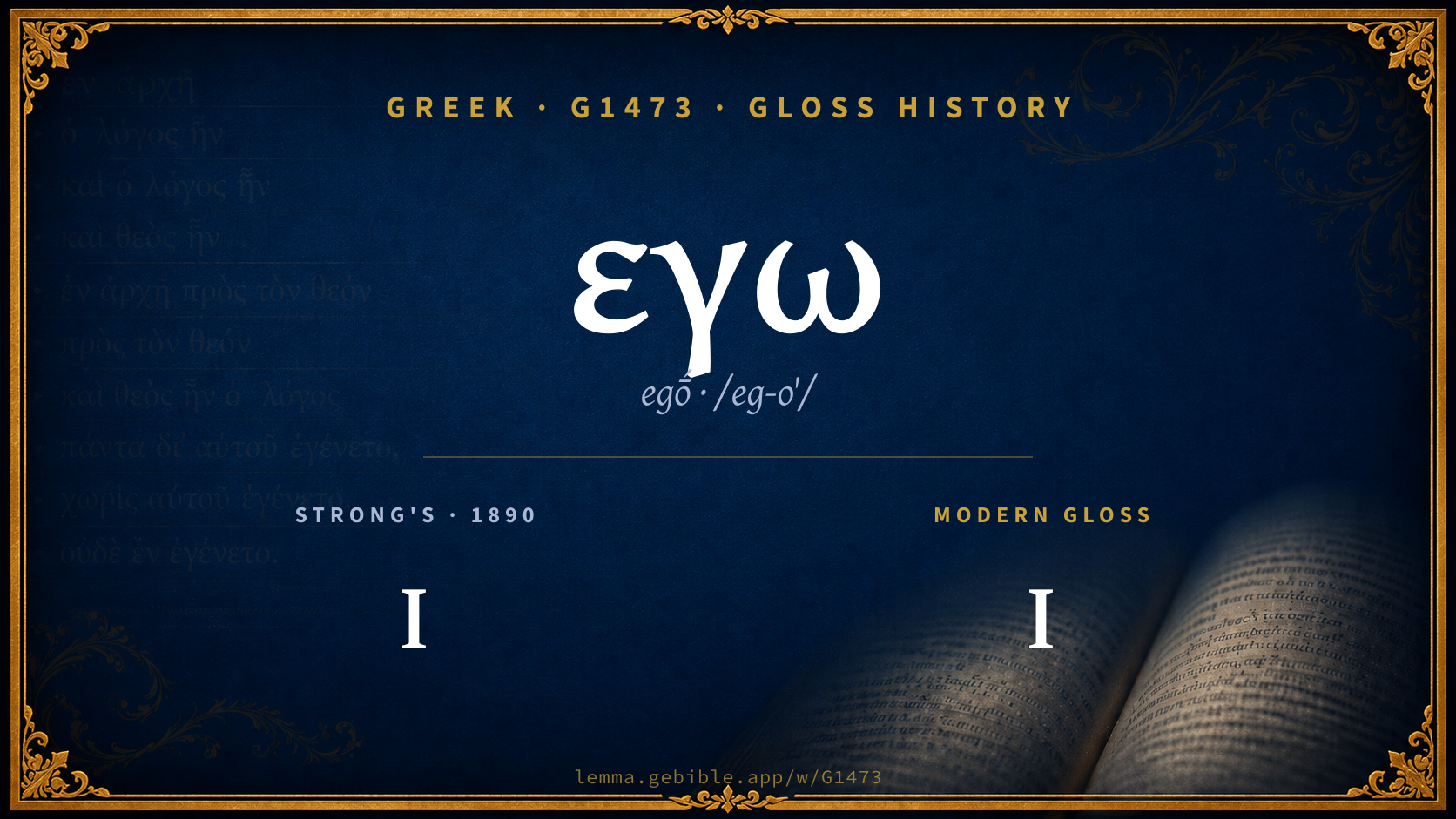
Gloss history
Strong's 1890 vs modern scholarship
About this word
Strong's G1473 catalogs a Greek word from the Greek New Testament.
These counts are not copied from any lexicon or concordance. They are computed here, from the morphology-tagged Greek New Testament. What Lemma adds →
- 1,171
- distinct verses
- The word appears in 1,171 distinct verses.
- 25 / 27
- NT books
- The word appears in 25 of 27 New Testament books.
- #10
- by frequency
- Top 10 most frequent Greek words (rank 10 of 5,347 Greek words by occurrence).
View all 1,171 occurrences in the concordance →
By section of the New Testament
By traditional corpus
Conventional, traditional groupings — biblical authorship is debated, so this is a traditional corpus grouping, not an authorship claim. Some books belong to more than one corpus (Luke is in both the Gospels and the Lukan corpus, and so on), so these shares overlap and need not total 100%. Each figure is a share of the word’s 1,171 distinct verses.
- Gospels 653 verses · 56%
- Johannine 330 verses · 28%
- Pauline corpus 289 verses · 25%
- Lukan (Luke–Acts) 275 verses · 23%
- Revelation 55 verses · 5%
- Hebrews 22 verses · 2%
- General (Catholic) Epistles 20 verses · 2%
How translations render this word
Counts come from each version’s own published word-to-Strong’s tagging or interlinear alignment — an approximate guide to how each version renders this word, not a word-level alignment the data otherwise carries. Because each total is that version’s own tagged count, the per-version totals vary from one another and need not match the appearance or distinct-verse counts above. These counts may also differ from a printed concordance because Lemma counts each distinctly tagged rendering and does not collapse phrase taggings into a single head-word total. This is a fixed set of word-tagged versions (KJV, ASV, BSB, ULT) and does not change with the reading translation you choose elsewhere. Each version’s license is shown beside its name below (and on Sources).
- King James Version: I 356×, I am 2×, Is it i 2×
- American Standard Version: I 337×, In 6×, It 3×
- Berean Standard Bible: Me 709×, My 492×, I 389×
- unfoldingWord Literal Text: Me 811×, My 511×, Us 394×
King James Version Public Domain
Renders G1473 across 370 tagged occurrences — most commonly:
Plus 6 renderings that appear only once — usually multi-word phrases or single function words the recovered tagging swept in, not distinct renderings.
American Standard Version Public Domain
Renders G1473 across 374 tagged occurrences — most commonly:
Plus 19 renderings that appear only once — usually multi-word phrases or single function words the recovered tagging swept in, not distinct renderings.
Berean Standard Bible Public Domain
Renders G1473 across 2,450 tagged occurrences — most commonly:
Plus other, less common renderings. Plus 38 renderings that appear only once — usually multi-word phrases or single function words the recovered tagging swept in, not distinct renderings. Not rendered by a distinct English word in 113 further occurrences.
unfoldingWord Literal Text CC BY-SA 4.0
Renders G1473 across 2,585 tagged occurrences — most commonly:
Plus other, less common renderings. Plus 15 renderings that appear only once — usually multi-word phrases or single function words the recovered tagging swept in, not distinct renderings.
Senses in Thayer's
The 1 sense Thayer's distinguishes for this word, in lexicon order (not ranked by frequency or importance). The full entry — with sub-senses — is in the Lexicon Entry tab.
- I, me, my
Word origin
Origin: a primary pronoun of the first person I (only expressed when emphatic)
Forms in the corpus
The 17 distinct written forms G1473 takes in the Greek New Testament, most frequent first — each parse links to that case’s occurrences in the concordance.
Same root — word family
Other Thayer's entries built from the same root as G1473, grouped by Strong’s listed origin. These share a root / origin per the lexicon — not necessarily a shared meaning. Each links to that word’s own entry.
Derived from this word
- εμος emós G1699 my
- εμου emoû G1700 me
- ημας hēmâs G2248 us
- ημεις hēmeîs G2249 we
- ημιν hēmîn G2254 us
- ημων hēmōn G2257 our
Compare all same-root words → Showing 4 of 7 — not the complete family. They share a root, not necessarily a meaning.
Septuagint usage
The same Greek word εγω appears 10,239 times in the Greek Old Testament (Septuagint), across 5,710 verses in 38 books.
- 10,239
- LXX occurrences
- Tagged occurrences of this Greek word in the Septuagint.
- 5,710
- verses
- Distinct Septuagint verses containing this word.
- 38 / 39
- OT books
- The word appears in 38 of the 39 Old Testament books.
Sample Septuagint occurrences
- Genesis 2:23 ἐγώ
- Exodus 1:9 ἐγώ
- Leviticus 8:31 ἐγώ
- Numbers 3:9 ἐγώ
- Deuteronomy 1:6 ἐγώ
- Joshua 1:2 ἐγώ
- Judges 1:1 ἐγώ
- Ruth 1:8 ἐγώ
- 1 Samuel 1:8 ἐγώ
- 2 Samuel 1:3 ἐγώ
- 1 Kings 1:2 ἐγώ
- 2 Kings 1:2 ἐγώ
Septuagint occurrences (same lexeme)
Every verse where the same Strong’s number (G1473) appears in the Greek Septuagint — showing the first 50 of 5,710. Verse text shown in the World English Bible for context; the Greek form is the matched word — the English is not keyword-highlighted.
- Genesis 2:23 ἐγώ The man said, "This is now bone of my bones, and flesh of my flesh. She will be called Woman, because she was taken out of Man."
- Genesis 3:12 ἐγώ The man said, "The woman whom you gave to be with me, she gave me of the tree, and I ate."
- Genesis 3:13 ἐγώ Yahweh God said to the woman, "What is this you have done?" The woman said, "The serpent deceived me, and I ate."
- Genesis 3:22 ἐγώ Yahweh God said, "Behold, the man has become like one of us, knowing good and evil. Now, lest he put forth his hand, and also take of the tree of life, and eat, and live forever..."
- Genesis 4:9 ἐγώ Yahweh said to Cain, "Where is Abel, your brother?" He said, "I don't know. Am I my brother's keeper?"
- Genesis 4:10 ἐγώ Yahweh said, "What have you done? The voice of your brother's blood cries to me from the ground.
- Genesis 4:13 ἐγώ Cain said to Yahweh, "My punishment is greater than I can bear.
- Genesis 4:14 ἐγώ Behold, you have driven me out this day from the surface of the ground. I will be hidden from your face, and I will be a fugitive and a wanderer in the earth. It will happen that whoever finds me will kill me."
- Genesis 4:23 ἐγώ Lamech said to his wives, "Adah and Zillah, Hear my voice, You wives of Lamech, listen to my speech, For I have slain a man for wounding me, A young man for bruising me.
- Genesis 4:25 ἐγώ Adam knew his wife again. She gave birth to a son, and named him Seth. For, she said, "God has appointed me another child instead of Abel, for Cain killed him."
- Genesis 5:29 ἐγώ and he named him Noah, saying, "This same will comfort us in our work and in the toil of our hands, because of the ground which Yahweh has cursed."
- Genesis 6:3 ἐγώ Yahweh said, "My Spirit will not strive with man forever, because he also is flesh; yet will his days be one hundred twenty years."
- Genesis 6:13 ἐγώ God said to Noah, "The end of all flesh has come before me, for the earth is filled with violence through them. Behold, I will destroy them with the earth.
- Genesis 6:17 ἐγώ I, even, I do bring the flood of waters on this earth, to destroy all flesh having the breath of life from under the sky. Everything that is in the earth will die.
- Genesis 6:18 ἐγώ But I will establish my covenant with you. You shall come into the ark, you, your sons, your wife, and your sons' wives with you.
- Genesis 7:1 ἐγώ Yahweh said to Noah, "Come with all of your household into the ark, for I have seen your righteousness before me in this generation.
- Genesis 7:4 ἐγώ In seven days, I will cause it to rain on the earth for forty days and forty nights. Every living thing that I have made, I will destroy from the surface of the ground."
- Genesis 9:9 ἐγώ "As for me, behold, I establish my covenant with you, and with your offspring after you,
- Genesis 9:11 ἐγώ I will establish my covenant with you; neither will all flesh be cut off any more by the waters of the flood; neither will there any more be a flood to destroy the earth."
- Genesis 9:12 ἐγώ God said, "This is the token of the covenant which I make between me and you and every living creature that is with you, for perpetual generations:
- Genesis 9:13 ἐγώ I set my rainbow in the cloud, and it will be for a sign of a covenant between me and the earth.
- Genesis 9:14 ἐγώ It will happen, when I bring a cloud over the earth, that the rainbow will be seen in the cloud,
- Genesis 9:15 ἐγώ and I will remember my covenant, which is between me and you and every living creature of all flesh, and the waters will no more become a flood to destroy all flesh.
- Genesis 9:16 ἐγώ The rainbow will be in the cloud. I will look at it, that I may remember the everlasting covenant between God and every living creature of all flesh that is on the earth."
- Genesis 9:17 ἐγώ God said to Noah, "This is the token of the covenant which I have established between me and all flesh that is on the earth."
- Genesis 12:11 ἐγώ It happened, when he was come near to enter into Egypt, that he said to Sarai his wife, "See now, I know that you are a beautiful woman to look on.
- Genesis 12:12 ἐγώ It will happen, when the Egyptians will see you, that they will say, 'This is his wife.' They will kill me, but they will save you alive.
- Genesis 12:13 ἐγώ Please say that you are my sister, that it may be well with me for your sake, and that my soul may live because of you."
- Genesis 12:18 ἐγώ Pharaoh called Abram, and said, "What is this that you have done to me? Why didn't you tell me that she was your wife?
- Genesis 12:19 ἐγώ Why did you say, 'She is my sister,' so that I took her to be my wife? Now therefore, see your wife, take her, and go your way."
- Genesis 13:8 ἐγώ Abram said to Lot, "Please, let there be no strife between me and you, and between my herdsmen and your herdsmen; for we are relatives.
- Genesis 13:9 ἐγώ Isn't the whole land before you? Please separate yourself from me. If you go to the left hand, then I will go to the right. Or if you go to the right hand, then I will go to the left."
- Genesis 14:21 ἐγώ The king of Sodom said to Abram, "Give me the people, and take the goods to yourself."
- Genesis 14:22 ἐγώ Abram said to the king of Sodom, "I have lifted up my hand to Yahweh, God Most High, possessor of heaven and earth,
- Genesis 14:23 ἐγώ that I will not take a thread nor a shoe-latchet nor anything that is yours, lest you should say, 'I have made Abram rich.'
- Genesis 14:24 ἐγώ Except only that which the young men have eaten, and the portion of the men who went with me, Aner, Eshcol, and Mamre: let them take their portion."
- Genesis 15:1 ἐγώ After these things the word of Yahweh came to Abram in a vision, saying, "Don't be afraid, Abram. I am your shield, your exceedingly great reward."
- Genesis 15:2 ἐγώ Abram said, "Lord Yahweh, what will you give me, seeing I go childless, and he who will inherit my estate is Eliezer of Damascus?"
- Genesis 15:3 ἐγώ Abram said, "Behold, to me you have given no seed: and, behold, one born in my house is my heir."
- Genesis 15:7 ἐγώ He said to him, "I am Yahweh who brought you out of Ur of the Chaldees, to give you this land to inherit it."
- Genesis 15:9 ἐγώ He said to him, "Take me a heifer three years old, a female goat three years old, a ram three years old, a turtle-dove, and a young pigeon."
- Genesis 15:14 ἐγώ I will also judge that nation, whom they will serve. Afterward they will come out with great substance.
- Genesis 16:2 ἐγώ Sarai said to Abram," See now, Yahweh has restrained me from bearing. Please go in to my handmaid. It may be that I will obtain children by her." Abram listened to the voice of Sarai.
- Genesis 16:5 ἐγώ Sarai said to Abram, "This wrong is your fault. I gave my handmaid into your bosom, and when she saw that she had conceived, I was despised in her eyes. Yahweh judge between me and you."
- Genesis 16:8 ἐγώ He said, "Hagar, Sarai's handmaid, where did you come from? Where are you going?" She said, "I am fleeing from the face of my mistress Sarai."
- Genesis 16:13 ἐγώ She called the name of Yahweh who spoke to her, "You are a God who sees," for she said, "Have I even stayed alive after seeing him?"
- Genesis 17:1 ἐγώ When Abram was ninety-nine years old, Yahweh appeared to Abram, and said to him, "I am God Almighty. Walk before me, and be blameless.
- Genesis 17:2 ἐγώ I will make my covenant between me and you, and will multiply you exceedingly."
- Genesis 17:4 ἐγώ "As for me, behold, my covenant is with you. You will be the father of a multitude of nations.
- Genesis 17:7 ἐγώ I will establish my covenant between me and you and your seed after you throughout their generations for an everlasting covenant, to be a God to you and to your seed after you.
These are occurrences of the same Greek lexeme (G1473) in the Septuagint — not a translation of any one Hebrew word. The store carries no word-level Hebrew↔Greek alignment, so no Hebrew original is asserted here. Counts come from the recovered LXX Strong's tagging — high-frequency vocabulary is well covered, while rare or late forms may be untagged — so they reflect tagged occurrences and may slightly undercount.